
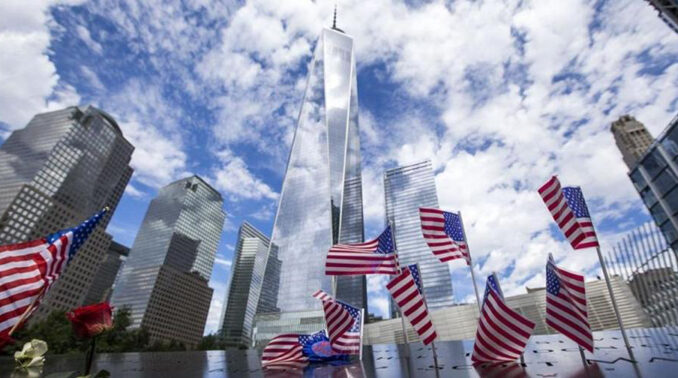

Twenty-five years after September 11, America must never forget. But remembrance must summon not only grief and resolve; it must also summon the courage to ask how humanity can build a world in which terrorism finds less ground on which to grow.
September 11, 2001, remains engraved upon the American consciousness.
On an otherwise ordinary Tuesday morning, terrorists turned passenger aircraft into weapons. The World Trade Center towers fell. The Pentagon was struck. United Airlines Flight 93 crashed in Pennsylvania after passengers and crew resisted the hijackers. Nearly 3,000 innocent people were killed.
Families were shattered. Firefighters, police officers and emergency workers rushed toward danger while others fled from it. A nation accustomed to feeling secure within its borders suddenly discovered its vulnerability.
Twenty-five years later, The Indian Panorama remembers the dead, honors the heroes and shares the continuing sorrow of all who lost someone that terrible day.
There can be no qualification in our condemnation of terrorism. No political grievance, religious belief, historical injury or ideological cause gives anyone the right to deliberately murder innocent human beings.
Yet remembrance imposes another responsibility upon us.
If humanity wishes not merely to punish terrorists but to reduce terrorism, we must have the courage to ask a difficult question:
Where does terrorism come from?
CONDEMNATION IS NECESSARY. UNDERSTANDING IS ALSO NECESSARY.
To ask why terrorism arises is not to excuse the terrorist.
There is an important distinction between an explanation and a justification. Physicians seek the cause of a disease without defending the disease. Societies, too, must examine the conditions in which violence grows if they genuinely wish to prevent it.
There is no single explanation for terrorism. Extremist ideology, religious fanaticism, nationalism, political ambition, sectarian hatred, propaganda, organized recruitment and the thirst for power have all played their part.
But history also teaches us that actual or perceived injustice, political exclusion, humiliation, discrimination, repression and unresolved conflicts can create grievances that extremists exploit.
Millions of people suffer injustice without becoming terrorists. That truth must always be remembered. Suffering does not automatically produce terrorism, nor does suffering absolve anyone who chooses to murder innocent people.
But another truth deserves equal attention: where anger and hopelessness are allowed to accumulate, those who preach hatred find easier recruits.
That is why military victories alone cannot permanently defeat terrorism.
Armies can destroy training camps. Intelligence agencies can uncover conspiracies. Police can arrest terrorists. Governments have not merely the right but the solemn duty to protect their citizens.
But bombs cannot destroy an idea. And overwhelming force cannot by itself remove every grievance from which extremists manufacture hatred.
The lasting answer must therefore include something more difficult: Justice.
THE RESPONSIBILITY OF THE WEAK—AND OF THE STRONG
There is a temptation when we have suffered injustice to believe that our suffering gives us permission to do anything in response. It does not.
And there is an equally dangerous temptation among the powerful to believe that superior military, political or economic strength gives them the right to impose their will upon others. It does not.
This is where we believe two principles should guide not merely America’s response to terrorism, but relations among peoples and nations:
Your weakness gives you no right to answer injustice with terrorism.
Your strength gives you no moral license to frighten or oppress others.
The first principle speaks to the aggrieved. However genuine your grievance, innocent lives cannot become instruments of revenge.
The second speaks to the powerful. However formidable your armies, however dominant your economy, however great your influence, power does not place you above justice.
Between these two propositions lies the moral territory upon which a more peaceful world might be built.
MEMORY MUST TEACH US
Some wounds become part of a people’s collective memory.
The Holocaust occupies an everlasting place in Jewish memory. Sikhs continue to carry the painful memories of the violence, humiliation and trauma of 1984 and the turbulent years surrounding it. Americans will carry September 11 in their national consciousness for generations.
These tragedies are historically different and should never be casually equated. Yet they remind us of something universal: communities remember profound suffering long after the immediate violence has ended.
The challenge is what we do with that memory.
Memory can become a teacher—or a jailer.
If memory teaches vigilance, compassion and determination that others should never suffer what we suffered, it serves humanity.
If memory becomes perpetual hatred, it can prepare the ground for tomorrow’s tragedy.
America’s answer to September 11, therefore, must ultimately be greater than vengeance.
NEITHER INFLICT FEAR NOR ACCEPT IT
More than three centuries ago, Guru Gobind Singh, the Tenth Master of the Sikhs and creator of the Khalsa, expressed a principle of extraordinary simplicity:
“Bhai kahu ko det neh, neh bhai manat aan.”
Its essence may be rendered: Neither do I frighten others, nor do I accept fear from another.
Consider the civilization contained within those few words.
Do not terrorize. Do not submit to terror.
They impose responsibility upon both the strong and the weak. The oppressed is called upon not to become an oppressor. The powerful is warned not to misuse power. And neither is asked to surrender human dignity.
Could there be a better principle for a world struggling against terrorism?
THE BEST MEMORIAL
Twenty-five years after September 11, America remains powerful. The terrorists did not destroy American democracy. They did not extinguish its freedoms. They did not bring down the nation they sought to humiliate.
That itself is victory.
But America’s greater victory will come when its power is accompanied by an equally commanding reputation for justice.
Let America remain strong enough that no terrorist imagines he can attack it with impunity.
But let America also be just enough that people across the world look upon its strength not with fear, but with respect.
The nearly 3,000 lives taken on September 11 deserve more than our tears. They deserve more than monuments, ceremonies and annual moments of silence. They deserve a world made wiser by their loss.
We cannot promise a world without hatred. We cannot eliminate every conflict, fanatic or violent ideology. Human history gives us no grounds for such easy optimism. But we can remove injustice where we find it. We can refuse to humiliate the weak. We can resolve grievances before demagogues weaponize them. We can defend ourselves without surrendering our humanity. And we can insist that justice restrain both desperation and power.
On this 25th anniversary, therefore, let us remember September 11 with sorrow—but without hatred; with vigilance—but without fear; with strength—but without arrogance.
And let us carry forward these two simple truths:
Your weakness gives you no right to answer injustice with terrorism.
Your strength gives you no moral license to frighten or oppress others.
Between them lies justice. And perhaps, someday, peace.



Be the first to comment