

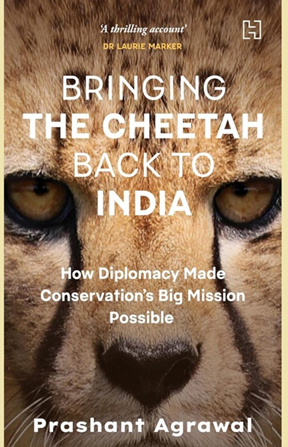

“Bringing the Cheetah Back to India: How Diplomacy Made Conservation’s Big Mission Possible” is a 2026 non-fiction book authored by senior Indian diplomat Prashant Agrawal. Published by Hachette India, the book provides an exclusive, insider account of the complex global negotiations and statecraft that enabled Project Cheetah—the world’s first intercontinental translocation of a large carnivore.
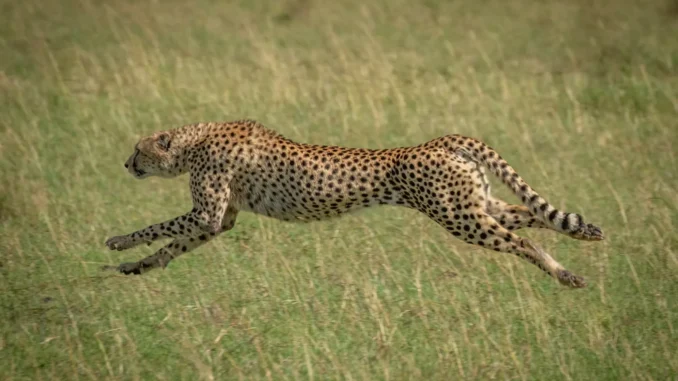
Undoubtedly, the cheetah is a stunningly beautiful animal. Feline supermodels, they can reach speeds of 105 kmph, accelerating from 0 to 95 kmph in just three seconds — performance that would make a Tesla take notice. India lost its last cheetahs at the dawn of independence, but the animal’s image and prowess have remained etched in the minds of generations of Indians, particularly Indian diplomats. In the main meeting room of Hyderabad House, where world leaders are received by India’s leadership, the dominant painting is of a cheetah. It was painted by George Stubbs and commissioned by Lord Pigot of Patshull, the late-18th-century Governor of Madras in British India.
Dr Lawrie Marker, whose Cheetah Conservation Fund (CCF) played a key role in bringing the cheetah back to India, is based near the town of Otjiwarongo in Namibia. The name means “beautiful place” in the local Herero language. It was from this beautiful place that the cheetahs reintroduced to India eventually came.
Their disappearance had left a void in India’s wildlife ecosystem. The translocation project sought to fill it. Before I left for Indonesia in August 2023 to take up my assignment as Ambassador, I had the privilege of calling on Prime Minister Modi. Among the many leads he asked me to pursue with my Indonesian interlocutors was the possibility of relocating some orangutans to an uninhabited island in the Andaman and Nicobar Islands. As a diplomat with a forestry background, I immediately understood the logic. Dispersing the orangutans could increase the chances of survival of the species. It was only later, after reading a fast-paced page-turner by my IFS colleague, that I began to wonder whether the cheetah project had been on the Prime Minister’s mind when he mentioned the orangutans to me.
My etymological mind was also delighted by what I learnt from the book: the word cheetah derives from chitraka, the Sanskrit word for “the spotted one”. Interestingly, orangutan is a combination of two Bahasa words — orang, meaning people, and hutan, meaning forest. Quite literally, “people of the forest”.
A Diplomatic Thriller
Prashant Agrawal’s Bringing the Cheetah Back to India: How Diplomacy Made Conservation’s Big Mission Possible is, in many ways, a thriller. The author tells a true story but manages to build suspense, twists and even a climax towards the end. The title gives away the outcome; we know the cheetahs eventually made it to India, yet the journey is sufficiently uncertain to make the story engrossing. It is an odyssey that unfolds over many years. I am one of those people with a collection of half-read books. This was not one of them. I finished this roller-coaster ride in continuous reading.
But the book is much more than the story of how cheetahs came to India. It is a masterclass in persistent diplomacy. Agrawal documents how the Ambassador of India in Namibia, supported by a small but dedicated team, was able to turn a national mission into a multinational effort. He shows, almost minute by minute, how the Indian team built the relationships needed to persuade its hosts to participate in a transcontinental conservation project that had never been attempted before. He seems to have recorded almost everything: meetings, phone calls and even the menu served at India House. The only detail I found myself looking for was the cost of the project, and whether India had to pay Namibia for the cats.
Building a Coalition
One of the most important ingredients of the project’s success was the extensive outreach undertaken by the Indian team in Windhoek. A sense of purpose brought together people from remarkably diverse backgrounds and nationalities. They met everyone who could help. And, eventually, help came from almost everywhere. The Namibian government, of course, deserves enormous credit for finally allowing the translocation to happen. But the presence of an institution such as the CCF, and its founder Dr Lawrie Marker, made a huge difference. When Agrawal became involved, there was hardly anyone in India with experience in handling cheetahs. Perhaps, therefore, Agrawal himself became India’s foremost cheetah expert. His passion, knowledge and commitment come through almost every episode of the book. As a fellow diplomat, I found another aspect particularly heartwarming. Indian diplomats have been involved in many challenging assignments over the years, but very few write about them. By documenting this story, Agrawal has done a great service to his fraternity.
Right from the beginning, the project was seized of one fundamental problem. Bringing cheetahs to India was India’s priority. It was not Namibia’s. In fact, India’s initial request had been denied. Yet Agrawal skillfully transformed the issue into an important bilateral agenda item and stayed with it through Covid, bureaucratic delays and complacency. He knocked on every door, including that of the President. He appears to have been possessed by the idea. Failure simply was not an acceptable answer. In the process, he built a coalition of the willing — and the unwilling — to bring a coalition of cheetahs to India.
The Power of a Word
Then came an even more fundamental obstacle. India and Namibia approached wildlife protection from very different philosophical positions. Namibia follows a conservation model that allows what is described as the sustainable consumption of wildlife. India, by contrast, is fundamentally opposed to legal wildlife consumption. This difference delayed the conclusion of the MoU on cheetah translocation. What initially appeared to be a philosophical divide seemed almost impossible to bridge. This is where diplomacy, at its best, becomes less about winning an argument and more about finding languages both sides can live with. Agrawal proposed a simple but ingenious solution. Instead of “sustainable consumption” he suggested “sustainable utilisation”. The Namibians could accept it. The Indians could live with it. And the cheetahs could move closer to Kuno. Sometimes diplomacy turns on grand principles. Sometimes it turns on a single word.
The Protagonist, the Villains and the Heroes
Agrawal is the protagonist of the story. Circumstances are the villains. And the heroines are, of course, the cheetahs. The beauty of the story is that there are very few conventional villains. Everyone is constrained by their own logic. One cannot blame the oil company for refusing to allow the “Queen of the Skies” to take off when payment has not been received. Nor can one blame Namibia’s national veterinarian for refusing to sign the NOC when the quarantine period is incomplete. Each person is doing what makes sense from where they sit. Agrawal is different. He sees the whole picture. And he puts together the giant jigsaw puzzle, with its many moving parts. His passion and love for nature keep him going. It comes through at every stage of the story. Anyone else in his place might well have given up. His IIT background clearly helped with meticulous planning. But the book also demonstrates the limits of planning when confronted with bureaucratic obduracy, last-minute changes and the inevitable vacillations of large institutions.
And these came from both sides. If Agrawal had to jump through hoops in Namibia, India threw its own curve balls at him. The last-minute decision to change the airport of arrival from Jaipur to Gwalior could easily have stalled the entire project. Anyone who has handled VIP flights and in this case a VIC, or Very Important Cat, flight knows how much depends on details such as runway length and ground-handling equipment. Fortunately, Gwalior had a runway long enough to accommodate a Boeing 747. The Indian Air Force was also able to provide ground handling at short notice. That in itself was no small feat. Anyone familiar with aircraft operations knows that stairways and lifts do not always reach the required heights.
Then came another problem. The IAF Chinooks that were supposed to transport the cheetahs from Gwalior to Kuno National Park might be too noisy for them. Who would have imagined that modern American Chinooks could be noisier than the veteran Russian Mi-17?
A Race Against Time
The moment the cheetahs left the CCF at Otjiwarongo, the project became a race against time. Agrawal and his team knew that the animals could survive the relocation journey for only a limited number of hours. At every stage, something could go wrong. First came the road journey from the CCF in open trucks to Hosea Kutako International Airport in Windhoek. Then the cheetahs had to wait under the blazing sun because airport authorities would not allow personnel onto the tarmac with the animals until the usual formalities had been completed. Every bottleneck threatened to strangle the project. The time taken to board the aircraft at Windhoek. The flight to Gwalior aboard the “Queen of the Skies”. The helicopter journey from Gwalior to Kuno. And finally, the moment when the cheetahs would be released. Everything had to work with clockwork precision.
As the book reveals, the team almost went to hell and back. Many things went wrong — not because of a lack of planning, but because circumstances have a habit of rubbishing plans. Of course, planning helped, but so did thinking on one’s feet. And resourcefulness. Whenever necessary, Agrawal drank deep into his well of contacts and knowledge to salvage the situation. At one point, a standoff with the fuel supplier at the airport threatened the flight. Agrawal resorted to a little Indian jugaad. He remembered that the manager of the fuel supply company knew him from Mauritius. Somehow, the right telephone number was obtained at exactly the right moment. Another problem solved. Another narrow escape. There were many more instances of Agrawal having to seize the bull by the horns — including some mock anger, sleight of hand and dissimulation. All, as it turns out, were part of the diplomat’s toolbox.
When Science Meets Art
What fascinates me most about this story, however, is that every decision ultimately had to come back to one question: What was best for the cheetahs? Should they be sedated or tranquilised during the air journey? Should they be given food? How should their crates be designed? Even the size of the crate mattered. It had to be large enough for the animals to be comfortable, but not so large that they could move around excessively. The reader gradually becomes aware of the extraordinary intricacies involved in transporting and caring for wildlife. It is both science and art. And Agrawal, through this extraordinary sojourn, mastered both. Bringing the Cheetah Back to India is therefore much more than a book about bringing a large carnivore from one country to another. It is a story about persistence. About relationships. About finding common ground where none appears to exist. And, above all, about diplomacy. The beautiful animals from a beautiful place came to a beautiful country that had been waiting for them for 75 years. And somewhere between Namibia and India, through the persistence of one diplomat and the cooperation of many others, a remarkable piece of history was made. For nature lovers, it is a must read. For diplomats, even more so.
(Sandeep Chakravorty is ambassador of India to Indonesia and former Consul General of India, New York)


Be the first to comment