
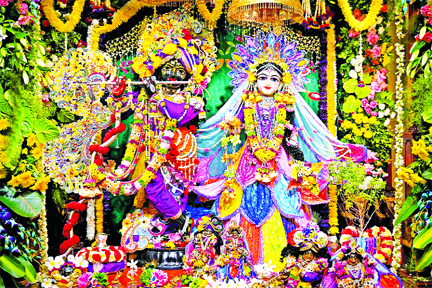

Radha Ashtami is celebrated as the sacred birth anniversary of Radha, the beloved companion and eternal devotee of Lord Krishna. Observed on the eighth day, or Ashtami, of the bright fortnight of the Hindu month of Bhadrapada, the festival holds a special place in the Vaishnava tradition, particularly in Braj, Mathura, Vrindavan and Barsana. This year, Radha Ashtami will be celebrated on September 18.
Every year, as the monsoon season begins to give way to the early signs of autumn, the sacred land of Braj comes alive with devotion, music and colour. Temples are decorated with flowers, devotional songs fill the air and devotees gather to celebrate Radha Ashtami, the festival commemorating the appearance of Radha, the divine beloved of Lord Krishna.
Observed on Shukla Paksha Ashtami, the eighth day of the waxing fortnight in the month of Bhadrapada, Radha Ashtami is particularly important in Barsana, traditionally regarded as Radha’s birthplace, as well as Mathura and Vrindavan. For devotees, however, the festival is much more than a celebration of a divine birth. It represents the spiritual ideal of selfless love, surrender and devotion.
The divine counterpart of Krishna
In Vaishnava traditions, Radha is revered as the embodiment of the highest form of devotion, or bhakti. While Krishna is worshipped as the Supreme Divine, Radha represents the soul’s complete love and surrender towards the Divine.
The relationship between Radha and Krishna has inspired generations of poets, saints, musicians, painters and spiritual teachers. Their love is generally understood not merely as an earthly romance but as a metaphor for the relationship between the individual soul and the Supreme.
Radha’s devotion is described as unconditional. She seeks nothing for herself; her joy lies in Krishna’s happiness. It is this quality that has made Radha an enduring symbol of divine love.
Origin and traditional account
The story of Radha’s birth is preserved primarily through later Vaishnava devotional traditions and texts rather than through a single uniform account found across all Hindu scriptures.
According to popular Braj tradition, Radha appeared on Bhadrapada Shukla Ashtami in Barsana. She was born to Vrishabhanu and Kirtida. Her father is traditionally described as a respected leader of the Braj community, while Kirtida is revered as her mother.
The traditional story says that when Radha was born, extraordinary joy spread through the household and the surrounding region. People came to offer their blessings, and the occasion was regarded as a divine event.
One popular devotional tradition says that Radha did not open her eyes immediately after her birth. When the infant Krishna was brought before her, she opened her eyes and gazed upon him. The episode has become one of the beloved stories associated with Radha’s childhood and is celebrated symbolically by devotees.
Different traditions narrate details of Radha’s birth and childhood differently. The enduring message, however, remains the same: Radha and Krishna are understood as eternally connected manifestations of divine love.
Radha and Krishna in Braj
The landscape of Braj occupies a central place in the Radha-Krishna tradition. Places such as Barsana, Vrindavan, Nandgaon, Govardhan and Gokul are associated with episodes from their divine childhood and youth.
According to devotional traditions, Radha and Krishna spent their childhood and youth surrounded by the natural beauty of Braj. The Yamuna, forests, groves and village paths became part of the sacred geography associated with their stories.
The Rasa Lila, Krishna’s divine dance with the gopis, occupies an especially important place in this tradition. Radha is regarded as the foremost among Krishna’s devotees and as the supreme expression of loving devotion.
For devotees, these stories are not simply accounts of a distant past. They are spiritual narratives through which qualities such as surrender, love, humility and longing for the Divine are contemplated.
Why Radha Ashtami is significant
Radha Ashtami has a special place in bhakti traditions because Radha represents pure devotion without expectation.
The festival teaches that devotion is not simply about seeking blessings or material rewards. Radha’s love for Krishna is traditionally portrayed as unconditional and completely selfless. Her spiritual significance therefore extends beyond the Radha-Krishna story itself.
For many devotees, Radha symbolises the soul yearning for union with the Divine. Krishna represents the Supreme Reality, while Radha’s devotion represents the complete surrender of the individual self.
This interpretation has been particularly influential in the devotional traditions of North India.
The sacred connection with Bhadrapada
Radha Ashtami falls approximately two weeks after Krishna Janmashtami, although the exact Gregorian date changes every year because the Hindu lunar calendar determines the festival.
The proximity of the two festivals gives the season a special devotional character. Janmashtami celebrates Krishna’s birth, while Radha Ashtami celebrates Radha’s appearance.
Together, the festivals highlight the inseparable devotional relationship between Radha and Krishna.
Rituals and observances
Devotees observe Radha Ashtami through fasting, prayer, temple visits, devotional singing and special worship.
Many devotees begin the day with a bath and wear clean or traditional clothes before preparing for puja. Some observe a fast for the day, while others follow a simpler form of dietary restraint. Fasting practices vary according to family traditions and individual religious observance.
At temples, Radha’s deity is ceremonially bathed in abhisheka with substances such as milk, yoghurt, honey and other traditional offerings. The deity is then dressed in beautiful garments and adorned with jewellery and flowers.
A special shringar, or ceremonial adornment, is often an important part of the celebration. Devotees offer flowers, fruits, sweets and other traditional offerings while reciting prayers and singing devotional songs.
Barsana: where Radha Ashtami comes alive
If there is one place where Radha Ashtami acquires a particularly powerful cultural and devotional expression, it is Barsana in Uttar Pradesh.
Barsana is traditionally identified as Radha’s birthplace and is home to the famous Shri Radha Rani Temple, popularly known as Ladli Ji Temple. During Radha Ashtami, thousands of devotees visit the town.
The temple and surrounding streets are decorated with flowers. Devotional music, chants and religious ceremonies continue through the celebrations.
The festival draws pilgrims from different parts of India who come to seek the blessings of Radha Rani.
Celebrations in Vrindavan and Mathura
Vrindavan and Mathura also witness elaborate Radha Ashtami celebrations. Temples dedicated to Radha and Krishna organise special pujas, abhishekas, shringar ceremonies and cultural programmes.
Devotees gather for kirtan, bhajan singing and aarti. Temple courtyards are filled with flowers, devotional music and the sound of sacred chants.


Be the first to comment