
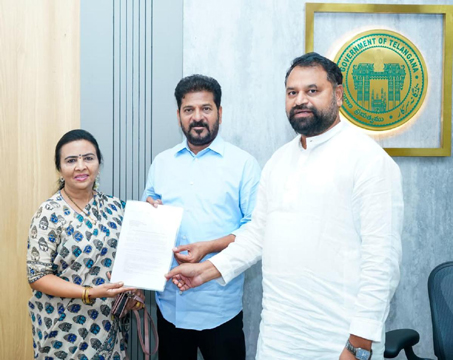

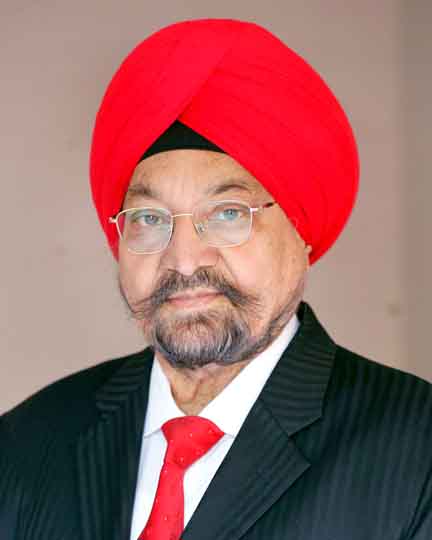
The proposal by Government Whip and MLC Dr. Addanki Dayakar and TPCC Vice President Hanumandla Jhansi Reddy for the establishment of a dedicated NRI Commission in Telangana deserves appreciation and serious consideration by Chief Minister Revanth Reddy.
The two leaders have correctly recognized both sides of Telangana’s relationship with its people overseas. The State has an obligation to assist its sons and daughters when they encounter difficulties at home; equally, Telangana should create avenues through which their knowledge, experience, investment, technology and goodwill can become part of the State’s development story.
The raison d’être of the proposed Commission is therefore compelling.
Telanganites living in the United States, Gulf countries, Canada, Europe, Australia and elsewhere frequently remain closely connected with their families, properties and communities back home. Yet distance can turn even an ordinary administrative problem into an ordeal. Property disputes, land grabbing, fraudulent transactions, documentation difficulties, family emergencies and legal matters can become especially difficult when the person concerned is thousands of miles away.
A genuine single-window institution capable of receiving a complaint, identifying the responsible government agency, following the case and ensuring a timely response would therefore be valuable.
But there is a lesson Telangana should learn before creating such a body: it is not enough to establish an NRI Commission; Telangana must establish an NRI Commission that works.
India is not without experience in creating institutions for its diaspora. Kerala, whose enormous expatriate population has profoundly influenced its economy and society, established the Department of Non-Resident Keralites Affairs—NORKA—in 1996, the first such state department in India. It subsequently enacted the Non-Resident Indians’ (Keralites) Commission Act, 2015 and constituted a statutory commission to protect the welfare of expatriate Keralites and their families.
Gujarat has created the Non-Resident Gujaratis’ Foundation and an NRI Division. Significantly, the official objectives of the Gujarat mechanism include maintaining communication with overseas Gujaratis, creating a database, tapping their technological, managerial and financial resources for development, addressing welfare concerns and helping during crises.
The language is remarkably similar to the objectives now being advanced for Telangana.
And that tells us something important: the idea is not the problem. Implementation is.
The Government of India itself recognized decades ago the enormous potential of its worldwide diaspora. Pravasi Bharatiya Divas was launched in 2003, with January 9 chosen to commemorate Mahatma Gandhi’s return to India from South Africa on that date in 1915. Its purpose was admirable—to connect India with its overseas community and bring its knowledge, expertise and skills onto a common platform.
The initiative was enthusiastically received. Overseas Indians travelled from around the world to participate, meet India’s leaders, discuss issues affecting their communities and explore ways of contributing to their ancestral homeland. Since 2015, the main Pravasi Bharatiya Divas Convention has been organized every alternate year; the 18th convention was held in Bhubaneswar in January 2025.
Nor has diaspora engagement been confined to ceremonial gatherings. India has developed the Overseas Citizenship of India scheme, the Know India Programme for diaspora youth, scholarship initiatives, the Indian Community Welfare Fund, welfare and grievance mechanisms, and the Pravasi Bharatiya Samman Award, the country’s highest honor for overseas Indians.
These are meaningful initiatives, and their achievements should be acknowledged.
Yet there is another side to the story.
Among many overseas Indians there is a perception that the extraordinary enthusiasm generated by diaspora conferences and declarations does not always translate into an equally satisfactory experience when an individual NRI confronts the machinery of government. A conference hall filled with speeches about the greatness of the diaspora is one thing; getting a land record corrected, a complaint investigated or a fraudulent property transaction stopped can be quite another.
This is where bureaucracy, delay, multiple jurisdictions and, at times, allegations of corruption can destroy confidence.
We should be careful not to dismiss all existing NRI institutions as failures. Some have provided valuable assistance, and government mechanisms have helped large numbers of Indians abroad. But neither should governments ignore the dissatisfaction of those who find that an impressive institutional architecture does not necessarily produce a prompt solution to an ordinary person’s problem.
An NRI does not need another welcoming speech when his property has been grabbed. He needs somebody to act.
That should be the guiding principle if Telangana establishes its Commission.
Every complaint should receive a number that can be tracked online. Every case should be assigned to a responsible officer. Reasonable deadlines should be prescribed for action and response. If a matter belongs to another department, the Commission—not the NRI sitting in New York, Dubai or London—should undertake the task of coordinating with that department.
The Commission should publish periodic data: complaints received, cases resolved, cases pending and average resolution time. Serious complaints involving land or property fraud should have access to designated legal and police coordination. There should also be safeguards against political influence, favoritism and corruption.
Above all, NRIs themselves must have a voice in the institution created in their name.
The Commission should regularly consult Telangana organizations overseas, professionals, entrepreneurs, workers in the Gulf, academics and community representatives. The problems of a technology entrepreneur in California may be very different from those of a Telangana worker in the Gulf. A credible institution must understand both.
And the Commission should not merely be a complaints office.
This is where Dr. Dayakar and Jhansi Reddy’s proposal has considerable promise. Telangana’s diaspora represents intellectual capital, professional expertise, investment capacity and international networks. The State should ask not only: What problems can we solve for you? but also: What can we build together?
Universities can be connected with researchers abroad. Hospitals can benefit from medical partnerships. Young entrepreneurs can find mentors among successful Telanganites overseas. Villages can benefit from carefully structured philanthropic projects. Technology, investment and international business connections can flow in both directions.
That is how a diaspora becomes a partner in development rather than merely a source of remittances.
We therefore commend Dr. Addanki Dayakar and Hanumandla Jhansi Reddy for taking this initiative and urge Chief Minister Revanth Reddy to give the proposal serious consideration.
But we would add one request to the two leaders themselves: do not consider your mission accomplished when the government announces the Commission. Consider it accomplished when the Commission begins delivering results.
Telangana does not need another office, another bureaucracy or another ceremonial platform. It needs a bridge—accessible, transparent, accountable and effective—between Telangana and its people across the world.
Create the NRI Commission. But create one that an ordinary Telanganite abroad can trust. That would be the true measure of its success.


Be the first to comment