
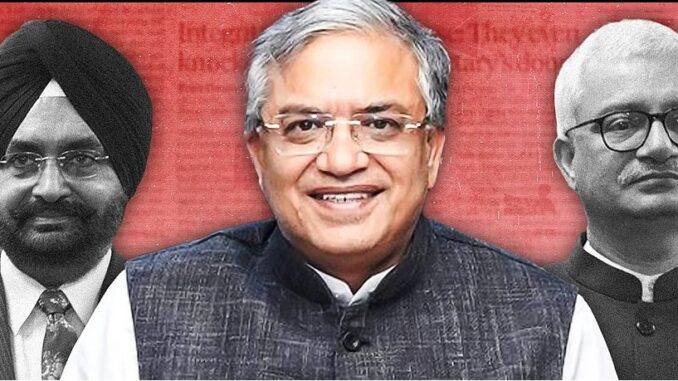

The controversy surrounding the Election Commission raises a question larger than one Chief Election Commissioner: Can electoral democracy survive if citizens cease trusting its referee?
Democracy contains an apparent paradox. Political parties are expected to fight ferociously for power, yet the institution supervising that fight must remain indifferent to who wins. That institution in India is the Election Commission.
The controversy now surrounding Chief Election Commissioner Gyanesh Kumar and the reported disagreements within the Election Commission should therefore not be reduced to another BJP-versus-Opposition quarrel.
The real question is institutional. Who guards the guardians of India’s ballot?
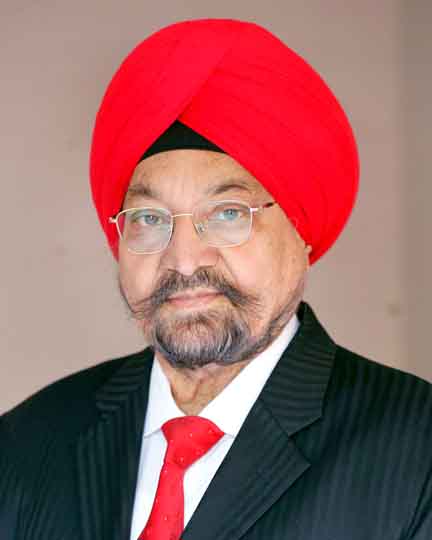
Recent reporting has revealed something extraordinary. Election Commissioners Sukhbir Singh Sandhu and Vivek Joshi reportedly recorded objections at least 14 times over ten months concerning electoral-roll decisions, including addition and deletion of voters, appeals and control over electoral-roll software.
Some reported objections concerned decisions allegedly taken without their knowledge.
The Election Commission has rejected the suggestion that this demonstrates improper functioning. Its position is that Commissioners may express different views during deliberation but that final Commission decisions, including the Special Intensive Revision, were unanimous.
That distinction matters.
So does another reported fact: the Commission’s September 9 meeting was its first full meeting in four months. What exactly occurred during those months must now be established from records rather than political accusation.
But there is a deeper reason Indians should care. An election can be compromised long before polling day.
The electoral roll determines who enters the democratic arena as a voter. Remove an eligible citizen wrongly and that person’s constitutional voice may disappear before a single ballot is cast.
That is why the scale of India’s Special Intensive Revision deserves close scrutiny.
Recent reporting says more than 13 crore names were removed from draft rolls across 30 states and Union Territories during the SIR process.
Not every deletion is sinister. Electoral rolls must be cleaned. People die. Citizens move. Duplicate registrations occur. Some entries may be invalid.
The Supreme Court itself, while examining Bihar’s SIR, recognized the Election Commission’s authority to undertake revision. Bihar began the exercise with approximately 7.89 crore electors; about 65 lakh were absent from the draft roll published in August 2025. During litigation, the Supreme Court directed publication of excluded names with reasons and required Aadhaar to be accepted as an identity document, while clarifying that Aadhaar is not proof of citizenship.
Those judicial interventions demonstrate precisely why transparency matters.
The question is not whether electoral rolls should be revised. Of course they should. The question is whether revision procedures make it easier to remove an eligible citizen than to protect that citizen’s vote.
West Bengal illustrates the stakes. The Election Commission recently told the Supreme Court that 27.16 lakh voters had been removed during SIR. More than 22 lakh subsequently appealed seeking inclusion. Whatever one’s politics, those numbers deserve attention. No democracy should casually accept a system in which enormous numbers of citizens must fight their way back onto electoral rolls.
This controversy cannot be separated from the method by which India’s Election Commissioners are selected.
In Anoop Baranwal v. Union of India in 2023, a Constitution Bench of the Supreme Court stepped into a legislative vacuum and prescribed that appointments should, until Parliament enacted a law, be recommended by a committee comprising the Prime Minister, Leader of Opposition and Chief Justice of India.
The reasoning reflected an obvious democratic concern: the Election Commission must possess independence from the political executive whose continuation in power depends upon elections administered by that very Commission. Parliament subsequently legislated. Under the new arrangement, the selection committee consists of the Prime Minister, the Leader of Opposition and a Union Cabinet Minister nominated by the Prime Minister. Thus, the government effectively occupies two of three seats. The constitutionality of provisions of that legislation has been challenged before the Supreme Court.
Whatever the eventual judicial determination, citizens are entitled to ask a simpler institutional question. Why should the government of the day possess dominant representation in selecting the referees of elections in which that government itself will compete? That question would be equally valid if Congress, BJP or any other party governed India.
Institutions should be designed not around the presumed virtue of today’s rulers but around the possibility of tomorrow’s abuse.
Gyanesh Kumar’s previous government service has also become part of the controversy. Before joining the Election Commission, the retired IAS officer served in important Union government assignments. He worked in the Home Ministry and handled Jammu and Kashmir matters during the period surrounding the abrogation of Article 370. He subsequently served as Secretary in the Ministry of Cooperation.
Both ministries were headed during relevant periods by Amit Shah.
Those facts are legitimate matters of public record. They do not establish that Kumar is controlled by Shah, nor should a career civil servant automatically be presumed partisan because he implemented policies of an elected government.
The stronger democratic argument is different.
Once a person enters a constitutional institution, previous loyalties—real or perceived—must become irrelevant. Independence must be demonstrated by conduct.
And that brings us back to the reported objections of Commissioners Sandhu and Joshi. If the reports are accurate, India deserves to see the institutional record.
What were the objections?
Which instructions were questioned?
Which were subsequently withdrawn or modified?
Which decisions received formal approval from all three Commissioners?
How did centrally controlled electoral software affect decisions of Electoral Registration Officers?
Why was there reportedly no full Commission meeting for four months?
These are factual questions capable of factual answers.
The Election Commission should provide them.
The Opposition, meanwhile, must also meet a standard of responsibility. Suspicion is not proof. Electoral defeats cannot automatically be converted into evidence of rigging. If political parties allege manipulation, they should produce verifiable evidence and submit it to judicial and institutional scrutiny.
Similarly, the government and BJP cannot answer every question about electoral administration by dismissing critics as disappointed opponents.
A democracy requires both responsible accusation and credible explanation.
What India now needs is sunlight.
The relevant institutional records should be disclosed to the maximum extent permitted by law. Serious allegations should receive independent examination. Parliament should debate whether the present appointment system sufficiently protects Election Commission independence. Courts should continue scrutinizing questions affecting voting rights when properly brought before them.
There is also a compelling case for institutional reform.
Major Election Commission decisions affecting electoral rolls should ordinarily require recorded deliberation of the full Commission. Material dissent should be preserved in official records. Electoral-roll software should leave auditable trails identifying who authorized consequential changes. Large-scale deletions should trigger automatic transparency safeguards and accessible appeals.
Most importantly, India’s method of appointing Election Commissioners deserves reconsideration with one objective above all others: no ruling political formation should be capable of creating a reasonable perception that it chooses its own referee.
The Election Commission is not another government department.
Article 324 gives it constitutional responsibility for the superintendence, direction and control of elections. That extraordinary authority carries an equally extraordinary obligation of independence.
The present controversy therefore offers India an opportunity.
Do not turn it merely into a demand to remove one man and then declare the system repaired.
Investigate the allegations. Establish responsibility wherever evidence warrants it. Protect individuals from unsupported accusations. And then repair any structural weakness that allowed the controversy to arise.
Because democracies rarely collapse only when someone announces their end.
They can also weaken quietly—when institutions lose credibility, when citizens cease believing that rules apply equally, and when electoral losers believe that the referee belongs to the winner.
India must never reach that point.
An Election Commission cannot tell 1.4 billion Indians simply to trust it.
It must show them why they should.
The government must be able to lose an election. The Opposition must be able to win one. And the citizen must be able to believe that neither result was written anywhere except on the ballot.
That is the standard.
Nothing less is worthy of the world’s largest democracy.

Be the first to comment