
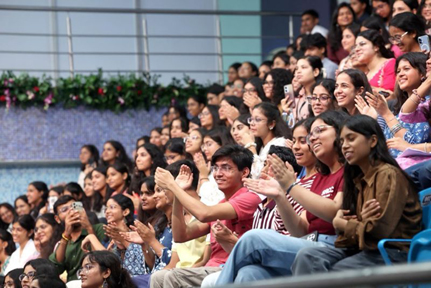

Modi’s choice of a leading college in Delhi to make his first outreach was problematic, both on account of the choice of the college and his use of some GenZ slang

The success of the BRICS summit, the 7.8% GDP growth in the first quarter of this financial year, the elaborate enthusiasm with which PM Modi’s 76th birthday was celebrated and the Akhil Bharatiya Vidyarthi Parishad’s retention of its posts in the Delhi University elections, although by much lower margins, cannot obscure the headwinds faced by the government and the Sangh Parivar in its saffronisation project.
The June-July Cockroach Janta Party protests led to the resignation of Education Minister Dharmendra Pradhan, a key demand of the protesters. It would not have been easy for Modi to let Pradhan go. However, the police crackdown on the protesters and the nationwide resonance of the protests did not leave the PM with any choice.
Certainly, some things have changed. But if Modi and his advisers believe, in the post-Pradhan scenario, that his resignation will help return the genie back into the bottle, especially after the repeat conduct of the NEET examination, then they may be mistaken.
More instances of paper leaks have surfaced to keep GenZ agitated even if these have occurred in non-BJP ruled states. The Nandan Nilekani committee’s report, when it comes, may help in assuaging some GenZ fears on leak-proof examinations but the extent to which it will be able to do so remains to be seen.
There is an enormous gap between some sections of GenZ’s thinking, attitudes and articulation and the ruling dispensation’s view on how India’s youth should behave. This applies especially to young women. It would be wrong to make generalizations, however, as social behavior is a very complex phenomenon.
It would, however, be safe to say that many young women, particularly in urban settings, have moved away from more conservative norms of behavior. In some cases, their deportment is seen as “masculine;” the RSS would like them to conduct themselves according to age-old notions of modesty.
No wonder Modi appeared most pained by the language that some young women had used during the CJP protest while expressing their anger and angst. He had said in a video posted on X “Cultural shock hai ki hamari betiyaan iss prakar ki bhasha kaise bol sakti hain.” He went on to say “Lekin samay hai bachhon ko raah dikhane ka”.
Young women in ever larger numbers are in public spaces. They are even part of combat formations in the navy and air force. They are leading police units in anti-crime operations. Through all this, and much more, gender relations are being redefined. In large sections of our society young women openly aver that if the crass behavior of men is condoned, then why should the same approach not apply to them.
Modi’s bewilderment at the language used by girls reveals an older, more cautious mindset: young women should be chaste, have downcast eyes, use polite language and remain modest.
Young girls of today, particularly in cities, generally do not accept gender discrimination — which raises the issue of whether they have in some way, gone beyond the basic postulates underlying the Sangh’s thinking on sanskar? This, notwithstanding the fact that religiosity may be increasing in India; but piety does not necessarily translate into conventional behaviour.
Modi’s instinctive response to bridge the gap with GenZ has been to engage them. GenZ is obviously not a monolith but Modi’s choice of a leading college in Delhi to make his first outreach was problematic, both on account of his choice of the college and his use of some GenZ slang.
The college is, of course, one of the country’s leading educational institutions but its student body is not the kind which would participate in GenZ protests in large numbers. Students of this college are more likely to get admissions in prestigious institutions or land good jobs than those from other colleges.
Hence, Modi chose to bat on a placid pitch. Like every generation, GenZ has its own slang. The question is how does it react to an older person — even if he is the country’s pre-eminent political leader — peppering his talk with some GenZ phrases.
More important than Modi’s style of outreach is his difficulty in meeting the expectations of large sections of GenZ for jobs and stability in their lives. Modi is rightly focusing on creating the right environment for entrepreneurship for the young.
This is good but the focus of a very large number of the youth, particularly from socially deprived sections in the north and the east, is on government or professional jobs. This is because they are associated with status.
It is here that the economy, despite being the world’s fastest growing large economy, is not doing enough. This is leading to a large number of youth being attracted to the issues such as those raised by the CJP. These young people respond to nationalism but is their focus on following the thinking of the Sangh Parivar?
It is here that Rahul Gandhi is scoring high. There seems to be some discomfort in the BJP on the kind of response he is receiving. It is believed that authorities in BJP-ruled states have been putting obstacles, for one reason or another, on his youth rallies. The Indore rally was finally held on September 19, and reports indicate that like its previous iterations, it received a good response.
This does not mean that the BJP with its huge election machinery will suffer great reverses in the coming elections, but it does lead to food for thought whether the saffronisation project currently underway resonates with large numbers of the young.
Thus, academic syllabi may be modified and institutions may be led by BJP-RSS leaders, but if the economy does not yield more jobs, their agenda will no longer be necessarily compelling for GenZ, certainly from those social sections that have not gained from the BJP’s economic preferences.
(Vivek Katju is former Secretary, Ministry of External Affairs)



Be the first to comment