

Congress demands Gyanesh Kumar’s resignation and arrest; reported objections by two Election Commissioners fuel row; NDA allies seek answers; Supreme Court petition challenges allegedly unilateral decisions
-
I.S. Saluja
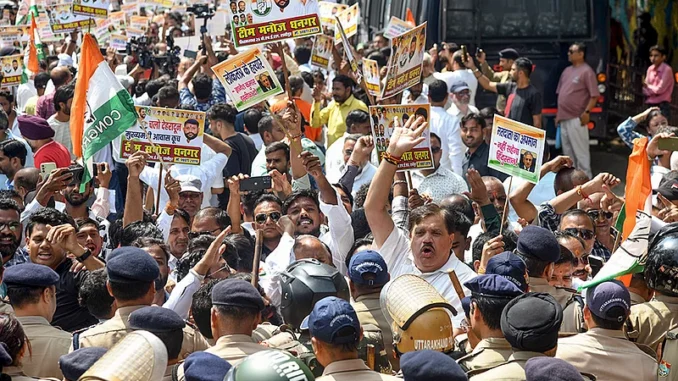
NEW DELHI (TIP): Pressure on Chief Election Commissioner Gyanesh Kumar and the Election Commission of India intensified Friday, September 25, as the Congress staged nationwide demonstrations demanding his resignation and arrest, while reports of repeated objections from the other two Election Commissioners, questions from some members of the ruling National Democratic Alliance, and a petition before the Supreme Court widened the controversy over the functioning of the constitutional poll body.
The Congress organized protests in Delhi and State capitals across the country, with workers attempting to march towards Election Commission offices. Police detained protesters at several places and used water cannons or tear gas in some cities as demonstrations were stopped from proceeding towards election offices.
Congress general secretary K.C. Venugopal demanded not only Kumar’s resignation but his arrest, alleging electoral malpractice. The demand is an allegation by the Congress; no finding of criminal wrongdoing against the CEC has been established by the protests themselves.
The political confrontation follows an investigation by The Indian Express reporting that Election Commissioners Sukhbir Singh Sandhu and Vivek Joshi had placed objections or concerns on record at least 14 times between November 2025 and August 2026 over decisions concerning electoral rolls and the Special Intensive Revision (SIR).
According to the report, the issues included voter additions and deletions, changes involving Form 6 used for voter registration, centralization of controls over the ERONet electoral-roll system, and electoral-roll matters in West Bengal and Goa.
The Election Commission has rejected the suggestion that these exchanges demonstrate a breakdown in collective decision-making. EC officials have said observations, operational queries and differing views are part of the normal functioning of a multi-member constitutional institution and maintained that final decisions of the Commission, including those concerning the SIR, had the approval of all three Election Commissioners.
The controversy has nevertheless moved beyond the Congress-led Opposition.
Union Minister and Lok Janshakti Party (Ram Vilas) president Chirag Paswan, an NDA ally, called upon the CEC to publicly clarify the Commission’s position, saying that doubts about the electoral process needed to be addressed in order to preserve public confidence. Upendra Kushwaha, another NDA ally, also sought clarification from the Election Commission over the controversy surrounding the SIR.
Biju Janata Dal president and former Odisha Chief Minister Naveen Patnaik separately called for Kumar’s resignation and said the entire SIR process should be revisited in light of the reported differences within the Commission. The Election Commission disputes the characterization of those exchanges as evidence that final SIR decisions lacked unanimity.
The controversy has also reached the Supreme Court. A petition filed by advocate Shailendra Mani Tripathi challenges decisions, guidelines and software changes allegedly undertaken without the concurrence of the other Election Commissioners and seeks legal action over alleged violations. These claims remain allegations before the court and have not been judicially established.
Separately, the Supreme Court this week raised concerns over aspects of the SIR process in Delhi, observing that a number of notices appeared to have been issued “almost mechanically” and suggesting that voters be permitted to respond through modern communication methods such as email and WhatsApp.
Another point of controversy is a “Mark VIP” feature in the Booth Level Officer application. The Congress has alleged that creation of such a facility constitutes unequal treatment of voters and has demanded disclosure of its purpose and operation.
The political temperature was visible across the country on Friday.
In Delhi, Congress workers and separate groups of activists demonstrated against the CEC. Civil society activists and political leaders participated in a protest at Jantar Mantar, while the Delhi Congress attempted to march towards Nirvachan Sadan, the Election Commission headquarters.
Police said protesters were detained where demonstrations had not received the required permission.
In Bihar, Congress workers marching towards the election authorities’ office in Patna were stopped with water cannons. Water cannons were also reported during protests in Chandigarh, while clashes occurred between protesters and police in Lucknow. In Assam, State Congress president Gaurav Gogoi and other leaders were detained during a demonstration.
Demonstrations were also reported in Jammu and Kashmir, Uttarakhand, Odisha, West Bengal, Manipur, Arunachal Pradesh, Telangana, Madhya Pradesh and other parts of the country. Police used tear gas to disperse protesters in Manipur.
Meanwhile, two scheduled voter-awareness programs involving CEC Kumar in Meerut and Varanasi were postponed. The Election Commission said the changes were routine and unrelated to the controversy, explaining that such programs can be rescheduled because of venue availability, official schedules and other logistical considerations.
The Congress has indicated that the agitation will continue and party sources have also spoken of the possibility of Opposition parties pursuing a motion in Parliament seeking Kumar’s removal. The matter is expected to figure at the Congress Working Committee meeting scheduled for September 29.
The dispute has therefore developed into a wider institutional controversy involving three separate questions: whether procedures governing revision of India’s electoral rolls have adequately protected eligible voters; whether important Election Commission decisions were reached through the collective process required of the three-member body; and whether the Commission has sufficiently explained its actions to maintain public confidence in the neutrality and integrity of elections.
For its part, the Election Commission maintains that its final decisions were unanimous and that internal observations and disagreements during deliberations should not be confused with institutional division. The allegations against Kumar and demands for his resignation, removal or prosecution remain political and legal claims that have not been established as findings of wrongdoing.
With protests continuing, a petition now before the Supreme Court and political demands for greater disclosure coming from beyond the principal Opposition, the controversy is unlikely to end with Friday’s demonstrations. At its center lies an issue larger than any individual office-holder or political party: public confidence that India’s electoral institutions operate transparently, collectively and impartially.



Be the first to comment