
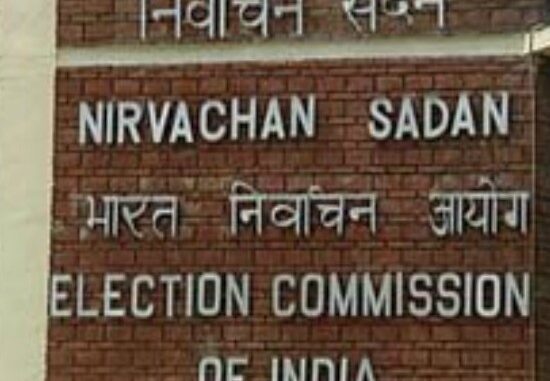

There are institutions in a democracy whose credibility cannot be allowed to become a matter of partisan faith. The Election Commission of India is one of them.
Governments may be loved or hated. Political parties may accuse one another. Elections may produce bitter winners and disappointed losers. But the referee must stand apart.
That is why the latest disclosures concerning the functioning of the Election Commission deserve something more serious than another exchange of accusations between the BJP and the Opposition. They demand answers.
An investigation by The Indian Express has reported that Election Commissioners Sukhbir Singh Sandhu and Vivek Joshi recorded objections at least 14 times over ten months to actions concerning matters at the very heart of elections—addition and deletion of voters, appeals concerning electoral rolls and control over the computer system through which voter information is administered. Even more troubling is the report that the three-member Commission did not hold a full meeting for four months before meeting on September 9.
The Election Commission disputes the implications being drawn from these disclosures. Its position is that differences of opinion during deliberations are natural and that final decisions of the Commission, including those concerning the Special Intensive Revision, were unanimous.
That response deserves to be reported. But it cannot be the end of the matter. If two Election Commissioners repeatedly placed objections on record concerning decisions affecting who may vote, the country is entitled to know precisely what happened.
The controversy assumes still greater importance because of the enormous scale of the Special Intensive Revision of electoral rolls. According to the recent investigation, more than 13 crore names were removed from draft rolls across 30 states and Union Territories during successive phases of SIR.
Deletion from a draft roll does not automatically prove wrongful disenfranchisement; names can disappear for legitimate reasons—death, migration, duplication or ineligibility—and mechanisms exist for claims and appeals. But numbers of this magnitude impose an extraordinary obligation of transparency.
Consider West Bengal. The Election Commission recently informed the Supreme Court that 27.16 lakh (over 2.27 million) names had been removed during SIR. More than 22 lakh (2.2 million) of those people subsequently sought restoration of their names.
Those figures do not by themselves establish electoral manipulation. They do establish that electoral-roll revision is no clerical matter. A name deleted from an electoral roll is potentially a voice removed from democracy.
India therefore needs to examine not merely whether procedures technically existed, but whether every eligible citizen was given a fair, accessible and timely opportunity to remain on the rolls.
The present controversy also brings India back to an older and fundamental question: who chooses the people who supervise India’s elections?
In March 2023, the Supreme Court, pending legislation by Parliament, prescribed a selection committee consisting of the Prime Minister, the Leader of Opposition and the Chief Justice of India for appointments to the Election Commission.
Parliament subsequently enacted legislation replacing the Chief Justice on the selection committee with a Union Cabinet Minister nominated by the Prime Minister.
That arrangement gives the political executive two places on a three-member selection body.
The law exists and challenges to it have been before the Supreme Court. But legality does not extinguish the legitimate democratic question: should those seeking political power enjoy such decisive influence over the process of selecting those entrusted with refereeing the contest for that power?
Gyanesh Kumar became India’s 26th Chief Election Commissioner in February 2025. Before joining the Commission, he had a distinguished bureaucratic career. He also held significant positions in the Union government, including assignments in the Home Ministry connected with Jammu and Kashmir during the abrogation of Article 370, and later served as Secretary in the Ministry of Cooperation.
Those facts do not prove partiality. A civil servant’s previous service under a government cannot by itself disqualify him from constitutional office.
But constitutional authority carries a higher burden than ordinary administration. The Election Commission must not merely be independent. People must be able to see that it is independent. That distinction is crucial.
Opposition parties have accused the Commission and its Chief Election Commissioner of favoring the BJP. The Commission rejects allegations that its decisions were improperly taken. The BJP has argued that internal differences demonstrate deliberation rather than institutional capture.
These competing claims cannot be settled by rhetoric. They can be settled only by facts. Publish the relevant records. Explain the 14 reported objections. Establish which decisions were formally approved by all three Commissioners and which administrative instructions were issued without prior concurrence. Explain the four-month interval between full Commission meetings. Make clear who controlled changes to electoral-roll systems and under what authority. And where credible allegations of illegality exist, let them be independently investigated.
The Indian Panorama would go further. Questions this serious should not be resolved through television debates, political rallies or selective leaks. Parliament, the courts and other constitutionally appropriate mechanisms should ensure a transparent examination capable of commanding public confidence.
If wrongdoing is established, accountability must follow—irrespective of office, party or position. If allegations are disproved, that too should be placed conclusively before the country.
What India must avoid is prejudging guilt while simultaneously refusing scrutiny. For, this is larger than Gyanesh Kumar. It is larger than Narendra Modi, Amit Shah, Rahul Gandhi, the BJP or Congress. It concerns the Indian voter’s ownership of democracy.
Free elections do not begin when a voter presses a button on an electronic voting machine. They begin much earlier—with an accurate electoral roll, transparent rules, equal treatment of political contestants and an Election Commission whose independence commands confidence across political divisions.
India’s Constitution entrusts the Election Commission with extraordinary responsibility under Article 324. That responsibility is not a privilege granted to its Commissioners. It is a trust placed in their hands by the Republic.
And trust cannot be demanded. It must be earned through transparency.
Chief Election Commissioner Gyanesh Kumar and his colleagues therefore owe India a complete accounting of what occurred within the Commission. Let the records speak. Let an impartial examination establish the truth. Let those responsible for any proven violation face the consequences prescribed by law.
But let nobody—government, opposition or Election Commission—appropriate the voter’s sovereign right to decide who governs India.
The ballot belongs neither to the BJP nor Congress. It belongs to the people. And whoever administers that ballot must remember that he is not its master. He is its custodian.


Be the first to comment