
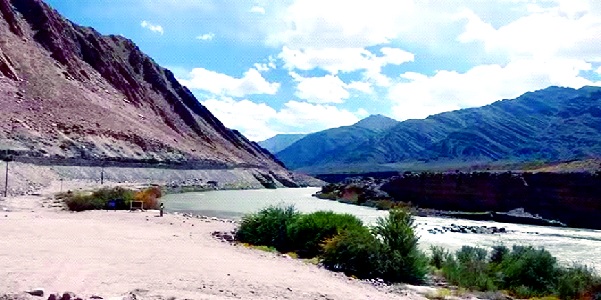

New Delhi (TIP): After Arunachal Pradesh, the Centre has formally named and mapped 28 places and features in Ladakh, the Ministry of Home Affairs said on Tuesday.
The MHA said that identifying these places formally on the Survey of India’s map of Ladakh “is aimed at facilitating their accurate recognition and better awareness among the public at large”. It said that the exercise has been done in consultation with the Ladakhi administration.
The MHA also released a map marking these places.
Earlier in August, the MHA had similarly standardised names of 27 places and features in Arunachal and published a map showing them.
The development comes as China has stepped up the ‘cartographic aggression’ by assigning Mandarin names to places in Arunachal and Ladakh to press its territorial claims — China says that Ladakh and Arunachal are part of Tibet and lays claims to these Indian territories.
In an earlier interview, China expert Anushka Saxena said that China has indulged in the renaming exercise first and foremost to rewrite history to solidify claims over territories it says are disputed — even though they may not be actually disputed.
“Moreover, the idea is to insert Chinese names in the usage of other countries and governments, so that associated territories only seem to be remembered as a part of the mainland. China also uses the renaming exercises as a response to actions that violate its so-called red lines,” said Saxena, an Associate Fellow with Takshashila Institution’s Geostrategy Programme.
China’s usage of Mandarin names for places outside of its borders is not limited to India. It has also used these internally, renaming Tibet as Xizang and East Turkmenistan as Xinjiang, as part of the ‘Sinicisation campaign’ in which the Communist Party’s Han leaders imposed the Han identity and culture on minorities, systematically erasing their native culture.
As part of such a campaign, China refers to Arunachal as Zangnan — southern Tibet. The naming and mapping of places in Arunachal and Ladakh is part of broader efforts to tackle such cartographic aggression.
When MHA announced the names of places in Arunachal in August, an official told Hindustan Times: “There has been a lot of ambiguity regarding the maps. China uses this to give fictitious names to Arunachal Pradesh’s territories, which are part of sovereign India. Putting these 27 locations on the Survey of India map provides clarity, makes our claim status strong and strengthens the official documentation of geographical features.”
Tawang chosen as venue for tourism meet, China invited
The government is set to hold a mega international event in Tawang in Arunachal Pradesh towards the end of this month.
The International Tourism Mart, being organised by the Ministry of Tourism from October 27 to November 1, will bring together delegates from around 20 countries.
Delegates from China have also been invited to the annual event which is held, by rotation, in one of the North-Eastern states. The 2025 edition of the event was held in Sikkim, and was attended by government representatives and industry stakeholders from over19 countries.
Sources maintained it is a routine rotational event, but the decision to hold the event in Tawang is significant, coming as it does weeks after the government identified 27 places/features in Arunachal Pradesh by standard place and feature names on the official maps of Survey of India for “their accurate recognition and better awareness among the public at large”. Tawang in the eastern sector is a primary bone of contention in the boundary dispute between India and China.
Beijing refers to Arunachal Pradesh as Zangnan or South Tibet and claims that it belongs to China. New Delhi strongly rejects China’s territorial claim, reiterating that Arunachal Pradesh is an “inalienable and integral part of India”.
Tawang is a primary bone of contention between India and China. Beijing refers to Arunachal Pradesh as Zangnan or South Tibet and claims it belongs to China. Delhi rejects China’s claim, reiterating that Arunachal Pradesh is an “inalienable and integral part of India”.



Be the first to comment