

AICHI (TIP): More than 6000 athletes from 45 member nations of the Olympic Council of Asia, after rubbing shoulders for 15 days as they sought to outplay one another and assert supremacy, bade farewell to Aichi Prefecture, promising to meet again.
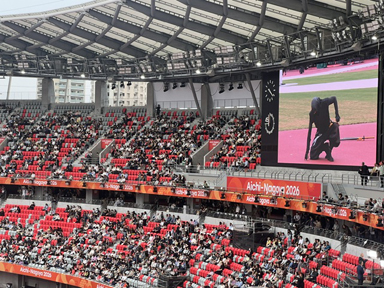
It was a ceremony held in true sports tradition. It not only brought down the curtain on the Games but also revealed new equations, new relations and new champions that emerged because of the Games. Empty seats in the stadium were not only an eyesore but also glaring. Perhaps, organizers could not sell or convince the locals of the significance and importance of the ceremony.
The philosophy of the 2026 Aichi Asian Games has been to project Asia as one.
The grand closing ceremony started on a low key, as almost three-fourths of the venue was empty. Low turnouts must have been disappointing for the organizers, as tickets for various events, including the closing ceremony, had no takers. Even members of the accredited media preferred to watch the ceremony on big TV screens of the media center rather than be physically present at the venue.
Restricted vehicular movement on the roads leading to the closing ceremony and tight security arrangements served more as deterrents for spectators than as assurances of an evening of entertainment and a cultural feast. Traditionally, opening and closing ceremonies are major crowd pullers. However, the Aichi Asian Games somehow missed the public response that is normally associated with such major sporting events.
Interestingly, the huge screens at the venue played instructions on how to handle medical emergencies in case of an earthquake. It may be pertinent to mention that some parts of Japan were rocked by tremors some weeks ago.
After 15 days of intense competition, one startling revelation was that the gap between the bigger sporting nations and upcoming nations has been widened. Of 1410 medals at stake during the games, almost one-fourth – 341 – went to China alone, while the hosts, Japan, had an impressive tally of 261, and the third-placed Korea aggregated 150.
Statistically speaking, 291 of 470 gold medals at stake went to the kitty of China, Japan and Korea. India placed fourth and got only 85, reflecting a huge gap between third-placed Korea at 150 and fourth-placed India at 85.
Besides 169 gold, China won 89 silver and 83 bronze medals. Japan had 95 silver and 91 bronze medals in its kitty, while Korea got 43 silver and 68 bronze. The president of the Olympic Council of Asia, in his address, expressed satisfaction, saying that 40 of 45 participating nations ended up on the medal tally. He gave a call to athletes to reassemble four years from now for the next edition of the Games in Doha before declaring the Games closed.
Before the ceremony started, a series of announcements directed spectators to remain seated or not to leave in the no-exit period and not to leave their seats at any time during the ceremony.
Since VIP movement was expected, spectators were informed that between 7.30 and 7.50 pm no one would be allowed to exit.
Exactly at 6, it started with the arrival of the Crown Prince, Prime Minister and Foreign Minister of Japan. After the hoisting of the flag of Japan.
Flag bearers of all participating nations, followed by a procession of participating athletes, comprised the most important, traditional part of any closing ceremony. After the entry of athletes, it was a recall of some of the glorious moments of the game through a video on big screens of the venue.
The baton was handed over to Doha, the hosts of the next edition of the games. Doha made a presentation.


Be the first to comment