
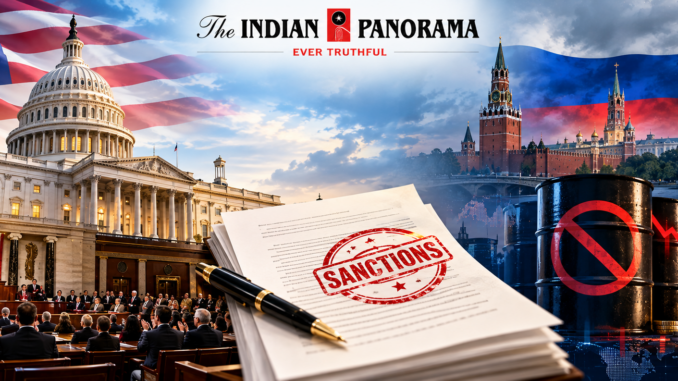

The US Congress has passed a Russia sanctions bill that could have real effects on India’s energy policy. On September 16, the House of Representatives voted 262-159 to send the Lindsey O. Graham Sanctioning Russia and Iran Act of 2026 to President Donald Trump. He signed it into law on September 18, about a year and a half after the late South Carolina senator first introduced the bill.
The Senate had already approved the bill in August with an 86-11 vote. This is the most significant Russia-related legislation Congress has passed since Trump started his second term in January 2025. During this time, Trump usually preferred to keep control over sanctions and tariffs himself, rather than let Congress decide. He agreed to a floor vote only weeks before Graham’s sudden death on July 11, after a negotiation between them that Graham’s Senate colleagues said helped the bill move forward.
What Specific Powers Does the Bill Give the President Over India?
A key part of the law gives the president the power to impose tariffs of up to 100 percent on the top five countries buying Russian oil or natural gas. There are exceptions for countries that import less than 15 percent of their natural gas from Russia and are making real efforts to cut those imports. India, which got about half of its crude oil from Russia in parts of 2026 by taking advantage of lower prices after Western sanctions, is one of the main countries this rule targets, along with China.
The bill’s authors, including Representative Michael McCaul, have said the law could seriously hurt Russia’s ability to fund its war in Ukraine by cutting the money Moscow gets from its biggest oil and gas buyers.
In addition to the tariff powers, the bill puts direct sanctions on Russian President Vladimir Putin, top officials in his government, Russian oligarchs, and major Russian banks and financial institutions. It also extends the Iran Sanctions Act by five years, as Trump requested, to keep up pressure on Iran’s energy and weapons sectors during the ongoing US-Israeli conflict with Tehran.
Why Did the Bill Face Opposition Even Among Democrats?
Even though both parties supported the bill, House Democratic leaders strongly criticized it. They argued that it gives Trump too much power to set tariffs, which could be used against US allies and trading partners, not just adversaries. House Democratic Leader Hakeem Jeffries warned that the bill has enough loopholes that truly tough sanctions on Russia might never be enforced. Other Democrats noted that Trump already has the power to sanction Russia directly but has not used it so far.
The bill gives the president the power to waive sanctions if he tells Congress it is in the US national interest. Critics say this could let the administration delay real pressure on India, China, or other big buyers of Russian oil, depending on wider diplomatic goals.
A few structural details help clarify exactly how thSome key details show how the new law might affect India in practice: top five countries purchasing Russian oil and gas, meaning India’s exposure depends directly on its ranking relative to other major buyers like China.
- Countries that import less than 15 percent of their natural gas from Russia and are actively working to reduce those imports can be exempt from the tariff rule.
- The president can fully exempt countries from sanctions if he certifies that it serves US national interests. This gives the White House a lot of control over how the law is enforced.
- The bill also includes sanctionsThe bill also adds sanctions related to the abduction of Ukrainian children, a change made during revisions earlier this year.onia, have publicly urged rapid implementation of the strongest possible sanctions, even as concerns persist that the bill’s tariff powers could complicate relations with European countries still importing Russian energy.
How Has India Responded to the Sanctions Threat So Far?
India has repeatedly defended its Russian oil purchases, saying they are needed for energy security and to keep fuel affordable for its 1.4 billion people. Officials argue that buying discounted Russian crude has helped control domestic fuel prices during global energy swings. External Affairs Minister S Jaishankar has often said that India’s energy choices are based on national interest, not global politics. New Delhi has stuck to this view even as Washington has sometimes threatened tariffs over the Russian oil trade in the past two years. Now that the bill is law, India’s real risk of tariffs will depend on how the Trump administration uses its new powers, and whether India’s ongoing talks and closer defense ties with Washington can help it get a waiver or exemption.
What Should India Watch for in the Coming Months?
For Indian policymakers, this bill makes an already tricky situation even more uncertain. They must balance keeping control over energy sources with protecting India’s important economic ties to the US, its biggest trading partner. The main question now is whether the Trump administration will use its new tariff powers against India, grant a waiver, or simply use the threat of tariffs as a bargaining chip in trade talks. India’s foreign policy team will be watching closely as the details of the new law become clear in the coming weeks.
Be the first to comment