
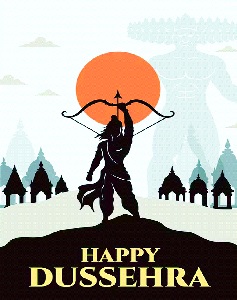

From Lord Rama’s epic battle against Ravana to Goddess Durga’s victory over Mahishasura, Dussehra brings together powerful stories of courage, sacrifice and righteousness. Celebrated in different ways across India, Vijayadashami is not merely a festival marking the defeat of evil but a reminder of the importance of conquering the weaknesses within ourselves.
Every year, as autumn settles over India, the country prepares for one of its most evocative festivals. Markets fill with festive decorations, artisans construct towering effigies of Ravana, theatre groups rehearse episodes from the Ramayana, and temples welcome devotees for special prayers. In eastern India, the farewell to Goddess Durga brings together devotion, music and elaborate processions. In Mysuru, royal traditions and spectacular displays lend Dasara an unmistakable grandeur, while the Kullu valley celebrates its presiding deities in a distinctive week-long festival.
These celebrations may differ in appearance, but they share a common message: the ultimate victory of righteousness over wrongdoing.
Dussehra, also known as Vijayadashami or Dasara, falls on the tenth day of the bright fortnight of the Hindu lunar month of Ashvin. It marks the culmination of Navratri, the nine-night festival dedicated to the divine feminine in many Hindu traditions. In 2026, Dussehra falls on October 20.
The festival is associated with two major mythological narratives: Lord Rama’s victory over Ravana, described in the Ramayana, and Goddess Durga’s defeat of Mahishasura, celebrated particularly during Durga Puja. Together, these stories give Dussehra its enduring spiritual significance.
Meaning of Dussehra and Vijayadashami
The name Vijayadashami is derived from two Sanskrit words: vijaya, meaning victory, and dashami, referring to the tenth lunar day. The name captures the central theme of the festival-the triumph of good over evil.
Dussehra is commonly associated in popular interpretation with the defeat of the ten-headed Ravana. The name is also linked to the idea of destroying or overcoming ten forms of evil. These interpretations have helped the festival acquire a wider moral significance beyond the events of a particular mythological battle.
The ten heads of Ravana are frequently understood symbolically as representing human weaknesses. Popular explanations include anger, pride, greed, attachment, jealousy, selfishness, injustice, cruelty, ego and uncontrolled desire. Such lists vary, and they should be understood as moral interpretations rather than a single authoritative scriptural enumeration.
The symbolism nevertheless offers an important lesson. Evil is not always an external force represented by a villain. It can also appear in everyday conduct-in dishonesty, intolerance, exploitation, arrogance and the misuse of power.
Vijayadashami thus becomes an occasion for introspection. The festival invites people to examine their actions, acknowledge their shortcomings and make a conscious effort to live with greater integrity.
Rama and Ravana: The epic battle that defines Dussehra
The most widely recognised Dussehra narrative comes from the Ramayana, one of the great epics of Hindu tradition.
Prince Rama, the eldest son of King Dasharatha of Ayodhya, is sent into exile along with his wife, Sita, and brother Lakshmana. During their stay in the forest, Sita is abducted by Ravana, the powerful ruler of Lanka. Determined to rescue her, Rama begins a search that eventually brings him into an alliance with Sugriva, the vanara king, and Hanuman, whose devotion and extraordinary courage become central to the story.
Hanuman travels to Lanka, finds Sita and carries Rama’s message to her. The search culminates in a military campaign against Ravana’s kingdom. Rama’s forces cross the sea to Lanka, where a fierce battle unfolds between the two sides.
Ravana is a formidable adversary. He is portrayed in the epic tradition as a learned ruler, a devotee of Shiva and a man possessing extraordinary abilities. His downfall is therefore not presented simply as the defeat of an ordinary villain. It illustrates how knowledge, power and achievement can become destructive when accompanied by arrogance and the violation of moral boundaries.
Rama eventually defeats Ravana and rescues Sita. His victory restores order and fulfils the central purpose of the campaign.
The story’s moral complexity is one reason for its enduring relevance. Ravana’s abilities do not erase the consequences of his actions, while Rama’s victory represents the restoration of dharma-the moral and cosmic order that sustains life and society.
Why Ravana has ten heads
Ravana’s ten heads are among the most recognisable images in Indian religious and cultural traditions. They are depicted prominently in Ramlila performances, paintings, sculpture and the enormous effigies burned on Dussehra.
The heads are often interpreted as symbols of his vast knowledge, formidable intellect and extraordinary power. In moral readings of the story, however, they also signify the dangers of an ego that becomes impossible to restrain.
The contrast between Ravana’s intelligence and his ultimate defeat offers a powerful reflection on human conduct. Knowledge alone does not guarantee wisdom, just as power does not necessarily produce justice.
Ravana’s downfall reminds devotees that personal greatness cannot justify wrongdoing. His story also raises questions about the responsibilities that accompany authority, wealth and influence.
The significance of burning Ravana’s effigy
The burning of Ravana’s effigy is the defining public ritual of Dussehra in much of northern India.
Communities organise Ramlila performances in open grounds, parks and temporary theatres. These enactments dramatise episodes from the epic, often culminating in Rama’s confrontation with Ravana. At sunset or in the evening, effigies of Ravana, Kumbhakarna and Meghnad are set alight, usually accompanied by fireworks.
The spectacle attracts families, children and visitors, turning the festival into a major community gathering. For many people, the moment the effigies burst into flames is the emotional climax of the celebrations.
Yet the ritual carries a message that goes beyond spectacle. Burning an effigy is symbolic; the more difficult task is to overcome the behaviour that the figure represents. The festival asks whether people can challenge dishonesty, prejudice, cruelty and the misuse of power in their own lives.
Goddess Durga’s victory over Mahishasura
Dussehra has a second major mythological foundation, particularly important in eastern and northeastern India.
According to Hindu tradition, Mahishasura was a powerful asura whose strength enabled him to challenge the gods and threaten the established cosmic order. In accounts associated with the Devi Mahatmya, his growing power culminated in the defeat of the gods, who were unable to overcome him individually.
The divine energies of the gods combined to manifest as Goddess Durga, a powerful expression of Shakti, or divine feminine energy.
The gods bestowed weapons upon her, including those associated with their own powers. Riding a lion, Durga confronted Mahishasura in a battle that extended over nine days and nights. On the tenth day, she defeated the demon.
This victory is commemorated through Navratri and Durga Puja, with Vijayadashami marking the culmination of the celebration.
The narrative is significant because it places feminine power at the centre of the restoration of cosmic balance. Durga is not merely a passive symbol of virtue; she is an active force who confronts danger, defeats oppression and protects the world.
Her many arms, each carrying a weapon or symbolic object, are commonly interpreted as representing her ability to act across multiple dimensions. The lion represents strength and courage, while the defeat of Mahishasura signifies the destruction of forces that threaten justice and order.
The story also highlights an important theme in Hindu traditions: the divine can manifest in different forms to address different challenges. While Rama’s victory represents the restoration of righteousness through the defeat of Ravana, Durga’s triumph celebrates the power of Shakti to overcome destructive forces.
Durga Puja: The goddess returns home
In West Bengal and other parts of eastern India, Vijayadashami marks the conclusion of Durga Puja, one of the region’s most important annual festivals.
Elaborately crafted idols of Durga are installed in decorated community pavilions known as pandals. The goddess is generally depicted with her children and in the act of defeating Mahishasura. The pandals may feature traditional architectural motifs, contemporary themes, elaborate lighting and artistic installations.
For several days, families visit the pandals, participate in prayers and enjoy cultural programmes. The celebrations combine religious devotion with art, music, food and community life.
The final day carries a different emotional tone. Vijayadashami is a farewell to the goddess, who is believed in popular Bengali tradition to visit her parental home before returning to her celestial abode.
In some communities, married women participate in sindoor khela, applying vermilion to the goddess and to one another as part of the farewell rituals. Processions then carry the idols to rivers or other designated water bodies for immersion.
The immersion symbolises the completion of the goddess’s earthly visit and the cyclical nature of arrival and departure. The sadness of farewell is balanced by the promise of her return the following year.
Durga Puja therefore celebrates both victory and renewal. The goddess’s departure does not mean the disappearance of her power; rather, her presence continues through faith, memory and the hope of another reunion.
The Pandavas, the Shami tree and the return of strength
Another legend associated with Vijayadashami comes from the Mahabharata, the epic that recounts the conflict between the Pandavas and the Kauravas.
After losing a game of dice, the five Pandava brothers were compelled to spend 12 years in exile, followed by a thirteenth year in which they had to remain undiscovered. If their identities were revealed during that final year, they would have to repeat the period of exile.
The brothers entered the kingdom of Virata in disguise and concealed their weapons in a Shami tree before taking up different roles in the royal household.
After completing the year without being discovered, the Pandavas recovered their weapons. Their identities were revealed, and they prepared to resume their rightful position.
In regional traditions, this episode is associated with Vijayadashami, the worship of weapons and the Shami tree. The custom signifies preparedness, courage and the restoration of strength after a period of restraint.
In parts of India, people worship tools, weapons, books, vehicles and instruments associated with their professions on this day. The underlying idea is that objects used to earn a livelihood or protect a community deserve respect and should be used responsibly.
The exchange of Shami leaves, treated symbolically as gold in some traditions, represents goodwill and wishes for prosperity. The ritual also reflects the belief that relationships and mutual respect are more valuable than material possessions.
Kautsa’s story: The value of generosity
The festival is also associated in popular tradition with the story of Kautsa, a student who wished to offer a gift to his teacher after completing his education.
Kautsa had studied under Rishi Varatantu. When the student insisted on giving his teacher a guru dakshina, the teacher initially declined, suggesting that the completion of the student’s education was itself a source of satisfaction.
Kautsa persisted, and the teacher eventually demanded an enormous sum of gold, traditionally described as 140 million coins corresponding to the 14 branches of knowledge he had imparted.
The student approached King Raghu, renowned for his generosity. The king, however, had already distributed his wealth through charity. Determined to honour Kautsa’s request, Raghu sought a way to obtain the required gold.
In popular versions of the story, Indra intervened and asked Kubera, the god of wealth, to cause gold coins to rain on trees near Ayodhya. Raghu gave the coins to Kautsa, who offered the required amount to his teacher. The surplus was returned to the student, who then sought to give it back to the king. Raghu refused to accept the gift, and Kautsa distributed the remaining wealth among the people.
The legend is associated with the tradition of exchanging Apta leaves in parts of Maharashtra, where the leaves are treated as symbolic gold.
Its enduring message concerns the relationship between knowledge, gratitude and wealth. Education creates obligations of respect, while generosity is meaningful when it benefits others rather than serving personal pride.
Dussehra across India: One festival, many traditions
India’s regional celebrations of Dussehra reflect the country’s cultural diversity. Although the central themes of victory and renewal remain shared, each region gives the festival its own character.
Mysuru Dasara: A royal celebration
Mysuru Dasara, celebrated in Karnataka, is among the country’s most famous Dussehra festivals. Also known as Nada Habba, it is closely associated with Goddess Chamundeshwari, who is believed to have defeated Mahishasura.
The festival has a long association with the Wadiyar royal family and the history of the Kingdom of Mysore. Royal ceremonies, cultural performances and the illumination of Mysuru Palace form important parts of the festivities.
The grand procession known as Jumbo Savari is a major attraction. Traditionally featuring a decorated elephant carrying the golden howdah containing the image of Chamundeshwari, the procession is accompanied by cultural troupes, music and other ceremonial elements.
The celebrations also include exhibitions, performances of classical music and dance, and events showcasing Karnataka’s cultural heritage.
Mysuru Dasara demonstrates how a religious observance can become a symbol of regional identity, artistic achievement and historical continuity.
Kullu Dussehra: The gathering of deities
In Himachal Pradesh’s Kullu valley, Dussehra has a distinctive calendar and ritual structure. The festival begins on Vijayadashami and continues for approximately seven days, unlike celebrations elsewhere that conclude on the tenth day.
The tradition is associated with Raja Jagat Singh, who ruled Kullu in the seventeenth century. According to local accounts, the king installed an image of Lord Raghunath as the presiding deity of the valley after a period of personal and political turmoil.
During the festival, village deities are brought to Kullu in decorated palanquins. Their processions, accompanied by music and traditional gatherings, create a large collective celebration.
The festival reflects the region’s distinctive religious traditions, in which local deities and community institutions play a prominent role. It is also an important occasion for bringing together people from across the valley.
Northern India: Ramlila and the victory of Rama
In Delhi, Uttar Pradesh, Punjab, Haryana, Uttarakhand and other parts of northern India, the burning of Ravana’s effigy is a defining feature of Dussehra.
Ramlila performances bring the Ramayana to public spaces, often over several evenings. Different communities have their own styles, ranging from traditional performances with devotional singing to elaborate theatrical productions.
The festivities are often accompanied by fairs, food stalls, rides and cultural programmes. The burning of Ravana’s effigy provides a shared public ritual through which the epic’s moral lessons are transmitted across generations.
Kumaon: A distinctive theatrical tradition
The Kumaon region of Uttarakhand has a well-established Ramlila tradition, particularly associated with Almora. These performances combine elements of theatre, music and regional cultural expression.
The Kumaon style developed through the contributions of performers and cultural figures over generations. It reflects how the Ramayana has been adapted to local languages, musical forms and theatrical conventions.
The tradition also illustrates the role of community theatre in preserving cultural memory and transmitting religious narratives.
Maharashtra: Auspicious beginnings and the exchange of leaves
In Maharashtra, Vijayadashami is widely regarded as an auspicious occasion for beginning new ventures and undertaking important activities.
Families may worship tools, books, vehicles and instruments associated with their work. The exchange of Apta leaves as symbolic gold is an especially well-known tradition in some communities.
The practice transforms a simple leaf into a gesture of goodwill, expressing wishes for prosperity and strengthening social bonds.
Southern India: Worship, learning and renewal
In several southern Indian traditions, the period of Navratri includes the worship of books, musical instruments, tools and other objects associated with learning and professional life.
Vijayadashami is regarded in many communities as an auspicious day to begin education or introduce children to formal learning. This ritual, often called Vidyarambham or by related regional names, highlights the importance of knowledge and the blessings sought at the beginning of an educational journey.
The precise customs differ by state and community, but the broader message is consistent: learning, skill and disciplined effort deserve reverence.
Why Dussehra remains relevant today
The mythology surrounding Dussehra belongs to ancient religious and literary traditions, yet its moral questions remain familiar.
Ravana’s story explores the dangers of arrogance and the misuse of power. Mahishasura’s defeat celebrates the courage required to confront oppression. The Pandavas’ recovery of their weapons emphasizes preparedness, while Kautsa’s story highlights gratitude and generosity.
These themes can be applied to modern life without reducing the religious meaning of the festival to a simple moral lesson.
In public life, the idea of dharma invites reflection on integrity, accountability and the responsible exercise of authority. In families and communities, the festival encourages people to value compassion, fairness and mutual respect. At an individual level, it offers an opportunity to recognize destructive habits and work towards meaningful change.
The festival also has a social dimension. Public celebrations bring people together across generations, while Ramlila performances and regional rituals help preserve traditional arts. Community organizations, artisans, performers and religious institutions all contribute to keeping these practices alive.
At the same time, the spirit of the festival can inspire more responsible celebrations. Reducing waste, using safer fireworks alternatives and ensuring public safety can help communities preserve the joy of Dussehra while being mindful of their surroundings.
The message beyond the celebrations
Dussehra is a festival of victory, but its deeper significance lies in what victory demands of those who celebrate it.
Rama’s triumph over Ravana is a reminder that power must be guided by righteousness. Durga’s victory over Mahishasura celebrates the courage to confront injustice. The Pandavas’ story highlights patience and preparedness, while the tale of Kautsa places generosity and gratitude above material wealth.
Across the country, the rituals may take different forms-burning effigies, immersing idols, worshipping weapons, gathering village deities or exchanging leaves as gold. Yet they return to a shared conviction: destructive forces must be confronted, and righteousness must be renewed through action.
When Ravana’s effigy burns, the spectacle lasts only a few moments. The more enduring task begins afterwards: to recognize the arrogance, dishonesty and intolerance that can take root in everyday life and to make a conscious effort to overcome them. That is the enduring promise of Vijayadashami-a celebration not only of victories won in ancient epics, but also of the possibility of choosing wisdom, courage and compassion in the present.


Be the first to comment