
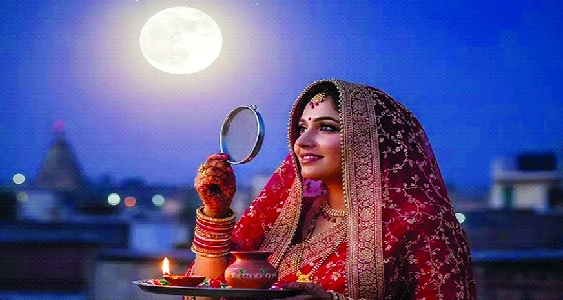

As the October sky darkens and the moon rises above rooftops, a familiar scene unfolds across North India. Women dressed in crimson, maroon and gold gather with decorated prayer plates, their hands adorned with intricate mehendi. Earthen pots, flickering lamps and whispered prayers fill the evening air. Families wait eagerly for the moon, whose appearance marks the end of a long day of fasting.
This is Karva Chauth, a festival where age-old legends meet contemporary romance, religious devotion mingles with celebration, and centuries-old traditions continue to find new meaning in modern Indian life.
The Festival of Devotion
Celebrated predominantly in Punjab, Haryana, Rajasthan, Uttar Pradesh and parts of Himachal Pradesh, Karva Chauth holds a special place in Hindu cultural and religious traditions. Many married Hindu women observe a day-long fast and pray for their husbands’ health, safety and longevity. Some unmarried women also observe the fast in the hope of finding a suitable life partner, while some couples now choose to fast together as an expression of mutual affection and commitment.
Karva Chauth falls on the Chaturthi, or fourth day, of the waning lunar fortnight associated with Kartik in the Hindu lunisolar calendar. Depending on regional calendar traditions, its precise lunar-month designation may vary. The festival usually occurs in October, sometimes extending into early November.
The word karva refers to an earthen pot traditionally used to hold water, while chauth means the fourth day. The decorated pot remains an important element of the festival’s worship and moon-offering rituals.
Beyond its religious significance, Karva Chauth brings together family customs, women’s friendships, festive clothing, storytelling and shared memories. For some, it represents unwavering faith; for others, it is a cherished family tradition or romantic occasion.
Origins: History, Harvest and Community
The precise historical origin of Karva Chauth is difficult to establish. Like many Indian festivals, it appears to have evolved through a combination of regional customs, religious observances and oral traditions rather than a single historical event.
One interpretation connects the festival with agricultural communities in northwestern India. Autumn marked an important seasonal transition as rural communities prepared for the winter cropping season, known as the rabi season. The earthen karva, associated with storing water and other essentials, reflects the material culture of these communities. Although the precise connection between agricultural practices and the festival’s origins remains uncertain, it offers a useful perspective on how rituals can develop within the rhythms of everyday life.
Another interpretation emphasises women’s social relationships. Traditionally, marriage often meant leaving one’s parental home to live with a husband’s family, sometimes in a distant village. Friendships with other women could provide companionship and emotional support as newly married women adjusted to unfamiliar surroundings.
Karva Chauth gatherings may have helped strengthen these relationships through shared prayers, storytelling and gift exchanges. These community networks remain an important aspect of the festival today.
Over time, regional observances became associated with devotional stories, elaborate rituals and distinctive festive practices. Cinema, television, fashion and social media have subsequently expanded the festival’s public image. Its history is best understood as an evolving tradition shaped by religion, community life and changing ideas about marriage.
The Legends of Karva Chauth
The vrat katha, or devotional story recited during the observance, explains the festival’s spiritual significance and celebrates faith, courage and perseverance. Several legends are associated with Karva Chauth, with details varying across regions and oral traditions.
Veervati: Faith and Devotion
One widely recited story concerns Queen Veervati, a young woman deeply loved by her seven brothers. During her first Karva Chauth after marriage, she observes a strict fast and grows weak as evening approaches.
Unable to bear her suffering, her brothers create the illusion that the moon has risen. In some versions, a brother holds a lamp behind a sieve; in others, a light is arranged to resemble moonlight. Believing the moon has appeared, Veervati breaks her fast.
Soon afterwards, she learns that her husband has died or is gravely afflicted. Grief-stricken, she realises her mistake and prays for divine intervention. Through renewed devotion and penance, her husband is eventually restored to life in the commonly told version.
The story traditionally emphasises sincerity, faith and the importance of religious vows. It also reflects the human desire to protect loved ones and the hope that devotion can overcome despair. It is a folkloric religious narrative rather than a documented historical account.
Karva and the Crocodile: Courage and Resolve
Another legend tells of a devoted woman named Karva whose husband is attacked by a crocodile while bathing in a river. Determined to save him, she appeals to Yama, the Hindu god associated with death, asking him to punish the crocodile and spare her husband.
When Yama hesitates, Karva threatens to curse him unless he intervenes. Impressed by her determination, he agrees to save her husband and deal with the crocodile.
Unlike the Veervati story, which centres on a mistake and its consequences, this tale celebrates courage and active resistance to danger. Karva is portrayed not as a passive devotee but as a woman prepared to challenge formidable powers to protect her family.
Savitri and Satyavan: Love That Challenges Death
The story of Savitri and Satyavan is another important narrative associated with marital devotion, although it is not exclusively a Karva Chauth legend.
Savitri chooses Satyavan as her husband despite learning that his life will be short. When his foretold death arrives, she follows Yama, who has taken her husband’s soul, and engages him in a conversation marked by wisdom and determination.
Impressed by her intelligence, Yama grants her several boons. Through her careful use of these wishes, Savitri ultimately secures Satyavan’s return to life. Her story celebrates devotion, but it also portrays a woman who reasons with authority, challenges death and actively shapes her destiny.
Together, these legends represent faith, courage and perseverance, offering different interpretations of the values associated with Karva Chauth.
Rituals: A Day of Devotion and Celebration
Karva Chauth follows a familiar rhythm, from the pre-dawn meal to the eagerly awaited moonrise. Customs differ among families and regions, but several rituals are widely recognised.
Sargi: Blessings Before Dawn
Women observing the traditional fast rise before sunrise to eat sargi, a pre-dawn meal often prepared or sent by the mother-in-law. Particularly important in many Punjabi households, sargi nourishes the woman before the long fasting period begins.
The meal may include fresh fruits, almonds, cashews, raisins, sweets, coconut, vermicelli with milk, parathas and other homemade dishes. Clothing, jewellery or bangles may also accompany the meal as gifts.
Beyond its practical purpose, sargi represents affection, blessings and the relationship between generations of women. It is often one of the most cherished moments of the festival.
The Fast and Festive Adornment
After the pre-dawn meal, the traditional fast begins. Many women refrain from food and water until the moon is sighted, observing what is known as a nirjala vrat. For devotees, the fast expresses discipline, faith and prayers for their husbands’ well-being.
Practices vary, and some women adapt the fast according to their health, beliefs and circumstances. Prolonged fasting without water is not suitable for everyone. Pregnant women and people with medical conditions or medicines affected by food and fluid intake should seek medical advice before undertaking such a fast.
As the day progresses, festive preparations begin. Women apply intricate mehendi designs featuring flowers, paisleys and other motifs. Red, maroon, pink and gold are popular colours for saris, lehengas and suits, while bangles, bindis, earrings and necklaces complete the traditional look.
This adornment, often called shringar, can express cultural belonging, personal style and the joy of celebrating with friends and family.
Puja Thali and Evening Worship
The decorated puja thali is central to the evening ceremony. Depending on family traditions, it may contain a karva filled with water, a diya, roli or kumkum, rice, sweets, offerings and a sieve used during the moon ritual.
Women gather at homes, temples or community spaces to worship Goddess Parvati, also known as Gauri, who is associated with marital auspiciousness. Lord Shiva may also feature in the observance.
The women offer prayers, listen to the vrat katha and participate in regional customs. In Punjab and some other communities, thali batana involves passing or rotating prayer plates while devotional songs and traditional verses are recited. Older women often guide the ceremony, passing down stories and customs to younger participants. These gatherings preserve oral traditions while strengthening friendships and neighbourhood connections.
Moonrise and Breaking the Fast
As darkness settles, women gather on balconies, terraces or in courtyards to await the moon. Once it becomes visible, they perform the customary arghya, or water offering, and recite prayers according to their family’s traditions.
Many women look at the moon through a sieve, or chhalni, and then look at their husbands through it. The husband traditionally offers his wife water and a sweet, helping her break the fast.
The ritual varies across communities, but the moonrise ceremony has become one of the festival’s most recognisable images. The evening continues with a family meal, conversations and celebrations. After a day of restraint and anticipation, sharing food becomes an expression of togetherness. For newly married couples, the occasion may mark a memorable first celebration; for others, it is a familiar ritual connecting another year of married life with those that came before.
Karva Chauth Across India and Abroad
Although strongly associated with North India, Karva Chauth is not celebrated identically everywhere.
In Punjab, sargi, festive clothing, mehendi, decorated thalis and communal prayers are prominent. Mothers and mothers-in-law may exchange gifts with daughters and daughters-in-law, while gatherings often include the recitation of the vrat katha and the passing of prayer plates.
In Haryana and Rajasthan, local customs shape the evening worship, storytelling and exchange of gifts. Gatherings led by older women help maintain continuity while accommodating differences between families and generations.
In Uttar Pradesh, fasting, traditional attire, prayers and family gatherings are common, although specific practices vary across communities.
The festival has also travelled with Indian communities to the United Kingdom, North America and other parts of the world. Families living abroad may prepare sargi at home, organise community celebrations or join relatives through video calls. These adaptations allow people to preserve cultural connections while observing the festival in different surroundings.
Karva Chauth in Modern India
Karva Chauth has evolved from a predominantly regional observance into a widely recognised celebration of marriage and romance. Cinema, television, advertising, fashion and social media have played a significant role in this transformation.
Bollywood, Fashion and Social Media
Hindi films frequently portray women in elaborate saris waiting for the moon, followed by emotional reunions and romantic gestures. These scenes have created a familiar visual identity for the festival, influencing how some couples celebrate the occasion.
The fashion and beauty industries have also embraced Karva Chauth. Shops display festive clothing, jewellery, cosmetics and decorated puja accessories, while salons and mehendi artists offer special services. Contemporary celebrations combine traditional bridal styles with pastel colours, fusion wear and personalised accessories.
For many women, these preparations are enjoyable expressions of personal style and cultural identity. However, commercialisation can create pressure to purchase expensive outfits, elaborate decorations or costly gifts. The value of the festival does not depend on extravagant spending.
Social media has added another dimension. Photographs of mehendi, coordinated outfits, decorated thalis and moonrise rituals allow families to share their celebrations across distances. Yet carefully staged images can also create unrealistic expectations.
Often, the most meaningful moments are simpler: a mother preparing sargi, friends sharing prayers or a couple enjoying a quiet meal after the fast.
Love, Equality and Personal Choice
Perhaps the most important question surrounding Karva Chauth today is what the festival means to those who observe it. For many devotees, fasting remains a cherished religious practice and a sincere expression of love. Others value the festival as a cultural inheritance, a family tradition or an opportunity to reconnect with friends.
At the same time, contemporary discussions about gender equality have encouraged couples to reconsider whether expressions of love should rest on one partner alone.
Some husbands now fast alongside their wives, while others participate in the rituals, share household responsibilities or make time for the evening ceremony. Some couples adapt the observance to include prayers for each other’s health, happiness and longevity.
These approaches need not diminish the festival’s traditional significance. Instead, they reflect the ways in which customs can evolve as relationships and social expectations change.
Critics have also questioned the gendered expectations surrounding the fast, particularly the idea that a wife’s sacrifice should be necessary for her husband’s well-being. For some women, the observance represents devotion freely chosen; for others, social pressure makes participation more complicated.
Recognising these different perspectives allows a more inclusive understanding of the festival. Religious traditions can be meaningful without being compulsory, and personal choice deserves respect.
Ultimately, a strong marriage depends on mutual care, trust, respect and shared responsibility. Whether couples observe Karva Chauth traditionally, adapt its rituals or choose not to participate, the underlying values of affection and commitment can be expressed in many ways.
A Tradition That Continues to Evolve
Karva Chauth brings together devotion, folklore, family relationships and celebration in a distinctive cultural observance. Its stories of Veervati, Karva, and Savitri and Satyavan preserve ideals of faith, courage and perseverance, while its rituals connect generations through food, prayer, storytelling and shared memories. From the pre-dawn sargi to the moonrise ceremony, the festival creates moments of anticipation and togetherness. Its contemporary expressions, shaped by cinema, fashion and digital communication, demonstrate how inherited customs continue to adapt to changing lives. For some, Karva Chauth remains a deeply religious vow. For others, it is a celebration of love, friendship or cultural identity. Its significance can also be reinterpreted through equality, mutual care and individual choice.
Ultimately, the enduring appeal of Karva Chauth lies not simply in the fast or the sight of the moon through a sieve, but in the human relationships that give these rituals meaning. As each generation makes the tradition its own, the festival continues to connect the past with the present, preserving familiar customs while leaving room for new understandings of love and commitment.


Be the first to comment