
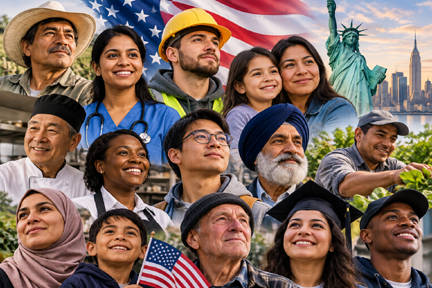


America is celebrating 250 years of independence in 2026. It is an occasion for national pride, historical reflection, and renewed commitment to the ideals upon which the Republic was founded. But as we celebrate America’s greatness, we must remember the millions of people whose labor, courage, enterprise, and sacrifice have contributed to its achievements.
America has been shaped and strengthened by successive generations of immigrants who arrived from distant lands in search of freedom, opportunity, security, and dignity. They spoke different languages, practiced different faiths, and carried different traditions. Yet they shared a common aspiration: to build a better life and contribute to the country they had chosen as their home.
A nation that has drawn its strength from the labor, loyalty, and dreams of immigrants must not deny them the dignity of belonging.
This conviction brings us to a question of immediate moral importance. What should America do about the millions of undocumented immigrants who have lived here for years, sometimes decades, working, raising families, paying taxes, and contributing to the country’s prosperity, yet remaining perpetually vulnerable to detention and deportation?
Our answer is simple: Stop hounding them. Give them their due.
This is not a plea for abandoning immigration laws or disregarding national security. Every sovereign nation has the right and responsibility to regulate immigration. But enforcing the law should never become an excuse for abandoning humanity. Nor should immigration status erase decades of honest contribution to American society.
America’s history is inseparable from migration. Its Indigenous peoples inhabited this land long before the United States existed. The nation’s development was also profoundly shaped by the forced labor of enslaved Africans, an injustice whose consequences remain part of America’s unfinished struggle for equality.
Alongside these histories came successive waves of immigrants who helped transform a young Republic into an industrial, agricultural, scientific, and economic powerhouse.
Irish immigrants built canals and railroads. German immigrants contributed to agriculture, manufacturing, and education. Chinese workers helped construct the transcontinental railroad, even while enduring discrimination. Italians, Jews, Poles, Greeks, and numerous other communities strengthened American industry and commerce.
More recently, immigrants from Asia, Latin America, Africa, and elsewhere have enriched America’s universities, hospitals, laboratories, technology companies, businesses, and neighborhoods.
Immigration has never been without controversy. Americans have repeatedly debated who should be admitted and who belongs. Too often, yesterday’s immigrants, once accepted, have forgotten the prejudice they encountered and directed similar suspicions toward newcomers.
Yet history demonstrates that America’s diversity, far from diminishing the nation, has been among its greatest strengths.
Living in the Shadows
Today, millions of immigrants live in the United States without permanent legal status. Their circumstances vary. Some entered without authorization; others overstayed visas. Some arrived recently; others have lived here for most of their adult lives.
These distinctions matter. Immigration policy should recognize them rather than treating everyone alike.
Consider someone who arrived twenty-five years ago, found employment, married, raised children, purchased a home, and became part of a community.
Consider the farmworker whose labor puts food on American tables, the construction worker who builds American homes, the restaurant employee who keeps a business operating, or the caregiver who looks after the elderly.
Many perform essential work without enjoying the security others take for granted.
For them, deportation is not an abstract political argument. It is a fear accompanying an ordinary journey to work or a knock at the door.
Their children may be American citizens. Their families, livelihoods, and memories are rooted in this country. Yet their future remains uncertain.
Must America continue to regard people who have spent decades contributing to its prosperity as strangers?
Surely, years of honest work and peaceful residence should count for something.
Enforcement Must Not Become Persecution
There is a legitimate national interest in maintaining secure borders, enforcing immigration laws, and removing individuals who pose serious threats to public safety.
But immigration enforcement should not become a campaign of intimidation that spreads fear among families, treats ordinary workers as dangerous criminals, or sacrifices due process to political expediency.
A distinction must be drawn between someone who threatens public safety and someone whose principal immigration violation is remaining in the country without authorization while otherwise living peacefully and productively.
Both are subject to immigration law. But fairness demands that their circumstances not be treated as morally identical.
The measure of a nation’s strength is not how harshly it can exercise power over the vulnerable. It is how responsibly and humanely it exercises that power.
An immigration policy driven primarily by fear may produce impressive enforcement statistics. But it can also separate families, frighten communities, and leave children suffering for decisions they did not make.
America should ask whether such outcomes serve its interests—or its ideals.
A Fair Path to Citizenship
What, then, should be done?
Congress should establish a carefully designed pathway to lawful permanent residence and eventual citizenship for long-settled undocumented immigrants who meet reasonable requirements.
Such a process could include identity verification, background checks, substantial residence, compliance with tax obligations, and demonstrated respect for the law. It should also address immigration backlogs and the legitimate interests of those who have followed lawful procedures.
Citizenship need not be immediate or unconditional. But the opportunity to earn it should be genuine and attainable.
There is a difference between indiscriminate amnesty and responsible regularization.
The Immigration Reform and Control Act of 1986 provided legal status to millions of qualifying undocumented immigrants while introducing employer sanctions. Its achievements and limitations offer valuable lessons.
A contemporary solution must combine credible enforcement, orderly immigration procedures, protection against exploitation, and a realistic means of addressing the status of people already deeply rooted in American life.
Above all, it requires political courage.
For too long, immigration has been an instrument of electoral mobilization. Politicians promise sweeping solutions, blame opponents, and appeal to public anxieties. Meanwhile, the people whose lives are at stake continue waiting.
A great nation should be capable of something better.
The Meaning of “We the People”
The opening words of the Constitution—“We the People”—remain among the most powerful expressions of democratic self-government.
At the founding, they did not guarantee equal political rights to everyone living in America. The nation’s history has been a long struggle to extend the practical meaning of liberty and equality.
That struggle continues.
Americans can reasonably disagree about immigration levels, border policies, eligibility requirements, and the pace of reform. But disagreement need not become hostility, and enforcement need not become cruelty.
A person does not cease to possess human dignity because of immigration status. Nor does love for America belong exclusively to those fortunate enough to have been born within its borders. America must not forget the hands that built it while deciding who deserves to belong to it.
Let the 250th Anniversary Mean Something
America’s 250th anniversary should be more than patriotic speeches, fireworks, and tributes to the nation’s founders.
It should also be an occasion to examine how faithfully the Republic honors its ideals.
What better tribute to America’s history than to offer a fair and humane resolution to the predicament of long-settled undocumented residents?
What better demonstration of national confidence than to acknowledge that compassion and the rule of law can coexist?
We do not suggest automatic citizenship for everyone without legal status. We ask that America recognize individual circumstances and provide a fair opportunity to those who have established deep roots and demonstrated responsible conduct.
Let America offer more than a commemoration of its glorious past. Let it offer hope to those who have spent years contributing to its prosperity while living in the shadows of uncertainty.
Let us stop hounding people whose hands have helped build America and whose hearts have long called it home.
Let us give them a fair opportunity to earn citizenship and stand openly, proudly, and securely among their fellow Americans.
That would be a celebration of democracy.
A celebration of America.
Above all, a celebration of We the People.



Be the first to comment