

India must be prepared to deal with a more difficult and erratic US President
“For India, the elections carry significant stakes across immigration, trade and geopolitics. Despite the turbulence of the past year, the underlying strategic logic of the US-India partnership will continue to enjoy bipartisan support in Washington. A Democratic-controlled House — with a friend of India, Sherrod Brown, flipping the Senate seat in Ohio — could give New Delhi additional political avenues to challenge some of the Trump administration’s contentious measures. A Democratic Congress may not necessarily be more sympathetic to Indian trade interests, but it could complicate Trump’s ability to use tariffs indiscriminately.”

There are tsunamis that come without warning and there are others which can be seen coming — but you can do little to avoid them. And so it was with US President Donald Trump and his Republican Party, who have been hit by a tidal wave of epic proportions.
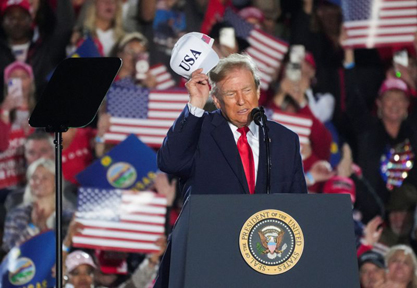
The Democratic sweep in the House of Representatives and the Senate will shape American politics in the years to come. A chastened Trump says now that he is willing to work with the Democrats, but they can hardly take this famously self-centered President at his word. He is more likely to lash out not just as a lame duck, but a particularly angry one who could hit out in all directions, with little care for the institutions of his country or his party.
Financial issues, inflation and mortgage rates have played a major role in the elections, in addition to the war in Iran, which has driven up petrol and diesel prices. Everything became unaffordable for many — healthcare, groceries, housing and higher education. There were also understated issues like corruption within the Trump administration; the President has made over $1 billion in crypto transactions in the past year.
This has been the most expensive midterms, with mega donors like Elon Musk putting in nearly half a billion dollars into the elections. There were donations from crypto millionaires and non-profit organizations, and more than $2 billion had been pumped into the House and Senate races alone.
The Democrats flipped seven Republican-held Senate seats — Iowa, Kansas, Ohio, North Carolina, South Carolina, Maine and Texas — to secure a majority in the Senate. The victories in Texas, where the Democrats won the Senate and the governorship, mark a massive political realignment. Jon Ossoff, who retained his Georgia seat, is already being talked about as the Democratic candidate for the 2028 elections.
The victory in Ohio suggests that organized labor and the working class are once again getting behind the Democrats. They have won Kansas for the first time since 1932, suggesting a deep rural backlash against the Republicans. Likewise, the defeat in Iowa indicates that agricultural pressures and tariffs were deeply unpopular issues in this pro-Trump state. Abdul El-Sayed’s victory in Michigan makes him the first Muslim to be elected to the US Senate; it is a validation of the unapologetically progressive policies in this crucial swing state.
This is a wave election, which comes with repercussions for governorships, state legislative seats and mayoralties, and power beyond committee rooms. The President will face scrutiny of his administration, family and allies. Secretary of War Pete Hegseth could face impeachment or pressure from the White House, which is looking for scapegoats.
Tariffs, the Iran war, Pentagon activities, health coverage and the US-Israel relationship will come under the Democratic microscope. But procedural delays and legal tactics can slow things down to a crawl for the Democrats. Trump has threatened to use the veto as a primary weapon. And the Democrats lack the numbers to remove him from office. But his capacity to govern will be severely affected.
The Republicans will in all likelihood remove Speaker Mike Johnson and Senate leader John Thune. But the biggest question mark will be over Vice President JD Vance, the all-but-declared presidential candidate for 2028. Will the electorate support Trump’s understudy after having rejected the President in 2026?
With the midterms over, the clock has now begun ticking for the presidential elections. The Democrats had been waiting for this moment ever since they lost the presidency to Trump. Now, they can build on their current victory to shape their 2028 campaign. Potential contenders have used the midterms to position themselves.
Besides Ossoff, who is a moderate, there are many potential Democratic candidates in the reckoning, including Kamala Harris. Take Alexandria Ocasio-Cortez, who feels that the victory of progressive Abdul El-Sayed is something that will “break open the entire political calculus in America” by bringing Left-leaning politics to the center stage. She contributed $1 million for El-Sayed’s campaign.
Another contender, Josh Shapiro, has won the governorship of Pennsylvania. He is less known nationally, but he has a “get things done” reputation. By defeating Republican Stacy Garrity by double digits and carrying three Democratic House candidates across the finishing line, he has positioned himself to make a bid for the top job.
Gavin Newsom, the California Governor, was not running for office, but he helped the Democrats gain five seats and take the House of Representatives. The defeat of the billionaire wealth tax bill, a measure opposed by Newsom, has enhanced his standing with the billionaires and the electorate.
The immediate international concern is the possibility of renewed US attacks on Iran. There are contradictory signals. Washington has told Arab Gulf states to prepare for a short, intense campaign, whereas
JD Vance is engaging with senior Iranian figures, including Mohsen Rezaei, in an effort to revive negotiations.
For India, the elections carry significant stakes across immigration, trade and geopolitics. Despite the turbulence of the past year, the underlying strategic logic of the US-India partnership will continue to enjoy bipartisan support in Washington. A Democratic-controlled House — with a friend of India, Sherrod Brown, flipping the Senate seat in Ohio — could give New Delhi additional political avenues to challenge some of the Trump administration’s contentious measures. A Democratic Congress may not necessarily be more sympathetic to Indian trade interests, but it could complicate Trump’s ability to use tariffs indiscriminately.
The midterm election results mark the beginning of the end of Trump’s presidency. But the process will be drawn out over the next two years. With his room for maneuver significantly reduced domestically, he is likely to lash out abroad. India must be prepared to deal with a more difficult and erratic Trump. It remains to be seen whether American institutions can impose meaningful constraints on his excesses.
(Manoj Joshi is Distinguished Fellow, Observer Research Foundation. His X handle is @manojmanoj1951)


Be the first to comment