

Children are the greatest treasures of a nation. They represent hope, innocence, happiness and the promise of a brighter future. They are not merely the future citizens of a country but also the foundation upon which the progress and development of society depend. Every child deserves love, care, education, protection and equal opportunities to grow into a responsible and successful individual. Recognising the importance of children in nation-building, India celebrates Children’s Day, popularly known as Bal Diwas, every year on 14 November.
In India, Children’s Day is celebrated on the birth anniversary of Pandit Jawaharlal Nehru, the first Prime Minister of independent India. He was born on 14 November 1889 and is fondly remembered as ‘Chacha Nehru’ because of his deep affection for children. Nehru believed that children were the real strength of the nation and that their proper upbringing, education and development were essential for India’s progress.
Children’s Day is therefore not simply an occasion for celebrations, games and cultural programmes. It is a day to remember Nehru’s vision, understand the importance of childhood and renew our commitment to creating a safe, educated, healthy and inclusive society for every child.
The occasion also provides an opportunity to remember the extraordinary contributions of Jawaharlal Nehru to India’s freedom struggle and his role in shaping the political, educational, scientific and economic foundations of modern India.
History and significance
Children’s Day is celebrated in India on 14 November every year to honour the birth anniversary of Pandit Jawaharlal Nehru. Before his death in 1964, Children’s Day was also observed in India on 20 November, which is recognised internationally as World Children’s Day.
Following Nehru’s death on 27 May 1964, his birthday was chosen as the occasion to celebrate Children’s Day in India in recognition of his love for children and his commitment to their welfare. Since then, 14 November has become an important day in the Indian calendar. Schools, colleges, educational institutions, children’s organisations and government departments organise various programmes to celebrate the occasion.
The day reminds us that children are entitled to a childhood filled with happiness, dignity, security and opportunities. It also highlights the responsibility of parents, teachers, governments and society to protect children’s rights and ensure their holistic development.
Interestingly, Nehru himself believed that the occasion should focus on children rather than on celebrating his birthday. In a speech delivered on Children’s Day in 1957, he emphasised that the day should be celebrated as Children’s Day and not merely as an occasion to praise him.
This reflects his genuine affection for children and his belief that their happiness and future should remain the central focus of the celebration.
Pandit Jawaharlal Nehru: The Man Behind Children’s Day
Pandit Jawaharlal Nehru was one of the most influential leaders in modern Indian history. He was a freedom fighter, political thinker, visionary statesman, writer and the first Prime Minister of independent India.
Popularly known as Pandit Nehru, he played a significant role in India’s struggle against British colonial rule and later became one of the principal architects of modern India.
His contribution to the freedom movement, democratic institutions, education, scientific development, industrialisation and international relations remains an important part of India’s historical journey.
Nehru believed in democracy, secularism, equality, scientific thinking and social justice. He wanted India to become a modern, progressive and self-reliant nation where every individual could enjoy freedom and equal opportunities.
His affection for children was another important aspect of his personality. He believed that children were like flowers whose innocence, curiosity and energy brought happiness to society.
His birthday is therefore celebrated as Children’s Day to honour his vision and remind future generations of the importance he attached to children’s welfare and development.
Early Life and Family Background 
Jawaharlal Nehru was born on 14 November 1889 in Allahabad, present-day Prayagraj, in Uttar Pradesh. He belonged to a prosperous and respected Kashmiri Pandit family.
His father, Motilal Nehru, was a distinguished lawyer and an influential leader of the Indian National Congress. His mother, Swarup Rani Nehru, was a caring and devoted homemaker.
Nehru grew up in a privileged environment at Anand Bhawan, the family residence in Allahabad. His childhood was comfortable, and he received considerable attention and opportunities for education.
He was the only son of his parents and had two sisters, Vijayalakshmi Pandit and Krishna Hutheesing.
Despite his privileged upbringing, Nehru gradually developed an interest in the political and social conditions of India. His family environment exposed him to discussions about national affairs, politics and the growing freedom movement.
His father, Motilal Nehru, initially wanted him to receive the best possible education and pursue a successful professional career. However, Jawaharlal eventually chose a different path and dedicated much of his life to the service of his country.
Education and Intellectual Development
Nehru received his early education at home under private tutors. One of his teachers, Ferdinand T. Brooks, encouraged his interest in science, literature and intellectual activities.
In 1905, at the age of fifteen, he travelled to England for higher education. He attended Harrow School, one of the prominent educational institutions in England.
Later, he joined Trinity College, Cambridge, where he studied natural sciences and graduated with honours in 1910. After completing his studies at Cambridge, he pursued legal education at the Inner Temple in London and qualified as a barrister.
His education in England exposed him to Western political philosophy, scientific developments, liberal ideas and international affairs.
During his stay abroad, he closely followed political movements and developments taking place in different parts of the world. He became increasingly aware of the struggle of colonised nations for freedom and self-determination.
After returning to India in 1912, he initially practised law in Allahabad. However, his growing interest in national politics soon drew him towards the Indian independence movement.
His education and international exposure played an important role in shaping his personality, political outlook and vision for a modern India.
Role in India’s Freedom Struggle
Jawaharlal Nehru made an extraordinary contribution to India’s struggle for independence. Although he came from a wealthy family, he chose to stand with the people fighting against British colonial rule.
His political journey developed under the influence of Mahatma Gandhi, whose principles of truth, non-violence and mass participation inspired him.
Nehru first became actively involved in the Indian National Congress in the early twentieth century. He gradually emerged as an important leader of the nationalist movement.
Jawaharlal Nehru as the First Prime Minister of India
On 15 August 1947, Jawaharlal Nehru became the first Prime Minister of independent India.
His appointment marked the beginning of a new chapter in Indian history.
At the time of independence, India faced enormous challenges. Partition had resulted in widespread violence, displacement and suffering. The country also struggled with poverty, illiteracy, unemployment, poor healthcare facilities and inadequate infrastructure.
Nehru inherited the responsibility of transforming a newly independent country into a stable, democratic and economically progressive nation.
He served as Prime Minister from 1947 until his death on 27 May 1964.
During his seventeen-year tenure, he introduced and supported several policies and initiatives that shaped India’s development.
Major Contributions of Nehru Promotion of Education
Education was one of the most important priorities of Nehru’s vision for India.
He believed that an educated population was essential for national development and that every child should have access to quality education.
He understood that poverty, illiteracy and social inequality could not be eliminated without expanding educational opportunities.
During his leadership, India invested in schools, universities, research institutions and professional educational establishments.
Several important institutions were established or developed during this period, including:
Indian Institutes of Technology (IITs).
All India Institute of Medical Sciences (AIIMS).
University Grants Commission (UGC).
Various scientific and technical research institutions.
Institutions supporting higher education and professional training.
He also encouraged the development of educational opportunities for women and disadvantaged communities.
His emphasis on education reflected his belief that knowledge and intellectual freedom were essential for building a strong and progressive nation.
Development of Science and Technology
Nehru was a strong supporter of scientific research and technological progress.
He believed that India could overcome poverty, disease, hunger and backwardness by adopting scientific methods and modern technology.
He popularised the idea of developing a scientific temper among citizens.
According to his vision, people should question outdated beliefs, examine evidence and develop rational approaches to solving problems.
He supported the growth of scientific institutions, laboratories and research centres.
Why Was Nehru Called Chacha Nehru?
One of the most affectionate names associated with Jawaharlal Nehru is ‘Chacha Nehru’.
The word ‘Chacha’ means uncle in Hindi.
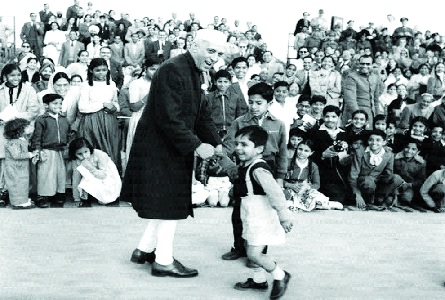
Nehru was extremely fond of children and enjoyed interacting with them. Children also admired his friendly nature, simple manner of communication and affection. He frequently met children during public functions, school visits and national celebrations.
He believed that children should be allowed to grow in an atmosphere of love, freedom, curiosity and encouragement.
His affectionate relationship with children earned him the popular name ‘Chacha Nehru’.
He believed that children should not be burdened with excessive pressure but should be encouraged to read, write, play, sing, dance and explore the world around them.
His ideas about childhood reflected his belief that education should develop the mind, body and character of a child.
He considered children the future architects of the nation and believed that their development should be a national priority.
Nehru’s Love for Children
and His Vision for Their Future
Nehru’s affection for children was not merely emotional. It was closely connected with his understanding of national development.
He believed that the future of India depended on how its children were educated, protected and nurtured.
For him, children were not simply young individuals who would become adults someday. They were active participants in shaping the future of society.
He wanted every child to have access to education, healthcare, nutrition and a safe environment.
His famous message about the importance of children in determining the future of India continues to inspire teachers, parents and students.
His vision reminds us that investing in children is an investment in the future of the nation.
How Is Children’s Day Celebrated in India?
Children’s Day is celebrated with great enthusiasm across India.
Schools, colleges, educational institutions and children’s organisations organise special programmes to make the day memorable.
The celebrations are generally filled with happiness, entertainment, learning and meaningful activities.
Some of the common ways in which Children’s Day is celebrated include:
Students participate in dance performances, singing competitions, dramas, poetry recitations and musical presentations.
These activities provide children with opportunities to express their creativity and develop confidence.
Teachers and students deliver speeches on the life and achievements of Jawaharlal Nehru. Essay-writing, debate and quiz competitions are also organised to increase awareness about children’s rights, education and national development.
Schools organise sports competitions, fun activities and recreational programmes. These events encourage physical fitness, teamwork, discipline and a spirit of healthy competition.
In many schools, teachers organise performances and entertainment programmes for students.
Some teachers even perform dances, songs and skits to make children feel special.


Be the first to comment