
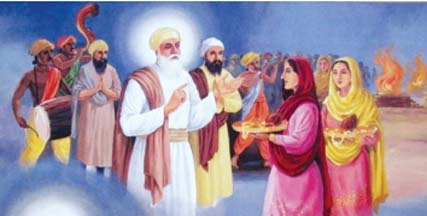

Five centuries before equality became a global social and political ideal, Guru Nanak Dev Ji challenged caste discrimination, questioned gender inequality and placed human dignity at the centre of spiritual life
The 15th and 16th centuries were periods of considerable social, political and religious change in the Indian subcontinent. Society was divided along lines of caste, occupation, wealth and religious identity. Social hierarchies determined an individual’s position, while discrimination and exclusion affected large sections of the population. Religious practices often became associated with rigid conventions, and the distance between the privileged and the marginalised remained deeply entrenched.
It was in this environment that Guru Nanak Dev Ji emerged with a message that challenged the foundations of social inequality. His teachings went beyond conventional religious instruction. He questioned the legitimacy of discrimination, rejected the idea that birth determined human worth and encouraged people to recognise the same Divine presence in every individual.
His vision of equality was not an abstract spiritual idea. It was a call for social transformation, one that required people to change their attitudes, conduct and institutions.
More than five centuries later, his message remains relevant in a world that continues to struggle with caste prejudice, racism, gender discrimination, economic inequality and religious intolerance.
The revolutionary idea of one humanity
At the heart of Guru Nanak Dev Ji’s philosophy was Ik Onkar, the belief in one universal Creator.
If there is one Creator of all existence, then no human being can claim superiority over another on the basis of birth, caste, religion or social status.
This principle challenged the belief that certain communities were inherently superior while others were considered inferior. It also questioned the social customs that restricted interaction between people of different backgrounds.
Guru Nanak Dev Ji taught that the Divine was not the exclusive possession of any particular religious group. God was present in all creation, and every human being had the potential to live a spiritually meaningful life.
His approach was particularly significant because it connected spiritual equality with social behaviour. It was not enough to accept that everyone was created by one God; individuals had to demonstrate that belief by treating others with respect.
Challenging the caste hierarchy
Caste discrimination was deeply rooted in the society of Guru Nanak Dev Ji’s time. Occupations, social relationships and access to religious spaces were often influenced by inherited status.
Guru Nanak Dev Ji rejected the idea that a person’s spiritual worth could be determined by birth.
For him, conduct was more important than lineage. A person who practised honesty, compassion and humility was worthy of respect, regardless of social background. Conversely, someone who possessed wealth or social prestige but behaved unjustly could not claim spiritual superiority.
His message challenged the belief that religious purity was connected with caste identity.
The institutions of Sangat and Pangat later became powerful expressions of this philosophy. In the Sangat, people gathered to listen to Gurbani and remember the Divine. In Pangat, they sat together to share Langar without distinctions of caste or economic status.
These practices transformed equality from a philosophical declaration into a shared social experience.
The dignity of women: A powerful message from Guru Nanak
One of Guru Nanak Dev Ji’s most remarkable contributions was his challenge to attitudes that treated women as inferior.
Women in many parts of the society of his time faced restrictions on their participation in religious and social life. Their status was frequently defined through patriarchal customs, and their contributions were often undervalued.
Guru Nanak Dev Ji questioned this attitude through one of his most celebrated compositions in Asa Di Var:
So kio manda aakhiye jit jammeh raajaan.
Why call her inferior, from whom even kings are born?
The verse is a powerful challenge to the denigration of women. It asks how the very person through whom generations enter the world can be considered inferior.
Guru Nanak Dev Ji’s question goes beyond motherhood. It challenges the entire social attitude that measures a person’s worth through gender.
His teachings recognised the essential place of women in society and rejected the notion that they were spiritually or morally inferior to men.
The importance of this message becomes clearer when viewed against the social conditions of his period. At a time when women were often excluded from positions of authority and public participation, his teachings offered a foundation for dignity and equality.
The Sikh tradition would subsequently develop under the leadership of successive Gurus, who encouraged women’s participation in religious and community life.
Bhai Lalo and Malik Bhago: The dignity of honest labour
One of the most famous traditional accounts illustrating Guru Nanak Dev Ji’s social philosophy concerns Bhai Lalo and Malik Bhago.
Bhai Lalo was a humble carpenter who earned his livelihood through honest labour. Malik Bhago, in contrast, was a wealthy and influential official associated with a lavish feast.
When Guru Nanak Dev Ji was invited to the feast, he chose instead to accept the simple food offered by Bhai Lalo.
The decision surprised people because Malik Bhago occupied a position of influence and had considerable wealth.
According to the traditional Janamsakhi account, the Guru demonstrated the difference between the food earned through honest labour and that associated with the exploitation of others. The episode is remembered as a symbolic explanation of the moral value of honest earnings.
The lesson was revolutionary in its social context. It challenged the assumption that wealth and influence automatically deserved respect.
Guru Nanak Dev Ji placed moral integrity above social prestige. A humble worker who earned honestly was more worthy of appreciation than a powerful person whose wealth was associated with injustice.
The story continues to hold relevance in modern society, where economic success is sometimes celebrated without examining the means through which it is achieved.
Against religious hypocrisy and empty rituals
Guru Nanak Dev Ji also challenged religious practices that emphasised outward appearances while ignoring inner morality.
He questioned the belief that wearing particular clothes, performing ceremonies or visiting sacred places automatically made a person spiritually superior.
His message was not a rejection of sincere religious practice. Rather, he challenged the use of rituals as substitutes for ethical behaviour.
He believed that genuine devotion must be reflected in compassion, honesty and humility.
A person who performs religious ceremonies but exploits others, spreads hatred or discriminates against fellow human beings has not understood the deeper purpose of spirituality.
His traditional encounters at Haridwar and Mecca are remembered as examples of this questioning approach.
At Haridwar, he challenged ritual offerings performed without reflection. At Mecca, the traditional account of his interaction with a religious attendant conveyed the omnipresence of God.
Both episodes highlight his conviction that spirituality must move beyond mechanical observances and lead to a deeper understanding of the Divine.
The rejection of social arrogance
Guru Nanak Dev Ji’s opposition to inequality was also directed at the arrogance associated with wealth, education and authority.
He believed that pride and ego created barriers between individuals and prevented them from recognising their shared humanity.
In Sikh philosophy, Haumai, or ego, is considered a major obstacle to spiritual awareness.
People often identify themselves through possessions, status, family background or professional achievements. Such attachments can create an illusion of superiority and encourage contempt towards those considered less fortunate.
Guru Nanak Dev Ji encouraged humility as an essential quality of spiritual life.
He taught that true greatness comes from recognising the Divine, serving others and living truthfully.
This philosophy also challenged the tendency of religious leaders to use spiritual authority for personal advantage.
Sangat and Pangat: Equality in practice
Guru Nanak Dev Ji’s message of equality found practical expression through the institutions of Sangat and Pangat.
Sangat is the congregation of people who gather to remember the Divine, listen to Gurbani and participate in collective worship.
It creates a shared spiritual environment in which individuals come together irrespective of their social position.
Pangat represents the practice of sitting together in rows to share food, particularly during Langar.
The practice challenges the social distinctions that traditionally separated communities. Everyone receives the same food and is treated with equal dignity.
These institutions helped establish a community culture in which equality was not simply discussed but experienced.
The subsequent Sikh Gurus strengthened these traditions and developed institutions that reinforced the social and spiritual foundations laid by Guru Nanak Dev Ji.
Equality as a continuing responsibility
The world has changed considerably since Guru Nanak Dev Ji’s time, but the problems he challenged have not disappeared.
Caste discrimination continues to affect communities. Gender inequality remains visible in access to education, employment and opportunities. Religious intolerance and racial prejudice continue to divide societies.
Economic inequality also raises questions about the distribution of resources and the dignity of labour.
Guru Nanak Dev Ji’s teachings provide a moral framework for addressing these challenges. They remind individuals that equality must be reflected in everyday conduct, not merely expressed in public statements.
His philosophy asks people to question prejudice, recognise the dignity of others and reject social practices that deny individuals their basic humanity.
A revolution rooted in compassion
Guru Nanak Dev Ji’s social revolution was not based on hostility or revenge. It was rooted in compassion, spiritual understanding and the conviction that every human being deserved dignity.
He challenged unjust systems by offering an alternative way of living. Through honest labour, shared meals, collective worship and respect for women, he demonstrated that a society could be organised around equality.
His message remains one of the most enduring contributions to the moral and spiritual history of humanity.
The 557th Parkash Purab provides an opportunity to revisit this remarkable vision and consider how it can guide contemporary society.
For Guru Nanak Dev Ji, the true test of spirituality was not a person’s caste, wealth or religious identity, but the humanity reflected in their actions.


Be the first to comment