
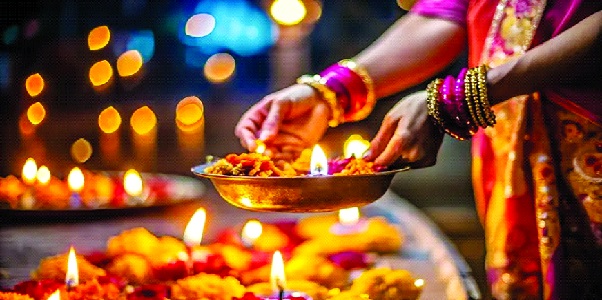

The soft glow of earthen lamps, the fragrance of freshly prepared herbal ubtan and the gentle hum of festive anticipation fill the air as India welcomes Chhoti Diwali, also known as Naraka Chaturdashi. Celebrated on the second day of the traditional five-day Diwali festivities, it is an occasion steeped in mythology, spiritual symbolism and age-old customs.
Often overshadowed by the grandeur of the main Diwali celebrations, Chhoti Diwali has a distinct identity and significance of its own. It is not merely a day of preparation before the festivities reach their peak; it is a celebration of purification, liberation and the victory of divine consciousness over evil.
While Diwali celebrates the triumph of light over darkness, Chhoti Diwali reminds us that the journey towards illumination begins with cleansing ourselves of negativity. Its rituals, legends and traditions encourage us to leave behind arrogance, ignorance and destructive tendencies and embrace a renewed sense of hope, positivity and spiritual well-being.
In many ways, Chhoti Diwali is the dawn before the festival of lights-a moment of quiet reflection before the magnificent celebrations unfold.
The origins of Naraka Chaturdashi are rooted in Hindu mythology and the fascinating tale of Narakasura, the powerful demon king of Pragjyotishpur, traditionally associated with present-day Assam.
According to Hindu legends, Narakasura was born to Bhudevi, the Earth Goddess, and Varaha, the boar incarnation of Lord Vishnu. Blessed with extraordinary powers, he became a formidable ruler. However, as his power increased, so did his arrogance. Gradually abandoning righteousness, he began committing terrible atrocities.
Narakasura imprisoned thousands of celestial women and seized the magnificent earrings of Aditi, the mother of the devas. His tyranny spread fear throughout the heavens and the earth, leaving the gods helpless.
Unable to endure his growing oppression, the devas approached Lord Krishna and sought his intervention.
Responding to their prayers, Lord Krishna set out to defeat the demon king, accompanied by his wife Satyabhama. Riding upon his celestial mount Garuda, Krishna attacked Narakasura’s heavily fortified kingdom, and a fierce battle followed.
In one widely narrated version of the legend, Satyabhama ultimately delivered the fatal blow to Narakasura. According to the tradition, she was an incarnation of Bhudevi herself, making the demon’s defeat a symbolic liberation from his own mother’s divine power.
Before his death, Narakasura realized his wrongdoing and repented. He requested that the day of his defeat be celebrated with joy and illumination rather than mourning.
His wish was honored, and Naraka Chaturdashi came to be observed as a celebration of the destruction of evil, the restoration of righteousness and the liberation of those who had suffered under oppression.
The story carries a timeless message: no matter how powerful arrogance, cruelty or injustice may appear, they cannot prevail forever against truth and righteousness.
A Day of Cleansing and Spiritual Renewal
Unlike the elaborate celebrations associated with the main Diwali evening, Chhoti Diwali traditionally places considerable emphasis on purification and preparation.
One of the most significant rituals of the day is the early-morning ceremonial bath known as Abhyang Snan. It is believed to cleanse the body, refresh the mind and prepare devotees for the auspicious celebrations ahead.
The tradition is associated with the belief that after defeating Narakasura, Lord Krishna bathed to cleanse himself of the impurities of battle. Devotees symbolically recreate this act through their own morning bathing rituals.
The practice is much more than a physical cleansing routine. It represents the removal of accumulated negativity, emotional burdens and undesirable tendencies, making way for a fresh beginning.
Abhyang Snan: The Sacred
Ritual of the Festive Bath
One of the most beautiful aspects of Chhoti Diwali is the traditional Abhyang Snan, performed before sunrise on Naraka Chaturdashi.
The ritual usually begins with the application of warm oil, traditionally sesame or coconut oil, to the body. In some households, the oil is infused with herbs or aromatic ingredients.
This is followed by the application of ubtan, a traditional cleansing paste prepared using ingredients such as gram flour, turmeric, sandalwood and other natural substances.
After the application, devotees take a bath, often using warm water, as part of the ritual of purification.
The various elements carry their own symbolism:
n Oil application: Represents nourishment, relaxation and rejuvenation.
n Herbal ubtan: Symbolises cleansing and the removal of impurities.
n The ceremonial bath: Represents purification of the body and renewal of the spirit.
n Wearing fresh clothes: Signifies a new beginning and readiness to welcome auspiciousness.
In several regions, taking an early-morning bath on Naraka Chaturdashi is considered especially auspicious. The ritual is believed to bring health, protection and prosperity.
Beyond religious beliefs, the practice also reflects India’s traditional relationship with natural ingredients, seasonal wellness and personal care.
Yamadeepdaan: Lighting Lamps
for Longevity and Protection
As evening approaches, another meaningful ritual associated with Chhoti Diwali is Yamadeepdaan, the offering of lamps to Yamraj, the Hindu deity associated with death and justice.
The custom is rooted in a popular legend about a young prince whose life was destined to be cut short.
According to the story, the sixteen-year-old son of King Hima was predicted to die from a snake bite on the fourth day of his marriage.
When his newly married wife learned about the prophecy, she decided to challenge fate. On the appointed night, she gathered gold and silver ornaments, jewelry and lamps and placed them near the entrance of their home. She then kept her husband awake throughout the night by singing songs and narrating stories.
When Yamraj arrived in the form of a serpent to claim the prince’s life, the dazzling brilliance of the lamps and ornaments temporarily overwhelmed him. He sat near the entrance, listening to the princess’s songs, and eventually departed without taking the young man’s life.
Since then, according to this popular tradition, people light lamps in honor of Yamraj, praying for protection from untimely death and for the long life and well-being of family members.
In many households, a small diya is placed outside the home, traditionally facing south, the direction associated with Yamraj.
The ritual is a poignant reminder of the value of life and the protective power of love, devotion and faith.
Lighting Diyas: Preparing the
Home for Diwali
Although Chhoti Diwali is often celebrated on a smaller scale than the main festival, lighting lamps remains an important part of the occasion.
As evening descends, homes are decorated with rows of earthen diyas, candles and decorative lights. Entrances are adorned with colourful rangolis and marigold garlands, creating a welcoming festive atmosphere.
In some households, footprints symbolising the arrival of Goddess Lakshmi are drawn near the entrance, while others prepare their prayer areas for the following evening’s Lakshmi-Ganesh Puja. The lighting of diyas carries a deeper meaning. Each flame represents the awakening of wisdom, the removal of ignorance and the triumph of positivity over negativity.
It also marks the transition from the quiet purification of Chhoti Diwali to the joyous illumination of the main festival.


Be the first to comment