
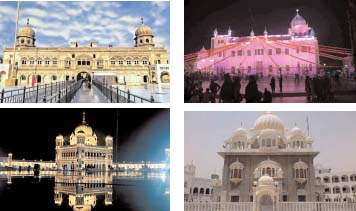

From Nankana Sahib and Sultanpur Lodhi to Kartarpur and the historic sites associated with his travels, these places preserve the memory of the First Sikh Guru and his universal message
The life of Guru Nanak Dev Ji was marked by journeys, encounters and a constant search for spiritual truth. Born in the village of Rai Bhoi Ki Talwandi in 1469, he travelled across regions, met people of different faiths and challenged practices that he believed had become disconnected from genuine spirituality.
The places associated with his life are now important centres of pilgrimage and historical remembrance. Some are connected with his birth and childhood, others with his spiritual awakening and the establishment of the Sikh community, while several are remembered through traditional accounts of his Udasis, or journeys.
For Sikhs across the world, visiting these places is more than an act of pilgrimage. It is an opportunity to connect with the life of the Guru, reflect on his teachings and understand the historical landscape in which the Sikh faith took shape.
Many of these sites are located in present-day Pakistan, while others are in India and across regions traditionally associated with his travels. Together, they form a remarkable spiritual geography linked to the life and legacy of Guru Nanak Dev Ji.
Nankana Sahib: The birthplace of Guru Nanak Dev Ji
The most significant place associated with Guru Nanak Dev Ji is Nankana Sahib, formerly known as Rai Bhoi Ki Talwandi.
It is here that Guru Nanak Dev Ji was born in 1469 to Mehta Kalyan Das, popularly known as Mehta Kalu, and Mata Tripta. His elder sister, Bebe Nanaki, also holds an important place in his early life and is remembered as one of the first people to recognise his spiritual qualities.
The town was renamed Nankana Sahib in his honour and has since become one of the most important Sikh pilgrimage destinations.
The principal shrine, Gurdwara Janam Asthan, marks the traditional site associated with his birth. The complex attracts pilgrims from different parts of the world, particularly during the annual celebrations of Guru Nanak Gurpurab.
For visitors, Nankana Sahib represents the beginning of a remarkable spiritual story. It is a place to remember the childhood of the Guru, his questioning nature and the teachings that would eventually transform the lives of millions.
The town is also associated with several other historical Gurdwaras connected with episodes from his early life.
Sultanpur Lodhi: The place of spiritual awakening
Sultanpur Lodhi occupies a special place in the life of Guru Nanak Dev Ji. It was here that he spent an important period of his early adulthood and is traditionally associated with the spiritual awakening that shaped the course of his mission.
Guru Nanak Dev Ji came to Sultanpur Lodhi through the influence of his sister Bebe Nanaki and her husband, Jai Ram, who was employed in the service of the local administration.
He worked in the Modi Khana, a storehouse associated with the administration of provisions. This period is remembered for his commitment to honest work and his interaction with people from different backgrounds.
The Kali Bein, a rivulet flowing near Sultanpur Lodhi, is central to the traditional account of his spiritual transformation. Sikh tradition relates that Guru Nanak Dev Ji disappeared while bathing in its waters and returned after three days with a profound spiritual message.
His declaration, commonly remembered as “There is no Hindu, there is no Muslim”, is understood as a challenge to religious divisions and a statement of the fundamental unity of humanity.
Gurdwara Ber Sahib is one of the principal shrines associated with this episode. It is visited by devotees who come to reflect on the Guru’s spiritual awakening and the beginning of his wider mission.
Sultanpur Lodhi also provides an opportunity to understand the importance of Bebe Nanaki, whose faith in her brother’s spiritual gifts is an important part of Sikh tradition.
Kartarpur Sahib: The community established by Guru Nanak
If Nankana Sahib represents the beginning of Guru Nanak Dev Ji’s earthly life, Kartarpur represents the establishment of his community and the practical expression of his teachings.
After his extensive travels, Guru Nanak Dev Ji settled at Kartarpur, where he spent the later years of his life.
He established a community based on the remembrance of God, honest labour and sharing. People gathered for prayer, worked to support themselves and participated in a collective way of life.
This community became an important model for the Sikh tradition. It demonstrated that spirituality could be practised while fulfilling family and social responsibilities.
Kartarpur is associated with the development of practices that later became central to Sikh community life, including Sangat and Langar.
Gurdwara Darbar Sahib Kartarpur marks the traditional site associated with the Guru’s final years. It is regarded as one of the most sacred places in Sikh history.
The Kartarpur Corridor, inaugurated in 2019, allows pilgrims from India to visit Gurdwara Darbar Sahib without requiring a conventional visa, subject to the applicable pilgrimage arrangements and permissions.
The corridor has particular significance because the shrine lies close to the international border. It has made it possible for many Indian devotees to visit a site that had remained difficult to access for decades.
Dera Baba Nanak: A historic connection across the border
Dera Baba Nanak is an important Sikh town associated with the memory of Guru Nanak Dev Ji.
It is located near the international border and has a strong historical connection with Kartarpur Sahib across the Ravi.
Gurdwara Darbar Sahib at Dera Baba Nanak is among the important shrines in the region. The town also serves as the Indian gateway for pilgrims travelling through the Kartarpur Corridor.
For devotees, the area carries a special emotional significance. The river, the border and the distant shrine at Kartarpur together create a landscape closely connected with the final chapter of the Guru’s life.
The town reminds visitors that the spiritual heritage of Punjab extends across present-day political boundaries.
Panja Sahib: The sacred imprint at Hasan Abdal
Gurdwara Panja Sahib at Hasan Abdal is one of the most revered Sikh shrines in Pakistan.
It is associated with a traditional account of Guru Nanak Dev Ji’s visit to the region during his travels.
According to the Janamsakhi narrative, the Guru was resting near a hill when a large rock was sent rolling towards him by a local spiritual figure traditionally identified as Wali Kandhari. The account says that Guru Nanak Dev Ji stopped the rock with his hand, leaving an impression that became associated with the shrine.
The sacred handprint is central to the identity of Gurdwara Panja Sahib.
The story is remembered as a lesson in humility, compassion and spiritual strength. The Guru’s response is traditionally understood as an example of the power of faith and the rejection of arrogance.
The shrine attracts pilgrims throughout the year and is particularly important during major Sikh religious observances.
Haridwar: Questioning ritual without understanding
Haridwar is among the places traditionally associated with Guru Nanak Dev Ji’s eastern Udasi.
The city, situated along the Ganga, is an important Hindu pilgrimage centre. It is known for its bathing ghats and religious ceremonies.
A famous Janamsakhi account describes the Guru observing people offering water towards the rising sun as part of a ritual.
He is said to have begun throwing water in the opposite direction, prompting questions from those present. The traditional story explains that he used the exchange to question the assumption that a ritual performed without understanding could fulfil its intended purpose.
The episode illustrates one of the central features of Guru Nanak Dev Ji’s approach: he encouraged people to examine the meaning behind religious practices rather than follow them mechanically.
Haridwar remains an important destination for pilgrims interested in the Guru’s travels and his engagement with different spiritual traditions.
Varanasi: A meeting of spiritual traditions
Varanasi, also known as Kashi or Banaras, is one of India’s oldest centres of religious and philosophical learning.
It is traditionally associated with Guru Nanak Dev Ji’s travels and his interactions with religious scholars and spiritual practitioners.
The city was an important centre of Hindu learning, ritual practice and philosophical discussion. It therefore provided a setting for the Guru’s engagement with questions about devotion, knowledge and the purpose of religious life.
The traditional narratives of his visit emphasize his insistence that spiritual understanding cannot be reduced to external symbols or inherited status.
For Guru Nanak Dev Ji, the remembrance of the Divine and the practice of truth were more important than outward displays of religious authority.
Mecca and Baghdad: The message beyond religious boundaries
The traditional accounts of Guru Nanak Dev Ji’s western Udasi associate him with Mecca, Medina and Baghdad.
These journeys are especially significant because they reflect his engagement with Islamic religious and intellectual traditions.
One of the best-known Janamsakhi narratives concerns his visit to Mecca. It describes an encounter in which the direction of his feet becomes the subject of a religious discussion. The story is traditionally understood as a reminder that the Divine cannot be confined to one direction or geographical location.
Baghdad is also associated with his travels. Sikh tradition remembers his interaction with religious scholars and spiritual figures there, highlighting his emphasis on the oneness of God and the limitations of human divisions.
The precise routes and chronology of these journeys are debated by historians, and the traditional accounts vary. Nevertheless, they remain an important part of the community’s memory of the Guru’s universal mission.
The places that preserve a universal message
The sacred places associated with Guru Nanak Dev Ji are spread across countries and regions, but their significance is connected by a common message.
Nankana Sahib recalls his birth. Sultanpur Lodhi is associated with his spiritual awakening. Kartarpur represents the community he established. Dera Baba Nanak and the Kartarpur Corridor connect pilgrims with the landscape of his final years. Panja Sahib, Haridwar, Varanasi, Mecca and Baghdad preserve memories of his engagement with different religious and cultural traditions.
These places are not simply monuments to the past. They are reminders of a philosophy that continues to shape Sikh life.
A visit to a historical Gurdwara can inspire reflection on the values of equality, honest work, compassion and service. It can also deepen understanding of the historical circumstances in which Guru Nanak Dev Ji spread his message.
A spiritual geography without boundaries
The life of Guru Nanak Dev Ji cannot be understood through a single town, region or country. His travels carried his message across cultural and geographical boundaries, while his settlement at Kartarpur demonstrated how those teachings could be translated into community life.
Today, the places associated with him are visited by Sikhs and people of other faiths who wish to learn about his legacy.
The 557th Parkash Purab offers an opportunity to remember not only the locations connected with his life but also the ideals that give those places their significance.
The true pilgrimage, however, is not complete with reaching a sacred place. It finds its meaning when the visitor carries the Guru’s message of truth, equality and compassion into everyday life.
Be the first to comment