
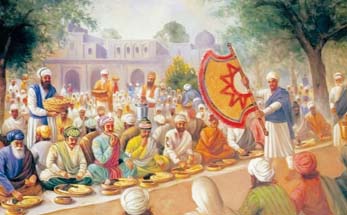

From the community established at Kartarpur to Gurdwaras across the world, the Sikh tradition of serving free meals represents Guru Nanak Dev Ji’s vision of sharing, dignity and universal brotherhood
In a world where social divisions often determine who eats with whom, the Sikh institution of Langar offers a remarkable alternative. At a Gurdwara, people from different religions, castes, nationalities and economic backgrounds sit together to share a common meal. There are no special tables for the wealthy, no separate arrangements for the socially privileged and no discrimination based on identity.
Everyone is welcome. Everyone is served. Everyone sits as an equal.
Langar is much more than a community kitchen. It is a living expression of the philosophy of Guru Nanak Dev Ji, whose teachings placed equality, honest living and sharing at the centre of spiritual life.
The institution has grown into one of the most recognizable features of Sikhism, with community kitchens serving millions of meals across the world. Its influence extends beyond religious observance, demonstrating how spiritual values can become practical instruments of humanitarian service.
The origins: Sharing as a spiritual responsibility
The foundations of Langar lie in the teachings and community life established by Guru Nanak Dev Ji.
After his extensive travels, the Guru settled at Kartarpur, on the banks of the Ravi river. There, he created a community in which people gathered for prayer, worked honestly and shared their resources.
The emphasis was on living a balanced life that combined remembrance of the Divine with social responsibility.
Guru Nanak Dev Ji believed that wealth should not become an instrument of selfishness. People had a responsibility to help those in need and ensure that the benefits of their labour were shared.
This philosophy is commonly associated with Vand Chhako, one of the three principles used to explain his teachings.
The community at Kartarpur demonstrated that sharing could become a regular part of collective life rather than an occasional charitable activity.
The practice of serving meals together gradually developed into one of the defining institutions of the Sikh community.
Langar: An institution strengthened by the succeeding Gurus
The tradition of Langar was further strengthened during the Guruship of Guru Angad Dev Ji, the Second Sikh Guru.
An especially important contribution came from Mata Khivi Ji, the wife of Guru Angad Dev Ji.
She played a significant role in organizing and sustaining the Langar tradition. Her service is remembered in Sri Guru Granth Sahib Ji, where she is praised for her contribution to the community kitchen.
The reference to Mata Khivi Ji is important because it recognises the contribution of women in the development of Sikh institutions.
Langar subsequently became an integral part of Gurdwara life and was strengthened under successive Sikh Gurus.
It evolved into a community institution through which equality, hospitality and service could be practised every day.
Pangat: Everyone sits as an equal
One of the most powerful aspects of Langar is Pangat, the practice of sitting together in rows to share a meal.
The significance of Pangat lies in its ability to challenge social hierarchy.
In societies where caste, class and occupation often determined social interaction, sitting together for a common meal represented a radical expression of equality.
A wealthy businessperson and a daily-wage worker sit side by side. A visitor from another country shares food with a local resident. People from different religious backgrounds participate in the same community meal.
The arrangement communicates a simple but profound message: no human being is superior or inferior because of birth, wealth or social status.
The food is prepared and served collectively, and everyone receives the same meal.
Pangat therefore transforms the idea of equality into a physical and shared experience.
Seva: The spirit behind every meal
Langar would not be possible without Seva, or selfless service.
Seva is one of the most important values in Sikh philosophy. It involves serving others without expecting recognition, reward or personal benefit.
In a Gurdwara, Seva can take many forms.
Some volunteers wash vegetables, prepare ingredients and cook meals. Others distribute food, serve water, clean the premises or wash utensils.
Every task is considered meaningful because the purpose is to serve the community.
This collective participation also reduces the distinction between those who serve and those who are served. Anyone can volunteer, and anyone can receive a meal.
Seva encourages humility and helps individuals overcome ego. It reminds people that service is not an act of superiority but an expression of shared humanity.
The kitchen that belongs to everyone
A traditional Langar kitchen is an example of collective organization.
Food is prepared using resources contributed by members of the community. Volunteers work together, often in large numbers, to ensure that meals are ready for everyone.
The menu generally consists of simple vegetarian food, which may include dal, roti, sabzi, rice and kheer.
The emphasis is not on luxury or variety but on nourishment, hospitality and equality.
The vegetarian nature of Langar makes it accessible to people from a wide range of dietary and religious backgrounds.
The kitchen also reflects the principle of cooperation. Individuals contribute according to their abilities, whether through money, ingredients, time or physical labour.
The entire process demonstrates how a community can organise itself around a shared purpose.
The Golden Temple: Langar on an extraordinary scale
The Langar at Sri Harmandir Sahib, popularly known as the Golden Temple, in Amritsar is among the most prominent examples of this institution.
Visitors from India and abroad are welcomed throughout the day, and the community kitchen operates on a remarkable scale.
Volunteers participate in preparing ingredients, cooking, serving meals and cleaning utensils.
The system relies heavily on community contributions and voluntary service.
The experience of eating Langar at the Golden Temple is deeply significant for many visitors. People sit together in Pangat, listen to the sounds of Gurbani and participate in a tradition that expresses the core values of Sikhism.
The institution demonstrates how a spiritual principle can be translated into an organised humanitarian service capable of serving very large numbers of people.
Langar beyond the Gurdwara
The reach of Langar is no longer limited to Sikh places of worship.
Sikh organizations and volunteers across the world have established community kitchens, food distribution initiatives and mobile services to assist vulnerable populations.
In the United Kingdom, Canada, the United States, Australia and several other countries, Sikh volunteers regularly participate in food drives and community welfare programs.
During natural disasters, conflicts and humanitarian emergencies, Sikh organizations have often mobilised resources to provide cooked meals and essential supplies.
These efforts demonstrate that the philosophy of Langar can be practiced beyond the boundaries of a Gurdwara.
The objective remains the same: no one should go hungry simply because of their social or economic circumstances.
Langar during humanitarian emergencies
One of the most visible expressions of Sikh humanitarian service has been the response of volunteers during disasters and crises.
During the COVID-19 pandemic, Sikh organizations in several countries organized food distribution, community kitchens and assistance for people facing isolation and financial hardship.
Sikh volunteers have also provided meals to people affected by floods, earthquakes, fires and other emergencies.
Such efforts reflect the principle of Chardi Kala, the spirit of resilience and optimism that encourages people to continue serving humanity even during difficult circumstances.
The contribution of Sikh volunteers during emergencies has helped introduce the philosophy of Langar to people who may previously have known little about Sikhism.
The values that Langar teaches
Langar communicates several important lessons that extend far beyond the act of sharing food.
Equality: Every person deserves the same dignity and respect, irrespective of wealth, caste, religion or nationality.
Generosity: Resources become more meaningful when they are shared with people in need.
Humility: Serving others helps individuals overcome ego and recognise their responsibility towards society.
Cooperation: Collective effort can achieve what individuals may find difficult to accomplish alone.
Hospitality: A welcoming community should remain open to everyone without discrimination.
These values make Langar an important social institution as well as a religious tradition.
The relevance of Langar in a divided world
Hunger and food insecurity remain major challenges across the world. Economic inequality, conflict, displacement and natural disasters continue to leave millions of people vulnerable.
Langar offers a practical model of community participation in addressing these problems.
It demonstrates that humanitarian service need not always depend on large institutions or complicated systems. Ordinary people, working together with a shared purpose, can create meaningful change.
It also challenges the tendency to view charity as an activity performed only by the wealthy. In the Langar tradition, everyone can contribute according to their capacity.
The institution has another important message for contemporary society: food is not merely a commodity but a basic human necessity, and no one should be denied dignity while receiving it.
A tradition that keeps Guru Nanak’s vision alive
The lasting significance of Langar lies in its ability to transform an idea into a daily practice.
Guru Nanak Dev Ji taught that humanity was one and that spiritual awareness must be accompanied by compassion and sharing. The Langar tradition gives these teachings a visible and practical form.
Every meal prepared, every person served and every volunteer participating in the kitchen contributes to the continuation of this legacy.
The tradition has survived for centuries because it is based on values that remain universally relevant.
As the world commemorates the 557th Parkash Purab, Langar stands as a powerful reminder that the teachings of Guru Nanak Dev Ji are not confined to sacred texts or historical accounts.
They live in the hands that prepare food, the volunteers who serve strangers and the communities that welcome everyone without discrimination.
A meal served without distinction can communicate a message more powerful than a thousand speeches: all human beings are equal, and sharing with one another is among the highest expressions of humanity.


Be the first to comment