
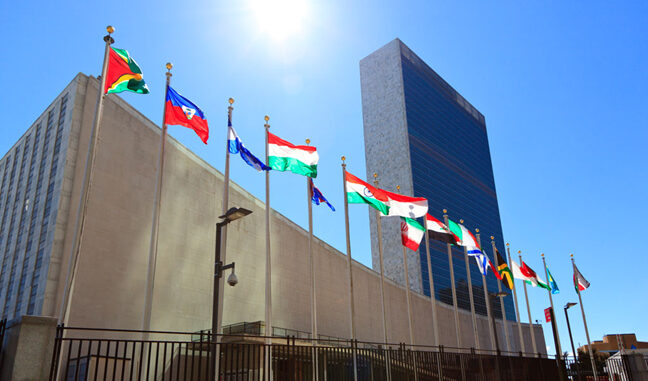

The UN’s vision for the future involves giving corporate executives crucial say in decisions. That is too dangerous to be allowed.
The secretary-general’s approach, called multistakeholder governance, would increase corporate influence over global governance, deepening the damaging consequences of prioritizing ‘return on investment’ above social and ecological needs. In a multistakeholder world, corporate executives and other founders bring together a friendly group of civil society organizations, governments, academics, UN staff, and other non-state organizations to take on a global governance role.

The United Nations needs a revamp. There can be little dispute about that. And the UN’s September 2024 Summit for the Future is an ideal opportunity for this upgrade. The people of the world expect a global form of governance that can confront the unique challenges of the 21st century. The UN’s creaking, post-World War II structures have been struggling to meet the challenges of the modern world for a long time. The many crises we face demand that the UN evolves to meet these challenges.
But Secretary-General Antonio Guterres’s vision for that evolution – as set out in his report to the General Assembly, Our Common Agenda – is ill-conceived and underwhelming. Instead of expanding access to the UN system to communities of people impacted by today’s crises, it gives more influence and power to corporate actors who are most culpable of bringing us to the precipice of ecological and social disaster.
The secretary-general’s approach, called multistakeholder governance, would increase corporate influence over global governance, deepening the damaging consequences of prioritizing ‘return on investment’ above social and ecological needs. In a multistakeholder world, corporate executives and other founders bring together a friendly group of civil society organizations, governments, academics, UN staff, and other non-state organizations to take on a global governance role.
This would marginalize over two-thirds of the nations of the UN. Instead, a new vision and institutional arrangement that focus on people and the planet should be at the heart of the Summit for the Future.
The role of national governments in the UN would be diluted by the addition of corporate-led bodies, which might soon take on more decision-making, managing everything from the oceans to financial markets. In this brave new world, a fossil fuel giant could have a privileged voice in decisions about providing important energy for all – conflicts of interest be damned. Do we really want the world’s biggest tech behemoths and profit-oriented Big Pharma firms ‘legislating’ global rules?
Perhaps most worrying of all in this new vision of the UN is the absence of ideas for new intergovernmental negotiations to deal with current social, economic, environmental or gender debates. As it stands, governments, as representatives of their citizens, take the final decisions on global issues and direct international organizations to implement these decisions. This proposed new system would make ‘stakeholders’ the main players.
But who exactly is a ‘stakeholder’ and why? There are countless possible stakeholder categories. At last year’s multistakeholder Food System Summit, organized out of the Office of the Secretary-General, for example, the ‘stakeholders’ were large agribusinesses, data management firms and commodity dealers, not the six billion people who actually need the food or their local representatives or civil society advocates.
Much of this thinking stems from the 2012 Global Redesign Initiative report of the World Economic Forum (WEF), which proposed such a shift in global governance. According to the WEF (and now the UN secretary-general), nation-states and governments alone cannot solve the main issues of global governance, and other actors need to be involved. The best of those actors according to them in WEF are corporations.
Indeed, we have already witnessed an increased role of the corporate private sector through their involvement in the implementation – or rather the non-implementation – of the Sustainable Development Goals.
In 2021, the WEF and the Office of the Secretary-General concluded a memorandum of understanding on this, which, not incidentally, was never made publicly available by the UN nor submitted to the General Assembly.
By displacing governments and states from decision-making, a brand-new parallel set of corporate-compromised institutions will sit with a voice and a de facto vote to decide on global policies that impact the planet and its people.
For decades, the corporate world has fraudulently claimed greater efficiency than all others. This efficiency can be seen in the hollowed-out public services of the rich world, the crippling debt burdens of the poor world, and almost universal cultural impoverishment.
Now, sweetening its proposition with insinuations of massive philanthropic financing, the corporate world – the only real beneficiaries of these proposed changes – has international decision-making in its sights.
Where nongovernmental organizations were once the largest non-state entities attending UN system meetings, transnational corporations (TNCs) have grown to become the biggest players. Civil society organizations, educators, scientists, women and other social communities now have less space to influence the behavior of the UN and intergovernmental processes.
This approach erodes sovereignty. When other actors are seen as equivalent to states, it undermines the longstanding concepts of state responsibilities, obligations and liabilities, as the new actors are unencumbered by any such legal requirements.
Multistakeholder groups and their corporate participants get to choose which policy issues they want to participate in, picking and choosing the ones likely to generate a profit, reduce the rate of return or which may limit the continued acceptance of globalization. When they do get involved in the governance of a certain issue, they act in such a way as to narrow the range of policy decisions to only those that are compatible with a commercial return. Needless to say, this is not always aligned with the public good.
Communities around the world already feel the international community is failing to solve problems. Multistakeholderism adds to this loss of trust by throwing up a smokescreen around conflicts of interest and proposing commercially viable ‘solutions’, which cannot address today’s major structural crises.
Meanwhile, rich country governments get to side-step their funding promises, while multistakeholder groups pose as open wallets that can underwrite global public goods and development. But direct payments and loans from governments are very different from investment flows, discounts on technology licensing, negotiated tax payments and supply chain funding. Even linguistically, multistakeholderism is taking us in the wrong direction. Public services around the world have subtly shifted their language from talking about ‘citizens’ to talking about ‘customers’. The longstanding UN vocabulary speaks of ‘peoples’, ‘citizens’, ‘communities’, ‘constituencies’ and ‘nongovernmental organizations’. Now everyone is a ‘stakeholder’.
This leads to absurdities such as equating the needs, interests and influence of huge corporations with those of governments or small economies or local nonprofit community organizations.
The future at stake
As the UN resets its agenda for the next 25 years, states from the Global South, represented by the G-77 at the UN, are pushing back against this dangerous new mission to quietly redefine how the UN works towards its mandate.
They are making sure that their voices are heard in the September 2023 Sustainable Development Goals Summit and the September 2024 Summit for the Future.
The UN Secretariat had originally proposed a September 2023 multistakeholder Summit of the Future, which was intended to solidify the secretary-general’s blueprint for reform.
At the end of 2022, however, a coalition of developing countries intervened to shift planning and decision-making to the General Assembly and erased the proposed lead role for multistakeholderism – for now. They also chose to halt the event’s preparations until 2024, arguing that the UN must focus this year on implementing its existing and faltering Sustainable Development Goals. Thanks to effective lobbying and continuing pressure from activists and scholars, the G-77 is continuing to fight back against the preponderance of corporate-friendly language and policies, and the increased role of corporations in global governance. The secretary-general must take heed, reverse course and keep ‘nations’ and ‘peoples’ at the center of global governance. A possibly irreversible corporate takeover of the UN system must be prevented.
(The author is Associate, Transnational Institute, and Senior Fellow at the Center for Governance and Sustainability, University of Massachusetts Boston)
(Source: Al Jazeera)


Be the first to comment