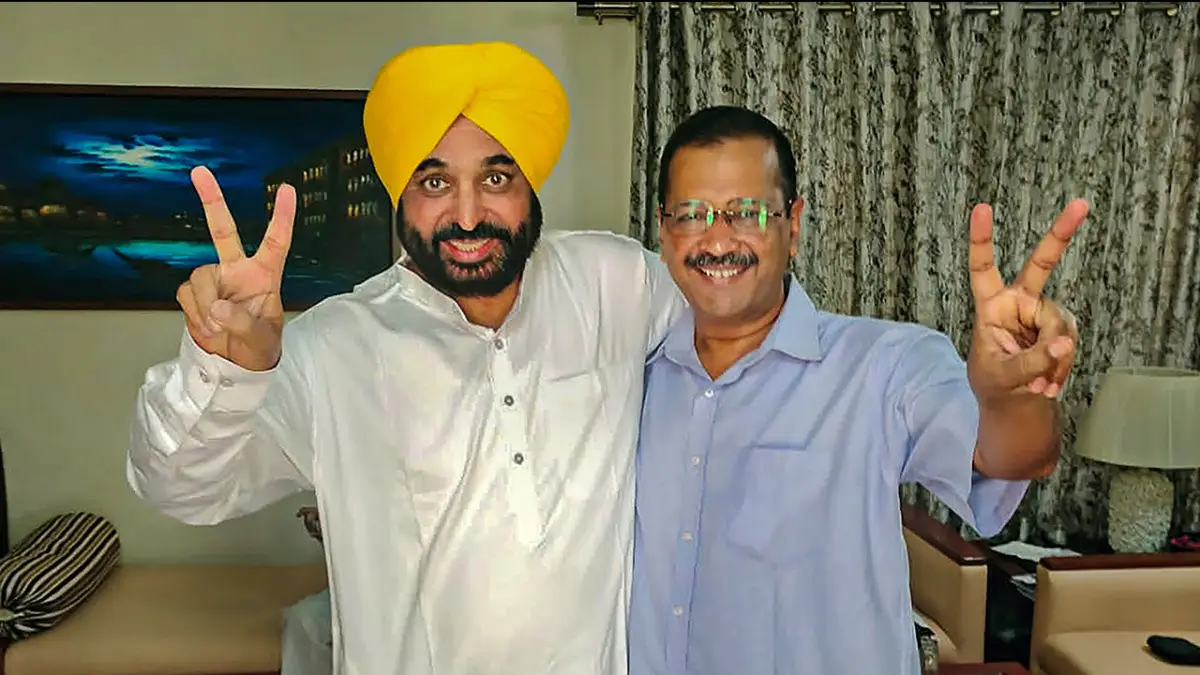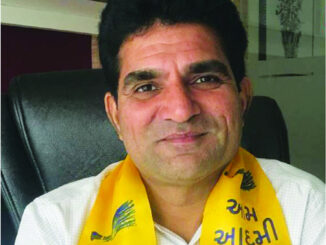
Delhi Chief Minister and Aam Aadmi Party (AAP) chief Arvind Kejriwal announced Isudan Gadhvi, 40, as Gujarat’s Chief Ministerial candidate for the AAP on Friday, November 4, at a public gathering in Ahmedabad, Gujarat. “Last week we invited public opinion, and 16,48,500 responses were received and 73 per cent of them named Isudanbhai Gadhvi”, Kejriwal said.
Last week, Kejriwal urged people to contact the party through SMS, WhatsApp, voice mail and e-mail to give their views about who should be the CM candidate from the party in the state for the elections, due to be held in two phases – on December 1 and 5.
After the announcement, Gadhvi embraced party colleagues Manoj Sorathiya and Yuvrajsinh Jadeja and got down the stage to seek the blessings of his mother. In a tweet, he thanked Kejriwal and the people of Gujarat.
Who is Isudhan Gadhvi?
Born to a farmer in Pipaliya village of Dwarka district in Gujarat on January 10, 1982, Isudan Gadhvi belongs to the community of other backward classes.
He graduated from Gujarat Vidyapeeth, Ahmedabad in 2005 where he pursued a Master’s degree in Journalism and Mass Communication and then worked as a journalist. He began working with Doordarshan and started as a field journalist in Porbandar with ETV Gujarati from 2007 to 2011. Gadhvi’s reporting helped bring focus on a 150-crore illegal deforestation scam in the Dang and Kaprada districts of the state, and the Gujarat government subsequently took action in the case. His reporting on farmers’ issues helped earn him a substantial following in rural areas.
In 2015, Gadhvi joined the Gujarati TV channel VTV as a prime-time show anchor. In his show called Mahamanthan, Gadhvi discussed national and state issues with panellists in the studio, as well as with the public via ‘phone-ins’ and organised debates. At VTV, he went on to become the youngest channel head in the regional media. He quit as the channel’s editor last year to join the AAP. The former journalist joined the Aam Aadmi Party on June 14, 2021, in presence of Arvind Kejriwal. He was among the first influential figures to join the party in Gujarat as AAP made a debut in BJP’s stronghold for 27 years.
Gadhvi began his foray into politics when he joined AAP last year. He was made the AAP’s national joint general secretary after his inclusion in the party.
New Delhi (TIP)- Reacting to Waqf Board chairman Amanatullah Khan’s arrest, Delhi Deputy Chief Minister Manish Sisodia on Saturday, September 17, accused the BJP of continuing with its Operation Lotus to “break” the AAP leaders. Khan, AAP MLA from Okhla, was arrested by the Anti-Corruption Branch on Friday in connection with the alleged irregularities in the Delhi Waqf Board recruitment, officials said.
“First, they arrested Satyendar Jain but there is no evidence against him in court. They raided my residence. Nothing was found. Then they initiated a fake probe against Kailash Gahlot, and now they arrested Amanatullah Khan. Operation Lotus to break each leader of AAP continues,” Sisodia said in a tweet in Hindi.
Earlier, the AAP leaders had alleged that the BJP was trying to buy AAP MLAs by offering them Rs 20 crore each to topple the Arvind Kejriwal government in Delhi.
SC Judge must probe ‘Operation Lotus’
Amid Aam Aadmi Party’s (AAP) allegations against BJP of trying to topple the Punjab government by poaching its MLAs, finance minister Harpal Cheema Thursday demanded a judicial probe into ‘Operation Lotus’ by a Supreme Court judge. Addressing the media here, Cheema said, “Not only Punjab, BJP indulged in poaching in other states like Goa, Karnataka, Madhya Pradesh, Assam. In all these states where the Operation Lotus took place should also be a part of investigation.”
“The BJP is offering ? 25 crore per MLA to switch sides. Operation Lotus may have succeeded in Karnataka, but the Delhi MLAs stayed firm and failed the BJP operation,” said Cheema. Cheema refused to give names of the BJP leaders against whom they had submitted an evidence to the police after which an FIR was registered by the Punjab Police Wednesday. “We have got the FIR registered. We will make the names public only after a thorough investigation is done. If we give out the names now, the Opposition will distort the facts.”
The Aam Aadmi Party (AAP), led by Arvind Kejriwal, on Thursday won a motion of trust that was tabled in the Delhi Assembly. Kejrwal had announced the trust vote on August 29 to prove that the BJP’s ‘Operation Lotus’ targeting AAP MLAs had failed. AAP, which has 62 of the 70 assembly seats in Delhi, won the election with 58 votes in its favour. Three BJP MLAs — Vijender Gupta, Abhay Verma and Mohan Singh Bisht — were marshalled out as they “argued” with deputy speaker Rakhi Birla, while the remaining saffron camp legislators walked out in protest soon after. Kejriwal has alleged the BJP tried to buy his party’s MLAs but none of them accepted the offer. In the Assembly, Kejriwal said in the upcoming Gujarat Assembly elections his party’s vote share in that state has increased by four per cent after the Central Bureau of Investigation (CBI) raids against his deputy Manish Sisodia in the excise policy case.
India needs grassroots, representative politics, not identity politics
Even the Hindi heartland would dump Hindutva if a credible alternative offers hope and change.
“Even when political Hinduism is pitted against political Islam — as in certain constituencies of Telangana or Kerala — or where another religious ideology is at play, as during Punjab’s latest by poll (won by a religious secessionist), Hindutva is often not even a factor. Our political pundits have been more cynical than our electorate, which wants change and is chasing the mirage of political idealism. And that is the only reason the BJP is not even in the reckoning in the states where it cannot offer change or a credible alternative. Its Hindutva cannot compete with a vibrant rival. That is the only reason it becomes a marginal player in most southern states. Even where it has gobbled up the Opposition space from the Congress, like in Odisha, the BJP has not been able to shake the people’s faith in a performing CM.”
By Rajesh Ramachandran
The foremost question in the minds of political observers on the 75th anniversary of India’s Independence is about the future of its democracy. Is India on a perilous path of majoritarian rule? Is political Hinduism or Hindutva going to be the tool of authoritarianism in the days to come? Many political scientists have written off Indian democracy as some sort of an oxymoron and are busy coining terms like undeclared emergency, ethnic authoritarianism, electoral dictatorship or even outright fascist one-party rule. But a closer analysis of the Indian situation would belie such intellectual acrobatics of the ousted elite of a failed establishment. Even the Hindi heartland would dump Hindutva if a credible alternative offers hope and change.
In the North, J&K cannot be ruled by Hindutva simply because of the lack of a Hindu majority. In Punjab, despite over 40 per cent Hindu population, the BJP won just two seats out of 117 and a measly 6.6 per cent votes. The AAP’s dazzling foray into Punjab was backed by its delivery, packaged in the Tricolor, in Delhi, where BJP’s Hindutva had failed again. ‘From Kashmir to Kanyakumari’ is how generalizations are dished out for everything, from pickles to politics. Interestingly, the BJP’s situation in Tamil Nadu is worse than it is in J&K: In 2021, it won just four seats despite partnering with the ruling party. Many in the AIADMK believe that their party was reduced to 66 seats only because of the BJP. Many in North India do not realize that Tamil Nadu is the repository of ancient Hindu temples and practices — so, staunch believers with religious markings on their forehead have voted in the DMK. But for Karnataka, there is not a single BJP government in South India. It drew a blank in the 2021 Kerala Assembly poll; the Vijayan government is surviving primarily because of the reasonable attitude of the Enforcement Directorate, which refuses to question the CM or his family in the gold smuggling case. The saffron party could not win a seat in the Andhra Pradesh Assembly election in 2019 and won just one in the Telangana Assembly poll in 2018, when Majlis-e-Ittehadul Muslimeen, the party of political Islam, won seven seats. In the West, the ugly saga of a mandate first being stolen from the single largest party and then stolen right back by the single largest party with a new Maratha satrap riding the Trojan horse has only proven that Indian democracy is alive and frolicking in all its filthy love for the lucre. In the East, Mamata Banerjee’s Trinamool Congress won 213 seats out of 292 last year, making mincemeat of the BJP’s Didi-o-Didi campaign.
Even when political Hinduism is pitted against political Islam — as in certain constituencies of Telangana or Kerala — or where another religious ideology is at play, as during Punjab’s latest by poll (won by a religious secessionist), Hindutva is often not even a factor. Our political pundits have been more cynical than our electorate, which wants change and is chasing the mirage of political idealism. And that is the only reason the BJP is not even in the reckoning in the states where it cannot offer change or a credible alternative. Its Hindutva cannot compete with a vibrant rival. That is the only reason it becomes a marginal player in most southern states. Even where it has gobbled up the Opposition space from the Congress, like in Odisha, the BJP has not been able to shake the people’s faith in a performing CM. Even the much-derided dynastic politics is not a deterrent, as is proven in Tamil Nadu, Andhra Pradesh or even Odisha, where Naveen Patnaik’s astute administrative mechanism is wrapped around his father Biju Patnaik’s legacy. Hindutva works only where the opponents are weak, self-serving and greedy beyond political goals. And, it works against the Congress as it is drifting in search of an identity. It is politically fashionable to hail Rahul Gandhi as the only Opposition leader who has taken on the RSS and Hindutva. But has he? He had to abandon his family’s pocket borough and its electoral legacy to seek refuge in a hilly constituency dominated by Muslim and Christian voters. So, if he is identifying himself with Muslim and Christian voters and representing them in Parliament, how is he taking on an organization that represents Hindus? Identity politics cuts both ways and is proving to be more helpful to larger communal identities than smaller groups. Rahul is only politically and ideologically legitimizing religious identity politics and thereby validating the RSS, the most successful practitioner of this brand of politics, by banking on Muslim and Christian voters of Wayanad.
The elitism and condescension of the Congress leadership, coupled with its one-trick poll pony — identity politics — were rejected in Punjab, with even Dalit voters voting out a Dalit CM. The Congress leadership still has no answer for the envy and aspiration of the middle and working-class voters, who find only elite opportunism in the politics of upper-class liberals, including that of Rahul. The problem with the present-day Congress leadership is not even the first family remaining out of touch with the party’s leaders and cadre — the problem is lack of representation of the masses.
The Gandhis still have not answered the question of representation. Who do they represent in terms of the identity politics they always practice? The minorities? The Muslims and the Christians have their own parties and do not need the Gandhis. Rahul needs Muslim League and Kerala Congress (a Christian party not to be confused with INC) voters more than the latter needing his endorsement. The Congress ought to be representing larger groups and hence should have a peasant caste or an OBC president — an Ashok Gehlot or a Bhupinder Hooda, someone who is a fulltime politician. Indian democracy badly needs a strong dose of grassroots, representative politics, as against identity politics. Even the Hindi heartland would dump Hindutva if a credible alternative offers hope and change.
Audacity reflects the social sanction to corruption
How else to describe it but as the audacity of the corrupt when a racket promising a Rajya Sabha seat or a governorship for up to Rs 100 crore is busted by the Central Bureau of Investigation? The four accused were arrested over phone intercepts offering appointments as chairpersons of government organizations, ministries and departments. One of the accused posed as a CBI officer and flaunted his connections with senior officials. While it is for the investigative agencies to unravel the intricacies of the scam and prove whether any one did end up falling for the con job, the worrying part of the episode is what it says about the political culture, and the social sanction to corruption. Moneybags who really do believe that positions of high office are available for a price, find nothing unusual about it and are willing to fork out any amount. The revelation about the racket came just two days after West Bengal’s Industry Minister was taken into custody following the recovery of over Rs 21 crore in cash from his aide’s house. The Enforcement Directorate has not exactly covered itself with glory in the recent past, but the allegations of targeting the Opposition fly in the face of a seizure of such magnitude. In Punjab, the anti-graft helpline has logged nearly three lakh complaints since its launch by the AAP government in March-end. As many as 3,750 of them are buttressed with video or audio recordings. A minister was sacked and he figured among the over 50 persons, including government and police officials, arrested on charges of corruption. Corruption has deep roots, but the undeniable takeaway over the past four months in Punjab has been the rise in the risk involved and the chances of being caught. Time will tell whether it is a temporary lull before new facets of cheating emerge, or, at last, corruption is being denied the social acceptability that allows its sustenance.
One of the key demands of the year-long farmers’ protest was for a legally recognized Minimum Support Price for crop procurement. File Photo : Reuters- Danish Siddiqui
“We will force the BJP-led NDA Government to make a law that guarantees MSP for all farm produce,” SKM Leader Darshan Pal said hoping that the MSP law would be in place before the 2024 general elections
By Prabhjot Singh
“Our agitation is far from over. We will not sit quietly till our demand of getting legal sanctity to the Minimum Support Price (MSP) for farm produce is conceded,” is the unanimous voice coming from farmers organizations especially those owing their allegiance to Samyukta Kisan Morcha (SKM). They are contemplating to revive their agitation as they feel that the NDA Government at the center was dilly dallying on their demand for guarantying MSP.
Upset over ignoring their demand for constituting an exclusive committee to suggest ways and means of making MSP mandatory, the SKM has outrightly rejected the proposed 29-member committee by the Union Government on minimum support price. The issue came up before the ongoing Monsoon session of Parliament where the ruling BJP refused to budge. AAP leader Raghav Chadha was on forefront in criticizing the 29-member Committee saying that by ignoring Punjab, the Government has played a cruel joke on the farming community in general and the food grain bowl of the country. Other parties, including Congress, took the Government to task over the discrimination with Punjab and its farmers in setting up the Committee. AAP and Congress leaders endorsed the stand of the SKM. The SKM leaders have been maintaining that this committee as proposed was nothing but a back door entry to corporates and yes men of the government to get the already repealed farm laws back in a new format. They held that they would not allow the government to serve “old wine in new bottles”. “We will force the BJP-led NDA Government to make a law that guarantees MSP for all farm produce,” SKM Leader Darshan Pal said hoping that the MSP law would be in place before the 2024 general elections.
The Samyukta Kisan Morcha leader also pointed that nowhere in the proposed committee notification was any mention of providing legal guarantee to MSP. “Even the agenda of the committee does not include provisions for making laws on mandatory MSP for all crops,” Darshan Lal said while rejecting the committee downright.
The SKM had considered the proposal at its general house meeting on July 3 where it was unanimously rejected. Instead, the SKM said it was surprised at the Union Government proposal of loading the committee with those who had earlier supported the three disputed Farm Bills or were supporters of corporatizing the agriculture sector.
Even major farm states like Punjab and Uttar Pradesh were completely ignored in the proposed committee. The Agriculture Minister Narendra Singh Tomar, however, questioned the SKM claims. He held that the government never told the SKM that it would constitute a committee to provide legal guarantees of MSP. Responding to a question in the Lok Sabha on whether the Government had assured the SKM for the constitution of such a committee in December 2021, Tomar said: “The Government had assured the formation of a committee to make MSP more effective and transparent, to promote natural farming and to change crop pattern keeping in mind the changing needs of the country. Accordingly, a committee has been constituted consisting of representatives of farmers, Central government, state governments, agricultural economists and scientists, etc.”.
The government fixes MSP for 22 mandated agricultural crops and Fair and Remunerative Price (FRP) for sugarcane on the basis of the recommendations of the Commission for Agricultural Costs and Prices (CACP), after considering views of state governments and Central ministries and departments concerned and other relevant factors, Tomar said.
“The Government has increased MSPs for all mandated Kharif, Rabi and other Commercial crops with a minimum return of 50 per cent over all India weighted average cost of production from year 2018-19 onwards,” he added.
The Government on Monday, the opening day of the Monsoon session of Parliament, set up a committee to look into issues related to agriculture, including making MSP more effective and transparent, crop diversification and natural farming, eight months after it promised to set up such a panel while withdrawing the three contentious farm laws.
The umbrella body of farmers’ organizations that organized an unprecedented more than a year-long peaceful agitation to demand withdrawal of three central farm laws, also made it clear that it had no plans to nominate three representatives to the panel as suggested by the Union Government.
According to the notification, the committee will hold discussions on making available MSP to farmers by making the system more effective and transparent. It will also make suggestions to give more autonomy to CACP. The committee will also suggest measures to make it more scientific; and strengthen the agricultural marketing system as per the changing requirements of the country to ensure higher value to the farmers through remunerative prices of their produce by taking advantage of the domestic and the export opportunities. Prime Minister Narendra Modi on November 19 last year had announced the repeal of the three controversial farm laws that triggered a massive farmer protest at Delhi borders. He also announced at that time that the government would set up a committee to make MSP more effective and transparent as well as suggest ways to promote zero budget natural farming. The SKM leaders held that they agreed to suspend their agitation and return home after the government promised to fulfil their remaining demands.
The SKM wants those twenty-two crops that include 14 Kharif crops—paddy, jowar, bajra, maize, ragi, tur (arhar), moong urad, groundnut, soyabean, sunflower, sesamum, niger seed and cotton—six Rabi crops—wheat, barley, gram, masur (lentil), rapeseed, mustard and safflower—besides two commercial crops—jute and copra be brought under mandatory MSP control. In addition, MSP for toria and de-husked coconut be also fixed on the basis of MSPs of rapeseed/mustard and copra, respectively.
(Prabhjot Singh is a veteran journalist with over three decades of experience covering a wide spectrum of subjects and stories. He has covered Punjab and Sikh affairs for more than three decades besides covering seven Olympics and several major sporting events and hosting TV shows. For more in-depth analysis please visit probingeye.com or follow him on Twitter.com/probingeye. He can be reached at prabhjot416@gmail.com)
Putting behind the Sangrur Lok Sabha bye-election debacle, three-month-old AAP Government has tried to salvage some of its prestige by presenting the State’s first ever “paperless”. Tax free and please all Budget in Punjab Vidhan Sabha on Monday, June 27. While the ruling party claimed “it is a historic Budget” – drafted in consultation with the people of Punjab, still members of the Treasury Benches were hard pressed to hide their disappointment over rejection by voters of their own citadel a day earlier. Calling it the Janata budget (people’s budget), AAP claimed that it was drafted after receiving 20,384 suggestions on the government portal and through e-mails. Drawing its consolation from Monday, as a new day, marking the start a new week, the Finance Minister Harpal Singh Cheema was upbeat in presenting his maiden budget of Rs 1.55 lakh crore without proposing any new taxes. Interestingly, some of the major initiatives or schemes announced in the Budget are replicas of similar schemes being run in Delhi. These include giving 300 units of free power, “Farishtey” scheme for victims of road mishaps, and “Mohalla” clinics for boosting health care. Even proposed reforms in education and distribution of essential commodities, including “atta”, are modelled on Delhi lines. Cheema said out of five, four “guarantees”—giving 300 units of free electricity, quality education, improving health infrastructure and raising compensation to families of martyred soldiers—have been fulfilled.
Providing 300 units of free power will put an additional burden of Rs 1,800 crore on the state exchequer, said Cheema. The AAP government had announced giving 300 units of free power to every household from July 1.
Only one guarantee of Rs 1,000 to each woman is yet to be fulfilled. Mr Cheema said this would also be done in due course of time. Cheema presented the first paperless budget in the ongoing assembly session and said this step was expected to save Rs 21 lakh per annum. Instead of huge bundles of Budget documents, entire information was made available through an App. Setting up of modern digital classrooms in 500 government schools to bring quality education to villages, upgrading 100 existing schools as “schools of eminence” and posting estate managers for a cluster of schools for the upkeep of their premises are among the proposals. The Government has also drawn a comprehensive scheme for installation of roof top solar panel systems in government schools. To encourage students to plan their careers, a Punjab Young Entrepreneur programme is also being launched. Students of class 11 will be encouraged to propose their business ideas for which the state would provide seed money of Rs 2,000 each.
To further professional education and to discourage students from going abroad for medical education, the Punjab Government has decided to set up 16 new medical colleges over five years, taking the total number of colleges in the state to 25. The first of these medical colleges will come up in Sangrur, the home district of both the Chief Minister and the Finance Minister. The government will also establish 117 “Mohalla Clinics”, for which Rs 77 crore has been earmarked.
To counter its criticism for deterioration in law and order and rapid growth in heinous crime, the Government has resolved to strengthen the police force and equip it the with latest gadgets, technology and tools to tackle crime, maintain law and order with an allocation of Rs 108 crore.
Further, cyber-crime control rooms shall be set up in all districts with an outlay of Rs 30 crore. The Government also intends to bring the entire State under the CCTV network to check the crime and tap criminals.
The stubble burning issue too has been put on priority list. To explore available possibilities and solutions, a sum of Rs 200 crore has been earmarked for the project.
Noting that the agriculture sector is at a crossroad, Cheema stressed on increasing farmers’ income and promoting crop diversification and earmarked Rs 11,560 crore for the agriculture sector. Seeking to put all speculations to rest, Cheema said the AAP government pledges to stand by its farmers and shall continue providing free power for the agriculture sector and allocated Rs 6,947 crore for the same.
Door-to-door delivery of well packaged ‘atta’ in place of wheat to 1.58 crore beneficiaries under National Food Security Act has been promised by the State. It will cost Rs 457 crore. A bailout package of Rs 350 crore for state-owned Punsup has also been mooted. Also among new initiatives is replication of ‘Farishtey’ scheme on the pattern of Delhi whereby the road accident victims will be given free treatment and the helper would be felicitated.
The focus in the first year of its rule, claimed AAP, would be to restore deteriorating fiscal health, deliver on the promises of good governance by ensuring effective use of public funds and concentrate on health and education.
The state’s effective outstanding debt was expected to be Rs 2,84,870.03 crore by end of current fiscal as against Rs 2,63,265.41 crore (revised estimates) for 2021-22.
The state government borrowed Rs 8,000 crore in the last three months besides contributing Rs 1,000 crore to the Consolidated Sinking Fund (CSF) of the state within the first two months.
The revenue deficit and fiscal deficit stood at Rs 12,553 crore and Rs 23,835 crore, respectively.
A total power subsidy, after 300 units concession, has been worked out at Rs 15,845 crore as against Rs 13,443 crore in 2021-22. The Punjab’s AAP government was hoping to generate revenue worth Rs 95,378.28 crore this fiscal, against an expenditure of Rs 1,55,859.78 crore. This would lead to a revenue deficit of Rs 12553.80 crore.
Since no new tax has been announced and the revenue receipts are projected to increase by almost Rs 14,000 crore over 2021-22, the increased revenue would be primarily through excise earnings that would yield an additional revenue of 56 per cent. Buoyancy in GST collection will get the state 27 percent additional revenue compared to last year. The State is also expecting an 11 percent increase in non-tax revenue.The government will fill 24,400 posts in the government sector besides regularizing 36,000 contractual employees. This will cost Rs 450 crore. The Government also reiterated its commitment to implement One MLA one pension scheme. Among various new schemes planned to be launched by the Government this year include Sardar Bhagat Singh Haryali Project under which 50,000 saplings would be planted in each of the 117 assembly segments. While no new taxes have been proposed, revenue receipts are expected to go up by 17.08%.
Another proposal says that 25,000 EWS houses would be constructed. The Budget also makes an allocation of Rs 780 crore for the relining of Rajasthan feeder and Sirhind feeder canal. To meet its financial needs, the state government proposes to raise Rs 31804.99 crore as market loans, up from Rs 27362.74 crore raised by the state last year. The State expects to spend Rs 20,122 crore on payment of interest. However, the total debt servicing will take Rs 36,068.67 crore of the state’s earnings. The State also proposes to set up a Traders commission and Fintech city to come up for IT companies in Mohali. The budgetary allocation for social security pensions is proposed to be increased from ₹4,071 crore during 2021-22 (BE) with coverage of 28.12 lakh beneficiaries to ₹4,720 crore in FY 2022-23 with a target of covering 31.23 lakh beneficiaries.
Rs 3,003 crore is being proposed for development of rural areas in the state. To promote direct seeding of rice, the State is keeping apart Rs 450 crore as financial assistance to beneficiary farmers.
A new Quick Freezing Centre is proposed to be established at Verka, Amritsar, at a cost of Rs 7 crore. Further, an Integrated Hi-tech Vegetable Production-cum-Technology Dissemination Centre at Malsian, Jalandhar, will come up at a cost of Rs 11 crore. For the cooperatives sector, Rs 1,170 crore allocated, which is an increase of 35.67% compared to the last financial year. Punjabi University, Patiala, will get Rs 200 crores as a special grant. An amount of Rs 30 crore has been earmarked for providing infrastructure facilities in libraries of government colleges of 9 districts – Tarn Taran, Barnala, Ludhiana, Fazilka, Malerkotla, Moga, Pathankot, Muktsar Sahib and Shaheed Bhagat Singh Nagar. The State would start a CM scholarship with an allocation of Rs 30 crores to general category students for giving them concessions in university. Students of poor families, especially of general category studying in government colleges, will get concession in the fee, based on the marks obtained by the student. But do these schemes of a government meet the hopes and aspirations of the people of Punjab who chose their new rulers just three months ago? Some of the new schemes look cosmetic with allocations that can best be described as “symbolic”. Allocations like Rs 35 crore or Rs 50 crore to deal with issues like career development of jobs-starved State may have good intent but not the all-out support.
(Prabhjot Singh is a veteran journalist with over three decades of experience covering a wide spectrum of subjects and stories. He has covered Punjab and Sikh affairs for more than three decades besides covering seven Olympics and several major sporting events and hosting TV shows. For more in-depth analysis please visit probingeye.com or follow him on Twitter.com/probingeye.He can be reached at prabhjot416@gmail.com)
Rocked by the gruesome assassination of folk singer-turned politician Sidhu Moose Wala on May 29, the ruling Aam Aadmi faces a litmus test in the Sangrur Lok Sabha seat bye-election scheduled for June 23.
The seat had fallen vacant after the incumbent Punjab Chief Minister Bhagwant Mann quit his Lok Sabha seat on his election to Punjab Vidhan Sabha from Dhuri. In the last two elections – in 2014 and 2019 – Bhagwant Mann had successfully contested from this seat.
Of the five contestants in the fray this time include Simranjit Singh Mann, President of Shiromani Akali Dal (Mann), who represented Sangrur in Lok Sabha from 1999 to 2004. There were speculations that all Sikh organizations and political parties would put up a joint Panthic candidate in their endeavor to get early release of Sikh prisoners languishing in various jails of the country.
The proposal was first taken at a meeting of the Panthic organizations. It was followed by a visit of Shiromani Akali Dal chief Sukhbir Singh Badal to the residence of Simranjit Singh Mann, President of Shiromani Akali Dal (Mann).
At the closed door meeting the two leaders and other senior leaders reportedly failed to reach unanimity.
While Simranjit Singh Mann went ahead to file his nomination papers day after the meeting, Shiromani Akali Dal chief Sukhbir Singh Badal announced the candidature of Kamaldeep Kaur Rajoana, sister of jailed Balwant Singh Rajoana. Various Panthic organizations have been making concerted efforts to seek release of Balwant Singh Rajoana undergoing life imprisonment in the Beant Singh assassination case. Other candidates in the fray include Gurmail Singh of ruling Aam Aadmi Party. An environmentalist, Gurmail Singh has been active in AAP politics as a youth leader and heads the Sangrur unit of the party.
Other than Simranjit Singh Mann, who contested the last Lok Sabha election from this seat unsuccessfully, Kewal Singh Dhillon is also in the running this time. Though last time, he was a Congress candidate, now he is representing Bharatiya Janata Party. Interestingly, Kewal Dhillon, who twice represented Barnala in Punjab Vidhan Sabha as a Congressman, joined BJP only a day before his nomination as the party candidate for the ensuing bye-election. Though the BJP contested the State assembly elections in February in alliance with Punjab Lok Congress, a new outfit floated by former Chief Minister Capt Amarinder Singh after leaving Congress, and Sanyukat Shiromani Akali Dal led by former MP Sukhdev Singh Dhindsa, announcement of Kewal Dhillon’s candidature, indicates that the alliance is no more in existence.
At one stage, the Sanyukat Shiromani Akali Dal had raised objections on the way the BJP was going alone on both scouting for the candidate and contesting the election on its own.
In the 2019 elections, Parminder Singh Dhindsa, who unsuccessfully contested from Dirba in the last Assembly elections, was the Shiromani Akali Dal candidate. He finished third behind Bhagwant Singh Mann and Kewal Singh Dhillon by polling 2,63,498 votes.
Parminder Dhindsa had represented Dirba in Punjab Vidhan Sabha for the 2017-2022 term.
Congress has named former Dhuri MLA, Dalvir Singh Goldy, as its candidate.
In the Punjab Assembly elections held early this year, all nine assembly segments – Lehra, Dirba, Sunam, Bhadaur, Barnala, Mehal Kalan, Malerkotla, Dhuri and Sangrur – that constitute this Lok Sabha, AAP candidates made a clean sweep.
Sangrur has a unique record as it has been sending representatives of different political parties, including Communists, Congress, and various factions of Shiromani Akali Dal, to Lok Sabha.
Ranjit Singh was the first Lok Sabha winner from Sangrur. He won in the 1952 elections as a representative of Congress.
Nirlep Kaur, owing allegiance to the then Shiromani Akali Dal (Sant Fateh Singh), won from Sangrur in 1967, the first general election after the reorganization of Punjab. Subsequently, Teja Singh Swatantar, wrested back the seat for Communist Party of India. In 1962, Ranjit Singh was the first CPI nominee to win from Sangrur.
Two of SAD MPs from Sangrur – Surjit Singh Barnala and Sukhdev Singh Dhindsa – remained part of the Union Cabinet in the NDA governments of their time.
SAD (Mann) was successful twice in representing this constituency in Lok Sabha. In 1989, Rajdev Singh was elected from here and 10 years later, the SAD(Mann) chief, Simranjit Singh Mann, won from Sangrur.
Before Bhagwant Mann was elected for the first time in 2014, the seat was held by Vijay Inder Singla for a term – 2009-2014.
Sukhdev Singh Dhindsa succeeded Simranjit Singh in 2004.
For Congress, Gurcharan Singh Nihalsinghwala (1980) and Gurcharan Singh Dadhahoor (1991) represented Sangrur in Lok Sabha.
Political analysts hold that things have changed significantly primarily because of the assassination of Sidhu Moose Wala. Days before his killing, he had reportedly held a meeting with Simranjit Singh Mann pledging support to him in the Lok Sabha bye-election.
(Prabhjot Singh is a veteran journalist with over three decades of experience covering a wide spectrum of subjects and stories. He has covered Punjab and Sikh affairs for more than three decades besides covering seven Olympics and several major sporting events, including eight World Cups in Hockey. He has been hosting TV shows. For more in-depth analysis and stories by him please visit probingeye.com or follow him on Twitter.com/probingeye and on Facebook @PrabhjotSingh.Journalist. He can be reached at prabhjot416@gmail.com)
“Neither the Chief Minister Bhagwant Mann nor any of the senior members of the High Command of AAP, including its Convener, Arvind Kejriwal, could visualize the serious consequences they would counter for their action of cutting down security cover of eminent personalities, including politicians, religious leaders, artists, and policemen.
“The broad daylight assassination of folk singer-turned budding politician Sidhu Moosewala not only evoked worldwide condemnation but also painted the action of the first-time ruling party in the State as a cheap and unlawful gimmick.” In less than 10 weeks of its landslide triumph in the Assembly elections of this trouble-torn revenue deficit border State, the ruling Aam Aadmi Party (AAP) is finding itself knee deep in hot waters. The reason: a highly publicized action that boomeranged on its face.
Neither the Chief Minister Bhagwant Mann nor any of the senior members of the High Command of AAP, including its Convener, Arvind Kejriwal, could visualize the serious consequences they would counter for their action of cutting down security cover of eminent personalities, including politicians, religious leaders, artists, and policemen.
The broad daylight assassination of folk singer-turned budding politician Sidhu Moosewala not only evoked worldwide condemnation but also painted the action of the first-time ruling party in the State as a cheap and unlawful gimmick. Needless to reiterate that security is a sensitive issue that is seldom revealed in public domain.
In less than 24 hours of issuance of orders of withdrawal or reduction of security cover to over 400 eminent personalities, the State plunged into one of its worst glooms in recent years with the killing of Sidhu Moosewala who had unsuccessfully contested the Punjab Assembly elections early this year.
Intriguingly, copies of the order, though confidential and marked “secret” , were made available to the entire media for “wide publicity” as “another daring step by the “Government that works for people.”
Without getting into the merits of the action or the order, the way it was publicized not only defeated its purpose but also made all those who felt aggrieved by it more “vulnerable”.
The subsequent explanation by the State police chief that the order was part of an annual exercise of making available additional security personnel for deployment for “ghallughara week” duties.
The present strength of Punjab police is more than 70,000. In addition, it has some Punjab Armed Police (PAP) battalions as well as India reserve battalions. Punjab also has a couple of trained Commando battalions. Of these men in uniform, nearly 30,000 to 35,000 are deployed in 300-odd police stations and police posts in the State.
Providing security cover to individuals or institutions is a highly sensitive subject that need not be discussed in any public domain. In the past a little more than 10 weeks of assuming power in the State, the AAP government has been issuing orders from time to time in reviewing security cover of political bigwigs and others. Such reviews were also widely publicized as was the last order of May 28.
In India, there are various agencies that provide security cover to individuals and vulnerable institutions, including installations. They include those that are under direct control of the Central Government like the Ministry of Home Affairs or the Ministry of Defense. They assess the threat perception and accordingly provide the security cover that at times work in close coordination with the State Security Agencies depending upon the movement of the protected personalities.
In addition to the Centre, the State Governments have their own Security wings that function under a senior police officer. Though broadly, the State Security agencies follow the same pattern of assessing the threat perception before deciding the quantum of security cover in each individual case. Normally, there is a regular review of security cover with changing threat perceptions, but this practice is not followed religiously. It is in rarest of rarest cases that the State police extends its security cover to individuals who are neither Bonafede residents of the State nor have any threats emanating from within the State. There are numerous when security audits are not conducted, and even if they are done, they are only to complete the formalities.
There is no denying the fact for many, security cover is more of a “status symbol” than a necessity. The bigger or larger the security cover is used to gauge one’s political or social height.
Security experts say that there is nothing like “absolute” or” foolproof” security. Their observation is corroborated by high profile assassinations taking place world over from time to time.
During my nearly 40 years stint in journalism, I reported several cases in which well protected political bigwigs, policemen or others were attacked. Many of these turned out to be gruesome assassinations, while few others left their victims shattered or crippled.
Security is a highly debatable subject as the State is mandated to protect life and property of its populace. However, deviating from this Constitutional mandate, the State or the people given the mandate to run the State start their own isolation on the pretext of security. Safety and security of a common man is getting greatly ignored.
Intriguingly, nearly 80 per cent of the police force in Punjab is undertrained. Studies from time to time reveal that nearly 80 per cent of the training budget of the police force is consumed by the top 5 to 10 percent of the force that generally covers up the gazetted officer’s level. Eight to 10 percent of the training budget is spent on the NGOs, who comprise about 10-15 per cent of the total strength and for the remaining 70-75 per cent, the constabulary, gets only five to eight per cent of the training Budget. Majority of the policemen undergo mandatory training only at the time of their induction in the force and seldom afterwards. They are the “lathi” or cane wielding policemen chosen to do route marking or simple beat duties with little or no power of investigation. They are the mainstay of the “visible” security for VIP visits or mass political events. Invisible security is an area that has generally remained ignored.
There may not be a single policeman to ensure the safety of hundreds of people at a busy marketplace, bus stand or railway station but a political bigwig or a senior police official comes surrounded by a horde of armed guards. The strength of the horde indicates the political or official rank of the protected politician or civil servant.
( Prabhjot Singh is a veteran journalist with over three decades of experience covering a wide spectrum of subjects and stories. He has covered Punjab and Sikh affairs for more than three decades besides covering seven Olympics and several major sporting events, including eight World Cups in Hockey. He has been hosting TV shows. For more in-depth analysis and stories by him please visit probingeye.com or follow him on Twitter.com/probingeye and on Facebook @PrabhjotSingh.Journalist. He can be reached at prabhjot416@gmail.com)
Bagga held by Punjab Police in Delhi, Brought back from Haryana by Delhi Police
CHANDIGARH / NEW YORK (TIP): In a dramatic turn of events that brought the police of three states face to face, BJP leader Tajinder Pal Singh Bagga was arrested by the Punjab Police from his Delhi residence around 8.30 am today, stopped by the Haryana Police in Kurukshetra while being taken to Punjab and brought to the national capital by the Delhi cops a few hours later, reports TNS.
The incident triggered a political slugfest with the BJP accusing the Punjab Police of abducting its leader allegedly at the behest of AAP convener and Delhi CM Arvind Kejriwal, against whom Bagga (36) has been quite vocal in criticism. Rejecting the charge, the AAP claimed the Delhi BJP spokesperson was arrested for allegedly stoking communal tension in Punjab.
Based on a complaint by Bagga’s father Preetpal Singh, the Delhi Police registered a case of kidnapping against the Punjab Police personnel. Sources in the Delhi Police claimed that their Mohali (Punjab) counterparts “violated” the mandatory norm of informing local cops before arresting Bagga from his residence in Janakpuri.
In a statement, the Mohali police claimed that Bagga was arrested in a case related to making allegedly provocative, false and communal statements in an interview given to the media and through posts on Twitter on March 1. They said five notices were served on the accused on April 9, 11, 15, 22 and 28, but “he deliberately did not join the investigation”. They said a case under Sections 153-A, 505, 505(2) and 506 of the IPC was registered against him on the complaint of Mohali AAP leader Sunny Ahluwalia.
Bagga had demanded an apology from Kejriwal for his speech in the Delhi Assembly regarding film ‘The Kashmir Files’, which a few BJP leaders had demanded be made tax-free. Kejriwal had contended that the filmmakers should upload the film on YouTube for all to watch free of cost. The Punjab Government, on its part, moved the Punjab and Haryana High Court against the “detention” of its police team in Kurukshetra.
The Delhi Police registered the case under IPC Sections 452 (house trespass, assault or wrongful restraint), 392 (robbery), 342 (wrongful confinement), 365 (kidnapping), 295 (injuring or defiling place of worship with intent to insult the religion of any class) and 34 (common intension). In his complaint, Bagga’s father said, “I was present at my home along with my son when, around 8.30 am, someone knocked on the door repeatedly. When I opened, a few persons entered my home and manhandled me. Some of them had weapons.
“They started asking me where is Tajinder Singh Bagga? When I asked them what they wanted from Tajinder, they slapped me. Later, my son came there and they started beating him up and didn’t even allow him to put on his turban while they were arresting him. When I tried to intervene, they pushed me,” it said.
The Punjab Police team that had arrested Bagga was on way to Mohali when it was stopped on the NH-44 near Khanpur Kolian village in Kurukshetra around 11.30 am. As a large number of BJYM workers soon reached the spot demanding Bagga’s release, the BJP leader and the Punjab Police team were taken to the Thanesar Sadar police station. Delhi Police officials reached the police station around 2.10 pm and Bagga, based on a search warrant issued by a Delhi court, was taken back to the national capital. The Delhi Police had shared the warrant with the Haryana Police when the latter stopped their Punjab counterparts.
Sources said the Haryana Police had information that Bagga had been “forcibly” picked up from his residence and they needed to verify and crosscheck the allegations. Mohali DSP (City-1) Sukhnaaz Singh said, “A police team was sent from Mohali to Delhi last night. A team arrested them today morning and simultaneously, another team reached the police station concerned in Delhi to inform local cops. The entire process has been video-recorded. Although Bagga resisted arrest, no force was used against him or his father.”
AAP would have to, and must remember the People’s temperament pertaining to ‘Opposition, Agitation, Rebellion and Change’.
By Gurmit Singh PalahiEnglish translation by Amarjit Singh Anand
There has come about an upheaval in the echelons of power, in the strategically significant border-State of Punjab, which has been relegated to a dilapidated condition. In this context, it is noteworthy that many a stalwart veteran political bigwigs have been reduced to a shambles, having tasted crushing defeat in the recent elections. Amongst those who tasted bitter fruit are Prakash Singh Badal (five-time CM) Sukhbir Singh Badal (Supremo o Akali Dal) ‘Raja’ Amarinder Singh (former CM) Charanjit Singh Channi (CM for a couple of months) Navjot Singh Sidhu (State-Congress Chief) and Jasvir Singh Garhi (BSP State-President) while Ashwani Sharma (BJP State-boss) has emerged victorious. Aam Aadmi Party (AAP) has been given a resounding mandate by the populace. Leaders have lost the contest and Punjab has won the battle. Has Punjab actually won, in reality?
Polling results for 117 seats in Punjab Assembly were declared on March 10. The State has 2.14 crore voters. In 2017, 70% voters had exercised their right to political franchise. This year, 71.95% people voted. Punjab was, apparently, dejected this time, as compared to 2017. A staggering number of 1,10,308 voters opted to accept ‘notes’, in exchange for votes.
AAP won a thumping 92 seats, BSP got 1, BJP 2, 1 Independent candidate won, Congress 18 and SAD was saddened at having bagged just 3 seats. Others including Leftist-parties, Kisaan Morcha and sundry outfits failed miserably while not evening opening their accounts. Could it be presumed that the overwhelming success of one party is a victory for AAP and the demolition of all other parties is a vote of disappointment against Congress and SAD ? There was noticeable widespread public protestation, anger and a rebellious wave to effect massive change, by bringing about the downfall of ‘the establishment’. All of these sentiments assumed the form of a volcanic eruption, which outpoured rivers of lava. Delhi CM Arvind Kejriwal and his Dy. CM Manish Sisodia visit Hanuman Mandir and then tell their party-cadre that “this is the biggest Inquilaab” (revolution). Is it, truly, a “revolution”?
The percentage of votes was as follows : AAP 42, SAD 18.38, BJP 1.77, CPI 0.05, CPM 0.06, CPML 0.03, Congress 22.98, NOTA votes (none of the above) totaled 0.71, RSP 0.01. The maximum % of 42.01 was claimed by AAP which had received only 23.7% in 2017. Congress got 22.98 as against 38.5 in 2017. SAD recorded a fall from 25.2 to 18.38. BJP registered 1.77 compared to 1.5 last time. Out of 69 seats in Malwa-belt, AAP captured 66. In this region, there was a strong presence of Kisaan protestors and a huge dejection against the previous governance by various parties or alliances. The farming community became a catalyst for Punjab’s empowerment and for giving power to AAP. Whether ‘Dera-following’ or caste-politicking or religious machinations, nothing at all could succeed obstruct the wave of massive awareness amongst the people. AAP reaped a rich harvest, on account of strong public resentment against the traditional parties, everywhere including the latter’s bastions. AAP’s slogan of “One Chance” resonated extremely well with the masses and their hearts were touched. Then, there were additional enticements like the National Coordinator’s poll-promises, which included Rupees 1000/-, 300 free units and 24-hour uninterrupted supply of electricity. It was an emotionally charged election.
After the victory-laps are over, AAP shall have no ordinary, common promises to keep but would have a very special agenda to adhere to, in order to retain the faith and trust of voters who installed AAP at the pinnacle of power. AAP would not benefit from breaching this faith and betraying such trust especially when the Party has promised revolutionary measures for the good of Punjab. Special emphasis would have to be given to the extinction of the era of traditional fashion or trend of lineage-nepotism, as promised by AAP. The general message is that the public wants change in various spheres and desire public-welfare schemes to be implemented. People want to visualize government as public servants and not as monarchs or dictators.
The political texture had been entangled since long, whereby one privileged and affluent and powerful segment was ruling the roost. ‘Once upon a time’ there used to be governance which was respected by the nomenclature of ‘Divine Kingship’, which was rejected by the people. Then came the era of Principalities, which also vanished. Finally, the era of democratic rule by majority votes came into effect but which was hijacked and misused by aristocrats, affluent ones and the ‘high and the mighty’. The devastatingly excruciating results of such selfish machinations, by vested interests, are verily visible. In 4 States of India, where polls were conducted, continuity and status-quo was maintained in Goa, Manipur, Uttarakhand and Uttar Pradesh. The winds of change were experienced in Punjab, where people were exasperated on account of rising rate of unemployment, rampant menace of drugs-influx, unresolved cases of repeated incidents of desecration of Guru Granth Sahib Ji, prevalent massive corruption, mal-administration and mafia-rule.
People in Punjab are becoming poorer. Farmers are giving up the non-profitable occupation of agriculture and are opting for labor-oriented vocations or they are migrating to other States. The farmers are pained to see their children flying abroad, in search of earning a livelihood. They are unable to envision the fulfillment of their aspirations, in Punjab, whose total annihilation they are pained to see. They are awaiting the manifestation of a miracle-of-sorts, to uplift Punjab out of the doldrums. Their foremost hopes rest on the politicians. For this sole reason, the people used their voting-prowess to ignite the ‘vacuum-cleaner’, instead of merely wielding the ‘broom’. This gave a clean-sweep to AAP, thereby awarding Kejriwal-Mann-combine an unimaginable mandate. Similar power had been given, earlier, to SAD-BJP-alliance, which miserably failed to deliver, despite having 93 seats, that’s 1 more than the seats gained by AAP, on its own. SAD-BJP bigwigs lost their reputation and image. People’s Power of Peaceful Protest was well demonstrated in the electoral arena and the betrayers were uprooted.
The public rewarded those who were part of the successful year-long strenuous Kisaan-Morcha, on the borders of Delhi, which had forced the Central government to revoke the ‘Three Black-Laws’. Those who appeared to be corrupt and double gamers were rejected outright, by the people. Punjabis have always adored those who lead from the front, those who fight for the people’s rights, those fearless ones who are valiant to face the onslaught of the might of oppressors. Martyr Bhagat Singh and Martyr Kartar Singh Sarabha have always been their role-models. Whenever the Punjabis see someone brave as the Martyrs, they decide to follow and support such leaders. So, AAP is everywhere, and all others have been wiped out, without a trace. However, it remains to be seen whether this trust is respected and if such faith fructifies. Only time shall tell if the victorious leaders, most of whom have been selected from amongst traditional outfits, prove to be loyal to Common-Cause of Public-Good.
Amongst the people of Punjab, there’s a general air of mistrust in the politicians. Unemployment is eating at their roots. There is intense frustration, irritation and bitterness in their mind, against mal-administration and there is immense resentment against those governing the State. The farmers are increasingly concerned about the fact that agriculture and agro-businesses are running into losses and their landholdings are receding, on account of the rampant influence of corporate-culture, which controls all political parties. Generally, the image of political leaders has been linked with nepotism, corruption, bribery, police-reports, violence, litigation et al. The politicians get votes by giving wind to communalism, fanning sentiments pertaining to religious bias. Would such intentions and policies of politicians change in Punjab? The people have given their verdict by bringing forward candidates with a clean image, who are expected to work on an agenda of growth, development, progress, to uplift the masses. People have favored the Delhi-model and would like to see it replicated in Punjab.
Aam Aadmi Partyhas members drawn from various spheres and there are many who give precedence to power, over and above working for public-good. They speak their own language and have their own opinions. Although the people of Punjab are not in any kind of a hurry, but they are, certainly, emotional and have the capability of analyzing those whom they have selected and elected. People shall judge the new government on the parameters of concrete policies, programs, performance, deliverance of results and they would not be content with living on mere minor concessions. The Central government is constantly maneuvering to destabilize the structure of ‘State-autonomous sphere of functioning’. What would be the stance of AAP, on this point? What would be the policy of AAP, on the issue of Punjab’s river-waters? What would be the approach and attitude of AAP, towards mitigating the sufferings of the unemployed youth, thereby ameliorating their condition? What would be the views and measures of AAP, regarding the farming community?
For AAP and for CM Bhagwant Mann, the major thrust areas are : presenting a budget whereby public-welfare schemes are offered; decision-making, implementation and functioning, free from the shackles of Central domination; providing an honest and transparent governance; taking effective action on sentimental-issues; giving priority to growth and development projects; working towards having a clean Punjab. These would be some of the major and primary tasks and challenges, for CM and his cabinet and for his party-cadre. Punjab is under severely exorbitant fiscal debts. Would there be effective control exercised over the mafia, ruling the land and construction sector? Would the CM be able to break free from the ‘High-Command-culture’, and work independently, as per the localized needs and requirements? Would the CM bid adieu to the party or be chucked out, just as Sukhpal Khaira, Kanwar Sandhu or Dharamveer met their fate?
AAP claims that it shall uplift Punjab economy from the throes of financial debt and red tape. Would the CM face a challenge while dealing with leaders drawn from ‘traditional-culture’ parties?
AAP would have to bravely face the greatest challenge of tackling major emotional issues, including farming, migration and booking the culprits who are guilty of desecration of Guru Granth Sahib Ji, with sheer grit and determination. No doubt, AAP has been victorious in Punjab. Arvind Kejriwal and Bhagwant Mann have risen in stature, nationally. Kejriwal has harbored ambitions of entering Punjab politics and his aspirations have seen fruition. Punjab is a challenge for him, now. Then, the question also arises whether the Delhi-model, especially on health and education, could possibly be replicated successfully, in Punjab. The culture, heritage and lifestyle conditions in Punjab are at variance with Delhi. Punjabis differ in their thought-process, from the folks in Delhi. People in Punjab have, now, started confabulating amongst themselves and have started questioning the politicians, openly and increasingly. The success of Kisaan-Morcha has effectively impacted the awareness-levels of the common folks in Punjab. People have rejected the ‘Supremo-culture’ of high-handedness, practiced by politicians. People of Punjab are no longer ignorant, indifferent and unaware; they do not refrain from expressing dissent and disagreement, in crystal-clear terms.AAP would have to, and must remember the People’s temperament pertaining to ‘Opposition, Agitation, Rebellion and Change’.
(The author is an India based retired Principal and a well-known columnist. He is President of Punjabi Columnists Patrakar Manch. He can be reached at gurmitpalahi@yahoo.com)
(New York based Amarjit Anand is a writer, thinker and an Ambassador for Peace. He can be reached at amar1ujagar1pritam@gmail.com)
“Expectations of people of Punjab who voted out the two earlier ruling parties – Congress and Shiromani Akali Dal – are high as they expect that instead of subsidies, the delivery systems in education and health care should be reliable and affordable. Similarly, civic issues, which the people have been fighting since Independence, need to be tackled in a more professional and competent manner. Corruption in public offices is another irritant that people want the new Government to handle with a firm hand.”
After a landslide triumph in the just concluded Punjab Assembly elections, the Aam Aadmi Party (AAP) has set upon itself the onerous task of reviving not only the tottering economy but also in establishing the Rule of Law in this border State. After an impressive oath ceremony, attended by hundreds of thousands of the party workers and well-wishers at the historic Khatkar Kalan, the birthplace of Shaheed-e-Azam Bhagat Singh, the Chief Minister, Bhagwant Singh Mann, is faced among other things , a difficult challenge of not only naming members of his Council of Ministers but also in deciding who seven will sit in the Upper House of Parliament, Rajya Sabha, as representatives of AAP. These are ticklish issues as some loyalists workers and leaders tend to feel offended if their loyalty and sincerity to the party is not recognized. While some of the second time MLAs, including Harpal Cheema, Aman Arora and Baljinder Kaur look certain choices for inclusion in the Council of Ministers, there may be pressures on the Chief Minister from other quarters and groups also. There will be similar pressures for nomination to Rajya Sabha.
Though these party level decisions will be taken in consultation with the national convener Arvind Kejriwal, Bhagwant Mann will have to put his head down to go about the task of restructuring the State Administration while following the legislative requirements in a time bound manner. He has to tone up the civil administration by making it responsive to public needs.
Convening of the session of the newly constituted Punjab Vidhan Sabha with a Pro-Tam Speaker administering oath of secrecy to all members, election of Speaker will follow. A date has also to be fixed for passing a vote on account as the new ruling party may need time to finalize its budget for the current financial year. The new excise policy that must become effective from April 1, too, needs to be drafted and approved by the Council of Ministers. While Vote on account must be done before March 31, the new Budget may take a couple of months and a special session of Vidhan Sabha. In between, the AAP government must take policy decisions on several issues of public interest, including implementation of promised 300 units of free power in the power tariff from April 1.
The AAP national convener Arvind Kejriwal had been talking about replicating the Delhi model in Punjab with certain promises, including free 300 electricity units to all. Punjab has almost 1 crore electricity consumers, including 73 lakh domestic consumers, 14 lakh agriculture consumers, 11.50 lakh commercial consumers and 1.5 lakh industrial consumers. The State spends Rs 10,000 crores as electricity subsidy of which a major chunk – Rs 7180 crores – goes to the farm sector alone.
The AAP government will also become cynosure of all eyes as it takes on the battle to fight mafias. The first step of the battle will get initiated with the announcement of the new Excise policy. How the State reins in those controlling the liquor trade, both in retail and wholesale, besides tightening control over the running of distilleries and breweries – major sources of evasion of excise duty – will be watched with bated interest. Simultaneously, it will face an uphill task of controlling deeply entrenched sand and gravel mafia not only to bring down these essential building raw materials but also to check the massive drain of State resources. Illicit mining has also been posing a serious threat to the ecology and environment of the State.
Expectations of people of Punjab who voted out the two earlier ruling parties – Congress and Shiromani Akali Dal – are high as they expect that instead of subsidies, the delivery systems in education and health care should be reliable and affordable. Similarly, civic issues, which the people have been fighting since Independence, need to be tackled in a more professional and competent manner. Corruption in public offices is another irritant that people want the new Government to handle with a firm hand.
Equally challenging will be handling the problem of unemployment and drain of youth to developed nations. Not only the able-bodied young men and women, especially those belonging to the 18-15 age group are heading for green pastures overseas, they are also adding to the debt of their aging and helpless parents and guardians by taking huge sums of money with them. The faith of the people in governance needs to be restored. It can be done only when the new Government with an unprecedented mandate starts delivering by keeping its pre-election promises. Fortunately, the coffers of the State are neither empty nor do they have any pending bills needing clearance. All the State needs is an honest government with a vision. Will Bhagwant Mann and his team deliver? Time will tell.
(The author is a veteran journalist with over three decades of experience covering a wide spectrum of subjects and stories. He has covered Punjab and Sikh affairs for more than three decades besides covering seven Olympics and several major sporting events and hosting TV shows. For more in-depth analysis please visit probingeye.com or follow him on Twitter.com/probingeye)
For Jatin
Categories: Breaking News, Front page, Politics, India, Punjab,
With jhadu clean-sweeping Punjab, AAP’s test begins
The jhadu has made a clean sweep in Punjab, with the voters impressively consigning even the bigwigs of AAP’s rival parties to the bin. A whopping 92 of the 117 Assembly seats going to the AAP, the 2022 Punjab Assembly elections will be remembered for a number of historic firsts. Upsetting the traditional bipolar applecart between the Congress and the Akalis, the surge of the AAP in the run-up to the polls indicated a strong multi-polar fight. But few could gauge the strength of the wind that had begun blowing in the 2017 election when the fledgling AAP was catapulted to the main Opposition rank on its debut as well as the December 2021 MC poll in the state’s capital, Chandigarh, when it emerged as the single largest party. The 2022 decisive verdict establishes that the AAP was fully buoyant to consolidate its twin gains.
No doubt, the landslide mandate is as much a vote for the AAP’s manifesto of governance practices as it is a thumbs down to the sitting Congress government, which had romped to power with 77 seats the last time, and a further erosion of the trust in the regional satrap, the SAD. The people have shown their disgust at the party-hopping, scam-ridden and corruption-tainted leaders of both parties and their blatant bids to protect each other when in power. The internal bickering in the Congress and the high command’s handling of the leadership tussle did it in. Riddled with the transport and cable TV scams, the SAD too miserably failed to win back the people’s faith.
This mandate, thus, puts an onerous responsibility on the AAP. It is a clear message to and hope from the Arvind Kejriwal-Bhagwant Mann-Raghav Chadha trio of putting Punjab back on the track of prosperity. The vote is a loud cry for clean governance. The AAP is obligated to taking honest steps towards tackling the burning issues of drugs and unemployment and strive for bettering the state of education, healthcare and industry. Only then can it hope to play the national-level game it is now eyeing.
Elections to five assemblies in Indiain 2022 have been remarkable in terms of their enormity. Participation ofmillions of voters andthousands of candidates, and an imposing machineryto ensure that elections are fairand beyond any question with regard to their integrity made the elections challenging. Coming to the political parties in the fray, one can easily see that the biggest gainer in these elections is the Aam Aadmi Partywhich has swept the elections in Punjab in a mighty sweep of their broom, the party symbol. The party which made its presence in the state of Punjab in the last elections with about 20 seats, on the way, was reduced to half its number becauseits elected members switched loyalty and joined Congress, the ruling party. Now the party has won an astounding 92seats in this state assembly, which has 117 seats. Obviously, itis a record of sorts. I don’t recall any single party in Punjab having won that number ever. Another party which has done very well and that has been doing so well for the last 8 years now, ever since 2014, is the BJP.
BJP came to power in UP in 2017 with a thumping majority. It floored one-time strong parties like the BSP and the Samajwadi Party. People were expecting a change because of anti-incumbencyfactors but it did not work in the State of Uttar Pradesh where Yogi Adityanath has created a record by becoming a chief Minister for a second term in succession.No Chief Minister in UP has ever been elected twice in succession except GobindBallabh Pant a long time ago.
However, BJP did lose a couple of seats andsettled for 274 seats in a house of 403 seats. The BJP’s loss was the gain of the Samajwadi Party which managed to double its strength from 2017 by registering 124 wins.
The exit polls have been indicating that BJP and Congress will be close contestants in the States of Uttarakhand and Goa, but they were proved wrong because BJP made clean sweep in both the states.
Coming to the losers, one can clearly seethat the Congress has been the biggest loser. Its streak of losing elections has been continuing and the greatest loss has been the state of Punjab where Congress was the ruling party with 70 odd seats and has been mauled badly, wining just 18 seats. Also, the SAD Badal suffered humiliating defeats when both Parkash Singh Badal and his son Sukhbir Badal who have been Chief Ministers lost election, besides the party folding up with just 4 seats. Yet, another party that suffered heavily and has probably almost lost its base is the BSP in Uttar Pradesh. A party which ruled the state on two occasions got just 1 seat.
With the elections over and the results out, there are celebrations in the BJP and AAP quarters while those that got the drubbing are huddling together to take stock of the reasons for their failure. Come 2024, and we will be watching a much bigger fight when General Elections are due. It will be interesting to see the course which India adopts post 2024 elections. Only time will tell whether Indiawill stay a multi-cultural and multi-religious nation or move towards a theocratic state which is the dream of the BJP and the Sangh Parivar. The recent electoral wins must have come as a shot in the arm of the BJP
Kejriwal is promising justice in sacrilege cases, jobs to youths and corruption-free governance.Sukhbir Singh Badal has not yet come up with any modelBy Prabhjot Singh
In the last 55 years, politics in Punjab has mainly revolved around politics of doles and appeasements that in turn wreaked havoc with the economy of the State bringing it down from the top spot in the country to the also ran category.
“After witnessing two partitions since 1947, the State is without its own capital, besides it has lost control over the prestigious hydel projects like Bhakra and Beas, its rivers waters are being diverted in utter violation of the conventional Riparian laws and several other prestigious institutions the State either acquired as a part of partition settlement or built on its own after 1947 like Panjab University, Postgraduate Institute of Medical Education and Research, Punjab Engineering College, etc., etc. are managed by the Union government or the Centre.”
For those, who are worried about the deteriorating fiscal health and social fabric of this border agrarian State, yes, “Punjab Model” should be a guiding factor for its electors in determining their future ruling political parties or leaders.
But then what is the “Punjab Model”?
Both the Punjab Pradesh Congress Committee chief Navjot Singh Sidhu and the Aam Aadmi supremo Arvind Kejriwal are going around with their “Punjab Model” in soliciting support of the worried voters as the State is on the verge of both political and financial bankruptcy.
Their models may not be in line or consonance with what Punjab needs today. They are mostly talking about models broadly to appease some sections of voters without dealing with the issues that have scripted tormenting history of the State since the 1947 partition in general and the reorganization in 1966 in particular.In the last 55 years, politics in Punjab has mainly revolved around politics of doles and appeasements that in turn wreaked havoc with the economy of the State bringing it down from the top spot in the country to the also ran category.
After witnessing two partitions since 1947, the State is without its own capital, besides it has lost control over the prestigious hydel projects like Bhakra and Beas, its rivers waters are being diverted in utter violation of the conventional Riparian laws and several other prestigious institutions the State either acquired as a part of partition settlement or built on its own after 1947 like Panjab University, Postgraduate Institute of Medical Education and Research, Punjab Engineering College, etc., etc. are managed by the Union government or the Centre.
In addition, there are other issues, like inclusion of Punjabi speaking areas, that prompted the State to demand “autonomy” through the Sri Anandpur Sahib resolution. Many elections have come and gone but these core issues or demands never made it to the top of the agenda or election manifesto of any political party. The coming elections are no different.
When and who is going to fight for these long-standing demands of Punjab?
Looking through the history of the State after Independence in general and reorganization in 1966 in particular, grabbing power has been the only agenda of the political parties or their leadership.
None other than Darshan Singh Pheruman of Akali Dal (Pheruman) made a sacrifice to press for acceptance of these demands. His sacrifice, however, went waste for lack of support from the mainstream parties.Unfortunately, these issues still do not figure in any of the “Punjab Models” being projected by Congress or AAP leaders. Should voters presume that these issues stay consigned to the history books and would not be raised or fought for.
Let us talk about the Kejriwal or AAP’s “Punjab Model” of governing the state after polls. Like Sidhu’s model, it is primarily about the current issues facing the State. He is promising justice in sacrilege cases, jobs to youths and corruption-free governance. With his model, he asserts, will help hard working people of the State to bring his party to power to break the friendly “partnership” between the Badals and the Congress. He maintains that his Punjab model will have a 10-point agenda that will include free power to people up to 300 units per billing cycle and controlling the drug menace. The AAP, while trying to lure women voters, also wants regular financial support for them saying each woman above the age of 18 would be given Rs 1000 each every month.
On the other hand, Navjot Sidhu had been going around and promising Punjab with his 13-point Punjab model. His mainstay is restructuring the economy of the State by pulling it out of debt trap. His concept of a healthy fiscal model is to use internal resources in not only generating new revenue channels but also solving the problem of unemployment. For Sidhu, liquor, sand and bajri (gravel) could serve as wonder commodities in filling the empty coffers of the State. He has been promising to set up state-owned liquor besides sand and bajri corporations for mobilizing revenue enough to make the State cut its annual borrowing and be on its way to great financial recovery. Sidhu feels convinced that from liquor alone, Punjab could generate about Rs 25,000 crore of revenue. His model also includes setting up a regulatory commission to control the cable sector.
Other major contestants, including the Shiromani Akali Dal-Bahujan Samaj Party alliance, Bharatiya Janata Party-Punjab Lok Congress-Sanyukta Shiromani Akali Dal alliance, and the Samyukat Samaj Morcha have so far refrained from making public their “Punjab Models”.
Even if all the contestants – political parties or alliances – make public their models, what legal sanctity these pronouncements will have in the post-election scenario remains a million-rupee question.
(The author, a former editor of The Tribune, is a senior journalist. He can be reached at prabhjot416@gmail.com)
Signup to our Newsletter!
Don’t miss out on all the happenings around the world