Tag: Adani Group

  • After Fitch, Moody’s also switches outlook on Adani group firms to ‘negative’

    After Fitch, Moody’s also switches outlook on Adani group firms to ‘negative’

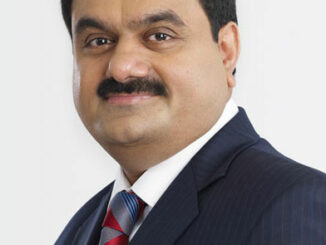
    NEW YORK (TIP): Moody’s Ratings has on Tuesday , November 26, 2024, affirmed the ratings of seven Adani Group companies from ‘stable’ to ‘negative’. In a statement the global rating firm said, “At the same time, we have changed the outlook on all seven issuers to negative from stable.”

    Earlier on Tuesday , November 26, 2024, Fitch Ratings also put Adani group firms on a negative rating watch.

    The seven affected issuers are:
    1. Adani Green Energy Limited Restricted Group (AGEL RG-1), which comprises Adani Green Energy (UP) Limited; Parampujya Solar Energy Private Limited; Prayatna Developers Private Limited,
    2. Adani Green Energy Limited Restricted Group (AGEL RG-2), which comprises Wardha Solar (Maharashtra) Private Limited, Kodangal Solar Parks Private Limited and Adani Renewable Energy (Rj) Limited,
    3. Adani Transmission Step-One Limited (ATSOL), Adani Transmission Restricted Group 1 (AESL RG1), which comprises Barmer Power Transmission Service Limited; Raipur-Rajnandgaon-Warora Transmission Ltd;
    4. Sipat Transmission Limited; Thar Power Transmission Service Limited; Hadoti Power Transmission Service Limited; Chhattisgarh-WR Transmission Limited, and 5. Adani Electricity Mumbai Limited (AEML).
    6.Adani Ports and Special Economic Zone Limited (APSEZ) and
    7. Adani International Container Terminal Private Ltd (AICTPL) have also been subjected to an outlook change from stable to negative, Moody’s said.

    Moody’s said its rating actions follow the indictment of Adani Green Energy Ltd’s (AGEL) chairman Gautam Adani and several senior management team members by the US Attorney’s Office in a criminal case and the filing of charges by the US Securities and Exchange Commission (SEC) in a civil case. The charges and allegations include: (1) bribery of Indian government officials, (2) securities and wire fraud, (3) conspiracy to violate the US Foreign Corrupt Practices Act and obstruct justice, (4) false statements made in AGEL’s annual reports, and (5) false statements made to the US government in relation to its investigation into the group.

    Identifying governance risks as material for its rating action, Moody’s said the negative outlook considers that this indictment of Mr. Adani and other senior Adani executives “will likely weaken Adani Group’s access to funding and increase its capital costs” and recognizes “the possibility of broader weaknesses in the governance structure across the rated Adani group entities as well as potential operational disruptions, including on their capital spending plans, while legal proceedings are going”.

    “Although the allegations and the charges made by US Attorney’s Office and SEC pertain to AGEL’s chairman and senior management team members, we believe they could have a broader credit impact on all rated Adani Group issuers, given Gautam Adani’s prominent role as chairman of each of the rated entities or their parent companies as well as the controlling shareholder,” it reasoned.

    The firm said an upgrade of these firms’ ratings is unlikely in the near term, given the negative outlook on all seven issuers. “However, we could change the rating outlooks to stable if legal proceedings conclude clearly with no material negative credit impact,” it noted, adding that the rated firms could also be subjected to downgrades based on specific risks relating to each business, including “access to funding” challenges that may arise for a couple of them.

  • U.S. court issues arrest warrant for Gautam Adani: report

    U.S. court issues arrest warrant for Gautam Adani: report

    NEW YORK (TIP): Following the Gautam Adani’s indictment in the U.S. over an alleged multi-billion-dollar fraud scheme, a New York judge has issued a warrant for Mr . Adani’s arrest, media reports said. According to ABC News, quoting court records, the arrest warrant will be given to foreign law enforcement authorities.

    Earlier, the U.S. Securities and Exchange Commission (SEC) has charged billionaire Gautam Adani, founder and chairman of the Adani Group, with allegedly defrauding American investors and bribing officials. The SEC alleged that the bribery scheme was orchestrated to enable renewable energy companies Adani Green and Azure Power to capitalize on a multi-billion-dollar solar energy project awarded by the Indian government.

    Adanis knew of U.S. probe when they sold ‘bribe-linked assets’ to TotalEnergies, say prosecutors

    In September 2024, TotalEnergies paid $444 million into a joint venture with Adani Green Energy for a 50% stake in 1.15 gigawatts of solar installations at the Khavda solar park. File. In September 2024, TotalEnergies paid $444 million into a joint venture with Adani Green Energy for a 50% stake in 1.15 gigawatts of solar installations at the Khavda solar park. File | Photo Credit: Reuters

    “Gautam and Sagar Adani knew their renewable energy company was under U.S. investigation for suspected bribery when they sold part of India’s largest solar park to France’s TotalEnergies,” prosecutors alleged in legal documents reviewed by Reuters.

    TotalEnergies did not immediately respond to a request for comment on Friday (November 22, 2024) on whether it knew the Adanis were being probed by U.S. authorities over an alleged bribery and fraud scheme when it bought the Khavda solar stake.

    U.S. prosecutors on Thursday (November 23, 2024) charged eight people — including Gautam Adani, his nephew Sagar Adani, and the former CEO of Adani Green Energy Limited — with promising and then making improper payments to officials between July 2021 and 2024 to ensure the solar project’s success.

    In September 2024, TotalEnergies paid $444 million into a joint venture with Adani Green Energy for a 50% stake in 1.15 gigawatts of solar installations at the Khavda solar park — the project at the heart of the bribery charges.

    The French oil and gas company is not named in the criminal case. The Adani Group has called the allegations baseless. It did not immediately respond to an email seeking comments about this story.

    According to the U.S. indictment, FBI special agents served Adani Green Energy Executive Director Sagar Adani with a search warrant and grand jury subpoena in March 2023 – more than a year before the sale to TotalEnergies. These documents identified Adani Green Energy, its former CEO Vneet Jaain, and chairman Gautam Adani as under investigation for alleged bribery to obtain business advantages for the firm. TotalEnergies bought a 20% stake in Adani Green Energy in January 2021 — after the company won what was then the world’s largest solar order, and just months before the alleged payments to officials began.

    Sangkaran Ratnam, TotalEnergies’ country chair for India and the French firm’s nominee to the board of directors of Adani Green Energy, did not respond to a request for comment on whether he had been aware of the investigation at the time TotalEnergies bought the stake in the Khavda assets.

  • Red alert on the Adani front

    Red alert on the Adani front

    Action by US authorities calls into question India’s capital market regulation

    From weak regulatory oversight to the blurring of lines between corporate and political interests across political parties, this scandal has laid bare challenges that India can no longer afford to ignore if it wants to maintain its position as an attractive investment destination and be seen as an economic powerhouse.

    By Sucheta Dalal

    The Adani Group, one of India’s most influential and high-profile conglomerates, finds itself in the crosshairs of an international controversy. In a damning indictment, the US Department of Justice (Eastern District, New York) and the Securities and Exchange Commission (SEC) have, in a joint action, filed civil and criminal charges, accusing the group of bribery, fraud, obstruction of justice and violations under the stringent Foreign Corrupt Practices Act (FCPA). This scandal has laid bare challenges that India can no longer afford to ignore if it wants to maintain its position as an attractive investment destination and be seen as an economic powerhouse.

    The alleged bribery scheme centers on a $6-billion contract awarded to Adani Green Energy Ltd by Solar Energy Corporation of India (SECI) in 2020. This was touted as a game-changer for India’s renewable energy ambitions. However, the indictment claims that the project faced viability issues due to a lack of interest among state electricity utilities to buy the expensive power it generated. The group allegedly resorted to bribing officials of various state electricity utilities (Andhra Pradesh, Odisha, Tamil Nadu, Chhattisgarh and Jammu & Kashmir) to buy power from the SECI. In doing so, it violated the declarations made under the FCPA and indulged in a series of misrepresentations to cover its tracks and also attempted to derail the investigation.

    The 54-page indictment by the US Justice Department details how and why the FCPA is applicable in this case and directly links Gautam Adani, his nephew Sagar Adani and key officials of the group in the payment of over Rs 2,000 crore as bribes in India. Arrest warrants against Gautam and Sagar have also been handed over to foreign law enforcement agencies. A statement from the White House that it is aware of the action signifies the seriousness of the matter.

    Although the Adani Group has denied the allegations, terming them baseless, it is less credible this time because of the revelations in the indictment by the Justice Department. The scandal has sent shockwaves across global markets and the impact on the group has been on multiple levels. It has also raised critical questions about how Indian businesses are run, the role of our market regulator and the extent to which political clout shapes economic outcomes.

    Stock prices of all Adani Group companies fell, while some key group energy stocks crashed by 10-22 per cent and fell further on November 21, when the broader market went up ferociously. The impact on business has also been significant. Another immediate fallout was that Adani Green Energy Ltd had to postpone a $600-million bond offering. GQG Partners, an investment management company listed in Australia, which made significant investments in the group even after the Hindenburg Research disclosures, informed the stock exchange that it was reviewing the situation with regard to its portfolios after the US action.

    The next-level impact will be seen in the group’s global businesses, which have attracted controversy in many countries. Kenyan President William Ruto was the first to respond by cancelling airport and energy deals of over $2.5 billion. The airport project was the subject of enormous controversy, public protests, senate hearings and litigation. We are likely to see similar action in other jurisdictions where Adani projects have attracted protests or controversy.

    In 2022, there were allegations that the Indian government pressured Sri Lanka over handing a renewable energy project to the Adani Group. The Adani power project which supplies 10 per cent of the electricity to Bangladesh is already mired in controversy, and the group has been cutting power supply in a bid to recover payments. The Bangladesh High Court has ordered a high-level probe into the power deal with the group. The group has also been facing massive public protests over its coal mines in Australia.

    Given the group’s enormous and open influence over the NDA government and proximity to the Prime Minister himself, this case will not be viewed as just another instance of corporate wrongdoing. As the legal process unfolds, it will not only test the group but also India’s broader corporate governance and regulatory framework. Under US laws, the charges themselves can be settled by negotiating a payment, without admitting or denying guilt, but it will be a hard bargain with many geopolitical implications in view of the global spread of the Adani empire and influence over India’s ruling establishment.

    The US action calls into question our capital market regulation. It is embarrassing that the Securities and Exchange Board of India (SEBI) has drawn a blank in its investigations despite enormous public scrutiny and an unprecedented Supreme Court-appointed committee. It is also hard to believe that despite being a member of the International Organization of Securities Commissions and having a bilateral agreement with the US SEC under an MoU on cooperation, consultation and technical assistance dating back to 1998, SEBI reportedly sought information from the US only after the SEC and the Justice Department went public with their action.

    Logically, the US action ought to open a broad, multi-agency investigation in India over diverse charges levelled against it over its corporate acquisitions across sectors and states. A failure to do so will lead to long-term reputational damage to India’s flawed business ecosystem. Going forward, companies seeking global capital are bound to face greater scrutiny and higher skepticism.

    From weak regulatory oversight to the blurring of lines between corporate and political interests across political parties, this scandal has laid bare challenges that India can no longer afford to ignore if it wants to maintain its position as an attractive investment destination and be seen as an economic powerhouse.
    (Sucheta Dalal is an Indian business journalist and author)

  • The Adani Saga: A Tale of Alleged Corruption, Political Patronage, and Global Embarrassment

    By Prof. Indrajit S Saluja
    By Prof. Indrajit S Saluja

    In recent years, the Adani Group, helmed by billionaire Gautam Adani, has repeatedly found itself at the center of allegations involving corruption, regulatory violations, and financial misconduct. Once hailed as a symbol of India’s economic resurgence, the group is now under the scanner for alleged business malpractice and crony capitalism. The implications of these accusations are far-reaching, casting a shadow on India’s governance and tarnishing its global reputation.

    For years, critics and independent watchdogs have accused the Adani Group of circumventing business norms. The conglomerate, which spans infrastructure, power, mining, and logistics, has often been accused of exploiting regulatory loopholes and leveraging its political connections to gain an unfair advantage. Allegations have ranged from tax evasion to environmental violations, and more recently, to bribery for securing contracts.

    The tipping point came in January 2023, when the U.S.-based financial research firm Hindenburg Research published a damning report accusing the Adani Group of stock manipulation, accounting fraud, and operating through shell companies in tax havens. The report, which sent Adani Group shares into a freefall, claimed the conglomerate had inflated its stock values to raise funds and sustain its operations. Hindenburg’s findings raised alarms about corporate governance and transparency within one of India’s largest business houses.

    The latest blow to the Adani Group’s credibility comes from the U.S. Securities and Exchange Commission (SEC). The SEC has reportedly indicted Adani and his associates for allegedly using funds raised from American investors to bribe Indian state governments for lucrative contracts. This marks a significant development, as it places the Adani Group under U.S. jurisdiction due to the involvement of American shareholders.

    The allegations highlight not just the misuse of foreign investments but also the complicity of Indian state governments in enabling such practices. The SEC’s indictment underscores the global dimensions of the Adani controversy, suggesting that the conglomerate’s operations have far-reaching implications beyond Indian borders.

    In India, the revelations have led to a growing demand for a thorough investigation into the Adani Group. Opposition parties, activists, and civil society organizations have called on the Modi government to probe the allegations, arguing that the credibility of India’s regulatory framework is at stake. However, the government’s response has been conspicuously muted.

    Prime Minister Narendra Modi’s perceived closeness to Gautam Adani has added fuel to the fire. Critics argue that Adani’s rapid rise to become India’s richest man coincided with Modi’s ascent to national power. Reports suggest that Adani’s financial support was instrumental in Modi’s political campaigns, both as Chief Minister of Gujarat and later as Prime Minister. This symbiotic relationship has led to widespread allegations of crony capitalism, with Modi accused of shielding Adani from scrutiny.

    The Securities and Exchange Board of India (SEBI), the country’s financial regulator, has also come under fire for its handling of the Adani case. SEBI Chairperson Madhabi Puri Buch has faced accusations of financial irregularities and favoritism, further eroding public confidence in the institution. Critics argue that SEBI’s inability to act decisively against the Adani Group reflects broader systemic issues, where regulatory agencies are compromised by political interference.

    The Adani controversy is not an isolated case. Over the years, the Modi government has been accused of protecting individuals and entities close to the ruling party. From allegations of corruption involving party leaders to irregularities in awarding contracts, the pattern of shielding wrongdoers has become a recurring theme. These actions undermine Modi’s claims of providing a “clean administration” and have led to a growing perception that the government prioritizes loyalty over accountability.

    The fallout from the Adani controversy extends beyond India’s borders. The SEC’s involvement has brought international attention to India’s regulatory lapses and political favoritism. For Indians abroad, particularly in countries like the United States, the scandal has become a source of embarrassment. Diaspora communities now face uncomfortable questions about the state of governance and corruption in their homeland, tarnishing India’s image as an emerging global power.

    The Adani controversy underscores the urgent need for institutional reforms in India. Regulatory agencies like SEBI must be empowered to operate independently, free from political interference. Transparency and accountability must be prioritized to restore public trust in governance.

    The Modi government must also address the growing perception of cronyism. Failure to do so risks not only its political credibility but also the nation’s economic stability. A government that claims to be committed to the welfare of its citizens cannot afford to turn a blind eye to allegations of corruption, especially when they implicate some of the country’s most powerful individuals and institutions.

    The allegations against the Adani Group are more than just a corporate scandal; they are a test of India’s democracy and its ability to uphold the rule of law. The government’s unwillingness to act decisively sends a troubling message: that wealth and political connections can place individuals above accountability.

    As the global spotlight continues to shine on the Adani controversy, India must confront the uncomfortable truths about its governance and regulatory systems. For a nation aspiring to be a global leader, the price of inaction is too high. It is time for India to clean house, not just for its own sake, but to restore its standing on the world stage.

  • Adani to invest $75 bn to scale up renewable energy portfolio

    Adani Group has plans to invest $75 billion on energy transition initiatives by 2030, its chairman Gautam Adani said on Wednesday. The investments will boost the group’s vision to have 45 gigawatt of renewable energy capacity by 2030, Adani said. “We are committed to large-scale renewables, developing an indigenous fully integrated manufacturing ecosystem and green hydrogen solutions.
    At the Adani portfolio level, a total investment of $75 billion by 2030 on our energy transition initiatives will further our vision to have 45 GW renewable energy capacity by 2030 and strengthen the pivotal role played by AGEL in India’s glide path to decarbonisation,” the group chairman said. The investments will be executed through Adani Green Energy Ltd.

  • An Open Letter to United States Congress

    Ref.: Unknown US companies and individuals providing services or products including raising capital in violation of The U.S. Financial Crimes Enforcement Network (FinCEN) standards and dealing with a Ghost company working for Russia in violation of US sanctions against Russia.

    Hon. Chairman McHenry, Hon. Chairman Wyden & Committee Members: Greetings. 

    The undersigned wants to draw the attention of the Honorable Committee that unknown US companies and individuals are providing services or products including raising capital to two Indian business entities that has become a threat to US Financial System and Security of our country. It is my humble request to the Honorable members of the committees to investigate these unknown US companies and individuals that have provided or are providing services or products or capital to the two Indian corporations in gross violation of various US Laws.

    • Adani Group is raising money in USA for the last 4 years in violation of US Laws:

    Adani Group of companies is owned by Gautam Adani with personal relations with India’s PM Modi dating back to the late 1990’s. It won’t be an exaggeration if Gautam Adani is called “The Poster Boy of Gangster Capitalism of India.” Adani’s status as a recipient of favors from Narendra Modi of BJP has been the subject of continuous criticism in India since Modi was Chief Minister of the State of Gujarat for 13 years from 2001 to 2014. The favors gathered speed after Modi took over as PM of India in 2014. Prior to Modi entering Gujarat politics in 1998, Adani was a key ally of Gujarat BJP leaders for years. BJP has been ruling Gujarat since 1995 to the present and it is a well-known fact that Adani helped Modi to become CM of Gujarat in 2001 and later PM of India in 2014. Harvard’s ranking of states and districts in Human Development Index; Gujarat has the lowest rank at 28 out of 28.  India’s ranking under PM Modi in the United Nations HDI has fallen to 132 of 191 countries in 2022. 

    Forbes, Jul 17, 2014: Adani has, over the years, leased 7,350 hectares–much of which he got from 2005 onward–from the (Modi) government in Mundra. He got the 30-year, renewable leases for as little as one U.S. cent a square meter (the rate maxed out at 45 cents a square meter). He in turn has sublet this land to other companies, including state-owned Indian Oil Co., for as much as $11 per square meter. Between 2005 and 2007 at least 1,200 hectares of grazing land was taken away from villagers. See Link # 12 & 8 Adani News

    (https://www.forbes.com/sites/meghabahree/2014/07/17/adani-finds-a-savior-in-the-modi-govt/?sh=1a141d54639f)

    Newsclick EXCLUSIVE: How Gujarat Government Helped Adani’s Port Company

    (https://www.newsclick.in/eXCLUSIVE-how-gujarat-government-helped-adani-port-company#:~:text=The%202012%2D13%20report%20of,the%20country%20in%20Mundra%2C%20Gujarat.)

    The Adani Group was established in 1988 and became publicly traded in 1994. But its real rise happened under Modi’s reign in Gujarat. From 2002 to March 2013 the group’s revenue rose from $765 million to $8.8 billion while net profits climbed even faster. Gautam Adani’s meteoric success started under CM Modi of Gujarat in 2001 and became an exceptional international story after Modi became PM of India in 2014. From an importer of primary polymers for small-scale industries, Adani grew to become the  biggest private operator of ports, Airports, and largest producer of electricity, under the preferential patronage of PM Modi. In addition, the Adani group has substantial interests in a variety of sectors: defense, coal mining, oil and gas exploration, gas distribution, transmission and distribution of electricity, civil construction and infrastructure, multi-modal logistics, international trade, education, real estate, edible oils, and food storage. His companies currently trade in over 30 commodities with at least 28 countries. At the same time, Adani ports are notorious for drug hauls for billions of dollars in India. See Link # 13 & 14 Adani.

    (https://www.bbc.com/news/world-asia-india-58634575)

    (https://thewire.in/government/heroin-seuzure-adani-mundra-worry-indian-authorities)

    The fact that Adani Group is tightly controlled by family members with very dubious records is well known in India and in countries where they are operating. The corporate structure is totally opaque with dozens of shell companies in various tax havens since the inception of Adani Group. The money is hard to track. Most have flowed into trusts, which don’t report financial results, making it impossible to tell where it ended up. In other instances, recipients simply report in filings that the funds came from a “related party,” offering no other details. And public disclosure in Mauritius, the Cayman Islands and UAE is scant. Moreover in 2018, the provision of dealing with an ‘opaque structure’ and requiring a Foreign Portfolio Investment (FPI) to disclose every ultimate natural person at the end of the chain of every owner of economic interest with the FPI was done away with by Modi government to benefit Adani.” This rickety structure has become a debt-ridden house of cards with rapid diversification after 2014 when Modi become PM of India.

    Louis Vuitton. Tesla. Amazon, Apple, Microsoft; the businesses behind the richest people in the world need no introduction. But last year, Gautam Adani, a state -created Billionaire, a name that does not command the same global recognition joined this rarefied list by becoming the 2nd richest person in the world in Sep 2022, with a net worth of $154 billion, up from $70 Million in 1998. The overall market capitalization of the 10 Adani Group stocks stood at its peak of $232 billion on Jan. 24, 2023, the day New York based Hindenburg Research released its report.

    Hindenburg accused that Adani group has “engaged in a brazen stock price manipulation, stock parking, accounting fraud, round tripping of cash, Import-Export scams, money laundering through 38 offshore shell companies etc. over the course of decades.” The report describes a galaxy of shell entities based in the Caribbean, Mauritius and the United Arab Emirates controlled by the Adani family. Further it accused that Gautam Adani’s elder brother Vinod Adani has played a pivotal part in perpetuating what it alleged is “the largest con in corporate history.” See Link # 1 Adani News

    (https://hindenburgresearch.com/adani/?fbclid=IwAR1o0U99rToDlgcI8s38bG2uJ3tUzQd1ijT3R2Hi7KJkeIe42u3aNkamshk)

    Then on Jan 29th, 2023, Adani group in its 413-page written rebuttal, denounced Hindenburg’s report as “baseless” and “malicious,” and accused the firm of having an “ulterior motive” for publishing the “missive.” It said Hindenburg’s actions represent a “calculated attack on India, the independence, integrity, and quality of Indian institutions, and the growth story and ambition of India.” See Link # 2 Adani News

     (https://www.adani.com/-/media/Project/Adani/Invetsors/Adani-Response-to-Hindenburg-January-29-2023.pdf)

    Same day on Jan 29, 2023, Hindenburg Research replied, “Fraud Cannot Be Obfuscated By Nationalism Or A Bloated Response That Ignores Every Key Allegation We Raised.       See Link # 3 Adani News

    (https://hindenburgresearch.com/adani-response/)

    What Hindenburg exposed was well known to Indian journalists for a long time, but they were forced to keep quiet about Adani’s meteoric rise because of fear of reprisal and heavy legal cost for defending themselves in million dollars lawsuits filed by Adani. On top of that, the world’s top reputed Mutual Fund Managers including a few Indian Managers also knew about Adani and for that reason they never invested in the Adani Group of companies. According to Fisdom Research, as of December 2022, mutual fund industry has a negligible exposure of 0.64 per cent to Adani group companies. Of which 0.18 per cent was through the passive route, where the fund manager had no option but to invest in stocks. See Link # 7 Adani News

    (https://themorningcontext.com/business/why-do-these-foreign-funds-love-adani-group-companies)

    Tim Buckley, an analyst in Sydney, Australia, who has followed Adani’s business for more than a decade said“The big issue is that Adani has spent the last four years in raising debt on Wall Street. If you raise money in America, you have to play by America’s rules.”

    Surprisingly even after Hindenburg Report, Rajiv Jain came up with a rosy presentation to the investors in his Fund GQG Partners, based in Florida by investing $1.9 Billion by calling Adani stocks “could be multibaggers” over five years. Can Rajiv Jain deny the existence of Shell Companies of Adani Bros that invested in Adani Group? Can Rajiv Jain deny the fact that money used by these Shell Companies (1) Could be money stolen from Indian public with the help of politicians OR (2) Could be Drug Money OR (3) illegal Arms Sale Money to Rouge Regimes or terrorist groups OR (4) Chinese Mafia Money OR (5) Russian Mafia Money OR (6) Middle East Royal Family member’s money siphoned off from their own Kingdoms. OR (7) Give detailed response/answers to 88 questions raised by Hindenburg Research.

    On top of that Rajiv Jain is peddling lies in the USA based on Modi aka Indian Media reports that Indian Supreme Court has given a clean chit to Adani. Bloomberg columnist Andy Mukherjee wrote that SC panel’s job was not to return a finding on allegations against Adani by Hindenburg.

    Saaransh Maurya, a 22-year-old assistant manager, has filed an affidavit in Supreme Court on behalf of SEBI (Securities and Exchange Board of India). Reacting to it, Shiv Senna (UBT) MP Priyanka Chaturvedi wrote, “Must be either super experienced…or naive enough.” Meanwhile, columnist Andy Mukherjee said, “Young enough to be hero of a John Grisham…novel.” See Link # 10 Adani News

    (https://economictimes.indiatimes.com/news/company/corporate-trends/view-adani-probe-will-only-produce-heat-not- light/articleshow/100389548.cms?utm_source=contentofinterest&utm_medium=text&utm_campaign=cppst)

    According to “The Morning Context, “if you remove these [offshore] funds, the effective [public] shareholding in Adani Enterprises comes down to only 10%.” In Adani Transmission, the “effective public float is about 7-8%.” This is in violation of SEBI’s own rules that listed companies are required to maintain a minimum public holding (or free float) of 25%. This allows a company to raise money from the market. [Note that stock exchanges froze the promoter shareholding of Patanjali Foods after the company failed to meet the 25% public shareholding.] But the Supreme Court’s expert committee report says that these provisions requiring FPI to disclose “ultimate natural person” were done away with in 2018.

    Adani, Jeffrey Skilling, Bernie Madoff, Ken Lay, Bernie Ebbers, Scott Sullivan, Robert Maxwell…. There’s an endless parade of swindlers who can pry apart accounting standards and financial regulations wide enough to drive a gigantic con through. They appear every 3 to 5 years. All of them have been prosecuted and locked up in Jails except Biggest Conman in Corporate history Gautam Adani. He is being defended by PM Modi’s Cabinet Ministers, BJP MP’s, Party officials, RSS & entire Media owned by friends of Modi as well as Adani; for being the biggest financial criminal in the corporate history of India; surpassing the other state created thug billionaires of India since 1947.

    What the Committee needs to understand is that Adani Group has not invented anything, nor built anything, nor come up with an original business idea like Amazon. It is built on only fraudulent agenda of massively looting public wealth of India with the help of politicians. This wealth was result of the sacrifices made by millions of poor Indians who donated their hard-earned assets to build a better nation. Adani is a threat to the financial system and security of America and must be stopped from operating in America. The US companies or individuals that have helped Adani or are helping him to raise funds and investments in America must be prosecuted. These financially well qualified entities or individuals don’t have a benefit of doubt that they were not aware of Adani’s background and history. People like Rajiv Jain that are promoting Adani in America are a danger to the moral and ethical fiber of our society. Rajiv Jain has no moral & ethical values the proof is his investment in Fraudster Adani Group that may have been created by looting Indian public wealth with the help of criminal politicians installed with the looted money. Since Rajiv Jain is more concerned about “Returns on his Fund’s Investments” than Ethics & Morality, tomorrow he can promote investments in Gambling or Prostitution or Drug or Arms Cartels that can give him better returns than Adani.

    2.Gatik Ship Management: A Ghost company backed by Russian’s received services from Unknown US companies or individuals in Violation of US Sanctions against Russia:

    Gatik’s Main Business: Crude Oil Shipments on the Russia-India Route. Gatik purchased services related to their shipping business from American Companies despite US sanctions against Russia. These US companies must be investigated and prosecuted for working against America. See Link # 1 Gatik News

    (https://www.wsj.com/articles/upstart-indian-shipper-helps-get-russian-oil-to-market-11674985846)

    As India does not recognize US sanctions imposed on Russia, it became the biggest buyer of Russian crude oil. Before the Ukraine war, Russia supplied less than 1 per cent of India’s crude. It now accounts for about 30 per cent, according to official trade statistics. India benefited from millions of barrels of Russian oil, sold at a heavy discount than to other buyers. During the first quarter of 2023, the oil bought by India cost $48.03 per barrel — $10 less than the average paid by other countries, according to Kyiv School of Economics research based on Russian oil sale records. India is leading the group of ‘laundromat countries’ that buy heavily discounted Russian crude oil, refine it, and sell the processed products to European countries, thus sidestepping European & US sanctions against Russia.

    Gatik which means “speed” in Sanskrit, was born out of nowhere to become the biggest transporter of Russian oil. Gatik has the postal address of a rundown Neptune Magnet Mall in Mumbai and has become one of the biggest international oil shipping giants in over the past 18 months. It owned only 2 chemical tankers in 2021 and by April 2023 it had a fleet of 58 vessels with over 50 crude oil tankers with an estimated value of over $1.6 billion. Great Eastern Shipping founded in 1948, India’s biggest private ship-owner by fleet size, has 67 ships comprising just 8 crude tankers.

    Gatik also shares their Mall office/address with little known Mumbai-registered company Buena Vista Shipping that has an office in Dubai also. Nautical Job boards show the company is recruiting heavily for a variety of roles on the ships in the past year, including chief cooks and oilers. There is no information available about Gatik’s relationship with Buena Vista Shipping and who funded the rapid expansion of Gatik’s fleet is a great mystery for the international oil market.

    According to the Indian Register of Shipping data most of Gatik’s ships are managed by Indian firms including Gaurik Ship Management, Geras Ship Management, Caishan Ship Management, Galena Ship Management, Zidan Ship Management and Plutos Ship Management. As per shipping database Equasis, these companies handle safety and environmental-related issues of the vessels while commercial operations are managed by Gatik.

    The origins and ownership all the business associated with Gatik are a mystery and no details about the companies could be found on the Indian corporate affairs ministry’s website. But shipbrokers, analysts and commodity traders suspect a link with its biggest client: Rosneft, the Kremlin-controlled and Russia’s biggest crude oil producer.  Because Rosneft is selling the cargos on a “Cost Insurance and Freight” basis meaning it is responsible for the delivery of the crude to the destination port in India-rather than the “Free on Board” basis before the Ukraine war, where the buyer was organizing the shipping. See Link # 3 Gatik News

    (https://www.ft.com/content/6f81585c-321a-41fb-bcdb-579e93381671)

    According to Vessels Value’s Rebecca Galanopoulos out of almost 14,000 live tankers owned by 1,361 companies, 1341 own fewer than 10 live tankers; only 20 companies, including Gatik, own 50 or more. All but two of Gatik’s vessels are registered to single-vessel companies registered in the Marshall Islands and the ownership of those companies is not public. Gatik’s ultimate beneficial owner/owners are unknown. It does not even have a functioning website. It is almost exclusively servicing Russian oil and thus could be an ultimate example of Russian oil companies who would want to get into shipping to evade western sanctions since the Ukraine war.

    Gatik had majority of the Ships flagged to St. Kitts & Navis till April 2023. Now it is flagged to Gabon and Mongolia. Most Gatik’s ships do not hold insurance from any of the recognized large mutual providers from European countries. Gatik’s 34 vessels have used the protection and indemnity insurance from the American Club, which belongs to the International Group of PHYPERLINK “https://www.igpandi.org/about/”&HYPERLINK “https://www.igpandi.org/about/”I Clubs that insures most of the global tanker fleet. Lloyd’s Register and the American Bureau of Shipping (ABS) had provided safety certification that they have withdrawn recently and now an Indian agency is providing safety certification for most of Gatik’s vessels. See Link # 1 Gatik News

    (https://www.tradewindsnews.com/tankers/shadow-fleet-linked-gatik-reshuffles-ships-as-indian-owner-is-dumped-by-lloyd-s-register/2-1-1456834) 

    The Honorable Committee must investigate US insurers that were providing insurance to Gatik’s vessels despite sanctions against Russia. The US companies that were providing Safety Certification along with other US companies that was providing any services or goods or technology to Gatik must also be investigated for violating US sanctions against Russia.

    Respectfully Submitted

    Devendra Makkar 

    Encls.: Links to News Articles on Adani & Gatik 

    References to the News Articles about Adani Group of Companies:

    1. Adani Group: How The World’s 3rd Richest Man Is Pulling The Largest Con In Corporate History

    Published on January 24, 2023

    https://hindenburgresearch.com/adani/

    1. ADANI RESPONSE TO HINDENBURG RESEARCH: (413 PAGES)

    JAN. 29, 2023

    Hindenburg’s actions represent a “calculated attack on India, the independence, integrity, and quality of Indian institutions, and the growth story and ambition of India.”

    https://www.adani.com/-/media/Project/Adani/Invetsors/Adani-Response-to-Hindenburg-January-29-2023.pdf

    1. Hindenburg Research replied, “Fraud Cannot Be Obfuscated By Nationalism Or A Bloated Response That Ignores Every Key Allegation We Raised.

    JAN. 29, 2023

    In terms of substance, Adani’s ‘413 page’ response only included about 30 pages focused on issues related to our report. The remainder of the response consisted of 330 pages of court records, along with 53 pages of high-level financials, general information, and details on irrelevant corporate initiatives, such as how it encourages female entrepreneurship and the production of safe vegetables.

    Adani Failed To Specifically Answer 62 of Our 88 Questions.

    Of The Questions It Did Answer, The Group Largely Confirmed Or Attempted to Sidestep Our Findings

    https://hindenburgresearch.com/adani-response/

    1. The Adani short sale puts investor trust in India in doubt

    A rise in jingoistic nationalism has added a new element of impunity to the behavior of some corporate chiefs

    26 January 2023, by Andy Mukherjee

    https://www.tbsnews.net/bloomberg-special/adani-short-sale-puts-investor-trust-india-doubt-574566

    1. Hindenburg Gives a Master Class. Adani Flunks

    The Indian tycoon’s pulled share sale shows financial globalization can mint centi-billionaires — and cancel them.

    Feb. 1, 2023, By Andy Mukherjee

    https://www.bloomberg.com/opinion/articles/2023-02-02/adani-hindenburg-short-seller-s-masterclass-in-financial-globalization#xj4y7vzkg

    6. Adani Rout Puts Spotlight on Billions Flowing Through Mauritius

    March 8, 2023, by Chris Kay

    https://www.bloomberg.com/news/articles/2023-03-09/adani-short-seller-report-puts-focus-on-billions-flowing-through-mauritius#xj4y7vzkg

    1. Why do these foreign funds love Adani Group companies?

    Several Mauritius-based investment funds have Gautam Adani-led companies as over 90% of their portfolios. Why?

    April 26, 2021, by Jayshree P. Upadhyay

    https://themorningcontext.com/business/why-do-these-foreign-funds-love-adani-group-companies

    1. EXCLUSIVE: How Gujarat Government Helped Adani’s Port Company

    Feb. 7, 2020        Dilip Patel , Paranjoy Guha Thakurta

    https://www.newsclick.in/eXCLUSIVE-how-gujarat-government-helped-adani-port-company#:~:text=The%202012%2D13%20report%20of,the%20country%20in%20Mundra%2C%20Gujarat

    1. Probe sought into Adani company’s profits from overpriced, dirty coal.

    Feb 10, 2023     Nityanand Jayaraman

    https://www.adaniwatch.org/probe_sought_into_adani_s_profits_from_overpriced_dirty_coal?fbclid=IwAR2JdrZl7uOX504-zIBDjeizGWZ3Feu6icsFxtmZAbmcbnc1YHz4csX-5tA

    1. View: Adani (SC) probe will only produce heat, not light

    A toothless expert panel looking over the shoulder of a regulator that has its suspicions but no evidence, and no hope of generating any without the help of other sleuthing agencies, means only one thing: No matter how long it goes on, the Adani probe will only produce heat, not light.

    May 21, 2023, by Andy Mukherjee

    https://economictimes.indiatimes.com/news/company/corporate-trends/view-adani-probe-will-only-produce-heat-not-light/articleshow/100389548.cms?utm_source=contentofinterest&utm_medium=text&utm_campaign=cppst

    1. Deloitte Flags Adani Ports Deals, Cites Need for Review

    Auditor spotlights transactions with Hindenburg named firms.

    Can’t comment without an external independent review: Deloitte.

    May 31, 2023, By Advait Palepu and Chris Kay

    https://www.bloomberg.com/news/articles/2023-05-31/deloitte-flags-adani-port-transactions-citing-lack-of-review#xj4y7vzkg

    1. Indian Billionaire Gautam Adani Finds A Savior In The Modi Govt

    Adani has, over the years, leased 7,350 hectares–much of which he got from 2005 onward–from the government in Mundra. He got the 30-year, renewable leases for as little as one U.S. cent a square meter (the rate maxed out at 45 cents a square meter). He in turn has sublet this land to other companies, including state-owned Indian Oil Co., for as much as $11 a square meter. Between 2005 and 2007 at least 1,200 hectares of grazing land was taken away from villagers.

    Jul 17, 2014, by Meghna Bahree

    https://www.forbes.com/sites/meghabahree/2014/07/17/adani-finds-a-savior-in-the-modi-govt/?sh=1a141d54639f

    1. Mundra Port: Nearly three tons of heroin seized at Gujarat port

    21 September 2021

    Indian anti-smuggling intelligence officials have seized nearly three tons of heroin – reportedly worth around $2.7bn (£1.9bn) – in a major operation at a port in Gujarat state.

    https://www.bbc.com/news/world-asia-india-58634575

    1. Heroin Seizures at Adani’s Mundra Remain a Source of Worry for Indian Authorities

    Aug. 3, 2022

    https://thewire.in/government/heroin-seuzure-adani-mundra-worry-indian-authorities

    1. The Adani Files (Australia)

    A short history of corruption, destruction, and criminal activity.

    https://adanifiles.com.au/#crime-corrupt

    References to the News Articles about Gatik Ship Management

    1. Upstart Indian Shipper Helps Get Russian Oil to Market

    Russia has successfully managed to keep the country’s oil moving to markets of the world, defying the fears that sanctions levied last month would result in a plunge in the country’s exports. Gatik Ship Management, which took control of 25 tankers after the invasion of Ukraine, now shuttles Russian crude along new trade routes.

    By Joe Wallace, Costas Paris  and Anna Hirtenstein

    Jan. 29, 2023

    https://www.wsj.com/articles/upstart-indian-shipper-helps-get-russian-oil-to-market-11674985846

    1. Indian Shipper Gatik Loses US P&I Insurance

    Fri, Apr 14, 2023

    By: Simon Martelli, London & Emily Meredith, Washington

    https://www.energyintel.com/00000187-81c9-dc4f-a7e7-9bfd941d0003

    1. The unknown Indian company shipping millions of barrels of Russian oil

    Gatik became one of the world’s largest vessel owners in little over a year, transporting crude to India for Rosneft

    Tom Wilson and Chris Cook in London,

    Chloe Cornish in Mumbai and Anastasia Stognei in Riga

    MAY 4, 2023

    https://www.ft.com/content/6f81585c-321a-41fb-bcdb-579e93381671

    1. Exclusive: Lloyd’s Register drops ships of top Indian carrier of Russian oil

    By Jonathan Saul and Nidhi Verma

    May 25, 2023

    https://www.reuters.com/markets/commodities/lloyds-register-drops-ships-top-indian-carrier-russian-oil-2023-05-25/

    1. Shadow fleet-linked Gatik reshuffles ships as Indian owner is dumped by Lloyd’s Register

    A string of new management companies emerge after operator suffers flag and insurance woes.

    26 May 2023

    By Paul Peachey in London

    https://www.tradewindsnews.com/tankers/shadow-fleet-linked-gatik-reshuffles-ships-as-indian-owner-is-dumped-by-lloyd-s-register/2-1-1456834

    1. Top shipper of Russian oil secures Indian cover as Western certifiers exit

    By Nidhi Verma and Jonathan Saul

    May 31, 2023

    https://www.reuters.com/business/top-shipper-russian-oil-secures-indian-cover-western-certifiers-exit-2023-05-30/

    1. India’s Gatik finds alternative to Lloyd’s for vessel registration – report.

    May 31, 2023

    India’s Gatik Ship Management has found an alternative vessel registrar to the maritime classification society Lloyd’s Register

    https://www.qcintel.com/article/india-s-gatik-finds-alternative-to-lloyd-s-for-vessel-registration-report-14264.html

    1. Lloyd’s Register in turn excludes the Indian tanker owner Gatik Ship Management

    June 2, 2023, By: Adeline Descamps

    After the ABS classification society, the P&I American Club and the Saint-Kitts-et-Nevis register, the Lloyd’s Register in turn withdraws its services from Gatik Ship Management.

    The Indian shipowner has become one of the most active transporters of Russian crude to India by means of a clandestine fleet.

    https://euro.dayfr.com/business/324086.html

    Compiled by:

    Devendra Makkar

    568 Ashwood Rd.

    Springfield, NJ 07081

    davemakkar@yahoo.com

    973 760 6006 

    CC:

    Honorable Maxine Waters                        Honorable Mike Crapo

    Ranking Member                                                 Ranking Member

    Financial Services Committee                           Committee on Finance (US Senate)
    2221 Rayburn House Office Building              219 Dirksen Senate Office Building
    Washington, DC 20515                                      Washington, D.C. 20510

    Fax: 202 225 7854                                               Fax: 202 228 0554

  • Adani group pulls out of M&As; plans to focus on debt prepayments

    Apart from calling off buying Macquarie’s road assets, the Adani group has withdrawn from a series of acquisition opportunities, including of power plants, a retail firm, a power trader and road projects since January this year, say bankers. The focus of the group is to conserve cash and prepay debt rather than acquiring new assets.
    “Till early this year, bankers would pitch every asset for sale with the Adani group. But now, the group is keen to expand their existing businesses, rather than acquiring stressed assets, so it is going slow on new acquisitions,” an investment banker said.
    Since January this year, the group withdrew from the race to acquire SKS Power, a stressed coal-based power plant in Chhattisgarh. In February, the group called off a plan to acquire DB Power’s thermal power assets at an enterprise valuation of Rs 7,000 crore. In the same month, it pulled out to make an offer to PTC India, a power trader. Later, the group did not make an offer for Future Retail after submitting its expression of interest to buy the asset via a joint venture company. On Thursday, Adani Enterprises announced that it will not go ahead with acquiring Macquarie group’s two road companies at an enterprise valuation of Rs 3,100 crore.
    Bankers said the group’s absence from the acquisition race has given an opportunity to foreign private equity players, which are keen to buy into Indian infrastructure projects. Top officials of American private equity giants Blackstone and KKR said they were keen to invest in the Indian infrastructure projects which gives good returns.

  • No regulatory failure: SC panel on Adani

    No regulatory failure: SC panel on Adani

    • Says SEBI probe has drawn a blank

    NEW DELHI (TIP): There was no evidence of stock price manipulation in Adani Group companies, a Supreme Court-appointed expert panel — which looked into allegations levelled by US-based short seller Hindenburg Research on January 24 — has said in its report. A separate SEBI probe into alleged violation in money flows from offshore entities in the Adani Group has “drawn a blank” and pursuing the case could be a “journey without a destination”, the six-member panel headed by Justice (retd) AM Sapre said. “At this stage, taking into account the explanations provided by SEBI, supported by the empirical data, prima facie, it would not be possible for the committee to conclude that there has been a regulatory failure around the allegations of price manipulation,” the committee said in its 178-page report.

    Clarifying that its remit was not to examine if price rise was justified, it said, “It is apparent that SEBI was apparently engaged with developments and price movements in the market.” The panel, however, said there was evidence of a build-up in short positions on Adani Group stocks ahead of the Hindenburg Research report that alleged fraud, stock manipulation and money laundering at the group. Profits were earned from squaring off positions after prices crashed post publication of the damning allegations.

    The committee recommended that “there is a need to develop a proper enforcement policy” and “laying down criteria, on the basis of which SEBI may choose the wide-ranging scope of measures available to it”, including imposing monetary penalty and launching criminal prosecution.

    As the news about the Supreme Court-appointed expert panel became public, shares of Adani Group companies rose by almost four per cent in the afternoon session. Justice Sapre panel was set up by the top court on March 2.

  • India’s Parliamentary Democracy on Test: Parliament logjammed with neither side relenting

    India’s Parliamentary Democracy on Test: Parliament logjammed with neither side relenting

    • Both Houses put together functioned for just five minutes and 45 seconds on Thursday, March 16,  as pandemonium breaks out over Rahul speech, Adani row

    NEW DELHI / NEW YORK (TIP): India’s both  Houses of Parliament put together functioned for 345 seconds on March 16, 2023, with the ruling BJP unrelenting in its demand for an apology from Congress leader Rahul Gandhi and the Opposition refusing to back down on the call for a joint parliamentary probe into the Adani Group controversy.

    While Mr. Gandhi’s remarks abroad that democracy is under attack has drawn the BJP’s ire, the Opposition parties are insistent that the government breaks its silence on the Adani issue. To further press their point, several MPs from the Opposition organized a human chain in the Parliament premises. The Lok Sabha worked for two minutes and 20 seconds in the pre-lunch sitting and 50 seconds in the post lunch sitting. The Rajya Sabha functioned for one minute and 55 seconds in the morning and 40 seconds in the afternoon.

    Pandemonium broke out in the Lok Sabha right from the moment the House convened for the day. MPs on both sides tried to outshout the other. Trinamool Congress MPs were already in the well with black cloth tied around their mouths, accusing the Treasury benches of stalling Parliament for four days in a row.

    Asking the protesting MPs to return to their seats, Speaker Om Birla said: “I want to run the House, I want to give you enough opportunities and time to speak. You have to go to your seats. You come to the well and then go outside and say that you don’t get a chance to speak. This is not right.” The House was adjourned till 2 p.m. without even the procedural functions such as laying of the papers and standing committee reports. The post-lunch sitting was even shorter.

    In the Rajya Sabha, Trinamool MPs sported black gags in the well and other Opposition members stood on their seats shouting slogans.

    Chairman Jagdeep Dhankhar’s pleas to maintain order went in vain. In the afternoon, Deputy Chairman Harivansh faced a similar challenge. Even before the Upper House met at 2 p.m., the Trinamool MPs made a circle around the table of the House. Watch and Ward personnel were assigned near the Chair. Mr. Harivansh adjourned the House for the day without taking up any business.

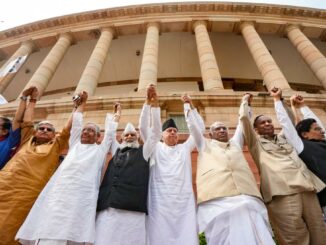
    Meanwhile, in the Parliament complex at 12:30 p.m., Opposition leaders formed a human chain questioning the government’s studied silence on the alleged stock manipulation by the Adani Group. Barring the Trinamool Congress, which did not participate in the protest, all major Opposition parties were represented, including the Congress, the DMK, the Samajwadi Party, the Aam Aadmi Party, the Rashtriya Janata Dal, the Shiv Sena (Uddhav Thackeray faction), the Jharkhand Mukti Morcha, the Communist Party of India, the Communist Party of India (Marxist), the Revolutionist Socialist Party, the Indian Union Muslim League and the Bharat Rashtra Samiti.

    The decision to form a human chain demanding a JPC probe was taken at a joint meeting of Opposition leaders convened by Congress president Mallikarjun Kharge on Thursday morning. Speaking to reporters during the protest, Mr. Kharge said, “Our demand from day one is that there should be a probe by a joint parliamentary committee but the government is shying away from it. What we do not understand is, when they have the majority, why are they afraid of constituting a JPC?”

    Among the major Opposition parties, the Trinamool Congress is alone in not supporting the demand for a JPC probe. The party, while demanding a debate specifically on the risk that SBI and LIC funds face because of investments in the Adani group, believes that a Supreme Court monitored probe — which is already under way — will be more effective.

    At a press conference later in the day, the Trinamool’s Rajya Sabha leader Derek O’Brien said the Congress party needed to make up its mind. “In Tripura, you will be friends with the Left, that’s your choice, in Bengal you will fight us tooth and nail… then in Meghalaya, before the election, you will write a litany on how bad Trinamool is. In Kerala, your friends in Meghalaya and West Bengal will become your enemy.” The Trinamool also accused Prime Minister Narendra Modi and Home Minister Amit Shah of turning Parliament into a “deep dark chamber”. “They don’t want Parliament to run because they don’t want to be accountable to the people,” Mr. O’Brien added.

    (With inputs from The Hindu)

  • Adani group repays $500 million bridge loan to regain investor faith: Report

    Adani group repays $500 million bridge loan to regain investor faith: Report

    New Delhi (TIP)-The Adani Group has repaid a $500 million bridge loan due Thursday, according to people with knowledge of the matter, adding to a slew of other payments as the Indian conglomerate works to restore confidence in its financial health after a scathing short seller report. The money was released to lenders on Tuesday, March 9, the people said, asking not to be identified as the details are private. Some banks had balked at refinancing the debt following a report from Hindenburg Research late-January that sent Adani assets tumbling, Bloomberg News reported in February.
    The empire led by billionaire Gautam Adani has since pre-paid about $2 billion of share-backed loans, made bond repayments on time and won another $1.9 billion investment from star investor Rajiv Jain of GQG Partners. That’s helped pare losses in the group’s market value to around $124 billion from as much as $153 billion. Global banks had lent Adani $4.5 billion to finance the purchase of Holcim Ltd. cement assets last year, and a portion of this was due March 9. The next tranche of the loan comes due in 2024, one of the people said.
    Adani rout puts spotlight back on Mauritius as it aims to shed ‘tax haven’ image
    The tiny island of Mauritius spent years trying to clean up its image as a base for murky money launderers and shell firms. The short-seller allegations against billionaire Gautam Adani are once again reviving questions about the country’s role as a tax haven for India’s tycoons.
    In a report late January that sent Adani stocks on a $153 billion downward spiral, Hindenburg Research said that entities controlled by the tycoon’s brother, Vinod, or his associates used Mauritius as a conduit for money laundering and share-price manipulation. Though the report mentioned a “vast labyrinth” of shell companies from the Caribbean to the United Arab Emirates, it pinpointed offshore firms in Mauritius as having played a pivotal part.
    The US-based short seller said 38 firms connected to Vinod were domiciled in the tropical island, located in the Indian Ocean off the eastern coast of Madagascar. Hindenburg claims some were used to reroute money from India that was then used to buy shares in the group, and inflate their stock prices back home.

  • Hindenburg: SC sets up six-member probe panel, wants report in 2 months

    Hindenburg: SC sets up six-member probe panel, wants report in 2 months

    NEW DELHI (TIP): The Supreme Court on Thursday, March 2, set up a six-member expert committee headed by former SC judge Justice AM Sapre to investigate if there had been a regulatory failure in dealing with the alleged contravention of laws pertaining to the securities market in relation to the Adani Group or other companies in the wake of the Hindenburg Research report. A three-judge Bench led by Chief Justice of India DY Chandrachud asked the committee to suggest measures to strengthen the regulatory framework and secure compliance with the existing framework for the protection of investors.
    “To protect Indian investors against volatility (in the securities market) of the kind that has been witnessed in the recent past, we are of the view that it is appropriate to constitute an expert committee for the assessment of the regulatory framework and for making recommendations to strengthen it,” said the Bench, which had earlier refused to accept the names suggested by the Centre for the expert committee. Other members of the committee are former SBI chairman OP Bhatt, former Bombay High Court judge JP Devadhar, Infosys co-founder Nandan Nilekani, former chief of New Development Bank of BRICS KV Kamath and advocate Somasekhar Sundaresan, who was recently recommended for appointment as a judge of the Bombay High Court. The Bench, which included Justice PS Narasimha and Justice JB Pardiwala, asked the expert committee to submit its report in a sealed cover to it in two months. The top court also directed market regulator SEBI to investigate if there was any manipulation of stock prices in contravention of existing laws. It took note of the fact that SEBI was already investigating the allegations made in the January 24 Hindenburg Research report. On February 20, it had said it couldn’t start with the presumption of a regulatory failure.
    “The above directions shall not be construed to limit the contours of the ongoing investigation. SEBI shall expeditiously conclude the investigation within two months and file a status report,” the Bench clarified.
    “Further, SEBI shall apprise the expert committee of the action taken in furtherance of the directions of this court as well as steps taken in furtherance of its ongoing investigation. The constitution of the expert committee does not divest SEBI of its powers or responsibilities in continuing with its investigation into the recent volatility in the securities market,” it further clarified.

  • Australia blocks proposed mine to protect Great Barrier Reef

    CANBERRA (TIP): Australia has for the first time rejected a coal mining application based on environmental law. Environment Minister Tanya Plibersek on February 9 blocked the proposed coal mine to protect the Great Barrier Reef. The mine’s owner, the controversial Australian billionaire Clive Palmer, has not yet responded to the rejection, BBC reported. Plibersek had recently announced she has rejected plans for the Central Queensland Coal Project because of the risks it posed to the iconic reef, freshwater creeks and groundwater, reports Xinhua news agency. She proposed blocking the site in August 2022 and launched a public consultation process, receiving more than 9,000 submissions — about 98 per cent of which were in favour of rejecting the project.

    “I made this decision after a lot of careful consideration because I decided based on the evidence before me that there was an unacceptable risk to the Great Barrier Reef, to freshwater creeks and groundwater leading into the reef,” she told Sky News on Thursday. “The freshwater and the groundwater that would be around the mine site — they were part of my considerations as well.” The planned mining site was about 10 km from the Great Barrier Reef world heritage area. If approved, the open-cut pits would have been constructed on the site to extract up to 10 million tonnes of coal annually for the next 20 years.

    Plibersek’s decision was welcomed by the state government and environmentalists after an independent regulator found the project posed a risk to the reef.

    Jaclyn McCosker, a campaigner from the Australian Conservation Foundation, said the mine would have been a climate and natural disaster, damaging local habitats.

    It may be recalled that in Queensland, Australia, Adani Group has developed the Carmichael open-pit coalmine, a hugely controversial project built on land that some local indigenous groups claimed was obtained without their permission, though they lost their legal bid to block the mine on this basis. According to a report in The Guardian dated December 20, 2022, Adani became the focus of protest in the UK, after the London Science Museum announced that it would be opening an Energy Revolution gallery, focusing on green energy, in 2023, with sponsorship from an Adani subsidiary.

    Adani’s representatives have long denied allegations of obtaining land through underhand tactics. “As a responsible corporate citizen, the Adani Group has always conducted its operations in total compliance with the laws of the country,” a spokesperson for the Adani Group told me via email, The Guardian report said. (IANS)

  • In Rajya Sabha, Modi thumps chest, says he alone is more than a match for entire Oppn

    In Rajya Sabha, Modi thumps chest, says he alone is more than a match for entire Oppn

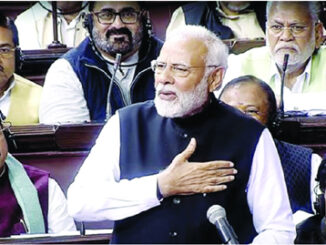
    New Delhi (TIP)- Prime Minister Narendra Modi launched a fresh broadside against the opposition on Thursday, February 9, saying their “keechad” (dirt) of allegations will only help the lotus bloom more and asserting he alone outweighs all who had to take turns to shout slogans to oppose him.

    Thumping his chest, Modi declared that he lives for the country and wants to do something for the country, which has rattled the opposition parties and they are playing political games just to save themselves.

    “Desh dekh raha hai, ek akela kitno ko bhari padh raha hai (the country is watching how one person has outweighed so many),” he said as the opposition members kept shouting “Modi-Adani, bhai-bhai”.

    Unperturbed by the jeering, Modi finished his 90-minute speech in reply to a debate on a motion thanking the President for her address to a joint sitting of Parliament, and listed various achievements of his government. With members of the treasury benches chanting “Modi-Modi”, he pointed at the opposition MPs who had gathered in the well of the House in a bid to shout him down and said, “Naare bolne ke liye bhi unko badal karna padhta hai (they have to take turns even to shout slogans).”

    “Ek conviction ke karan chala hoon, desh ke liye jeeta hoon, desh ke liye kuch karne ke liye nikla hoon (I live for the country and have embarked with the conviction to serve the nation),” he said, adding that his political opponents are playing games as they do not have the courage to take him on.

    The opposition, he said, is resorting to this means to save themselves. Replying to the Congress charge that the Bharatiya Janata Party was ignoring Jawaharlal Nehru’s efforts in nation-building after Independence, Modi retorted that if the first prime minister was so great, why have his scions never used his surname.

    As he rose to speak, opposition MPs, some holding placards, rushed into the well shouting slogans against the prime minister and seeking a joint parliamentary committee probe into allegations levelled by the US short-seller Hindenburg Research against tycoon Gautam Adani.

    Hitting back, Modi said, “Jitna keechad uchaloge, kamal utna hee zyada khilega (the more dirt you fling, the bigger the lotus – also the election symbol of the BJP -will bloom).”

    “Keechad unke pass tha, mere pass gulal. Jo jis ke pass tha, usne diya uchal,” Modi quoted Manik Verma’s poem in response to the allegations opposition parties levelled on him and his government.

    Roughly translated, it means they had dirt and I had gulal, whosoever had whatever they flung in the air.

    Opposition parties used the debate on the motion to attack the government for the Adani group’s phenomenal rise during the last few years. In his reply, Modi accused the Congress of adopting only “tokenism” in solving problems the country faced and said it was bothered only about its political ambitions and not the welfare of the nation. “We don’t believe in tokenism. We have chosen the path of hardwork in taking the country forward,” he said, adding technology was being used as an aid in this mission.

    He accused the Congress of trampling on the rights of states and regional parties by dismissing elected governments on 90 occasions by “misusing” Article 356 of the Constitution. “Who are the people?” he asked and responded that Indira Gandhi alone had used the article 50 times to dismiss governments.

    “This country is not anyone’s fiefdom. Our policies reflect national and regional aspirations,” he said. “But these people who are now sitting (with the Congress), I want to expose them today.”

    He then narrated how elected governments of the Left in Kerala, NT Rama Rao in Andhra Pradesh, Sharad Pawar in Maharashtra and M G Ramachandran in Tamil Nadu were dismissed by the Congress. And today these parties are sitting along with the Congress, he said.

    “NT Rama Rao’s government was dismissed when he was in the US for medical treatment,” he said, adding M G Ramachandran must be turning in his grave seeing his DMK align with the Congress.

    He also alleged that the Congress had committed sins in the past and is now trying to mislead the country.

    The prime minister warned states against resorting to populist measures for political gains, saying it would be “anarth-niti” (disastrous policy). With many parties in states promising freebies and reverting to heavy cash outflow schemes like old pension in run-up to elections, he cited examples of near bankruptcy in neighbouring countries to say that they should not play with the financial health and economic policies. “Do not do any such sin which leaves the burden on the next generation.”

    Source: PTI

  • Will Prime Minister Modi Restore Investors’ Confidence in Indian Markets and Regulatory Mechanism, Investigate Adani Group?

    Prime Minister Narendra Modi and Gautam Adani
    The handshake with Gautam Adani need not prevent PM Modi from doing his duty to the nation.

    Since 2014 under PM Modi, it has become a fashion and accepted norm in India that if you are a criminal and you belong to RSS family of organizations; you can hide behind “Fake Nationalism” or behind a false cry of “Hinduism is in Eminent Danger”. Under this magic formula, your every crime will go away and you can become a Central or State Minister or Chief Minister or member of legislative bodies in the center or state, or a State Governor. If you do not belong to RSS family of organizations and you are a rapist, murderer, bomb maker , terrorist, money launderer, drug dealer, mine mafia, arms dealer etc. by joining any of the RSS family of organizations; you can become sin aka crime free and now you are called Sanskari aka person of Good Character!

    Disgustingly Adani Group founded by Gautam Adani, it’s CFO Jugeshinder Singh has gone one step ahead of the above time tested Magic Formula used by criminals supported by RSS family of organizations; has found a new way to cover his Boss Gautam Adani’s crimes. He has draped his boss, his family members and Adani Group’s crimes behind the National Flag of India. No one from RSS family of organizations and their Godi Media has raised any objections or has said a word that it is an insult to every Indian, Indian National Flag and Mother India. Can the PM Modi’s Government or RSS family of organization’s top officials explain if the Indian National Flag is Adani Group’s Corporate Logo?

    This happened when Gautam Adani aka Adani Group though its CFO Jugeshinder Singh in a video for Media, defended himself against the accusations — leveled by US-based short sellers Hindenburg Research — that it had “engaged in a brazen stock price manipulation, stock parking, accounting fraud, round tripping of cash, Import-Export scams, money laundering through 38 offshore shell companies etc. over the course of decades,” the choice of décor was more persuasive than the denial of frauds.

    Nationalism is not to be abused.

    CFO Singh stood in front of a giant Indian flag that made him look more like a very high level government official than an embattled company executive. His message was clear: If you are a “foreign entity” coming after Gautam Adani or Adani Group, you’re coming after India.

    No, sir; it’s not an attack on India.

    CFO Singh while defending Gautam Adani aka Adani Group also said, “It does not surprise me. In Jallianwala Bagh, only one Englishman gave an order, Indians fired on other Indians. So am I surprised by the behavior of some fellow Indians? No.”

    Shamelessly CFO Singh has equated frauds committed by Gautam Adani aka Adani Group exposed by Hindenburg Research with the martyrs fighting for Indian independence from the British. At the same time, he is giving an open warning to every Indian if they believe in Hindenburg Research report and question Gautam Adani or Adani Group, they will be called traitors aka anti-Nationals.

    Then on Jan 29th, 2023 Adani group in its 413-page written rebuttal, denounced Hindenburg’s report as “baseless” and “malicious,” and accused the firm of having an “ulterior motive” for publishing the “missive.” “This is rife with conflict of interest and intended only to create a false market in securities to enable Hindenburg, an admitted short seller, to book massive financial gain through wrongful means at the cost of countless investors.”
    It said Hindenburg’s actions represent a “calculated attack on India, the independence, integrity, and quality of Indian institutions, and the growth story and ambition of India.”

    Same day on Jan 29, 2023, Hindenburg Research replied, “Fraud cannot be obfuscated by Nationalism or a bloated response that ignores every key allegation we raised.
    Adani has stoked a nationalist narrative, claiming pour report amounted to a “calculated attack on India.” In short, the Adani Group has attempted to conflate its meteoric rise and the wealth of its Chairman, Gautam Adani, with the success of India itself.

    We disagree. To be clear, we believe India is a vibrant democracy and an emerging superpower with an exciting future. We also believe India’s future is being held back by the Adani Group, which has draped itself in the Indian flag while systematically looting the nation.

    Hindenburg investigation speaks of Adani Group’s shell companies.

    We also believe that fraud is fraud, even when it’s perpetrated by one of the wealthiest individuals in the world.

    In terms of substance, Adani’s ‘413 page’ response only included about 30 pages focused on issues related to our report.

    The remainder of the response consisted of 330 pages of court records, along with 53 pages of high-level financials, general information, and details on irrelevant corporate initiatives, such as how it encourages female entrepreneurship and the production of safe vegetables.

    Within one week of the Hindenburg Research report, Adani Group companies have lost $108 Billion in Market Cap, one of the biggest wipeouts in India’s history. Gautam Adani himself lost $48 Billion in personal wealth and now ranks 16TH in the Index of World’s Richest from 3rd rank on Jan. 23, 2023. On Feb. 1, 2023 Credit Suisse stopped accepting Bonds of Adani Group collateral for margin loans to private banking clients. Citigroup Inc’s (C.N) wealth arm also stopped accepting securities of Gautam Adani’s group of firms as collateral for margin loans.

    Hindenburg report speaks of fraud by Adani GroupHindenburg

    Adani Enterprises Ltd (AEL) late on Feb. 2, 2023 decided to withdraw its Rs 20,000 crore ($2.5 Billion) follow-on public offering (FPO), India’s biggest such issue after claiming over subscription on Feb. 1, 2023 and announced that investors money will be returned. Sajjan Jindal and Sunil Mittal subscribed the Adani FPO in a last-minute push from their personal funds and do not involve listed businesses that they head like JSW Steel Ltd. and Bharti Airtel Ltd. FPO offering price band was Rs 3,112-3,276 per share while it was trading below Rs 3,000.00 in the market. The closing price of Gautam Adani’s Flagship company closed at Rs 1,565.25 at BSE on Feb. 2, 2023 that is 52 weeks low from its high of Rs 4,190.00
    The decision to withdraw the FPO issue came right after Forbes flash news that “there’s evidence of wrongdoing that the Adani Group likely bought into its own $2.5 Billion Share sale. It must be noted that despite the FPO being oversubscribed, its retail portion was subscribed only 0.12 times (12%) with investors bidding for only 2.74 million shares as against the quota of 22.9 million shares. The non-institutional investor category was over-subscribed 3.32 times while that of qualified institutional buyers (QIB) was also oversubscribed 126%.

    Post Hindenburg Report , Value of LIC investment in Adani Group shares have fallen from ₹77,000 CR to ₹53,000 CR- loss of ₹23,500 CR. Also, LIC shares have lost ₹22,442 CR. SBI share’s “market cap” has declined by a whopping ₹ 54,618 CR. The Loan Exposure of SBI and other Banks to Adani Group is ₹ 81,200 CR. SBI alone has $2.6 billion or Rs 21,000 crore  of loans to Adani Group.

    Indians wish they opened their eyes for the sake of India and the Indians.

    On Feb. 2, 2023, India’s parliament was adjourned for the day after pandemonium broke out when the upper house chair rejected opposition lawmakers’ demand for a debate on Billionaire Gautam Adani’s dispute with a US short seller Hindenburg Research. They were demanding an investigation into accusations of “brazen stock manipulation and accounting fraud” made against Adani Group by the Hindenburg Research. Later Mallikarjun Kharge, president of the Indian National Congress party and leader of the opposition, told reporters, “We want either a joint parliamentary committee … or a committee headed by the chief justice of the Supreme Court to investigate this matter and release the day-to-day report.”

    It is a well-known fact that current Indian PM Narendra Modi and Gautam Adani are close friends for over 2 decades and both have helped each other in their respective professions. Adani from Diamond sorter became the 3rd richest person in the world. That position he held till the Hindenburg Research made disclosures of serious frauds by Adani Group. Despite having no apparent experience or expertise; he is in every field of India; right from ports, airports, military hardware, railways, mining, cement, power, real estate, fresh & processed food etc. mostly due to government favors.

    Modi from menial RSS worker became its Pracharak aka “Messenger of RSS’s misguided Hindutva and Hindu Rashtra Philosophy” to became the face along with L K Advani in the Rath Yatra for Ram Mandir, later to become the CM of Gujarat in 2001. So many independent Indian and foreign bodies hold CM Modi responsible for ethnic cleansing of Muslims in Gujarat riots in 2002. There was “widespread rape of Muslim women” and killing of Muslims. “Muslim businesses, including businesses partially owned by Muslims and their properties were systematically targeted and destroyed. “This was followed by calls for an economic boycott of Muslim owned businesses, denial of jobs, rentals & forcible sale of their properties in Hindu localities.” As per official figures 1,044 dead, 223 missing, and 2,500 injured. Of the dead, 790 were Muslim and 254 Hindu. The Concerned Citizens Tribunal Report estimated that as many as 1,926 Muslims may have been killed. Over 140,000 people were displaced in the violence, of which 100,000 were Muslims. “Conditions in refugee camps were extremely poor for Muslims” and initially compensation offered by the Modi’s Gujarat government was “discriminatory”: Rs 200,000 for Hindu victims, and Rs 100,000 for Muslims. This was later modified “at the request of the Central government in Delhi”. Still Modi remain Chief Minister of Gujarat till 2014 to become the Prime Minister of India by invoking fake nationalism. misguided Hindutva and his support to make India a Hindu Rashtra.

    The loyalty to Gautam Adani should not deter the Prime Minister of India from doing his duty to the nation.

    If PM Modi’s government has an iota of shame, care for international reputation of India, and even 0.1% faith in Democratic norms and love for India as per the Hinduism they swear by; Adani Group’s founders, family members, top executives and enforcement agencies’ top officials must be investigated. If they are found guilty, they must be given exemplary punishment to deter future financial crimes like this by anyone, including persons belonging to richest club or bureaucrats or politicians of India. In the meantime Adani Group’s Chief Financial Officer  Jugeshinder Singh must be arrested immediately for insulting Indian National Flag, Indians and Mother India. Singh should be arrested on non-bailable warrants and must do minimum 6 months rigorous imprisonment with regular criminals with no privileges for being a rich or highly educated man or a foreign national. Being a highly educated and ex-Indian citizen, he was fully aware of the rules and protocols about using the Indian National Flag by a common citizen. He cannot hide behind the fact by saying that he is an Australian citizen and gave up his Indian citizenship to give lectures on Indian Nationalism!

    Adani Group: How The World’s 3rd Richest Man Is Pulling The Largest Con In Corporate History
    Published on January 24, 2023

    Adani Group: How The World’s 3rd Richest Man Is Pulling The Largest Con In Corporate History

    ADANI RESPONSE TO HINDENBURG RESEARCH:
    (413 PAGES)
    JAN. 29, 2023
    https://www.adani.com/-/media/Project/Adani/Invetsors/Adani-Response-to-Hindenburg-January-29-2023.pdf

    HINDENBURG’s REPLY TO ADANI’s RESPONSE:
    JAN. 29, 2023
    Fraud Cannot Be Obfuscated by Nationalism Or A Bloated Response That Ignores Every Key Allegation We Raised

    Our Reply To Adani: Fraud Cannot Be Obfuscated By Nationalism Or A Bloated Response That Ignores Every Key Allegation We Raised

    (The special report has been compiled by Dave Makkar for The Indian Panorama. Mr. Makkar is a social activist based in New Jersey)
    The Indian Panorama welcomes readers’ comments which will be published in the next weekly editions.

  • Hindenburg allegations

    • Imperative for Adani Group, India to shore up investor trust

    The turmoil in the stock markets, largely caused by the sell-off of the Adani Group shares since late last week, has brought into sharp focus India’s regulatory framework, apart from the necessity of robust accounting practices. Investor sentiment suffered following the release of a report by New York-based Hindenburg Research — an investor research firm that positions itself as an investigator-activist — which alleged that the Adani Group had engaged in ‘a brazen stock manipulation and accounting fraud scheme over the course of decades.’ Even as it lost tens of billions of dollars in valuation, the Adani Group denied the accusations, calling them ‘selective misinformation and stale, baseless and discredited allegations’, and ‘a calculated attack on India.’ The report also raised questions over the group’s high debt levels and accused it of using shell companies based in tax havens. In the past, analysts have pointed at large investments in the Adani Group by entities such as the LIC and several public sector banks.

    The allegations made by Hindenburg may be insufficient to prosecute Adani, but it’s imperative that regulators such as SEBI and the Reserve Bank of India address the issue swiftly and decisively. This is important because at stake is India’s reputation as an investment destination — India’s is the fifth-largest economy in the world and many investors now look at the country as a more attractive option than China and other emerging economies. The episode also focuses the spotlight on audit firms — across the world, the unscrupulous among these have been known to help big companies mislead investors by manipulating accounts. Just in the current century, many observers blamed audit firms for the collapse of Enron in 2002 and Lehman Brothers in 2008.


    To shore up investor trust, the Adani Group and regulatory institutions must dispel fears of auditing fraud or any other malpractice. Probity in accounting safeguards institutional and individual investments, helping investors make informed decisions. The regulatory authorities and the government must ensure that the interests of the average investor are protected, and the country’s reputation as an investment destination is not sullied.
    (Tribune, India)

  • NSE & BSE put 3 Adani Group companies under short-term surveillance

    NSE & BSE put 3 Adani Group companies under short-term surveillance

    Apart from Adani Enterprises, the other two firms listed by the exchanges are — Adani Ports and Special Economic Zone and Ambuja Cements

    NEW DELHI (TIP): As many as three Adani group companies, including Adani Enterprises, have come under short-term additional surveillance measure (ASM) framework of the BSE and NSE, according to the latest data available with the exchanges on Thursday, February 2. Apart from Adani Enterprises, the other two firms listed by the exchanges are — Adani Ports and Special Economic Zone and Ambuja Cements.

    The parameters for shortlisting securities under ASM include high-low variation, client concentration, number of price band hits, close-to-close price variation and price-earning ratio.

    The National Stock Exchange (NSE) and BSE said these companies have satisfied the criteria for inclusion in short-term additional surveillance measure or ASM.

    Under the short-term ASM, the exchanges said, “applicable rate of margin shall be 50 per cent or existing margin whichever is higher, subject to maximum rate of margin capped at 100 per cent, with effect from February 6, 2023 on all open positions as on February 3, 2023 and new positions created from February 6, 2023”.

    Market experts believe that putting in this framework means intra-day trading would require 100 per cent upfront margin. The exchanges also noted that the shortlisting of securities under ASM is purely on account of market surveillance, and it should not be construed as an adverse action against the concerned company or entity.

    Meanwhile, shares of Adani Enterprises tumbled over 26 per cent on Thursday, a day after the firm said it has decided not to go ahead with its Rs 20,000-crore Follow-on Public Offer (FPO) and will return the proceeds to investors. The counter had plunged more than 28 per cent on Wednesday.

    Most of the other group firms also declined for the sixth day in a row on Thursday and 10 listed Adani Group firms have faced a combined erosion of over Rs 8.76 lakh crore in the past six days.

    Adani Group stocks have taken a beating on the bourses after US-based Hindenburg Research made a litany of allegations in a report, including fraudulent transactions and share price manipulation at the Gautam Adani-led group. Adani Group has dismissed the charges as lies, saying it complies with all laws and disclosure requirements.

  • Short seller Hindenburg accuses billionaire Gautam Adani of ‘largest con in corporate history’

    Short seller Hindenburg accuses billionaire Gautam Adani of ‘largest con in corporate history’

    I.S. Saluja

    NEW YORK (TIP): It may be the biggest scandal in corporate history in India in recent times. The Hindenburg report on Adani conglomerate has created shockwaves in the financial world. Nobody can wish away or wash away the findings of the Hindenburg investigation. It is not the first time that Hindenburg has investigated a corporate .

    Earlier, in 2020, Hindenburg published a report detailing malfeasance at the electric vehicle firm Nikola Corp.   Hindenburg said Nikola had engaged in an “intricate fraud,” including an instance in which the company faked a video that appeared to show one of its electric trucks driving down a highway. In actuality, the company “simply filmed it rolling down the hill.” Nikola founder Trevor Milton was later found guilty of securities fraud after Hindenburg’s allegations prompted an investigation

    A New York Post report of January 25 quoted  Hindenburg Research Group as alleging  that Gautam Adani, Asia’s richest man, is pulling “the largest con in corporate history” through his India-based conglomerate Adani Group”

    Hindenburg — whose previous targets have included electric truck makers Nikola and Lordstown Motors — revealed in a research note late Tuesday it had taken a short position in Adani Group and alleged that Adani’s rise in wealth was fueled by a variety of illegal misdeeds, The New York Post said.

    “We have uncovered evidence of brazen accounting fraud, stock manipulation and money laundering at Adani, taking place over the course of decades,” Hindenburg claimed in the note.

    Adani, 60, amassed a fortune estimated by Forbes at $125.5 billion before the Hindenburg report — overseeing a sprawling network of companies with holdings across several industries, including control of major ports and airports, energy, real estate and cement.

    “Adani has pulled off this gargantuan feat with the help of enablers in government and a cottage industry of international companies that facilitate these activities,” the firm added.

    He began Wednesday, January 25,  trailing only French luxury goods magnate Bernard Arnault and Tesla CEO Elon Musk in overall wealth, according to Forbes. But Adani lost an estimated $6.5 billion during the day after the Hindenburg report, dropping him to fourth behind Amazon founder Jeff Bezos.

    The firm noted that Adani Group has “previously been the focus of 4 major government fraud investigations” alleging money laundering, corruption and theft of taxpayer money.

    Hindenburg said it conducted a two-year investigation of the Adani business empire — with research that included dozens of interviews, including some with former company executives, as well as an analysis of internal documents and due diligence visits at company-controlled sites.

    The report alleged that Adani, several family members and other company executives oversee a network of offshore shell companies located in tax havens across Mauritius, the United Arab Emirates and the Caribbean.

    Hindenburg alleged that some of the shell companies appeared to be hastily cobbled together, with websites “featuring only stock photos, naming no actual employees and listing the same set of nonsensical services.”

    Hindenburg alleged that many of the shell companies are reportedly operated by Adani’s older brother, Vinod, or his “close associates.”

    “The Vinod-Adani shells seem to serve several functions, including (1) stock parking / stock manipulation (2) and laundering money through Adani’s private companies onto the listed companies’ balance sheets in order to maintain the appearance of financial health and solvency,” Hindenburg said.

    Hindenburg included a list of 88 questions about company operations that “we hope the Adani Group will be pleased to answer.” “Even if you ignore the findings of our investigation and take the financials of Adani Group at face value, its 7 key listed companies have 85% downside purely on a fundamental basis owing to sky-high valuations,” Hindenburg said.

    The short seller stressed that its report “represents our opinion and investigative commentary” and urged readers to draw their own conclusions about Adani Group.

    Adani Group has dismissed the report as baseless. Adani Group CFO Jugeshindar Singh said the company was “shocked” by Hindenburg’s allegations and issued a firm denial.

    “The report is a malicious combination of selective misinformation and stale, baseless and discredited allegations that have been tested and rejected by India’s highest courts,” Singh said.

    “The timing of the report’s publication clearly betrays a brazen, mala fide intention to undermine the Adani Group’s reputation,” Singh added.

    Billionaire investor Bill Ackman was all praise for U.S. short-seller Hindenburg Research’s report on Indian conglomerate Adani Group, calling it “highly credible” and “extremely well researched.”

    Billionaire investor Bill Ackman was all praise for U.S. short-seller Hindenburg Research’s report on Indian conglomerate Adani Group, calling it “highly credible” and “extremely well researched.”

    Hindenburg’s report on Wednesday accused the conglomerate of improper use of offshore tax havens and stated it held short positions in the company via its U.S.-traded bonds and non-Indian-traded derivative instruments.

    Adani group loses $48 billion since January 25; FPO takes a hit in light of Hindenburg report

    Adani Enterprises Ltd began a record $2.45 billion (₹20,000 crore) secondary share sale for retail investors on Friday, as a heavy selloff in Adani group companies intensified after an attack by a U.S.-based short seller.

    Seven listed companies of the Adani conglomerate — controlled by one of the world’s richest men Gautam Adani — have lost a combined $48 billion in market capitalization since Wednesday, January 25,  and saw falls in its U.S. bonds after Hindenburg Research flagged concerns in a report about debt levels and the use of tax havens.

    Adani Enterprises aims to use the share sale proceeds for capital expenditure and to pay debt. The anchor portion of the sale saw participation from investors including the Abu Dhabi Investment Authority on Wednesday.

    Bidding for the Adani Enterprises share sale for retail investors started on Friday and will close on January 31. The firm has set a floor price of ₹3,112 ($38.22) a share and a cap of ₹3,276. But on Friday the stock slumped to as low as ₹2,721.65, well below the lower end of the price offering.

    Adani group stocks took a beating, falling up to 20% after Hindenburg Research’s damaging allegations. The group’s flagship Adani Enterprises, which launched the ₹20,000 crore FPO on Friday, tanked 18.52%. Adani Ports plunged 16%, Adani Power by 5%, Adani Green Energy by 19.99%, and Adani Total Gas by 20%.

    In two days, the Adani group firms have lost a whopping ₹4,17,824.79 crore from their market valuation. The market valuation of Adani Total Gas plummeted ₹1,04,580.93 crore while that of Adani Transmission by ₹83,265.95 crore. Adani Enterprises market capitalization fell by ₹77,588.47 crore, Adani Green Energy lost ₹67,962.91 crore and Adani Ports by ₹35,048.25 crore.

    The market valuation of Ambuja Cements declined by ₹23,311.47 crore, Adani Power by ₹10,317.31 crore, ACC by ₹8,490.8 crore and Adani Wilmar by ₹7,258.7 crore. The rout took shares of Adani Enterprises, the group’s flagship company, well below the offer price of its secondary sale, which had initially been offered at a discount.

    In its report, Hindenburg said key listed Adani Group companies had “substantial debt”, putting the conglomerate on a “precarious financial footing”, and that “sky-high valuations” had pushed the share prices of seven listed Adani companies as much as 85% beyond actual value.

    Billionaire U.S. investor Bill Ackman said on Thursday, January 26,  that he found the Hindenburg report “highly credible and extremely well researched”.

    Hindenburg said it held short positions in Adani through its U.S.-traded bonds and non-Indian-traded derivative instruments, meaning it is betting that their price would fall.

    The Hindenburg report has encouraged political parties in India to demand a thorough investigation into the working  and practices of the Adani Group.

    Congress has demanded a  ‘serious investigation’ by RBI and SEBI into allegations levelled against the Adani Group. In a strongly worded statement, Congress general secretary in-charge of communication Jairam Ramesh asserted that exposure of financial institutions like the Life Insurance Company of India (LIC) and the State Bank of India (SBI) to the Adani Group would have implications for the country’s financial stability and crores of depositors “whose savings are stewarded by these pillars of the financial system”.

    “Normally a political party should not be reacting to a research report on an individual company or business group prepared by a hedge fund. But the forensic analysis by Hindenburg Research of the Adani Group demands a response from the Congress party,” Ramesh said, adding, ”This is because the Adani Group is no ordinary conglomerate: it is closely identified with Prime Minister Narendra Modi since the time he was Chief Minister”.

    The ports-to-power conglomerate, however, had said the charge against the Adani Group was “malicious, unsubstantiated, one-sided, and was timed to ruin the public listing of its shares”.

    “The allegations require serious investigation by those who are responsible for the stability and security of the Indian financial system, viz. the Reserve Bank of India (RBI) and the Securities and Exchange Board of India (SEBI),” Ramesh said.

    “The allegations of financial malfeasance would be bad enough, but what is worse is that the Modi government may have exposed India’s financial system to systemic risks through the liberal investments in the Adani Group made by strategic state entities like LIC, SBI and other public sector banks,” he added.

    The Congress leader said as much as 8% of LIC’s equity assets under management, amounting to a sum of ₹74,000 crore, are invested in the Adani Group of companies, while public sector banks have lent to the Adani Group twice as much as the private banks, with 40% lending being done by SBI. “Indians are increasingly aware of how the rise of Modi’s cronies has exacerbated the problem of inequality, but need to understand how this has been financed by their own hard-earned savings. Will the RBI ensure that risks to financial stability are investigated and contained? Are these not clear-cut cases of “phone banking”?” asked Ramesh.

    Asking if there is a quid pro quo between the Modi government and the Adani Group, the Congress leader alleged, “In perhaps, the most egregious case of crony capitalism, the previous operator of Mumbai’s Chhatrapati Shivaji Maharaj International Airport, India’s second busiest airport, was raided by the Enforcement Directorate (ED) and the Central Board of Investigation (CBI) after it rejected an offer by the Adani Group”.

    “The operator agreed to sell the airport to Adani a month later and it is a mystery what happened to the ED and CBI cases thereafter,” Ramesh added.

    Lok Sabha member Manish Tewari said on Twitter that if the Hindenburg report was even partially correct, “it merits both a Joint Parliamentary Committee-much like the 1992 JPC & a Supreme Court Monitored investigation to get to the bottom of the matter. The Budget Session of Parliament begins 31st Jan 2023”.

    Congress Rajya Sabha member Randeep Surjewala tweeted, ”Exposure of #LIC in Adani Group is ₹77,000 CR. LIC has today lost ₹23,500 CR in invest value in Adani Group i.e. at ₹53,000 CR against ₹77,000 CR. LIC is money of People of India. In any other country, heads would have rolled including that of FM# HindenburgReport.”

    (Source: New York Post, Agencies)

  • Adani buys Roys’ 27.26% stake in NDTV for Rs 602 cr

    Adani buys Roys’ 27.26% stake in NDTV for Rs 602 cr

    New Delhi (TIP)- The Adani Group on Friday, December 30,  acquired 27.26% equity stake in NDTV from its founders Prannoy Roy and his wife Radhika Roy for Rs 602.3 crore.

    “RRPR, an indirect subsidiary of the company and member of the promoter/promoter group of NDTV, has acquired a 27.26% equity stake in NDTV from Prannoy Roy and Radhika Roy by way of inter-se transfer. The acquisition was completed on December 30, 2022 on the block,” said an Adani Enterprises’ regulatory filing to the bourses.

    “Vishvapradhan Commercial Private Limited (an indirect subsidiary of the company) holds 8.27% equity stake in NDTV and RRPR (prior to the present acquisition) held 29.18% equity stake in NDTV. Consequent to the present acquisition, RRPR will hold 56.45%,” it added.

    The Roys sold their equity at Rs 342.65 per share, which is 17% higher than what was offered to other shareholders in the open offer that closed on December 5. This premium may attract the attention of SEBI as such a difference in payouts is not allowed unless the selling company (RRPR) is part of the group offloading the shares. Roys had given up on December 23 when they announced their decision to sell off 27.26% of their holding while retaining 5% of the shares.

  • Adani world’s third richest, first from Asia

    Adani world’s third richest, first from Asia

    Adani Group’s chairman Gautam Adani is now the world’s third-richest person after overtaking France’s Bernard Arnault according to Bloomberg Billionaires Index.

    With a total net worth of $137.4 billion, 60-year-old Adani has surpassed the wealth of Louis Vuitton chairman Arnault and is now just behind business magnate Elon Musk and Jeff Bezos in the ranking.

    In the latest Bloomberg Billionaires Index, Reliance Industries Chairman Mukesh Ambani is at number 11 with a net worth of $91.9 billion. This is the first time an Asian person has broken into the top three of the Bloomberg Billionaires Index.

    The index is a daily ranking of the world’s richest people. Details about the calculations are provided in the net worth analysis on each billionaire’s profile page. The figures are updated at the close of every trading day in New York.

    The net worth of Elon Musk and Jeff Bezos are currently at $251 billion and $153 billion, respectively.

    Adani is a first-generation entrepreneur and the Adani Group comprises seven publicly listed entities with businesses spanning energy, ports and logistics, mining and resources, gas, defence and aerospace and airports.