Tag: Afghanistan

  • Afghans tighten security as Taliban threaten vote

    Afghans tighten security as Taliban threaten vote

    KABUL (AFGHANISTAN (TIP)): Afghan police and soldiers are manning checkpoints at almost every intersection, searching vehicles and banning trucks from the streets, tightening security ahead of a weekend presidential election. Insurgents have intensified attacks ahead of Saturday’s runoff vote, and the Taliban have issued a new statement warning voters to stay away from the polls.

    The first round in April passed relatively peacefully, but a recent assassination attempt against one of the two presidential hopefuls left in the race has raised fears. Still, a senior UN envoy expressed confidence Thursday that Afghan voters will turn out as they did in the first round on April 5.

    Jan Kubis also called on candidates Abdullah Abdullah and Ashraf Ghani Ahmadzai to give electoral authorities time to tally the ballots and resolve any complaints about fraud.

  • China under-reported defence by 20%: Pentagon

    China under-reported defence by 20%: Pentagon

    WASHINGTON (TIP): China underestimated its growing defence budget by nearly 20% with its spending likely nearing $145 billion last year, the Pentagon has said. In an annual report required by Congress, the Pentagon said yesterday that China’s defence budget for 2013 was higher than the officially announced $119.5 billion. “We think that if you start factoring in other considerations, other funding streams that go into the military, other investments that are not included in the defence budget, that it could be up to $145 billion,” a Pentagon official said of the report.

    The United States and its allies, especially Japan, have repeatedly voiced concern about the Chinese military’s lack of transparency amid growing tensions between Beijing and neighbouring countries over maritime disputes. In its previous annual report on China, the Pentagon said that Beijing’s military spending was anywhere between $135- 215 billion. The $145 billion estimate “reflects an improvement in our understanding of how China develops its defence budget,” the official said. “But I would say there’s a lot that we still don’t know about China’s defence spending and that’s an area where we encourage China to be more transparent,” he said.

    In March, China announced a new hike of 12.2% in its defence budget to an official 808.23 billion yuan ($132 billion) for 2014. China dismissed foreign criticism, with the staterun China Daily saying, “World peace needs a militarily stronger China.” China’s military budget — either the official figure or Pentagon estimate — is significantly higher than the amount spent by its neighbours.

    In 2013, Russia’s defence budget was $69.5 billion, Japan’s was $56.9 billion, with India at $39.2 billion and South Korea at $31 billion. But China’s budget is much lower than that of the United States, by far the world’s largest military power, which has a $495.5 billion defence budget in 2013 along with another $82 billion allocated for the Afghanistan war.

  • Pakistan court orders FIR against ex-CIA station chief

    Pakistan court orders FIR against ex-CIA station chief

    ISLAMABAD (TIP): Pakistan court on June 05 ordered police to lodge an FIR against former CIA station chief for killing civilians in US drone strikes in the volatile northwestern tribal regions stretching along the border with Afghanistan. Justice Shaukat Aziz Siddiqui of Islamabad High Court issued the order on petition filed by Abdul Karim Khan, a native of Mir Ali town in North Waziristan in 2010. In the petition, Khan pleaded that drone strikes kill innocent civilians and added that his 18-year-old son Zaheenullah and brother Asif Iqbal were both killed in one of such attacks in 2009.

    Khan, also an anti-drone activist, said that the strikes in which his son and brother were killed were ordered by ex-CIA station chief, Jonathan Banks. While accepting the petition, the judge ordered station house officer of Islamabad’s secretariat police station to register an FIR against Banks. “Justice Shaukat Aziz Siddiqui of IHC ordered today registration of a criminal case for offences of murder, conspiracy, waging war against Pakistan and offences under the provisions of Terrorism Act 1997, against the ex-CIA chief, Jonathan Banks,” Mirza Shahzad Akbar, Khan’s counsel, said in a statement. “We are fighting this legal battle since 2010 and the police was reluctant to pursue our case but finally we succeeded,” he added.

    The legal assistance to Khan has been provided by the Foundation for Fundamental Rights, a charity associated with Britain’s Reprieve. Khan had earlier also sent a 500 million dollars claim for damages in drone attacks to the US Defence Secretary Robert Gates, CIA chief Leon Panetta and Banks. “Today is a V-day for all those people who lost their near and dear ones in drone attacks,” Khan vowed before reporters outside the court. Khan has been trying since 2010 to register a case against Banks but Islamabad police had refused to file an FIR on advice of its prosecution department which said the application was not maintainable as the site of the drone strike was out of its jurisdiction.

    The CIA had accused Pakistan’s spy agency ISI in 2010 of endangering its station chief’s life by releasing his name, a charge which ISI had denied. Following the incident, relations between the two agencies went sour and Banks was withdrawn from Pakistan. According to AFP, 2,155 people have been killed in drone attacks since August 2008, with critics charging that the strikes cause many civilian casualties while international think tanks, including The New American Foundation and UK-based Bureau of Investigative Journalists, reportedly claim that more than 3,000 people, 70% of whom were civilians, have been killed in drone attacks since 2004. The last drone took place in last December in North Waziristan.

  • Taliban release video showing handover of US soldier

    Taliban release video showing handover of US soldier

    KABUL (TIP): The Taliban on June 4 released a video showing the handover of Sgt Bowe Bergdahl to US forces in eastern Afghanistan, touting the swap of the American soldier for five Taliban detainees from Guantanamo as a significant achievement for the insurgents.

  • A new beginning to the peace chapter

    A new beginning to the peace chapter

    Despite reservations in some circles, most Pakistanis welcomed Prime Minister (PM) Nawaz Sharif’s decision to attend Mr Narendra Modi’s swearing-in as the new PM of India at the latter’s invitation.

    Although similar invitations were extended to the heads of state and government of all the SAARC countries, all eyes were focused on the interaction between the PMs of traditional rivals Pakistan and India. And the warm welcome PM Modi extended to Nawaz Sharif raised the hopes of the hopeful, comprising most Pakistanis, while the sceptics, including the Kashmiris, seemed unconvinced. The body language and atmospherics at the first meeting between the two PMs seemed excellent. It could be claimed with confidence therefore, that a good beginning had been made.

    At the glittering swearing-in ceremony at Rashtrapati Bhavan (President’s House) in New Delhi, the SAARC leaders in attendance were joined by a large invited crowd, including political and business leaders and celebrities from all segments of Indian society, including Bollywood’s well known figures.

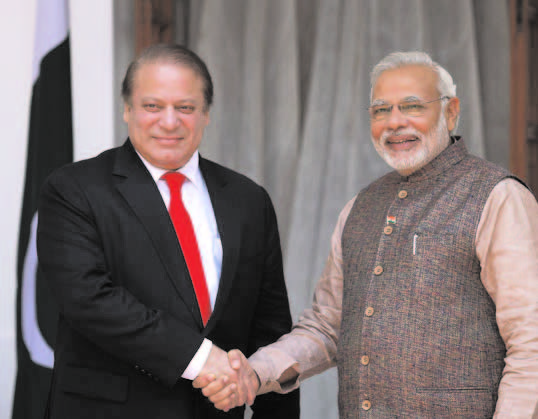
    Mr Modi’s vigorous welcoming handshake with Nawaz Sharif underlined the mutual desire of the two leaders to nudge their bilateral relationship towards normalisation. Apprehensions accompanying Modi’s rise to the apex office include the fears of the minorities in India, particularly Muslims, about the dark past of Mr Modi, especially in the Gujarat massacre of Muslims in 2002 when he was the chief minister.

    Perhaps aware of his polarising and divisive past, Mr Modi’s message after taking oath of office was to build an ‘inclusive’ India with a relatively lean cabinet, the latter reflecting his slogan: “Minimum Government, Maximum Governance”.

    This is intended to reinforce the election platform on which Mr Modi ran, emphasising good governance and economic development rather than the Hindutva agenda of the Bharatiya Janata Party (BJP) or the even more extreme stance of the BJP’s ‘mother’ movement, the Rashtriya Swayamsevak Sangh (RSS), which on the eve of the swearing-in ceremony and meeting with Nawaz Sharif, belligerently threatened that if Pakistan did not correct course vis-à-vis India, Mr Modi would be forced to press the nuclear button against it.

    On his part, PM Nawaz Sharif opened his innings in New Delhi with the statement that there existed a great chance to open a new chapter, starting from where he and former BJP PM Atal Bihari Vajpayee left off in 1999. He offered attractive investment opportunities to Indian businessmen, which no doubt went down well with the proven business-friendly Modi.

    It goes without saying that enhanced trade and business opportunities between Pakistan and India are to the mutual benefit of both despite the naysayers and sceptics in Pakistan. Trade between the two countries is officially at around $ 2.5 billion, with the balance heavily tilted towards India, whose exports account for $ 1.75 billion of the total.

    Around $ 3 billion trade is believed to be routed through Dubai, again tilted heavily in India’s favour and which deprives both countries of tax revenues. The issue of Most Favoured Nation (MFN) status, which India has long ago extended to Pakistan but has not been reciprocated, may now be revived under the new title of Non- Discriminatory Market Access (NDMA).

    While the positives of the warm welcome to PM Nawaz Sharif and the overwhelming run of opinion in Pakistan that it was the right decision to accept the invitation from Mr Modi are welcome, there are still many issues that remain to trouble relations between the two South Asian neighbours.

    Memories of 1999, when General Musharraf’s adventure in Kargil effectively sealed the fate of the Sharif- Vajpayee rapprochement, haunt the renewed process of normalisation. However, 2014 is a very changed scenario from 1999. Pakistan is beset with trouble on its western border, including a homegrown Taliban insurgency that has been described as an existential threat to Pakistan’s security rather than any external enemy.

    The military therefore appears, contrary to conspiracy theorists, to be on board regarding the critical need to normalise relations with India on the eastern border. That of course does not mean that long standing issues such as Kashmir and the Pakistan-India rivalry for influence in Afghanistan are about to disappear.

    They can cause tensions between Islamabad and New Delhi again as in the past. However, internally the fears of the minorities in India, particularly Muslims, at the rise to power of Modi have been underlined by a communal clash in his home province Gujarat on the very day he took oath. The underlying communal tensions lingering from 2002 burst forth into clashes between the Hindu and Muslim communities after an innocuous traffic accident.

    Reportedly, the first one-to-one meeting between PMs Nawaz Sharif and Narendra Modi yielded the expected positions of both sides. India raised the issue of terrorism and closure of the Mumbai attacks case. Pakistan seemed to agree on cooperation to overcome terrorism while emphasising the economic side of bilateral relations. Naturally, such summits are always followed up by experts and officials’ working out of the details of the vision of their leaders.

    Let us hope that that process will now proceed with dispatch, in contrast with the virtual halt during the Congress government’s later tenure. – The Daily Times

  • 12 people, including 10 militants, killed in Afghanistan violence

    12 people, including 10 militants, killed in Afghanistan violence

    KABUL (TIP): Twelve people, including 10 militants, were killed in separate incidents of violence in Afghanistan on May 29, authorities said. In one attack, a district intelligence chief was killed while three intelligence officials were wounded when a roadside bomb struck a vehicle in Aqcha district of northern Jawzjan province at noon, provincial police chief Faqir Mohammad Jawzjani told Xinhua.

    Separately, police official Abdul Matin and a colleague were injured when a sticky bomb attached to a police jeep went off in Maehtarlam, the capital city of eastern Laghman province before noon. In northern Kunduz province, an Afghan Local Police (ALP) officer was killed and three ALP personnel were wounded when Taliban launched an attack in Ali Abad district around midday.

    The ALP, or community police, was established in 2010 to protect villages and districts around the country where army and police have limited presence. In the neighbouring Dashti Archi district, one Taliban fighter was killed and six other militants were injured in an exchange of fire with security forces earlier Thursday. The Taliban-led insurgency has been rampant since the militant group launched an annual rebel offensive against security forces and more than 51,000 Nato-led troops stationed in the country earlier this month.

    In southern Helmand province, a known Taliban stronghold, nine Taliban insurgents were killed when the roadside bombs they were planting exploded in three separate incidents Thursday morning, according to army spokesman Mohammad Rassoul Zazai. The Taliban have urged civilians to stay away from official gatherings, military convoys and centres regarded as legitimate targets by militants besides warning people not to support government and foreign troops.

  • Top Senator proposes first 100 days action plan for India-US

    Top Senator proposes first 100 days action plan for India-US

    WASHINGTON (TIP): A powerful American Senator has proposed “100 days action plan” for the Modi government and the Obama administration to “refresh” the India-US relations. Senator Mark Warner, who is the Democratic co-chair of the Senate India Caucus, has suggested the Modi government to modify the defense-offset regime, agreeing to build community colleges in India, lifting the foreign direct investment caps in some of the sectors, and announcing a new electronic payment systems.

    In the first 100 days of the Modi government, Waren has proposed to the Obama administration to name a senior official for defense trade, review tourist visa policies and access to high skill visas. Among other action plans for the first 100 days, he has advised the Modi government and the Obama administration to announce a joint energy project, convene a meeting of India-US strategic dialogue, hold bilateral talks on Afghanistan, restart negotiations to achieve a bilateral investment treaty (BIT), re-launch the defense policy group, and establish a publicprivate working group on infrastructure investment.

    “I believe we have an opportunity, in the early days of the new Indian administration, to refresh the US-India relationship and work cooperatively to make progress that will benefit both of our countries,” Warner said in a fourpage 100-days action plan. As a co-chair of the US Senate India Caucus for several years,Warner has been working with US and Indian government officials and business leaders to address important issues for both countries, including education, skills development, infrastructure and energy.

    “However, over the last 18-24 months, the relationship lacked a catalyst.With this month’s historic Indian election, we can harness the enthusiasm of the Indian people to boost our partnership. “We can use the first 100 days to move from dialogue to action and build a path forward for more ambitious cooperation,” he said. “There are many areas where a partnership between our countries would serve goals on both sides, and if the respective administrations choose just two or three deliverables to shoot for in the first 100 days, we could provide the business community on both sides a new optimism that we can work together and get things done,” Warner added.

    In his action plan,Warner has proposed that the India-US Strategic Dialogue this year be held in New Delhi, instead of Washington DC as originally scheduled. “Since the new Indian government will just be getting started, holding the Dialogue in Delhi will be less disruptive to organizing meetings and will provide both sides the opportunity to meet and get to work early in the term on joint initiatives,” he said. India and the US have meandered through several rounds of stop and start negotiations about how to proceed with BIT, he said.

    “Announcing that both sides will sit down and negotiate a framework would boost confidence that a BIT is possible. A BIT would provide important protections for investors, help unleash needed investment, and provide a level playing field for both countries,” he added. The Obama administration, he said, should name a senior-level official who reports directly to the secretary of defense to lead the defense trade and technology Initiative.

    “Under Ash Carter’s leadership this was one of the most successful programs and helped shepherd billions of dollars of defense deals through the pipeline as well as clearing out inefficiencies on both sides of the US-India defense trade to make defense trade simpler, more responsive, and more effective,” Warner said. Warner said the US should conduct a review of visa policies with an eye toward further opening of global entry and trusted traveler programs for frequent travelers, including business leaders and investors.

    “A review of policies for high-skill employees would help ensure companies in both countries have access to talent to help US companies and the American economy grow and innovate and encourage more joint research and cooperation between universities,” he said. An agreement to increase travel and tourism between the two countries would increase more people to people interaction, he argued. For the Modi government, he said lifting FDI caps in some of the sectors that have been under discussion for years would be a positive signal to foreign firms that India was again “open for business.”

    Specifically, defense, insurance, railways, e-commerce and banking sectors are ripe for reform, he said. Warner said India and the United States share a unique bilateral relationship. “As the world’s oldest and largest democracies there are many areas in which our strategic interests combine, and when we find ways to cooperate and work together both of our countries benefit,” he said. “The historic and sweeping election that has made Narendra Modi Prime Minister of India is a testament to a thriving democracy and a signal that the people of India are ready for economic growth and productivity,” he added.

  • BJP leaders greet SAARC Presidents and Prime Ministers

    BJP leaders greet SAARC Presidents and Prime Ministers

    NEW DELHI (TIP): OFBJP Global Convener Vijay Jolly stated, May 28, that the visiting SAARC Presidents & Prime Ministers at the Indian Prime Minister Narendra Modi’s oath taking ceremony, were separately welcomed & greeted with courtesy calls by senior Bharatiya Janata Party leaders in New Delhi.

    BJP General Secretary (Organization) Ram Lal, BJP MP Vijay Goel, BJP Spokeswomen Meenakshi Lekhi (MP) & Nirmala Seetharaman (now Union State Minister), senior RSS Pracharak Indresh Kumar, OFBJP Co- Conveners Dr. Rajni Sarin & Amit Thakar accompanied by Vijay Jolly called on the visiting SAARC leaders in New Delhi recently.

    SAARC leaders President of Maldives Abdulla Yameen Abdul Gayoom, Prime Minister of Bhutan Tshering Tobgay, Prime Minister of Nepal Sushil Koirala, Speaker of Bangladesh Parliament Shirin Sharmin Chowdhury, Prime Minister of Pakistan Nawaz Sharif, Prime Minister of Mauritius Dr. Navin Ramgoolam, President of Sri Lanka Mahindra Rajapaksa & President of Afghanistan Hamid Karzai attended the oath taking ceremony of BJP & Prime Minister Mr. Narendra Modi govt.

    The BJP leaders conveyed to the visiting SAARC leaders the strong resolve of the party to strengthen ties with India’s neighboring friendly nations. The historic decision to invite all the SAARC leaders by Prime Minister Modi will promote friendship, understanding, businesscommerce & enhance regional ties in the region, stated OFBJP Convener.

    OFBJP leaders from 35 nations of the world attended the oath taking ceremony. Nearly 95 overseas delegates attended a specially convened meeting at the BJP headquarters to honor them. They were presented with “Ganesh statues” & “safron lotus scarfs”. BJP leaders Ram Lal and Vijay Jolly addressed & greeted them for their special efforts to visit India and witness the historic event of BJP govt. formation in New Delhi.

  • Police say Taliban kidnap 27 Afghan officers

    Police say Taliban kidnap 27 Afghan officers

    KABUL (TIP): Taliban fighters kidnapped 27 police officers during an assault on a northeastern province in Afghanistan, authorities said on Thursday, part of the extremist group’s spring offensive ahead of the withdrawal of foreign troops at the end of this year. Gen. Fazeluddin Ayar, the police chief in Badakhshan province, said that the 27 officers were hiding in a cave during the Taliban attack on Wednesday in Yamgan district. The Taliban took the officers hostage and police have launched an effort to try and find them, Ayar said.

    The Taliban claimed responsibility for the attack in a message to journalists. The militants routinely execute security forces they capture. Insurgents ambushed several police checkpoints in Badakhshan province, killing at least six police officers in Yamgan district, Ayar said Wednesday. The fighting started late Tuesday and lasted into Wednesday. Reinforcements were sent to the site, but the police were forced to pull back from the area and were fighting the Taliban forces from surrounding mountains as army helicopters flew overhead, Ayar said.

    Five insurgents also were killed, and three policemen were wounded, he added. The Taliban said its fighters had raised the movement’s white flag above the district headquarters. Badakhshan province, nestled in the Hindu Kush and Pamir mountain ranges and bordering China, is one of the most remote in the country. The area has seen few attacks from insurgents following the 2001 U.S.-led invasion of Afghanistan.

    A recent landslide in the province killed hundreds in a rural village. The violence comes as the Taliban has launched its annual spring offensive promising to step up attacks against Afghan security forces in a bid to undermine the Western-backed government as foreign combat troops prepare to withdraw by the end of the year. The Taliban also have pledged to disrupt voting as Afghans prepare for a second round of presidential elections on June 14. The first round was relatively peaceful, but no candidate won a majority forcing a runoff vote between the top two vote-getters – Abdullah Abdullah and Ashraf Ghani Ahmadzai.

  • Indian Consulate in Herat, Afghanistan attacked

    Indian Consulate in Herat, Afghanistan attacked

    Two Terrorists killed: Taliban behind attack

    KABUL (TIP): The Indian consulate in the Afghan city of Herat has been attacked, and the area is surrounded by security forces. Police initially said three gunmen opened fire with machine guns and rocket-propelled grenades but one of them was killed. The other two fled into a nearby building. However, the latest report says two terrorists were killed. Afghan government sources said Taliban was behind the attack.

    The Indian foreign ministry said all of its personnel were safe.Syed Akbaruddin, a spokesman for the Indian government, confirmed the incident and praised “brave” consulate staff and Afghan security forces for repelling the attack. “All safe. Operation underway,” he tweeted. Herat lies near Afghanistan’s border with Iran and is considered one of the safer cities in the country.

    In September 2013, the Taliban launched a similar assault on the US consulate in the city, killing at least four Afghans but failing to enter the compound or hurt any Americans. Friday’s incident comes on the eve of the inauguration of new Indian Prime Minister Narendra Modi, which will be attended by Afghan President Hamid Karzai. Afghanistan has seen a surge in attacks in recent weeks as foreign troops begin to withdraw from the country.

    Millions of Afghans defied Taliban threats to take part in the first round of elections in April to replace outgoing President Karzai. The second round, due in mid-June, pits front-runner Abdullah Abdullah against Ashraf Ghani, a former World Bank economist.

  • 10 militants killed in US drone attack in Pakistan

    10 militants killed in US drone attack in Pakistan

    PESHAWAR(TIP) At least 10 militants were reportedly killed and 14 others injured on Wednesday in a US drone strike at a militant compound along the Pakistan-Afghanistan border, the first such strike after a five-month lull. The unmanned aerial vehicle targeted a militant hideout and also destroyed some of their vehicles in the restive Khyber tribal district, the Dawn news reported.

    The US drones fired three missiles on the compound, it said. Media persons and journalists have no access to the area attacked and the death-toll could not be independently verified. The last drone attack occurred in the last week of December, 2013, killing three suspected insurgents. Reports in the US media have suggested the drone strikes had been temporarily halted to allow the Pakistani government a chance to hold talks with the Taliban aimed at ending their seven-year insurgency.

  • Afghan presidential election goes to 2nd round

    Afghan presidential election goes to 2nd round

    KABUL (TIP): Afghanistan’s election commission announced on Thursday that the country’s presidential election is going into second round, with the two top vote getters to face off on June 14. The race will likely be tight between the two contenders, former foreign minister Abdullah Abdullah and ex-finance minister Ashraf Ghani Ahmadzai.

    The second round will coincide with the height of the Taliban spring offensive that was launched earlier this week. The insurgency has renewed its campaign of attacks on the Afghan police and military — increasing fears over security when voters head to the polls. The Taliban have pledged to disrupt the vote with bombings and other attacks, although the first round on April 5 was relatively free of violence.

    Abdullah garnered 45% of votes in the first round while Ahmadzai came in second with 31.6%, Independent Election Commission chairman Ahmad Yousuf Nouristan said. The final results announced by Nouristan were almost exactly the same as the preliminary results released late last month. The runoff will take place June 14, Nouristan said. Earlier this week, Abdullah picked up a potential election-tipping endorsement in Zalmai Rassoul, an exforeign minister who took 11.5% in the first round.

    But it’s unclear whether Rassoul can deliver the votes of his supporters, who are largely Pashtuns, the country’s largest ethnic group. International attention is also focused on whether the new president will sign a deal already negotiated by outgoing President Hamid Karzai to allow some US forces to stay in Afghanistan after the end of the year.

  • Bomb in Kabul kills 1 Afghan soldier

    Bomb in Kabul kills 1 Afghan soldier

    KABUL, AFGHANISTAN (TIP): An Afghan official says a bomb stuck onto a military vehicle exploded in the capital, Kabul, killing one soldier and wounding two civilians. The city’s police chief, Gen. Mohammad Zahir Zahir, says the explosion took place in the eastern part of the Afghan capital early on Wednesday. A woman and one child were wounded in the attack. Taliban spokesman Zabihullah Mujahid claimed responsibility for the attack in a message to reporters.

  • Taliban suicide car bomber kills 5 in southern Afghanistan

    Taliban suicide car bomber kills 5 in southern Afghanistan

    KABUL (TIP): A suicide car bomber attacked an Afghan army vehicle Sunday in southern Afghanistan, killing five civilians and wounding 36, authorities said. The blast also wounded four Afghan army soldiers in the Maywand district of Kandahar province, local government spokesman Dawkhan Menapal said.

    Taliban spokesman Qari Yousef Ahmadi claimed responsibility for the attack. Afghan security forces are frequently targeted by insurgents. Violence has intensified in the country as most international troops prepare to withdraw at the end of the year. Separately Sunday, Nato said one of its service members died as a result of a non-battle related injury in the country’s north. The NATO force said the death occurred Sunday but gave no other details. Coalition policy is for home countries to identify their military dead.

  • Aid rushed to survivors of Afghan landslide

    Aid rushed to survivors of Afghan landslide

    AAB BAREEK (AFGHANISTAN) (TIP): Aid groups on May 4 rushed to help survivors of a landslide in northern Afghanistan that entombed a village, killing hundreds of people and leaving 700 families homeless in the mountains.

    Much of Aab Bareek village in Badakhshan province was swallowed on Friday by a fast-moving tide of mud and rock that swept down the hillside and left almost no trace of 300 homes. Government officials said the current death toll was at least 300 and warned it could rise by hundreds more, after initial reports suggested that as many as 2,500 people may have died.

    Large crowds gathered at the remote disaster site, where rescue efforts were abandoned due to the volume of deep mud covering houses. Only a few bodies have been pulled from the debris. “Around 1,000 families are thought to have been affected with some 300 houses totally destroyed,” the United Nations Office for the Coordination of Humanitarian Affairs said in a statement.

    “Assessments to determine priorities on immediate child protection and water, sanitation, and hygiene needs for (displaced) families are continuing.” It added that 700 families were displaced, with many fleeing their homes in fear the unstable hillside could unleash more deadly landslides. Tents, emergency food supplies, health services and support for children who lost parents were being organised after many survivors spent another night in the open.

    Wailing near her father’s destroyed house, Begum Nisa, a 40-year-old mother of three, described the moment when the wall of mud smashed through the village. “I was eating lunch by the window of my house, then suddenly I heard a huge roar,” she said. “I shouted to my family to save themselves, but it was too late. I have lost my dear father and mother. I also lost my uncle and five members of his family.”

  • Bomb kills 3 policemen in western Afghanistan

    Bomb kills 3 policemen in western Afghanistan

    KABUL (TIP): An Afghan official says a roadside bombing has killed three policemen and wounded two in the country’s western Herat province.

    District police chief Shir Agha Alokozay says the attack took place in the province’s Obe district today morning, when the police vehicle the officers were riding in hit the roadside bomb.

    Alokozay says the bomb was set off by a remote control device and that the police have caught a suspect with the remote control.

    No one immediately claimed responsibility for the attack but Afghan security forces are frequently targeted by insurgents and violence has intensified in the country as most international troops prepare to withdraw at the end of the year.

  • A MODI GOVERNMENT MUST PROJECT A MORE ROBUST FOREIGN POLICY

    A MODI GOVERNMENT MUST PROJECT A MORE ROBUST FOREIGN POLICY

    “Rather than debating a new conceptual framework for our foreign policy – more “nationalistic” or resting on an “India first” foundation – we could look at how some concrete issues should be addressed by a Modi-led government”, says the author.

    Now that it appears that the next government in New Delhi could well be Modi-led, questions about the possible changes in India’s foreign policy are being raised inside and outside the country. India’s external challenges are well known and policy responses have been examined over time by governments in power. Whether or not existing policies represent the best balance in coping with our external environment with the capacities we have can always be debated.

    Some say that our foreign policy is weak and accommodating, too risk-averse and lacking in self-confidence. Others argue that we are unsure of what we want and consequently we are reactive, allowing others to define the agenda on which then we position ourselves. ‘Modi is not above the law’: NaMo insists he has nothing to hide from snoopgate probe and denies corruption slur against Vadra Hurriyat supports Army Chief’s statement that Kashmir is the ‘jugular vein’ of Pakistan Pakistan Army chief calls Kashmir the country’s ‘jugular vein’ Such a foreign policy is not seen as compatible with India’s stature and role in international affairs.

    Refashion
    Some others advocate that the Modigovernment should make a break with the Nehruvian foreign policy that India has been practicing, even under the previous NDA government. The implications of this are unclear. It could mean that we should defend our interests more vigorously, worry less about international opinion and attenuate the moral overtones of our foreign policy. Inflammatory: Pakistan’s army Chief General Raheel Sharif recently termed Kashmir Pakistan’s ‘jugular vein’ More importantly, we should develop the necessary military sinews to pursue a more robust foreign policy, including accelerating our strategic programs and climbing down from the nuclear disarmament bandwagon.

    It could mean therefore a more muscular China and Pakistan policy. It could also mean discarding our allergy to alliances, getting rid of the malady of non-alignment that still afflicts us, shedding leftist, third world rhetoric and not allowing concepts of “strategic autonomy” to constrict more decisive foreign policy choices. Rather than debating a new conceptual framework for our foreign policy – more “nationalistic” or resting on an “India first” foundation – we could look at how some concrete issues should be addressed by a Modi-led government. Pakistan is a perennial problem, embodying the worst challenges India faces, whether of terrorism, religious extremism and nuclear threats, all linked to its territorial claims on us.

    The latest statements by Pakistan’s Interior Minister and its army chief reflect Pakistan’s abiding hostility towards us. Nawaz Sharif has been harping aggressively on the Kashmir issue, calling it Pakistan’s “jugular vein”, a phrase repeated by the current army chief. By speaking highly politically about Kashmir, the army chief has drawn a red line for Pakistan, besides signaling support to the separatists in Kashmir. An unreconstructed Nawaz Sharif is lobbying with the US and UK to intervene in the Kashmir issue.

    If by “jugular vein” Pakistan means that we can inflict death on Pakistan by thirst, it is dishonestly ignoring India’s strict adherence to the 1960 Indus Waters Treaty despite the 1965, 1971, 1999 armed aggressions by Pakistan, its terrorist onslaught against India since the mid-1980s, with the 2008 Mumbai terrorist attacks capping its emergence as the epicenter of international terrorism, and its policy of derailing our power projects on the western rivers allowed by the Treaty by dragging us into international arbitration.

    Mismanagement
    Meanwhile, by acquiring contiguity with China through its illegal occupation of parts of J&K and preventing our contiguity with Afghanistan, Pakistan’s “jugular vein” receives plentiful sustenance to counter us strategically. These Pakistani statements helpfully give room and reason to a Modi-led government to reject any hurried dialogue with Pakistan and exclude Kashmir and Siachen from any future structured agenda.

    Pakistan’s intransigence also argues against any back-channel contacts, because unless Pakistan can publicly speak of its willingness to compromise over its differences with India, the back-channel is simply a means to “soften” India and exploit its attachment to a come-what-may, dialogueoriented and “readiness to walk the extramile” approach to extract concessions. China presents a more complex case as it has outshone us in its diplomatic, economic and military performance and has decisively gained ground on us regionally and internationally. By mismanaging our democratic politics internally, neglecting our defense preparedness and failing to sustain high rates of economic growth, we have gravely weakened ourselves vis a vis China.

    Diminished
    China is thus setting the agenda for our bilateral engagement, advancing its interests, keeping us on the defensive with calculated provocations and evading any serious response to our concerns. We should continue our engagement of China but make it more balanced by calibrated countervailing steps by us like winding up the Special Representatives mechanism which is no longer serving the specific purpose for which it was set up, apart from allowing the Dalai Lama to call on India’s new leader after May 16, refusing visas to Tibetans in any Chinese delegation visiting India, avoiding any official meeting between the two sides on Tibetan territory and the new prime minister visiting Tawang and Japan before the expected visit of the Chinese president to India.

    The US seems to be giving diminished political attention to India while stepping up economic pressure on us. Its threats of isolating Russia and sanctioning powerful Russian political and business personalities for actions in Crimea in disregard of Russia’s nuclear armory, its huge resource base, European energy dependence on Russia, and the risk of losing Russian logistic support for Afghanistan and for dealing with Iran and Syria, contrasts with the US reluctance to punish Pakistan for its misdemeanors in the region that has cost American lives too. US’s domination of the global financial system and its readiness to use it as an instrument of coercion stresses the need for India to assess more carefully the future of the India-US strategic partnership. Much more than this will be on the new government’s plate, of course. But if the big morsels are chewed well, the smaller ones can be swallowed with ease.

  • 60 militants dead after major attack on Afghan army post

    60 militants dead after major attack on Afghan army post

    KABUL (TIP): Afghan forces repulsed an assault by hundreds of militants, many from across the border in Pakistan, officials said April 30, in the biggest clashes since the presidential election almost four weeks ago. Nato air support was called in to help beat back the attack that left 60 militants and at least five Afghan soldiers dead at an army base near the porous border on Monday night.

    “A group of terrorists and foreign fighters numbering about 500… launched a big operation targeting army posts in Zirok district of Paktika province,” the Afghan defence ministry said in a statement. It said the militants were trying to score a high-profile victory after failing to mount a significant attack on polling day despite threatening to target voters, election officials and security forces.

    The Afghan National Directorate of Security, the country’s intelligence agency, said 300 fighters from the Haqqani network, which is allied to the Taliban, and other insurgents were involved. “Haqqani and foreign fighters along with suicide attackers carried out an assault on the night of April 28 to capture a military base in Zirok district,” it said. “As a result of a counter-attack by government forces backed by coalition airforce, 60 members of Haqqani and other foreign fighters were killed and a large number injured.”

    The Haqqani network is blamed for some of the deadliest attacks in Afghanistan, including bombings of the US and Indian embassies in Kabul. A Haqqani source in Pakistan confirmed Monday’s incident to AFP. “Allied forces and the Afghan army retaliated to the assault and killed 60 fighters,” he said. “The fighters left and took with them 40 bodies of their colleagues and 12 Afghan soldiers who were alive.” The Haqqani source said the bodies of 20 militants were with the Afghans and a message had been sent offering to exchange the captured soldiers for them. Afghan officials said only one soldier had been taken hostage.

    US officials have in the past accused Pakistani intelligence agencies of links to the Haqqani network, which has bases in Pakistan’s tribal districts. Washington put the network on its terror blacklist in September 2012, and the Pentagon said the group represented a “significant threat” to national security. Afghanistan’s election is heading for a run-off on June 7 after former foreign minister Abdullah Abdullah and ex-World Bank economist Ashraf Ghani failed to secure the 50 percent vote needed for first-round victory. A second election in June – at the height of the traditional “fighting season” – will present another major challenge for Afghanistan’s stretched security forces.

  • Taliban suicide car bomb kills 13, including six policemen, in Afghanistan

    Taliban suicide car bomb kills 13, including six policemen, in Afghanistan

    KABUL (TIP): A Taliban suicide car bomb killed at least 13 people, including six policemen, on May 1 in a normally peaceful region of eastern Afghanistan, officials said, nearly one month after elections. “A suicide attacker detonated his vehicle-loaded explosive after been identified by security forces,” Abdul Aziz Ghairat, police chief of Panjshir province, told AFP.

    “Six police were killed, and seven civilians. A number of other civilians and security forces were wounded.” The ministry of interior confirmed the incident at the highly-guarded checkpoint where vehicles enter the Panjshir valley. “Around 5:00pm, a suicide bomber in a Toyota Sedan vehicle detonated his explosives-loaded vehicle,” it said in a statement.

    “As a result of this attack, six policemen were killed and a number of civilians were wounded.” Panjshir province, north of Kabul, was a bastion of anti-Taliban resistance during the extremists’ 1996-2001 regime, and has been relatively stable since they were ousted. The steep valley in the Hindu Kush mountain range is also famous for its residents’ dogged resistance against the Soviet occupation of the 1980s

  • Number of suicides in US military dropped in 2013

    Number of suicides in US military dropped in 2013

    WASHINGTON (TIP): The number of suicides in the US military dropped by 18 per cent in 2013 but rose among parttime soldiers in the reserves, the Pentagon said on April 25. A new report said 261 active-duty troops took their lives last year, compared to 318 in 2012, according to “preliminary” figures.

    Suicide levels, however, have not dramatically changed over the past six years even though large numbers of US forces are no longer engaged in combat in Afghanistan and have withdrawn from Iraq. Although the overall number had declined for 2013, suicides increased five percent among those in the US Army National Guard and Reserves, the report said. Suicides rose to 213 last year among reservists, up from 203 in 2012, it said.

    Reservists sometimes lack access to the kind of support services available to active-duty, full-time troops, and it was possible the suicide numbers might reflect that gap, officials said. US commanders have struggled to stem the suicide problem and have yet to identify its precise causes. The relentless pace of deployments to Iraq and Afghanistan over the past decade has often been cited as a likely trigger for the suicide problem in the armed forces, but the latest figures failed to support that hypothesis.

    When fighting peaked for American troops in Iraq, the number of suicides reached 268 in 2008 and 309 in 2009, figures that are similar to the past two years. Friday’s report said only 13 per cent of those who took their lives last year had experienced “direct combat” while 57 per cent had deployed to war zones over the past decade. The “most prevalent” aggravating factors were failed relationships, a history of administrative and legal problems and “financial or workplace difficulties,” it said.

    The overwhelming majority of those who killed themselves were male, white, under the age of 25, lowranking enlisted troops who were married, according to the report. About 65 per cent of the suicide victims used a gun to take their lives, but the firearms were bought privately and were not weapons issued by the military, it said.

  • Flash floods kill over 80 in north Afghanistan

    Flash floods kill over 80 in north Afghanistan

    MAZAR-I-SHARIF (Afghanistan): Flash floods in northern Afghanistan after two days of torrential rain have killed more than 80 people, officials said on Friday, with scores more missing as helicopters searched for stranded villagers. Local officials told AFP that 43 people died in Jowzjan province, 33 in Faryab province and six in Sar-e Pol province.

    The floodwaters swept through villages and fields, engulfing thousands of homes and leaving many people seeking safety on the roofs of their mud-brick houses. “We have been able to recover 43 bodies,” Jowzjan provincial police chief Faqir Mohammad Jowzjani told AFP. “Rescue helicopters have evacuated some 200 people, but many people are still trapped on roofs of their homes and some are also missing.”

    Faryab governor Mohammadullah Batash said the death toll in the province, which borders Turkmenistan, was expected to rise. “We have a confirmed toll of 33 people dead and 2,152 houses destroyed, several districts have been badly affected,” he said. “Rain is still continuing, which is hampering relief efforts.”

    In Sar-e Pol, another northern province, the flooding killed at least six people with more than a dozen still missing, said governor Abdul Jabar Haqbeen. The floodwaters destroyed farmland and also killed livestock across the remote region. Flooding often occurs during the spring rainy season in northern Afghanistan, with flimsy mud houses offering little protection against rising water levels.

  • Afghan preliminary election results due as run-off looms

    Afghan preliminary election results due as run-off looms

    KABUL (TIP): Afghanistan is set to announce preliminary presidential election results on Saturday, with former foreign minister Abdullah Abdullah ahead in early counting but below the 50-per cent vote required to avoid a run-off.

    Abdullah secured 43.8 per cent of the vote, with his main rival Ashraf Ghani on 32.9 per cent, after four-fifths of ballots were counted, according to partial results released on Thursday. A spokeswoman for the Independent Election Commission told AFP that a press conference would be held on Saturday to release the full preliminary results, but she said the time of the event had not yet been decided. The final official result is set to be announced on May 14 after a period for adjudication of complaints.

    If no candidate gains more than 50 per cent, a secondround run-off between the two leading names is scheduled for May 28. Both Abdullah and Ghani, a former World Bank economist, have vowed to fight on if a run-off is required. A second-round vote could be avoided by negotiations between the candidates in the coming weeks, but Abdullah has dismissed talks of a possible power-sharing deal. “We have not talked or negotiated with anyone about forming of a coalition government,” he told reporters after Thursday’s batch of results.

    Eight men ran in the April 5 election, with polling day hailed a success by Afghan officials and foreign allies as the Taliban failed to launch a major attack despite threats to disrupt the vote. Hundreds of serious fraud allegations are being investigated after the vote to choose a successor to President Hamid Karzai, who has ruled Afghanistan since the Islamist Taliban regime was ousted in 2001. The 2009 election, when Karzai retained power, was marred by fraud in a chaotic process that shook confidence in the multinational effort to develop Afghanistan and also started a sharp decline in relations with the US.

    Turnout from this month’s poll is set to be nearly seven million voters from an estimated electorate of 13.5 million — well above the 2009 figure. The eventual winner will have to oversee the fight against a resilient Taliban insurgency as 51,000 US-led combat troops leave Afghanistan this year. Karzai, who is constitutionally barred from serving a third term, pledged to stay neutral in the election. But he was widely thought to have backed former foreign minister Zalmai Rassoul, who took just 11 per cent of the vote on the partial count.

  • The United States and India: Global Partners in the Global Economy

    The United States and India: Global Partners in the Global Economy

    Remarks made by Nisha Desai Biswal, Assistant Secretary, Bureau of South and Central Asian Affairs, at Tampa Convention Center, Tampa, FL on April 25, 2014

    Thank you, Dr. Singh, for your warm welcome. It is a great honor to participate in the 2014 FICCI-IIFA Global Business Forum. Tampa is an ideal location to talk about the important and growing economic ties between the United States and India. Not only is Tampa the seventh-largest port in the United States by volume, it also handles the highest volume of goods headed to India.

    And FICCI is certainly the right partner for this conversation, as they have been such a key player in advancing our economic relationship. And how thrilling it is for the IIFA Awards to be held in the United States for the first time! Indian culture is increasingly influencing popular culture, not just in America but around the globe. I recall a moment some two decades ago,when I was a Red Cross volunteer in Tbilisi, Georgia, and I went to a local theater where Sholay was playing, dubbed in Russian.

    Imagine listening to some of the most iconic dialogues of Hindi cinema in Russian! And I will never forget the time I was in the small mountain town of Kutaisi and was asked to sing a folk song. I started singing “mera joota hai japani,” and the entire room of 200 Georgians started singing with me. They knew all the words! Indian art, culture, and film have global appeal. Every day, ethnic, linguistic, and cultural lines are blurred, because from Kabul to Kinshasa, from Moscow to Mumbai, from Tampa to Trivandrum,we are all under the thrall of Indian popular culture. But it isn’t just pop culture.

    It is the idea of India itself that holds such special appeal to so many around the world. As for the United States, we want to take what three successive presidents and two prime ministers and most importantly our 1.6 billion citizens have built in 15 years, in this defining partnership of the 21st century, and make it even better. Today, I want to discuss the opportunities that lie ahead as the U.S.-India economic relationship expands and matures, and as our two economies become increasingly intertwined and interdependent.We are living in a truly globalized world, brought closer by technology and trade – and yes, even movies! But despite the lightning speed of technological advances that are transforming so many aspects of our life for the better,we’re also contending with one of the most complex moments in world affairs with very real challenges, including conflict, poverty, and climate change.

    Nowhere is this more apparent than in Asia, which boasts nearly two-thirds of the world’s population, squeezed into only a third of its landmass. It is a region with tremendous promise and potential. As President Obama said in Tokyo yesterday,when he reiterated that we are and always will be a Pacific nation, “America’s security and prosperity is inseparable from the future of this region,” and that’s why we’ve made it a priority to renew American leadership in the Asia Pacific. By 2050, Asia may well comprise half of global GDP. But for the region to realize its potential, it must embrace strong, inclusive, and sustainable economic growth, one where the private sector, not government, leads economic development.

    It must defeat terrorism and counter violent extremism,while at the same time advancing human dignity and human rights. And in an age where citizens have more access to information and are demanding more accountability than ever, governments must promote effective and transparent governance. Despite these challenges,we’ve never been more optimistic about the future of Asia – and the role the United States and India will play in advancing prosperity and stability in the region. One reason is India’s growing economic connectivity – eastward with Bangladesh, Burma, and Southeast Asia; and we see promise in links westward with Pakistan, Afghanistan, and Central Asia. These are vital to the prosperity and stability of Asia.We are committed to supporting economic linkages that will cultivate new markets and knit these countries even closer together – and make them more integrated with the global economy. We’re advancing regional initiatives that do just that.

    First, there’s the historic opportunity to connect South and Southeast Asia into an integrated economic landscape. This Indo-Pacific Economic Corridor is a unique geography teeming with opportunity, but traditional northsouth trade still trumps east-west movement of goods and services by a factor of five. And through our New Silk Road initiative,we have been focused on creating regional energy markets that link Central Asia with South Asia; promoting trade and transportation routes and investing in critical infrastructure; improving customs and border procedures; and linking businesses and people. Today, Afghanistan and its neighbors are increasingly championing and owning that New Silk Road vision, creating new transit and trade routes that complement the very vibrant east-towest connections across Eurasia.

    And the region is making concrete efforts to reduce barriers to trade, invest in each other’s economies, and support development and cross-border projects. At the heart of all of that is India, because prosperity in South Asia hinges on dynamic growth of its economic powerhouse. The United States is committed to working with India to fully unlock the true potential of our economic ties. Today, the United States is one of India’s largest trade and investment partners. Our bilateral trade in goods and services has grown to nearly $100 billion. I think India’s excellent envoy in Washington, Ambassador Jaishankar, said it best recently when he noted that the extraordinary growth in our trade relations has “changed the chemistry of our ties.”

    Tectonic shifts in global economics have helped bring us to where we are today. And it didn’t happen overnight. After the Second World War, the creation of a rules-based trading system increased commerce, connectivity, and prosperity across the globe.While India’s economic transformation is more recent, its progress has been swift. Import tariffs on average are more than 30 times lower than they were in 1991,when then-Finance Minister Manmohan Singh began sweeping reforms. And since 2005 we have seen an increase in goods trade by 250%, in services trade by 350%. But we can do even better.

    As Vice President Biden said last July, there is no reason why our bilateral trade shouldn’t quintuple again if our countries work to grow together and remain candid with each other about the obstacles that exist. I believe $500 billion in total trade is entirely possible. Bilateral investment flows have also grown immensely, with foreign direct investment into India from the United States reaching $28.2 billion last year. Cumulative Indian FDI into the United States has also grown remarkably, from a negligible $96 million in 2000 to $5.2 billion by 2012. Even so,we still lack the investment diversity needed to fuel the growth of new and emerging sectors in our respective economies.

    India needs a transparent, straightforward way of attracting foreign investment, offering private capital a way to share in India’s opportunity. There must be a welcoming business environment that allows every dollar of investment to work efficiently. Currently, the United States and India are negotiating a Bilateral Investment Treaty, or BIT, which will be critical to deepening our economic relationship, improving investor confidence, and supporting economic growth in both countries. A BIT will go a long way toward bringing our economies closer and reducing the friction that’s only natural with two complex free-market systems such as ours. It will help us move past the choppiness that comes from not having an over-arching investment framework. And it will open up even more opportunities for American and Indian firms.

    Beyond our BIT, India’s investment and tax policies need to be designed to attract capital flows from across the world. Regulatory requirements need to be transparent and consistently enforced. Contracts must be upheld and honored across jurisdictions, and perhaps most importantly, intellectual property rights – based on international norms – must be recognized. And the future of India’s economy critically depends on the ability of people and goods to move where they are needed – efficiently and affordably. Soon, some sixty-eight Indian cities will have populations of over one million people each. India’s planned trillion-dollar commitment to infrastructure, with its strong emphasis on public-private partnerships, is both ambitious and admirable.

    No doubt infrastructure improvements will help to relieve the congestion on roads, railways, ports, airports, and in the power supply. American businesses are eager to participate – an effort the U.S. government fully supports. India’s future prosperity will also depend on one of our shared strengths – innovation. Increasingly, our two countries are putting our best minds together, to make growth more sustainable and inclusive and address 21stcentury challenges like climate change and energy security. That’s why we are so excited about the U.S.-India Technology Summit and Expo in November of this year in Delhi. The event will showcase our cooperation on science and technology, helping commercialize technology for economic growth and development, and shaping an ecosystem that incentivizes innovation.

    Policy-makers, industry leaders, educators, and scientists will discuss topics including manufacturing; life sciences and healthcare technologies; clean and renewable energy; IT; and earth science – all areas where U.S.-India collaboration can help us seize the opportunities, and respond to the challenges, of the 21st century. The Tech Summit is the idea place to showcase initiatives like the Millennium Alliance with FICCI,where we support Indian innovators and entrepreneurs who are coming up with new technologies to meet India’s development challenges. In March, I saw first-hand some of the most cutting-edge cooperation in science and technology,when I visited the Indian Space Research Organization, ISRO.NASA’s cooperation with ISRO on India’s Mars Orbiter Mission – India’s first inter-planetary space launch – and ongoing discussions about future joint initiatives, show that even the sky is not the limit when it comes to our partnership. And our energy partnership is changing the way our economies are powered.With 400 million people in India lacking reliable access to energy, the stakes for India’s future growth are enormous.

    We’re collaborating on clean and renewable energy, oil and gas, new technologies, energy efficiency, and civil nuclear energy. But real prosperity is only possible if it is also truly inclusive. That’s why ensuring women and girls are part of the conversation is a critical element to all these areas of partnership. Positive linkages between women’s engagement and a country’s economic status have been definitively proven, and the Obama Administration is determined to elevate the status of women and girls as a critical aspect of our foreign policy.We firmly believe that women’s rights are human rights, and women’s security is national security. While India is a leader in supporting women’s leadership across government, civil society and certainly in business, in many ways the potential of women and girls in India remains untapped and underutilized as a force for growth and development.

    This is why we support efforts like the Girl Rising Project to encourage public dialogue on gender and education issues to encourage community level interventions to help improve girls’ education. So I look forward to the next panel as a way to advance this discussion. In this area and in so many others, our relationship is much broader than our government and business ties. As the late Senator Edward Kennedy noted, our relations are not just government to government, but people to people, citizen to citizen, and friend to friend. Nowhere is that more evident than in the deep and rich ties between the people of the United States and India. Nearly 100,000 Indian students are studying at colleges and universities in the United States. Last year, almost 700,000 Indians visited the United States for business or tourism.

    It is these connections, between our entrepreneurs, scientists, scholars, and artists that make this partnership whole. We find that the relationship is also flourishing at the state and city level. And our cities and states are partnering more extensively than ever before, helping plant even deeper and stronger roots for our partnership. A growing number of states and cities are tailoring their international outreach efforts for India, with delegations from Arizona, Iowa, Indianapolis and San Francisco visiting the subcontinent over the last year. And these trips are yielding real results, opening new doors for business, educational exchanges, and workforce skill development.

    A great example is California and Maharashtra, home to the megacities of Los Angeles and Mumbai, sharing ideas on how to improve fuel quality for India’s fast-growing vehicle fleets. These efforts will not only improve the health of urban inhabitants, but help mitigate climate change. So in conclusion, let me say that I am bullish on this relationship because I believe in the strength and vibrancy of our two countries. I know there is no challenge that we can’t address, no problem that we can’t solve when we bring our two societies together. Thank you again for this opportunity. I would be happy to take a few questions.

  • Taliban negotiator under house arrest in UAE, Afghanistan says

    Taliban negotiator under house arrest in UAE, Afghanistan says

    KABUL (TIP): A leading Taliban peace negotiator has been placed under house arrest in the United Arab Emirates, officials said on April 18, dealing a blow to President Hamid Karzai’s efforts to jump-start a nascent Afghan peace process before leaving office. Agha Jan Mutassim, a finance minister during Taliban rule from 1996 to 2001, has been missing for over a week, according to the Afghan government, disappearing after arranging a meeting in Dubai between Afghan and Taliban officials in February.

    “Mutassim … one of the key Taliban leaders and who supported Afghan peace initiative, was put under house arrest in the UAE where he lived,” the Afghan High Peace Council, a body formed by Karzai to engage in peace talks with the Taliban, said on Thursday. “The Afghan government has made requests to the UAE authorities to lift all the restrictions,” it said in a statement. A Western security source in Kabul confirmed Mutassim had been put under house arrest, and that the UAE was considering deporting him to Afghanistan. It was not immediately clear why Mutassim was confined to his home, or who was behind his arrest.

    Authorities in the UAE declined to comment. The Karzai administration, in its final months of power, has been trying to rekindle dialogue with important members of the Afghan insurgency that has lasted for more than 12 years. The Taliban leadership’s willingness to hold talks only with Western or Arab officials has angered Karzai. Last ditch push for peace In March, Mutassim, once a powerful figure in the Taliban political committee but whose links to the group are now unclear, brought 16 highranking former and current Taliban figures and Afghan peace council members together in Dubai, Afghan officials told Reuters. Few details have emerged about the talks, and little progress is believed to have been made.

    The Taliban central leadership council disavowed Mutassim’s peace overtures in a statement and said it did not authorise any peace talks with Afghan government representatives. It said he did not represent the movement. Afghan and Western officials, however, say Mutassim remains an influential figure and could lure senior members of the group to the peace process. The Taliban are fighting to expel foreign forces and impose strict Islamist rule. For years, their reclusive leadership, believed to be located in Pakistan under the leadership of Mullah Mohammed Omar, has refused to negotiate directly with the government of Karzai, whom the Taliban says is an illegitimate leader installed by the United States.

    The Karzai government has held informal talks with Taliban figures since 2001, and has renewed peace efforts in recent months, perhaps to ensure Karzai leaves a legacy as he readies to hand over the leadership before the end of the year. This month, Afghans went to the polls to elect a new president to replace Karzai who is constitutionally bound to step down after serving two terms. Afghanistan’s allies praised the April 5 vote as a success because of a high turnout estimated at 60 percent of 12 million eligible voters and the failure of the Taliban to stage high-profile attacks. Early results show no outright winner, meaning a likely run-off between former foreign minister Abdullah and a former World Bank official and former finance minister, Ashraf Ghani. Final results are due on May 14, with a run-off, if needed, in late May.

  • ‘Pentagon’s new religious guidelines still discriminatory

    ‘Pentagon’s new religious guidelines still discriminatory

    WASHINGTON (TIP): Pentagon’s new religious guidelines are still discriminatory as they impose “stifling” requirements on religion observing service members, according to 21 faith and interfaith groups. These organisations, in a letter to the Department of Defense, have asked the Pentagon to consider fine-tuning its revised instruction to better accommodate religious practices.

    The new guidelines require service members to violate their religion while accommodation requests are pending and they are made to repeatedly apply for temporary waivers, the letter which was also signed by the Sikh Coalition said. The letter states that these “stifling” requirements “may needlessly limit career opportunities, or, in some cases, end careers.”

    “If a service member can graduate from boot camp and successfully perform his or her military duties, their religion alone shouldn’t be a barrier to serving our country,” said Rajdeep Singh, director of Law and Policy for the Sikh Coalition. Since the Pentagon began restricting the ability of Sikhs to serve in the US armed forces in 1981, only three Sikhs, Major Kamaljeet Singh Kalsi, Captain Tejdeep Singh Rattan and Cpl Simran Preet Singh Lamba, have received permission to serve in the US Army while maintaining their articles of faith.

    Despite their achievements, including promotions, awards, and two successful deployments to Afghanistan, their religious accommodations are neither permanent nor guaranteed under the new guidelines, must be constantly renewed and can be taken away at any time even shortly before retirement.

    In their letter, the 21 faith and interfaith organisations said as currently drafted, revised instruction would require religion observing service members and prospective service members to remove their head coverings, cut their hair, or shave their beards ? a violation of their religious obligations ? while their request to accommodate these same religious practices is pending. “This is so, even if they are otherwise qualified to serve and an accommodation is unlikely to undermine safety or other necessary objectives.

    We urge you to reconsider this provision, which has the effect of forcing some religion observing service members to make an impossible choice between their faith and their chosen profession,” the letter said. Without further revisions, these instructions will have an unwelcome and unnecessary chilling effect on religious liberty and will limit opportunities for talented individuals of faith to serve in our nation’s military, it said.

    The signatories to the letter include Muslim Advocates, National Council of Jewish Women, Sikh American Legal Defense and Education Fund (SALDEF), United Methodist Church, General Board of Church and Society.