Tag: Afghanistan

  • Dealing with a toxic legacy

    Dealing with a toxic legacy

    President Barack Obama’s recent statement of his Afghanistan policy has again revealed the intractable situation the United States has faced since it led the invasion of that country in 2001.

    In his State of the Union address to Congress on January 28, Mr. Obama said the mission there would be completed by the end of the year, and that thereafter the U.S. and its allies would support a “unified Afghanistan” as it took responsibility for itself. With the agreement of the Afghan government, a “small force” could remain to train and assist Afghan forces and carry out counterterrorism operations against any al- Qaeda remnants.

    Washington has withdrawn 60,000 of its troops from Afghanistan since Mr. Obama took office in 2009, but 36,500 remain, with 19,000 from other countries in the NATO-ISAF coalition. Western plans are for a residual force of 8,000 to 12,000, two-thirds of them American, but sections of the U.S. military have suggested a U.S. strength of 10,000, with 5,000 from the rest of the coalition. Mr. Obama is discussing the options with senior officers.

    The President wants to avoid a repeat of Iraq, which with the exception of Kurdistan has become a battleground between Sunni and Shia leaders, claiming over 7,000 lives in 2013 alone. But over Afghanistan he is caught in a cleft stick. Afghan President Hamid Karzai is yet to sign the deal for NATO-ISAF troops to stay; he would prefer his successor to sign the agreement after he leaves office in April 2014, but the successor will not take office until September.

    Secondly, Mr. Karzai has infuriated Washington by planning to release 37 Taliban detainees, by blaming American forces for terrorist attacks on civilians, and by calling the U.S. a “colonial power.” Yet the Afghan National Security Forces, which include the police, number 334,000, or about 20,000 below the numbers envisaged for them, and the U.S. Department of Defense has reported to Congress that the ANSF cannot operate on their own.

    The U.S. public have little wish to continue the war, but the military may have its own agenda. The September 2013 quarterly report by the Special Inspector General for Afghan Reconstruction shows that of nearly $100 billion in reconstruction aid, $97 billion went towards counter-narcotics, security, and other operations; only $3 billion was used for humanitarian aid. If the President feels hemmed in, it is because of the toxic legacy of his predecessor George W. Bush who went into the country in search of Osama bin Laden and al-Qaeda. At the end of 12 years of American occupation, Afghanistan has not emerged as a more secure place; nor has the U.S. had much of a success in nation-building.

  • Teri McLuhan

    Teri McLuhan

    MEN LIKE BADSHAH KHAN COME ONLY EVERY 100 YEARS

    Author of 5 books and director of countless documentaries and films, Teri McLuhan offered to the world some of the most heart-rending stories that are easy to overlook in the world of elapsed morals. Her film, Frontier Gandhi: Badshah Khan, A Torch for Peace, took 22 years in the making. But the fruit it bears is deliciously sweet.

    The Consulate General of India in association with Bharatiya Vidya Bhavan had a special screening of ‘Frontier Gandhi: Badshah Khan, A Torch for Peace’ at the Indian Consulate in New York on 27th January. Below are some excerpts from an interview with Teri McLuhan and The Indian Panorama’s Pooja Premchandran.

    Q. When everyone is looking towards a quicker commercial success, what made you look at Badshah Khan, a hero from a region you weren’t familiar with?
    It all started with a book. A friend gave me a book called ‘Non-violent Soldiers of Islam’ by Eknath Ishwaran. I began reading it and by around 3 AM, all the electrons in my bedroom shifted. I had realized that I have found a new form of human spirit, and that got me involved.

    Then a little bit later, I was invited to visit India by the Government of India, where Satyajit Ray and Shyam Benegal hosted two other filmmakers and me. We were generally discussing our forthcoming ventures and when they asked me what I was planning on, I said I want to make a movie on Badshah Khan. There was silence in the room when I announced this. But both Satyajit Ray and Shyam Benegal wished me luck. This is how it started.


    7
    Teri was amused when Pooja asked her what her future held for her.

    Q. How different is this movie from your usual work?
    The five books I have written so far, all highlight different cultures from around the world and they all deal with concepts such as land, earth and memory. They all involve an amount of respect for the Earth, which includes a peaceful manner of living on the earth. I never worked on anything about this region of the world, so that is new. But in terms of themes, non-violence and peace, no, it’s just a different personality.

    Q. The film that took 22 years to complete. That must have meant immeasurable research and exhausting deadlines. Did you face any challenges or obstacles that seemed incessant?
    We were working with the Indian crew in Afghanistan and Pakistani borders. There were plenty of challenges, plenty of obstacles, and many of them were present with us 24/7. We were dodging missiles, and in those days most of the lines were unmarked. We have faced major sandstorms and multiple equipment disappearances and even arrests. We were dealing with that part of the world, where there is no infrastructure. So whatever you wanted, you had to build it.

    There were no roads, there were just boulders. Yet, whatever it was, when you are on a mission, when you are passionate, none of it matters. You always go forward. Also, the more I learned of this remarkable individual called Badshah Khan, the more I moved into his spirit. Three things kept me going during all times. First was his spiritual and moral certainty about his life and his own mission. Second was his uncommon courage and fearlessness and lastly his profound absence of doubt. Imagine that, living without doubts.

    While in India, did you sample any Bollywood movies? What are your thoughts on them?
    I love Bollywood musicals. I actually watch Indian cinemas a great deal. They are so much fun and highly imaginative. Hollywood doesn’t come close to be able to put on such show. But yes, I love Aparna Sen’s work. I absolutely loved Rakeysh Omprakash Mehra’s Bhaag Milka Bhaag. It left everyone of us moved. The thing about Bollywood is that everything is possible. And that is true; we should not put ourselves in a box and say we will make only Hollywood movies or independent movies. It’s all about stretch.


    8
    Maker of the much talked about film on Frontier Gandhi Badshah Khan, Teri McLuhan speaks about the subject and making of the film at the Indian Consulate in New York on January 27, 2014.

    Besides a moving book, what else got you passionate about Badshah Khan?
    One of the reasons why I feel Badshah Khan is of such significance today is because my feeling is that men like him come only every 100 years. And why do they come? To lift us and to assist us. Many such individuals have come and walked this earth like Gandhi, Mother Theresa and even now countless nameless people are here whose job is to enlighten and awaken us. To me, Badshah Khan is a lighthouse, a beacon of light when times are dark. When I became aware of his spirit, how could I not walk with him?

    In today’s world though, has ideals of Badshah Khan or Gandhi become forgotten morals?
    Well, yes. I mean, look at Mahatma Gandhi. People don’t pay much attention to his teachings. There is a cursory attention among people, which basically says that he is important. But many of these people have no morals on how they live today. In fact, we are living in the completely opposite way than what these ideals preached. We have wandered away from what mattered. But I believe, we are now moving back again to what matters. It’s happening.

    What does your future hold for you?
    I have another book coming up called ‘Daring of it all’. But because I am in the process of writing it, I do not want to say much. I have written for two movies. The first one is called ‘Cave of Light’. It is much like an Indiana Jones story and it will be shot in India. The second one is not named yet. But it is about 2 figures coming together from different parts of the world over a span of 2000 years. It basically says that 2000 years doesn’t matter. They both are narrative films. I am going to take a break from documentaries. Besides this, I plan visiting India a lot. India is the home of my heart.

  • Afghanistan to free 37 prisoners soon despite US protests

    Afghanistan to free 37 prisoners soon despite US protests

    KABUL (TIP): Afghanistan said on January 28 it expects to release within two weeks a first batch of alleged Taliban prisoners, who the US says are responsible for dozens of NATO and Afghan deaths.

    Kabul announced on January 9 that a total of 72 detainees held at Bagram jail near Kabul would be freed due to lack of evidence, and an official said today that 37 were to be released initially. The US military force in Afghanistan condemned the news of the releases, saying the prisoners were “dangerous insurgents” who had “Afghan blood on their hands”.

    The issue threatens further to strain US-Afghan relations, amid pressure for the two countries to sign a long-delayed security deal allowing some American soldiers to stay in the country after 2014. Abdul Shukur Dadras from the government body reviewing detainees at Bagram, which was previously run by US forces, said 37 prisoners would be released soon.

    “Their dossiers are reviewed, completed and we have ordered their release,” Dadras told AFP. “They will be released from the prison after the required technical and security procedures are completed. This will, I think, take more than one week and less than two weeks.” Dadras also said the review of the remaining prisoners was continuing.

    Amid resurgent Taliban violence, US-Afghan relations are strained over a number of issues including President Hamid Karzai’s refusal to sign a pact governing Washington’s future military role in Afghanistan. “The ARB ( Afghan Review Board) is releasing back to society dangerous insurgents who have Afghan blood on their hands,” the US military in Afghanistan said in a statement. It said 17 of those about to be freed were linked to improvised explosive device attacks, the deadliest of the Taliban’s weapons, while others were connected to the deaths or wounding of 11 Afghan and 42 US or coalition soldiers.

  • War hero’s story in speech draws standing ovation

    War hero’s story in speech draws standing ovation

    President Obama invoked the struggles faced by a wounded army ranger as he urged the US Congress on Tuesday to work with him to tackle big problems such as boosting the economy and promoting justice and fairness.

    Obama paid tribute to Sergeant First Class Cory Remsburg, who spent months in a coma after being wounded by a roadside bomb in Afghanistan. Remsburg is blind in one eye and had to re-learn to speak and walk after he was left partially paralyzed. Remsburg sat next to first lady Michelle Obama in her box during the address.

    The president, who had met Remsburg before his injuries, described him as someone who “does not quit,” prompting a long standing ovation. The president told Remsburg’s story at the close of his speech, making the point that the country’s big challenges have “never come easy.”

  • President Hamid Karzai again asks US to end air strikes in Afghanistan

    President Hamid Karzai again asks US to end air strikes in Afghanistan

    KABUL, AFGHANISTAN (TIP): Afghanistan’s president demanded on January 21 that the United States no longer carry out military operations or air strikes and must jump-start peace talks with the Taliban before his country signs a security deal to keep US troops in Afghanistan after 2014.

    President Hamid Karzai’s deepening anti-American rhetoric comes as the Taliban intensifies its assaults ahead of the planned withdrawal and after Friday’s militant raid on a popular Kabul restaurant, the deadliest single attack against foreign civilians in the course of the nearly 13-year US-led war. Although Karzai has made similar demands in the past, he has in recent weeks ratcheted up his condemnations of alleged US failures as Afghans look fearfully ahead to an uncertain future. Karzai made the statement after being presented with the findings of an investigation into a joint Afghan-US military operation last week that resulted in civilian casualties which he blamed on a US military air strike.

    The US-led international military coalition, however, provided a sharply different account Sunday of what happened during the two-day operation against insurgents in eastern Parwan province, saying it was an Afghan-led effort and carried out at the request of the government. Karzai convened his National Security Council on Sunday to discuss the Parwan attack. “Air strikes are a matter of concern for the Afghan people. The National Security Council said there should be an immediate end to all operations and airstrikes by foreign forces,” a statement said. Karzai sent a delegation to investigate the January 15 airstrike in the Ghorband district of Parwan province, which borders Kabul. The delegation blamed the US for ordering an operation it said killed 12 civilians and four Taliban fighters.

    It further said local authorities were not informed about the operation. The coalition, which is carrying out its own investigation, said the government was not only aware but had requested the operation ahead of the country’s April 5 presidential elections because the area had fallen under Taliban control. “The operation was requested by the governor in response to those conditions,” the coalition said in a statement. “The resulting plan, approved through the Ministry of Defense, was a deliberate clearing operation to disrupt insurgent activity, based on intelligence obtained primarily by Afghan forces.”

    The coalition said a team of more than 70 Afghan commandos with a few US Special Operations Forces carried out the operation. Senior US military officials, who requested anonymity as they weren’t allowed to brief journalists about an ongoing investigation, said the commandos came under heavy fire almost immediately. An Afghan commando and US soldier were killed, they said. Afghan National Security Forces had nine US advisers with them when they became trapped by withering fire from residential homes, they said.

  • FOREIGN RELATIONS OF INDIA

    FOREIGN RELATIONS OF INDIA

    India has formal diplomatic relations with most nations; it is the world’s second most populous country, the world’s mostpopulous democracy and one of the fastest growing major economies. With the world’s seventh largest military expenditure, ninth largest economy by nominal rates and third largest by purchasing power parity, India is a regional power, a nascent great power and a potential superpower.

    India’s growing international influence gives it a prominent voice in global affairs. The Economist magazine argues, however, that underinvestment in diplomacy and a lack of strategic vision have minimised India’s influence in the world. India is a newly industrialised country, it has a long history of collaboration with several countries and is considered one of the leaders of the developing world along with China, Brazil, Russia and South Africa (the BRICS countries). India was one of the founding members of several international organisations, most notably the United Nations, the Asian Development Bank, G20 industrial nations and the founder of the Non-aligned movement.


    32
    India has often represented the interests of developing countries at various international platforms. Shown here is Prime Minister Manmohan Singh with Dmitry Medvedev, Hu Jintao and Luiz Inácio Lula da Silva during BRIC summit

    India has also played an important and influential role in other international organisations like East Asia Summit, World Trade Organisation, International Monetary Fund (IMF), G8+5 and IBSA Dialogue Forum. Regionally, India is a part of SAARC and BIMSTEC. India has taken part in several UN peacekeeping missions and in 2007, it was the secondlargest troop contributor to the United Nations.[12] India is currently seeking a permanent seat in the UN Security Council, along with the G4 nations. India’s relations with the world have evolved since the British Raj (1857–1947), when the British Empire monopolised external and defence relations. When India gained independence in 1947, few Indians had experience in making or conducting foreign policy. However, the country’s oldest political party, the Indian National Congress, had established a small foreign department in 1925 to make overseas contacts and to publicise its freedom struggle.

    From the late 1920s on, Jawaharlal Nehru, who had a longstanding interest in world affairs among independence leaders, formulated the Congress stance on international issues. As a member of the interim government in 1946, Nehru articulated India’s approach to the world. India’s international influence varied over the years after independence. Indian prestige and moral authority were high in the 1950s and facilitated the acquisition of developmental assistance from both East and West. Although the prestige stemmed from India’s nonaligned stance, the nation was unable to prevent Cold War politics from becoming intertwined with interstate relations in South Asia.


    33

    In the 1960s and 1970s India’s international position among developed and developing countries faded in the course of wars with China and Pakistan, disputes with other countries in South Asia, and India’s attempt to balance Pakistan’s support from the United States and China by signing the Indo- Soviet Treaty of Friendship and Cooperation in August 1971. Although India obtained substantial Soviet military and economic aid, which helped to strengthen the nation, India’s influence was undercut regionally and internationally by the perception that its friendship with the Soviet Union prevented a more forthright condemnation of the Soviet presence in Afghanistan. In the late 1980s, India improved relations with the United States, other developed countries, and China while continuing close ties with the Soviet Union. Relations with its South Asian neighbours, especially Pakistan, Sri Lanka, and Nepal, occupied much of the energies of the Ministry of External Affairs.

    In the 1990s, India’s economic problems and the demise of the bipolar world political system forced India to reassess its foreign policy and adjust its foreign relations. Previous policies proved inadequate to cope with the serious domestic and international problems facing India. The end of the Cold War gutted the core meaning of nonalignment and left Indian foreign policy without significant direction. The hard, pragmatic considerations of the early 1990s were still viewed within the nonaligned framework of the past, but the disintegration of the Soviet Union removed much of India’s international leverage, for which relations with Russia and the other post-Soviet states could not compensate. After the dissolution of the Soviet Union, India improved its relations with the United States, Canada, France, Japan and Germany. In 1992, India established formal diplomatic relations with Israel and this relationship grew during the tenures of the Bharatiya Janata Party (BJP) government and the subsequent UPA (United Progressive Alliance) governments.

    In the mid-1990s, India attracted the world attention towards the Pakistan-backed terrorism in Kashmir. The Kargil War resulted in a major diplomatic victory for India. The United States and European Union recognised the fact that Pakistani military had illegally infiltrated into Indian territory and pressured Pakistan to withdraw from Kargil. Several anti-India militant groups based in Pakistan were labeled as terrorist groups by the United States and European Union. India has often represented the interests of developing countries at various international platforms. Shown here are Prime Minister Manmohan Singh with Dmitry Medvedev, Hu Jintao and Luiz Inácio Lula da Silva during BRIC summit in June, 2009. In 1998, India tested nuclear weapons for the second time which resulted in several US, Japanese and European sanctions on India.

    India’s then-defence minister, George Fernandes, said that India’s nuclear programme was necessary as it provided a deterrence to potential Chinese nuclear threat. Most of the sanctions imposed on India were removed by 2001. After the 11 September attacks in 2001, Indian intelligence agencies provided the U.S. with significant information on Al-Qaeda and related groups’ activities in Pakistan and Afghanistan. India’s extensive contribution to the War on Terror, coupled with a surge in its economy, has helped India’s diplomatic relations with several countries. Over the past three years, India has held numerous joint military exercises with U.S. and European nations that have resulted in a strengthened U.S.-India and E.U.-India bilateral relationship. India’s bilateral trade with Europe and United States has more than doubled in the last five years.

    India has been pushing for reforms in the UN and WTO with mixed results. India’s candidature for a permanent seat at the UN Security Council is currently backed by several countries including France, Russia,[50] the United Germany, Japan, Brazil, Australia and UAE. In 2004, the United States signed a nuclear co-operation agreement with India even though the latter is not a part of the Nuclear Non- Proliferation Treaty. The US argued that India’s strong nuclear non-proliferation record made it an exception, however this has not persuaded other Nuclear Suppliers Group members to sign similar deals with India. During a state visit to India in November 2010, US president Barack Obama announced US support for India’s bid for permanent membership to UN Security Council as well as India’s entry to Nuclear Suppliers Group, Wassenaar Arrangement, Australia Group and Missile Technology Control Regime.

  • Congress passes USD 1.1 trillion spending bill

    Congress passes USD 1.1 trillion spending bill

    WASHINGTON (TIP): The US Senate has passed the USD 1.1 trillion omnibus spending bill that eliminates the threat of another government shutdown at least until October and puts conditions on Pakistan for continuation of aid. Passed by the House of Representatives a day earlier, the bill now goes to the White House for President Barack Obama to sign it into law, thus preventing another shutdown. While the Senate passed the massive bill by 72-26 votes yesterday, the House approved it by 359-67 votes on Wednesday. All Senate Democrats supported the spending package and also 17 Republicans voted in its favour.

    Obama has pledged to sign the 1500-page bill, which among others puts conditions on Pakistan with regard to continuation of civilian and military aid. As in the previous year, the Congress requires a certification from the Secretary of State and the Defense Secretary to release the civil and military aid to Pakistan. The officials require to certify that Pakistan is co-operating with the US in counter-terrorism efforts…And taking steps to end support for terrorist groups and prevent them from basing and operating in Pakistan and carrying out cross border attacks into neighboring countries The Secretary of State also requires to certify the Congress that Pakistan is not supporting terrorist activities against US or coalition forces in Afghanistan, and Pakistan’s military and intelligence agencies are not intervening extra- judicially into political and judicial processes.

    It also seeks certification that Pakistan is dismantling improvised explosive device, networks and interdicting precursor chemicals used in the manufacture of IEDs; preventing the proliferation of nuclearrelated material and expertise; and implementing policies to protect judicial independence and due process of law. However, in the national security interest, these provisions are waived off. Further, the Congress has also withheld USD 33 million assistance until Pakistan releases Dr Shakil Afridi, who helped the US in locating Osama bin Laden, from prison. It also seeks from the Obama Administration a spending plan including achievable and sustainable goals, benchmarks for measuring progress, and expected results regarding combating poverty and furthering development in Pakistan, countering extremism, and establishing conditions conducive to the rule of law and transparent and accountable governance.

    The Secretary of State is authorised to suspend assistance if Pakistan fails to make measurable progress in meeting such goals or benchmarks, the bill says. The White House supported the Consolidated Appropriations Act, 2014 describing it as a positive step forward for the Nation and the economy. “This bipartisan legislation provides funding for investments in areas like education, infrastructure and innovation ? investments that will help grow our economy, create jobs, and strengthen the middle class,” said Sylvia Mathews Burwell, Director of the Office of Management and Budget.

  • Congress passes USD 1.1 trillion spending bill

    Congress passes USD 1.1 trillion spending bill

    WASHINGTON (TIP): The US Senate has passed the USD 1.1 trillion omnibus spending bill that eliminates the threat of another government shutdown at least until October and puts conditions on Pakistan for continuation of aid. Passed by the House of Representatives a day earlier, the bill now goes to the White House for President Barack Obama to sign it into law, thus preventing another shutdown. While the Senate passed the massive bill by 72-26 votes yesterday, the House approved it by 359-67 votes on Wednesday. All Senate Democrats supported the spending package and also 17 Republicans voted in its favour.

    Obama has pledged to sign the 1500-page bill, which among others puts conditions on Pakistan with regard to continuation of civilian and military aid. As in the previous year, the Congress requires a certification from the Secretary of State and the Defense Secretary to release the civil and military aid to Pakistan. The officials require to certify that Pakistan is co-operating with the US in counter-terrorism efforts…And taking steps to end support for terrorist groups and prevent them from basing and operating in Pakistan and carrying out cross border attacks into neighboring countries.

    The Secretary of State also requires to certify the Congress that Pakistan is not supporting terrorist activities against US or coalition forces in Afghanistan, and Pakistan’s military and intelligence agencies are not intervening extra- judicially into political and judicial processes. It also seeks certification that Pakistan is dismantling improvised explosive device, networks and interdicting precursor chemicals used in the manufacture of IEDs; preventing the proliferation of nuclearrelated material and expertise; and implementing policies to protect judicial independence and due process of law.

    However, in the national security interest, these provisions are waived off. Further, the Congress has also withheld USD 33 million assistance until Pakistan releases Dr Shakil Afridi, who helped the US in locating Osama bin Laden, from prison. It also seeks from the Obama Administration a spending plan including achievable and sustainable goals, benchmarks for measuring progress, and expected results regarding combating poverty and furthering development in Pakistan, countering extremism, and establishing conditions conducive to the rule of law and transparent and accountable governance.

    The Secretary of State is authorised to suspend assistance if Pakistan fails to make measurable progress in meeting such goals or benchmarks, the bill says. The White House supported the Consolidated Appropriations Act, 2014 describing it as a positive step forward for the Nation and the economy. “This bipartisan legislation provides funding for investments in areas like education, infrastructure and innovation ? investments that will help grow our economy, create jobs, and strengthen the middle class,” said Sylvia Mathews Burwell, Director of the Office of Management and Budget.

  • IM PLANS TO USE ‘STICKY BOMBS’ ON OIL TANKERS

    IM PLANS TO USE ‘STICKY BOMBS’ ON OIL TANKERS

    NEW DELHI (TIP): The Indian Mujahideen is planning to turn oilcarrying tankers into fireballs using magnetic explosive device for spectacular strikes, counter-terror officials familiar with the revelations made by the terror outfit’s top operative, Yasin Bhatkal, have told HT. “Bhatkal has revealed that the plan is to convert an oil-carrying goods train into a mega-bomb,” a counter terror official told HT requesting anonymity. “Once one wagon explodes due to an IED (improvised explosive device) blast, other wagons will also blow up, turning the goods train into a big firestorm.” One can easily imagine the devastation such a train bomb would cause at a busy railway station, the official said. Sticky bombs are sophisticated, hard to detect and more lethal than IEDs. Used extensively to devastating effect in Afghanistan and in Iraq during the latter part of US occupation, sticky bombs are rare to India.

    The only known instance is when an Israeli embassy car was badly damaged in the Capital on February 13, 2012 after a sticky bomb stuck on the rear of the vehicle went off, injuring four people. The IM, sources said, had already conducted initial experiments when Bhatkal and his aide, Asadullah Akhtar, were picked up by Indian counter-terror officials from Pokhra in Nepal and formally arrested at the Indo-Nepal border on August 29. Two IM operatives Tehseen Akhtar, alias Monu, and Waqas were preparing magnetic IEDs when their hideout in Mangalore, Karnataka was raided after Bhatkal’s arrest. “More than 50 magnets were found at the hideout. When Yasin was asked about the magnets, he revealed the whole plan – of fabricating the IEDs with magnets and sticking them on oil tankers.” The outfit was also planning to convert oil tanker lorries into ‘smaller’ bombs, said the official. Monu and Waqas are on the run. Security agencies last spotted Monu in Pushkar, Rajasthan, working as a tourist guide.

  • UK gives Af atheist religious asylum

    UK gives Af atheist religious asylum

    LONDON (TIP): Britain has granted asylum to an atheist from Afghanistan due to fears he would be prosecuted back home, in what is believed to be the first case of its kind, his lawyers said on Tuesday. The unnamed man was brought up a Muslim but after arriving in Britain in 2007 at the age of 16, he gradually lost faith, said the university whose law school helped his case. His leave to remain will expire in 2013 but he feared going back because he might be prosecuted for abandoning his faith.

    The man’s case was taken up by Kent Law Clinic, a free service provided by University of Kent students in England and supervised by qualified lawyers. Claire Splawn, the undergraduate law student who prepared his case, said that an atheist should protected “in the same way as a religious person is protected.” The lawyers concluded that the man’s return could result in a death sentence for being an apostate unless he remained discreet about his atheist beliefs.

  • Seven militants killed in Afghanistan

    Seven militants killed in Afghanistan

    KABUL (TIP): At least seven militants were killed in separate military operations in Afghanistan, the interior ministry said in a statement on January 14. The Afghan police, army and the National Directorate for Security (NDS) have carried out several operations in Baghlan, Zabul, Uruzgan and Farah provinces and killed at least seven Taliban militants, injured three and arrested six others, Xinhua quoted the ministry as saying. They also found weapons and defused several improvised explosive devices and roadside bombs, it said.

  • Suicide attacker strikes police bus in Afghanistan, 6 injured

    Suicide attacker strikes police bus in Afghanistan, 6 injured

    KABUL, AFGHANISTAN (TIP) : Police say a suicide attacker has struck a bus carrying police recruits in eastern Kabul, wounding at least six police. Kabul Police Chief General Mohammad Zahir Zahir says three civilians were also very slightly wounded in the attack, which occurred around 3:30 p.m. local time (1100 GMT). Police spokesman Hashmat Stanekzai said Sunday that the attacker, who died in the attempt, rode a bicycle packed with explosives and targeted a bus from the Kabul police training center.

  • Taliban suicide attack on Nato convoy in Kabul: Officials

    Taliban suicide attack on Nato convoy in Kabul: Officials

    KABUL:
    A Taliban suicide bomber detonated an explosives-packed vehicle next to a Nato military convoy in Kabul on Friday, officials said, though no details about casualties were immediately available. The attack occurred on a main road that passes by a series of government compounds and military facilities in the Afghan capital on the way to the eastern city of Jalalabad. “Around 1:00pm, a suicide bomber blew up a car targeting a convoy of foreign forces on the Kabul-Jalalabad road,” Hashmatullah Stanikzai, spokesman for the Kabul police, said. “Our security forces have rushed to the scene to investigate, and we don’t have any information on casualties yet.

    ” An AFP reporter said that civilian ambulances and armoured vehicles from the US-led Nato mission in Afghanistan were at the blast site, which was quickly cordoned off by police. “Our mujahideen have detonated a car bomb attack on a convoy of foreign forces today afternoon,” Taliban spokesman Zabihullah Mujahid said. “As a result of the attack, several foreign forces were killed and a number of their vehicles were damaged.” The Taliban routinely exaggerate death tolls after attacks. A spokesman for Nato’s mission in Afghanistan, the International Security Assistance Force (ISAF), said the explosion was being investigated but gave no further details.

  • Christmas Celebrated around the World

    Christmas Celebrated around the World

    NEW YORK (TIP):
    Christmas Eve was marked by festivities and preparations around the world today. The faithful prepared for midnight services in places both traditional and unusual. At the Vatican, worshipers filled Saint Peter’s Basilica for Pope Francis’s first Christmas midnight mass as pontiff. Thousands more gathered outside in St. Peter’s Square. He was assisted by more than 300 cardinals, bishops and priests. In his homily, Pope Francis urged people to lead humble lives. “If our heart is closed, if we are dominated by pride, deceit, and the constant pursuit of self interest, then darkness falls within and around us,” he said.

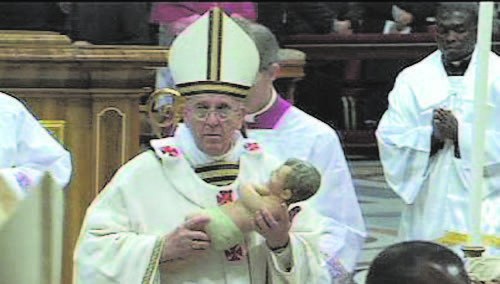
    In a break with tradition, Pope Francis himself performed a task usually given to an aide. He carried a figurine of the baby Jesus to the altar at the start of the mass. The statue of Jesus was then placed in the manger of a life-size nativity scene behind the altar. Pope Francis offered a Christmas wish for a better world, praying for protection for Christians under attack, battered women and trafficked children, peace in the Middle East and Africa, and dignity for refugees fleeing misery and conflict around the globe. Francis delivered the traditional ”Urbi et Orbi” (Latin for ”to the city and to the world”) speech from the central balcony of St. Peter’s Basilica to 70,000 cheering tourists, pilgrims and Romans in the square below.

    He said he was joining all those hoping ”for a better world.” In his first Christmas message since being elected pontiff in March, he asked for all to share in the song of Christmas angels, ”for every man or woman … who hopes for a better world, who cares for others,” humbly. Among places ravaged by conflict, Francis singled out Syria, which saw its third Christmas during civil war; South Sudan; the Central African Republic; Nigeria; and Iraq. In Iraq on Wednesday, militants targeted Christians in two attacks, including a bomb that exploded near a church during Christmas Mass in Baghdad.

    The separate bombings killed dozens of people. The Vatican has been trying to raise concern in the world for persecution and attacks on Christians in parts of the Middle East and Africa. ”Lord of life, protect all who are persecuted in your name,” Francis said. pope also prayed that God ”bless the land where you chose to come into the world and grant a favorable outcome to the peace talks between Israelis and Palestinians.” Francis then explained his concept of peace. ”True peace is not a balancing of opposing forces. It’s not a lovely facade which conceals conflicts and divisions,” the pope said. ”Peace calls for daily commitment,” Francis said, reading the pages of his speech.

    Francis also spoke about the lives of everyday people, especially those struggling for a better life. In Bethlehem, parades filled the streets, as Christian pilgrims and tourists from around the world poured into Manger Square, considered the birthplace of Jesus. Decorations and holiday lights adorned the West Bank for the evening’s celebrations. And in Afghanistan, U.S. troops in Kabul marked the 13th Christmas Eve for American forces in Afghanistan with candles and hymns. In India which has a sizeable Christian population, Christmas was celebrated with zeal and enthusiasm.

    The faithful attended midnight mass in churches while a general atmosphere of celebration was witnessed in all major cities. Santa Claus has been a major attraction, as always. In the Philippines, survivors of last month’s catastrophic typhoon erected giant Christmas lanterns across the devastation in Tacloban. People in other towns sang and danced to holiday songs as they remembered lost loved ones.

    Devyani Khobragade had…
    December 12 for allegedly presenting fraudulent documents to the United States State Department in support of a visa application for an Indian national employed as a babysitter at housekeeper at Khobragade’s home in Manhattan? As it now turns out, diplomat Devyani Khobragade was accredited as an advisor to the Permanent Mission of India to the UN, allowing her full immunity from personal arrest or detention, when she was picked up from her children’s school by US authorities. India Government sources said Khobragade was accredited advisor to the Indian mission to the UN on August 26, 2013 to help the mission with work related to the General Assembly, and her accreditation was valid until December 31.

    The sources claimed the Convention on the Privileges and Immunities of the United Nations Article 4 Section 11A specifies “immunities from personal arrest or detention and from the seizure of their personal baggage” of all representatives of members to the United Nations. Section 16 of the same Article specifies that the expression “Representative” shall be deemed to include all delegates, deputy delegates, advisors, technical experts and secretaries of delegations. She was accredited as advisor on August 26 and was transferred to the permanent mission after the arrest and is currently holding the position of counselor. Because she was attached to the permanent mission only temporarily (until December 31), the State Department was not required to issue its own identity card and it is possible that they may not have known about Khobragade’s status.

    Sources said this was all the more reason for the State Department to have informed India about the move to arrest Khobragade. As the diplomat was working as acting consul general, the US ought to have notified India about her arrest under the Vienna Convention on Consular Relations. The MEA joint secretary who handles the US desk, Vikram Doraiswamy, was in that country on the day Khobragade was arrested, but he wasn’t informed about it. The alacrity with which the US “evacuated” Khobragade’s domestic help Sangeeta Richard’s family, two days before the diplomat’s arrest, rattled New Delhi. Bharara later justified this in a statement saying the Justice Department was “compelled” to make sure that victim, witnesses and their families “are safe and secure while cases are pending”.

    As the case now unravels fast, several US officials, especially those who handled Khobragade’s arrest,may have opened themselves to claims for damages and liability. The government has also discovered that the amount of $4,500 quoted by Bharara as salary promised to Sangeeta by Khobragade was actually just a mention of the employer’s salary on the help’s visa application form. The State Department’s own guidelines on diplomatic and consular immunity emphasize that law enforcement officials need to be sensitive because short-term official visitors from other States to the United Nations or to international conferences convened by the UN may enjoy full diplomatic immunity equivalent to that afforded to diplomatic agents.

    “Owing to the temporary nature of their visit, such officials will normally not have the usual official identity documents recognizable in the United States. Law enforcement officials (particularly in New York) should be sensitive to the existence of this situation and always coordinate with the US authorities indicated in the list of Useful Phone Numbers if confronted with an apparent offender appearing to fall into this category’,” it states. A diplomat’s daughter, Krittika Biswas, had last year filed a lawsuit in a NYC court seeking $1.5 million as damages for her wrongful arrest.

    Ambassador Dr. S.Jaishankar…
    Rao who has since retired. Dr. Jaishankar comes to Washington, DC with more than three decades of diplomatic experience. Joining the Indian Foreign Service in 1977, Dr. Jaishankar has represented India’s interests and fostered friendly working relationships in countries around the world. Dr. Jaishankar’s first postings abroad were as Third and Second Secretary (Political) at the Embassy of India in Moscow from 1979 to 1981. From 1981 to 1985, he served as Under Secretary (Americas) and Policy Planning in the Ministry of External Affairs.

    He then spent three years from 1985 to 1988 as First Secretary handling political affairs at the Indian Embassy in Washington, DC, followed by two years as First Secretary and Political Advisor to the Indian Peace Keeping Force (IPKF) in Sri Lanka. In 1990, Dr. Jaishankar became Commercial Counsellor in Budapest. After three years in that position, he returned to India where he served first as Director of East Europe Division of the Ministry of External Affairs, and then as Press Secretary for the President of India. Following this service in India, Dr. Jaishankar went abroad again – to Tokyo in 1996 as Deputy Chief of Mission. In the year 2000, he was appointed the Ambassador of India to Czech Republic and served in Prague till 2004.

    Upon completing his time as Ambassador in Prague, Dr. Jaishankar returned once again to India, where he led the Americas Division in the Ministry of External Affairs. After three years heading the division, he again left India in 2007 to serve as High Commissioner to Singapore for two years. Most recently, Dr. Jaishankar was the Ambassador of India to China from 2009 to 2013. Dr. Jaishankar holds a Ph.D. and M.Phil in International Relations and a M.A. in Political Science. He is a member of the International Institute for Strategic Studies in London. Dr. Jaishankar is married to Kyoko Jaishankar and has two sons and a daughter.

  • Christmas Celebrated around the World

    Christmas Celebrated around the World

    NEW YORK (TIP): Christmas Eve was marked by festivities and preparations around the world today. The faithful prepared for midnight services in places both traditional and unusual. At the Vatican, worshipers filled Saint Peter’s Basilica for Pope Francis’s first Christmas midnight mass as pontiff. Thousands more gathered outside in St. Peter’s Square. He was assisted by more than 300 cardinals, bishops and priests. In his homily, Pope Francis urged people to lead humble lives. “If our heart is closed, if we are dominated by pride, deceit, and the constant pursuit of self interest, then darkness falls within and around us,” he said.

    In a break with tradition, Pope Francis himself performed a task usually given to an aide. He carried a figurine of the baby Jesus to the altar at the start of the mass. The statue of Jesus was then placed in the manger of a life-size nativity scene behind the altar. In Bethlehem, parades filled the streets, as Christian pilgrims and tourists from around the world poured into Manger Square, considered the birthplace of Jesus. Decorations and holiday lights adorned the West Bank for the evening’s celebrations. And in Afghanistan, U.S. troops in Kabul marked the 13th Christmas Eve for American forces in Afghanistan with candles and hymns. In India which has a sizeable Christian population, Christmas was celebrated with zeal and enthusiasm.

    The faithful attended midnight mass in churches while a general atmosphere of celebration was witnessed in all major cities. Santa Claus has been a major attraction, as always. In the Philippines, survivors of last month’s catastrophic typhoon erected giant Christmas lanterns across the devastation in Tacloban. People in other towns sang and danced to holiday songs as they remembered lost loved ones. Some of 2013’s first Christmas Eve celebrations occurred in China, where guards and volunteers held back hundreds crowding into a Beijing cathedral for holiday services. And far above the planet, astronauts on the International Space Station performed a rare Christmas Eve space walk, only the second in NASA’s history, the goal, to replace a faulty cooling system that failed December 11, all this as American shoppers raced against time to find last- minute gifts.

  • Lawyer of ‘bin Laden doctor’ flees Pakistan

    Lawyer of ‘bin Laden doctor’ flees Pakistan

    PESHAWAR (TIP):
    The main lawyer for a Pakistani doctor who helped the CIA find al-Qaida chief Osama bin Laden fled Pakistan on december 11 after receiving death threats from militants, his colleagues said. The lawyer had represented Dr Shakil Afridi since his arrest following the May 2011 killing of bin Laden in a US raid in the northwestern city of Abbottabad. The doctor ran a vaccination program for the CIA to collect DNA to verify bin Laden’s presence. An assistant and a colleague in the northwestern city of Peshawar said the lawyer Samiullah Afridi travelled to Dubai to save his life.

    “Samiullah Afridi before leaving for Dubai told me that he has received death threats from militants,” as assistant to Afridi said. The assistant and lawyer said Afridi, who is not related to his client, told them he was leaving the country to save his life. They spoke on condition of anonymity to avoid retaliation for their connection to the case. The doctor’s brother Jamil Afridi said the lawyer had not informed him about the departure, saying the family has a panel of attorneys and would have to choose another lead attorney if it is confirmed. Pakistani officials were outraged by the bin Laden operation, which led to international suspicion that they had been harboring al-Qaida’s founder.

    In their eyes, Afridi was a traitor who had collaborated with a foreign spy agency in an illegal operation on Pakistani soil. But the doctor — who is being held in a prison pending retrial on a separate allegation — was never charged by Pakistan of helping the CIA, and US officials have demanded his release. The case has caused friction between Pakistan and the US, complicating a relationship that Washington views as vital for fighting the Taliban and al-Qaida, as well as negotiating an end to the war in neighboring Afghanistan.

  • New Taliban chief returns to Pakistan’s tribal areas: Spokesman

    New Taliban chief returns to Pakistan’s tribal areas: Spokesman

    MIRANSHAH, PAKISTAN (TIP): The new head of the Pakistani Taliban has returned to the country’s tribal areas, a spokesman for the militants said on December 2, after several years based in Afghanistan. Hardline cleric Maulana Fazlullah was elected as leader of the Tehreek-e-Taliban Pakistan (TTP) last month after his predecessor was killed by a US drone. Fazlullah has been based mainly in the mountains of eastern Afghanistan since 2009, when a military operation ended his followers’ brutal two-year rule of Pakistan’s northwest Swat valley.

    TTP spokesman Shahidullah Shahid said Fazlullah was now “commanding the Taliban movement at an unknown location in the tribal areas”. The TTP and other militants have strongholds in the seven semiautonomous tribal areas along Pakistan’s rugged, porous border with Afghanistan. Shahid’s comments came after some Pakistani TV channels reported that Fazlullah had reached Waziristan. “It is not true that Maulana Fazlullah is in Waziristan, he is in the tribal areas but at unknown location,” Shahid said.

    Then-TTP chief Hakimullah Mehsud was killed by a US drone attack in North Waziristan on November 1, while South Waziristan was largely cleared of militant hideouts by a military offensive in 2009. Washington has pushed for a similar operation in North Waziristan, currently seen as the major hub of Taliban and al-Qaida militants plotting attacks on the West and in Afghanistan. Fazlullah, who has a $500,000 government bounty on his head, has mounted some brutal and humiliating attacks on Pakistan’s military, including the beheading of 17 soldiers after an attack in June 2012.

  • Afghanistan-US reach draft security agreement

    Afghanistan-US reach draft security agreement

    KABUL/WASHINGTON (TIP): The United States and Afghanistan on November 20 reached a draft agreement on a crucial security pact, a day before thousands of Afghan elders are set to debate whether to allow US troops to stay in the country after 2014. Without the accord, the United States has warned it could withdraw its troops by the end of next year and leave Afghan forces to fight a Taliban-led insurgency without their help.

    Thousands of Afghan dignitaries and elders are due to convene in a giant tent in the capital Kabul on Thursday to debate the fate of US forces after a 2014 drawdown of a multinational Nato force. “We have reached an agreement as to the final language of the bilateral security agreement that will be placed before the Loya Jirga tomorrow,” Kerry told reporters. Intense negotiations between Kabul and Washington have provoked frustration among the Afghan tribal and political elders who made perilous journeys from all over the country to the capital Kabul for a grand assembly to debate the pact.

    Efforts to finalize the pact stalled on Tuesday amid disagreement over whether US President Barack Obama had agreed to issue a letter acknowledging mistakes made during the 12-year Afghan war. Kerry denied there had been any discussion about the possibility of a US apology to Afghanistan for US mistakes or Afghan civilian casualties during the 12-year US military presence in Afghanistan. Such an apology would draw widespread anger in the United States. “The important thing for people to understand is there has never been a discussion of or the word ‘apology’ used in our discussions whatsoever,” Kerry said, adding that Afghan President Hamid Karzai had also not asked for an apology.

    State Department spokeswoman Jen Psaki said the possibility of a letter, or some other kind of correspondence, would seek to reassure the Loya Jirga of the importance of the US-Afghan relationship and to address concerns over civilian casualties. The Afghan government said it had received assurances that an Obama letter would be provided this week to the grand council of Afghan elders, known as a Loya Jirga. But Susan Rice, Obama’s national security adviser, insisted on Tuesday that an apology was “not on the table.”

    NATIONAL INTERESTS

    The drawdown of Western troops has allowed tentative peace overtures between Kabul and the Taliban to gather pace, and Afghan officials arrived in Pakistan on Wednesday to initiate talks. The Taliban have nonetheless condemned the Loya Jirga as a farce, and security has been tight in Kabul following a suicide bomb attack near the assembly ground over the weekend. Insurgents fired two rockets at the tent where the last Loya Jirga was last held in 2011, but missed the delegates. If the two sides cannot agree on a pact, Karzai has suggested submitting different versions of the document for the Loya Jirga to decide on. That caused confusion among Jirga members.

    Khan Ali Rotman, who runs a Kabul youth organization, said if the pact was not in Afghanistan’s national interests, “we will raise our voice and not vote for it”. But a Kabul senator, Khan Mohammad Belaghi, said Afghanistan had no choice but to sign: “We have to have a partnership with a country like the United States and we will vote in favor of it because it can protect us from threats from neighboring countries, especially Pakistan, and the Taliban.” Violence spiraled on the eve of the meeting, with the Taliban attacking two high-ranking police officials.

    Gunmen ambushed and killed the police chief of Marja district in the southern province of Helmand on his way to work, said Omar Zwak, a spokesman for the provincial governor. Also in the south, guards shot dead a suicide bomber trying to force his way inside the house of the Kandahar provincial police chief, said Hamid Zia Durrani, a spokesman for the police. Later a bomb exploded at a hotel a few doors away, killing three and wounding 14, he said.

  • UN TRUST FUND TO END VIOLENCE AGAINST WOMEN ANNOUNCES OVER USD 8 MILLION IN GRANTS IN 18 COUNTRIES AND TERRITORIES

    UN TRUST FUND TO END VIOLENCE AGAINST WOMEN ANNOUNCES OVER USD 8 MILLION IN GRANTS IN 18 COUNTRIES AND TERRITORIES

    NEW YORK (TIP): The United Nations Trust Fund to End Violence against Women (UN Trust Fund) announced, November 22, USD 8 million in grants to 17 initiatives in 18 countries and territories. First-time grant recipients include organizations from Antigua and Barbuda, Mauritania, Myanmar and Kosovo (under UNSCR 1244). These new grants are expected to reach 2.3 million beneficiaries between 2014 and 2017.

    “Violence against women and girls can be systematically addressed, and, with persistence, eliminated. The UN Trust Fund to End Violence against Women is dedicated to doing just this,” said Ms. Phumzile Mlambo-Ngcuka, Executive Director of UN Women. “Working with partners across the world, the Fund supports concrete action toward a world free of violence. The support of governments, corporations, foundations and individuals is crucial in achieving this goal.” Violence against women and girls continues to be one of the most pervasive human rights violations in the world, affecting as many as one in three women and girls during their lifetime.

    It severely impacts survivors and comes at tremendous emotional and economic costs for families and societies. “The sheer scale of prevailing violence against women and girls is an abomination as well as an obstacle to inclusive development,” said Ms. Lilianne Ploumen, Netherlands Minister for Foreign Trade and Development Cooperation, one of the UNTF’s multi-year donors. “There is urgent need for action to live up to the commitments made in Resolutions and at the Commission of the Status of Women. The Netherlands will continue to support the UN Trust Fund to End Violence against Women and encourages others to do so as well.”

    The grants announced today will support initiatives that respond to three priority areas of the UN Trust Fund: prevention, expanded access to services, and strengthened implementation of national laws, policies and action plans on violence against women and girls. Additionally, this year, funds will be used to address violence against adolescent and young girls, including through engaging school girls in Bangladesh and Viet Nam and developing the capacities of young girl leaders in the Ukraine.

    Other new UN Trust Fund grantees spearheading pioneering approaches include:

    o In South Africa, Grassroot Soccer will upscale and expand its innovative SKILLS Plus sports-based intervention to foster girls’ empowerment, expand girls’ awareness of sexual and reproductive rights and increase girls’ access to medical, legal and psychosocial services;

    o Medical Services in the Pacific will operate mobile clinics in seven rural market locations across Fiji, providing 18,000 women with improved access to sexual and reproductive healthcare, sexual assault counseling and referral services.

    o The Danish Refugee Council will empower displaced women through the provision of legal aid to survivors of violence by creating mobile legal clinics to serve communities hosting high concentrations of returnees and internally displaced persons in Afghanistan and refugee and asylumseekers in Tajikistan.

    The new grants are made possible with generous support from the Governments of Australia, Austria, Germany, Iceland, Ireland, Italy, Japan, Kazakhstan, Liechtenstein, the Netherlands and South Africa. The Fund is also grateful for the vital support of its partners in the private and non-profit sectors: the Saban Foundation; the United Nations Federal Credit Union, UN Women National Committees (Austria, Iceland, Japan, Singapore and the United Kingdom) and Zonta International.

    Administered by UN Women on behalf of the UN System, the UN Trust Fund has supported 368 initiatives in 132 countries and territories, delivering a total of USD 95 million since its establishment by the General Assembly in 1996. On 25 November, the International Day for the Elimination of Violence against Women, the Fund will also launch its next grant cycle with a global call for proposals to support country-level programs to end violence against women and girls in 2014. UN Women is the UN organization dedicated to gender equality and the empowerment of women.

    A global champion for women and girls, UN Women was established to accelerate progress on meeting their needs worldwide. For more information, visit www.unwomen.org. UN Women, 220 East 42nd Street, New York, NY 10017, New York. Tel: +1 646 781-4400. Fax: +1 646 781-4496.

  • The Geopolitics of Nuclear Proliferation

    The Geopolitics of Nuclear Proliferation

    AS I SEE IT

    It is not easy for Iran and the US to end mutual hostility

    The author sees no end to three decades of mutual hostility and suspicion between Iran and the US.

    Just after the foreign ministers of the self-styled “international community” (comprising the EU members and the US) together with their Russian and Chinese counterparts met the Iranian Foreign Minister in Geneva, the Foreign Ministers of India, China and Russia issued a statement which recognized “the right of Iran to peaceful uses of nuclear energy, including for uranium enrichment, under strict IAEA safeguards and consistent with its international obligations”.

    This was an important declaration as the Republican right wing in the US, egged on by a predictable alliance of Israel and Saudi Arabia, would like to scuttle any possibility of an agreement that ends sanctions against Iran in return for Iran accepting safeguards mandated by the IAEA on all its nuclear facilities. Israel wants a termination of uranium enrichment and plutonium production in Iran, together with an end to Iran’s implacable hostility to its very existence. American policies on clandestine nuclear enrichment have been remarkably inconsistent. The country responsible for triggering the proliferation of centrifugebased uranium enrichment technology was the Netherlands.

    It was the Dutch who carelessly granted A.Q. Khan access to sensitive design documents on centrifuge enrichment technology when he worked at the Holland-based Physical Dynamic Research Laboratory, a sub-contractor of the “Ultra Centrifuge Nederland”. Former Dutch Prime Minister Ruud Lubbers has revealed that after Khan’s activities came to light, he was prepared to arrest Khan in Holland, but was prevented from doing so in 1975 and 1986 by the CIA. It is well known that the Reagan Administration had tacitly assured Pakistan that it would look the other way at Pakistani efforts to build the bomb.

    If President Reagan looked the other way at Pakistani proliferation, President Clinton winked at Chinese proliferation involving the transfer of more modern centrifuges, nuclear weapon designs and ring magnets apart from unsafeguarded plutonium facilities to Pakistan. The A.Q. Khan-Iranian nexus goes back to the days of Gen Zia-ul-Haq when the Iranians received the knowhow for uranium enrichment from Khan. Iran is now known to possess an estimated 19,000 centrifuges, predominantly at its enrichment facilities in Natanz.

    It has an old plutonium reactor used for medical isotopes which, it says, is to be replaced by a larger reactor together with reprocessing facilities being built at Arak. Given the clandestine nature of its nuclear program, its activist role in the Islamic world and its virulent anti-Semitism, Iran’s nuclear program has invited international attention. This has resulted in seven UN Security Council Resolutions since 2006, which called on Iran to halt enrichment and even led to the freezing of assets of persons linked to its nuclear and missile programs.

    There have also been cyber attacks (Stuxnet) by the Americans and the killing of some of Iran’s key scientists, believed by the Iranians to have been engineered by the Israelis. While Iran’s nuclear program enjoys widespread domestic support,what have really hurt the Iranians are the crippling economic sanctions by the US and its European allies. These sanctions have led to the shrinking of its oil exports and spiraling of inflation. They have been crucial factors compelling Iran to seek a negotiated end to sanctions, without giving up its inherent right to enrich uranium that it enjoys under the NPT.

    Crucially, the US can now afford to review its policies in the Middle East. Its dependence on oil imports from the Persian Gulf has ended, its oil production will exceed that of Saudi Arabia in the next five years and it is set to become a significant exporter of natural gas. The emergence of Saudi backing for al Qaeda-linked Salafi extremists in Iraq and Syria is not exactly comforting as the Americans prepare to pull out of Afghanistan. While the Obama Administration may make soothing noises to placate the ruffled feathers in Riyadh and Jerusalem, rapprochement with Iran does widen its options in the Muslim world at a time when Iranian Foreign Minister Mohammad Javad Sharif proclaims that Shia-Sunni tensions are “the most serious threat not only to the region but to the world at large”.

    But it would be unrealistic to expect that negotiations between the P 5 and Germany on the one hand and the Iranians on the other will produce any immediate end to the Iranian nuclear impasse. The Israelis and the Saudis, who wield immense clout in the Republican right wing, the US Congress and in many European capitals will spare no effort to secure support for conditions that the Iranians would not agree to. Iran already has one nuclear power plant built by the Russians at Bushehr, with another 360 MW plant under construction at Darkhovin. It currently has stockpiles of uranium enriched to either 3.5%, which can be used in power reactors, or to 20%, which can be relatively easily further enriched and made weapons grade.

    The Iranians are reported to have agreed that the highly enriched uranium will be converted into fuel rods or plates. Iran has an old plutonium reactor for medical isotopes, which it requires to shut down. It is constructing a larger plutonium research reactor at the city of Arak. The Iranians claim that the reactor at Arak is set to replace the existing plutonium reactor, which is being shut down. This is not an explanation that skeptics readily buy. In the negotiations at Geneva, France reportedly took a hard-line position, demanding that the construction of the Arak plutonium reactor should stop and that there should be no reference to Iran’s “right” to enrich uranium.

    This is not surprising. France has recently concluded a $1.8 billion arms deal with Saudi Arabia and is the recipient of large Saudi investments in its sagging agricultural sector. The Iranians are hard bargainers and will not unilaterally give any concessions unless these are matched by a corresponding and simultaneous lifting of economic sanctions. Having already concluded an agreement with the IAEA, granting the IAEA access to its uranium mine and heavy water plant, Iran is unlikely to agree to yield to demands to stop the construction of its new plutonium reactor.

    More importantly, given the continuing gridlock in Washington between the Obama Administration and the Republican-dominated Senate, the Obama Administration will not find it easy to secure Congressional approval for easing sanctions against Iran, especially in the face of Israeli and Saudi opposition. It is not going to be easy for Iran and the US to end over three decades of mutual hostility and suspicion.

  • Afghanistan-US reach draft security agreement

    Afghanistan-US reach draft security agreement

    KABUL/WASHINGTON (TIP): The United States and Afghanistan on November 20 reached a draft agreement on a crucial security pact, a day before thousands of Afghan elders are set to debate whether to allow US troops to stay in the country after 2014. Without the accord, the United States has warned it could withdraw its troops by the end of next year and leave Afghan forces to fight a Taliban-led insurgency without their help.

    Thousands of Afghan dignitaries and elders are due to convene in a giant tent in the capital Kabul on Thursday to debate the fate of US forces after a 2014 drawdown of a multinational Nato force. “We have reached an agreement as to the final language of the bilateral security agreement that will be placed before the Loya Jirga tomorrow,” Kerry told reporters. Intense negotiations between Kabul and Washington have provoked frustration among the Afghan tribal and political elders who made perilous journeys from all over the country to the capital Kabul for a grand assembly to debate the pact. Efforts to finalize the pact stalled on Tuesday amid disagreement over whether US President Barack Obama had agreed to issue a letter acknowledging mistakes made during the 12-year Afghan war.

    Kerry denied there had been any discussion about the possibility of a US apology to Afghanistan for US mistakes or Afghan civilian casualties during the 12- year US military presence in Afghanistan. Such an apology would draw widespread anger in the United States. “The important thing for people to understand is there has never been a discussion of or the word ‘apology’ used in our discussions whatsoever,” Kerry said, adding that Afghan President Hamid Karzai had also not asked for an apology. State Department spokeswoman Jen Psaki said the possibility of a letter, or some other kind of correspondence, would seek to reassure the Loya Jirga of the importance of the US-Afghan relationship and to address concerns over civilian casualties.

    The Afghan government said it had received assurances that an Obama letter would be provided this week to the grand council of Afghan elders, known as a Loya Jirga. But Susan Rice, Obama’s national security adviser, insisted on Tuesday that an apology was “not on the table.”

    NATIONAL INTERESTS

    The drawdown of Western troops has allowed tentative peace overtures between Kabul and the Taliban to gather pace, and Afghan officials arrived in Pakistan on Wednesday to initiate talks. The Taliban have nonetheless condemned the Loya Jirga as a farce, and security has been tight in Kabul following a suicide bomb attack near the assembly ground over the weekend. Insurgents fired two rockets at the tent where the last Loya Jirga was last held in 2011, but missed the delegates. If the two sides cannot agree on a pact, Karzai has suggested submitting different versions of the document for the Loya Jirga to decide on.

    That caused confusion among Jirga members. Khan Ali Rotman, who runs a Kabul youth organization, said if the pact was not in Afghanistan’s national interests, “we will raise our voice and not vote for it”. But a Kabul senator, Khan Mohammad Belaghi, said Afghanistan had no choice but to sign: “We have to have a partnership with a country like the United States and we will vote in favor of it because it can protect us from threats from neighboring countries, especially Pakistan, and the Taliban.” Violence spiraled on the eve of the meeting, with the Taliban attacking two high-ranking police officials.

    Gunmen ambushed and killed the police chief of Marja district in the southern province of Helmand on his way to work, said Omar Zwak, a spokesman for the provincial governor. Also in the south, guards shot dead a suicide bomber trying to force his way inside the house of the Kandahar provincial police chief, said Hamid Zia Durrani, a spokesman for the police. Later a bomb exploded at a hotel a few doors away, killing three and wounding 14, he said.

  • The Geopolitics of Nuclear Proliferation It is not easy for Iran and the US to end mutual hostility

    The Geopolitics of Nuclear Proliferation It is not easy for Iran and the US to end mutual hostility

    The author sees no end to three decades of mutual hostility and suspicion between Iran and the US.

    Just after the foreign ministers of the self-styled “international community” (comprising the EU members and the US) together with their Russian and Chinese counterparts met the Iranian Foreign Minister in Geneva, the Foreign Ministers of India, China and Russia issued a statement which recognized “the right of Iran to peaceful uses of nuclear energy, including for uranium enrichment, under strict IAEA safeguards and consistent with its international obligations”.

    This was an important declaration as the Republican right wing in the US, egged on by a predictable alliance of Israel and Saudi Arabia, would like to scuttle any possibility of an agreement that ends sanctions against Iran in return for Iran accepting safeguards mandated by the IAEA on all its nuclear facilities. Israel wants a termination of uranium enrichment and plutonium production in Iran, together with an end to Iran’s implacable hostility to its very existence. American policies on clandestine nuclear enrichment have been remarkably inconsistent. The country responsible for triggering the proliferation of centrifugebased uranium enrichment technology was the Netherlands.

    It was the Dutch who carelessly granted A.Q. Khan access to sensitive design documents on centrifuge enrichment technology when he worked at the Holland-based Physical Dynamic Research Laboratory, a sub-contractor of the “Ultra Centrifuge Nederland”. Former Dutch Prime Minister Ruud Lubbers has revealed that after Khan’s activities came to light, he was prepared to arrest Khan in Holland, but was prevented from doing so in 1975 and 1986 by the CIA. It is well known that the Reagan Administration had tacitly assured Pakistan that it would look the other way at Pakistani efforts to build the bomb.

    If President Reagan looked the other way at Pakistani proliferation, President Clinton winked at Chinese proliferation involving the transfer of more modern centrifuges, nuclear weapon designs and ring magnets apart from unsafeguarded plutonium facilities to Pakistan. The A.Q. Khan-Iranian nexus goes back to the days of Gen Zia-ul-Haq when the Iranians received the knowhow for uranium enrichment from Khan. Iran is now known to possess an estimated 19,000 centrifuges, predominantly at its enrichment facilities in Natanz. It has an old plutonium reactor used for medical isotopes which, it says, is to be replaced by a larger reactor together with reprocessing facilities being built at Arak.

    Given the clandestine nature of its nuclear program, its activist role in the Islamic world and its virulent anti-Semitism, Iran’s nuclear program has invited international attention. This has resulted in seven UN Security Council Resolutions since 2006, which called on Iran to halt enrichment and even led to the freezing of assets of persons linked to its nuclear and missile programs. There have also been cyber attacks (Stuxnet) by the Americans and the killing of some of Iran’s key scientists, believed by the Iranians to have been engineered by the Israelis.

    While Iran’s nuclear program enjoys widespread domestic support,what have really hurt the Iranians are the crippling economic sanctions by the US and its European allies. These sanctions have led to the shrinking of its oil exports and spiraling of inflation. They have been crucial factors compelling Iran to seek a negotiated end to sanctions, without giving up its inherent right to enrich uranium that it enjoys under the NPT. Crucially, the US can now afford to review its policies in the Middle East.

    Its dependence on oil imports from the Persian Gulf has ended, its oil production will exceed that of Saudi Arabia in the next five years and it is set to become a significant exporter of natural gas. The emergence of Saudi backing for al Qaeda-linked Salafi extremists in Iraq and Syria is not exactly comforting as the Americans prepare to pull out of Afghanistan. While the Obama Administration may make soothing noises to placate the ruffled feathers in Riyadh and Jerusalem, rapprochement with Iran does widen its options in the Muslim world at a time when Iranian Foreign Minister Mohammad Javad Sharif proclaims that Shia-Sunni tensions are “the most serious threat not only to the region but to the world at large”.

    But it would be unrealistic to expect that negotiations between the P 5 and Germany on the one hand and the Iranians on the other will produce any immediate end to the Iranian nuclear impasse. The Israelis and the Saudis, who wield immense clout in the Republican right wing, the US Congress and in many European capitals will spare no effort to secure support for conditions that the Iranians would not agree to.

    Iran already has one nuclear power plant built by the Russians at Bushehr, with another 360 MW plant under construction at Darkhovin. It currently has stockpiles of uranium enriched to either 3.5%, which can be used in power reactors, or to 20%, which can be relatively easily further enriched and made weapons grade. The Iranians are reported to have agreed that the highly enriched uranium will be converted into fuel rods or plates. Iran has an old plutonium reactor for medical isotopes, which it requires to shut down.

    It is constructing a larger plutonium research reactor at the city of Arak. The Iranians claim that the reactor at Arak is set to replace the existing plutonium reactor, which is being shut down. This is not an explanation that skeptics readily buy. In the negotiations at Geneva, France reportedly took a hard-line position, demanding that the construction of the Arak plutonium reactor should stop and that there should be no reference to Iran’s “right” to enrich uranium. This is not surprising.

    France has recently concluded a $1.8 billion arms deal with Saudi Arabia and is the recipient of large Saudi investments in its sagging agricultural sector. The Iranians are hard bargainers and will not unilaterally give any concessions unless these are matched by a corresponding and simultaneous lifting of economic sanctions. Having already concluded an agreement with the IAEA, granting the IAEA access to its uranium mine and heavy water plant, Iran is unlikely to agree to yield to demands to stop the construction of its new plutonium reactor.

    More importantly, given the continuing gridlock in Washington between the Obama Administration and the Republican-dominated Senate, the Obama Administration will not find it easy to secure Congressional approval for easing sanctions against Iran, especially in the face of Israeli and Saudi opposition. It is not going to be easy for Iran and the US to end over three decades of mutual hostility and suspicion.

  • Planning wave of revenge attacks in Pakistan: Taliban

    Planning wave of revenge attacks in Pakistan: Taliban

    DERA ISMAIL KHAN (TIP): The Pakistani Taliban announced on November 8 they would orchestrate a wave of revenge attacks against the government after naming hardline commander Mullah Fazlullah as their new leader. The rise of Fazlullah, known for his fierce Islamist views and rejection of peace talks, by the Taliban shura, or leadership council, a day earlier follows the killing of Hakimullah Mehsud, the previous leader, in a US drone strike on November 1. “We will target security forces, government installations, political leaders and police,” Asmatullah Shaheen, head of the shura, told Reuters by telephone from an undisclosed location. He said the Taliban’s main target included army and government installations in Punjab province, the political stronghold of Prime Minister Nawaz Sharif. “We have a plan. But I want to make one thing clear. We will not target civilians, bazaars or public places. People do not need to be afraid,” Shaheen added. Pakistan publicly condemns US drone strikes as a breach of its sovereignty but in private officials admit the government broadly supports them. Militants are mainly holed up in remote areas on the Afghan border where the army has no presence.

    “Pakistan has full information about drone attacks,” said Shaheen. “Pakistan is a slave of America. It is an American colony.” The Pakistani Taliban are fighting to topple the government and impose Islamist rule in the nucleararmed nation. Attacks have been on the rise since Sharif came to power in May, a concern for global powers already unnerved by the possible security implications of the planned withdrawal of most US-led troops from neighbouring Afghanistan in 2014. Mehsud and his allies had been tentatively open to the concept of ceasefire talks with the government, but Fazlullah, whose men were behind the attack on schoolgirl Malala Yousafzai last year, strongly opposes any negotiations. No meaningful talks have taken place since Sharif’s election and Fazlullah’s rise could signal the start of a new period of uncertainty and violence in the already unstable region.

  • A great game that all sides can win

    A great game that all sides can win

    Pakistan is averse to discussing Afghanistan with India, fearing that would legitimize India’s interests in that country. But it would be in the interests of all three to do so, says the author.

    Two questions have increasingly taken centre-stage in discussions about what might happen in Afghanistan after United States withdrawal in 2014. One, if it will become a proxy battlefield for India and Pakistan, the two big South Asian rivals, and two, if anything can be done to prevent this.

    William Dalrymple, for instance, wrote in an essay for Brookings Institution this year that beyond Afghanistan’s indigenous conflicts between the Pashtuns and Tajiks, and among Pashtuns themselves, “looms the much more dangerous hostility between the two regional powers – India and Pakistan, both armed with nuclear weapons. Their rivalry is particularly flammable as they vie for influence over Afghanistan.

    Compared to that prolonged and deadly contest, the U.S. and the ISAF [International Security Assistance Force] are playing little more than a bit part – and they, unlike the Indians and Pakistanis, are heading for the exit.” The assertion is not new.Western commentators have long put out that the new great game in Afghanistan is going to be between India and Pakistan.

    The theory goes that India’s search for influence in Afghanistan makes Pakistan insecure, forcing Islamabad to support and seek to install proxy actors in Kabul to safeguard its interests, and that this one-upmanship is one of the biggest stumbling blocks to stability in that country. As 2014 nears, the idea has naturally gained better traction. India would have several problems with this formulation.

    The foremost is that such a theory panders to the Pakistan security establishment’s doctrine of strategic depth, in the pursuit of which it sees a third, sovereign country as an extension of itself. India, for its part, views its links to Afghanistan as civilization, and its own interests there as legitimate. Its developmental assistance to Kabul now tops $2 billion and it has undertaken infrastructure projects in Afghanistan.

    And, if the situation allowed, Afghanistan could become India’s economic gateway to Central Asia. New Delhi also believes the “proxy war” theory buys into Islamabad’s allegations against India that it refutes as baseless. Since about 2005, Islamabad has alleged that Indian consulates in Afghanistan, especially in Jalalabad and Kandahar, which are close to the Pakistan-Afghan border, are a cover for anti-Pakistan activities.

    It alleges that Afghanistan is where India arms and funds Baloch secessionists. And after the Taliban unleashed a relentless campaign of terror inside Pakistan, allegations are rife that sections of them are on India’s payroll. The Indian position would be that if there is a war, it will actually be a one-sided one, in which Pakistan targets Indian interests and Indians in Afghanistan through its proxies.

    The latest was the attempted bombing of the Jalalabad consulate in August. The deadliest, the bombing of the Kabul embassy in July 2008, was linked by the Americans too to the Haqqani network, a faction of the Taliban that is widely viewed as a proxy of the Pakistan security establishment. Despite repeated prodding by the Americans, the Pakistan Army has made it clear it will not go after safe havens of the Haqqanis in the Federally Administered Tribal Areas.

    NEW DELHI’S CONCERN

    Concerned that any instability in Afghanistan is certain to spill over across Indian borders, over the last two years New Delhi has suggested repeatedly to Islamabad that the two sides should talk about Afghanistan. But as Pakistan has emerged as a key player in facilitating talks with the Taliban, and while it has no problems talking to every other country with an interest in Afghanistan, including Russia and China, it has cold-shouldered India.

    The ideal course would of course be for trilateral talks involving Kabul, Islamabad and New Delhi. For, Afghanistan is not just a piece of strategic real estate but a sovereign country made up of real people. Right now, though, Pakistan is averse to any idea of talks on Afghanistan, believe as it does that India has no role in there, and that talking would give legitimacy to New Delhi’s claim that it does. It already resents the India- Afghanistan Strategic Partnership Treaty.

    DIVERGENCE ON VIEW

    The divergence surfaced starkly at a recent Track-2 dialogue convened by Friedrich Ebert Stiftung – a German think tank associated with the Social Democratic Party, which brought together retired bureaucrats, former generals, journalists, civil society representatives as well as one politician each from the two countries.

    One of the issues that came up for discussion was if there was at all a need for India and Pakistan to talk about Afghanistan. Most, but not all, Pakistani participants and some Indians too were of the view that talking about Afghanistan was impossible so long as tension between India and Pakistan remained, and that right now Islamabad was in any case too preoccupied with the ‘reconciliation’ process in Afghanistan.

    A suggestion was made by an Indian participant that in view of the approaching U.S.-set deadline for the withdrawal of its troops, and the possibility that a dialogue on other subjects between India and Pakistan was unlikely to resume until after the 2014 Indian elections, the two sides should consider discussing Afghanistan as a standalone subject in the interim. But this was dismissed by many Pakistani participants.

    Why should Pakistan jump to talk on something simply because India considered it important, asked one, when on every other issue, New Delhi behaves as if talks are a huge concession to Islamabad – including the recent Manmohan Singh-Nawaz Sharif summit in New York. But a far-sighted approach perhaps would be to consider that none of the likely scenarios in Afghanistan after the U.S.

    drawdown looks pretty, and to weigh the consequences for Pakistan itself especially if, as one Pakistani participant rightly suggested, the Taliban refuse to play Islamabad’s puppet; after all, they did not when they ruled Afghanistan from the late 1990s to 2001. As well, the Afghan presidential election, to be held in April 2014, is sure to have its own impact, though it is still anyone’s guess if it will be held and whether the country will make a peaceful democratic transition. In Pakistan, many commentators believe the backwash from Afghanistan post-2014 is dangerously going to end up on its western/north-western borders.

    Strategic depth no longer holds Pakistanis in thrall the way it used to in the last century. A Pakistani participant pointed out, only half-jokingly, that his country had ended up providing strategic depth to Afghanistan through its two wars, rather than the other way around.

    As for the view that Pakistan and India cannot talk about Afghanistan without repairing their own relations first, it might be worth considering if such a discussion could actually contribute to reducing bilateral tensions, given that the concerns over Afghanistan do not exist in a vacuum but arise from other problems in the relationship between the two.

    It could even provide the opportunity the Pakistan side has long wanted to bring up with New Delhi its concerns about Balochistan. By rejecting Kabul’s entreaties to New Delhi to play a bigger role in securing Afghanistan post-2014 than just training Afghan security forces, India has signaled it is sensitive to Pakistan’s concerns. As Afghanistan’s immediate neighbor, Pakistan is right to claim a pre-eminent stake in what happens in there, and India should have no quarrel with this. As was pointed out at the Track-2 meeting, Pakistan has suffered the most from the two Afghan wars; it provided refuge to Afghans during the first war in the 1980s. More than 100,000 Pakistanis live in that country.

    The two countries are linked by ethnicity, culture and religion; over 55,000 Afghans cross daily into Pakistan through the two crossing points Torkham and Chaman, not to mention the hundreds who cross over the Durand Line elsewhere. What Pakistan could do in return is to acknowledge that as an important regional actor, India too has legitimate interests in Afghanistan, and also as a route to Central Asia.

    After all, if Pakistan considers itself to be the guard at the geo-strategic gateway to Afghanistan, it must also recognize that squatting at the entrance can only serve to neutralize rather than increase the gate’s geostrategic importance. On the other hand, India-Pakistan cooperation in Afghanistan could open up a world of opportunities for both, and who knows,maybe even lead to the resolution of some old mutual problems. As both countries grapple with new tensions on the Line of Control, Afghanistan may seem secondary on the bilateral agenda. In reality, it may be too late already.

  • Afghanistan wooed Taliban to settle scores with Pak army?

    Afghanistan wooed Taliban to settle scores with Pak army?

    NEW YORK (TIP): Eyeing an upper hand in a baroque regional power game after the withdrawal of US troops next year, the Afghan government tried to work with the Pakistan Taliban with the “ultimate” goal of taking revenge on the Pakistani military , a media report said on october 29 The plan of the Afghan intelligence of trying to work with the al-Qaida allies was “disrupted” after United States Special Forces raided an Afghan convoy that was ushering a senior Pakistan Taliban militant Latif Mehsud to Kabul for secret talks last month. Mehsud is in custody but the “bungled attempt by the Afghan government to cultivate a shadowy alliance with Islamist militants escalated into the latest flash point in the troubled relationship between Afghanistan and the US,” the New York Times said in a report, according to new accounts by officials from both countries. The Afghan intelligence was seeking to work with the Tehrik-i- Taliban Pakistan (TTP) in order to find a “trump card in a baroque regional power game” that will unfold once the American forces withdraw from the country. behind this plan was that the Afghans could “later gain an advantage” in negotiations with the Pakistani government by offering to back off their support for the militants . Aiding the Pakistan Taliban was an “opportunity to bring peace on our terms,” the NYT report quoted one senior Afghan security official as saying. The report said the US caught Afghanistan “redhanded” after its forces were “tipped off ” to the plan.