Tag: Afghanistan

  • Pakistan Taliban vow to avenge Waliur death

    Pakistan Taliban vow to avenge Waliur death

    ISLAMABAD (TIP): A “shocked” Pakistani Taliban on Thursday confirmed the death of its deputy chief Waliur Rehman in a American drone strike and announced it was withdrawing its offer to hold talks with the new Pakistan government over the killing. “I confirm the martyrdom of Waliur Rehman in a drone strike on Wednesday. We are shocked at the martyrdom of our leader but are proud of his sacrifices,” said Ihsanullah Ihsan, spokesman for the banned Tehrik-e-Taliban Pakistan.

    Ihsan said the Taliban was withdrawing its offer of a dialogue with the new government, and would take revenge for Rehman’s killing. “We had sincerely offered a dialogue to the government but we strongly believe that the government has a role to play in the drone strikes,” he said. The Taliban consider the Pakistan government “fully responsible” for the drone strikes because it was “passing on information” to the US, he said.

    Rehman and three senior militant commanders were among six persons killed in the CIA-operated drone strike carried out in Chashma Pul area of North Waziristan Agency. Sources said his death would hit the incoming PML-N government’s plans to open a dialogue with the Taliban as mediators were hoping to establish contact with the militants through the relatively moderate Rehman. The PML-N, which won the general election earlier this month, has said it will hold talks with the Taliban and other militants to usher in peace in the country.

    Earlier in the day, security officials told journalists in the country’s northwest that Rehman was buried at an undisclosed location on Wednesday night. The US had accused Rehman of involvement in a 2009 suicide attack in Afghanistan that killed seven CIA employees. Rehman was carrying a $5 million bounty on his head. The Pakistani Taliban, formed in late 2007, aims to overthrow the Pakistani government, which it believes is too closely aligned with the US.

  • Red Cross halts all staff movement after Afghan attack

    Red Cross halts all staff movement after Afghan attack

    KABUL (TIP): The International Committee of the Red Cross has halted all staff movement across Afghanistan and closed its office in Jalalabad that was hit by a suicide and gun attack. “All movements have been frozen throughout Afghanistan, there is not a single ICRC delegate or employee that is moving, taking the roads, today,” Jacques De Maio, ICRC’s South Asia chief, said in a statement released in Geneva on Thursday.

    “Our sub-delegation in Jalalabad has been closed, so we are reconnecting with the government and re-connecting with armed groups to determined what happened and why.” The ICRC maintains strict neutrality in the Afghan conflict and was thought to be protected from attack by its working relations with the Taliban and other insurgent groups. No militant group has claimed responsibility for Wednesday evening’s attack, in which one guard died at the start of the two-hour assault.

    “He was unarmed, defenceless, he was protecting a compound from where hundreds of thousands of Afghans were getting valuable services,” De Maio said in the video statement. “It was a brutal, despicable and frankly senseless attack… there isn’t a single Afghan that would not recognise that we are strictly independent and humanitarian in what we do.” It was the first time that offices of the ICRC had been targeted since the organisation began work in Afghanistan in 1987. ICRC, which has 1,800 employees nationwide, had 36 staff, including six expatriates, in the eastern city of Jalalabad.

  • Two more arrested as London terror probe expands

    Two more arrested as London terror probe expands

    LONDON (TIP): British police have made two further arrests and searched multiple properties as they widened their investigation into May 22 fatal hacking to death of a British soldier in broad daylight on a busy London street by two Muslim terrorists, a Fox news report says. The two arrests, of a man and a woman — both 29 — on suspicion of conspiracy to murder, raises the possibility that the gruesome attack was not a so-called “lone wolf” killing as once thought.

    Earlier it had been reported that the attackers were known to UK authorities and one had ties to a radical jihadist group well before the shocking attack that has stunned the United Kingdom and risked inflaming tensions between communities. The two men, who were captured on cellphone video covered in blood and spouting jihadist rhetoric moments after the attack, have not yet been named, although Scotland Yard confirmed that they remained hospitalized in stable condition after being shot by armed police at the scene.

    But the killers, who wielded a machete and a cleaver and were dubbed “sickening individuals” by an incensed Prime Minister David Cameron, were already on the radar of security services, according to the BBC. And Anjem Choudary, the leader of radical Islamist organization al- Muhajiroun — a group banned under antiterrorism laws in the UK — has told Reuters that he knows one of the reported suspects.

    Michael Adebolajo, a Muslim convert from Christianity named by the BBC as one of the attackers, attended a number of the organization’s demonstrations, lectures and activities according to Choudary, although he claimed not to have seen him for about two years. The Ministry of Defense has named the slain soldier as 25-year-old Drummer Lee Rigby, of 2nd Battalion The Royal Regiment of Fusiliers.

    In a statement made outside his Downing Street office after having chaired a meeting of the British government’s COBRA (Cabinet Office Briefing Room A) emergency committee, British Prime Minister David Cameron refused to comment about whether security forces had prior knowledge of the suspects. However, he firmly condemned the attack in Churchillian terms, stating: “We will never give in to terror, or terrorism, in any of its forms.”

    Additionally, the Conservative Prime Minister emphasized that “there is nothing in Islam that justifies this truly dreadful act,” and that the fault lay solely with the attackers. He also noted that more Muslim lives have been lost in terrorist acts than any other religion. President Obama, in a statement May 23 afternoon, condemned the attack in strong terms, and reaffirmed the relationship between the US and the UK, stating: “The United States stands resolute with the United Kingdom, our ally and friend, against violent extremism and terror.

    ” Prime Minister Cameron also praised the bravery of Ingrid Loyau-Kennett, a cub scout leader and mother of two, who got off a bus and tried to reason with the attackers after she tried to help the victim lying on the street. The 48-year-old tried to keep talking to the two attackers before police arrived at the scene near the Royal Artillery Barracks in the neighborhood of Woolwich.

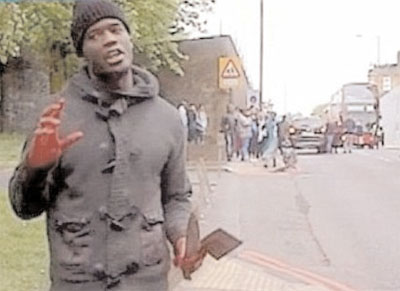
    The British government’s COBRA emergency committee met Thursday after Prime Minister David Cameron said there were “strong indications” it was an act of terrorism, and two other officials said there were signs the attack was motivated by radical Islam. One of the attackers went on video to explain the crime — shouting political statements, gesturing with bloodied hands and waving a meat cleaver.

    Images from the scene showed a blue car that appeared to have been used in the attack, its hood crushed and rammed into a signpost on a sidewalk that was smeared with blood. A number of weapons — including butchers’ knives, a machete and a meat cleaver — were strewn on the street. Footage — obtained by ITV news and The Sun newspaper — showed a man in a dark jacket and knit cap walking toward a camera, clutching a meat cleaver and a knife.

    Speaking in English with a British accent, he apologized that female passers-by “have had to witness this” barbarity, saying that “in our land our women have to see the same.” He gave no indication what that land was as he urged people to tell the government to “bring our troops back.” British troops are deployed in Afghanistan and recently supported the French-led intervention in Mali. “We swear by almighty Allah we will never stop fighting you,” the man declared. “We must fight them as they fight us.”

    The camera then panned away to show a body lying on the ground. Scotland Yard confirmed that counterterrorism officers were leading an investigation into the attack. Commissioner Sir Bernard Hogan-Howe said the two men had been arrested and urged Londoners to remain calm. Both men were hospitalized, one in serious condition. Late Wednesday, riot police fanned out in Woolwich as about 50 men waving the flag of the far-right English Defense League gathered, singing nationalistic songs and shouting obscenities about the Quran.

  • Hamid Karzai gives India military equipment ‘wish list’

    Hamid Karzai gives India military equipment ‘wish list’

    NEW DELHI (TIP): Afghan President Hamid Karzai said on Wednesday he had given a “wish list” of military equipment to India during his visit this week, presenting a conundrum for New Delhi as it weighs whether arming the Afghan army is in its interests. India wants to stabilize Afghanistan and is concerned about the resurgence of militant groups after foreign combat troops leave in 2014.

    However, arming Afghanistan would alarm Pakistan. It takes issue with the influence of its old rival in Afghanistan. India does not want to get drawn into a proxy war with Pakistan, which has ties to the Taliban. India and Afghanistan signed a strategic partnership agreement in 2011 under which New Delhi agreed to assist in the training and equipping of Afghan security forces. India has trained Afghan security force personnel in its military academies, but it has provided little military equipment, according to Indian officials.

    India’s Afghan strategy has centred on boosting its influence through economic reconstruction projects. “We have a wish list that we have put before the government of India,” Karzai told reporters, adding that it was up to India to decide how much help it was prepared to give Afghanistan. Karzai would not say what was on the list, but firstpost.com website said it included 105mm artillery, medium-lift aircraft, bridgelaying equipment and trucks. The Indian government had no immediate comment on Karzai’s statement.

    Karzai’s spokesman said both countries had agreed not to discuss the contents of the shopping list. An Indian government official said earlier that India had already provided some military equipment to Afghanistan but he declined to give details. He said he was surprised that Afghanistan was speaking openly about a weapons request. India is not a major weapons exporter, and suffers chronic shortages of defence equipment itself, including artillery.

    Contested border
    Afghanistan’s request for military equipment comes as its relations with Pakistan, which have been difficult for decades, are again at a low. This month, Pakistan border guards and Afghan police clashed over a contested border area.

  • Zardari Agrees To Restore Cj To Office

    Zardari Agrees To Restore Cj To Office

    In March 2009, growing demonstrations led Zardari to agree to restore the chief justice to office; the government also subsequently announced it would appeal the banning of Sharif and his brother from politics. The supreme court overturned the ban in May, and in July it ruled that Musharraf’s emergency rule had been unconstitutional and illegal. In April, the government received pledges of .2 billion in foreign aid (over two years) to help finance social programs.

    As government forces moved to restore control over areas near Swat, the situation in Swat deteriorated, and in May the military mounted a major offensive against the militants there. In subsequent weeks Islamic militants in response mounted a number of suicide bomb attacks in Pakistani cities, and fighting also intensified in S and N Waziristan and other areas.

    Some 2 million people were displaced by the fighting. The fighting in Swat was declared largely over by late July and by September four fifths of the residents had returned to Swat. Militant attacks continued in Pakistani cities, however, and in Oct., 2009, the military launched a major offensive against militants based in S Waziristan; after some two weeks of fighting militants largely pulled back, ceding most of their main bases to the military by mid-November. In Mar., 2010, an offensive was launched in Orakzai agency in the Tribal Areas, against militants believed to have fled there from S Waziristan; some 200,000 people were displaced by the fighting.

    Fighting continued also in Bajaur and other parts of the Tribal Areas. In Dec., 2009, the supreme court ruled illegal a 2007 Musharraf decree that had declared an amnesty on corruption cases. Benazir Bhutto and the PPP had sought the amnesty in order to end prosecutions begun under Prime Minister Sharif that they asserted were politically motivated, but some 8,000 government officials, politicians, and others were ultimately absolved by the decree.

    The court also called for any case that was derailed by the decree to be reopened. Pakistan and India resumed talks in Feb., 2010; it was the first meeting since the 2008 Mumbai attacks, and agreed a year later to restart formal peace talks. In Apr., 2010, Pakistan adopted constitutional changes that reduced the powers of the president and increased those of the prime minister and parliament, making the president a largely ceremonial head of state; the powers of the provinces were also increased, and the North-West Frontier Province was renamed Khyber Pakhtunkhwa.

    Beginning in late July, the monsoon season resulted in devastating floods of unprecedented proportions along the Indus and its tributaries that impacted, to a greater or lesser degree, all of the country’s provinces and submerged roughly one fifth of its land area. Some 20 million people, the vast majority of them farmers, were affected by the floods, which continued in some areas through September. Some 1,800 died, and the damage was estimated at .7 billion.

    Zadari, who left the country during the crisis, was increasingly unpopular as a result, and the scale of the disaster overwhelmed the government’s ability to respond. Pakistan’s government, which was in financial difficulties before the floods, was faced with estimated rebuilding and recovery costs of billion. By December the financial difficulties threatened the government when the Muttahida Qaumi Movement (MQM) withdrew from the governing coalition over an impending fuel price increase.

    Prime Minister Gilani was forced to roll back the increase in early January in order to regain MQM’s support, and a sales tax overhaul—a condition imposed by the IMF for the release of additional loans—was postponed. The first week of January also saw the assassination of the governor of Punjab because of his support for reforms to Pakistan’s blasphemy laws; in March the minorities minister was similarly killed. In May, 2011, Osama bin Laden, who was in hiding in Abbottabad, Pakistan, was killed there by U.S. commandos, leading to tense relations between Pakistan and the United States; in July the U.S. government announced significant cuts in U.S. aid to Pakistan.

    In Sept., 2011, severe monsoon flooding again hit the country, mainly in Sind. Relations with the United States were further strained in November after U.S. forces, under unclear circumstances during nighttime operations, launched deadly air attacks on Pakistani forces by the Afghanistan border.

    In early 2012 the Pakistani supreme court sought to force the prime minister to ask Swiss officials to reopen a corruption case against President Zadari; the case was among those affected by the 2007 amnesty that the court overturned in 2009. Prime Minister Gilani refused, arguing that the president had immunity, leading the court to convict Gilani of contempt in Apr., 2012. The court then disqualified Gilani as a member of parliament and prime minister in June. Raja Pervez Ashraf, the minister for water and power and a PPP member, subsequently succeeded Gilani as prime minister; Ashraf subsequently also refused to ask the Swiss to reopen the Zadari corruption case.

    Ashraf’s arrest, on corruption charges relating to his previous post, was ordered by the supreme court in Jan., 2013, but anticorruption officials called the charges questionable and refused to arrest him.

    Historic elections
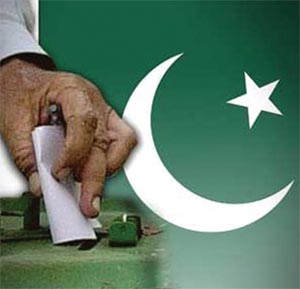
    May 11, 2003, saw historic elections in Pakistan. Despite the violence in the run-up to the elections, which saw regular bomb blasts and the kidnapping of the son of a former prime minister, May 11 votes marked the first time the country has transitioned from one democratically elected government to another. Former Prime Minister Nawaz Sharif is expected to be the new prime minister, based on preliminary results.

    KEY EVENTS IN PAKISTAN’S POLITICAL HISTORY
    -Aug. 14, 1947: Pakistan is founded when British rule over the region ends and the Asian subcontinent is partitioned into Islamic Pakistan, divided into East and West, and predominantly Hindu India.
    -Sept. 11, 1948: Pakistan founder Muhammad Ali Jinnah dies.
    -Oct. 16, 1951: Pakistan’s first prime minister, Liaquat Ali Khan, assassinated in gun attack, triggering political instability.
    -Oct. 27, 1958: Pakistani army chief Mohammed Ayub Khan seizes power.
    -March 25, 1969: After months of opposition rioting in West and East Pakistan, Mohammed Ayub Khan hands over power to army chief Gen. Yahya Khan.
    -Dec. 7, 1970: East Pakistan-based Awami League wins general elections. In response, Yahya Khan suspends the government, triggering widespread rioting in East Pakistan. Civil war breaks out in the wake of army action.
    -Dec. 16, 1971: Pakistan troops surrender in East Pakistan after India’s intervention in the civil war. East Pakistan becomes independent Bangladesh.
    -Dec. 20, 1971: Yahya Khan resigns, Zulfikar Ali Bhutto becomes president. A parliamentary system of government is adopted later, and Bhutto becomes prime minister.
    -July 5, 1977: Pakistani army chief Gen. Mohammed Zia ul-Haq seizes power.
    – April 4, 1979: Bhutto hanged after Supreme Court upholds his death sentence on charges of conspiracy to murder and Zia rejects his mercy petition.
    -Aug. 17, 1988: Zia dies in a mysterious plane crash.
    -December 2, 1988: Bhutto’s daughter Benazir becomes Pakistan’s first woman prime minister.
    -Aug. 6, 1990: Ms. Bhutto’s government dismissed amid charges of corruption and mismanagement.
    – Nov. 1, 1990: Nawaz Sharif becomes prime minister following election.
    -April 18, 1993: President Ghulam Ishaq Khan dismisses Sharif’s government on corruption charges but the Supreme Court revokes the order and reinstates Sharif.
    -July 18, 1993: Due to serious differences between President Khan and Prime Minister Sharif, then-army chief Gen. Waheed Kakar forces both to resign.

  • Political History Of Pakistan

    Political History Of Pakistan

    Pakistan was one of the two original successor states to British India, which was partitioned along religious lines in 1947. For almost 25 years following independence, it consisted of two separate regions, East and West Pakistan, but now it is made up only of the western sector. Both India and Pakistan have laid claim to the Kashmir region; this territorial dispute led to war in 1949, 1965, 1971, 1999, and remains unresolved today. What is now Pakistan was in prehistoric times the Indus Valley civilization (c. 2500–1700 BC).

    A series of invaders—Aryans, Persians, Greeks, Arabs, Turks, and others— controlled the region for the next several thousand years. Islam, the principal religion, was introduced in 711. In 1526, the land became part of the Mogul Empire, which ruled most of the Indian subcontinent from the 16th to the mid-18th century. By 1857, the British became the dominant power in the region.With Hindus holding most of the economic, social, and political advantages, the Muslim minority’s dissatisfaction grew, leading to the formation of the nationalist Muslim League in 1906 by Mohammed Ali Jinnah (1876–1949).

    The league supported Britain in the Second World War while the Hindu nationalist leaders, Nehru and Gandhi, refused. In return for the league’s support of Britain, Jinnah expected British backing for Muslim autonomy. Britain agreed to the formation of Pakistan as a separate dominion within the Commonwealth in Aug. 1947, a bitter disappointment to India’s dream of a unified subcontinent. Jinnah became governorgeneral. The partition of Pakistan and India along religious lines resulted in the largest migration in human history, with 17 million people fleeing across the borders in both directions to escape the accompanying sectarian violence.

    The New Republic
    Pakistan became a republic on March 23, 1956, with Maj. Gen. Iskander Mirza as the first president. Military rule prevailed for the next two decades. Tensions between East and West Pakistan existed from the outset. Separated by more than a thousand miles, the two regions shared few cultural and social traditions other than religion. To the growing resentment of East Pakistan,West Pakistan monopolized the country’s political and economic power. In 1970, East Pakistan’s Awami League, led by the Bengali leader Sheik Mujibur Rahman, secured a majority of the seats in the national assembly.

    President Yahya Khan postponed the opening of the national assembly to skirt East Pakistan’s demand for greater autonomy, provoking civil war. The independent state of Bangladesh, or Bengali nation, was proclaimed on March 26, 1971. Indian troops entered the war in its last weeks, fighting on the side of the new state. Pakistan was defeated on Dec. 16, 1971, and President Yahya Khan stepped down. Zulfikar Ali Bhutto took over Pakistan and accepted Bangladesh as an independent entity.

    In 1976, formal relations between India and Pakistan resumed. Pakistan’s first elections under civilian rule took place in March 1977, and the overwhelming victory of Bhutto’s Pakistan People’s Party (PPP) was denounced as fraudulent. A rising tide of violent protest and political deadlock led to a military takeover on July 5 by Gen. Mohammed Zia ul-Haq. Bhutto was tried and convicted for the 1974 murder of a political opponent, and despite worldwide protests he was executed on April 4, 1979, touching off riots by his supporters. Zia declared himself president on Sept. 16, 1978, and ruled by martial law until Dec. 30, 1985, when a measure of representative government was restored. On Aug. 19, 1988, Zia was killed in a midair explosion of a Pakistani Air Force plane. Elections at the end of 1988 brought longtime Zia opponent Benazir Bhutto, daughter of Zulfikar Bhutto, into office as prime minister.

    A Shaky Government
    In the 1990s, Pakistan saw a shaky succession of governments—Benazir Bhutto was prime minister twice and deposed twice and Nawaz Sharif three times, until he was deposed in a coup on Oct. 12, 1999, by Gen. Pervez Musharraf. The Pakistani public, familiar with military rule for 25 of the nation’s 52-year history, generally viewed the coup as a positive step and hoped it would bring a badly needed economic upswing. To the surprise of much of the world, two new nuclear powers emerged in May 1998 when India, followed by Pakistan just weeks later, conducted nuclear tests. Fighting with India again broke out in the disputed territory of Kashmir in May 1999. Close ties with Afghanistan’s Taliban government thrust Pakistan into a difficult position following the Sept. 11 terrorist attacks. Under U.S. pressure, Pakistan broke with its neighbor to become the United States’ chief ally in the region. In return, President Bush ended sanctions (instituted after Pakistan’s testing of nuclear weapons in 1998), rescheduled its debt, and helped to bolster the legitimacy of the rule of Pervez Musharraf, who appointed himself president in 2001. On Dec. 13, 2001, suicide bombers attacked the Indian parliament, killing 14 people. Indian officials blamed the attack on Islamic militants supported by Pakistan. Both sides assembled hundreds of thousands of troops along their common border, bringing the two nuclear powers to the brink of war.

    Musharraf Extends Power
    In 2002, voters overwhelmingly approved a referendum to extend Musharraf’s presidency another five years. The vote, however, outraged opposing political parties and human rights groups who said the process was rigged. In August, Musharraf unveiled 29 constitutional amendments that strengthened his grip on the country. Pakistani officials dealt a heavy blow to al- Qaeda in March 2003, arresting Khalid Shaikh Mohammed, the top aide to Osama bin Laden, who organized the 2001 terrorist attacks against the U.S. The search for bin Laden intensified in northern Pakistan following Mohammed’s arrest.

    In Nov. 2003, Pakistan and India declared the first formal cease-fire in Kashmir in 14 years. In April 2005, a bus service began between the two capitals of Kashmir— Srinagar on the Indian side and Pakistan’s Muzaffarabad—uniting families that had been separated by the Line of Control since 1947. Abdul Qadeer Khan, the father of Pakistan’s nuclear bomb, was exposed in Feb. 2004 for having sold nuclear secrets to North Korea, Iran, and Libya. Musharraf had him apologize publicly, and then pardoned him. While much of the world reviled him for this unconscionable act of nuclear proliferation, the scientist remains a national hero in Pakistan. Khan claimed that he alone and not Pakistan’s military or government was involved in the selling of these ultraclassified secrets; few in the international community have accepted this explanation.

    Relationship with Taliban
    Pakistan has launched major efforts to combat al-Qaeda and Taliban militants, deploying 80,000 troops to its remote and mountainous border with Afghanistan, a haven for terrorist groups. More than 800 soldiers have died in these campaigns. Yet the country remains a breeding ground for Islamic militancy, with its estimated 10,000–40,000 religious schools, or madrassas. In late 2006 and into 2007, members of the Taliban crossed into eastern Afghanistan from Pakistan’s tribal areas.

    The Pakistani government denied that its intelligence agency has supported the Islamic militants, despite contradictory reports from Western diplomats and the media. In Sept. 2006, President Musharraf signed a controversial peace agreement with seven militant groups, who call themselves the “Pakistan Taliban.” Pakistan’s army agreed to withdraw from the area and allow the Taliban to govern themselves, as long as they promise no incursions into Afghanistan or against Pakistani troops.

    Critics said the deal hands terrorists a secure base of operations; supporters counter that a military solution against the Taliban is futile and will only spawn more militants, contending that containment is the only practical policy. That agreement came under fire in the U.S. in July 2007 with the release of a National Intelligence Estimate. The report concluded that al-Qaeda has gained strength in the past two years and that the United States faces “a persistent and evolving terrorist threat over the next three years.” The report also said the deal has allowed al-Qaeda to flourish. An earthquake with a magnitude of 7.6 struck Pakistani-controlled Kashmir on Oct. 8, 2005. More than 81,000 people were killed and 3 million left homeless. About half of the region’s capital city, Muzaffarabad, was destroyed. The disaster hit at the onset of the Himalayan winter. Many rural villages were too remote for aid workers to reach, leaving thousands vulnerable to the elements.

  • Return Of The Tiger

    Return Of The Tiger

    NAWAZ SHARIF IS PAKISTAN’S NEW CAPTAIN
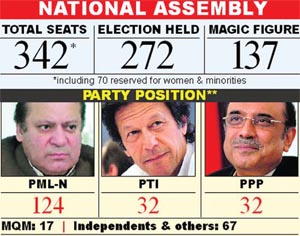
    ISLAMABAD (TIP): The Pakistan Muslim League-Nawaz (PML-N) is all set to form government in Islamabad as it has acquired majority in the National Assembly after as many as 17 independent winners of NA seats joined the Nawaz Sharif-led party. The News quoted sources as saying that a party meeting would be convened during the next two days to discuss formation of Cabinet. Nawaz’s brother Shahbaz Sharif met Jamiat Ulema-i-Islam-Fazl chief Maulana Fazlur Rehman and invited him to join the government in Islamabad. However, Fazl sought time to seek consent of his party’s central committee.

    The sources said that Fazl failed in convincing Sharif to form coalition government in Khyber Pakhtunkhwa, where Imran Khan’s Pakistan Tehreek Insaf (PTI) emerged as the largest party in May 11 polls. Toppled in a 1999 military coup, jailed and exiled, Pakistan’s Nawaz Sharif has made a triumphant election comeback and is certain to become the Prime Minister for a third time. The Pakistan Muslim League- Nawaz (PML-N) has taken an unassailable lead in the landmark elections with its main rivals — former cricketer Imran Khan’s Tehrik-i-Insaf (PTI) and the Pakistan People’s Party (PPP) — trailing far behind.

    To win a simple majority, a party or coalition would have to bag 137 of the 272 National Assembly seats for which polls were held. Another 70 seats in the 342- member National Assembly are reserved for women and minorities. Sharif is set to return to power at a time when Pakistan is facing several major challenges, including growing extremism, a strong Taliban presence in the country’s northwest, rampant corruption, uneasy relations with the US ahead of the withdrawal of foreign forces from war-torn Afghanistan and an economy that has virtually been in free fall for the past few years. Sharif ’s party is also set to form the government in the Punjab province where it was leading in 204 seats out of 304. The PTI was unexpectedly trailing far behind in Punjab though it was bracing for forming government in that province.

    Sharif won reminding people of the path of progress on which the country was moving under his rule in 1990s and five years of good governance under his brother Shahbaz Sharif in Punjab after the 2008 polls. During his rallies, Sharif blamed the PPP for crippling power outages that hit Punjab most, paralysing its industry, disrupting social and economic life and rendering millions of factory workers unemployed. Amid wave that he will be the next premier, influential politicians who had been shifting parties in the past, moved in a big way to join the PML-N giving it a major victory.

    img21

    The PML-N also got the backing of business houses, the middle class, factory workers and rural poor. Imran fascinated and motivated millions of youth, and educated middle class which turned up to vote in large numbers. Imran, who pledged to eliminate corruption, devolve power to lowest level in villages, recast relations with US, collect taxes from rich and run clean austere government, won on three seats — Peshawar, Rawalpindi and home district Mianwali — of the four he contested. He, however, lost to his former party loyalist Ayaz Sadiq of PML-N in Lahore.

    Sharif and Shahbaz Sharif won handily on two seats each and so did PTI’s president Javed Hashmi while its chairman Shah Mahmood Qureshi lost on both seats he contested. The PPP was routed in Punjab and was the case of its ally, ANP in Khyber Pakhtunkhawa, where its president Asfandyar Wali Khan also lost. Rudderless and leaderless, it failed to conduct any election campaign in the country. The Bhutto name, however, won for it Sindh province. It newly appointed presidents Manzoor Wattoo in Punjab and Anwar Saifullah in KP lost. The party could win only one National Assembly seat in Punjab. Former Prime Minister Raja Pervez Ashraf was also demolished badly. Individually, former minister Shaikh Rashid won in Rawalpindi with the PTI help and Ejazul Haq, son of ex-military dictator Ziaul Haq, won in Bahawalnagar.

  • Sharif for warmer ties with India

    Sharif for warmer ties with India

    Says tackling terror and economic revival top priorities for the PML-N govt
    ISLAMABAD (TIP): Nawaz Sharif, poised for a record third term as Pakistan Prime Minister after his party’s emphatic victory in the landmark General Election, has sought “warmer ties” with India and said his government would devise a national policy to tackle the problem of terrorism. “We will contact every party for the purpose of forming our policy on terrorism,” Sharif said during an interaction with a group of foreign journalists at his farmhouse on the outskirts of Lahore on Monday. Referring to the attack on PML-N leader Sanaullah Zehri in Balochistan, Sharif said it would be wrong to say that terrorism had not affected PML-N. He said the PML-N government would respect the mandate given to parties by the people from the areas where they have won. Claiming that Pakistan will become the Asian tiger under his leadership, Sharif said economic revival was a top priority for the PML-N government.

    Sharif was greeted by world leaders, including the Saudi royal family and the British premier. Sharif expressed resolve to have cordial ties with all neighbors, including Iran, Afghanistan, China and India. Sharif called upon Pakistan Tehreek-e- Insaf to respect the mandate of the people and accept the results of the elections. Sharif said he would be “very happy” to invite Prime Minister Manmohan Singh to Pakistan for his oath-taking ceremony as the new Premier. “We will be very happy to invite him. I got a call from him (Singh) yesterday. We had a long chat on the phone and then he extended an invitation to me and I extended an invitation to him,” said Sharif. He said it would be an honour if Manmohan Singh was present at the swearing-in. He further said he hoped to meet the Indian Prime Minister as soon as possible as he was keen on forging good relations between the two countries.

    The PML-N chief had earlier said he is keen on resuming the India-Pakistan peace process that was interrupted in 1999 by then Army chief Pervez Musharraf, who ousted Sharif’s government in a military coup. Prime Minister Singh had yesterday lost no time in congratulating Sharif on his election victory. Responding to questions on the drone strikes, Sharif said he would discuss the issue with the US leadership. Meanwhile, President Asif Ali Zardari on Monday telephoned Pakistan Muslim League-Nawaz (PML-N) leader Nawaz Sharif and congratulated him on winning the historic polls, according to dawn.com. Zardari expressed hope that Sharif would be able to strengthen the democratic process during his political tenure.

  • Transition in Afghanistan: A War of Perceptions

    Transition in Afghanistan: A War of Perceptions

    CONTD FROM PREVIOUS ISSUEAbstract
    A decade after the military intervention that dislodged the Taliban-Al Qaeda combine, peace and stability continues to elude Afghanistan. There is still no consensus in Western capitals on what constitutes the ‘end-state’ in Afghanistan. The Western public’s frustration with a long-drawn war has coalesced with the global economic slowdown, the Euro crisis and the pressures of electoral campaign politics in the United States – thereby complicating the efforts for the long-term stabilization of Afghanistan. Premature announcements of exit and dwindling financial assistance have added to the Afghan anxieties of being ‘abandoned’ once again. This paper brings to light the divergent perceptions among the key stakeholders in Afghanistan and in the international community (IC) on the trajectory of the ‘inteqal’ (transition) process. The paper argues that the war in Afghanistan is essentially a war of perceptions on progress made thus far. This widening gap in perceptions is bound to complicate the transition and long term stabilization process.

    The negotiations with the Taliban constitute one such source of anxiety. As Americans claim that they have established contacts with the insurgents for peace talks in Qatar, various segments of the insurgency and power brokers are aiming to outbid each other in order to secure a larger portion of the pie. Not surprisingly, most of the violence has taken place in areas dominated by the Hizbe- Islami. Its leader Gulbuddin Hekmatyar, is eyeing a major share of the peace deal. Aid, Economic Development and Regional Cooperation Most of the discourse on transition has focused on the numerical strength of the troops that would be adequate to maintain the country’s security.

    Civilian capacity building, economic opportunities, trade, transit and investment that would change the narrative of Afghanistan from being an aid-dependent ‘rentier state’ to a selfsustaining economy, thereby bringing in long-term stability, have received comparatively less attention. The intrinsic nature of aid-giving and execution of development projects through contracts and sub-contracting, has done little to build on state capacities or local ownership.

    Afghanistan’s problem essentially lies in the lack of ‘unity of effort’ (UoE) on the part of the international community in developing a well-coordinated and longterm strategy to build and strengthen the institutions and ‘bring the state back’ into the development process. In rebuilding conflict-ridden states like Afghanistan, aiddelivery through ‘alternate delivery mechanisms’ like the IOs and INGOs or direct delivery through embassies, and community-based groups plays a crucial role in providing immediate humanitarian relief and assistance but in the long term have not been helpful in building state institutions of delivery and implementation. At a time of dwindling international financial assistance to Afghanistan, concerns abound on sustaining its economy and revenue beyond 2014.

    Contrary to the Afghan government’s November 2011 estimate, it requires US$120 billion (at the rate of US$10 billion per year) in aid in the post-2014 period, through 2025. At the Tokyo summit in July 2012, international community promised to give US$16 billion through 2015 to build its economy and make necessary reforms. Such dwindling financial aid is construed as a natural corollary of the declining interest of the West in Afghanistan. Development aid from US, the largest aid donor, has dropped from US$3.5 billion in 2010 to about US$2 billion in 2011. Aid to support democracy, governance and civil society dropped by more than 50 per cent and from US$231 million to US$93 million in the same period. Amidst such a drop in aid-giving, exploring avenues for revenue generation, trade, foreign investment and development of indigenous economic base remains critical.

    Over the coming years, Afghanistan will have to compensate for such shrinkage of external support. The full impact of the shrinkage on Afghanistan’s economic growth, fiscal sustainability and service delivery will probably not be felt until after 2014. The huge international spending in Afghanistan over the past decade has dramatically raised domestic prices (particularly of skilled workers and residential/commercial properties) that the country is no longer export-competitive vis-a-vis other South Asian countries. At least in this respect, the gradual scaling down of foreign spending might help lower prices closer to ‘South Asian levels’, which may help Afghanistan in increasing its exports although ‘transit’ issues will still remain a challenge. The transition process also assumes that Afghanistan will remain an aid-dependent state, in need of assistance to its economy and development for at least another decade.

    While the second Bonn conference on ‘Afghanistan and the International Community: From Transition to the Transformation Decade’ held in December 2011 has set an extended period of international assistance: 2014-24 and has termed it the ‘transformational decade’, the contours of international assistance and engagement remain highly unclear.

    A series of international conferences seems to miss the crucial point that stabilizing Afghanistan by devising quick-fix solutions and setting arbitrary timelines that do not meet the needs on the ground. A successful transition is contingent on the continued, albeit slow, growth in the administrative capacity of government ministries, and on improvements in local governance, civil service, development and employment opportunities at the district level. Afghanistan’s tragedy lies in the fact that time and again its internal contradictions have got trapped in the external power agenda. With the intensification of the search for the ‘end-game’, a regional consensus by forging greater cooperation is seen as a way out of the imbroglio. One way of building a cooperative regional architecture is through greater trade and transit, investment opportunities, including energy pipelines.

    The Istanbul Conference for Afghanistan: Security and Cooperation in the Heart of Asia, held on 2 November 2011, provided a new agenda for regional cooperation, by placing Afghanistan at its centre and engaging the ‘Heart of Asia’ countries in sincere and result-oriented cooperation for a peaceful and stable Afghanistan, as well as a secure and prosperous region as a whole. The emphasis for the first time on a regionally owned process led by Afghanistan, with support and collaboration from its near and extended neighbors, would make this effort ‘sustainable and irreversible’ in the long term.[50] As the first follow-up ministerial meeting of the Istanbul Process, the ‘Heart of Asia’ Ministerial Conference, convened on 14 June 2012 in Kabul, re-affirmed the commitments enshrined in the 2002 Kabul Declaration of Good Neighborly Relations and in the document on principles stipulated in the Istanbul Process on Regional Security and Cooperation for a Secure and Stable Afghanistan.

    The narrative has thus been gradually shifting to regional confidence-building, development, governance, and most lately, trade, transit and investment, aiming to use the country’s resource- and transitpotential to build its economic viability, sustainability and self- reliance. To a large extent, the genesis of this thinking is based on the inadequacies of the securitydominated approach of the last decade. The discovery of huge reserves of minerals and natural gas has raised hopes of possibility of revenue generation, foreign investment and employment opportunities. To what extent these strategies can overcome the need to bring in security remains to be seen.

    The Afghanistan International Investment Conference of 30 November 2010 held in Dubai and the Brussels Euro Mines Conference of 26 October 2011, aimed at promoting economic investment in Afghanistan, made valuable recommendations, but they essentially put the onus for investment on actions to be initiated by Afghanistan. The 28 June 2012 Delhi Summit, taking into consideration the realities and needs on the ground, explored near-term and long-term possibilities in the current environment and at the same time, sought a mechanism to address the needs of foreign and private sector investors and the government of Afghanistan. This is reflective in the efforts geared to catalyze investment decisions and forge cross-country and international partnerships to promote cooperation and greater collective confidence.

    A collective view of security for foreign investors would emerge from the reality of venturing together, rather than individual investors risking an uncertain environment all by themselves. The long term economic benefits, revenue and employment opportunities arising out of investment, trade and transit would help build ‘constituencies of peace’. The Turkmenistan-Afghanistan-Pakistan- India (TAPI) pipeline is another regional collaborative venture that has enormous potential of bringing in economic dividends through mutually beneficial regional cooperation.

    By forging a greater stake and regional commitment to rebuilding Afghanistan through alternate economic opportunities, , foreign investment and local development strategies, capitalizing on Afghanistan’s location, energy and mineral resources in a mutually interdependent regional framework, could pave the way out of the stability-instability paradox. Not all is lost in Afghanistan.

    As Afghanistan traverses a difficult course of transition, there is an immediate need to bridge the perception gap between the Afghans and the international community to build on the gains and address the immediate areas of concern. In the decadelong international involvement, an unified vision and effort of putting Afghans in the lead for rebuilding their state and society remains the missing link in the stabilization efforts. It is critical to rectify this trajectory and set realistic timetables on drawdown based on conditions on the ground. The gains made thus far are substantial but remain fragile.

    Unless critical efforts are made to shore up the state’s institutions and capacities before the drawdown date of 2014 and unless longterm international commitment, a unified strategic communications strategy and regional cooperation is guaranteed, stability in Afghanistan would remain a distant dream.

  • Democracy wins, federation loses

    Democracy wins, federation loses

    While Nawaz Sharif has won the election decisively, he faces the challenge of reaching out beyond his main base in Punjab to the rest of Pakistan
    Pakistan achieved a historic landmark with the completion of its five-year term by the civilian coalition government led by the Pakistan Peoples Party (PPP) and the successful completion of elections resulting in the clear victory for Nawaz Sharif’s Pakistan Muslim League (PML-N). The election results, surprising for many, point to the challenges ahead for the country. Although the PML won enough seats to be able to form the government without having to bargain too much with too many factions, its success comes entirely through the support of one ethnic group – the Punjabis. Every Pakistani province appears to have chosen a different party to represent it. The overall high turnout nationwide masks the harsh reality that very few people voted in Balochistan, where alienation from the centre has been growing.

    Ethnicity
    There is no doubt that people voted out the incumbents amid questions about their performance. But the virtual wiping out of the PPP in Punjab means that each Pakistani political party now reflects the dominant sentiment of a particular ethnic group. The PPP was the only party that had representation from all four provinces of Pakistan in the outgoing Parliament. The election result may be a step forward for Pakistani democracy. It is a step backward for the Pakistani federation. Given the history of complaints about Punjabi domination, Nawaz Sharif will have to reach out to the leaders of other provinces. Authoritarian rule has undermined national unity in the past because of Punjab’s overwhelming supremacy in the armed forces, judiciary and civil services.

    Democracy should not breed similar resentment among smaller ethnic groups through virtual exclusion from power at the centre. In addition to bringing the provinces other than Punjab on board, Sharif’s other major headache would be to evolve a functioning relationship with Pakistan’s military establishment. Although he rose to prominence as General Zia-ul Haq’s protégé, Sharif clashed with General Pervez Musharraf over civilian control of the military. He might be tempted to settle that issue once and for all, partly because of the sentiment generated by his overthrow and imprisonment by Musharraf. Changing the civil-military balance in favor of the civilians would be a good thing. But if it is done without forethought and caution, it could end up risking the democratic gains of the last several years. The PML-N’s view of Pakistani national identity being rooted in Islam and the two-nation theory does not differ much from that of the Pakistani establishment. His real difference with the establishment is over his belief that he, as the elected leader, and not the military must run the country.

    Foreign policy
    Sharif has publicly stated his intention to pick up the threads of the peace process he initiated with Atal Behari Vajpayee in 1999. That process was undermined by the Kargil war, which Sharif now says was initiated by Musharraf without his authority. There can be no assurance that the establishment will let Sharif move forward over changing Pakistan’s posture towards Afghanistan and India, something it did not allow the PPP-led coalition to pursue. Moreover, having been elected with the support of hardline conservative Punjabis, how far can Sharif go against the wishes of his base? During the election campaign, Sharif said little about Afghanistan. In his previous two terms he maintained close ties with the United States but did nothing against the jihadi groups.

    It was under Sharif’s rule that Pakistan officially recognized the Taliban regime and established diplomatic relations. This time, he has spoken of good relations with the West but his voters are overwhelmingly anti-American. The best he might be able to do on foreign policy would be to say the right things publicly without making tough policy decisions. The Punjab electorate, in particular, and some parts of Khyber-Pukhtunkhwa were clearly swayed by a hypernationalist tide, with tinges of Islamist grandiloquence.

    Sharif’s PML-N and Imran Khan’s PTI used similar hypernationalist, anti-American language about Pakistan no longer asking the West for aid. Both parties courted Islamist extremists to bolster their respective vote banks. It might be difficult for them to get off that tiger any time soon. The National Assembly seat break-up is skewed in favor of one province, the largest province of Punjab. Punjab sends 148 general and 35 women’s seats or a total of 183 out of 342 seats which is more than half the seats in the lower house of Parliament.With deep ethnic, linguistic and economic diversity among the provinces, with trust between the provinces being at an all-time low and with the challenge of terrorism facing the country, there is a need for Mr. Sharif to show statesmanship and to appeal beyond his urban Punjabi base.

    Other players
    Sharif is not the only one facing challenges. The PPP has suffered a national setback but has held onto its base in Sindh. It is now time for the party to look inwards and understand that the country has changed. It is growing more urban and Sindh is also doing so. The party is down but not out. It will have to reinvigorate itself by asserting its liberal, social democratic roots. Like the Congress in India, it can continue to seek unity in leadership from the family of Zulfikar Ali Bhutto and Benazir Bhutto. But it has to be a party that is not dismissed as a family enterprise. As for Imran Khan, he achieved a breakthrough by mobilizing disenchanted, apolitical youth. But if he seeks to remain relevant he must realize that there is more to politics than slogans and catch-all phrases. Railing against corrupt and patronage-based politicians is one thing, offering a viable democratic alternative is quite another.

  • Transition In Afghanistan: A War Of Perceptions

    Transition In Afghanistan: A War Of Perceptions

    CONTD FROM PREVIOUS ISSUE
    Abstract A decade after the military intervention that dislodged the Taliban-Al Qaeda combine, peace and stability continues to elude Afghanistan. There is still no consensus in Western capitals on what constitutes the ‘end-state’ in Afghanistan. The Western public’s frustration with a long-drawn war has coalesced with the global economic slowdown, the Euro crisis and the pressures of electoral campaign politics in the United States – thereby complicating the efforts for the long-term stabilization of Afghanistan.Premature announcements of exit and dwindling financial assistance have added to the Afghan anxieties of being ‘abandoned’ once again. This paper brings to light the divergent perceptions among the key stakeholders in Afghanistan and in the international community (IC) on the trajectory of the ‘inteqal’ (transition) process. The paper argues that the war in Afghanistan is essentially a war of perceptions on progress made thus far. This widening gap in perceptions is bound to complicate the transition and long term stabilization process.

    According to Fawzia Koofi, a potential presidential contender and Member of Parliament (MP) from Badkshan, the main issue facing post-conflict societies is the construction of a politically stable and democratic state that has both the institutions and legitimacy to remain viable in the long run.

    Afghan observers point out that the first and second Bonn conferences did not address the need for political reform. The 2004 Constitution, which is sourced mostly from the 1964 Constitution when Afghanistan was a monarchy, has established one of the most highly centralized governments in the world.

    A gradual political reform towards a less centralized government is a necessary step. Amending the 2004 Constitution to establish different forms of government based on decentralization, while preserving the unity of Afghanistan, remains the only viable option. This would help build consensus among Afghans and lay the foundations of durable peace as the international military foot print recedes in 2014.

    If Afghanistan is to achieve some degree of stability after 2014, a concerted effort must be exerted towards political reform through checks and balances. Two rounds of elections in Afghanistan have identified the ineffectiveness of the current electoral system. The Afghan Constitution has shown limitations in providing answers to disputes arising from power relations of three branches of the government and jurisdictions of institutions over governing elections.

    Despite a decade-long international commitment to rebuilding Afghanistan, not much has been done for institution-building, improving governance and establishing the rule of law. The nascent democratic government led by President Karzai is perceived as weak, corrupt and ineffective by the international community and the local population. The fraud-marred parliamentary elections of September 2011 further strengthened this perception.

    Moreover, the reliance on local power brokers and warlords in the security operations and aid-delivery has undermined the development of effective state institutions and the rule of law. Consequently, the government now lacks credible institutional and political muscle to offset the influence of local power brokers and their deeply entrenched patronage systems.

    This has resulted in corruption that permeates and impedes not only governance but also the political and economic sectors and has become a major obstacle in achieving security and development. Problems in the political sector have been exacerbated by a corresponding governance deficit. The near absence of an effective and independent Afghan civil service is another area of concern The Afghan government runs almost entirely on ‘contract employment’ and most of the better-qualified government employees are getting their pay from donor-financed project.

    This effectively means that when the donors leave with their funds, most of these government officials would also leave with them, leaving the country with an even poorer prospect of establishing service-delivery mechanisms. The lack of effective governance, anticorruption measures and the absence of more inclusive politics would impede effective transition. Despite repeated attempts, the international community has been unable to convince President Karzai to permit political parties to assume a more direct role in the election process.

    This combined with a peculiar voting system of Single Non Transferable Vote (SNTV) has contributed to the country’s fragmented politics and often immobilized legislative process. Analysts forewarn that the international community’s leverage with Afghan government in pressing for political sector reforms would decline as its presence in the country reduces.

    The presidential elections are scheduled to be held in 2014, coinciding with the pullout of international troops. In the absence of large scale political sector and electoral reform, the danger of repeat of previous instances of electoral malpractices at a crucial time of transition remains a cause for widespread concern. The Afghan Constitution does not allow President Karzai to run for a third term.

    A smooth transition of power to a new elected president and an expansion of the political basis of the government will have a positive impact on the stabilization of the country. On the contrary, any attempts by the present-day government to delay the elections as part of a power-sharing deal with the Taliban or to introduce measures such as convening a ‘Loya Jirga’ to rubber stamp an unconstitutional move to stay in power or appoint a ‘successor’, or resort to a la Putin technique could see the country slide back into renewed civil strife.

    Peace Talks, Reconciliation and Reintegration
    The ambiguity of the peace processes, reconciliation, reintegration, talks and negotiations with the insurgents has complicated the search for the ‘political solution’ to end the long war in Afghanistan. As individual countries are involved in unilateral and parallel efforts of negotiations, setting up office and contacts outside Afghanistan, this has further reinforced the notion that the West is willing to cut a deal with the insurgents and leave.

    Such secretive and uncoordinated attempts have also raised concerns among the women and human rights groups and ethnic minorities. According to a survey conducted by Asia Foundation, ‘most Afghans want their girls educated, they want women to be able to go to the marketplace freely, they want them to be in public freely, they don’t agree with what the Taliban had done in the 1990s’. However, in the present discourse on transition, not just the gender narrative has taken a back seat, there are impending fears that the achievements made in the last decade with regard to women’s rights could be lost.

    The indigenous peace-building efforts like the High Peace Council (HPC) and the Afghan Peace and Reintegration Program (APRP) appear to be casualty in the process, of both the insurgent onslaught and the international community’s strategy of omission. Even with the long-standing focus on negotiation with the high-ranking Taliban leaders, it is unclear if the international community has moved beyond a phase of opportunistic negotiation, i.e. negotiating with whosoever is available and willing rather than with insurgents of consequence and insurgents enjoying the sanction of top leaders in the insurgent hierarchy.

    It is still not clear whether the process involves the Taliban leadership based in Quetta ( Quetta Shura Taliban). Or, is it simply trying to rope in people who have grown irrelevant to the insurgent movement, sometimes even getting duped by impostors who pose as interlocutors or representatives of the Taliban. While the lack of credible information on the identity of the interlocutors is a lesser problem, , several critical hurdles remain for the parties involved to make any significant headway.

    The most important is the demand of the US that it would retain bases within Afghanistan beyond 2014. President Karzai has down played the talk of permanent presence of US troops, stating that it would be an impediment for negotiations with the Taliban who demanded complete withdrawal of foreign forces as a precondition for talks. Some moves were made to release imprisoned Taliban commanders from the detention centre at Guantanamo Bay, the failure to do so prompted the Taliban to suspend the peace talks in March 2012.

    Efforts, however, continued to keep the fledgling negotiation process going, both by the US and its allies. Lack of a Pakistani endorsement, rooted in the country’s fear of being sidelined from the end-game in Afghanistan, has also played spoiler. In 2009, the negotiation prospect with the Taliban made some progress through a Taliban commander Mullah Baradar, second in command to Mullah Omar, the leader of the Taliban. However, Pakistani establishment stepped in and arrested Baradar in early 2010, derailing the entire process.

    The same process resumed in 2012. Some other sources identified Tayyeb Agha, head of the political committee of the Taliban as another key interlocutor for the back channel talks. Tayyeb, too, was rumored to have been arrested by Pakistan in 2010 along with some other Taliban leaders. The control of the Pakistani military and intelligence on the ‘strategic assets’, the Taliban leadership, would make any meaningful Afghan-led reconciliation process an arduous task.

    The US desire to talk to the insurgents from a position of strength continues to be a pipe dream.With the beginning of drawdown of international forces, the Taliban perceive themselves to be winning. In addition, by launching a successful campaign of violent retribution and targeted assassinations, the Taliban managed to create a power vacuum of sorts in southern Afghanistan. Three major assassinations in 2011 – Ahmed Wali Karzai, half brother of President Karzai, and presidential aide Jan Mohammed Khan, both powerful warlords and the Mayor of Kandahar, Ghulam Haider Hamidi – created a power vacuum in the south with consequent erosion of President Karzai’s support base among the Pushtuns.

    As the contours of the negotiations remain unclear, the high-profile killings in the north and systematic elimination by the insurgents of those who oppose the negotiations process have raised fears among other ethnic and women groups. It has also led to polarization of among other ethnic groups with whispers of civil war gaining momentum. The talk of the early withdrawal of international forces and the ongoing negotiations with the Taliban have not only raised the levels of anxiety but have also been exploited by various actors as they position and jockey for power and influence in post-2014 Afghanistan.

  • Prince Harry Pays Tribute To Us War Dead

    Prince Harry Pays Tribute To Us War Dead

    WASHINGTON (TIP) Prince Harry, in the dress uniform of his British army regiment, paid tribute Friday to US soldiers killed in Iraq and Afghanistan on day two of a US tour dedicated in good part to war veterans. With white-gloved hands behind his back, he strolled alone through rows of white headstones in a section of the sun-kissed Arlington National Cemetery reserved for those who died in America’s most recent wars.

    He wore the dark blue uniform of the Blues and Royals cavalry regiment, which he joined in 2006, together with a powder blue beret representing his role as an Apache attack helicopter pilot in the British army’s air wing.

    On a floral arrangement, the 28-year-old captain — who has twice deployed in Afghanistan — left a signed handwritten note: “To my comrades-in-arms of the United States of America, who have paid the ultimate sacrifice in the cause of freedom,” it said. Harry also laid a wreath at the Tomb of the Unknown Soldier at Arlington, watched by a youthful crowd of T-shirted tourists kept at a distance behind a metal barricade, and paused at the grave of president John F Kennedy, assassinated 50 years ago this November.

    Later in the day, he crossed town to the Walter Reed National Military Medical Center to mingle with US soldiers undergoing physical therapy and get a private briefing on the latest breakthroughs in prosthetics. On the weekend, Harry will be in Colorado for the Warrior Games, where 200- plus wounded servicemen and women will compete in such sports as archery, cycling, swimming, track and field, and wheelchair basketball. Harry, who last visited Washington a year ago, is on his best behavior after cellphone naked photos of him partying in a Las Vegas hotel suite spilled onto the Internet last August.

    Like his father Prince Charles and older brother Prince William, he is assuming a bigger share of royal duties on behalf of his grandmother Queen Elizabeth II, who turned 87 last month.

  • Pakistan Votes In Landmark Election, Coalition Govt Likely

    Pakistan Votes In Landmark Election, Coalition Govt Likely

    ISLAMABAD (TIP): Despite a bloody campaign marred by Taliban attacks, Pakistan was holding historic elections on Saturday pitting a former cricket star against a two-time prime minister once exiled by the army and an incumbent blamed for power blackouts and inflation. Polls opened on Saturday morning across the nation in what is a closely watched race to determine the fate of this nuclear-armed country crucial to stability in the region.

    The vote marks the first time in Pakistan’s 65-year history that a civilian government has completed its full term and handed over power in democratic elections. Previous governments have been toppled by military coups or sacked by presidents allied with the powerful army. Deadly violence struck again on Friday, with a pair of bombings against election offices in northwest Pakistan that killed three people and a shooting that killed a candidate in the southern city of Karachi.

    More than 130 people have been killed in the run-up to the vote, mostly secular party candidates and workers. Most attacks have been traced to Taliban militants, who have vowed to disrupt a democratic process they say runs counter to Islam. The vote is being watched closely by Washington since the US relies on the country of 180 million people for help in fighting Islamic militants and negotiating an end to the war in neighboring Afghanistan.

    The rise of former cricket star Imran Khan, who has almost mythical status in Pakistan, has challenged the dominance of the country’s two main political parties, making the outcome of the election very hard to call. “I think it is the most unpredictable election Pakistan has ever had,” said Moeed Yusuf, South Asia adviser at the United States Institute of Peace.

    “The two-party dominance has broken down, and now you have a real third force challenging these parties.” The election of both the national and provincial assemblies comes at a time of widespread despair in Pakistan, as the country suffers from weak economic growth, rampant electricity and gas shortages, and a deadly Taliban insurgency. The bombings that killed three people on Friday occurred in Miran Shah, the main town in the North Waziristan tribal area, a major sanctuary for the Pakistani Taliban.

    The blasts also wounded 15 people, said intelligence officials, speaking on condition of anonymity because they were not authorized to talk to the media. The candidate who was gunned down in Karachi, Shakil Ahmed, was running as an independent for the provincial assembly, said police officer Mirza Ahmed Baig.

    There is concern that the violence could benefit Islamist parties and those who take a softer line toward the militants, including Khan and former Prime Minister Nawaz Sharif, because they were able to campaign more freely. The government said it would deploy 600,000 security personnel on election day.

    After more than a decade in the political wilderness, the Oxford-educated Khan has emerged as a force in the last two years with the simple message of “change.” He has tapped into the frustrations of millions of Pakistanis – especially urban middle class youth – who believe the traditional politicians have been more interested in enriching themselves through corruption than governing.

    The two main parties that have dominated politics – the Pakistan People’s Party, which led the most recent government, and Sharif’s Pakistan Muslim League-N – have ruled the country a total of five times in the past 25 years. Khan has also struck a chord by criticizing Pakistan’s unpopular alliance with the US and controversial American drone attacks against Islamic militants in the country’s northwest tribal region.

    “I am happy to vote for the person of my choice,” said Mohammed Ayub, who was the first man to vote at a polling station in Islamabad. “I am voting for Imran as he is a strong voice against wrongs.” Support for the 60-year-old Khan may have increased out of sympathy following a freak accident this week at a political rally in which he fell 15 feet (4.5 meters) off a forklift, fracturing three vertebrae and a rib. He is expected to make a full recovery and seems to be making the most of the accident.

    The party has repeatedly aired an interview he did from his hospital bed hours after the fall as a paid advertisement on TV. Nobody is sure how effective he will be in translating his widespread popularity into votes, especially considering he boycotted the 2008 election and only got one seat in 2002. Turnout will be critical, especially among the youth.

    Almost half of Pakistan’s more than 80 million registered voters are under the age of 35, but young people have often stayed away from the polls in the past. Khan faces a stiff challenge from the two main parties, which have spent decades honing vote-getting systems based on feudal ties and political patronage, such as granting supporters government jobs. Because of the strength of this old-style politics and unhappiness with the outgoing government, many analysts see the Pakistan Muslim League-N as the front-runner in the election.

    Sharif has twice served as prime minister and is best known for testing Pakistan’s first nuclear weapon in 1998. Sharif was toppled in a military coup by then-army chief General Pervez Musharraf in 1999 and spent years in exile in Saudi Arabia before returning to the country in 2007. His party, known for its pro-business policies, came in second in the 2008 elections and is seen as more religiously conservative than the Pakistan People’s Party

  • Transition in Afghanistan: A War of Perceptions

    Transition in Afghanistan: A War of Perceptions

    While the US and NATO and the Afghan security officials are willing to underline the latter’s ascending capacities, such views have been viewed with considerable skepticism among civil society and women groups, NGO’s and people in Afghanistan . The impressive performance of the ANSF during some of the high-profile and well coordinated insurgent attacks has been cited as evidence of its growing strength and capabilities. Analysts insist that they have come of age and no longer the ‘rag tag’ men in uniform they used to be.

    At the same time, concerns still exist on the ANSF capability to gather adequate intelligence on the planning and execution of well-coordinated multiple sieges, an insurgent tactic that has gained predominance. Example is cited of the multicity Taliban attack on 15 April 2012, when Taliban suicide attackers carried out attack on Kabul, and three other eastern provinces – Nangarhar, Logar and Paktia. The fact that the insurgents could slip into the protected capital evading several security check points with a huge stockpile of weapons and penetrate the most secure inner circle of Kabul’s ring of steel is a matter of deep worry. NATO commended the ANSF for effectively defending the city and ultimately quelling the attack. But observers are quick to point out that the operation appeared impossible to conclude without the back-up support from NATO helicopters and Special Forces.

    NATO’s praise for the ANSF is understandable, for it is on such success that the exit strategy is predicated. The ANA has been primarily employed to augment the international forces’ COIN campaign. In 2011, over 90 per cent of ISAF operations were conducted in conjunction with the ANA, an increase from 62 per cent of such operations in spring and summer of 2008. However, this projected conjunction could actually be a misnomer. According to a recent US Department of Defense report in 2012, only 13 out of the 156 Afghan Army battalions are classified as ‘independent with advisers’ and only 74 are seen as ‘effective with advisers’. In effect, there is very little to indicate that the ANA will be able to act autonomously over large swathes of the countryside in the next two or three years. Especially remote in the coming years is the possibility of transferring responsibility for the protection of the provinces bordering Pakistan to the Afghan army. Alongside the questions of capacities, maintaining a huge security force establishment is a financial impossibility for the resource-starved Afghan government.

    The total strength of the ANSF in October 2011 reached 306,903 (170,781 soldiers and 136,122 policemen). Future plans envisage an increase to 352,000 personnel (195,000 ANA and 157,000 ANP) by October 2012. Final ANSF end-strength post-2014, however, remains to be determined by prevailing security, political and financial conditions. The government in Kabul is bound to face the most formidable challenge of mentoring the forces and finding continuous funding for such a huge project.. These numbers would be highly unsustainable for an external aid dependent state whose core annual budget is barely US$2.685 billion for the 2012-13 financial year. It was after much deliberation, the US and its allies at the Chicago summit, envisaged a force of 228,500 with an estimated annual budget of $4.1 billion. This amounts to what the U.S. currently spends every 12 days in Afghanistan The greater worry, however, lies in the scenario of acceleration of training impinging on the quality of the forces. Analysts suggest that the ANSF is already ‘unmanageable’ and hence, the term ‘expansion’ is nothing but a paradox.

    While observers perceive some success in terms of raising a capable and independent ANA, serious concerns have been expressed about the capabilities of the ANP and the convoluted attempts in establishing rule of law. Analysts point out that while the ANA is seen as a relative success vis-a-vis the ANP, the chronic deficiencies and problems of funding, equipment, training, desertion, ethnic balancing and infiltration cannot be overlooked. There are serious concerns of creating a ‘hyper-militarized’ state. The feasibility of building a large army without addressing larger issues of civil-military relations has been questioned, particularly when the government in Kabul is perceived to be weak. The lingering concerns of ethnic balancing and representation combined with the challenges of building a national army on meritocratic lines remain.

    Despite major efforts by the NATO Training Mission in Afghanistan (NTM-A) in recent years, the development of the institutional capacity of the ANSF will take years. The ANSF’s quality, its professional and institutional capability and its capacity to function in an unstable and conflict-ridden environment are bound to be tested in the coming years. The rising incidence of ‘green on blue attacks’, i.e. rogue soldiers and police turning their weapons on their ISAF mentors, remains a serious concern. In 2011, 35 NATO soldiers and trainers were killed in 21 incidents of such ‘green on blue’ attacks by the Afghan soldiers. In the first half of 2012, there have been 32 such incidents, killing 40. The Taliban are quick to claim credit for such attacks, claiming infiltration of its cadres into the ANSF ranks. NATO commanders, on the other hand, argue that many such attacks are driven by personal grudges rather than loyalty to the Taliban or other groups.

    In addition to problems associated with inadequate vetting mechanisms and background checks due to the rush to recruit, the increased number of attacks has led to a ‘trust deficit’ between the Afghan soldiers and their mentors leading to scaling down of the NATO’s training and mentoring assistance. While the ANA is construed to be relatively successful, the Afghan National Police (ANP) is bedeviled with problems. The ANP is expected to perform law enforcement, border protection and counter-narcotics functions. However, the ANP is not only perceived to be ineffective, corrupt and illdisciplined, it faces the problems of funding, training, recruitment, equipment, infiltrations and desertions. ANP’s development has been hindered by lack of institutional reform, widespread corruption, insufficient international military trainers and advisors. As a result, ANP has minimal control over the urban centers, with almost no presence in Afghan villages where they are most needed.

    To address the inadequacies of the ANP, a stop-gap measure of recruiting tribal militias under the Afghan Local Police (ALP) has been initiated. In a spate of anti-Taliban uprisings, on the lines of the Anwar Awakening in Iraq, these forces have been successful in repelling the harsh Taliban edicts, school closings in Ghazni, music bans in Nuristan, beheadings in Paktia and murders in Laghman, among other causes. However, concerns remain of such independent and ‘well-stocked armoriesmilitias and they typically behave like the Taliban with a different name’. The project of replicating the Iraq model runs imminent danger of a contravention of the efforts of long-term institution-building and reforms in the security sector. These persisting weaknesses and ‘quick fixes’ are bound to affect the ANSF performance in the long term. Political Sector, Constitutional and Electoral Reform While most of the debate on transition has veered towards security sector, meaningful discussion on the transition in the political sector, particularly when the year of handover of responsibility coincides with the 2014 presidential elections in Afghanistan, seems to be missing. Analysts posit that ‘placing sole responsibility for Afghanistan’s future stability on the ANSF without making progress in creating a stronger political consensus among Afghanistan’s diverse factions, both armed and unarmed, is a highrisk gamble’.

    Over the past decade, the highly centralized executive form of political system has been constantly challenged, both by the insurgent campaign to discredit the present political system and also by the challenges from within the system. The constant bickering between the President and Parliament, deteriorating security, poor governance and the near-absence of rule of law have sparked debates inside and outside Afghanistan for the need for wide-ranging political sector reforms. The magnitude of the problem and simmering discontent has led observers to forewarn: ‘If in 2001 the West was afraid that the absence of a strong centralized government in Kabul would prompt Afghanistan’s dissolution, by 2011 the West has come to fear that a dysfunctional centralized government could cause this same outcome.’ In addition to the existing challenges in the political sector, the complexity of holding elections in the year of handover of authority is daunting. Analysts point out: ‘The Afghan presidential election slated for 2014 is an uninspiring prospect given the skyhigh levels of corruption, nepotism, and patronage that beleaguers the Afghan political system.

    To make things worse, President Hamid Karzai has suggested holding the elections in 2013 to avoid an overlap with the planned end of NATO’s combat mission. And there is still no functional plan in place for a smooth transfer of political power to a post-Karzai government.’ In the absence of large scale political sector and electoral reform, the danger of repeat of previous instances of electoral malpractices at a crucial time of transition is cause for widespread concern. The challenges associated with institutionbuilding in the political sector stem from inadequate steps taken by the international community to help build a robust political system based on a sound understanding of the nature of the Afghan state and the political processes, which shape the local preferences.

    Abstract

    A decade after the military intervention that dislodged the Taliban-Al Qaeda combine, peace and stability continues to elude Afghanistan. There is still no consensus in Western capitals on what constitutes the ‘end-state’ in Afghanistan. The Western public’s frustration with a long-drawn war has coalesced with the global economic slowdown, the Euro crisis and the pressures of electoral campaign politics in the United States – thereby complicating the efforts for the long-term stabilization of Afghanistan. Premature announcements of exit and dwindling financial assistance have added to the Afghan anxieties of being ‘abandoned’ once again. This paper brings to light the divergent perceptions among the key stakeholders in Afghanistan and in the international community (IC) on the trajectory of the ‘inteqal’ (transition) process. The paper argues that the war in Afghanistan is essentially a war of perceptions on progress made thus far. This widening gap in perceptions is bound to complicate the transition and long term stabilization process.

    To be continued next week

  • Seven killed, dozens hurt in Afghanistan earthquake

    Seven killed, dozens hurt in Afghanistan earthquake

    JALALABAD (TIP): Seven people were killed, dozens injured and many homes destroyed when a powerful earthquake struck eastern Afghanistan on Wednesday, officials said. The quake, measured at a magnitude of 5.6 by the US Geological Survey, sent people rushing from their homes in worst-hit areas and was felt in the Afghan capital Kabul and in Islamabad in neighbouring Pakistan. It struck at 0925 GMT at a depth of 62 kilometres (39 miles), with its epicentre 24 kilometres northwest of the eastern Afghan city of Jalalabad near the Pakistani border, the USGS said in a revised update. Six people died in Nangarhar province of which Jalalabad is the capital, said provincial spokesman Ahmad Zia Abdulzai, and 75 people were injured.

    Forty of them were given first aid and the rest admitted to hospital for further treatment. “We are still in the process of getting information from the affected areas. Among the dead are some children,” Abdulzai told AFP. One person was killed and one injured in neighbouring Kunar province and many homes were destroyed, said provincial spokesman Wasefullah Wasef.

  • Transition in Afghanistan: A War of Perceptions

    Transition in Afghanistan: A War of Perceptions

    Abstract:
    A decade after the military intervention that dislodged the Taliban-Al Qaeda combine, peace and stability continues to elude Afghanistan. There is still no consensus in Western capitals on what constitutes the ‘end-state’ in Afghanistan. The Western public’s frustration with a long-drawn war has coalesced with the global economic slowdown, the Euro crisis and the pressures of electoral campaign politics in the United States – thereby complicating the efforts for the long-term stabilization of Afghanistan. Premature announcements of exit and dwindling financial assistance have added to the Afghan anxieties of being ‘abandoned’ once again. This paper brings to light the divergent perceptions among the key stakeholders in Afghanistan and in the international community (IC) on the trajectory of the ‘inteqal’ (transition) process. The paper argues that the war in Afghanistan is essentially a war of perceptions on progress made thus far. This widening gap in perceptions is bound to complicate the transition and long term stabilization process
    The Af-Pak Strategy, Surge & Exit
    President Barack Obama, in emphasizing on a renewed focus and more resources to the ‘good war’ in Afghanistan, announced a troop surge in his speech at West Point on 1 December 2009. Along with the surge, by setting the end of 2014 as the date for drawdown of forces, he ended speculations of the United States’ intent in that country and at the same time provided some clarity to his domestic constituency.

    It assuaged the concerns of the civilian team, led by Vice-President Joe Biden who had opposed the military commanders’ (General Stanley McChrystal and General David Petraeus) request of deploying additional troops for a population-centric counter-insurgency (COIN) campaign. However, the announcement of a date of drawdown sent a different message to the ‘friends and foes’ in the region. While it evoked concerns particularly among the Afghans, the message fed into the propaganda of the Taliban-led insurgency. The US Secretary of Defense Leon Panetta exacerbated the situation in early 2012 by stating that the transition process could be completed by 2013, a year earlier than 2014. Likewise, calls for early withdrawal by NATO allies have further added to the concerns inside Afghanistan and the region.

    Although the declaration arrived at the 2010 Lisbon summit had stated that the ‘transition will be conditions-based, not calendar-driven, and will not equate to withdrawal of ISAF-troops’, there was a perceived turn around at the Chicago Summit in May 2012. President Obama and the NATO leaders agreed to end their role in the Afghan war, stating it is time for the Afghan people to take responsibility for their own security and for the US-led international troops to go home. The Summit decision called for the beginning of full transition in all parts of Afghanistan by mid- 2013 and the Afghan forces taking the lead for security nation-wide.

    As per the plan, the ISAF will gradually draw down its forces to complete its mission by 31 December 2014. Such hasty announcements of early troop drawdown, largely perceived as ‘exit’, have been the source of obvious concerns inside Afghanistan, especially when the insurgency is perceived to be growing in strength and the capacity of the Afghan National Security Forces (ANSFs) to withstand the insurgent onslaught remains suspect. Analysts in the West posit that the withdrawal of Western forces, in such a situation, would lead to a collapse of the evolving security system. Others point out that transition will either fail or be determined by Afghanistan’s internal dynamics and the role of regional states, regardless of what the US, Europe, and other aid-donors do.

    Amid such pessimistic assessments, the talks and attempts of actualizing an effective transition and stabilization process appear to be a mere lip service. It is, thus not surprising that Afghans view the inteqal (transition) process as a last opportunity for the international community to set the course right in their country.

    The paper is an exercise at stock-taking of the ground realities vis-a-vis the varying perceptions among the Afghans and the international community on the progress and challenges for Afghanistan’s transition and long-term stabilization. While the West in its haste to ‘exit’ wants to demonstrate progress, there remain concerns on the ground on the fragility of these achievements. The Afghans, while acknowledging progress, seek longer international commitment to address the grey areas that could undermine gains achieved thus far. More importantly, ‘unity of effort’ and an appropriate strategic communications strategy is imperative to address this widening perception gap. Unlike pessimistic analyses that predict a return of the Taliban in post-2014 Afghanistan, the paper argues against such possibility.

    The paper highlights the tangible gains made in the security, political, governance and economic sectors during the decade-long international presence in the country and also, the areas where gains remain fragile and reversible. Unless unified effort is made to shore up the state and institution building processes before the drawdown date of 2014, the dangers of reversal are imminent resulting in a civil war (worse case scenario) or the continuation and intensification of chaos and instability (stalemate), with the external power interventions and the regional proxies further exacerbating the internal-external conflict dynamics (internecine warfare).

    The Evolving Security Situation and the Taliban led Insurgency Afghanistan continues to encounter a fragile security situation.
    While the 2010 troop surge achieved notable security gains on the ground, analysts argue that such gains are reversible and almost un-sustainable by the ANSFs alone. According to the drawdown plan, the additional troops of 33,000 have been withdrawn in September 2012 leaving behind 68,000 US troops in the country. As the debate on the usefulness of the surge continues, the US-Afghan Strategic Partnership Agreement signed on 1 May 2012 has ensured a minimal troop presence (20- 30,000) for limited counter-terrorism, train and assist mission. While the security situation is said to have improved in south-western Afghanistan, eastern Afghanistan, primarily provinces of Paktika, Paktia, and Khost (known as the P2K region), bordering Pakistan’s Federally Administered Tribal Areas (FATA), and area of operations of the Haqqani Network, remain deeply insurgency infested. The campaign of violence by the insurgents has been lethal and continues to sap the nascent institutions of the Afghan state.

    By employing asymmetric tactics with increasing use of improvised explosive devices (IEDs) and suicide bombers, the insurgents have managed to keep the levels of troop deaths high. High-profile attacks on symbolic targets like the Intercontinental hotel in Kabul (June 2011), British Council (August 2011), the American embassy (September 2011), Kabul Star Hotel (April 2012), Qargah attack (June 2012), Camp Bastion (September 2012) demonstrate their deep strike capability and intent to garner instant and worldwide media attention. The Taliban have adopted brutal tactics of violent retribution and intimidation of the population, targeting those deemed to be associated with, or sympathetic to, the government.

    This strategy witnessed rampant killing and abduction of government officials, aid workers, teachers, religious and tribal leaders. . Systematic targeting and elimination of power brokers, government officials and police chiefs in 2011 added new set of complexities and raised the specter of civil war in the north. Likewise, elimination of key government officials and power brokers in the South, has led to a power vacuum in the Pashtu areas. The Taliban have established shadow governments in areas where the writ of the Afghan government was limited or nonexistent. Much of the insurgent strength is derived from the sense of safety the insurgents are accorded across the Durand line, within Pakistan. Taliban recruits and enjoys safe havens in that country.

    The Pentagon’s April 2012 report to Congress on Security and Stability in Afghanistan stated that despite progress, international efforts to stabilize the country ‘continued to face both long-term and acute challenges’. ‘The Taliban-led insurgency and its Al Qaeda affiliates still operate with impunity from sanctuaries in Pakistan,’ the report said. ‘The insurgency’s safe haven in Pakistan, as well as the limited capacity of the Afghan Government, remain the biggest risks to the process of turning security gains into a durable and sustainable Afghanistan’, it added. The heightened tensions between Pakistan and the US over the assassination of Osama bin Laden by American Special Forces in the garrison town of Abbottabad in May 2011 and the subsequent accidental killing of 28 Pakistani security forces during a NATO air raid in Salala in November 2011, the increase in drone strikes inside Pakistani territory, have added complexities and limited the scope of the counter-terrorism cooperation with Pakistan. This has also resulted in Pakistan being at the ‘margins’ in the evolving end game in Afghanistan.

    Security Sector Reform (SSR) and Preparedness of ANSF

    At the 2010 Lisbon Summit, NATO provided a road map to transfer security responsibility to the Afghans. The first tranche of provinces, districts, and municipalities, which has 25 per cent of Afghanistan’s population, was handed over to the Afghans in July 2011. The second and third tranches were announced in November 2011 and March 2012 respectively.While the second tranche put the Afghans in the lead of providing security for more than 50 per cent of the country’s population, with the beginning of the third tranche, 75 per cent of the Afghan population will be living in areas where the ANSF have lead security responsibility.

    As per the decisions arrived at the May 2012 Chicago Summit, full transition in all parts of Afghanistan will begin by mid- 2013. The natural corollary of the ANSF taking charge of the security of Afghanistan is a change in NATO mission – from combat to an advisory role. The shift to ‘train and assist’ mode has further compounded the complexities and brought to sharp focus the levels of preparedness of the Afghan forces for independent action. The contours of post- 2014 security assistance to Afghanistan will be mentoring, training, and funding the ANSF. Although numerically, both the Afghan National Army (ANA) the Afghan National Police (ANP) are impressive, with 194,466 troops and 149,642 policemen respectively, widespread reservations have been expressed on their capacities.Will the ANSF, product of a rushed, under-resourced and frequently revamped recruitment and training procedure, be able to deliver, remains a critical question.

  • The End of Road for Musharraf

    The End of Road for Musharraf

    Whichever way the Hitchcockian drama in Islamabad plays out there is at least one certainty in the grand confusion: that Pervez Musharraf, arguably the most delusional of the four military dictators that have ruled Pakistan for nearly half its existence, has reached the end of the road. His pipedream of landing in his country after five years of exile, like a triumphant Caesar – in the hope of being welcomed by people still nostalgic about what he had done for them in the past and anxious to give him another chance to lead them – has turned out to be a nightmare.

    He can now rue over his folly during his house arrest in his sprawling farmhouse at the edge of the Pakistani capital. As a matter of fact, Islamabad-based foreign correspondents who had gone to Karachi to cover Musharraf’s “momentous arrival” have reported that it should have been clear from that moment that the former president had no future. His candidature in the four constituencies has already been rejected and most of the political leaders he expected to be with him have already joined other mainstream parties.

    He has no role in the ongoing elections or any influence on their outcome. Incidentally, the most delightful and appropriate comment on his present plight has come from Xinhua, the official news agency of China, Pakistan’s “all-weather” friend where at one time Musharraf used to be welcome. There was, says Xinhua, “poetic justice” in Pakistan when the Islamabad Supreme Court issued an arrest warrant against the former president – something he had done “against dozens of judges when he arrested them in 2007”. On the fate that awaits him, opinions differ widely.

    Some hope, rather than think, that the judiciary that he humiliated so disgracefully in 2007 would not be content without hanging him, especially because the three main charges against him are heinous and include the assassination of Benazir Bhutto and the murder in cold blood of the eminent Baloch leader, Sardar Mohammed Akbar Bugti. Some others believe that if the law and the judicial process don’t get Musharraf, the lawless Taliban would. In my view, this possibility should also be ruled out in view of the enormous commando security the Pakistan Army has provided this former commando general. As of now, the most plausible scenario seems to be that Musharraf’s judicial custody up to May 4 will be extended beyond the date of elections that is May 11. Thereafter his trial can begin, if the judiciary and the new government insist on it. But then it can go on and on for years, if only because in this and many other basic practices the underlying unity of the subcontinent endures. However, overall it is a safe bet that Pakistan’s power structure cannot afford to hurt the sentiments of the all-powerful Army by executing or even imprisoning a former army chief.

    According to available information, General Ashfaque Pervez Kayani, though a one-time protégé of Musharraf, did not want him to come home, leave alone take part in the elections. It is said that messages to this effect were sent to him several times. However, when the megalomaniac former military ruler having hallucinations about his popularity with the Pakistani masses did arrive, the Army considered it its bounden duty to see to it that no harm came to his person and that his, and more importantly, the Army’s izzat (an expression dear to both the Indian and Pakistani armies) was not besmirched in any way. This situation will prevail regardless of the dispensation resulting from the May 11 poll. It would be no surprise if some kind of an understanding already exists among the major stakeholders in Pakistan on this subject.

    Come to think of it, even under a caretaker government, whose only duty is to hold free and fair elections, all concerned have treated Musharraf with kid gloves. Remarkably, Xinhua has taken note of “the speculations” that despite the apex court’s clear order to arrest him, “some bigwigs” in the government told the police to “go slow on Musharraf”.

    It would, indeed, be instructive to look back on the events in 1999 when, after his successful coup, Musharraf wanted to “fix well and proper” his bete noir and then Prime Minister, Nawaz Sharif. But then Saudi Arabia intervened and the military dictator agreed to let Sharif go in exile to Saudi Arabia for 10 years. Today, the Saudi stakes in the stability of Pakistan are even higher than before.

    There are two other points that call for comment. The first is the rather intriguing fact that the United States is refusing to comment on Musharraf”s house arrest one way or the other. Does this lend any credence to his calculation while planning his strategy to take part in elections that, given the configuration of forces in the post-poll Pakistan, the Americans would prefer a government led by him?

    After all it was he who, on the morrow of 9/11, had reversed Pakistan’s policy on Afghanistan and lined up his country with the US in the “war on terror”. Moreover, as revealed only recently, in 2003Musharraf unhesitatingly allowed the Americans to use drones to kill as they wished in North Waziristan as long as they left the Lashkar-e-Toiba (LeT), Jaish-e- Mohammmed and other Pakistani terrorist outfits operating against India well alone?

    Today, the US desperately needs Pakistani cooperation for its plan to withdraw its combat troops from Afghanistan by the end of 2014.

    Secondly, the speculation in some quarters in both India and Pakistan that should the civilian government resist the Army’s demand to let Musharraf go, Kayani and the Army would stage a coup should be dismissed.

    Firstly, over the years Gen Kayani has demonstrated repeatedly that he sees no point in directly taking over when the Army can get its way anyhow. Furthermore, gone are the days of the Cold War when the US had a vested interest in embracing and coddling military dictators in Pakistan. Samuel P. Huntington had then written a book to press home the point that in newly independent countries the armed forces were the best instrument for stability.

    Those days are gone. Today, America is the super-salesman of democracy across the world. It can ill-afford a military takeover in Pakistan, never mind the adverse reaction of the world community in general.

  • US aims to expand India arms trade by “billions of dollars”

    US aims to expand India arms trade by “billions of dollars”

    WASHINGTON (TIP): The United States has already made “tremendous progress” in expanding weapons sales to India since 2008, and US companies could see “billions of dollars” in additional sales in coming years, a senior US State Department official said on april 18.

    Andrew Shapiro, assistant secretary of state for politicalmilitary affairs, said US sales of military equipment to India had grown from zero in 2008 to around $8 billion, despite a decision by India to choose a French-built plane in a closely-watched fighter plane competition. “While that fighter competition loss was disappointing, we have made tremendous progress in the defense trade relationship,” he told a news briefing. “There’s going to be billions of dollars more in the next couple of years.” He said a major arms trade initiative headed by Deputy Defense Secretary Ashton Carter was making good progress and should lead to “an ever greater pace of additional defense trade.” He gave no details on future possible arms sales. US weapons makers including Lockheed Martin Corp (LMT.N), Boeing Co (BA.N), Raytheon Co (RTN.N) and others, are keen to sale their wares to India, the world’s largest arms importer, especially since US military spending is now declining after a decade of sharp growth fueled by the wars in Iraq and Afghanistan. India plans to spend about $100 billion over the next decade upgrading its mostly Sovietera military hardware.

    Shapiro, who is due to leave the State Department at the end of this week, said he had seen news reports about delays in India’s talks with France’s Dassault Aviation (AVMD.PA) about a $15 billion purchase of 126 Rafale fighter jets. But he said the US State Department had not received word from India that it planned to reopen that competition or move ahead with a separate Indian naval fighter competition. Lockheed and Boeing were eliminated from the Indian fighter competition in April 2011.

    Shapiro said the State Department was seeing continued demand for US weaponry from the Middle East and Asia, but US companies faced stiff competition from European weapons makers, who are also facing declining demand in their home markets. He declined to discuss any specific arms sales, but noted that Singapore, Indonesia, and Australia had been key partners in defense trade in recent years. South Korea is also expected to announce the winner of its 60-fighter competition soon.

    Shapiro said his office had dramatically increased its advocacy for US weapons makers under former Secretary of State Hillary Clinton, and her successor, John Kerry, planned to continue the “economic diplomacy” initiative. Shapiro said State Department representatives planned to attend a major air show in Paris in June, despite mandatory budget cuts required under a process known as sequestration, but said officials would have to be conservative about the number of air shows they attended. He said sequestration-related furloughs could also slow the Pentagon’s work on export license requests, which threatened to slow or reverse progress made by the State Department in accelerating work on the licenses to 17 days on average now from 40 to 60 days several years ago. “Those processing times are likely to increase at a time when we’re trying to increase our defense trade. That’s not the best signal to send,” Shapiro said.

  • Looking East, Looking West: U.S. Support for India’s Regional Leadership

    Looking East, Looking West: U.S. Support for India’s Regional Leadership

    Today, I’d like to talk about India’s growing influence, felt in the East through its “Look East” policy and in the west, particularly as we move toward the transition in Afghanistan. I’ll highlight how India’s engagement in these areas is crucial to U.S. foreign policy objectives and our pursuit of a stable, secure and prosperous region. India’s leadership has powerful implications that extend beyond its immediate neighborhood – as a beacon of democracy, stability, and growth. India has much to offer all of us, including communities right here in Cambridge. Harvard University’s increased engagement with India, through events like this, through its South Asia Institute, its research center in Mumbai, President Faust’s 2012 visit to India, through over 1,500 Harvard alumni in India, as well as a myriad of research projects, academic collaborations and student and faculty exchanges, testify to India’s growing prominence and our recognition of its increasing importance in the global arena. Massachusetts, likewise, has become a pioneer in forging closer relations with this key partner.

    The State Department strongly champions and supports state-to-state and cityto- city engagement,which is now a vital part of advancing our economic and people-to-people relationships. This year alone, at least eight American Governors are leading trade and other missions to India, not only to develop new markets but to attract job-boosting investments. Massachusetts was an early pioneer: back in 1995,when then-Governor Weld announced plans to forge an alliance with Karnataka, such engagement was a novel concept and a new approach. Governor Weld had the foresight to know that those who didn’t pursue ties with India would miss out on the many rewards this relationship has to offer. His delegation, consisting of 22 U.S. companies, paved the way for numerous U.S. firms to open in and around Bangalore. Today, Massachusetts is one of India’s top 25 trading partners in the world, and last year India received nearly $300 million of this state’s exports. But I hardly need to tell this audience how critical the U.S.-India relationship is.

    Those of you involved in collaborations with India, particularly in academia and research, are fully aware of the benefits. But our bilateral partnership benefits not only our two nations; it is of vital importance to a global vision for a future of shared prosperity. During his visit to India in 2010, President Barack Obama recognized the promise of our shared future and hailed the U.S.-India relationship as “one of the defining partnerships of the 21st century.” We and our Indian friends have taken significant steps to realize that vision. We established a Strategic Dialogue chaired by the Secretary of State and External Affairs Minister to give strategic direction to the wide range of bilateral dialogues between our two governments. We have expanded counterterrorism cooperation, intelligence sharing, and law enforcement exchanges that have helped make both of our countries safer, but clear-eyed about the threats that persist. Bilateral trade has grown by 50% from $66 billion to $93 billion in the last four years and is set to cross $100 billion this year.

    Indian foreign direct investment in the United States increased from $227 million a decade ago to almost $4.9 billion in 2011 – investments that have created and support thousands of U.S. jobs. Another growing component of our bilateral relationship with India is defense trade. Since 2000, sales to India have surpassed $8 billion, representing both an excellent commercial opportunity for U.S. companies but also advancing a vital component of our bilateral security relationship.We will continue to pursue defense trade cooperation with India, including a whole-of-government effort led by Deputy Secretary of Defense Ash Carter to reduce bureaucratic impediments, ease transactions between buyers and sellers, increase cooperative research, and focus on coproduction and co-development opportunities. We have grown our partnership with India on export controls and non-proliferation.We have worked closely with our companies to help them move deeper into India’s nuclear commercial markets, and we hope to announce more tangible commercial progress by the next Strategic Dialogue.

    We have increased our collaboration on clean energy through programs such as the U.S.-India Partnership to Advance Clean Energy (PACE). Since its creation, PACE has mobilized over $1.7 billion in renewable energy financing to India and has driven full-spectrum activity from basic research to development and commercialization in solar technology, advanced biofuels, and building efficiency. India is hosting the Fourth Clean Energy Ministerial (CEM) in New Delhi later this month. The CEM offers a tremendous opportunity for partnership on a range of clean energy technologies, particularly in buildings and appliance efficiency, that are among the world’s most ambitious. And we have witnessed an expansion of our already robust people-to-people ties, particularly in the educational arena,where there is great demand. India has about 600 million people under 25.

    The next generation can only fulfill their roles as economic drivers if equipped with the right training and skills. India aims to increase its higher education enrolment from under 20 percent to 30 percent by the end of the decade. That means it needs 50,000 more colleges and 1 million more faculty. Since the first iteration of the U.S. India Higher Education Dialogue last year,we have focused our efforts on such critical areas as skills training and workforce development by strengthening community college collaboration. We are preparing for another round of Obama Singh 21st Century Knowledge Initiatives awards,which will further partnerships and junior faculty development between U.S. and Indian higher education institutions in priority fields and we have sought to encourage more Americans to study in India and build American expertise about India and by ramping up our Passport to India initiative.

    With its strong democratic institutions, unprecedented demographic growth, economic promise and rising military capabilities, India is poised to play a critical leadership role both regionally and globally.With rising power comes greater global responsibility and in moving beyond its tradition of non-alignment, India has established its credentials as a responsible player in the global arena.We are committed to working together, along with others in the region, toward the evolution of an open, balanced, and inclusive architecture. India has long been an integral member of the Asia-Pacific region, sharing cultural and historical ties that have laid the foundation for its expanded engagement of today.With its “Look East” Policy, initiated in 1991, India began to work more closely with its Asian partners to engage the rest of the world, reflecting the belief that India’s future and economic interests are best served by greater integration with East and Southeast Asia.

    Today, India is forging closer and deeper economic ties with its eastern neighbors by expanding regional markets, and increasing both investments and industrial development from Burma to the Philippines. India is also seeking greater regional security and military cooperation with its neighbors through more intensive engagement with ASEAN and other near neighbors. This week, in fact, India and China held their annual counterterrorism dialogue and focused on pan-Islamic extremism in the backdrop of Afghanistan’s transition. Such interaction evinces Beijing and Delhi’s interest in coordinating to work together for stability in Kabul in 2014 and beyond. Trade, and by extension maritime security, are key components of our bilateral collaboration. The economic dynamism of South, Southeast and East Asia, along with improving relations between India and its neighbors to the East, has spurred the region’s interest in revitalizing and expanding road, air, and sea links between India, Bangladesh, Burma, and the rapidly expanding economies of ASEAN. From 2011 to 2012, trade between India and the countries of Southeast Asia increased by 37%.

    This emerging Indo-Pacific Economic Corridor, as we have come to call it, is a boon for the region and for the United States, providing our own economy with potential new markets. Linkages and infrastructure investments between the rapidly expanding economies of South Asia and those of Southeast Asia are a critical component to integrating regional markets to both accelerate economic development and strengthen regional stability,while helping unlock and expand markets for American goods and services. An India that is well-integrated into the Asia’s economic architecture, that pursues open market policies, and that has diverse and broad-based economic relationships across the East Asia region is not only good for India, but is good for the United States and the Asia- Pacific region as a whole.

    But trade can only prosper when maritime security is assured. Oceans are essential to India’s security and prosperity, as they are to ours. By volume, 90% of the goods India trades are carried by sea. India therefore has a strong interest in guaranteeing unhindered freedom of navigation in international waters, the free flow of commerce, and the peaceful resolution of maritime disputes. But beyond its own economic benefit, India realizes that the economic integration enabled by the improvements of connections across Asia, will lead to prosperity that benefits all nations. India’s growing naval capacity and modernization have enabled its strong presence across the Indian and Pacific Oceans and further bolstered its role as a net security provider in the maritime domain.

    Already in the Western Indian Ocean region, New Delhi is demonstrating its growing maritime capabilities with a robust counter-piracy approach that serves common regional interests and many of their own nationals held hostage in Somalia. As a founding member of the international Contact Group on Piracy off the Coast of Somalia, India has shown great leadership in the efforts to confront and combat piracy stemming from Somalia which threatens trade flows to and from Asia. Our shared vision for economic integration and the promotion of regional stability also extends westward. The United States and India are both strong supporters of a more economically integrated South and Central Asia, with Afghanistan at its heart — what we call the New Silk Road vision.

    At the core of this vision is an Afghanistan at peace and is firmly embedded in the economic life of the region. Such an integrated region will be better able to attract new investment, benefit from its resource potential, and provide increasing economic opportunity and hope for its citizens. Improving connections between South and Central Asia is made all the more urgent as Afghanistan moves through the transition process and puts its economy on a more sustainable private sector-led footing. The countries of the region have embraced a new vision for Afghanistan that places it at the center of a rejuvenated network of commerce, communications and energy transmission, a “land bridge” connecting the Middle East and central Asia to the dynamic markets of China, India and Southeast Asia. Its economic development and ultimate economic integration into the larger network of regional markets is yet another piece of the New Silk Road tapestry. As Afghanistan increasingly takes the lead in its own security, political, and economic situation,we also strongly support the constructive role that India is playing in Afghanistan’s ongoing development.We look to India to play an active part in ensuring that that stability and security endure and that the gains made in Afghanistan over the past 11 years are sustained. Indeed, great challenges lie ahead. But India is committed to our shared vision for a peaceful, stable and secure Afghanistan and has already proven its commitment to assume a greater role in enabling that vision to come to fruition. In 2011, India pledged through the signing of a wide-ranging strategic agreement to train and equip Afghan security forces.

    As the largest regional provider of humanitarian and reconstruction aid to Afghanistan, India has given some $2 billion in aid to the country. Indian public and private companies are building the infrastructure which will carry the nation forward. They have built highways from Kandahar to Kabul and a new parliament building in the capital, put transmission lines between Afghanistan and Uzbekistan and have plans to power Afghan cities through the Salma dam project and to help Afghanistan realize its mineral wealth through development of the Hajigak iron ore mines. On the soft power side, India’s Bureau of Parliamentary Studies and Training invited most senators in Afghanistan’s Upper House, the Meshrano Jirga, for a training session in legislative and budgetary processes in New Delhi, much as the JFK School of Government does for new lawmakers in Washington.

    There’s perhaps no better example of the potentially impact of the New Silk Road vision for Afghanistan and its region than the Turkmenistan-Afghanistan-Pakistan-India pipeline, or TAPI. By connecting abundant energy reserves in Turkmenistan with rapidly rising demand for that energy in South Asia and providing Afghanistan with much-needed transit revenue, TAPI can be transformative for the region. While there’s still much to be done to make this project a reality,we are closer today than anyone would have thought possible just a few years ago, thanks in no small part to Indian leadership. Beyond these infrastructure efforts, India has rallied the international community to encourage further development and to garner the support needed to enable Afghanistan’s successful transition.

    Last year New Delhi hosted a major summit on international investment in Afghanistan’s economy. As Afghanistan shifts the foundation of its economy from aid to trade in the coming years, India’s regional role as a driver of economic prosperity and anchor of democratic stability becomes even more important. Later this month in Almaty, the United States, India, and other countries of the region, will meet to discuss how we can best support a secure and prosperous Afghanistan, integrated into its region. This gathering is part of the Istanbul Process, in which neighbors and nearneighbors support Afghanistan through a range of initiatives that advance security and regional economic cooperation. India has already demonstrated a clear leadership role through its chairing of a working group focused on expanding cross-border commercial and business-to-business relations.

    In conclusion, in Afghanistan as in so many other areas, meeting the challenges of today and seizing the opportunities of tomorrow demand cooperative responses and lasting partnerships.We have found, in India, a strong partner in our shared quest for peace, stability, and prosperity in South Asia, the Asia-Pacific region, and beyond. As India continues to grow economically and extends its engagement outward,we see that our strategic investment in partnership with India is paying dividends that will last for generations.

    An India that is well-integrated into the Asia’s economic architecture, that pursues open market policies, and that has diverse and broad-based economic relationships across the East Asia region is not only good for India, but is good for the United States and the Asia-Pacific region as a whole”, says the author

  • Dev Ratnam-Integrity, Charity, Modesty Propel This Visionary

    Dev Ratnam-Integrity, Charity, Modesty Propel This Visionary

    I am passionate about doing well not only in career but also in my community. I won’t say it’s a passion but I am very keen on being an honorable member in our community. I believe in being a good representative of India. Whatever obligations I have with the government, banks, other financial institutions of US and other countries, I want to deal with them with honor. I never want to escape from that. I never want to fail India, or my state. Life will always force you to deal with breaks, be it good breaks or bad breaks. How you deal with it is your legacy.

    Dev Ratnam began his career as a scientist. But he never wanted to be master at just one trick. He wanted to explore all the opportunities around him before settling into one. He tells us, “In true spirit, I am an entrepreneur, so I try many businesses. Though my education and experience is as a scientist from Penn state in 1977, I still wanted to venture beyond my degrees.” Dev graduated from Indian Institute of Science, Bangalore in Engineering and completed Masters in Engineering from Queens University, Canada and got a Ph.D. in Solid State Science from Penn State University in 1971. Yet, his dream was to always go back to India and set up his own business there. He tried his true best to fulfill that dream. Dev explains, “I was planning to buy a factory from Australia. The agent from Melbourne belonged to a big family.


    img12

    He used to be the Governor of Maharashtra and his son was my partner. We wanted to buy that factory and bring it to Chennai and set it up in India. But somehow the politics played its part after I reached Melbourne. I realized that I would be a minority party. And I had to walk away from my dream of setting up business in India. Of course, I tried to buy a factory from here and take the technology and equipment to India, but that never materialized. But in that search for a factory, I found a company in Long Island called Poly Mag Ink.

    A couple of partners and me bought it, but unforeseen factors didn’t allow it to be a big company. It still exists and it does have big clients like GM, Kodak, etc. Perhaps the location in Long Island was a disadvantage.” While many would give up and try to move on to something else, Dev Ratnam never stopped believing in himself. He defines himself as an eternal optimist and does not think giving up is an option. “I just never wanted to give up. In my years of experience, I have come through all the time. Yes, I did not perhaps see bright successes all over.

    But I have seen spurts of success and it was good with me.” Never to give up, even Dev Ratnam had to let go his dream of establishing business in India. But the blame for that lies on the political system of India. “I don’t want to sound negative, but in 40 years I have never succeeded with one project in India. But in China, South Korea or United States, it is entirely different. That does not make India bad.

    But I cannot recall one fruitful project, be in charity or investment in India.” His passion is what perhaps distinguishes him the most. He is a firm believer in the thought that a successful man is only successful enough if he can give back to his community. Dev explains, “I am passionate about doing not only well in career but also in my community.

    I won’t say it’s a passion but I am very keen on being an honorable member in our community. I believe in being a good representative of India. Whatever obligations I have with the government, banks, other financial institutions of US and other countries, I want to deal with them with honor. I never want to escape from that. I never want to fail India, or my state. Life will always force you to deal with breaks, be it good breaks or bad breaks. How you deal with it, is your legacy.” Dev Ratnam’s dreams and ambitions are just as extraordinary. His dream of helping others has paved the way for success in many people’s lives. He is on the Board of Interfaith Nutrition Network since 1995; had been a voice on the board on behalf of Indian community.

    He charts out a few of his projects. “I just want to do good things in life at this point. I have seen a couple of charitable programs that I want to take up. There is one in particular called Shri Chakra, which is an organization that concentrates on providing electricity through bicycle pedaling. It is on hold for now, due to some real-estate issues, but it’s a temporary hold. I want to provide electricity to rural parts of countries such as India, Afghanistan, Nepal, etc.

    That is my dream for sure. I am working with many major organizations. I am also working on some projects in my village in India too. My daughter is running for the marathon in Rwanda to commemorate the victims of the Rwandan massacre. I am helping her in this project through Rotary Hicksville. So I have a couple of such projects that I am extremely involved in.” Dev Ratnam was born in West Godavari in a small village in Andhra Pradesh and was the eldest son in his family. His father was the biggest influence on his life.


    img13

    Dev explains, “My father’s upbringing had a great impact on me. When he was 14, he had bought a car for marriage. He was a socialist. He too was involved in many ventures. He moved to Chennai with us and I completed my education there. I got a scholarship and went to Canada. From there, I moved here to the US and finished my PhD at Penn State. My father also had a tremendous passion to help people. He never had a formal education.

    Yet he went to Chennai and learnt English and began helping people in many ways. When he came to the US, he hand-drew the map of the US with all the 50 states and began learning about each state. Even before he came here, he knew about Edgar Allan Poe, an American writer and poet most Indians living here now don’t know about.

    But his thinking is what inspired me. Besides being a Socialist, he was able to understand the land of opportunity that United States really is.” Dev Ratnam’s biggest passion after social causes is perhaps traveling. His wife and he share a common interest in visiting and paying homage to the ancient civilizations of the world. “I am a citizen of the world. My wife and I love to travel. We have explored civilizations in Turkey, Greece, Cambodia and other places. We love to go to those places.

    Recently we went to Greece for a vacation. It was astounding to see the civilization there. We stood there and marveled at how the human culture evolved. We paid homage to all these cultures.” Dev admits that his ventures have not been a continual forerunner in their field. He only wishes that he had done his due diligence before beginning the investments. “Do I regret anything I have done? Well, maybe I was not too thorough. My son is 25 and he works for a venture cap holding. And when I see his company work, the immaculate attention to detail, I believe I did not do my due diligence. I guess that is my only regret. But on the other hand, almost all the real estate companies and other companies did just as bad since 2006. So I don’t know if it was just my choices.” He has a lot of praise for our community and believes that there is just as much misconduct in our community as in any other.

    But he commends our community’s foresight and achievements too. “They all belong to different strata. The ones who came in 70s came through education. They got good jobs and earned very well. So they are well adjusted in US. The ones who came in 80s came as immigrants, who basically were brought into the country by mainly extended relatives. They began setting up businesses. Now the people who belong to this group are becoming the core Indian community. They are aggressive, motivated and passionate about their ventures and see them succeeding. I believe they are easily the more successful than any other group of Indian community. So I would say this for our community, that we have an impeccable foresight. We know what can make us prosperous.” Dev Ratnam has an outstanding family too. His wife Prof.

    Runi Mukerji Ratnam is a dynamic leader in academics at SUNY in the entire New York State and a leader in several professional and social organizations. His daughter Romola Ratnam is an NYU graduate and is well known in the sports marketing field in Manhattan. She has also initiated several charity programs much like her father. His son Basudev graduated from Brown University and is an excellent tennis player. Dev Ratnam had ambitions to make his son a national level tennis player but unfortunately Basudev suffered a few injuries that dissuaded him from playing on national levels.

    At present, Basudev is working with a private equity company in Manhattan. Before I take leave, I ask him if he still has plans to move to India and realize his long lost dream. And to that he replies. “No it’s too late now. This is our home now.” From all the readers of The Indian Panorama we wish Mr. Dev Ratnam success in all his professional and social ventures.

  • Obama sends Congress $3.8 trillion budget plan

    Obama sends Congress $3.8 trillion budget plan

    WASHINGTON (TIP): President Barack Obama sent Congress a $3.8 trillion budget plan that hopes to tame galloping deficits by raising taxes on the wealthy and trimming America’s most popular benefit programs. In aiming for a compromise between Republicans who refuse to raise taxes and Democrats who want to protect those benefits, he’s upset some on both sides. The White House wants to break away from the current cycle of moving from one fiscal crisis to another while the government skirts the brink of a shutdown.

    Deep political divisions have blocked substantial agreements to address the country’s gaping debt. It’s unlikely that Congress will begin serious budget negotiations before summer, when the government once again will be confronted with the need to raise its borrowing limit or face the prospect of a first-ever default on US debt.

    Obama on Wednesday night hosted a private dinner at the White House with a dozen Republican senators as part of efforts to win over the opposition. Republican Sen. Johnny Isakson said in a statement, “Sitting down to talk about how to get our arms around our debt is a good first step to what I hope will be an ongoing discussion and a path forward to solving our nation’s problems.” The president’s budget proposal includes $1.8 trillion in new deficit cuts as the US tries to wrestle down its debt. The last time the government ran an annual surplus was in 2001, the year of the 9/11 attacks that led to the wars in Afghanistan and Iraq. The Treasury Department said the US deficit was on pace to finish below $1 trillion for the first time in five years. The deficit hit a record $1.41 trillion in budget year 2009.

    Obama’s budget blueprint for 2014 assumes that Washington reverses the recent deep budget cuts that have become a daily reality for the military. It calls for a base Defense Department budget of $526.6 billion and $52 billion more than the level established by the blunt spending cuts, which had been designed to force the White House and Congress to reach a fiscal deal to avoid them. The budget plan includes an $88.5 billion placeholder for additional war costs in Afghanistan as Obama decides on the pace of the drawdown of US combat troops next year.

  • Afghanistan helicopter crash kills 2 US troops

    Afghanistan helicopter crash kills 2 US troops

    KABUL (TIP): A NATO helicopter crashed in a field in eastern Afghanistan on Tuesday, killing two American service members. The US-led International Security Assistance Force said the cause of the crash is under investigation but initial reporting indicates there was no enemy activity in the area at the time. It did not immediately identify the nationalities of those killed.

    But a senior US official confirmed they were Americans. The official spoke on condition of anonymity because he wasn’t authorized to release the information ahead of a formal announcement. The deaths raised to nine the number of Americans, including three civilians, killed in Afghanistan so far this month.

    A local official, Mir Baz Khan, said the helicopter crashed in an agricultural field in the Pachir Wagam district in Nangarhar province. Shir Azam, a teacher who lives in a village near the site, said he heard a loud explosion, then saw the helicopter in flames as it plunged to the ground. Then, he said, more helicopters came and American troops sealed off the site. He also said he heard nothing to indicate any shooting before the crash.

  • Bomb attached to donkey kills Afghan policeman

    Bomb attached to donkey kills Afghan policeman

    KABUL, AFGHANISTAN (TIP): An official says a bomb attached to a donkey has exploded, killing a policeman and wounded three civilians. Local government spokesman Sarhadi Zwak says the donkey blew up in front a police security post in the Alingar district of Laghman province. He says Taliban militants carried out Friday’s attack. Insurgents are finding new ways to thwart stepped up security measures in their bid to undermine confidence in the Afghan government, as US and other foreign combat forces prepare to withdraw by the end of 2014.

  • NATO helicopter kills four Afghan police officers, police say

    NATO helicopter kills four Afghan police officers, police say

    GHAZNI, AFGHANISTAN (TIP): Gunfire from a helicopter operated by NATO forces killed four Afghan police officers in the eastern province of Ghazni, a district police chief said on Thursday. Civilian casualties are a source of friction between President Hamid Karzai and his international allies, and the mistaken killing of members of the Afghan security forces is likely to compound Afghan government anger. The four Afghan Local Police (ALP) officers were in a village in Deyak district when the helicopter fired on them on Wednesday, said district police chief Faiz Mohammad. “The gunship must have mistaken the policemen for insurgents,” police chief Faiz Mohammad told Reuters, adding that the four were not wearing uniforms. Two civilians who were nearby were wounded, he said. A spokesman for the NATO-led International Security Assistance Force said it was “assessing” the report. “We’re aware of local reports of an alleged air strike in Ghazni province yesterday in which several people were reportedly killed,” the spokesman said.

    In recent years, Deyak district has largely been under the control of the Taliban but the ALP, who are often recruited from militias, have pushed the militants out of the area. Last week, an air strike by NATO helicopter supporting Afghan security forces killed two children and nine suspected Taliban in a different area of Ghazni province.

  • Taliban kill 44 in attack on Afghan court: Officials

    Taliban kill 44 in attack on Afghan court: Officials

    HERAT (TIP): Taliban militants stormed an Afghan court on Wednesday, killing at least 44 people in a bid to free insurgents standing trial, officials said, in the deadliest attack for more than a year. It was not immediately clear whether the accused men had escaped the court complex in the western town of Farah, although a hospital doctor said one prisoner was among those being treated for injuries.

    The multiple bomb and gun assault will raise further questions about the Afghans’ ability to secure the country as Nato winds down its combat mission in the war-torn country by the end of next year. “I can confirm that 34 civilians, six army and four policemen have been killed and 91 people, the majority of them civilians, have been injured,” Najib Danish, interior ministry deputy spokesman, told AFP. “Nine attackers have also been killed.” The death toll was the highest in Afghanistan from a single attack since a Shiite Muslim shrine was bombed in Kabul in December 2011, killing 80 people. “The attack is over, but the casualties have unfortunately risen,” Farah provincial governor Mohammad Akram Khpalwak told AFP, putting the final death toll as high as 46. “In total, 34 civilians and 12 (Afghan) security forces have been killed in the attack.

    We have also discovered the bodies of eight attackers, more than 100 people have also been injured.” The governor added a group of Taliban had been brought for trial today, without giving further details. Taliban militants fighting the US-backed central government claimed responsibility. “Our fighters attacked several government buildings in Farah according to their planned tactic. They conducted the attack with small arms and grenades,” the group said on its website. “The fighting happened after information that (President Hamid) Karzai’s administration wanted to try several fighters in a cruel way in this court.”