Tag: Afghanistan

  • The worries in Afghanistan

    The worries in Afghanistan

    In the days that have passed since American Defense Secretary Chuck Hagel visited Kabul and received a less than cordial welcome from President Hamid Karzai, there has been no visible improvement in relations between the Karzai administration and the International Security Assistance Force. The fact that two Americans and some others were killed in a “green-on-blue” attack the day after Karzai made his speech criticizing America and the Taliban was probably a coincidence. But the speech itself blaming the two for colluding to create security conditions to justify a continued American presence was deemed provocative. US and Nato commander Gen Joseph Dunford issued an advisory to his commanders in the field asking them to be extra alert after what he termed an inflammatory speech that could trigger insider attacks by Afghan forces against Westerners. He even went on to say that “he [Karzai] may issue orders that put our forces at risk”.

    It is difficult to think of anything else that could better describe how precarious the Afghan-American relationship has become. After a call from US Secretary of State John Kerry, Karzai did acknowledge the importance of working with America and maintained: “My recent comments were meant to help reform, not destroy the relationship.” He did not, however, retract his charges of Taliban-American collusion or change his adamant stand on the transfer of Bagram’s Parwan prison unconditionally to Afghan authorities.

    In subsequent conversations with Dunford, Karzai’s office claimed it had been agreed that the transfer would be completed within a week but the American statement on the subject went no further than stating that the next week would be used to work out the issues.

    It does not seem likely that the Americans will agree to the transfer unless they are given assurances that the three dozen or so prisoners the Americans regard as “enduring security threats” will not be released by the Afghan judicial system. And therein lies the rub. If one understands Karzai it would appear that beyond the publicly stated position of asserting Afghan sovereignty Karzai does want to release these mostly Pakhtun prisoners because of the influence they enjoy in the Pakhtun-dominated areas of south and east Afghanistan. Perhaps he believes that these prisoners will on release become the vehicle for dialogue with the Taliban leadership that Karzai says he desperately wants as a means of advancing reconciliation. More likely he hopes that they will galvanize support in the Pakhtun belt for the candidate he puts forward for next year’s presidential election. In the meanwhile, Karzai’s speech has provoked reactions both within Afghanistan and in the West.

    In Washington a senator, Lindsey Graham, involved in Afghan policy has been quoted as being ready to “pull the plug” on assistance to Afghanistan. The New York Times in an editorial has called Karzai’s behavior “appalling” and opined that “it will make it harder for Mr. Obama to argue compellingly to keep a smaller counterterrorism and training force in Afghanistan into 2015 and beyond”. In Kabul, a group of representatives from 14 political parties – most of them opposition groups but several with members in government – held a news conference to denounce the president’s stance.

    On the other hand, there have been demonstrations in Maidan Wardak and Kabul calling for the immediate implementation of the Karzai order to remove all American forces from Wardak. The Afghan Ulema Council, all government appointees, have made a similar demand in a statement which called the Americans “infidels” and threatened that if they [the Americans] did not “honor their commitments then this [their presence in Afghanistan] will be considered as an occupation, and they may expect to see a reaction to their action”.

    The Americans currently are adamant that this contretemps will not affect their military plans but the truth is that if there is an increase in “green-on-blue” attacks it is not only a residual presence but also an orderly American withdrawal that will become a nightmare. British commentators are grimly recalling the fate of British troops in the First and Second Afghan wars. The accepted axiom that “retreat is often the most dangerous part of a deployment especially when the military falls below the critical mass required to protect itself” will certainly apply if by April 2014, 34,000 troops are withdrawn. This would leave half the number to carry out their own withdrawal and that of the $48 billion worth of equipment currently in Afghanistan, which would require the movement of 95,000 containers and 35,000 vehicles. America will do what it can to avoid such a situation. One way is to pursue reconciliation with or without Karzai. The Afghan president’s opponents have now made public their efforts, undoubtedly with American support, to seek recon-ciliation with the “armed” opposition.

    An Associated Press story by Kathy Gannon, easily the Western correspondent with the best connections with Afghan politicians and knowledgeable Pakistanis, recently said that the 20-party Council of Cooperation of Political Parties which counts among its numbers some heavyweight Afghan politicians, many part of Karzai’s administration, is reaching out to both the Taliban and Gulbuddin Hekmatyar. And that two senior Taliban officials have indicated the group is willing to pursue talks.

    The problem is that, to my mind, these parties all have different agendas and while they could come together to frame a “charter of democracy” in September 2012 laying down reasonable conditions for Afghan elections, they will have very different views on how negotiations with the Taliban should be conducted and what the outcome of these negotiations should be. It is difficult to imagine that they can sink their differences and reach a solution. The outlook is bleak for Afghanistan and therefore for Pakistan. Can we do something about it? And if not, can we make whatever effort we can to insulate ourselves from the turbulence that is to begin in Afghanistan?

    It does not seem likely that the Americans will agree to the transfer unless they are given assurances that the three dozen or so prisoners the Americans regard as “enduring security threats” will not be released by the Afghan judicial system.

  • Five NATO troops die in Afghan chopper crash

    Five NATO troops die in Afghan chopper crash

    KABUL (TIP): Five members of the NATO-led international force fighting in Afghanistan were killed in a helicopter crash in bad weather in the country’s south, the coalition and provincial authorities said. Police in the southern province of Kandahar said the helicopter had come down on Monday evening during a heavy rain storm in Daman district.

    The NATO-led International Security Assistance Force (ISAF) does not release the nationality of casualties, but US, British and Australian soldiers operate in the south of Afghanistan, battling an Islamist insurgency. “The cause of the crash is under investigation. However, initial reporting indicates there was no enemy activity in the area at the time,” ISAF said following the incident. Helicopter crashes are fairly frequent in Afghanistan, where the 100,000-strong international mission relies heavily on air transport.

  • Gender equality in India among worst in world: UN

    Gender equality in India among worst in world: UN

    NEW DELHI (TIP): When India’s Human Development Index is adjusted for gender inequality, it becomes south Asia’s worst performing country after Afghanistan, new numbers in the UNDP’s Human Development Report 2013 show. Pakistan, Nepal and Bangladesh, which are poorer than India and have lower HDIs, all do comparatively better than India when it comes to gender equality. The new UNDP report, released on March 14, ranks India 136th out of 186 countries, five ranks below postwar Iraq, on the HDI.

    The HDI is a composite indicator composed of three equally weighted measures for education, health and income. On the newly constituted Multidimensional Poverty Index (MPI), which identifies multiple deprivations in the same households in education, health and standard of living, only 29 countries do worse than India (though data-sets are from varying periods of time across nations). The MPI puts India’s poverty headcount ratio at 54%, higher than Bangladesh and Nepal.

    This was even as India did extremely well economically. India and China doubled output per capita in less than 20 years, at a scale the UNDP has said was “unprecedented in speed and scale”. “Never in history have the living conditions and prospects of so many people changed so dramatically and so fast,” the UNDP said; it took Britain 150 years to do the same after the Industrial Revolution and the United States, which industrialized later, took 50 years. On the whole, developing countries have been steadily improving their human development records, some faster than others.

    No country has done worse in 2012 than in 2000, while the same was not true for the preceding decade. India, Bangladesh and China are among 40 countries that have done better on the HDI than was predicted for them in 1990. By 2030, more than 80% of the world’s middle class is projected to be in the global South; within Asia, India and China will make up 75% of the middle class. The HDR identifies three drivers of human development transformation in the countries of the global South – proactive developmental states, tapping of global markets and determined social policy innovation.

  • NACSAA’s ‘Thomas Jefferson’s Eternal Vigilance’ Awards Presented

    NACSAA’s ‘Thomas Jefferson’s Eternal Vigilance’ Awards Presented

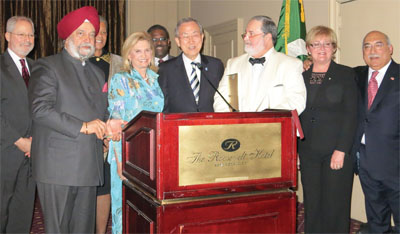
    NEW YORK (TIP): National Advisory Council on South Asian Affairs’ (NACSAA’s) “Thomas Jefferson’s Eternal Vigilance” Awards were presented to Ambassador Abdullah Hussain Haroon and Ambassador Hardeep Singh Puri on March 8, 2013, at the Roosevelt Hotel here.

    While Congresswoman Caroline Maloney presented the award to Ambassador Abdullah Hussain Haroon , Secretary General Ban Ki Moon presented the award to Ambassador Hardeep Singh Puri. Each was recognized for “for his exemplary service to humanity, unflinching dedication to freedom, the rule of law and helping ‘…form a more perfect world.’” In addition, Cong. Maloney presented Ambassador Haroon with a Congressional Record issued in his honor.

    At the event held in honor of UN Secretary General Ban Ki Moon, Ambassador Haroon spoke of the need for nations to keep talking in earnest, for as long as they are talking war is avoided. SG Ban spoke of the need to find a unified vision, with respect and friendship amongst nations, so humanity may better enjoy peace and prosperity.

    img2

    The select audience of over 130 guests was made up of members of the United Nations Security Council, Permanent Representatives, national, state and local elected officials, and dignitaries, including Congressman Gary L. Ackerman, Chef de Cabinet Susana Malcorra and Mrs. Ban. Congressman Meeks was unable to attend the event, as he was part of the official United States delegation to attend the funeral of President Hugo Chavez in Venezuela. Prior Thomas Jefferson Eternal Vigilance Award recipients include United States Assistant Secretary of State Richard Boucher, and Congressmen Gary L. Ackerman, Eliot L. Engel and inter alia, Gregory W. Meeks. NACSAA is made up of Americans with ancestry from, inter alia, Afghanistan, Pakistan, India, Sri Lanka, Nepal and/or Bangladesh.

  • India Sixth Most Favourable Nation For Americans: Poll

    India Sixth Most Favourable Nation For Americans: Poll

    WASHINGTON (TIP): India is the sixth most favourable nation for Americans, while at least eight out of 10 do not like Pakistan, making it the third most unfavourable nation after Iran and Korea, according to a latest poll.

    According to the Gallup Polls, nearly seven (68 per cent) out of every 10 persons interviewed for the poll favoured India, thus ranking it sixth after Canada (91 per cent), Great Britain (88 per cent), Germany (85 per cent), Japan (81 per cent) and France (73 per cent).

    In fact Israel, the traditional American ally ranks seventh after India with 66 per cent while Mexico get only 47 per cent favourable votes. Opinion about Russia is equally divided among favourable and unfavourable rating while 52 per cent of the Americans put China in the unfavourable category. Nine out of 10 Americans have an unfavourable view of Iran, making it the worst rated country out of 22 surveyed. Seven other countries – Libya (72 per cent), Iraq (76 per cent), Afghanistan (80 per cent), the Palestinian Authority (77 per cent), Syria (75 per cent), Pakistan (81 per cent) and North Korea (84 per cent)– also receive unfavourable ratings of 70 per cent or more. “Eight countries with the most negative ratings are currently or over the past decade were involved in wars, disputes, or turmoil — in a number of instances, in ways that are hostile to the US,” Gallup said. It said the currently “hostile” category includes Iran and North Korea.

    Libya was hostile toward the US under the government of Muammar Gaddafi and more recently Ambassador Christopher Stevens and three other Americans were killed there. “The US-Pakistani relationship is beset with rockiness despite the strained cooperation between the two on military matters. Americans also strongly favour Israel’s enduring conflict with Palestinian Authority,” the survey said.

  • Bin Laden’s son-in-law captured, charged in US with conspiring to kill Americans

    Bin Laden’s son-in-law captured, charged in US with conspiring to kill Americans

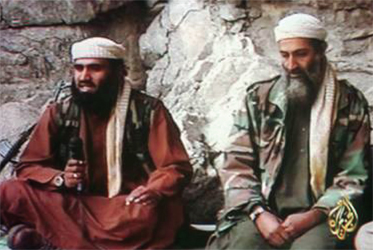
    NEW YORK (TIP): A top Al Qaeda spokesman who is the son-in-law of Osama bin Laden has been captured overseas and charged in the United States with conspiracy to kill Americans, according to an indictment unsealed Thursday, March 7. Sulaiman Abu Ghaith appeared alongside bin Laden in a 2001 video in which they took responsibility for the 9/11 attacks and warned of more, before he dropped out of sight for more than a decade before his arrest.

    According to the officials, who spoke on condition of anonymity, Turkish officials captured Abu Ghaith in the capital Ankara, where a court ruled he had entered the country illegally with a fake passport. The Turkish government then ostensibly deported Abu Ghaith to his birthplace Kuwait, but arranged for him to transit through Jordan where he was ultimately taken into custody by U.S. law enforcement, the officials said. Jordanian sources confirmed that Abu Ghaith was sent by Turkey via Jordan to Kuwait, and intercepted in Jordan and brought to the U.S. “I commend our CIA and FBI, our allies in Jordan, and President Obama for their capture of al-Qaeda spokesman Sulaiman Abu Ghaith,” said Rep. Peter King, R-N.Y., a member of the Homeland Security Committee, who first announced the news.

    “I trust he received a vigorous interrogation, and will face swift and certain justice,” added King, who is also chairman of the Sub-Committee on Counterterrorism and Intelligence. Prosecutors say from at least May 2001 to around 2002, Abu Ghaith served alongside bin Laden, appearing with him and his then-deputy Ayman al-Zawahiri, speaking on behalf of the terrorist organization and in support of its mission, and warning that attacks similar to those of September 11, 2001 would continue. The government says around May 2001, Abu Ghaith urged individuals at a guest house in Kandahar, Afghanistan, to swear allegiance to bin Laden. On the evening of Sept. 11, 2001, after the terrorist attacks on the United States, bin Laden summoned Abu Ghaith and asked for his assistance. He agreed to provide it.

    On the morning of Sept. 12, 2001, Abu Ghaith appeared with bin Laden and Zawahiri, and spoke on behalf of al-Qaeda, warning the United States and its allies that “[a] great army is gathering against you” and called upon “the nation of Islam” to do battle against “the Jews, the Christians and the Americans,” the court document says. Also, after the September 11, 2001 terrorist attacks, Abu Ghaith delivered a speech in which he addressed the then-U.S. Secretary of State and warned that “the storms shall not stop, especially the Airplanes Storm,” and advised Muslims, children, and opponents of the United States “not to board any aircraft and not to live in high rises.” Abu Ghaith arranged to be, and was, successfully smuggled from Afghanistan into Iran in 2002, where he spent most of the decade, U.S. officials said. Even as government officials applauded the arrest of Abu Ghaith, his transport to the United States stirred controversy among lawmakers who were apparently caught by surprise by the news. “We believe the administration’s decision here to bring this person to New York City, if that’s what’s happened, without letting Congress know is a very bad precedent to set,” said Sen. Lindsey Graham, R-S.C., who held a press conference with Sen. Kelly Ayotte, R-N.H. “And when we find somebody like this, this close to bin Laden and the senior al- Qaeda leadership, the last thing in the world we want to do, in my opinion, is put them in civilian court. This man should be in Guantanamo Bay,” Ayotte said. “So we’re putting the administration on notice,” said Graham. “We think that sneaking this guy into the country, clearly going around the intent of Congress when it comes to enemy combatants, will be challenged.” Earlier, House Intelligence Chair Mike Rogers, R-Mich., strongly criticized the administration for bringing Abu Ghaith to the United States. Rogers, a former FBI agent, said that Mirandizing a top al-Qaeda suspect and bringing him to the United States for trial creates a host of problems – instead of sending him to the facility at Guantanamo Bay, Cuba, which was built to handle high value prisoners. “Al-Qaeda leaders captured on the battlefield should not be brought to the United States to stand trial,” Rogers said. “We should treat enemy combatants like the enemy.

    The U.S. court system is not the appropriate venue.” The Obama administration has been trying to clear out Guantanamo and not bring any new prisoners there. Sen. Charles Schumer, D-N.Y., said it’s fine with him if Abu Ghaith is put on trial in New York because key state and city officials had been consulted in advance, unlike in the case of terror suspect Khalid Sheikh Mohammed. “Unlike with KSM, Kelly and others had been consulted ahead of time about this and they gave the green light to do it. As you know, (Police Commissioner) Ray Kelly, Mayor (Michael) Bloomberg and I opposed the trial of (Mohammed) in New York and we successfully made sure that didn’t happen,” said Schumer. “On issues like this, I defer to Commissioner Kelly, and I think the mayor does as well. And he thinks it’s OK to do it here, and I’ll go by that,” Schumer said.

  • Hagel Committed To Ties With India, Says Pentagon

    Hagel Committed To Ties With India, Says Pentagon

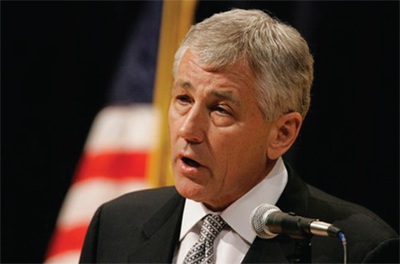
    WASHINGTON (TIP): As Chuck Hagel took over as Barack Obama’s new defense secretary amid a controversy over his comments on India’s role in Afghanistan, Pentagon – the US defense department headquarters – said that Hagel will work to strengthen ties to India. Hagel’s strong commitment to fostering a close defense relationship was reported Wednesday, February 27, by Washington Free Beacon, the rightwing online newspaper that had disclosed a video-recording of a speech Hagel made in 2011 about Indian aid to Afghanistan. “Secretary Hagel is strongly committed to the US strategic partnership with India and to fostering an even closer defense relationship with India that builds upon the work of Secretary (Leon) Panetta, Deputy Secretary (Ashton) Carter, and their Indian counterparts,” Free Beacon quoted Pentagon spokesperson George Little as saying. “Secretary Hagel looks forward to working closely with Indian national security and defense officials,” Little told the newspaper that had dug out the controversial comments during Hagel’s contentious confirmation hearings with his former Republicans attacking him for his positions on Israel and Iran.

    In his previously unreleased 2011speech, Hagel had said: “India for some time has always used Afghanistan as a second front, and India has over the years financed problems for Pakistan on that side of the border. “And you can carry that into many dimensions, the point being (that) the tense, fragmented relationship between Pakistan and Afghanistan has been there for many, many years.” The remarks raised a furor in New Delhi. However, in a calibrated response to the Free Beacon, the India Embassy said that Hagel’s 2011 remarks were not grounded in “reality.” “Such comments attributed to Sen.

    Hagel, who has been a long-standing friend of India and a prominent votary of close India-US relations, are contrary to the reality of India’s unbounded dedication to the welfare of the Afghan people,” the embassy spokesperson said in an email to the newspaper. “India’s commitment to a peaceful, stable, and prosperous Afghanistan is unwavering, and this is reflected in our significant assistance to Afghanistan in developing its economy, infrastructure, and institutional capacities,” the spokesperson said. “Our opposition to terrorism and its safe havens in our neighborhood is firm and unshakeable.” The existence of the video of Hagel’s speech at Cameron University in Oklahoma was disclosed by the online newspaper hours before the decorated Vietnam veteran was confirmed by the Senate after weeks of severe criticism from former Republican colleagues. The former Republican senator from Nebraska, who won two Purple Hearts for his bravery as a soldier during the Vietnam War, was accused of being critical of Israel and weak on Iran’s alleged nuclear weapon ambitions.

  • Pak Paranoid About Closer Afghan-India Ties: US General

    Pak Paranoid About Closer Afghan-India Ties: US General

    WASHINGTON (TIP): A retired American General has expressed the view that the United States is “diplomatically paralyzed” in dealing effectively with Pakistan on the issue of Afghanistan’s future since Islamabad remains paranoid about closer Afghan-India relations. Further, Pakistan has always hedged its bet with the Taliban as it reckons that it may have to deal with them again in the future, General John M Keane told a Congressional hearing on the “Transition in Afghanistan: View of outside experts”.

    Stating that American interests in Afghanistan conflict with those of Pakistan, Gen Keane said: “That’s why they (Pakistan) have always hedged their bet with the Taliban, so to speak, because they believe they may have in fact to deal with them again.” He also pointed out that the Pakistan is very concerned about the Karzai Government and what it perceives to be its “closer relationship” with India. That, in fact, is the “paranoia that the Pakistanis have always suffered from”, he added.

    As the US is rapidly moving towards its critical milestone of withdrawal of its troops by the end of 2014, Gen Keane, who has conducted several military assessments in Afghanistan, said much of the future is dependent on the success of 2014. “After almost twelve years of war in Afghanistan the central issue for me is how do we best manage the risk? How do we avoid squandering the gains that we have made in Afghanistan?” said Keane, who also voiced disappointment that US force levels in 2014 will be so low that they will have negligible impact on the security of the next Afghan elections.

    He advocated priority targeting of the Taliban and Haqqani leaders in their sanctuaries in Pakistan, noting: “Once systematic targeting commences, the sanctuary will cease to exist as we currently know it; a place where strategy, training, operational oversight, intelligence and logistics is executed, routinely, in safe haven. These functions will suffer significantly which will positively impact operations in the East. Additionally, it will be a huge morale boost for the ANSF (Afghanistan National Security Forces).”

  • Ajanta Caves A Legacy From The Golden Age

    Ajanta Caves A Legacy From The Golden Age

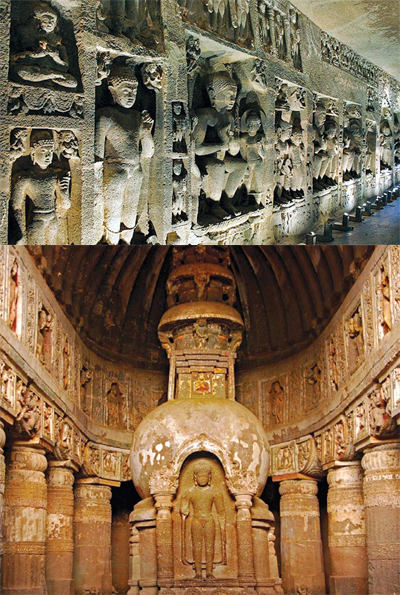
    Ajanta and Ellora are the pride of Maharashtra. The rock-cut caves of both these sites are world famous and illustrate the degree of skill and artistry that Indian craftsmen had achieved several hundred years ago. Ajanta dates from 100 B.C. while Ellora is younger by some 600 years. The village of Ajanta is in the Sahyadri hills, about 99 kms. From Aurangabad; a few miles away in a mammoth horseshoe-formed rock, are 30 caves overlooking a gorge, `each forming a room in the hill and some with inner rooms.

    Al these have been carved out of solid rock with little more than a hammer and chisel and the faith and inspiration of Buddhism. Here, for the Buddhist monks, the artisans excavated Chaityas (chapels) for prayer and Viharas (monasteries) where they lived and taught. Many of the caves have the most exquisite detailed carvings on the walls, pillars and entrances as well as magnificent wall paintings.

    These caves were discovered early in the 19th century quite by chance by a party of British Officers on manoeuvres. Today the paintings and sculptures on Buddha’s life, belonging to the more mellow and ritualistic Mahayana Buddhism period, are world famous. Copies of them were shown in the Crystal Palace exhibition in London in 1866. These were destroyed in a fire there.

    Further copies were published soon afterwards and four volumes of reproductions were brought out in 1933 by Ghulam Yazdani, the Director of Archaeology of the then Hyderabad State. Ajanta has formed an epicentre of interest for those who appreciate and are eager to know more about Indian history and art. It is a protected monument under the Archaeological Survey of India and has been listed in the World Heritage list of monuments.

    The 30 caves of Ajanta were created over a span of some 600 years. In their range of time and treatments they provide a panorama of life in ancient India and are a source of all kinds of information… hair styles, ornaments, textiles, musical instruments, details of architecture, customs etc.

    It was from this collection of classical Indian art that a particular style was formed that traveled with Buddhism to many parts of the world. Similar paintings can be seen in Sigiriya in Sri Lanka, Bamiyan in Afghanistan, temples and shrines in Tibet, Nepal, China and Japan. Royal patronage made Ajanta possible. Professional artists carried out much of the work and each contributed his own individual skill and devotion to this monumental work.

    Visitors often ask how the artist who painted the detailed frescoes and chiseled out the intricate carvings, managed to work in the dark interiors of the caves. It has been noticed that the caves are illuminated by natural light for part of the day and it is presumed that metal mirrors or sheets of white cloth were used to reflect sunlight into the inner recesses.

    Here, briefly, are some of the highlights of the caves. In the Cave 26, the sculpture is elaborate and beautiful though the painted frescoes are incomplete. The arched chapel window set in an elegantly simple façade, is repeated in an elaborate frontage in Cave 19 with its complete Chaitya and a slender votive stupa enclosing a standing Buddha at the far end. Of particular note is a sculpture of a seated Nagaraja with his consort and female attendant.

    Cave 16 is an elegant Vihara with an inscription that mentions the king and his minister who had the cave built. Here a towering Buddha sits preaching. He is flanked by attendants with fly whisks.

    There are undamaged portions of the wall paintings that are clear and vibrant in Caves 1, 2, 16 and 17. Cave I has the well known Bodhisattva Padmapani which is a wonderful portrayal of tender compassion. A gentle figure holding a lotus delicately in one hand. In the same cave is the golden figure of Avalokiteswara, elaborately adorned. The women, nymphs, princess and attendants are elegant and beautifully attired.

    Here also is a lively panel of dancing girls and musicians. In Cave 2 there is a detailed panel of Queen Maya’s dream, of the white elephant which was interpreted by royal astrologers to mean the birth of an illustrious son. The row upon row of Buddhas, can be seen in this cave. In Cave 17, there is a flying apsara in a fashionable embroidered turban and splendid jewellery.

    It is worth walking away from the caves in order to look back on to the horseshoe gorge. The ingenuous water cistern system can be seen which must have provided water for the monks and their visitors. Ajanta was on the ancient trade route leading to the coast so there must have been considerable activity and many visitors. Nobody really knows what life was like in those times and visitors can interpret the past as they wish, which is perhaps yet another secret charm of Ajanta.

  • Joseph Dunford: ‘Fighting Joe’ To Lead Us Out Of Afghanistan

    Joseph Dunford: ‘Fighting Joe’ To Lead Us Out Of Afghanistan

    Gen Dunford, formerly theassistant commandant of theUS Marine Corps, haspromised to complete the transition ofsecurity duties to Afghan forces and to”set the conditions for an enduringpartnership with the Afghan people”.He replaces another Marine: GenJohn Allen, who was recently clearedof misconduct after an investigationinto “potentially inappropriate”communication with a Floridasocialite.Gen Allen this week said he wouldretire from the military instead ofaccepting President Barack Obama’sappointment as supreme Natocommander in Europe, citing familyhealth issues.

    While Gen Allen was busy finishinghis recommendations to the WhiteHouse on how quickly to withdrawtroops from Afghanistan next year,Gen Dunford was studying up andpreparing for deployment.As the second-ranking MarineCorps officer, Gen Dunford has visitedAfghanistan many times.Maren Leed, senior adviser at theCenter for Strategic and InternationalStudies, says Gen Allen’s departurewill not lead to a major revision in theUS exit plan from Afghanistan. As itstands now, the US is to finish itsmission in Afghanistan by the end of2014.”What you will see is [Dunford]spending time building and nurturingrelationships, trying to keep moraleup, and keep pressure on the Afghangovernment to make sure that theyare progressing and meeting theircommitments,” she says.

    While some Republicans suggestGen Dunford will be susceptible topolitical pressure from the WhiteHouse, Ms Lees says the generalrejects this notion.”Once he is in command, if heperceives that [withdrawal] deadlineto be counter-productive or to be tooearly, he absolutely would make thatvery clear to the White House,” shesays.Gen Dunford earned the nickname”Fighting Joe” in the Iraq war, whenhe led the initial attack into Iraq andon to Baghdad. Subsequently, GenDunford shot rapidly up the chain ofcommand, faster than almost anyonein recent Marine history.

    Afghanistan may prove GenDunford’s most challengingassignment yet. Ms Leedsummarised the tasks ahead:
    finish negotiations on legalframework governing how remainingUS forces are treated in Afghanistancontinue the military campaigndiscuss with Washington the paceand size of the troop withdrawalweigh in on the roles andresponsibilities of remaining USforceskeep morale high and troopscommitted to the missionThe arrival of the war-wise Marinegeneral as the new top Natocommander provides the US with anopportunity to reassure Afghans thatwhile America’s longest war is ending,the Americans are not leavingcompletely anytime soon.

  • Republicans Delay Chuck Hagel’s Defence Secretary Vote

    Republicans Delay Chuck Hagel’s Defence Secretary Vote

    NEW YORK (TIP): Republican senatorshave delayed a vote to confirm PresidentObama’s nominee for US secretary ofdefense.They say questions remain about SenatorChuck Hagel but have agreed to an up-ordownvote later this month.Mr Hagel’s backers say the US militaryneeds a leader in place while troops remainin Afghanistan and North Korea has justtested a nuclear device.Outgoing Secretary of Defense LeonPanetta is to remain in his post until MrHagel is confirmed.

    ‘Not without consequence’
    White House press secretary Jay Carneydenounced the delay, saying SenateRepublicans had put political posturingahead of America’s national security.”A clear majority in the US Senatesupports Sen Hagel’s confirmation, sotoday’s action runs against both themajority will of the Senate and our nation’sinterest,” he said in a statement.”This waste of time is not withoutconsequence. For the sake of nationalsecurity, it’s time to stop playing politicswith our Department of Defense and tomove beyond the distractions and delay.”

    But Republicans, who have agreed to avote following an upcoming 10-day recess,have said they need more time to weighoutstanding questions about Mr Hagel.South Carolina Senator Lindsey Grahamalso said he would continue to use theconfirmation vote as leverage in his effortto wring more information from the WhiteHouse about the response to the 11September attack on a US consulate inBenghazi, Libya.Mr Hagel was a private citizen at thetime of the attack.”There seems to not be much interest tohold this president accountable for anational security breakdown that led to thefirst ambassador being killed in the line ofduty in over 30 years,” Sen Graham said.”No, the debate on Chuck Hagel is notover. It has not been serious. We don’t havethe information we need. And I’m going tofight the idea of jamming somebodythrough until we get answers about whatthe president did personally when it cameto the Benghazi debacle.”

    One vote short
    On Thursday, Republicans forced thedelay with a parliamentary manoeuvreblocking the Senate Democratic leader’smotion to end debate on Mr Hagel’snomination and proceed to an up-or-downvote on confirmation.Even though the Democrats command amajority of 55 votes, Senate rules in thiscase require them to come up with 60 to enddebate. They fell one short.Mr Hagel, a decorated and twicewoundedveteran of the Vietnam War,served in the Senate for 12 years.But correspondents say he is seen bysome of his former colleagues as arenegade for breaking with Republicanranks on issues such as the Iraq War.He has also been criticised during theconfirmation process for comments hemade years ago claiming “the Jewish lobby”had too much influence over Americanpolicy.His remarks in 1998 that a nominee foran ambassadorial post was “openly,aggressively gay” have also raisedeyebrows. Mr Hagel has since apologisedfor that comment.

  • Want US Out, Taliban Okay: Afghan Women Senators

    Want US Out, Taliban Okay: Afghan Women Senators

    Women senators from Afghanistan say they want US troops out of their country andwill not mind having the Taliban in the government if they respected the constitution

    NEW DELHI (TIP):Women senators fromAfghanistan have said they wanted US troopsout of their country and would not mind havingthe Taliban in the government so long as theyrespected the constitution.”We want the US out of Afghanistan, but asfar as Taliban is concerned, any one who is aresident of Afghanistan can be a part of thegovernment, if they respect the constitutionand women’s rights,” said Tayeba Zahidi,member of the upper house of Afghanistan,during an interaction with Indian journalists atthe Indian Women’s Press Corps.

    US PresidentBarack Obama has vowed that by the end of2014, the US war in Afghanistan would end, andUS troops would be pulled out.Senators from Afghanistan’s upper house arein India to participate in a training programmeorganised by the Bureau of ParliamentaryStudies and Training here. The senators saidthe incidents of the last few decades inAfghanistan have affected women, who havefought back and are emerging into their ownagain. “In past 35 years, lots of incidents haveoccurred which have affected women. ButAfghan women have fought back.

    Ourparliament and legal structure is fighting to ridsociety of violence and make things safe forwomen,” Sediqua Balbhi, another member ofAfghanistan’s upper house said. The womensaid more and more women are now gaining aneducation in Afghanistan.”Education plays an important role inempowering women. More and more girls arenow being enrolled in schools, completingcollege and also doing PhD degrees,” said NajibaHussaini.Women were barred from educationand work during the rule of the Taliban inAfghanistan, which started in 1996 and endedDec 2001.

  • As I See It : When The Us Fails, Others Suffer

    As I See It : When The Us Fails, Others Suffer

    Nuclear’ Iran is getting to be a bigger botherfor the US and the rest of the world thanmany had assumed in the earlier stages. It isfallacious to argue that Tehran will become a stablepartner in global peace by having a nuclear arsenal.Iran will either get ‘the’ bomb or get bombed. Whatthis means regionally is anyone’s guess since thereare too many variables surrounding these twopossibilities.

    One thing that is invariable though, isAmerica’s dogged adherence to icons and dogmaswhich ensures that only the extremes are possible.As the situation stands, no one, not even theRussians and the Chinese, doubt in private that Iranis accelerating its efforts to build a bomb. In public,though, there are two narratives – the first is of thecrazy suicidal mullahcracy so rabidly obsessed withkilling Jews that another holocaust is on the horizon.The other, less printed, argument is that a nuclearIran would actually bring a greater level of stabilityto what is a highly volatile region. Both of course arehyperbolic, but they dominate print and broadcastopinions in one variant or the other.

    The former needs no serious refutation. The latteris true to a certain extent in that it alleviates Iran’sacute conventional inferiority vis-à-vis its neighbors,but this is only half the story. As the experience ofPakistan and North Korea has shown, nuclearweapons provide revisionist states with a shield for awhole new paradigm of provocations like Mumbai26/11 or the sinking of the South Korean warship,The Cheonan. Nuclear weapons, therefore, provide acertain strategic stability in that it prevents all-outwar, but then introduce great levels of subconventionalinstability either by covert actions or bynon/sub/quasi state actors.

    The problem here is, the proponents of the theorythat a nuclear Iran will bring stability have veryfrequently lost credibility either because theymisdirect their fire, obfuscate the nuance or engagein hyperbole – all aimed at exculpating the UnitedStates. Take for example Kenneth Waltz arguing thatIran is attempting to balance the 40-year-old Israeliarsenal. This ignores the fact that the prime ‘sabrerattler’and major nuclear power in the Middle Eastis, in fact, the United States that has already regimechangedtwo of Iran’s neighbors – Afghanistan andIraq, has Iran completely encircled and has skewedthe conventional balance by reckless arms sales toIran’s arch rivals.

    To blame Israel for the situation isas incredulous as Iranian President MahmoudAhmadinejad holding the Elders of Zion responsiblefor Iran’s travails.The prime mover of a nuclear Iran was in fact theUnited States spearheaded by arch neo-cons DonaldRumsfeld, Dick Cheney and Paul Wolfowitz in the 70s -ostensibly to buttress Iran’s position vis-à-vis theUSSR. Though suitably couched in terms of energy,the deal would have ensured that Tehran receivedboth enriched uranium and plutonium – all butproviding for the existence of a latent arsenal. Iran’s’policies’ in those days, of course, were directed in thepursuit of US policy.

    William Blum, for example, inhis book, Killing Hope: US Military and CIAInterventions since World War II, lists howAfghanistan was deliberately destabilized by Iran todrag the Soviets in. Today Iran’s ‘mischief’ is directed- largely by default – against the Unites States’interests.It is of course quite natural for any country toadopt double standards; no country on earth has adouble standard-free foreign policy. But what isworrying about the United States is how theinformation and the intelligence loops form a closedcircuit that filters out any divergent opinion – wherethe Government actually starts believing its ownspin, and sadly the academia tends to buttress this.Take for example Saddam Hussein’s use of nerveagents in Halabja in the 80s.

    Till the invasion ofKuwait, most US experts were keen to emphasize that”doubts existed” over who had resorted to usingmustard gas and in some form or another and it wasimplied that Iran had done it. Similarly, in spite ofoverwhelming evidence that Georgia had disruptedthe status quo in South Ossetia and Abkhazia, mostUS ‘experts’ on television went out of their way toeither claim that the evidence wasn’t clear.This pattern of self-delusion continues to buttressUnited States rigidity on Iran and revolve around fivemain points.

    First, the United States actually seems tothink the sanctions on Iran are smart and shouldhumanitarian concerns arise, they will be suitablymodified.

    Second, that sanctions are still an effectivetool that will achieve results.

    Third, no geopoliticalconcessions need to be made to Iran – or as Americansclaim “the world has moved on from spheres ofinfluence driven politics”.

    Fourth, the only ‘carrots’Iran needs to be offered are economic – likemembership of the World Trade Organization at somedistant point in the future.

    And fifth, Mr.Ahmadinejad’s statement on wiping Israel off the mapis proof of Iran’s diabolical designs.

    As far as one can remember, images of horriblydeformed Iraqi children did nothing to change the UShard line on the causative sanctions for 13 long yearsafter which the Washington, DC solution was toinvade. That sanctions can be effective has beendiscounted time after time. Anybody who bothersstudying Myanmar and Libya knows that the former’scompliance had more to do with a series of complexissues and the latter’s compliance with Gaddafi’ssuccession plans. The notion that somehow Iran willsit pretty and accept the fall of its allies like SyrianPresident Bashar al-Assad, the crushing of the Shiasand its conventional inferiority is laughable at best.As for the world moving on from spheres of influenceone would like to see how the United States reacts to aChinese announcement of setting up a nuclearmissile base in Venezuela or Cuba.

    The naïveté in believing that a country that hasendured severe sanctions and embargos for the betterpart of the last 30 years will be tempted by WTOaccession boggles the mind. Finally, it is curious thatthe United States does not accept at face value theabsence of homosexuality in Iran given that PresidentAhmadinejad claims just this, but his pronouncementson wiping out Israel are of course gospel truth.Between rigid dogma and iconoclastic hyperbole, theonly thing that gets reinforced is the United States’sense of infallibility and the consequences foreverybody else – paying the price for America’s failures.

  • 4-Nation Gas Pipeline Plan Gets Fresh Push

    4-Nation Gas Pipeline Plan Gets Fresh Push

    NEW DELHI (TIP): Aiming to speedup implementation of the ambitiousTurkmenistan-Afghanistan-Pakistan-India (TAPI) natural gas pipeline, theUnion Cabinet on February 7approved the setting up of a specialpurpose vehicle to build the 1,680-kmpipeline that terminates at Fazilka inPunjab.Tapi Ltd, the Dubai-based SPV,would undertake the feasibility studyand design work for the pipeline, huntfor a consortium leader to build the $9 billion project, operate it, arrangefor finances and work to ensure safedelivery of gas.

    At the Cabinet meeting chaired byPrime Minister Manmohan Singh, theSPV was given the go-ahead andpermitted Gas Authority of IndiaLimited (GAIL) to join it as India’srepresentative.It was announced officially thatTAPI Ltd initially requires $ 20million contribution, with each of thefour participating countries funding $5 million. GAIL being a NavratnaCompany, is empowered to make aninvestment of this level for India.TAPI Ltd is being formed for theproject as multinational corporationsare unwilling to participate in theproject without a share inTurkmenistan’s rich gas fields. Theproject had got stuck since India wasnot agreeable to the suggestion by theother three that each country buildthe pipeline on its own and operate it.

    At a meeting of the steeringcommittee last September,Turkmenistan suggested formation ofan SPV to put the project after allparties reaffirmed their commitmentand intention to fast track it since italso a symbol of regional cooperation.India joined the Turkmenistan-Afghanistan-Pakistan (TAP) Projectin April, 2008, two years after theUnion Cabinet gave its ‘in principle’approval. Thereafter, the name of theproject stood amended toTurkmenistan-Afghanistan-Pakistan-India (TAPI) Gas Pipeline Project.The pipeline originates and runs144 km in Turkmenistan, passes 735km through Afghanistan and travels800 km in Pakistan en route India.

    Last May, the four countries signedthe gas sale and purchase agreement.The 1,680 km pipeline will carry 90million cubic metres a day (mmcmd)of gas and is scheduled to becomeoperational in 2018 and supply gasover a 30-year period. India andPakistan will get 38 mmcmd each,while the remaining 14 mmcmd willbe supplied to Afghanistan. TAPI willcarry gas from Turkmenistan’sGalkynysh field, known earlier asSouth Yoiotan Osman that is knownto hold gas reserves of 16 trillioncubic feet.Turkmenistan, which holds morethan 4 per cent of the world’s naturalgas reserves, signed pacts last May tosell gas last to India and Pakistanthrough the 1,680-km pipeline at theCaspian Sea resort of Avaza inTurkmenistan.

    THE ROUTE

  • Turkmenistan-Afghanistan-Pakistan-India
  • Length: 1,680-km
  • The pipeline runs 144 km inTurkmenistan, passes 735 kmthrough Afghanistan andtravels 800 km in Pakistanbefore entering India at Fazilka in Punjab
  • Role of the SPV
    Undertake a feasibility study anddesign work for the pipelineHunt for a consortium leader to buildthe $9 billion projectOperate it and arrange for financesOperational in 2018The project is scheduled to becomeoperational in 2018 and supply gasover a 30-year periodIt will carry 90 million cubic metres aday (mmcmd) of gasIndia and Pakistan will get 38mmcmd each, while the remaining 14mmcmd will be supplied toAfghanistan

  • As I See It: Worry About Kerry

    As I See It: Worry About Kerry

    As the US president, Barack Obama embarks on his second term, New Delhi is once again feeling the chill of a new administration in Washington. Sections of the Indian foreign policy making community are once again doing what they do best – crying hoarse over a possible change in the tone and tenor of US foreign policy. Obama has a new cabinet line-up with John Kerry nominated for the post of secretary of state, Chuck Hagel for the secretary of defense and John Bremmer as the head of the CIA. The US foreign policy is in a state of flux and some very significant changes are likely over the course of the next few years under the second Obama presidency. The most important issue in the short to medium term will be withdrawal of around 66,000 US troops from Afghanistan after more than a decade battling al Qaeda and the Taliban.

    Like most nations around the world, New Delhi will also be impacted by the impending changes in the foreign policy priorities of Washington. But instead of debating the larger ramifications of these changes, the discussion in India today is reminiscent of the discussion in the country when Obama came to office for the first time in 2008. There were widespread concerns about Obama’s attitudes towards India after eight years of privileged position under George W Bush administration. George W Bush, deeply suspicious of communist China, was personally keen on building strong ties with India.

    Hence, he was willing to sacrifice long-held US non-proliferation concerns to embrace nuclear India and acknowledge it as the primary actor in South Asia, dehyphenated from Pakistan. The Obama administration’s concerns in its initial months with protecting the nonproliferation regime, dealing with the immediate challenge of the growing Taliban threat in Afghanistan and Pakistan, and solving the unprecedented economic challenge led it to a very different set of priorities and an agenda in which India seemed to have a marginal role. The only context in which Obama mentioned India in his early months was related to the need to resolve Kashmir so as to find a way out of the west’s troubles in Afghanistan.

    To many Indians, the new administration seemed intent on sidelining India. In a similar vein, discussion these days is centered around the appointment of John Kerry and his supposed ’tilt’ toward Pakistan. Kerry has been closely associated with Obama administration’s Pakistan policy.

    It was he who helped broker the release of the CIA contractor, Raymond Davis, arrested on suspicion of murder and later persuaded Islamabad to return parts of US stealth helicopter that crashed during the Abbottabad raid that killed Osama bin Laden. Kerry has already been termed by sections of the Indian media as a friend of Pakistan, implication being that he would be unfriendly towards India. Kerry’s strong support for strengthening the NPT and the Kerry-Lugar-Berman bill authorizing a five-year $7.5 billion financial aid package to Pakistan have been viewed as examples of Kerry’s pro-Pakistan worldview.

    Sympathetic ear
    Pakistan’s effusive praise for Kerry’s nomination may indeed underscore a sense in Islamabad and Rawalpindi that they have gained a sympathetic ear in the new US cabinet. It won’t be surprising if the recent adventurous behavior of Pakistan military at the Line of Control may have been inspired by this bravado.

    But just as Pakistan will be fooling itself, if it believes that Kerry is going to be Pakistan’s friend, India is being unnecessarily defeatist if it thinks that Kerry’s nomination will be a disaster for India. Kerry is neither going to be pro-India nor pro-Pakistan, he will be pro-US. And if Obama had to change his foreign policy worldview vis-à-vis India soon after coming into office, Kerry will have no choice but to build on Obama’s first term and strengthen ties with India.

    After all, it was Kerry who has described India-US ties as “without doubt one of the most significant partnerships in US foreign policy.” The US-India relationship has matured and reached a stage where changes in personnel will only have a limited impact on its trajectory. There is a growing perception that India is not yet ready for prime-time and that the political leadership in New Delhi remains perpetually preoccupied with domestic turmoil and lacks political will to claim India’s rightful place in the comity of nations.

    It is for India to pursue strategic partnerships with like-minded nations and advance its interests. The world will only take India seriously when India starts taking itself seriously and starts behaving like a serious power. There is a larger problem that underlies this perpetual hyperventilation in India about the ostensible tilt in Washington.

    It has become a regular feature of Indian diplomacy to press America toward securing its own regional security interests. The speed with which India has outsourced its regional foreign policy to Washington is astonishing.New Delhi is now reduced to pleading with Washington to tackle Pakistan and to rein in Pakistan army’s nefarious designs against India in Afghanistan, in Kashmir and elsewhere.

    For all the breast beating in recent years about India emerging as a major global power, Indian strategic and political elites display an insecurity that defies explanation. A powerful, self-confident nation should be able to articulate a coherent vision about its priorities and national interests.

    The brazen display of a lack of self-confidence by Indian elites in their nation’s abilities to leverage the international system to its advantage only weakens India.

    A diffident India will continue to crave for the attention of Washington but will find it difficult to get. A confident India that charts its own course in world politics based on its national imperatives will force the world to sit up and take notice.

  • Rethinking our China strategy

    Rethinking our China strategy

    Senate committees will soon be asked to vote on President Obama’s nominees to head the departments of State and Defense and the Central Intelligence Agency. Many, if not most, of the senators’ questions will be focused on the nominees’ views on the pressing security problems the United States faces in the greater Middle East and Afghanistan. But it would be a mistake for the committees to let the hearings pass without also examining the administration’s own stated policy priority – the “pivot” or “rebalance” to the Asia-Pacific region. A productive discussion of the pivot, however, will require a frank acknowledgment that the primary factor driving the change is increased nervousness in Washington and Asian capitals about China’s rise and, in turn, recognition that the U.S. policy of engagement with China has not been as effective in shaping that rise as successive administrations, Republican and Democratic, had hoped. On this point, it is particularly useful to reread then-Deputy Secretary of State Robert Zoellick’s 2005 speech in which he famously invited Beijing to become a “responsible stakeholder” in the international system. Since the late 1970s, the U.S. had been, as Zoellick put it, “opening doors to China’s membership into the international system” with the expectation that doing so would lead to change in Chinese behavior as it saw the security and economic benefits of that system. By no means a China “hawk,” Zoellick provided a reasonable set of benchmarks for judging just how successful engagement would be in moving China along the path of a benign rise to great-power status. So,what does the score card look like? To start, Zoellick noted that, although China had “gained much from its membership in an open, rules-based international economic system,” its mercantilist economic policies put in doubt its commitment to that system’s underlying principles. And little has changed on that front. China keeps its currency undervalued to promote its exports, limits foreign access to its markets and treats natural resources as exclusive national assets. The government has done little to rein in intellectual property piracy or commercial cyber-espionage. State-owned banks still dominate China’s financial sector, and Beijingdriven industrial policies have increased, not decreased, in recent years. Another point of contention Zoellick hoped the Chinese would address was the lack of transparency when it came to China’s military buildup. But despite repeated U.S. initiatives, military-to-military exchanges have produced little of substance, and American intelligence continues to be surprised as some new Chinese weapons system is rolled out of its hangar or deployed at sea. Even during some of the roughest patches of the Cold War, the White House had a direct hot line to the Kremlin, and we knew, by mutual agreement, how many strategic warheads and missiles the Soviets had.With China,we haven’t a clue. As a responsible stakeholder, Zoellick said, China could and should do more to address the problem of North Korea and weapons proliferation more generally. On North Korea, only Beijing has the ability to pressure or persuade Pyongyang to change behavior. Yet North Korea continues to stockpile nuclear weapons and is bent on perfecting missiles that threaten our allies and, soon enough, the United States. If there is any good news, China’s direct role in proliferating has lessened. And while the recent vote by Beijing in support of the U.N. Security Council resolution condemning North Korea’s last missile test is a small but positive step, Beijing has not used its considerable leverage with Pyongyang to stop North Korea’s proliferation, and has dragged its feet on helping the rest of the world deal with the destabilizing impact of Iran’s nuclear program.

    As Zoellick noted, “China’s actions on Iran’s nuclear program will reveal the seriousness of China’s commitment to nonproliferation” and, so far, its record falls short of that mark. And, finally, Zoellick said that “China’s choices about Taiwan will send an important message too…. It is important for China to resolve its differences with Taiwan peacefully.” However, despite the most conciliatory government in Taiwan since the establishment of the People’s Republic of China, Beijing’s military buildup across from the island democracy has not diminished.

    Since Zoellick’s speech, China has taken an even more aggressive posture toward its neighbors, with confrontations with Japan in the East China Sea and Vietnam and the Philippines in the South China Sea. So what does this assessment of Chinese behavior mean for U.S. policy in an Obama second term? First, it reinforces the administration’s rationale for upping America’s strategic game in the Asia-Pacific region.

    What the Senate should be looking to hear, however, is exactly how the new national security team will go about making that a reality, especially in an era of major cuts in defense spending. Second, it means that, to the extent engagement is pursued, it should be with an eye to what is mutually and concretely beneficial, not with the expectation that the process itself will lead to China’s transformation.

    Finding the right balance in U.S.-China policy is a complex task. But the first step for the new secretaries of State and Defense in getting it right must be to understand what engagement can and can’t do, and to realize it is unlikely that China will become a member in good standing of the liberal international order until its leaders have made the decision to become liberal at home.

  • The Republic Of India

    The Republic Of India

    The Republic of India is a large South Asian country rich in ethnic diversity,with over one billion people speaking hundreds of languages. Politically it is the world’s largest liberal democracy. The Indian economy is the fourth largest in the world, in terms of purchasing power parity, and is the world’s second-fastest growing economy. India is also the second most populated country in the world. India has grown significantly, in terms of both population and strategic importance, in the last twenty years attributed to economic reforms. Strategically located in Asia,constituting most of the Indian subcontinent,India straddles many busy trade routes. It shares its borders with Pakistan,the People’s Republic of China,Myanmar,Bangladesh,Nepal,Bhutan and Afghanistan.Sri Lanka,the Maldives and Indonesia are the nearby island nations in the Indian Ocean. Home to some of the most ancient civilisations in the world, India was formally ruled by the British for almost ninety years before gaining independence in 1947.

    Origin of India’s name:
    The official name India is derived from Sindhu, the historic local appellation for the river Indus and is the most internationally recognisable of the country. The Constitution of India and general usage also recognises Bharat as the other official name of equal status. Bharat comes from the name of an ancient Hindu king and means seeker of knowledge. The third name is Hindustan, meaning land of the Hindus (where Hindu refers to those who dwell to the right of the Indus/Sindhu river) used from the Mughal times onwards. India,a sub-continent with 5000 year old History. A civilization united by its diversity,richness of culture,the glory of past,the turbulences and triumphs. The landmarks of each era,the achievements of a change,the legacy of a regime.

    As we walk through the history,India is an amazing discovery and its history is a unique tale of the past. With the arrival of the Portuguese, French and English traders, advantage was taken of the fractured, debilitate kingdoms to colonise India. In 1857, an insurrection amongst the army sepoys ensued in the popular Revolt of 1857 against the powerful British East India Company; this mobilised resistance, though short-lasting, was caused by the widespread resentment against discriminatory policies of the British. After the revolt, the Indian independence movements started demanding complete independence. On August 15th, 1947, India was finally granted independence from British rule and became a secular republic.

    January 26 (Republic Day of India): Republic Day is one of the greatest national celebrations observed throughout the country on January 26 every year. India became Republic on the 26th Jan, 1950. The country became a sovereign democratic republic with a written constitution and an elected parliament. At the time of independence, although India was under British rule, there were 565 Princely States, big and small, ruled by powerful sovereigns who were protected by treaties of alliance with the British Crown.

    Without bringing them together, the fundamental unity of the country was not possible. This unification was accomplished by Sardar Vallabhbhai Patel, whose statesmanship helped to integrate the country into one nation. In a little less than 2 years, all the princely States became a part of the Republic of India. It was on this date in 1927 that the Indian National Congress, then fighting its nonviolent war for freedom, voted for complete independence as against ‘dominion status’. When members of the INC took the pledge to work towards a ‘sovereign democratic republic’ of India.

  • Obama Vows To Take America Forward

    Obama Vows To Take America Forward

    WASHINGTON (TIP): The second inauguration of Barack Obama as the 44th President of the United States took place in a private swearing-in ceremony on Sunday, January 20, 2013 in the Blue Room of the White House.

    A public ceremony marking the occasion took place the following day, on Monday, January 21, 2013 at the United States Capitol building. The inauguration marked the beginning of the second term of Barack Obama as President and Joe Biden as Vice President. The inauguration theme was “Faith in America’s Future”, a phrase that draws upon the 150th anniversary of President Abraham Lincoln’s Emancipation Proclamation and the completion of the Capitol dome in 1863. The theme also stresses the “perseverance and unity” of the United States, and echoes the “Forward” theme used in the closing months of Obama’s reelection campaign.

    The inaugural events held in Washington, D.C. from January 19 to 21, 2013 included concerts, a national day of community service on Martin Luther King, Jr. Day, the swearing-in ceremony, luncheon and parade, inaugural balls, and the interfaith inaugural prayer service. The presidential oath was administered to Obama during his swearing-in ceremony on January 20 and 21, 2013 by Chief Justice of the United States John G. Roberts.

    While Beyonce sang the National Anthem at the ceremonial swearing-in for President Barack Obama at the U.S. Capitol during the 57th Presidential Inauguration, it was Richard Blanco, the 44-year-old Madrid-born Cuban-American poet who read his poem “One Today” at the swearing-in ceremony for President Obama. Blanco is only the fifth poet – Robert Frost (1961), Maya Angelou (1993), William Miller (1997) and Elizabeth Alexander (2009) were the previous ones – reading at a presidential inauguration. He is also the first Hispanic as well as the first openly gay one. In his 18 minute speech, Obama tied current issues to founding principles.

    He sought to link the past and future, tying the nation’s founding principles to the challenges confronting his second term in a call for Americans to fulfill the responsibility of citizenship.

    Eschewing poetic language for rhetorical power, Obama cited the accomplishments of the past four years while laying out a progressive agenda for the next four that would tackle thorny issues like gun control, climate change and immigration reform. “We have always understood that when times change, so must we; that fidelity to our founding principles requires new responses to new challenges; that preserving our individual freedoms ultimately requires collective action,” he said. “My fellow Americans, we are made for this moment and we will seize it so long as we seize it together,” he added later.

    Analysts called the speech politically astute and an important expression of new forcefulness by the president as he enters his second term following re-election last November. “It’s a real declaration of conscience, about principles, about what he believes in,” said CNN Senior Political Analyst David Gergen. “He basically said, ‘When I came in the first term, we had all these emergencies, we had these wars. We’ve now started to clear the decks.

    Let’s talk about what’s essential.’” The foundation of the address, and Obama’s vision for the future, were the tenets he quoted from the Declaration of Independence — “that all men are created equal, that they are endowed by their Creator with certain unalienable rights, that among these are life, liberty, and the pursuit of happiness.” “Today, we continue a neverending journey, to bridge the meaning of those words with the realities of our time,” Obama said to gathered dignitaries and flag-waving throngs on the National Mall. “For history tells us that while these truths may be self-evident, they have never been self-executing; that while freedom is a gift from God, it must be secured by His people here on Earth.” In particularly pointed references, the president made a forceful call for gay rights that equated the issue with the struggle for women’s rights in the 19th century and civil rights in the 1960s. “We, the people, declare today that the most evident of truths — that all of us are created equal — is the star that guides us still; just as it guided our forebears through Seneca Falls, and Selma, and Stonewall,” Obama said, mentioning landmarks of the women’s, black and gay rights movements. “It is now our generation’s task to carry on what those pioneers began,” he continued, prompting the loudest applause and cheers of his address when he said “our journey is not complete until our wives, our mothers, and daughters can earn a living equal to their efforts.” More cheers came when Obama called for “our gay brothers and sisters” to be treated “like anyone else under the law — for if we are truly created equal, then surely the love we commit to one another must be equal as well.” According to observers, it was the first time a president championed gay marriage in an inaugural address. With further mention of topical issues such as immigration reform and gun control, Obama came to his key point — that adhering to America’s bedrock principles requires taking action on today’s challenges. “Being true to our founding documents does not require us to agree on every contour of life; it does not mean we will all define liberty in exactly the same way, or follow the same precise path to happiness,” he said. “Progress does not compel us to settle centuries-long debates about the role of government for all time — but it does require us to act in our time.” A deep partisan divide in Washington and the country characterized Obama’s first term, with Congress seemingly paralyzed at times and repeated episodes of brinksmanship over debt and spending issues bringing the first-ever downgrade of the U.S. credit rating.

    Acknowledging the political rift, Obama called for leaders and citizens to work for the greater good of the country. “We cannot mistake absolutism for principle, or substitute spectacle for politics, or treat name-calling as reasoned debate,” he said. “We must act, knowing that our work will be imperfect.” At the same time, he made clear he would fight for the central themes of his election campaign. “For we, the people, understand that our country cannot succeed when a shrinking few do very well and a growing many barely make it,” he said.

    While “we must make the hard choices to reduce the cost of health care and the size of our deficit,” he said, “we reject the belief that America must choose between caring for the generation that built this country and investing in the generation that will build its future.” In particular, he defended the need for popular entitlement programs that provide government benefits to senior citizens, the poor and the disabled, saying they were part of the American fabric. “The commitments we make to each other — through Medicare, and Medicaid, and Social Security — these things do not sap our initiative; they strengthen us,” Obama said. “They do not make us a nation of takers; they free us to take the risks that make this country great.” On Monday, Senate Republican leader Mitch McConnell, one of Obama’s harshest critics, called the president’s second term “a fresh start when it comes to dealing with the great challenges of our day; particularly, the transcendent challenge of unsustainable federal spending and debt.” Other issues also appear difficult, if not intractable.

    Obama made a reference to gun control, saying that the nation needed to ensure that “all our children, from the streets of Detroit to the hills of Appalachia to the quiet lanes of Newtown, know that they are cared for, and cherished, and always safe from harm.” However, congressional Republicans and some Democrats, as well as the powerful gun lobby, have rejected proposals Obama recently announced in response to the Connecticut school shootings that killed 20 Newtown first-graders last month.

    In citing climate change as a priority, Obama raised the profile of the issue on the national agenda after a presidential campaign in which it was almost never mentioned. “We will respond to the threat of climate change, knowing that the failure to do so would betray our children and future generations,” he said, warning of a “long and sometimes difficult” path to sustainable energy sources in a nation dominated by its fossil fuel industries such as oil and coal. “America cannot resist this transition; we must lead it,” Obama said. “We cannot cede to other nations the technology that will power new jobs and new industries — we must claim its promise.” Obama infused his speech with references to two assassinated American icons — President Abraham Lincoln and civil rights leader Martin Luther King Jr. In one passage, Obama cited “blood drawn by lash and blood drawn by sword” in mentioning the Civil War and slavery.

    It mimicked Lincoln’s second inaugural address in 1865, when he spoke of the possibility that “every drop of blood drawn with the lash shall be paid by another drawn the sword.” Of King, Obama referred to those who came to Washington almost 50 years ago “to hear a preacher say that we cannot walk alone; to hear a King proclaim that our individual freedom is inextricably bound to the freedom of every soul on Earth.” The inauguration coincided with the national holiday honoring King.

    The president concluded by urging Americans to fulfill their responsibility as citizens by meeting “the obligation to shape the debates of our time — not only with the votes we cast, but with the voices we lift in defense of our most ancient values and enduring ideals.” At a little more than 2,100 words, Obama’s speech was about 300 shorter than his first inaugural address four years earlier.

    In 2009, he was fresh off his historic election as the nation’s first African- American president, facing an economic recession, wars in Iraq and Afghanistan and the ongoing terrorist threat.

    David Maraniss, author of the book “Barack Obama: The Story,” said the difference from four years ago was palpable, adding: “I could feel his heart beating this time.” The inauguration was attended by approximately a million people.

    Obama Inauguration:
    The Inaugural Poem WASHINGTON (TIP): Inaugural poet Richard Blanco read his poem “One Today” at the swearing-in ceremony for President Obama. Blanco, the 44-year-old Madrid-born Cuban-American poet, is only the fifth poet – Robert Frost (1961), Maya Angelou (1993), William Miller (1997) and Elizabeth Alexander (2009) were the previous ones – reading at a presidential inauguration. He is also the first Hispanic as well as the first openly gay one.
    Here is the Poem
    One sun rose on us today, kindled over our shores,
    peeking over the Smokies, greeting the faces
    of the Great Lakes, spreading a simple truth
    across the Great Plains, then charging across the Rockies.
    One light, waking up rooftops, under each one, a story
    told by our silent gestures moving behind windows.

    My face, your face, millions of faces in morning’s mirrors,
    each one yawning to life, crescendoing into our day:
    pencil-yellow school buses, the rhythm of traffic lights,
    fruit stands: apples, limes, and oranges arrayed like rainbows
    begging our praise. Silver trucks heavy with oil or paperbricks
    or milk, teeming over highways alongside us,
    on our way to clean tables, read ledgers, or save livesto
    teach geometry, or ring-up groceries as my mother did
    for twenty years, so I could write this poem.

    All of us as vital as the one light we move through,
    the same light on blackboards with lessons for the day:
    equations to solve, history to question, or atoms imagined,
    the “I have a dream” we keep dreaming,
    or the impossible vocabulary of sorrow that won’t explain
    the empty desks of twenty children marked absent
    today, and forever. Many prayers, but one light
    breathing color into stained glass windows,
    life into the faces of bronze statues, warmth
    onto the steps of our museums and park benches
    as mothers watch children slide into the day.

    One ground. Our ground, rooting us to every stalk
    of corn, every head of wheat sown by sweat
    and hands, hands gleaning coal or planting windmills
    in deserts and hilltops that keep us warm, hands
    digging trenches, routing pipes and cables, hands
    as worn as my father’s cutting sugarcane
    so my brother and I could have books and shoes.

    The dust of farms and deserts, cities and plains
    mingled by one wind-our breath. Breathe. Hear it
    through the day’s gorgeous din of honking cabs,
    buses launching down avenues, the symphony
    of footsteps, guitars, and screeching subways,
    the unexpected song bird on your clothes line.

    Hear: squeaky playground swings, trains whistling,
    or whispers across café tables, Hear: the doors we open
    for each other all day, saying: hello, shalom,
    buon giorno, howdy, namaste, or buenos días
    in the language my mother taught me-in every language
    spoken into one wind carrying our lives
    without prejudice, as these words break from my lips.

    One sky: since the Appalachians and Sierras claimed
    their majesty, and the Mississippi and Colorado worked
    their way to the sea. Thank the work of our hands:
    weaving steel into bridges, finishing one more report
    for the boss on time, stitching another wound
    or uniform, the first brush stroke on a portrait,
    or the last floor on the Freedom Tower
    jutting into a sky that yields to our resilience.

    One sky, toward which we sometimes lift our eyes
    tired from work: some days guessing at the weather
    of our lives, some days giving thanks for a love
    that loves you back, sometimes praising a mother
    who knew how to give, or forgiving a father
    who couldn’t give what you wanted.

    We head home: through the gloss of rain or weight
    of snow, or the plum blush of dusk, but always-home,
    always under one sky, our sky. And always one moon
    like a silent drum tapping on every rooftop
    and every window, of one country-all of usfacing
    the stars
    hope-a new constellation
    waiting for us to map it,
    waiting for us to name it-together.

  • Pakistan’s Crisis Could End In A Military Coup

    Pakistan’s Crisis Could End In A Military Coup

    ISLAMABAD (TIP): Experts are not ruling out the possibility of a military takeover in Pakistan after the country’s top court ordered the arrest of the PM. Antigovernment protesters continue with their sit-in outside parliament. An anti-government protest in Islamabad enters its third day as tens of thousands of people demand the resignation of the Pakistan People’s Party’s (PPP) government and that an “impartial,” interim government backed by Pakistan’s powerful army and newly-independent judiciary be formed.

    The so-called “long march” is led by a moderate Pakistani-Canadian cleric Tahirul- Qadri, who is demanding major reforms in the electoral system of the country ahead to this year’s parliamentary elections. The cleric has threatened to storm the parliament if his demands are not met. The political turmoil in the Islamic Republic worsened with the Supreme Court’s order on Monday for the arrest of Prime Minister Raja Pervez Ashraf on corruption charges. Ashraf and his party assert their innocence.

    Pakistan’s non-governmental Human Rights Commission of Pakistan (HRCP) said in a statement following the Supreme Court order that the arrest order of the prime minister threatened the democratic set up of the country any derailment of the democratic system at this juncture will imperil Pakistan’s integrity and undermine the prospects of the future generations,” HRCP chairperson Zohra Yousuf said in statement on Tuesday.

    ‘Orchestrated’
    Many analysts in Pakistan believe it is no coincidence that the apex court ordered the prime minister’s arrest at a time when the agitation against his government is at its peak. “Tools of the establishment have now been exposed,” Asma Jahangir, prominent human rights activist and former president of the Supreme Court Bar Association, told the media at a press conference in Karachi on Tuesday. She said Tahir-ul-Qadri’s “long march” and the court’s order appeared “preplanned.” Supporters of President Asif Ali Zardari’s PPP government are of the view that the judiciary, backed by the army and its Inter- Services Intelligence (ISI) spy agency, are trying to undermine the supremacy of parliament and civilian democracy. In a controversial verdict in June last year, the Pakistani Supreme Court disqualified former Prime Minister Yousuf Raza Gilani from holding office, following a contempt conviction two months earlier.

    An ‘unpopular’ government
    But experts say that the new crisis seems to be more detrimental than the previous ones, as the country is heading towards general elections. They say that Qadri’s sudden arrival from Canada to Pakistan and the success of his well-financed campaign looked all well-timed. “Most people in Pakistan think Qadri is being backed by the Pakistani establishment, particularly the Pakistani army,” Ghazi Salahuddin, a senior journalist in Karachi, told DW, adding that the possibility of the military coup in this situation could not be dismissed. Pakistani has seen three military coups throughout its 65-year history.

    Analysts say Pakistani generals call the shots even when the civilian government is in power. Salahuddin was of the opinion that the government had become extremely unpopular and a lot of people did not want to see them in power anymore. He, however, criticized the way in which Qadri was trying to dislodge the government. “The PPP’s governance has been dismal over the last five years. The Quetta killings and the way the government dealt with it made people angrier with the government. It is true that this government has been shaken,” Salahuddin commented. Independent researcher and political activist Sartaj Khan believes the liberal intelligentsia is opposing Qadri because he challenges the status-quo.

    “The liberals want to save the corrupt PPP government and are ready to tolerate it for another five years in the name of ‘fake democracy.’ What is important about the antigovernment protests is not who Qadri is but what he stands for. People are fed up with this system,” Khan told DW. He said that PPP supporters were trying to scare people with the idea of military rule in the country to prolong their rule. But Islamabad-based human rights activist Tahira Abdullah said that the democratic process would take time, and would only be possible through elections. “We know that the rulers are corrupt but people can vote them out in elections. Only regular elections can guarantee good governance,” she said.

    Regional implications
    Experts say the US, Pakistan’s biggest aid donor, is closely observing the deepening crisis in the nuclear-armed state. Recent border clashes between South Asian arch rivals Pakistan and India have also alarmed the US and other Western countries whose armed forces are preparing to leave Afghanistan in 2014. Tensions between India and Pakistan can have a negative impact on the stability of Afghanistan and its peace process. Experts point out that political chaos in a volatile country like Pakistan and its tensions with India are disturbing not only to the region but to the entire international community. “Pakistan’s history is marred by these kinds of political crises. The international community does not trust us. The regional situation is very complex. The recent political developments in Pakistan cannot be looked at in isolation,” Zaman Khan, a Lahore-based activist, told DW. Nuclear-armed Pakistan is struggling with a weak economy and bloody Islamist insurgency led by the Taliban.

  • In Mutual Interest: India And Iran

    In Mutual Interest: India And Iran

    Inits first major diplomatic engagement of the New Year, India hosted Iran’s supreme national Security Council secretary and chief nuclear negotiator, Saeed Jalili, last week. Jalili was in Delhi at the invitation of the national security advisor, Shiv Shankar Menon, and met not only Menon but also the finance minister, P. Chidambaram, and the foreign minister, Salman Khurshid. In spite of bilateral ties between Delhi and Teheran losing their past sheen, Jalili underscored that “there are very good relations between the two countries” and that the two nations remain “friends”.

    The visit was also significant because Jalili is considered as a potential successor to the present Iranian president, Mahmoud Ahmadinejad, who completes his two terms in office this year. The economic situation in Iran has deteriorated rapidly over the last few months.

    Because the Central Bank of Iran has been having trouble maintaining its currency peg of 12,260 rials to the dollar, more and more Iranians are trying to trade their rials for foreign currency. This has led to a free fall in the value of the rial.

    The Western sanctions have blocked Iran international bank networks, making it difficult for Iranian businesses to borrow money at a time when the CBI is having difficulty meeting demands for dollars. As a consequence, Iran is facing its worst financial crisis since the Iran-Iraq war of the 1980s. It has therefore become urgent for Iran to reach out to non-Western nations to seek help. Russia, China and India are natural players in this context and so Jalili’s high-profile visit to Delhi is important. Jalili tried to project Iran as a destination where countries like India can fill the vacuum by suggesting that international economic sanctions on Iran were not a “threat”, but an “opportunity”. Even the Iranian healthcare system is close to collapse under the weight of sanctions and Teheran has reached out to India for help with life-saving drugs. India is now exporting one of its largest consignments of medicines ever to Iran.

    Iran is also trying to make a case to Delhi that it could be a reliable provider of energy security to India even though the past experience of India has been rather problematic. But Jalili argued that “Iran’s capability is not just supplying oil and gas. Providing security of energy is one of the principles of Iran’s policy in this respect. We have the best capability [among all neighboring countries] in providing energy security for the region”. Jalili made a case for the extension of the gas pipeline with Pakistan to India underlining that Iran “has the capacity to provide security”.

    But India has been trying to reduce its dependence on Iranian oil for some time now and it is not entirely clear if there will be a change of heart in New Delhi because of Jalili’s visit, although India recognizes the benefits of using Iranian territory as a transit route into Afghanistan and Central Asia. In terms of energy security, actions by the United States of America and the European Union considerably impede India’s pursuit of resources in Iran, where India is the third-largest recipient of exported oil. This is well-illustrated by recent EU sanctions banning European companies from insuring tankers that carry Iranian energy resources anywhere in the world. With nearly all tanker insurance based in Western nations, Indian shipping companies are reportedly forced to rely on state insurance, which only covers tankers for $50 million as opposed to the estimated $1 billion in coverage typically offered by European agencies. Shippers therefore face great risk in transportation. Western efforts to undermine financial institutions in Iran have also complicated payments for Iranian oil exports. An executive order issued by the White House in November 2011 authorizes the US secretary of state to impose financial sanctions on any entity failing to satisfactorily curb support of the Iranian market according to US terms, thus pressuring countries such as India to reduce imports supporting the Iranian economy.

    China, like India, has a massive demand for energy security. China is present in nearly every geographic area of importance to India’s energy security and Chinese State-owned companies have proved more willing and able to secure deals at any cost than Indian companies. This intricate challenge of remaining competitive with China and close to the US is manifest in Iran. While New Delhi faces pressure from the West to curb its ties with Iran, Beijing continues to pursue close bilateral relations with Teheran under a firm policy of non-interference to ensure the security of its energy and strategic interests. Beijing was a highly significant factor in Iran’s acquisition of capabilities throughout the 1980s and early 1990s that helped initiate its nuclear program. Although China curbed official support of Iran’s nuclear program in 1997 under heavy US pressure, American officials suspect the continuation of informal support under the auspices of non-governmental entities. China continues to supply arms to Iran as well, and although the value of these transfers declined in the first decade of the 2000s, Chinese arms are still presumed to be supporting proxy militant groups in the Middle East via Iran, much to the dismay of Washington. China also functions as a diplomatic ally that can offer leverage to Iran within the International Atomic Energy Agency and United Nations Security Council.

    Beijing is vocal in its support for diplomacy rather than force in dealing with Teheran and is adamant in denouncing unilateral or bilateral sanctions that prohibit economic interactions to isolate Iran. China thus retains significant value for Iran in a manner that would be difficult for India to emulate, particularly given its greater dependency on good relations with the US and basic objections to Iran’s nuclear program. Teheran and the P-5+1 (the five permanent UN security council members plus Germany) are set to resume talks later this month, although the place and date for the negotiations have not been finalized. The talks would be the first highlevel negotiations over Iran’s nuclear program since the negotiations in Moscow in June, offering at least the prospect of a thaw in a standoff that has grown increasingly tense in recent months. A Washington-Teheran rapprochement will allow India greater strategic space to pursue its diplomatic interests and, as the situation in Afghanistan continues to unravel, this will be useful in shaping the regional environment to India’s advantage.

  • Thirty Hostages Reported Killed In Algeria Assault

    Thirty Hostages Reported Killed In Algeria Assault

    ALGIERS (TIP)- Thirty hostages and at least 11 Islamist militants were killed on Thursday when Algerian forces stormed a desert gas plant in a bid to free many dozens of Western and local captives, an Algerian security source said. Details remained scant – including for Western governments, some of which did little to disguise irritation at being kept in the dark by Algeria before the raid and its bloody outcome. Two Japanese, two Britons and a French national were among at least seven foreigners killed, the source told Reuters.

    Eight of the dead hostages were Algerian. The nationalities of the rest, as well as of perhaps dozens more who escaped, were unclear. Americans, Norwegians, Romanians and an Austrian have also been mentioned by their governments as having been captured. Underlining the view of African and Western leaders that they face a multinational, al Qaeda-linked insurgency across the Sahara – a conflict that prompted France to send troops to neighbouring Mali last week – the official source said only two of the 11 dead militants were Algerian, including their leader. After an operation that appeared to go on for some eight hours, after Algeria refused the kidnappers’ demand to leave the country with their hostages, the bodies of three Egyptians, two Tunisians, two Libyans, a Malian and a Frenchman were found.

    So too was that of Taher Ben Cheneb, an Algerian whom the security official described as a prominent jihadist commander in the Sahara. The gunmen who seized the important gas facility deep in the desert before dawn on Wednesday had been demanding France halt its week-old offensive against Islamist rebels in Mali. French President Francois Hollande said the hostage drama, which has raised fears of further militant attacks, showed that he was right to send more than 1,000 French troops to Mali to back up a West African force in support of Mali’s government. Algerian government spokesman, who confirmed only that an unspecified number of hostages had died, said the tough response to a “diehard” attitude by the militants showed that, as during its bloody civil war against Islamists in the 1990s, Algiers would not negotiate or stand for “blackmail” from “terrorists”.

    SECURITY IN QUESTION
    The apparent ease with which the fighters swooped in from the dunes to take control of an important energy facility, which produces some 10 percent of the natural gas on which Algeria depends for its export income, has raised questions, however, over the reliability of what was thought to be strong security. Foreign companies said they were pulling non-essential staff out of the country, which has only in recent years begun to seem stable after a decade of blood-letting. “The embarrassment for the government is great,” said Azzedine Layachi, an Algerian political scientist at New York’s St John’s University.

    “The heart of Algeria’s economy is in the south. where the oil and gas fields are. For this group to have attacked there, in spite of tremendous security, is remarkable.” Algiers, whose leaders have long had frosty relations with the former colonial power France and other Western countries, may also have some explaining to do over its tactics in putting an end to a hostage crisis whose scale was comparable to few in recent decades bar those involving Chechen militants in Russia. Communication Minister Mohamed Said sounded unapologetic, however. “When the terrorist group insisted on leaving the facility, taking the foreign hostages with them to neighbouring states, the order was issued to special units to attack the position where the terrorists were entrenched,” he told state news agency APS, which said some 600 local workers were freed.

    A local source told Reuters six foreign hostages had been killed along with eight of their captors when troops fired on a vehicle being used by the gunmen at the Tigantourine plant. The standoff began when gunmen calling themselves the Battalion of Blood stormed the facility early on Wednesday morning. They said they were holding 41 foreigners. In a rare eyewitness account of Wednesday’s raid, a local man who had escaped from the facility told Reuters the militants appeared to have inside knowledge of the layout of the complex and used the language of radical Islam. “The terrorists told us at the very start that they would not hurt Muslims but were only interested in the Christians and infidels,” Abdelkader, 53, said by telephone from his home in the nearby town of In Amenas. “‘We will kill them,’ they said.” Mauritanian agency ANI and Qatarbased Al Jazeera said earlier that 34 captives and 15 militants had been killed when government forces fired at a vehicle from helicopters.

    BAD NEWS EXPECTED
    British Prime Minister David Cameron said people should prepare for bad news about the hostages. He earlier called his Algerian counterpart to express his concern at what he called a “very grave and serious” situation, his spokesman said. “The Algerians are aware that we would have preferred to have been consulted in advance,” the spokesman added. Norwegian Prime Minister Jens Stoltenberg said he had been told by his Algerian counterpart that the action had started at around noon.

    He said they had tried to find a solution through the night, but that it had not worked. “The Algerian prime minister said they felt they had no choice but to go in now,” he said. The incident dramatically raises the stakes in the French military campaign in neighbouring Mali, where hundreds of French paratroopers and marines are launching a ground offensive against Islamist rebels after air strikes began last week. “What is happening in Algeria justifies all the more the decision I made in the name of France to intervene in Mali in line with the U.N. charter,” Hollande said, adding that things seemed to have taken a “dramatic” turn. He said earlier that an unspecified number of French nationals were among the hostages. A French national was also among the hostage takers, a local source told Reuters. A large number of people from the former French colony live in France.

    Algerian Interior Minister Daho Ould Kablia said the kidnappers were loyal to Mokhtar Belmokhtar, a veteran Islamist guerrilla who fought in Afghanistan and set up his own group in the Sahara after falling out with other local al Qaeda leaders. A holy warrior-cum-smuggler dubbed “The Uncatchable” by French intelligence and “Mister Marlboro” by some locals for his illicit cigarette-running business, Belmokhtar’s links to those who seized towns across northern Mali last year are unclear. Britain said one of its citizens was killed in the initial storming on Wednesday and “a number” of others were held. The militants had said seven Americans were among their hostages. The White House said it believed Americans were among those held but U.S. officials could not confirm the number. “This is an ongoing situation and we are seeking clarity,” White House spokesman Jay Carney told reporters.

    FOREIGN FIRMS
    Norway’s Statoil , which runs the plant with BP of Britain and Algeria’s state energy company, said it had no word on nine of its Norwegian staff who had been held, but that three Algerian employees were now free. BP said some of its staff were being held but would not say how many or their nationalities. Japanese media said five workers from Japanese engineering firm JGC Corp. were held, a number the company did not confirm. The Irish government said one Irish hostage was freed. Hollande has received public backing from Western and African allies who fear that al Qaeda, flush with men and arms from the defeated forces of Libya’s Muammar Gaddafi, is building a desert haven in Mali, a poor country helpless to combat fighters who seized its northern oasis towns last year.

    However, there is also some concern in Washington and other capitals that the French action in Mali could provoke a backlash worse than the initial threat by militants in the remote Sahara. The militants, communicating through established contacts with media in neighbouring Mauritania, said on Wednesday they had dozens of men armed with mortars and anti-aircraft missiles in the compound and had rigged it with explosives. They condemned Algeria’s secularist government for letting French warplanes fly over its territory to Mali and shutting its border to Malian refugees. The attack in Algeria did not stop France from pressing on with its campaign in Mali.

    It said on Thursday it now had 1,400 troops on the ground there, and combat was under way against the rebels that it first began targeting from the air last week. The French action last week came as a surprise but received widespread public international support. Neighbouring African countries planning to provide ground troops for a U.N. force by September have said they will move faster to deploy them. Nigeria, the strongest regional power, sent 162 soldiers, the first of an anticipated 906. A day after launching the campaign in Mali, Hollande also ordered a commando raid in Somalia, which failed to free a French hostage held by al Qaeda-linked al Shabaab militants since 2009. Al Shabaab said it had executed the hostage, Denis Allex. France said it believed he had died in the raid.

  • A Unique Saint Soldier  Guru Gobind Singh

    A Unique Saint Soldier Guru Gobind Singh

    Nature has its own ways to establish equilibrium in the universe. Otherwise, the powerful will always prevail and vanquish the weak. At about the time Guru Gobind Singh was born in the winter of 1666 A.D., India was passing through a period of extreme religious bigotry.

    A home grown centuries old religion- Hinduism- was the faith of the majority of Indians. They were subjugated and ruthlessly ruled by a far fewer number of Sunni Muslim conquerors hailing from Afghanistan. The Sunni Muslim Afghan conquerors wanted to propagate and spread only their form of religion in India.

    Guru Gobind Singh was vehemently opposed to such dictats. The founder of Sikhism Guru Nanak was the first high profile social reformer in India, who was a witness to the cruelty and tyranny of the first Mughal Emperor Zahir-Ud-Din Babar. Guru Nanak was briefly imprisoned by Babar, but soon Babar realized his folly, apologized to Guru Nanak and released him from the prison. Babar’s grandson Jalal-Ud-Din Akbar was more tolerant and just to the people of all faiths and he befriended the successors of Guru Nanak.

    By far the most intolerant Mughal Emperor was Aurangzeb Alamgir. He was determined to convert every well-meaning Indian to his Sunni Muslim faith. He picked up the affluent and fair colored and blue eyed Brahmins living in the Northern most hilly areas of Kashmir for forcible conversion into Sunni Islam. Guru Gobind Singh’s father, Guru Tegh Bahadur the ninth “Jyot” of Guru Nanak was on a gospel tour of North Eastern India, when Guru Gobind Singh was born in an ancient city of Patna on “Poh Sudi Satween” (according to the Christian Calendar in 1966). Guru Gobind Singh’s early childhood was spent in the North Eastern areas of India consisting of the present states of Bihar, Jharkhand, West Bengal, Assam and Bangladesh.

    As a child, he developed a strong inclination to play with bows and arrows. At his early age before ten, the family moved to a small hamlet in the lower Shivalik Himalayas in Punjab. This place later on became famous as Anandpur Sahib in Ropar district of Punjab. One fine autumn morning in 1675 A.D., a group of Kashmiri Brahmins came to see Guru Gobind Singh’s father Guru Tegh Bahadur at Anandpur Sahib. From their grim faces it could be made out that they were quite a frightened lot. Soon they started narrating their tales of utter despair and miseries. According to their version, they were being coerced to convert to Islam.

    Guru Tegh Bahadur was not opposed to conversion by logic and persuasion, but he was fiercely opposed to all forms of forced conversion. On hearing their tales of horror, while Guru Tegh Bahadur was absorbed in thoughts, his nine year old son Gobind Rai came there. Seeing his father immersed in deep thoughts, he asked him about the reason for his being so immersed in thoughts. When Guru Tegh Bahadur told him the story of the Kashmiri Brahmins and asked for his son’s advice, the son surprised everyone when by advising his father to offer his own supreme sacrifice to awake the conscience of the nation.

    This is how Guru Tegh Bahadur made up his mind to offer himself to be beheaded in the national capital, Delhi. The place where Guru Tag Bahadur was beheaded is now a sacred Sikh temple. After Guru Tegh Bahadur’s merciless beheading, his son Gobind Rai made up his mind to fight the Sunni Islamic tyranny of Emperor Aurangzeb with an army of highly motivated saint soldiers. For years, young Gobind Rai struggled consistently against the far superior Mughal Armies. During the spring harvest season in 1699, Gobind Rai gave a call to his “Sikhs” to congregate at Anandpur Sahib in big numbers. In this very congregation he established the order of the “Khalsa” (the pure) and he changed his as well as his male followers’ last name to “Singh” and the last names of the females were changed to “Kaur”. Thus was created the bearded and turbaned “Khalsa”.

    From 1699 to 1907 A.D., Guru Gobind Singh fought a relentless series of battles against the imperial forces of Auranzeb Alamgir and scores of his subject Rajas of small hill area principalities. In the process of fighting the tyranny of Emperor Aurangzb Alamgir, Guru Gobind Singh lost all four of his sons and his mother. Thousands of his saint soldiers, including his five most favorite disciples and forty of his choicest soldiers died in the battlefields.

    Aurangzeb died in 1707. His son Bahadur Shah abandoned his father’s bigotry and coercive policies and befriended Guru Gobind Singh. A meeting marking a period of peace and harmony was arranged between Guru Gobind Singh and Emperor Bahadur Shah in 1707 A.D., after which Guru Gobind Singh moved to the Southern Peninsular India and started living at a place called Nanded (Sri Huzoor Sahib).

    Here he was assaulted with sharp edged weapons by two Muslim assassins. Guru Gobind Singh died at the age of forty two in 1708. Due to Guru Gobind Singh’s relentless military campaign against Mughal Emperor Aurangzeb, the Mughal Empire’s power base started eroding. After the death of Guru Gobind Singh, even the dreaded Mughal Empire saw its slow disintegration. Guru Gobind Singh was a great soldier, a great linguist and a brilliant scholar of theosophy.

    He composed volumes of spiritual verses. His poetry was composed in a number of Sanskrit, Persian and Arabic meters, unmatched by any other poet. The line by line weight in his poetry is so well balanced that it is a treat to sing his poetry in classical Raagas. He was so humble that he did not include his own poetry in the Sikh holy book “Sri Guru Granth Sahib”, although he did include some “Baani” of his illustrious father Guru Tegh Bahadur in the final version of “Sri Guru Granth Sahib”.

    Guru Gobind Singh very well knew that the time to end the practice of living Gurus has arrived. He had a group of fifty two celebrated poets in his court, who used to admire his poetry and likewise the Guru used to enjoy their poetry. Before his death, Guru Gobind Singh most respectfully placed the final version of holy “Sri Guru Granth Sahib” on a higher pedestal and then bowed his head before it.

    This gesture contained a message to his followers to take all spiritual and worldly guidance from the holy book and not to believe in any living Guru henceforth. He believed in a classless society and he created it amongst his followers. He always helped and never abandoned the poor and the downtrodden.

  • India Tourism Woos Indian Diaspora; Incentives And A Conducive Environment Vital To Attract Investments

    India Tourism Woos Indian Diaspora; Incentives And A Conducive Environment Vital To Attract Investments

    KOCHI (TIP): Incentive investors and give them a conducive environment and smoothen the approval processes and witness the surge of investment in the tourism sector, both from overseas and domestic investors. This was the message that tourism professionals conveyed to the Government at a pre-PBD Seminar on Tourism on the occasion of the 11th Pravasi Bharatiya Divas. Mr. A P Anilkumar, Minister of Tourism, Government of Kerala, said that there are immense investment opportunities in the tourism sector and the Indian Diaspora can venture into building of resorts and hotels, destination development, adventure activities, MICE facilities and human resource development. He mentioned that measures must be taken to strengthen the tourism sector in India and assured that he would play an instrumental role in developing the sector.

    Mr. Amitabh Kant, CEO and MD, Delhi Mumbai Industrial Corridor Development Corporation, and former Tourism Secretary, Government of Kerala, said building brand India and putting India on the world tourism map would require focused attention on what he described as the 6Cs – civil aviation development, civic governance, capacity building, constant communication strategy, convergence with other sectors and community participation. Mr. Kant said that India needed to replicate the success of Indian-Americans who have collectively put up 21,000 hotels across America. “The Patels need to set up hotels in this country just as they have done so successfully in their host countries.” The multiplier effect of such investment in hotels in terms of creating jobs and other tourism-related infrastructure would be huge, he pointed out.

    Mr. Alkesh Patel, President, Asian American Hotel Owners Association (AAHOA), USA, underlined the need to tap the expertise of the members of AAHOA in setting up franchisee hotels in India. While commending India’s overseas tourism campaigns, Mr. Patel pointed out that such campaigns are not backed up by commensurate infrastructure, and India is thus unable to provide an experience to tourists that could be converted into a return visit. Mr. K Sudhakaran, Member of Parliament, stated that India is becoming a preferred destination for healthcare tourism as it has top-notch medical facilities with only one-fifth cost compared to the West. But there are some challenges such as poor management, lack of sound marketing strategies, communication gap, bad roads, gap between availability of manpower and supply which are hindering the growth of medical tourism.

    Mr. E M Najeeb, President, Confederation of Tourism Industry, Kerala and CMD, ATE Group, said, “Tourism promotion should be focused on the 30 million strong Indian Diaspora. A mere 5% materialization would change the dimension of Indian tourism. They are high spenders and respect the culture and environment of our country. So they are quality tourists.” He added, “The national carrier Air India should change the policy to focus and take care of the Indian travelers. That would make to the airline profitable. Special packages and programs should be tailor-made for the Indians abroad, particularly the second and third generation PIOs.”

    Mr. Najeeb suggested that tourism promotional campaigns should be aimed at them and called for appointing Indians as tourism brand ambassadors of Indian Tourism. According to a theme paper brought out on the occasion, the emerging new dimensions of tourism include Golf Tourism, Education Tourism, Domestic Tourism, Luxury Trains,Wedding, Eco- Tourism and Tea Tourism. The average growth of global tourism industry is expected to be four per cent during the next 10 years, but the increase is not dispersed equally. Emerging markets, primarily India, contributes a lion’s share of the expansion with an increase of eight per cent. Smaller cities are expected to lead air-traffic growth in the country; the Government is planning to build nearly 200 low-cost airports in the next 20 years in Tier II and III cities.

    This additional aviation infrastructure is likely to be developed through public-private partnership (PPP) model, paving the way for new business opportunities for infrastructure developers. The first phase of growth in the aviation sector was led by low-cost airlines, and the next phase would be driven by lowcost airports. The market size of the Indian medical tourism sector is likely to be more than double and reach USD 2.4 billion by 2015 from USD 1 billion at present. The inflow of medical tourists in India is also expected to cross 32 lakh by 2015 from the current number of 8.5 lakh. Medical travel, health and wellness tourism in India are projected as some of the most important avenues to improve tourism economy.

    The healthtravel industry is increasingly grounded in tourism. Currently, Indian healthcare market is growing at a rate of more than 30 per cent every year. India’s share in the global medical tourism industry is expected to climb to around 2.4 per cent by the end of 2012. India’s competitive edge in Healthcare Tourism is globally recognized with only one-fifth cost as compared to the West, far less or no waiting lines, super specialty hospitals and renowned medical practitioners. The top-notch healthcare facilities like cardiology, joint replacement, orthopedic surgery, transplants and urology are some of the key factors which make India a preferred destination in terms of medical tourism. The states like Andhra Pradesh, Karnataka, Kerala, Tamil Nadu, Maharashtra and Delhi are fast emerging as India’s best medical centers with several hospitals and specialty clinics.

    India is also offering other medical services such as yoga, meditation and ayurveda, which are increasingly becoming popular as alternate, nonsurgical treatments for various ailments. Large numbers of medical tourists visit India from the Middle East, USA, and Europe and also from neighboring countries like Bangladesh, Pakistan and Afghanistan to avail high quality and low cost medical facilities. India’s topmost cities will see an addition of around 50,000 new rooms in the next 5-6 years.

    About 14,800 new hotel rooms are expected to add by the end of 2012, of which 2,000 rooms have already entered the market. The demand has been strong from both foreign as well as domestic tourists.With a total supply of 17,500 rooms in the next five years, the national capital region is expected to see the highest hotel room supply. Mumbai with 10,200 rooms and Bangalore with 9,400 rooms will significantly add to the existing inventory. The addition of new inventory will largely be in the potential growth areas around airports, commercial growth corridors, industrial corridors and special economic zones.

  • Army Calling The Shots In Pakistan Again?

    Army Calling The Shots In Pakistan Again?

    ISLAMABAD (TIP): The Pakistani aggressors who killed Indian soldiers and mutilated their bodies may have undermined one of the key factors underpinning the peace process. Pakistan lured India, deeply distrustful of its intent post-26/11, to the negotiation table by promising that the Pakistani Army was on the same page as the Zardari government on the restoration of normalcy in ties. The brutality on the Line of Control (LoC) raises doubts about the credibility of the promise, and prompt India to take a fresh look at its options. More so, because India was in any case expecting that Pakistan is likely to get more “assertive” in Jammu & Kashmir, which may be a direct consequence of the US-sponsored role the Pakistan Army believes it is playing to bring the Taliban into Afghan government in Kabul.

    The latest Pakistani provocation, including beheading an Indian soldier during an infiltration bid in Kashmir, on Tuesday did not come as a huge surprise to the strategic leadership of this government. The brutality of the attack was unexpected and carried reminders of a similar attack by Ilyas Kashmiri over a decade ago. On the face of it, Pakistani government has really no proximate reason to escalate temperatures on their eastern flank. Their western flank remains under pressure of both Afghan and Pakistani Taliban, drone attacks and terrorism inside Pakistan have been on with unflinching regularity. There are no elections due any time soon, so there is really no reason to whip up nationalist sentiment inside Pakistan by invoking the India bogey. The Pakistani Army is in no particular danger from the civilians, in fact, quite the contrary.

    All the reasons for Pakistan to concentrate on its western flank continue to hold. So why would Pakistan resort to this kind of provocation that could invite a sharper Indian response? But something has changed. The change actually started a few years ago. In the years since Pervez Kayani has taken over the reins of the Pakistan Army, infiltration into India has steadily increased. Nothing eye-popping, but the charts have kept ticking. India, desperate to maintain a show of peace and a modicum of normalcy, has routinely glossed over the increased numbers of terrorists being pushed in. Indian forces’ ability to intercept terrorists has also increased, which has resulted in less “incidents”. But the fact remains, infiltration has not stopped. Government sources had confirmed that last year saw the highest levels of infiltration in the past five years.

    In recent weeks, Pakistan has been pulled out of the doldrums after suffering its worst couple of years with the US. Its renewed sense of importance lies in once again being identified as the key to peace in Afghanistan. With the US preparing to turn off the lights in Afghanistan by 2014 – some say, even this year – the concerted western effort there is to go the tried and tested way. The Pakistani Army is once again being given the keys to the peace effort in Afghanistan, by being asked to broker a deal with the Taliban, to bring them into the government. New Delhi has been very unhappy at the turn of events, because they reckon that the price would be paid by increased terrorism against India by Pakistan-supported elements. This week’s incident may just be the beginning of a difficult period.

  • US May Leave No Troops In Afghanistan: Officials

    US May Leave No Troops In Afghanistan: Officials

    WASHINGTON (TIP): The Obama administration gave the first explicit signal that it might leave no troops in Afghanistan after December 2014, an option that defies the Pentagon’s view that thousands of troops may be needed to contain al-Qaida and to strengthen Afghan forces. The issues will be central to talks this week as Afghan President Hamid Karzai meets with President Barack Obama and Defense Secretary Leon Panetta to discuss ways of framing an enduring partnership beyond 2014.

    “The US does not have an inherent objective of ‘X’ number of troops in Afghanistan,” said Ben Rhodes, a White House deputy national security adviser. “We have an objective of making sure there is no safe haven for al-Qaida in Afghanistan and making sure that the Afghan government has a security force that is sufficient to ensure the stability of the Afghan government.” The US now has 66,000 troops in Afghanistan, down from a peak of about 100,000 as recently as 2010. The US and its NATO allies agreed in November 2010 that they would withdraw all their combat troops by the end of 2014, but they have yet to decide what future missions will be necessary and how many troops they would require.

    At stake is the risk of Afghanistan’s collapse and a return to the chaos of the 1990s that enabled the Taliban to seize power and provide a haven for Osama bin Laden’s al-Qaida network. Fewer than 100 al-Qaida fighters are believed to remain in Afghanistan, although a larger number are just across the border in Pakistani sanctuaries. Panetta has said he foresees a need for a US counterterrorism force in Afghanistan beyond 2014, plus a contingent to train Afghan forces. He is believed to favor an option that would keep about 9,000 troops in the country. Administration officials in recent days have said they are considering a range of options for a residual US troop presence of as few as 3,000 and as many as 15,000, with the number linked to a specific set of military-related missions like hunting down terrorists.

    Asked in a conference call with reporters whether zero was now an option, Rhodes said, “That would be an option we would consider.” Karzai is scheduled to meet Thursday with Panetta at the Pentagon and with secretary of state Hillary Rodham Clinton at the State Department. Karzai and Obama are at odds on numerous issues, including a US demand that any American troops who would remain in Afghanistan after the combat mission ends be granted immunity from prosecution under Afghan law. Karzai has resisted, while emphasizing his need for large-scale US support to maintain an effective security force after 2014. In announcing last month in Kabul that he had accepted Obama’s invitation to visit this week, Karzai made plain his objectives. “Give us a good army, a good air force and a capability to project Afghan interests in the region,” Karzai said, and he would gladly reciprocate by easing the path to legal immunity for US troops.

    Without explicitly mentioning immunity for US troops, Obama’s top White House military adviser on Afghanistan, Doug Lute, told reporters Tuesday that the Afghans will have to give the US certain “authorities” if it wants US troops to remain. “As we know from our Iraq experience, if there are no authorities granted by the sovereign state, then there’s not room for a follow-on US military mission,” Lute said. He was referring to 2011 negotiations with Iraq that ended with no agreement to grant legal immunity to US troops who would have stayed to help train Iraqi forces. As a result, no US troops remain in Iraq. David Barno, a former commander of US forces in Afghanistan and now a senior fellow at the Center for a New American Security, wrote earlier this week that vigorous debate has been under way inside the administration on a “minimalist approach” for post-2014 Afghanistan.

    In an opinion piece for ForeignPolicy.com on Monday, Barno said the “zero option” was less than optimal but “not necessarily an untenable one.” Without what he called the stabilizing influence of US troops, Barno cautioned that Afghanistan could “slip back into chaos.” Rhodes said Obama is focused on two main outcomes in Afghanistan: ensuring that the country does not revert to being the al-Qaida haven it was prior to September 11, 2001, and getting the government to the point where it can defend itself. “That’s what guides us, and that’s what causes us to look for different potential troop numbers – or not having potential troops in the country,” Rhodes said.

    He predicted that Obama and Karzai would come to no concrete conclusions on international military missions in Afghanistan beyond 2014, and he said it likely would be months before Obama decides how many US troops – if any – he wants to keep there. Rhodes said Obama remains committed to further reducing the US military presence this year, although the pace of that withdrawal will not be decided for a few months. Last year the U.S. military pulled 23,000 troops out of Afghanistan on Obama’s orders.