When America’s leading companies look to hire top technology talent, their search often follows a well-worn path: Recruiters fan out to world-renowned institutions like MIT, Caltech and Stanford, or they solicit applications from community colleges and other universities with the leading IT and engineering programs. For too long, though, another source of talent has been largely overlooked, despite producing many of America’s most talented technology professionals.
We’re talking about the U.S. military.
On land and in the air, under the sea and out in space, America has the most technologically advanced armed forces in history.
Military researchers and inventors have pioneered technological innovations, including the Internet and GPS, that have transformed modern life. Today, more than 150,000 men and women in the U.S. military are working in tech jobs—like the developers who create the software for fighter jets and the network engineers who protect our country from cyberattacks.
And whether they were establishing wireless networks in Baghdad, repairing communications equipment in the mountains of Afghanistan, or maintaining data-storage units on 100,000-ton aircraft carriers in the South China Sea, these military personnel have often done their jobs in conditions that most people can’t even begin to imagine.
Given this experience, chances are that these men and women can handle whatever comes their way in an office building in Silicon Valley. And when they decide to hang up that uniform and make the transition to civilian life, any company that decides to hire or train them will surely benefit from what they have to offer.
Former Air Force cyber analyst Donny Greene is a perfect example. Last year, after more than two decades in the military, Donny took a job at a company called RBR-Technologies. Since then, he has already completed numerous certifications, represented the company at multiple conferences and worked tirelessly to develop junior analysts. Today, RBR tells us, customers frequently request Donny by name to support their cyber exercises and operations.
Many military spouses, who serve and sacrifice right alongside America’s men and women in uniform, have similar skills and experience. Sandy Brown’s husband is an Army colonel. And even while their family frequently moved from base to base across the country, Sandy continued to excel in her own career. After starting as a software engineer at Raytheon 16 years ago, she is now an area director responsible for $350 million of their business and more than 2,500 employees.
In addition to their hard skills, veterans and military spouses like Donny and Sandy also bring plenty of hard-won life skills: an exacting sense of discipline; a commitment to executing missions perfectly every time; the ability to juggle competing priorities; experience managing diverse teams in high-pressure situations.
It is therefore not surprising that companies across America have realized that hiring veterans and military spouses isn’t just the patriotic thing to do: It’s the smart thing to do for their bottom lines.
That is why, on Thursday, more than 50 American companies and organizations—from small startups to multinational corporations like Amazon, J.P. Morgan Chase, and AT&T—are pledging to hire more than 110,000 veterans and military spouses and to train more than 60,000 of them.
These companies won’t be hiring just for tech jobs, but also for the countless other roles that tech firms need to fill, from logistics and administration to human resources and project management. No matter what job a company has open, chances are that America’s men and women in uniform have been doing that job already in the military and will show up ready to succeed on day one.
The companies making these commitments aren’t alone. Since we launched our Joining Forces initiative in 2011 and started asking Americans to honor and support service members, veterans and their families, leaders in many industries—from private equity and construction to transportation and energy—have answered the call. All told, over the past five years the unemployment rate for veterans has been cut in half, and through Joining Forces companies have hired or trained more than 1.2 million veterans and military spouses.
Despite that remarkable achievement, there is plenty left to be done: 200,000 service members are returning to civilian life every year, and as far as we’re concerned, one unemployed veteran is one too many.
That is why, no matter who takes our husbands’ places next year, we urge them to continue making veteran and military-spouse employment a national priority with leadership from the White House. Giving these men and women an opportunity to find their next mission here at home isn’t just good for American businesses, it is one important way that we as a nation can fulfill our obligation to serve them as well as they have served this country.
(Mrs. Obama is the first lady of the United States. Dr. Biden is the second lady of the United States.)
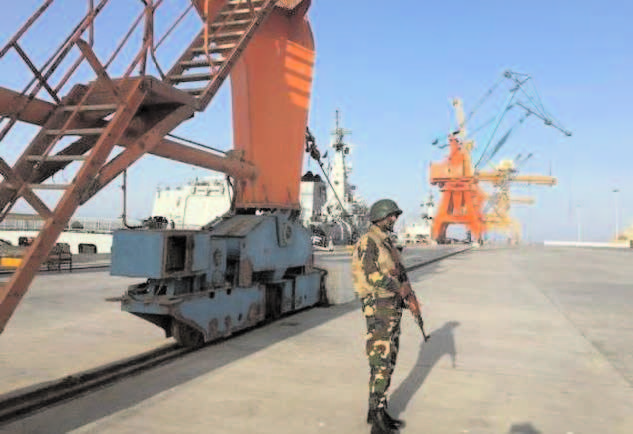
GWADAR (TIP): Pakistan’s army chief accused longtime regional rival India of seeking to undermine his country’s $46 billion project to build an economic corridor to transport goods from China’s western regions through the Pakistani deepwater port of Gwadar.
Chief of Army Staff General Raheel Sharif, speaking at a development conference on the impact of the China Pakistan Economic Corridor (CPEC), said the significance of a Pakistan-China economic alliance had “raised eyebrows” in the region.
“In this context, I must highlight that India, our immediate neighbour, has openly challenged this development initiative,” Sharif told the conference in Gwadar.
“I would like to make a special reference to Indian intelligence agency RAW that is blatantly involved in destabilising Pakistan. Let me make it clear that we will not allow anyone to create impediments and turbulence in any part of Pakistan. Therefore, it is important for all to leave behind confrontation and focus on cooperation.”
Indian officials could not be reached for comment late on Tuesday night.
RAW is India’s Research and Analysis Wing, its main external intelligence agency.
Last month, Pakistan said it had detained a suspected Indian spy for RAW in Baluchistan, the southwestern Pakistani province where most of the CPEC is taking shape.
India has confirmed that the man is a former Indian navy official but denied that he is a spy.
Majority Hindu India and mostly Muslim Pakistan, once part of a vast British colonial holding, have fought three wars since they were partitioned upon independence in 1947, leading to a violent separation that has fed decades of mutual suspicion.
Pakistan believes India is supporting a separatist insurgency in resource-rich Baluchistan. It also accuses India of fuelling strife in the city of Karachi. India denies any such meddling.
India has long accused Pakistan of backing militants fighting Indian security forces in its part of the divided Kashmir region, of helping militants launch attacks elsewhere in India and backing the Taliban in Afghanistan.
Pakistan says it only offers diplomatic support to the Muslim people of Kashmir living under what Pakistan says is heavy-handed Indian rule. It denies backing militant attacks in India.
ISLAMABAD (TIP): Pakistan received at least $13 billion from the US since the September 11, 2001 attacks for logistic and other support in the war against terrorism, the country’s parliament was told.
This was stated by defence secretary Alam Khattak while briefing the Senate committee on defence here on Wednesday.
Khattak said that his country got “USD 13 billion under the Coalition Support Fund (CSF) since 9/11”, while another USD 200 million is due to be reimbursed by the US.
He said that 40 per cent of the amount received was allocated to civil government while 60 per cent was given to the armed forces.
The CSF is going to end on September 30 this year with the US troop withdrawal from Afghanistan.
The New York Indian Film Festival was the first festival in the United States devoted to Indian films and has grown to be the largest and most influential, helping to set up several other Indian Film festivals in the US. Claus Mueller speaks with the New York Film Festival Executive Director Aroon Shivdasani on the progress story and the problems encountered.
Celebrating its 16th anniversary from May 7-14, 2016,the New York Indian Film Festival was the first festival in the United States devoted to Indian films and has grown to be the largest and most influential, helping to set up several other Indian Film festivals in the US. It is part of a comprehensive program in the arts offered by the New York based Indo-American Arts Council. As other specialty or niche festivals, the NYIFF has a unique programming profile devoted to features,documentaries and shorts made in the Indian Diaspora, or by Indian independent film makers. Its goal is to foster an understanding of India and its culture and to contribute to improving US Indian relations. The festival is attracting a growing number of Americans. Individuals of Indian ancestry account for 60%of the audience. That group encompasses about 700.000 persons in the tristate area. As other Indian Americans they are characterized, according to census data, by a very high educational achievement and part of the richest ethnic group in the US with an average household income of about $100,000. As other programs initiated and organized by the IndoAmerican Arts Council theNew York Indian Film Festival has been growing. Whereas 53 films were screened in 2015 this year’s edition will show 79 films and added two more screening days. Yet in spite of this expansion of the program, inclusion of production from other South Asian countries and an opinion shaping upscale audience the festival faces challenges common to other niche festivals. First there is the perennial funding problem and second is the question of how to best serve the Indian American community and others interested in Indian culture. This interview with the festivals driving spirit, its executive director, Aroon Shivdasani, presents her perspectives.
Claus Mueller: What is the status of the New York Indian Film Festival?
AroonShivdasani, the festival’s driving spirit and its executive director
Aroon Shivdasani: We started this film festival in 2001 because we wanted to showcase Indian Independent and Diaspora films in the US -something that had not been done before. Less than two decades ago, nobody knew about real Indian Cinema in North America. We are the oldest Indian film festival in the US – older than any of the other Indian film festivals that have now cropped up all over the country, like those in Los Angeles, Chicago, Atlanta, Seattle, and many others. We started as an Indian Diaspora film festival screening films made by Indians living all over the world – outside India. We conceived of a program to which the North American audience could relate -before bringing in Indian independent, alternate and art house films. Our first festival opened with the Godfather of Indian diaspora cinema, Ismail Merchant. The Merchant-Ivory film SHAKESPEAREWALLAH had won a Silver Bear at the Berlin Film Festival and featured Madhur Jaffrey and Shashi Kapoor. We closed the festival with Mira Nair’s Monsoon Wedding to a packed audience of people sitting in the aisles and standing at the back.
CM: When you focused on a target audience whom did you start with?
AS: We wanted mainstream America to see these films. However, the first festival had an 80%audience from the Indian subcontinent.
C M: Is it currently still that high?
AS: No, it now reaches out to all film aficionados. However, we still have a South Asian audience of approximately 60% – the rest of the 40% is American. You must remember that I am including the second generation Indian-American in the South Asian audience. This demographic is actually American – people like my children who were born in the US.
CM: Has there been a significant change?
AS: Certainly, but there have been several other dramatic changes. The first couple of years most of the diaspora films we received were still immature. Less than two decades ago there were a handful of good Indian Diaspora film makers. Our first film festival had only twelve films because that was the number of good diaspora films we showed that year. Indian diaspora filmmakers have matured over the last 15 years and we now have a plethora of films submitted to our festival. However, we have also added films from all over the Indian subcontinent (India, Pakistan, Sri Lanka, Nepal, Bhutan, Bangladesh, and Afghanistan) which increased our annual submission rise to over 300 for each festival – giving us a problem that we enjoy – plenty of good films from which to choose our final program.
CM; So what is the mix of productions you show this year?
AS: We will screen 35 feature narratives, 36 short narratives, 5 feature documentaries and 3 short documentaries. Now we have more independent films than Diaspora films. Probably 60% are independent/art house/alternative productions and the remainder is from the Diaspora. Over the last years there have been great increases of independent films submitted from India and the rest of the Indian subcontinent, which are quite remarkable in content and quality as well as growth in the number of productions.
CM: How many films were submitted this year, including shorts?
AS: 190 productions were submitted
CM: Do you carry in your festival traditional commercial Indian films such as Bollywood productions?
AS: No – unless we were to program a retrospective of a great Indian Director who has made a significant contribution to Indian cinema. Our mission is to show the real India through our films, to give socially conscious films a platform, to encourage audiences to view a different kind of cinema. Bollywood does not need us to do this for them. They have a large captive audience of their own. We often screen films that have commercial Indian cinema stars or directors – however those films are in the independent stream – smaller budgets, socially conscious plots or plots reflecting real lives and stories. We screen features, documentaries and shorts. I would love to screen Aamir Khan films – I do believe he has turned the tide of popular Indian cinema. Bollywood audiences respond to his films because he is of that world despite the fact that he now produces films in the independent genre which means his independent films receive mass audiences. In addition, there seems to be a turning tide in Bollywood too.several commercial films are also looking at real issues in the Indian subcontinent.
CM: Let’s take another area. If you check the box office results of Indian films in the US, it seems to be limited. Among the top scoring 100 foreign language films ranked since 1980 by Mojo, you will find only three Indian titles, MONSOON WEDDING.PK and OM SHANTI OM. So what is the contribution of your festival to get high quality independent productions and Diaspora films into distribution in the US?
AS: First let us qualify your comment. High quality Indian independent and Diaspora films fall into the same category as the films shown in special venues such as the Film Forum, Lincoln center, IFC, Quad Cinemas, Sunshine and the Angelika. One cannot place “foreign” films in the same category as the top grossing American films – their markets are completely different. If we are talking about distribution, we need to keep in mind that our films are part of the foreign language film group that play in art house theaters, the alternative or specialty film markets. Both known and unknown Indian Diaspora films have had successful screenings in these theatres: Mira Nair’s Monsoon Wedding & Namesake, Deepa Mehta’s Water, Gurinder Chadha’s Bride & Prejudice, David Kaplan’s Today’s Special, Vikram Gandhi’s Kumare and a host of others. In fact, I would place Danny Boyle’s Slumdog Millionaire in the same category. We premiered it and it then became a runaway success!!
CM: But that market is also rather small. Foreign language films with box office receipts of more than$100,000 grossed only $ 63.9 million out of a total box office of $10.3 billion in 2014. In 2015 there was a decline. But it is significant that of all foreign language films released to date in 2015 and 2016 those from Indiahad with $16.63 million higher receipts than French and German films respectively. Indian films have a brief theatrical exposure rarely exceeding two weeks. Overall US box officereached $13.9 billion during the same period. Foreign language films continue to lose ground, possibly in part due to use of other platforms but there are no hard data as to their financial returns in alternative distribution.
It is indeed a specialty market. But looking at specialty distribution, have you been able to track the films you are showing with respect to their subsequent use by art houses or theaters specializing in foreign and/or Indian Films?
AS:Yes, recently we have started to track our films. It is still a rather small percentage of Indian films that have received distribution here. I mentioned some of them above – others include Mathew Joseph’s BOMBAY SUMMER, Rajnesh Domalpali’s VANEJA, Srinivas Krishna’s GANESH BOY WONDER, and Shonali Bose’s AMU. Several notable independent films from our program have been screened in mainstream independent cinemas – Mira Nair’ s RELUCTANT FUNDAMENTALIST, Deepa Mehta’s MIDNIGHT CHIDREN, Anurag Kashyap’s GANGS OF WASSEYPUR. I am sure many films from our 2013 & 2014 festivals will soon be in the cinemas such as Nitin Kakkar’s FILMISTAAN, Feroz Khan’s DEKH TAMASHA DEKH, Anurag Kashyap’s UGLY and Hansal Mehta’s SHADID.
CM: In some cases, did they have prior distribution deals?
AS: Absolutely! And, in other cases distributors picked them up at our festival e.g. VANEJA, GANESH BOY WONDER, TODAY’S SPECIAL, BOMBAY SUMMER, AMU, UGLY, GANGS OF WASSEYPUR ……actually a large percentage of films screened at our festivals for the last few years have wound up in theatres.
CM: Is there is a general problem cracking the specialty market, even if marketing support is provided?
AS: Correct, we encourage film makers to bring their contacts from the industry. We provide passes to distributors and film financiers but also use the festival to reinforce audience appeal, and work the media. Further the festival program ensures that there is always a post-screening discussion which gives filmmakers a chance to talk to the audience about their films and allows the industry to recognize and approach them.
CM: But you do have an advantage over let’s say Italian or French festival films? There is a sub circuit of Indian film theaters in the US films, not only lots of the mom and pop operations but also theaters that were acquired by the Reliance Theatre Circuit. I understand that the success of these theaters with the Indian language audience has led to neighboring main line theaters to play Indian films now.
AS : No, I don’t think so. For one, mainstream America is already familiar with Italian and French films and filmmakers. Indian Independent filmmakers are still in their infancy with regard to visibility in the “foreign film” audience. With regard to Indian mom and pop theaters – they are reluctant to play the productions we offer because they are not confident of the recurring audiences they get with Bollywood films. Reliance has closed most of their theatres!
CM: What if you have a commercially viable product?
AS: Well, I believe we have to start inviting movie theatre owners to our festival to show them the sold out houses for our films – in English, Hindi as well as all the other Indian regional languages. In fact, we have long lines of wait lists for several of our films.
CM: What about new distribution platforms, Video on Demand, Netflix, Hulu, special cable or satellite channels aimed at the Indian Diaspora audience, specialized circuits? Reliance figures that there are millions of people in this country speaking Indian languages. Have you ever explored these new platforms?
AS: Yes, we are increasingly aware of these platforms. I believe Star TV, Netflix and several other established online distribution platforms are already screening Indian films. Netflix carries about 70 feature films from India, though mostly Bollywood productions, they still have to recognize Indian independent productions. Several smaller ones have approached us to stream our films through them. In 2015 we continue to move in that direction. In 2012 Mela attended our festival to invite filmmakers to stream their films through them; Republic of Brown has approached our filmmakers as are big companies like SONY and MTV. Several small distribution companies have started checking out our festival to acquire films. The large ones have very strict rules of compliance whereas the smaller ones are more laissez faire. We have important Indian film content that can garner a whole new audience of film aficionados for these channels. These companies have approached us because they realize that we have become an important entry point for Indian content. I have heard Rediff.com is thinking along those lines too although I wouldn’t swear to that. Companies realize that there is a huge potential market in streaming good films that are not easily available after a one time screening at our film festival. The Asian Indian population is one of the fastest growing ethnic groups in the US, amounting to more than 3 million people now. People attending our festival frequently ask where they and their friends or relatives can view our films. We hope to give them concrete answers after our 2016 film festival.
CM: What about other exposure?
AS: We have been approached by the Museum of the Moving Image, the Indians of Long Island, EKAL, and the Indian Cultural Council of Greenwich to show a few of our NYIFF 2016 films at their venues immediately following our screenings. Also, all of the local Indian media cover the festival, TV Asia, ITV, India Abroad, News India Times, and several others.
CM: What is your current principal problem?
AS: Money. Funding has become a major problem. Indian and US corporations don’t seem particularly interested. We made some small steps this year. I hope their experience with our festival leads them to get more involved next year. They were really happy with the exposure they received, the festival itself, as well as our audiences. Limited funding precludes expansion and, equally important, it prevents providing better services to our audiences.
CM: What about public funding?
AS:We receive small amounts from the federal, state and city governments. However, they are extremely small amounts to start with, and have been further slashed due to the economy.
CM: Can you identify other potentials sources?
AS:We have approached several corporations; I hope some of them come through. Individual giving has, to date, been extremely important. This means individuals who believe in our organization, its mission and are equally pleased with the execution and results.
CM: What about official Indian agencies? They come to mind since I had a very positive response by government and private sector officials to a presentation I gave in New Delhi several years ago in New Delhi on the important role of Indian films in propagating Indian culture overseas through public diplomacy projects.
AS: ICCR (Indian Council for Cultural Relations) and the Consulate General of India. The ICCR used to send us artists – that has changed with new Indian and US Government rules. The Indian Consulate General gives us in-kind support by hosting some receptions, and the Indian Tourist Office (Incredible India) has, in the past, sponsored us with small amounts of cash. However, that too has stopped as per new orders from India. There is no significant monetary support from Indian Government agencies.
CM: Do you detect any shifts since India is rapidly becoming a major international power?
AS:Unfortunately, I don’t see any visible signs of change. In fact, besides verbal bravado, the small amounts of funding we previously received have also been cut off.
CM: Well, I do hope that this will be different in the future. Thank you very much for your reflections.
(Claus Mueller can be reached at filmexchange@gmail.com)
WASHINGTON (TIP): US President Barack Obama has said Nato is “critical” to the security of America and its allies in Europe, a virtual rejection of Republican frontrunner Donald Trump’s views that the intergovernmental military alliance has outlived its utility.
“Nato continues to be the linchpin, the cornerstone of our collective defence and US security policy,” Obama told reporters on Monday along with Nato secretary general Jens Stoltenberg in the White House.
The Obama-Stoltenberg meeting came in the wake of Trump’s remarks.
White House press secretary Josh Earnest has termed such remarks as “ill-advised”. Obama, however, did not make any direct comment on Trump’s comments.
Obama said he had an excellent discussion that started with marking the tragedy that had taken place in Brussels, and reinforcing the importance of us staying focused on Islamic State (ISIS/ISIL) and countering the terrorism that has seeped up into Europe and around the world.
“We agreed that one of the most important functions that Nato is performing and can continue to perform is to help in the training and assisting process for troops in Iraq, in Jordan, in many of the areas in the region.
“And we are continuing to cooperate on an ongoing basis about operations potentially in areas like Libya, where you have the beginnings of a government and we can I think provide enormous help in helping to stabilize those countries,” Obama said. Obama and Stoltenberg also discussed situation in Afghanistan, Russia and Ukraine. “We continue to be united in supporting Ukraine in the wake of Russian incursions into Ukrainian territory. We continue to work in a train-and-assist fashion in helping support Ukraine develop its military capabilities defensively,” he said.
Stoltenberg said Nato is as “important as ever”.
“Because Nato has been able to adapt to a more dangerous world. We stand together in the fight against terrorism. Terrorism affects us all, from Brussels to San Bernardino, and all Nato allies contribute to the US-led efforts to degrade and destroy ISIL. And just last week, we started training Iraqi officers, and we will continue to support the efforts of the United States and other countries to fight ISIL,” he said.
The US value the contributions it received from the large number of Nato members who are a part of counter-ISIL coalition, Earnest said.
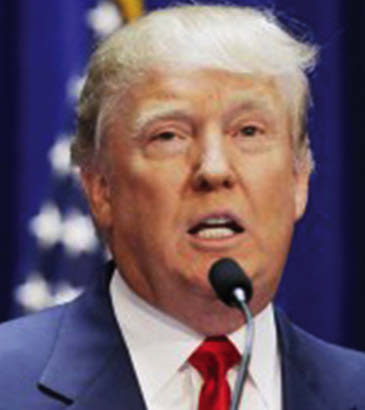
WASHINGTON (TIP): Nuclear-armed Pakistan is a “very, very vital problem”, Republican presidential front-runner Donald Trump has said and asserted that the country needs to “get a hold of” its situation.
“Pakistan is a very, very vital problem and really vital country for us because they have a thing called nuclear weapons. They have to get a hold of their situation,” Trump told CNN during a town hall in Wisconsin, where the Republican presidential primary is scheduled for April 5.
“When I see that and when I see it put in a park because it was mostly Christians, although many others were killed other than Christians, I think it’s just absolutely a horrible story,” he said referring to the terrorist attack in Lahore on Easter Sunday that claimed 74 lives and injured over 300 others.
“I’m talking about radical Islamic terrorism. I will solve it far better than anybody else running,” Trump said in response to a question.
A large number of people were present at the crowded Gulshan-e-Iqbal Park of Allama Iqbal Town in Lahore when a powerful blast took place on Sunday. A large number of Christian families were present in the park due to Easter Sunday.
The brutal attack by a suicide bomber-believed to be in his 20s – was claimed by the Jamaatul Ahrar, a splinter group of the Tehrik-i-Taliban Pakistan (TTP).
Earlier this month, Trump had said that the “US needs to stay in Afghanistan because its immediate neighbor Pakistan has nuclear weapons which have to be protected”.
“I think you have to stay in Afghanistan for a while, because of the fact that you are right next to Pakistan, which has nuclear weapons and we have to protect that. Nuclear weapons change the game,” he said. Last year, Trump had called Pakistan the most dangerous country in the world. In an interview, he had indicated that Pakistan needs to be denuclearize.
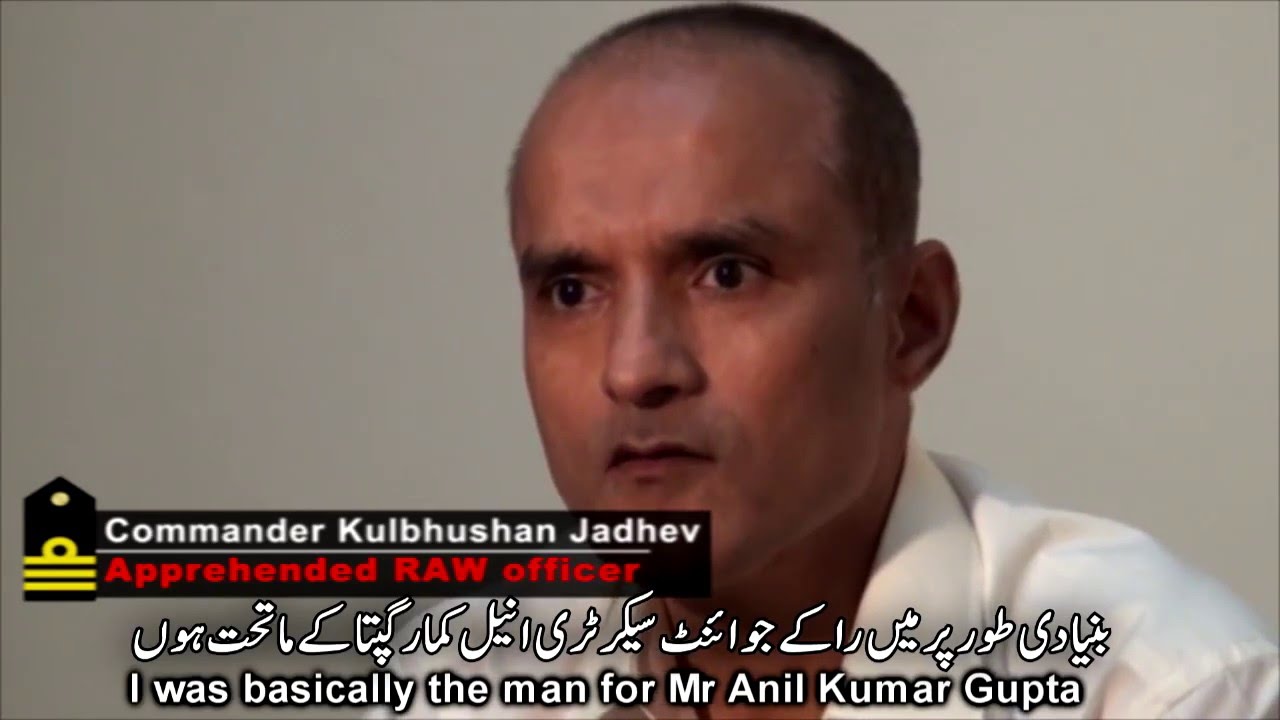
Pakistan on Tuesday released a video in which an arrested Indian spy is heard confessing New Delhi’s alleged involvement in terrorist activities in Balochistan.
Kulbushan Yadav says in the video that he had been directing various activities in Karachi and Balochistan “at the behest of RAW”, the Indian intelligence agency, and that he was still with the Indian Navy.
Yadav added that he had played a role in the deteriorating law and order situation in Karachi, Dawn reported.
The video was released at a press conference attended by Pakistan Army spokesman Lt Gen Asim Bajwa and Information Minister Pervez Rashid.
Terming Yadav’s arrest a “big achievement”, Bajwa said Yadav was directly handled by the RAW chief and Indian National Security Adviser Ajit Doval.
“His goal was to disrupt development of the China-Pakistan Economic Corridor (CPEC), with Gwadar port as a special target,” Bajwa said.
“This is nothing short of state-sponsored terrorism… There can be no clearer evidence of Indian interference in Pakistan.”
Yadav is heard saying in the video that he was still a serving officer in the Indian Navy and would be due for retirement in 2022.
“By 2002, I commenced intelligence operations. In 2003, I established a small business in Chabahar in Iran.
“As I was able to achieve undetected existence and visits to Karachi in 2003 and 2004. Having done some basic assignments within India for RAW, I was picked up by RAW in 2013 end,” Yadav said.
He said his purpose was to meet Baloch insurgents and carry out “activities with their collaboration”.
Law enforcement agencies arrested Yadav in an intelligence-based raid in Balochistan’s Chaman near the border with Afghanistan last week. He held a valid Indian visa.
India denied Yadav was an intelligence operative and said he was formerly from the navy. New Delhi also demanded consular access to Yadav, which has been denied.
Yadav was shifted to Islamabad for interrogation, during which an unnamed official said the spy revealed he had bought boats at the Iranian port in Chabahar in order to target Karachi and Gwadar ports, Dawn reported.
India on Tuesday dismissed, as baseless, remarks made by an alleged Indian spy in a video released by Pakistan in which he “confessed” New Delhi’s alleged involvement in terrorist activities in Balochistan.
“We have seen a video released by Pakistani authorities of a former Indian naval officer, doing business in Iran, who is in Pakistani custody under unexplained circumstances,” the external affairs ministry said in a statement.
“The video has this individual making statements which have no basis in fact. That the individual claims to make the statements of his own free will not only challenges credulity but clearly indicates tutoring,” it said.
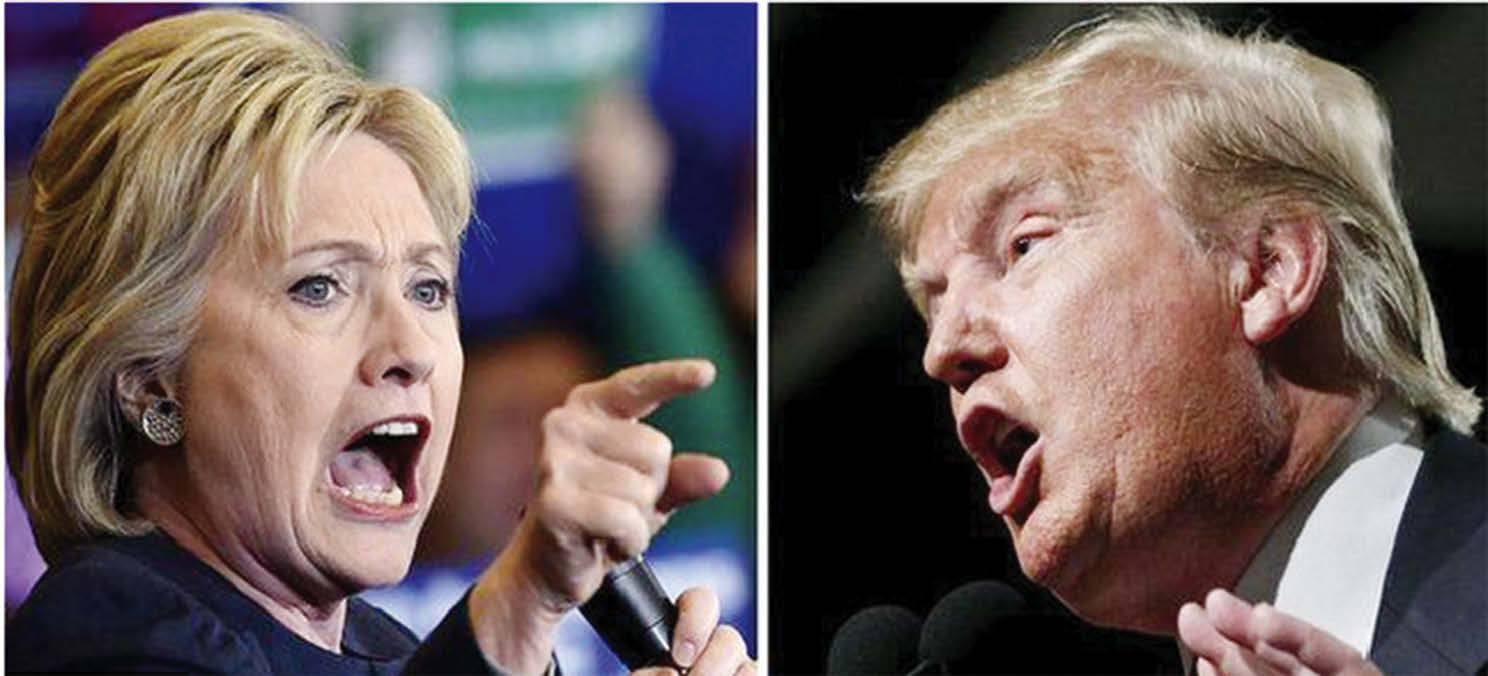
The front runners -Republican Donald Trump and Democratic Hillary Clinton.Irrespective of who wins, the tilt is towards India
American presidential elections get international attention because of worldwide interest in who is going to become the most powerful leader on the international stage. The US presidential elections in 2012 were less exciting than usual, because of the widespread belief that President Obama would be re-elected. We are now witnessing party primary elections, in which a flamboyant billionaire with a mercurial temperament, Donald Trump, has captured worldwide attention. Trump, a property baron, owns a network of hotels, casinos, golf courses and other properties. He has, paradoxically, struck a chord among blue-collared workers, who feel their jobs threatened by immigrants. His populist response has been to advocate building a wall across the US-Mexico border and banning immigration of Muslims, whom he labels collectively as terrorists.
Hillary Clinton’s primary opponent, former Senator Bernie Sanders, has likewise, espoused the cause of ending free trade arrangements and called for tighter control over Wall Street. Sanders alleges that unemployed and blue-collar workers suffer, because of excessive trade liberalization and the unholy nexus between politicians (including Hillary) and the financial, business and industrial barons of Wall Street. The tactics Trump and Sanders have adopted have won huge support from insecure blue-collar workers, making life difficult and the competition unexpectedly tough, for Clinton. Despite this, Hillary is expected to win the Democratic Party nomination, unless she encounters difficulties, because of alleged misdemeanors during her tenure as Secretary of State. Trump could likewise sail through as the candidate of the Republican Party. A word of caution on the upcoming elections is called for. The Republican Party could land itself in a mess, if its establishment chooses to ignore the political verdict and nominates an eminent party politician to replace Trump as its presidential candidate.
Trump has moved far away from the Republican Party in his views on several foreign policy issues. He has criticized military intervention in Iraq, Syria and Libya and voiced his opposition to such military intervention abroad. He remains ambivalent on his approach to Israel, though he will inevitably fall in line with conventional thinking on the Jewish state. Interestingly, Trump vows to build bridges with President Vladimir Putin, while Hillary remains steadfastly hostile to the Russian leader. Both Hillary and Trump have suspicions and misgivings about China, with Trump repeatedly asserting that China got rich at the cost of American industry and its working class. The two frontrunners hold opposing views on liberalizing trade, with Trump claiming that liberalization damages the livelihood of American workers.
While Trump has expressed serious misgivings and suspicions about the Islamic world in general, he has expressed specific reservations about the behavior of Pakistan. Quite unexpectedly, Trump has answered his critics on their charge that he is anti-immigrant and racist by suggesting that he has great admiration for Indians, who are hardworking, intelligent and innovative. He has suggested that Indian students who come for studies in US universities should be allowed to stay on and work.
The eight years of the Clinton presidency included some of the worst years in India-US relations. The Clinton administration turned the heat on India to give up its nuclear program. It pressured Russia to end space cooperation with India. It promoted a worldwide effort to cripple our economy after our nuclear tests and failed. In its early years, the Clinton administration even made overtures to the Hurriyat in Kashmir. On the other hand, the George Bush presidency saw a remarkable turnaround in India-US relations. American pressure after 9/11 forced the Musharraf dispensation to sue for a ceasefire in J&K and end cross-border infiltration in the state. This continued till the last days of the Bush presidency. Global nuclear sanctions against India ended, as the Bush administration used all its persuasive powers to get the 45-member Nuclear Suppliers Group to end sanctions on India. Shortly thereafter, at US initiative, India was welcomed into new global economic forums, like the G20.
While President Obama had pledged to strengthen the US-India strategic partnership, his approach to India has been largely transactional, seeking greater Indian purchases of US weapons, while doing very little to turn the squeeze on Pakistan to end terrorism targeting India and Afghanistan. Intelligence sharing with India has been episodic and sometimes duplicitous, given the delay and reluctance with which intelligence information on the revelations of David Headley was shared with us. More importantly, the US is actively partnering Pakistan and China to bring about “reconciliation” with the Taliban in Afghanistan. Well-placed Afghans complain bitterly of the pressures they are facing from this US-China-Pakistan axis, to keep making concessions to the Taliban. Interestingly, even some in the Obama administration are concerned about what is transpiring.
The world is now seeing an opportunistic move by the Obama administration to persuade India to back US efforts to rein in the Chinese in the Western Pacific, given China’s expanding maritime border claims on South Korea, Japan, Taiwan, Vietnam, the Philippines, Malaysia, Brunei and Indonesia. At the same time, the Obama administration is joining China and turning a blind eye to Pakistan-sponsored terrorism in Afghanistan. What the Obama administration is thereby doing, is to seek India’s support to curb Chinese maritime claims in the Asia-Pacific, even as its colludes with China to determine the future of Afghanistan, in a manner that furthers Pakistan’s regional ambitions. There has been much talk, but little action by the Obama administration to curb Pakistan-sponsored terrorism.
Hillary has taken a personal interest in relations with India. Unlike her husband, and John Kerry, her viscerally anti-Indian successor, as Secretary of State, Hillary did respond in a friendly manner to India’s concerns and policies across both its eastern and western land and maritime borders. This was evident in her approach to India’s role in the ASEAN Regional Forum. She chose to call a spade a spade when it came to Pakistan-sponsored terrorism leading to the emergence of extremist outfits that threated Pakistan itself, with the words: “You cannot nurture vipers in your backyard and expect that they will bite only your neighbor”. In these circumstances, we can expect a more mutually beneficial relationship with the US, after the coming presidential elections.
By G Parthasarathy – (The author is a former diplomat)
KABUL (TIP): At least 15 members of the Islamic State (IS) militant group were killed in airstrikes in the eastern Afghan province of Nangarhar, the government said on Monday. “Acting upon confirmed intelligence reports, the pilotless plane of the coalition forces stormed a hideout of IS militants in Achin district last night,” Xinhua quoted a government statement as saying.
The district, bordering Pakistan, has been the scene of heavy clashes between IS militants and security forces, backed by pro-government local militiamen over the past couple of months.
In an unrelated incident, six Taliban militants were killed and seven injured after security forces repelled an attack on three villages in Darqad district of Takhar province, a police spokesperson said.
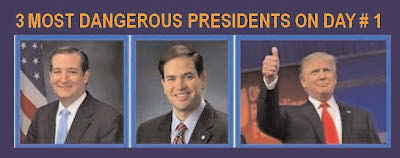
On Day #1, they want to repeal Obama care. Forget their hatred for the President, but look at their political meanness to deprive 22 Million Americans of their health insurance. Many of those Americans may be facing life threatening ailments. When they repeal Obama-care on Day # 1, a number of them may die for lack of access to the necessary health care. Do American lives matter to them?
For the first time in American history, the U.S. Government has put the money to right use, to care for Americans rather than blow it on destroying other nations like Iraq and Afghanistan. For the first time pre-existing conditions were covered by health insurance, it is important to know that many American lives have been saved and will continue to be saved. These three men care less about ordinary Americans. While they can afford to buy any insurance, the average Americans living from pay check to pay check cannot.
Our country needs a strong defense system to fight off external aggression as well as internal health aggressions. The three should be grateful to Obama for having implemented the measures and means of paving the way for a healthier America and saving American lives.
Furthermore, on Day #1 – they also want to tear up the Iran deal. That would certainly appease Netanyahu, but completely disregards the long term security of Israel, and as a consequence it would free Iran to pursue the Nuclear Weapons program which brings uncertainty and instability to the region.
President Obama has removed a potential threat to Israel with this deal; and the American Jews have the wisdom to recognize this and support it.
President Carter, the architect and the facilitator of a permanent Peace Treaty between Israel and its onetime arch enemy Egypt brought relief, after that Israel had one less enemy to worry and thus saved tension, tanks and lives. I am sure the thoughtful American Jewry will express their gratitude to President Carter. Indeed, Israel should install a statue of President Carter at the Ben Gurion Airport to express their gratitude to him.
President Clinton on the other hand took out another enemy on the east; Jordan, and President Obama has given the iron dome to Israel and has removed another enemy; Iran.
Tearing up the Iran Deal would be one of the gravest blunders in the US Foreign policy. It would amount to recklessly rejecting Iran’s partnership treaty with Russia, China, UK, Germany, France and the United States. How do you build coalitions if you are disrespectful to nations that work with us on common goals of reducing conflicts and focusing on economic development? If we mess with this deal; Iran is likely to become another Rogue Nuclear nation like North Korea and pose a direct and greater threat to Israel.
For the first time in fifty years, a U.S., President has done the right thing, a conservative thing to develop and implement a foreign policy based on friendship and treaties rather than animosity and hostilities.
We may destroy Iran, but we will also destroy ourselves much more. Gas prices will go up for millions of servicemen/repairmen to make service calls, as it happened towards the end of the Bush era. Small businesses will fold, divorces will become routine, home foreclosures will be back, loss of lives of our men and women, and a few more trillion dollars of deficit will be added to our budget.
Why is little Rubio screaming in every sentence to save our ally Israel? Israel does not need friends like him who will ruin their long term security. Israel needs prudent, wise and visionaries like Obama, Clinton and Carter who will bring long term peace and security to them by turning enemies into friends and partners in peace and cooperation.
The things Rubio has been clinging on to are repeal Obama-care, tearing up the Iran Deal and supporting Israel’s paranoia. Every sentence he utters is about supporting Israel, and I am sure Trump supporters resent that, because they want America first and not Israel. Rubio’s non-sensual rhetoric may increase anti-Semitism in the form of resentment. He and Cruz are dangerous to Israel not only from Americans, but also from those five nations (Russia, China, UK, France and Germany) whose nuclear contracts with Iran they plan to trash, and it is like spitting in their faces. The costs of the idiotic behavior of Rubio will not fall on themselves, but on the average. I wonder if Saudi Arabia, Germany or UK can throw enough bones at him to let him bark for them. He does not give a crap about the 22 Million Americans’ health care or our economy. He has a serious character flaw.
Ted Cruz, the bloody war monger will carpet bomb other nations like Bush did, and he will add a few more trillion dollars of deficit to the budget, and shoot the unemployment rate through the roof to go up to 12%, more divorces will follow, home foreclosures will rise, and businesses will start closing down. Yes, neither Cruz does care what happens to America. He and some of his macho men may draw sadistic pleasure from destroying other nations, but we the people do not want destruction, for which we end up paying again.
Furthermore, Cruz has been disrespectful towards the Supreme Court Justices and their decisions. Is he above the law to use such vulgar language about them? He does not seem care, he would let our government shut down and ruin our credit ratings, and he does not give a rat’s ass about the 22 Million Americans’ health care either. Voting for Cruz is regressing to the big bad times of Bush Administration.
Trump will turn his back on nuclear Non-proliferation Deals and peace negotiations just to advance his own agenda, and not necessarily what is good for America. Foreign leaders are not his employees whom he fires at his whim; instead they will turn around and tell him to take a hike. The Muslim nations, some 56 of them would not want to be humiliated by these idiots and will turn to Russia or the UK to purchase their military hardware. Who will be the losers? The men and women employed in our export and defense industry. That is a large number of people and it may hurt our economy severely.
These three men, Rubio, Cruz and Trump are wrecking balls, and we will be screwed on Day # 1 if we were to elect them as our President. It is time to redefine conservatism; none of the three loose mouths are conservatives in my books.
(The author is a community consultant, social scientist, thinker, writer, news maker, and a speaker on Pluralism, Interfaith, Islam, politics, terrorism, human rights, India, Israel-Palestine and foreign policy. He is committed to building cohesive societies and offers pluralistic solutions on issues of the day. Visit his 63 links at www.MikeGhouse.net and TheGhousediary.com for his writings)
JALALABAD (TIP): At least 10 people were killed and over 40 injured when a suicide bomber blew himself up near a market in Afghanistan’s eastern province of Kunar today, officials said.
“A suicide bomber riding a motorcycle detonated his explosives in a market in Asadabad the provincial capital, 10 people were killed and over 40 were injured.” Ghani Mosamem, spokesman for the provincial governor told AFP.
KABUL, AFGHANISTAN (TIP): US Army General John W “Mick” Nicholson has taken command of US and Nato forces in Afghanistan, inheriting America’s longest war and a vicious insurgency.
Resident Ashraf Ghani of Afghanistan has warned in several recent interviews that unless peace talks with Pakistan and the Taliban produce results in the next few months, his country may not survive 2016. Afghanistan is barely standing, he says, after the Taliban onslaught last year, which led to the highest casualties among civilians and security forces since 2001.
“How much worse will it get?” Mr. Ghani asked in a recent television interview. “It depends on how much regional cooperation we can secure, and how much international mediation and pressure can be exerted to create rules of the game between states.”
What he means is it depends on how much international pressure can be brought to bear on Pakistan to cease its aggression.
Critics of the Afghan leadership say it’s not Pakistan’s fault that its neighbor is falling apart. They point to the many internal failings of the Afghan government: political divisions, weak institutions, warlords and corruption.
But experts have found a lot of evidence that Pakistan facilitated the Taliban offensive. The United States and China have been asking Pakistan to persuade the Taliban to make peace, but Afghanistan argues that Islamabad has done nothing to rein in the Taliban, and if anything has encouraged it to raise the stakes in hopes of gaining influence in any power-sharing agreement.
This behavior is not just an issue for Afghanistan. Pakistan is intervening in a number of foreign conflicts. Its intelligence service has long acted as the manager of international mujahedeen forces, many of them Sunni extremists, and there is even speculation that it may have been involved in the rise of the Islamic State.
The latest Taliban offensive began in 2014. United States and NATO forces were winding down their operations in Afghanistan and preparing to withdraw when Pakistan decided, after years of prevarication, to clear Taliban and Al Qaeda fighters from their sanctuary in Pakistan’s tribal area of North Waziristan.
The operation was certainly a serious endeavor – Taliban bases, torture chambers and ammunition dumps were busted, town bazaars were razed and over one million civilians were displaced.
But the militants were tipped off early, and hundreds escaped, tribesmen and Taliban fighters said. Many fled over the border to Afghanistan, just at the vulnerable moment when Afghanistan was assuming responsibility for its own security. Ninety foreign fighters with their families arrived in Paktika Province that summer, to the alarm of Afghan officials.
Further along the border in Paktika Province, Taliban fighters occupied abandoned C.I.A. bases and outposts. A legislator from the region warned me that they would use the positions to project attacks deeper into Afghanistan and even up to Kabul. Some of the most devastating suicide bomb attacks occurred in that province in the months that followed.
Meanwhile, in Pakistan, the Haqqani network, the most potent branch of the Taliban, moved from North Waziristan into the adjacent district of Kurram. From there it continues to enjoy safe haven and conduct its insurgency against American, international and Afghan targets.
Pakistan regards Afghanistan as its backyard. Determined not to let its archrival, India, gain influence there, and to ensure that Afghanistan remains in the Sunni Islamist camp, Pakistan has used the Taliban selectively, promoting those who further its agenda and cracking down on those who don’t. The same goes for Al Qaeda and other foreign fighters.
Even knowing this, it might come as a surprise that the region’s triumvirate of violent jihad is living openly in Pakistan.
First, there’s Sirajuddin Haqqani, the leader of the Haqqani network, and second in command of the Taliban. He moves freely around Pakistan, and has even visited the Pakistani intelligence headquarters of the Afghan campaign in Rawalpindi.
Then there is the new leader of the Taliban, Mullah Akhtar Muhammad Mansour, who has openly assembled meetings of his military and leadership council near the Pakistani town of Quetta. Since he came to power last year, the Taliban has mounted some of its most ambitious offensives into Afghanistan, overrunning the northern town of Kunduz, and pushing to seize control of the opium-rich province of Helmand.
Finally, Al Qaeda’s leader, Ayman al-Zawahri, enjoys sanctuary in Pakistan – one recent report placed him in the southwestern corner of Baluchistan. He has been working to establish training camps in southern Afghanistan. In October, it took United States Special Operations forces several days of fighting and airstrikes to clear those camps. American commanders say the group they were fighting was Al Qaeda in the Indian Subcontinent, a new franchise announced by Mr. Zawahri that has claimed responsibility for the killings of bloggers and activists in Karachi and Bangladesh, among other attacks.
Pakistan denies harboring the Taliban and Al Qaeda, and points out that it, too, is a victim of terrorism. But many analysts have detailed how the military has nurtured Islamist militant groups as an instrument to suppress nationalist movements, in particular among the Pashtun minority, at home and abroad.
Perhaps most troubling, there are reports that Pakistan had a role in the rise of the Islamic State.
Ahead of Pakistan’s 2014 operation in North Waziristan, scores, even hundreds, of foreign fighters left the tribal areas to fight against President Bashar al-Assad in Syria. Tribesmen and Taliban members from the area say fighters traveled to Quetta, and then flew to Qatar. There they received new passports and passage to Turkey, from where they could cross into Syria. Others traveled overland along well-worn smuggling routes from Pakistan through Iran and Iraq.
The fighters arrived just in time to boost the sweeping offensive by ISIS into Iraq and the creation of the Islamic State in the summer of 2014.
If these accounts are correct, Pakistan was cooperating with Qatar, and perhaps others, to move international Sunni jihadists (including 300 Pakistanis) from Pakistan’s tribal areas, where they were no longer needed, to new battlefields in Syria. It is just another reminder of Pakistan’s central involvement in creating and managing violent jihadist groups, one Pakistani politician, who spoke on the condition of anonymity when talking about intelligence affairs, told me.
This has been going on for more than 30 years. In 1990, I shared a bus ride with young Chinese Uighurs, Muslims from China’s restive northwest, who had spent months training in Pakistani madrasas, including a brief foray into Afghanistan to get a taste of battle. They were returning home, furnished with brand-new Pakistani passports, a gift of citizenship often offered to those who join the jihad.
Years later, just after Osama bin Laden was found and killed in Pakistan, I interviewed a guerrilla commander from the disputed region of Kashmir who had spent 15 years on the Pakistani military payroll, traveling to train and assist insurgents in Bosnia, Chechnya, Kashmir and Afghanistan.
In 2012 I came across several cases where young clerics, fresh graduates from the Haqqania madrasa in Pakistan, returned to their home villages in Afghanistan, flush with cash, and set about running mosques and recruiting and organizing a band of Taliban followers.
I visited that madrasa in 2013. It is the alma mater of the Afghan Taliban, where many of the leaders of the movement were trained. The clerics there remained adamant in their support for the Taliban. “It is a political fact that one day the Taliban will take power,” Syed Yousuf Shah, the madrasa spokesman, told me. “We are experts on the Taliban,” he said, and a majority of the Afghan people “still support them.”
The madrasa, a longtime instrument of Pakistani intelligence, has been training people from the ethnic minorities of northern Afghanistan alongside its standard clientele of Pashtuns. The aim is still to win control of northern Afghanistan through these young graduates. From there they have their eyes on Central Asia and western China. Pakistani clerics are educating and radicalizing Chinese Uighurs as well, along with Central Asians from the former Soviet republics.
No one has held Pakistan to account for this behavior. Why would Pakistan give it up now?
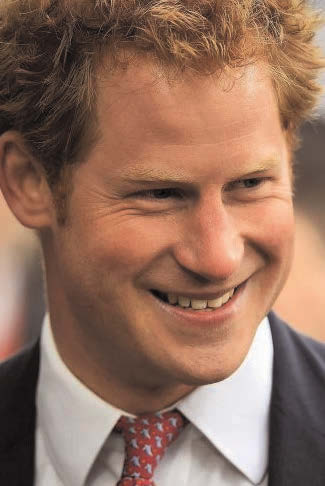
LONDON (TIP): Britain’s Prince Harry will travel to Kathmandu next month on a maiden visit to Nepal and meet people affected by last year’s devastating earthquakes.
The prince will visit Nepal between March 20 and 23.
“Prince Harry is really looking forward to his first trip to Nepal. It is a country he has long wanted to visit,” a Kensington Palace spokesperson said today.
“The Prince has been moved by the stories of resilience of the Nepali people following the earthquakes last year and is now eager to learn more about their country and culture,” the spokesman said.
Harry, the fifth-in-line to the British throne, will meet survivors of last April’s earthquake in the region, which claimed over 9,000 lives.
“With Britain and Nepal currently celebrating 200 years of cooperation, Prince Harry will experience the strength of the relationship and traditional warmth of the Nepali welcome,” the spokesperson said.
The 31-year-old royal will also take part in a trek and visit a national park. The tour will begin and conclude in Kathmandu, where he will meet President Bidhya Devi Bhandari.
Having served alongside Gurkhas in Afghanistan, the prince will visit the British Gurkha Camp in Pokhara, where he will commend the bravery and service to the Crown of an “exceptional group of soldiers”, the ‘Evening Standard’ reported.
His visit to South Asia is expected to coincide with that of his older brother, Prince William, to India and Bhutan.
The exact dates and details of the visit by Prince William and wife Kate have not been announced yet but they are expected to make their first visit to the Taj Mahal in Agra during the tour.
Pakistan continues to be a major target of terrorism, most recently demonstrated by the attack on Bacha Khan University, which killed 20 people.
Only a week before, three attacks in close succession at a UN-backed polio clinic in Quetta, a local broadcaster and the Pakistani consulate in Jalalabad killed at least 20 people and injured more than 30, which included civilians and security personnel.
Slowly but surely, Pakistan’s terrorism crisis has morphed into an existential nightmare, one that is threatening to unravel any semblance of stability. As the country finds itself at the crossroads of prosperity and failure, its fight against terror is more important now than ever.
Pakistan is one of the main victims of terrorism, a fact often ignored in the West. To put matters in perspective, Pakistan’s terrorism-related deaths from 2007 to 2014 numbered 1,592 – a 940 percent increase from 1998-2006, according to the 2015 Global Terrorism Index.
The same study also ranks Pakistan fourth out of 124 in a list of countries most affected by terrorism with the tragic Peshawar army school attack in late 2014 serving as an ominous exclamation point.
The Afghanistan connection
Many of Pakistan’s problems stem from the political upheaval in Afghanistan. The US invasion after 9/11 turned the lawless border between the two countries into a breeding ground for terrorist activity.
Nestled between three volatile borders, Pakistan is also situated in one of the most geopolitically sensitive areas of the world, with different players vying for competing interests.
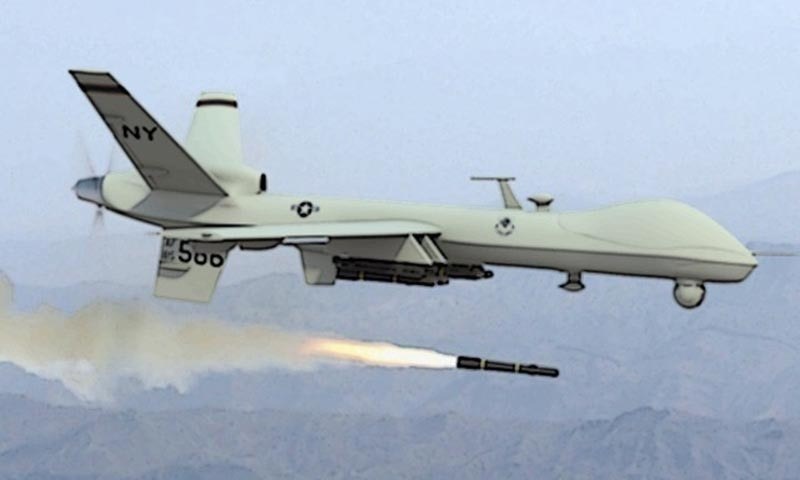
Ongoing US drone campaigns have radicalized segments of the local population and mobilized groups such as the Pakistani Taliban to carry out attacks against civilians and military targets. These attacks only exacerbate sectarian tensions between Pakistan’s Sunni and Shia communities and continue to bring into question the integrity of Pakistani statehood. With ISIL now in the mix, the situation can only degrade further.
The military and … the ISI must take fundamental efforts to cease the practice of using terrorism as a foreign policy asset and avoid domestic blowback.
External factors aside, Pakistan must also take a genuine stance against terrorism within its own borders, root out internal terrorist sympathies and take a leadership role in ending the use of proxies.
The military and particularly Pakistan’s intelligence agency, the ISI, must make fundamental efforts to cease the practice of using terrorism as a foreign policy asset and avoid domestic blowback.
With a projected GDP growth of over 5 percent for the next three years, an improved currency and recent consolidation of its three stock exchanges into the new Pakistan Stock Exchange, the country might be showing signs of economic progress after years of volatility.
The $46bn China Pakistan Economic Corridor project, linking the Gwadar port to the Chinese city of Kashgar, has the potential to turn Pakistan into a strategic trading hub.
Also given Iran’s post-sanctions reintegration into the world economy, a rekindling of the Iran-Pakistan gas pipeline to address the energy shortage also becomes a real possibility.
Peace with India
Indian Prime Minister Narendra Modi’s surprise visit last month also signals that peace with India, although difficult, might not be as elusive as some believe. Similarly, Afghanistan’s new President, Ashraf Ghani, has also shown signs that he is not willing to give up on improving ties with its eastern neighbor despite pressure from within his government.
History has shown that Pakistan’s military remains the de facto power within the state. However, the head of Pakistan’s armed forces, General Raheel Sharif, has shown restraint by focusing on Operation Zarb-e-Azb in Northwest Pakistan and rooting out political mafias in Karachi rather than plotting coups.
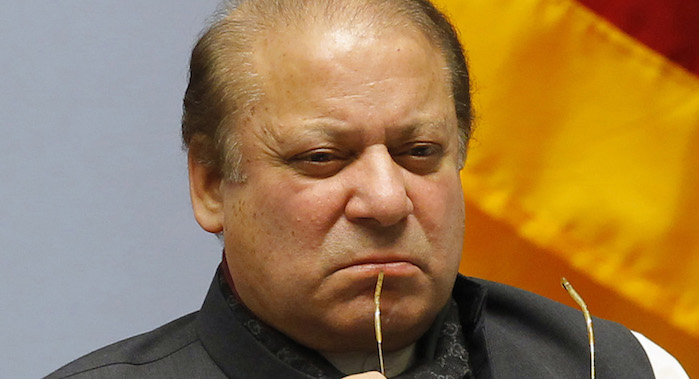
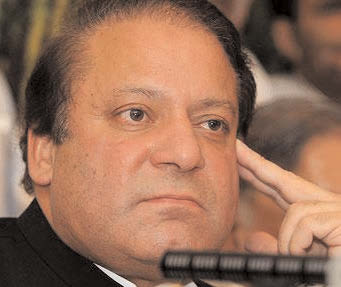
Nawaz Sharif’s civilian government continues to govern after what marked Pakistan’s first peaceful democratic transition in the country’s 68-year history.
Often viewing India as a territorial threat, even the ISI might also be on board with improving relations.
In a 2008 research report for his master’s degree at the US Army War College, the now Director-General of the ISI, Rizwan Akhtar, had argued that Pakistan should “aggressively pursue rapprochement with India”.
Given that the recent Pathankot attack on an Indian army base is unlikely to deter ongoing dialogue, it seems that a substantial shift in the bilateral relationship based on cooperation and goodwill is under way. A similar approach with Afghanistan in the form of an inter-intelligence accord has both nations bolstering their fight against a shared threat.
With these positive internal and external developments, it is imperative for Pakistan to capitalize on the political environment and continue to focus on the fight against terrorism in an effort to maintain economic and diplomatic momentum.
Pakistan’s future, and its very soul, depends on it.
KABUL (TIP): As the Afghan government goes into a new spell of talks with the Taliban on Saturday, Kabul appears to have “dropped” the “red lines” that had earlier defined the Kabul-Taliban negoitiatons. Violence by the Taliban against Afghans is virtually at an all-time high, yet the government will not insist that the terror group either give up violence or endorse the constitution before going into the talks.
Talking to jouirnalists in Delhi, the Afghan chief executive, Dr Abdullah Abdullah said, the “red lines” would apply when they talk to the Taliban. “The red lines are the rights of the people, especially women’s rights, the right to education, the democratic process all of which are enshrined in our constitution. We will not compromise on these when we talk to the Taliban. People who are violent or in touch with the terrorists cannot join the political mainstream. But this is in the outcome of talks. Before the talks there will be no pre-conditions.”
He said the Afghan government would talk with “those who were willing to talk. Once they (Taliban) agree to sever links with terrorist groups and be part of a political process, at that stage we can think of going beyond. At this point, they continue to insist on being called the Islamic Emirate.”
This has been stressed by Pakistan, the chief patron of the Taliban, and endorsed by the US and UK. The latter, said sources, are looking at an exit deadline before the end of the Obama administration. On January 11, Sartaj Aziz was quoted as saying, “The primary objective of the reconciliation process is to create conditions to bring the Taliban groups to the negotiation table and offer them incentives that can persuade them to move away from using violence as tool for pursuing political goals … Threat of the use of military action against irreconcilables cannot precede the offer of talks to all the groups and their response to such offers.”
So Afghanistan is in the unenviable position of talking to the Taliban, without any reduction in violence (the most recent attack claimed by Taliban was in Kabul earlier in the week), or any promise of reduction.
Pakistan is in the driving seat here, as they had been earlier. The last round of peace talks fell apart after it was revelaled that the Taliban’s reclusive leader, Mullah Omar had been dead for over two years. Taliban continues to get support from Pakistan, that has not changed. They are the only country to exrt the most influence on the Taliban. But the Afghan people’s appetite for peace talks with the Taliban is likely to diminish if attacks continue and Afghan casualties rise every day.
Afghans are joining the flood of refugees crowding into European countries which is adding to the western desire to bring some sort of closure to the Afghan situation.
The Afghan economy is slowing down any way, Abdullah observed, adding the people were expecting greater delivery of governance. India is picking up some of the slack — the third phase of India’s successful small development projects were announced last week, which would be about 92 infrastructure projects in different parts of Afghanistan. But that will not be enough, because the big investments are still afraid of the adverse security situation. Like the Indian Hajigak investment or the Chinese investments in Aynak or in the north. The new entrant in the fragile security situation is Daesh or ISIS, which is making its presence felt in the eastern areas, particularly Nangarhar. “Daesh in Afghanistan is different from those in Syria and Iraq,” Abdullah said. A number of them are disaffected Taliban, mixed up with criminals.”
WASHINGTON: Terrorist safe havens inside Pakistan, providing shelter to terrorist outfits like the Taliban and the Haqqani network, is a serious problem, a top US general nominated to be the commander of NATO forces in Afghanistan said on Thursday.
“I view it (terrorist safe havens inside Pakistan) as a serious problem,” General John “Mick” Nicholson told members of the Senate Armed Services Committee during his confirmation hearing.
If confirmed by the Senate, he would replace General John Campbell as commander of the US and NATO forces in Afghanistan at a time when serious concerns have been raised about the security situation in Afghanistan, where Taliban militants have caused large numbers of casualties and Islamic State affiliates have made some inroads.
“One of the biggest problems has been the sanctuary, particularly for the Haqqani Network, particularly the involvement of the ISI in Pakistan, which in many cases have been supporting the Haqqani Network. Have you seen any progress in this whole problem?” Senator John McCain, chairman of the Senate Armed Services Committee, asked General Nicholson.
In response, Gen Nicholson said continued presence of the terrorist safe haven has been a major problem.
“This has been one of the principal challenges. It’s a sanctuary that our enemies, in particular the Haqqani Network, have enjoyed inside Pakistan,” he said.
“I note that the Pakistanis have also suffered significant casualties in the tens of thousands in terms of their security forces and their civilians,” he noted.
However, the US is not satisfied that there’s adequate pressure put on the Haqqanis, he told the Senators.
The recent operations in northern Waziristan have helped, as well as stationing of additional soldiers in tribal areas.
“Some of this has pushed some fighters into Afghanistan, which has contributed to some of the issues there,” he said.
KABUL (TIP): As the fate of Helmand Province hung in the balance last month during a withering Taliban offensive, the province’s deputy governor, Mohammad Jan Rasoolyar, found his urgent pleas for help from the central government going unheeded. So he did what millions of other people do every day: He ranted on Facebook. Rasoolyar posted an open letter to President Ashraf Ghani’s government on the site, in which he deplored the precarious state of the military and police forces in Sangin district. Without immediate aid, he said, Sangin, as well as the provincial capital and perhaps the entire province, would probably fall.
In one sense, Rasoolyar’s plea worked: His Facebook post drew wide attention from the news media, adding pressure on the government to speed up reinforcements to Helmand. In another sense, successful social media activism can look a lot like insubordination: The government fired Rasoolyar for his trouble.
Abdul Malik Sediqqi, an official with the directorate which oversees the administration of the country’s 34 provinces, announced this month that the Afghan National Security Council considered the Facebook postings of Rasoolyar and another official, the deputy governor of Ghazni province, Mohammad Ali Ahmadi, to be “irresponsible” and “intolerable”.
In an order Sediqqi cited the security council as saying that “using social media for expressing disapproval of any government decisions or policies can in no way be tolerated,” and that violations would result in “serious action”. Ahmadi was fired after he went online with his concerns about a reported influx of al-Qaida terrorists to his province. (NYT news Service)
Four eminent Indian-Americans, including two women, have been nominated to the Democratic Party’s 2016 Convention Standing Committees which would formally announce its candidate for the presidential polls.
Smita Shah
Topping the list of Indian-Americans is Smita Shah, president and CEO of Chicago-based Spaan Tech, who has been nominated as vice chair of the Rules Committee.
Shefali Razdan Duggal
One of the top fund raisers for President Barack Obama and now Hillary Clinton, California-based Shefali Razdan Duggal has been nominated a member of the Rules Committee.
Dr Sreedhar Potarazu
Renowned ophthalmologist and entrepreneur, Dr Sreedhar Potarazu has been nominated to the Credentials Committee, according to the list released by the Democratic National Committee (DNC) Chairwoman Debbie Wasserman Schultz.
Saif Khan
Saif Khan, an Iraq war veteran who had served as a Combat Engineer in the Iraqi city of Mosul as part of Operation Iraqi Freedom, was nominated to the Rules Committee. He hails from Mysore and currently lives in Washington, DC.
DNC rules provide for the Chair to appoint 75 Party Leader and Elected Official Members to the three Convention Standing Committees to be held in Philadelphia in July, which would formally announce party’s presidential candidate.
These Party Leader and Members serve in addition to and together with the over 160 members that are elected in every state to those same committees.
“This slate represents the great variety of perspectives, backgrounds, and experiences that make up our party. We wanted to make sure that the diversity of our party was reflected at the highest levels in terms of race, gender, age and geography,” Ms Schultz said.
A Clinton White House staffer, Ms Shah was a delegate at the 1996 and 2004 Democratic National Conventions and was on the DNC’s Rules Committee in 2000 and 2004.
In 2012, she become the first Indian-American to serve as a Democratic National Convention parliamentarian.
Ms Duggal is a presidential appointee to the US Holocaust Memorial Council, which supervises the United States Holocaust Memorial Museum, for a term expiring in January 2018.
She is one of the top fund raiser for the Clinton campaign and also serves on the National Finance Committee for Hillary for America, Clinton’s 2016 presidential campaign.
Dr Potarazu is the founder of VitalSpring Technologies Inc., a privately held enterprise software company focusing on providing employers with applications to empower them to become more sophisticated purchasers of health care.
Saif Khan is the Founder & Managing Director of Khanections. He is one of the founders of American Veterans Committee and a member of the American Legion, Iraq and Afghanistan Veterans of America and a life member of the Veterans of Foreign Wars.
(CORRECTION: An earlier version of this article incorrectly referred to Mr. Saif Khan, as a Pakistani-American appointment to one of the Democratic Convention Standing Committees. This version has been corrected – 01/27/2016 – 12:09:30 PM EST.)
WASHINGTON: Over 14,000 of the 8.8 lakh Indians who travelled to the US on visitor or business visa in 2015 overstayed in the country, according to official figures.
The data provided by the Department of Homeland Security (DHS) said that 14,348 Indians overstayed in the US in 2015.
In 2014, of the 7.6 lakhs Indians who were supposed to leave the country before the expiry of their B1-B-2 visas, 11,653 of them overstayed in the US, it said.
Overstaying means a non-immigrant who was lawfully admitted to the US for an authorised period but stayed or remains in the country beyond his or her lawful admission period.
According to the “Entry/Exit Overstay Report” released by the DHS, in fiscal 2015, of the nearly 45 million non-immigrant visitor admissions through air or sea ports of entry that were expected to depart last year, 527,127 individuals overstayed their admission, for a total overstay rate of 1.17 per cent.
In other words, 98.83 per cent had left the US on time and abided by the terms of their admission, the report said.
The report does not include student on F-1 visa or those who arrived on work visas like H-1B.
In FY 2015, of the nearly 45 million nonimmigrant visitor admissions through air or sea ports of entry that were expected to depart in FY 2015, DHS determined that 527,127 individuals overstayed their admission, for a total overstay rate of 1.17 per cent.
In other words, 98.83 per cent had left the US on time and abided by the terms of their admission.
The report breaks the overstay rates down further to provide a better picture of those overstays that remain in the US beyond their period of admission and for whom CBP has no evidence of a departure or transition to another immigration status, DHS said in a statement.
At the end of FY 2015, the overall Suspected In-Country Overstay number was 482,781 individuals, or 1.07 per cent.
Due to further continuing departures by individuals in this population, by January 4, 2016, the number of Suspected In-Country overstays for FY 2015 had dropped to 416,500, rendering the Suspected In-Country Overstay rate as 0.9 per cent, it said.
In its report, DHS said a number of countries with ties to terrorism had significant numbers of nationals still in the US accounted for by the federal government: 1,435 from Pakistan, 681 from Iraq, 564 from Iran, 440 from Syria, 219 from Yemen, 219 from Afghanistan, and 56 from Libya.
Masood Azhar, the stodgy, 5ft 3-inch Maulana, under detention for the audacious attack on Pathankot’s air base has had his eyes firmly set on India for two decades now.
Most remember he was flown to freedom by a special plane on December 31, 1999 so that 155 passengers on board a hijacked plane to Kandahar could be rescued but few know that when Azhar first landed in India in 1994 on a fake Portuguese passport, Srinagar was not the city he first went to.
The Maulana chose Lucknow as his first stop after landing at Delhi’s international airport on January 29, 1994.
Reaching Ayodhya was far more important because the demolition of the Babri Masjid was the spark that ignited his desire for jihad. His visit to the disputed site, where all that was left of the Babri Masjid was rubble, is an experience best narrated in the Maulana’s own words.
“I remember the day I was standing there. In front of me lay the Babri Masjid in ruins. Angrily, I was stamping the ground, squashing the Indian soil with my shoes and saying, ‘O Babri Masjid, we are ashamed, O Babri Masjid, we are sorry… you were a sign of our glorious past and we will not rest till we restore you to your former glory.’”
These lines — translated by intelligence officials from tapes that sold openly in Bahawalpur, his home town in Pakistan’s Punjab — became part of speeches he gave to indoctrinate and motivate the militant cadre.
Azhar, who formed the Jaish-e-Mohammad (Army of the Prophet) only after his release in Kandahar, started his learning at the Jamia Islamia school in Karachi’s Binori mosque, where he found himself in the company of students who were under the influence of leaders of the Harkat-ul-Mujahideen (HuM), a militant organization that was then active in Afghanistan and later extended its activities to Kashmir.
The Maulana may never have turned his attention to India or Kashmir were it not for the demolition of the Babri Masjid. He was content playing the role of a ‘journalist’ through a militant journal called Sada-i-Mujahid (Knock of the Mujahid). He spent time spreading the message of jihad through his writings and also travelled to collect funds for his comrades in Afghanistan, where he went for training but failed because he was overweight.
He was good at procuring donations through his speeches, he told interrogators after he was arrested in Kashmir.
He came to the Valley – after a brief stop in Ayodhya – with a precise mission: To motivate the militants. Once in Srinagar, he contacted Sajjad Afghani, a sharpshooter who had performed bravely against the Russians in Afghanistan and whom Azhar had first met at the training camp in Yuvar in Afghanistan.
Word had already reached Srinagar and the neighboring district of Anantnag that the Maulana had arrived and that he would soon be visiting and addressing them.
Sajjad joined him at the mosque in Lal Bazaar that evening and they set off for a remote village in Anantnag, about 70km from Srinagar.
The meeting or majlis-e-jehad that took place there is once again best described in Azhar’s own words: “About 25 armed mujahideen were gathered at a small house in the village. They greeted us warmly and soon a religious discourse began. The young men’s chests were decorated with magazines and within them burned the flame of courage and bravery. All of them were listening to me intently and their AK-47s lay cradled in their laps like children in their mother’s care. Some of them also had carbines and rocket launchers that they must have seized from the army. Three or four of our soldiers were guarding the door downstairs and they had wanted to join us too but then duty came first and they had to be content with listening to me over their wireless sets.”
“After the majlis ended, my brothers stretched out on the floor and I decided to go down and join the mujahedeen who were on guard duty. Before I did that, I picked up a Kalashnikov and after feeling the weapon in my hands, found that it was ready to talk to the mushrikeen (enemy). The bullet was in the chamber and it was ready to fire and I felt ecstatic at the thought of enemy soldiers falling… my joy knew no bounds as I held the loaded gun in my hands.”
Two days later, he was arrested along with Sajjad.
Azhar spent the next few months in the hands of various interrogating officials, drawn from agencies like the Intelligence Bureau and the Research and Analysis Wing. The interrogating officer for Kashmir’s counter-intelligence wing, after several days of trying to break Azhar, interestingly noted in his report that “he (Azhar) was not himself involved in any subversive activity in Kashmir”.
It was soon after his arrest that I had a chance to meet him. Azhar refused to look me in the eye for his religion forbade eye contact with women. It didn’t matter at all that the Indian Army surrounded him or that he was in captivity. He had no problems, rather, no reservations, narrating what he had done in the two days that he had spent in the Valley. He was fortunate, I remember him telling me, that Allah had chosen him for what he called an Islamic duty and his only regret was that he had been captured and not killed.
“Had he been tortured?” I asked him. Driven by rage — he broke his own rule — and looking me straight in the eye and said sarcastically, “No, the army has been showering me with petals.”
Unknown to his interrogators, the Pakistan establishment was devising desperate strategies to secure the Maulana’s release. The Pakistan high commission in Delhi even wrote to the ministry of external affairs. Azhar was also charged with an attempted jail break while he was in custody in Jammu.
The plan to free Azhar finally came through after he was swapped in exchange for passengers in Kandahar. For Azhar himself, it was a moment when he had been blessed.
His flight to freedom is, once again, best described by him. “The plane was flying high and heading for Pakistan and soon it would be over Baluchistan and then over Afghanistan… Jaswant Singh, the minister of Bharat, sat in the very first row. He had a personal physician with him who gave him some tablets. The cabin crew politely offered us refreshments but we declined, saying we were fasting. We were neither hungry nor thirsty but lusting for the freedom that would soon be ours. The historic moment arrived when the plane started descending…”
“…The runway flashed by and I felt a mixture of emotions. The land where the plane had touched down, everything belonging to it was intensely dear to me. Mullah Omar (the one-eyed leader of the Taliban), the person whose deep love filled my heart, lived here in Kandahar. He, whose presence is a true blessing for Muslims, had made Islam proud. When I was in prison, I desperately yearned to behold this city and kiss the hand of Mullah Omar… The plane was racing towards the airport building and the sight of the beautiful faces of the thousands of Taliban armed guards was adding joy to my heart…”
“A few feet away stood the Indian plane that had been hijacked a week ago. As I watched mesmerized, two masked men came down on a rope ladder and ran towards our car and hugged me in a warm embrace. A storm of emotions washed over us and tears welled up in our eyes. Had the world seen those tears, they would have known why these soft-hearted men — being called terrorists and extremists — had taken this step. It was because of the atrocities committed by India…”
“…Both my hands were free and I was sitting in a Taliban car heading towards freedom, a freedom about which my prayer is: Ya Allah, make it a precursor to the liberation of Kashmir, the Babri Masjid and the Masjid-al-Aqsa (Jerusalem).”
That freedom has been curtailed for the first time. Azhar, who formed the Jaish-e-Mohammed in 2001, is once again under the scanner for his and his organization’s role in the Pathankot attack. Once again, he finds himself under the scrutiny of AK Doval, the national security adviser who as a senior Intelligence Bureau officer then, was a key negotiator — talking to the hijackers — on the same tarmac where the Maulana had regained his freedom.
ISLAMABAD (TIP): The dreaded Islamic State militant group has claimed responsibility for the attack on a Pakistani media house that had injured one person.
Unidentified assailants riding a motorbike lobbed a hand grenade on ARY News office and fired several shots on Wednesday.
Security guards present at the office entrance retaliated forcing the attackers to flee away dropping pamphlets, ARY news said in a report.
Global terror outfit ISIS’s Afghanistan chapter claimed responsibility of the attack in the pamphlets ‘in reaction to the channels coverage of ongoing operation Zarb-e-Azb’.
In the attack, a non-linear editor was injured who was hit by a shrapnel in the head. He was immediately whisked to a hospital for medical attention.
Prime Minister Nawaz Sharif denounced the attack in strongest words. He directed the authorities to provide security to ARY News employees.
A probe is going on and no arrest has been made in the case, police said.
Pakistani police said in December they arrested eight suspected IS extremists after a raid in the central province of Punjab, accusing them of planning attacks.
Pakistan has officially denied that Islamic State organisation is operating in Pakistan, but authorities have expressed fears the extremists could find recruits among the country’s myriad Islamist militant groups.
TORONTO (TIP): A Canadian who was held by the Taliban in Afghanistan since 2010 has been released. Canadian foreign minister Stephane Dion said in a statement on Monday that efforts to secure the release of Colin Rutherford have been successful. Rutherford was a tourist in Afghanistan when he was seized by the Taliban in November 2010. The Taliban released a video of Rutherford in 2011 and accused him, then 26, of being a spy. Rutherford insisted he was not a spy and had travelled to Afghanistan to study historical sites and shrines. It was not immediately clear how he was released, but Dion thanked the government of Qatar for its assistance.
Members of a right-wing group (Hindu Sena) allegedly on Thursday vandalised the office of Pakistan International Airlines (PIA) near Barakhamba Road in New Delhi area here, following which one person was arrested.
The four activists of Hindu Sena went to all the three rooms in the office, vandalising furniture and computers. They also scattered some pamphlets while they dismantled a miniature replica of an airplane installed near the reception desk.
The outfit blamed Pakistan in connection with the attacks at Pathankot and the Indian consulate in Afghanistan.
“There should be no talks with Pakistan unless they take stern action against people who have caused damage to India and hand over people like Dawood Ibrahim and Hafiz Saeed to India,” it said.
“The arrested person has been identified as Lalit Singh, who is a member of Hindu Sena. Efforts are on to nab his associates,” DCP (New Delhi) Jatin Narwal told reporters.
According to the police, the incident took place around 3.15 PM when four Hindu Sena members entered the premises of PIA’s city office on the fifth floor of Narayan Manzil in the outer fringes of Connaught Place.
By the time police teams reached the spot, three of them had fled and Singh was nabbed. Security was stepped up near the PIA office after the incident. A central security force team was also rushed there later, police said.
Owning responsibility for the incident, Hindu Sena chief Vishnu Gupta said, “Through this act, the members of our Delhi unit have expressed their anger and sent a message to Pakistan that they should respect our sentiments and keep in mind that we are not weak.”
Gupta himself was arrested last October, days after he called up the police alleging that “beef” (cow meat) being served at Kerala house canteen here.
Police intervention in the case, which Delhi top cop B S Bassi refrained from calling a raid, attracted severe criticism from several quarters, including the office of Kerala Chief Minister Oommen Chandy.
The PIA office here was vandalised in August 2013 too allegedly by a right wing group in the wake of the death of an Indian soldier in a ceasefire violation by Pakistan forces along the LoC.
The Islamic State group claimed responsibility for an attack on a Pakistani consulate in eastern Afghanistan today, which Afghan officials said left at least seven members of the security forces dead.
In a statement translated by the SITE Intelligence Group, US monitors of militant groups, the “Khorasan Province of the Islamic State” said three of its “soldiers” attacked the consulate in Jalalabad, capital of the volatile province of Nangarhar, which borders Pakistan. It claimed to have killed “dozens” of consulate staff.
Afghan officials said seven members of the security forces were killed in the attack.
Attaullah Khyogani, spokesman for the governor of Nangarhar province, said another seven people were injured during the attack, which began when a suicide bomber detonated explosives outside the consulate in the provincial capital Jalalabad and ended with a gun battle between Afghan security forces and militants.
He said that three attackers were killed, including the one who had detonated explosives on his body at around 9 AM.
The siege ended when the two gunmen, who had taken position in a guesthouse close to the consulate, were killed at around 12.30 PM local time, Khyogani said.
Hazrat Hussein Mashraqiwal, the spokesman for the provincial police chief, said the dead included three police and two intelligence service officers, one each from the army and border police. Seven people were wounded, including three civilians, he said.
It was the first insurgent-style attack on a Pakistan embassy or consulate in Afghanistan, an official at the Pakistani embassy said, speaking on condition of anonymity as he was not authorized to speak to the media.
Pakistani government properties have come under attack in the past during protests by Afghans angry at Islamabad’s perceived support for the Taliban, who have waged war on the Kabul administration for more than 14 years.
The scene of the attack is close to a hospital and schools as well as the Indian consulate. The schools were evacuated, officials said.
The Pakistani consulate is usually busy during morning rush hour as people queue for visas. The suicide bomber joined the visa queue before blowing himself up, officials said.
The embassy official said all consular staff were evacuated. In Islamabad, the foreign affairs ministry condemned what it called “the terrorist attack” on its Jalalabad consulate and requested a thorough investigation.
Signup to our Newsletter!
Don’t miss out on all the happenings around the world