Tag: Ahmedabad

  • Ahmedabad: Center of Gujarati cultural activities

    Ahmedabad: Center of Gujarati cultural activities

    Founded in the 15th century, Ahmedabad is the largest city in the state of Gujarat. The city is a vibrant business district and rising centre of education, information technology and scientific industries. Divided in two – the old city and the new city; The city offers different moods right from the hustle-bustle of C.G. Road in the heart of Ahmedabad to the quite retreat of  the Sabarmati Ashram. Ahmedabad enjoys a thriving cultural tradition, being the centre of Gujarati cultural activities and diverse traditions of different ethnic and religious communities. Popular celebrations and observances include Uttarayan – an annual kite-flying day on 14 January and the nine nights of Navratri – celebrated with people performing Garba – the folk dance of Gujarat – at venues across the city.

    Places to see

    Sabarmati Riverfront

    Sabarmati Riverfront is a waterfront developed on the banks of river Sabarmati in Ahmedabad. Started with an objective for sustainable development and environmental improvement, the pace has now become a major tourist attraction owing to its lush green promenades, beautiful parks and plazas and an all-around soothing ambience.

    Dada Hari Wav

    Situated in Asarwa, 15 km from Ahmedabad, the Dada Harir Wav, initially known as the Bal Harir Stepwell is among the two famous step-wells of the region. Established during the Mehmud Begda era, this octagonal stepwell designed in sandstone is a remanence of the Solanki style of architecture. It is a space of respite for the locals during the summers. The seven-levels of the stepwell, which is a great source of water conservation, can also accommodate several visitors at the same time. Located right behind the Dada Hari grave, this unique construction showcases three stairways to the bottom of the well from the first storey. The whole structure of the Dada Harir Wav is a masterpiece of Gujarati design and intricate artistry in stone.

    Statue of Unity

    Statue of Unity is a memorial to The Iron Man of India, Sardar Vallabhbhai Patel. The statue has been erected to propagate Sardar Vallabhbhai Patel’s vision of India and to inspire the Citizens of India through his patriotism and freedom struggle. The Bronze statue of the founding father of the Republic of India stands 182 metres tall grabbing the attention of the whole world as the ‘Tallest statue in the World’. The statue of Unity is Located in Gujrat, by the banks of River Narmada on the River Island of Sadhu Bet overlooking the Narmada Dam (Sardar Sarovar Dam) from 3.2 km away. The Statue of Unity will be well connected via expressways, improved rail system and helipads for the convenience of visitors. The surrounding of the statue is proposed to be a haven for clean Industries, Research facilities and educational institutions to improve the economic integrity in and around the region.

    Swaminarayan Temple

    Located in the Kalupur area of Ahmedabad, Shri Swaminarayan Temple (also known as Akshardham Temple) is a shrine dedicated to Narayan Dev. This splendid temple was built in the year 1822 on the instructions of Swaminarayan, who was the founder of the Swaminarayan sect of Hinduism. Embellished with vivid colours and intricate carvings, Swaminarayan temple is a marvellous example of the architecture of the nineteenth century. Inside the sanctum, the deities are decorated with ostentatious ornamentations and beautiful fabrics. The temple attracts a million people on the day after Diwali for darshan.

    The personal artefacts of Swami Narayan are also preserved for safekeeping here. The temple is also quite well known for its morning ‘Aarti’ or prayer service. The temple complex also has a multi-storey guesthouse and a medical clinic within its compound for the convenience of the visitors. This temple is also the headquarter of the Nar Narayan Gadi, which makes it an even more revered temple among believers. Beautifully carved out of Burma Teak wood, the intricate detailing in the carvings of this temple makes it an engineering masterpiece.

    Sabarmati Ashram

    Once the residence of Mahatma Gandhi and his wife Kasturba, Sabarmati Ashram is the site where Gandhiji started the famous Dandi March from. Situated in the 5km north of Ahmedabad’s centre, it is located on the tranquil and serene stretch of Sabarmati River. Also referred to as the ‘Gandhi Ashram’, ‘Mahatma Gandhi Ashram’ and most importantly, ‘Satyagraha Ashram’, it is believed that Mahatma Gandhi chose this site for it is located between a prison and a cemetery and a Satyagrahi is likely to end up in one of these.

    In gratitude of the substantial impact Dandi march had on the Indian independence movement, the Indian government has recognised the Sabarmati Ashram as a national monument. The Mahatma Gandhi Ashram has a number of other establishments within its bounds. The most famous among them is the museum ‘Gandhi Smarak Sangrahalaya’ which has some of Gandhi’s personal letters and photographs on display.

    Rani ki Vav

    Rani Ki Vav or ‘Queen’s Stepwell’ is a distinctive form of water storage system located in the small town of Gujarat called Patan, on the banks of River Saraswati. Believed to be the grandest stepwell in the state of Gujarat, Rani ka Vav epitomises the peak of Maru-Gujarat architectural style. The 900-year-old structure listed as a UNESCO World Heritage Site is displayed prominently in the new ? 100 currency note issued by the Reserve Bank of India.

    Kankaria Lake

    Kankaria Lake is the second largest lake of Ahmedabad, formerly known as Hauz-e-Qutub. Located near the Maninagar area, the lakefront is popular for the balloon safari, zoo, toy trains and the amusement park. The pristine lake is perfect for evening strolls with multi-coloured lights glowing all around its periphery. For adventure buffs, Kankaria Lake lays down a plethora of options like archery, gymnastics and water rides. The most beguiling festival – Kankaria carnival is celebrated with immense vim and vigour. Kankaria Lake is a place where entertainment, culture, knowledge and talent perfectly blend with each other.

    Modhera

    Modhera is an ancient village in the state of Gujarat, famed for housing the remains of the Sun Temple built by the Chalukya dynasty is a true historical treasure. The village is surrounded by a mystical aura that the Sun Temple brings along, it is also a hub for spirituality and culture. Modhera gives you a glimpse into the glory days of the royal lineage of the Chalukyas and is one of the finest testaments of the architectural excellence of the past. If history entices then this place is perfect for you with the village being neck deep in historical relics, structures and legends.

  • Vibrant Gujarat

    Vibrant Gujarat

    Located in the westernmost part of India, Gujarat is home to several architectural marvels and is famous for its vibrant culture and rich heritage, apart from the scenic landscapes and mouth-watering cuisine. Offering a broad range of the most spectacular attractions, Gujarat, also known as ‘The Land of Legends’, presents a perfect blend of art, history, music and culture.

    Being the sole home of the pure Asiatic Lions, Gujarat also offers splendid views of the scenic beauty ranging from the Great Rann of Kutch to the hills of Satpura. Apart from the picturesque landscapes and the more than 1600 kilometres long coastline, Gujarat also offers its tourists with some magnificent ancient cave paintings, historic murals, holy temples, historic capitals, wildlife sanctuaries, beaches, hill resorts and fascinating handicrafts. Gujarat is a dry state but the cultural exuberance of the Gujratis will give rejuvenate you.

    Places to Visit Ahmedabad

    A rapidly growing metropolis, an industrial hub, an educational hotspot, and a city with a magnificent past – Ahmedabad is one of the most important cities in Gujarat. Located on the banks of the Sabarmati River, Ahmedabad is the former capital of Gujarat, and its delicious food, colourful culture is making it a fast-growing tourist destination. The historic city of Ahmedabad or the old part of the city was declared as the UNESCO World Heritage Site.

    Home to a plethora of remarkable temples like Swaminarayan Temple, intriguing museums and classy markets, with a little bit of colonial history attached to it, Ahmedabad is an excellent example of how a city can still retain every bit of its old-world charm while still rapidly progressing on the path of globalisation.

    Ahmedabad is famous for its textiles and its tie-dye bandhani handloom technique, which makes it a great place to shop. From bandhani sarees, dupattas to traditionally embroidered dress materials, and other local handicrafts.

    Sabarmati Ashram, situated directly beside the Sabarmati river, is a quaint and peaceful ashram built by Mahatma Gandhi after he returned from South Africa. To this date, Gandhiji’s living quarters are preserved here and is now used as a museum where visitors can learn all about his life and his teachings. The infamous Dandi Salt March, which was a crucial point in India’s independence struggle, originated from this ashram.

    Kutch

    Virtually an island that resembles the shape of a tortoise, Kutch is an erstwhile princely state of India holding onto its grandeur nature from the past. Kutch is probably one of the most beautiful, yet surreal places in India with the vast expanses of the white salt desert.  The place comes to life during the winters when the Rann Festival is held during December-February everywhere in which there are huge camp settlements with cultural programs, functions and adventure activities like hot-air ballooning.

    Kutch is also among the largest district of India with a terribly low population density. Also, Kutch lies on the India-Pakistan border and you can see parts of Pakistan from Kutch. Kutch is also famous for crafts and embroidery works, Flamingo Sanctuary and Wild Ass Sanctuary. Bhuj is an ideal starting point to visit the Rann of Kutch. Beautiful beaches of Mandvi near Bhuj are also totally worth visiting during your trip to Kutch. Don’t miss to see the ancient town of Dholavira.

    Gir National Park

    Gir National Park and Wildlife Sanctuary is the only remaining home for the Asiatic Lions. Located in Talala Gir in Gujarat, the Sanctuary is a part of Kathiawar- Gir dry deciduous forests ecoregion. Gir National Park is closed from 16 June to 15 October every year and the best time for wildlife spotting is April and May.

    Gir provides you with the unique experience of visiting a place which almost singularly plays a crucial and defining role in the preservation and sustaining of a certain species. The preservation of these lions was initiated by the Nawab of Junagadh when these were just about to enter the phase of extinction due to hunting.

    The official count said that there were 411 lions in 2010. Also, there are roughly different 2375 species of fauna here with 38 species of mammals, over 300 species of birds, 37 species of reptiles and over 2000 species of insects. Other important wildlife forms found here are leopard, chausingha, spotted deer, hyena, sambar deer and chinkara.

    Somnath

    Somnath, literally meaning ‘lord of the moon’ is a pilgrim center and is home to one of the 12 Jyotirlingas. It is a town which derives much of its identity from the mythology, religion, and legends that surround it.

    Primarily a temple town, Somnath is a place where a strong scent of religion and legends lingers around tourism and even daily life. Its spiritual environment is ornamented by the huge number of temples in the area, however, Somnath also offers beaches, museums and other attractions. While the Somnath temple and Somnath beach are the primary places to visit here, Gita Mandir, Balukha Tirtha, Kamnath Mahadev Temple, Somnath Museum are some of the other places that one can visit.

    Vadodara

    Vadodara or Baroda is a cosmopolitan city located in Gujarat. Home to some of the most exemplary displays of architecture, Vadodara is a fitting memorial to Maratha leader Sayaji Rao Gaekwad III who had envisioned a dream to make this Big City an educational, industrial and commercial centre.

    Known for one of the most lavish palaces in India- the Lakshmi Vilas Palace and plenty more legendary monuments, Vadodara is the cultural capital of Gujarat. With a prominent part of it being occupied by the Gujaratis, this place is the most sought after during the nine days of the Navratri festival. No city in India celebrates the festival of Navratri with as much zeal and exuberance as Vadodara does. It houses one of the premier universities of India- the Maharaja Sayajirao University.

    Dwarka

    Located on the western tip of the Saurashtra peninsula in Gujarat, Dwarka is believed to be the capital city of Lord Krishna’s kingdom. Known as Devbhoomi Dwarka, Dwarka boasts of being the only city that is a part of both Char Dham (four principal holy places) and also Sapta Puris (seven sacred cities) mentioned in the Hindu religion. Dwarka was a part of the ancient kingdom of Krishna and Nageshwar Jyotirlinga Temple, one of the 12 Jyotirlingas, is also located in Dwarka. The beachside and the seashores are an added tourist attraction.Legend has it that the city was once engulfed by the sea and recent excavations reveal that a city did exist here. The name Dwarka translates to dwar meaning ‘door’ and ka meaning ‘moksha’ meaning the ‘door to salvation.

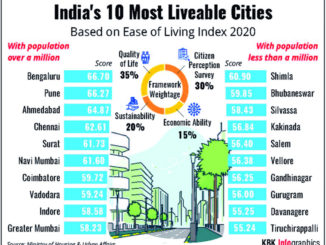
  • Bengaluru, Shimla most livable cities, Delhi at 13th spot in ‘Ease of Living Index’

    Bengaluru, Shimla most livable cities, Delhi at 13th spot in ‘Ease of Living Index’

    New Delhi (TIP): Bengaluru was adjudged the most liveable among 111 cities in India in the government”s ”Ease of Living Index” on Thursday, March 4, followed by Pune, Ahmedabad, Chennai, Surat, Navi Mumbai, Coimbatore, Vadodra, Indore and Greater Mumbai.

    Of the 49 cities ranked on livability index in the ”million-plus population” category, Delhi figures in the 13th spot and Srinagar at the bottom.

    According to the index released by Union Housing and Urban Affairs Minister Hardeep Singh Puri, Shimla topped the category of cities with ”population less than million”.

    In this category, Bhubaneshwar was ranked second, Silvassa came third, and they were followed by Kakinada, Salem, Vellore, Gandhinagar, Gurgaon, Davangere and Tiruchirapalli.

    Muzaffarpur figured at the bottom of the livability index for 62 cities in the ”less than million population” category.

    New Delhi Municipal Council topped the ”Municipal Performance Index” in the ”less than million” population category. It is followed by Triputi, Gandhinagar, Karnal, Salem, Tiruppur, Bilaspur, Udaipur, Jhansi and Tirunelveli.

    Indore topped the ”Municipal Performance Index” in the million-plus population category.

    In this category, Surat came second, followed by Bhopal, Pimpri Chinchawad, Pune, Ahmedabad, Raipur, Greater Mumbai, Visakhapatnam and Vadodara.

    In the million-plus category, Indore has emerged as the highest ranked municipality, followed by Surat and Bhopal while Guwahati, Kota and Srinagar ranked lowest. Among municipalities catering to a population of a less than a million, New Delhi Municipal Council has emerged as the leader, followed by Tirupati and Gandhinagar while Shillong, Imphal and Kohima municipalities were ranked lowest.

    The MPI examined the sectoral performance of 114 municipalities (with Delhi being assessed separately for NDMC, and the three Municipal Corporations) across five verticals which comprise of 20 sectors and 100 indicators in all totality. The five verticals under MPI include services, finance, policy, technology and governance, the report noted.

    The methodology and approach for the revised edition of EoLI and MPI were released by the ministry in February 2019. Essentially, the EoLI report aims to measure the well-being of Indian citizens in 111 cities, across the pillars of Quality of Life, Economic-ability, and Sustainability, with 49 indicators under 14 categories, the report noted. It also incorporates citizen perception of cities into the index through the Citizen Perception Survey that was conducted by the housing ministry.

  • India rout England by 10 wickets inside two days of third Test

    India rout England by 10 wickets inside two days of third Test

    Ahmedabad (TIP): India registered only their second Test victory inside two days, overhauling a meagre target of 49 against England in the day-night third game to take an unassailable 2-1 lead in the four-match series here on Thursday, February 26. The last time India won inside two days in a Test was in 2018, beating Afghanistan in Bengaluru. England”s previous Test loss inside two days came way back in 1921 against Australia. There was no end to England”s batting woes against the spin duo of Axar Patel and Ravichandran Ashwin as the side folded for 81 in its second innings. This was the team”s lowest Test total against India. Openers Rohit Sharma (25) and Shubman Gill (15) then completed the formalities in 7.4 overs, barely half an hour into the final session of the day. Earlier, Patel picked five wickets in the English second essay, adding to his outstanding haul of six in the first innings. His became the best bowling performance in a pink-ball match.

    Ashwin, on the other hand, added four more to his first-day spoils of three scalps to cross the 400-wicket mark in the longest format.

    He became the fourth Indian after Anil Kumble (619), Kapil Dev (434) and Harbhajan Singh (417) to achieve the feat.

    England”s scorecard bore a dismal look with all-rounder Ben Stokes 25 and Ollie Pope”s 12 being the best contributions.

    In the afternoon session, India”s first innings folded for 145 with opener Rohit Sharma top-scoring with a 66-run knock. England captain Joe Root returned career-best figures of 5/8 for his team.

    Ashwin Becomes Fastest Indian To 400 Test Wickets

    India off spinner Ravichandran Ashwin became the fastest Indian bowler to 400 Test wickets on Thursday. Ashwin, playing his 77th Test, was on 397 wickets at the end of England’s first innings of the ongoing third Test and dismissed England batsmen Ben Stokes, Ollie Pope and Jofra Archer in the second innings to get to the milestone. Ashwin is only behind Sri Lanka’s Muttiah Muralitharan in the list of fastest players to 400 wickets in Tests. Muralitharan got there in just 72 matches. Other Indians to have picked more than 400 wickets are Anil Kumble (619), Kapil Dev (434) and Harbhajan Singh (417).

    Ashwin opened his account in the second innings by trapping Stokes lbw and then followed it with bowling Ollie Pope.

    The 400th wicket was Jofra Archer, who missed with an expansive sweep shot as the ball hit him low on the pad. India appealed and the on-field umpire gave it out.

    Ashwin’s moment was briefly interrupted as Archer reviewed the decision only for DRS to return three reds and complete a well-deserved feat for India’s premier off spinner.

    Ashwin picked three wickets in England’s first innings where the visitors were bowled out for 112.

    The 34-year-old has been in good form with both bat and ball in this series, having picked up 23 wickets in the series thus far and scored 176 runs including a century in the second innings of the second Test.

    He became the fourth-highest wicket taker for India in international cricket on Day 1 of the third Test as he went past Zaheer Khan’s tally of 597 wickets.

    In addition to 400 Test wickets, Ashwin has 150 wickets in ODIs and 52 in T20Is since his international debut in 2010.

  • Science of Spirituality/SKRM Feeds Tens of Thousands  During India’s Nationwide Lockdown

    Science of Spirituality/SKRM Feeds Tens of Thousands During India’s Nationwide Lockdown

    NEW YORK / NEW DELHI (TIP): As the world comes to grips with a global pandemic of epic proportions, countries have taken strong measures to curb the spread of the COVID-19 virus. On March 24, a nationwide lockdown was instituted in India in an effort to protect its 1.3 billion-strong population by breaking the cycle of infection and containing the outbreak. However, as declared by Dr Tedrous Ghebreyesus, director general of the World Health Organization (WHO), “these steps can have unintended consequences for the poorest and most vulnerable within a population.” In India, millions of migrant workers dependent on daily wages have been impacted. Government programs are being implemented to ensure food and essentials reach the most vulnerable at this time.

    Complementing the national efforts, under the leadership and guidance of Sant Rajinder Singh Ji Maharaj, spiritual head of US based  Science of Spirituality (SOS)/Sawan Kirpal Ruhani Mission (SKRM), SOS volunteers across the country have mobilized to set up food kitchens and food drives, bringing warm meals and basic essentials to individuals in need. From Delhi to Jalandhar, Amritsar to Hyderabad, Mumbai to Dehradun, SOS volunteers, while practicing social distancing, have united to prepare and package meals and supplies at SOS Centers around the country. These packages are then distributed in collaboration with the local government authorities on a daily basis as a means of alleviating hunger within the communities. With over 3000 satellite centers around the world, and over 2000 centers in India alone, the organization’s large footprint affords it the expansive reach necessary to feed tens of thousands during these challenging times.

                                                  Distributing food in Ahmednagar, Maharashtra

    Service to humanity or seva, as it is known in Hindi, is a core tenet of Science of Spirituality, a worldwide spiritual organization dedicated to transforming lives through meditation. In the words of Sant Rajinder Singh Ji Maharaj, service is “the sweetest fruit on the tree of love.” It is an acknowledgement of the fundamental unity underlying our existence, and when carried out with kindness, compassion, and in a spirit of selflessness, such service has the power to change the world, one heart at a time.

                                                   Distributing food in Ahmedabad, Gujarat

    This spirit of selflessness, kindness, and generosity has been growing around the world as individuals and communities embrace their common humanity and find creative ways to help each other at this time. So much so that when the definitive history of the coronavirus pandemic is written, it will not only relate a story of loss and despair, but also one of human unity, where we came together as a global community to meet one of the greatest challenges of our time.

    For more information about Sant Rajinder Singh Ji Maharaj and Science of Spirituality, visit www.sos.org