Tag: Air India

  • Mrs. Vandana Sharma given a warm send off

    Mrs. Vandana Sharma given a warm send off

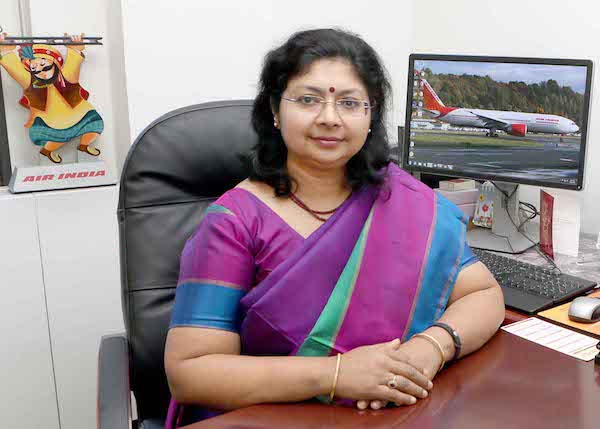
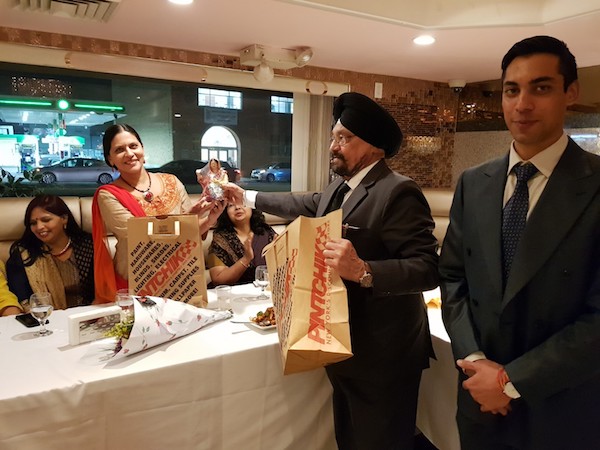
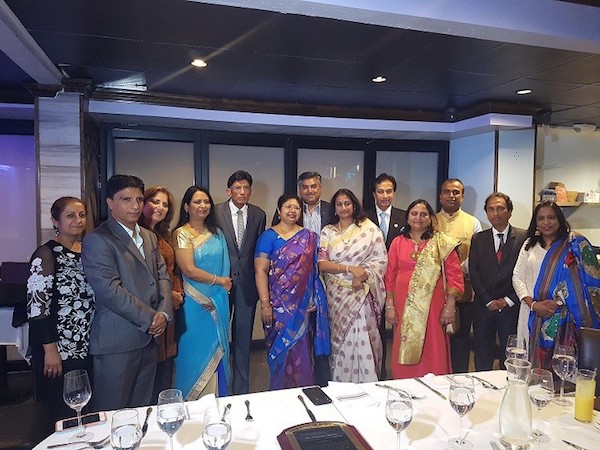
    NEW YORK CITY(TIP):Mrs Vandana Sharma, Regional Manager‑Americas of Air India,who is returning to New Delhi to administer Indira Gandhi International Airport, was bid farewell by over 50 prominent Indian community members at Zaika Restaurant, NYC, on

    October 12. Hosts were Harish Thakkar (AIA‑ NY), HR Shah (TVAsia), Kamlesh C Mehta (The South Asian Times), Dr. Navin Mehta (Bharatiya Vidya Bhavan), Neeta Bhasin (ASB Communication) and Dr Neeta Jain (Democratic Party District Leader). Also welcomed was new Regional Manager Mrs. Bhuvana Rao.

    (PR/SAT)

  • Ms Bhuvana Rao succeeds Mrs. Vandana Sharma  as Air India Regional Manager-Americas

    Ms Bhuvana Rao succeeds Mrs. Vandana Sharma as Air India Regional Manager-Americas

    NEW YORK(TIP): Ms Bhuvana Rao took over  over as Air India Regional Manager-Americas, October 17. She succeeds Mrs Vandana Sharma who has been transferred as Deputy General Manager at Indira Gandhi International Airport.

    Ms Bhuvana Rao, an MBA from University Business School, Chandigarh is a seasoned Aviation professional with over 30 years of experience in  various areas of Commercial Aviation. She had  2 overseas assignments, heading  Air India operations in France and in Abu Dhabi. In her last assignment she was in charge of Sales & Marketing for Western Region in Mumbai.

  • Air India Regional Manager -Americas Vandana Sharma given a warm send off

    Air India Regional Manager -Americas Vandana Sharma given a warm send off

    Congressman Tom Suozzi recommends Stronger US India relationship

    HICKSVILLE, NY(TIP):  Mrs. Vandana Sharma, Regional Manager of Air India was hosted to a warm send off by the Indian American community here, October 8.

    Congressman Tom Suozzi presenting a Congressional Recognition to Mrs. Vandana Sharma, Regional Manager-Americas, Air India, October 8

    The dinner co-hosted by Prof. Indrajit S Saluja, Publisher/Editor of The Indian Panorama, Attorney Ravi Batra and his wife Ranju Batra at Antun’s in Hicksville , was attended by over a hundred community representatives and officials, which included Consul General of India in New York , Ambassador Sandeep Chakravorty who was accompanied by wife Taruna Chakravorty, and Congressman Tom Suozzi, besides leaders of various community organizations, officials from different sectors, and friends.

    Ambassador Sandeep Chakravorty, Consul General of India in New York had all praise for Mrs. Vandana Sharma

    Speaking on the occasion, Ambassador Sandeep Chakravorty recalled the tremendous work done by Mrs. Vandana Sharma to take the Indian national carrier Air India to new heights. He mentioned how Mrs. Sharma played a leadership role in times of emergencies and set an example of customer care. He congratulated Mrs. Sharma for her achievements and wished her well in her new position.

    Ambassador Chakravorty also spoke about the ever-strengthening relationship between India and the US and said much more needed to be done. He appreciated the large Indian Diaspora in the US for their contribution to ever growing relationship between India and US. H e mentioned briefly the enormous contribution of Indians in various spheres in the US.

    Congressman Tom Suozzi extended his good wishes to Mrs. Sharma and presented her a Congressional Recognition for the great work she did as Regional Manager of Air India.

    Congressman Tom Suozzi spoke at length about his long and happy relationship with the South Asian community, of which Indian American community is a large segment. He said he represents New York’s Congressional District 3 which includes the largest number of South Asians in a District in the whole of US.  He spoke about how the Indian American community has been growing in his district both in numbers and in strength, economically and politically.

    Speaking about US India relations, the Congressman commended both US and India for having worked in close cooperation in various fields. He said there was need to not only keep up the pace of cooperation but also to accelerate it. He referred to growing ambition of China to “dominate” the world “economically and militarily”. It is in the interest of both the US and India to come together to counter China’s growing power, he said. He called upon the Indian American community to continue their effort at strengthening the close cooperation between the two great democracies of the world.

    Mr. Suozzi also recalled his memorable visit to India where besides meeting Prime Minister Narendra Modi (The Indian Panorama had published the news report) and other leaders including India’s External Affairs Minister Sushma Swaraj, he went for sightseeing. He grew nostalgic about the Taj Mahal in Agra in his mention of the places. He said he found India a great place and Indians a great people.

    Referring to the contribution of the Indian American community (which he never fails to do), he observed that the community has done well and is influential. However, he suggested that the community should get more involved in the political system.

    All through his address, he repeatedly returned to Mrs. Vandana Sharma, praising her as a fine person and as an efficient administrator of India’s largest airline Air India. He wished her “continued success and 8happiness in your future endeavors” and presented the Congressional Recognition which said “I thank you for spending your time, talent and treasure with Air India-Americas. Your sincerity and dedication to those you serve has not gone unnoticed and is appreciated. Best wishes for continued success and happiness in your future endeavors”.

    Attorney Ravi Batra, a co-host of the send off dinner, dwelt on how important it is for the Indian American community to intelligently define their relationship with the country of their adoption.

    Attorney Ravi Batra spoke about the tremendous contribution in refurbishing the image of Air India
    Ranju Batra recalled how Mrs. Sharma helped her at every step in her effort to have the Diwali Stamp issued.

    Ranju Batra who introduced Vandana Sharma, spoke very highly of Mrs. Sharma, describing her as the finest human being and a true friend.  She recalled how Mrs. Sharma had extended all cooperation when she was waging a relentless struggle to have the Diwali stamp issued.

    Mrs. Vandana Sharma expressed her gratitude to the Indian American community for their cooperation and love
    Mrs. Vandana Sharma surprised all with a soulful playing on Violin

    Mrs. Vandana Sharma was visibly emotional while speaking to the gathering. She thanked the community for their cooperation and love during her 3 year stay in New York. She said she had received immense love from all quarters- he colleagues, customers, and community. She invited the gathering to Delhi where she said she would love to receive them with all warmth and live over the happy days spent in New York.

    Prof. Indrajit S Saluja extending a word of welcome

    Earlier, Prof. Indrajit Saluja extended a word of welcome and mentioned how Mrs. Sharma endeared herself to all with her affable nature. He described Mrs. Sharma is a pleasant person who will be deeply missed. However, he said, most people land at Delhi airport while visiting India, and since Mrs. Sharma is taking over as Deputy General Manager, Delhi Airport, it will be easier to look her up.

    The presentation of bouquets to guests was ably handled by 7-year-old Kabir Raj Beri, Prof. Saluja’s grandson.

    Mrs. Vandana Sharma with community leaders who penned down their good wishes for her on a Card which was presented on their behalf to Mrs. Sharma by Prof. Indrajit S Saluja
    Photos / Mohammed Jaffer-SnapsIndia

    Prof. Indrajit S Saluja, presented, on behalf of the community a good wishes card signed by over 100 persons present in the room.

    Kolkata based Sarod virtuoso Apratim Majumdar and Tabla Player Amit Chatterjee cast a magic spell on the audience

    Kolkata based Sarod virtuoso Apratim Majumdar and Tabla Player Amit Chatterjee cast a magic spell on the audience. Apratim is the most thinking and creative Sarod player, a composer of a very special quality, and a brilliant performer.

    Amit Chatterjee is a highly gifted Tabla player who received training from the famous internationally reputed Tabla Maestro Pandit Sankha Chatterjee.

    The two were joined by another gifted artist- Suresh Kumar Ketwaroe who was not only incredible with his Guitar, but also entertained the gathering with superb rendering of Hindi and Punjabi songs.

    Mrs. Purnima Desai, Founder and Director of Shikshayatan and Sriniketan- the two institutions dedicated to promoting Indian culture and classical music and dances, who had only last week organized a two-day International music concert in which around 50 eminent artists participated, was kind enough to invite all three to the send off dinner to Mrs. Vandana Sharma.

    Pratibha Goyal who gave a superb performance of Kathak
    A view of the gathering

    Another extremely talented artist present and performing was Pratibha Goyal who gave a superb performance of Kathak. Mrs. Gunjan Rastogi, President of India Association of Long Island discovered the artist for the occasion.

  • Air India Regional Manager Americas Vandana Sharma Transferred to Delhi

    Air India Regional Manager Americas Vandana Sharma Transferred to Delhi

    NEW YORK(TIP) Air India Regional Manager Vandana Sharma has been transferred to Delhi. She will assume charge as Deputy General Manager at the Indira Gandhi International Airport.

    Ms Sharma’s tenure of nearly 3 years (she took over as RM Americas in 2015) has been an eventful one. She has since helped Air India to grow from 21 flights per week out of three gateways in the United States to approximately 36 flights per week out of five gateways.

    Having achieved a high leadership role at Air India—which she noted has the highest percentage of women pilots in the world—Sharma said she believed that it is important that companies hire an equal number of men and women.

    A workaholic, Ms Sharma says: “Each day is a test of skills and capabilities and gives me an opportunity to learn”.

  • Air India gets fresh fund infusion from Centre; disinvestment on hold for now

    Air India gets fresh fund infusion from Centre; disinvestment on hold for now

    Government working on new turnaround plan for Air India

    NEW DELHI(TIP): Speaking to reporters on the sidelines of the International Aviation Summit on Tuesday, September 4, civil aviation secretary RN Choubey said that the government was continuing to fund Air India despite a decision being taken to sell it so that the company’s value doesn’t erode till the time it is disinvested in. “Our first aim is to work out the necessary support for Air India’s healthy functioning. We will not like value destruction to happen. If we do not support, there may be value erosion. Otherwise, when we actually find that environment has improved, oil prices have come down and we actually want to sell, we may find that value has eroded,” Choubey said.

    Late August, the Ministry of Civil Aviation, in its representation to the Parliamentary Standing Committee for transport, tourism and culture, said that disinvestment of Air India is not going to be happening any time soon. The first attempt by the government to sell its stake in the airline – codenamed Project Royal – failed mainly due to the government not parting with the entire stake, the high debt-levels and a high employee-to-aircraft ratio. To help the airline survive, the government had announced a financial restructuring plan (FRP) in 2012 as part of the original turnaround plan, as per which the airline’s working capital loans were restructured to long-term debt.

    “If FRP was working, Air India wouldn’t have been in a dire strait. FRP didn’t go wrong. The FRP earmarked crude at $45 a barrel and today the crude is at $75 a barrel. Dollar was still high. The plan, now, is to make Air India stand on its own feet so that it can be sold in future when its conducive to sell the airline. Unlike the FRP, where the government did financial restructuring, the new plan will focus more on organizational reform. Will make it a board managed company. One more outsider may join the board,” a senior Air India official said, on condition of anonymity. Last month, the government appointed ITC Chairman YC Deveshwar and Aditya Birla Group Chairman Kumar Mangalam Birla as independent directors on the board of Air India.

    As per estimates by aviation consultancy CAPA India, the national carrier is expected to lose more than $2 billion in value during 2018-19 and 2019-20. “Air India’s value will continue to erode, making future privatization unlikely. In the absence of full recapitalization and a clear direction, Air India is likely to see a continued decline in its domestic and international market share, and head towards strategic irrelevance. This will diminish its potential to be revived and to secure a strategic investor. In the meantime, it will remain a structural distortion for the industry and a burden on the tax payer. The quantum of losses will become increasingly unacceptable,” CAPA India said in its mid-year aviation outlook for 2018-19.

    The Air India official pointed out that the carrier’s financials for the 2017-18 did not show any signs of improvement, primarily due to the soaring fuel costs. “I can’t reveal more on this as the results are being audited,” he said. For the year 2016-17, Air India reported a net loss of Rs 6,288 crore. Choubey said the ministry was yet to take a call whether the new turnaround plan for Air India will require a Cabinet approval or can be done bilaterally between the ministries of civil aviation and finance.

    Meanwhile, Air India Ltd will raise ₹500 crore in debt to meet working capital needs and pay interest on its outstanding loans, a senior official at the state-run carrier said on Wednesday, September 5.

    “Air India will soon issue a tender to raise ₹500 crore from domestic banks,” said the official who didn’t want to be named.

    The latest fundraiser will exhaust the sovereign guarantee limit of ₹2,000 crore offered by the government to the loss-making airline, the official said.

    Air India had in August raised ₹1,500 crore from Bank of Baroda under a sovereign guarantee to service bank loans and dues of international vendors, including leasing companies.

    The latest fund-raising follows a failed government attempt to privatize Air India to stem the flow of public funds into running the airline.

    Civil aviation secretary Rajiv Nayan Choubey on Tuesday, August 4 said the government has agreed to make a fresh equity infusion in Air India and also provide a sovereign guarantee.

    “At the moment, we are borrowing from domestic banks as it doesn’t make sense to borrow from international lenders due to the value erosion of the rupee (against the dollar),” the official said.

    Air India also used the ₹1,500 crore debt raised in August to “normalize debt accounts”, some of which were in danger of turning into non-performing assets, the official said.

    Air India has a net debt of about ₹55,000 crore, including about ₹21,000-22,000 crore of aircraft debt, the official said. “We are hoping to repay the aircraft debt fully by 2021.” The carrier took on the loans to pay for new planes from Boeing and Airbus.

  • Air India’s Pragmatism before Sale

    Air India’s Pragmatism before Sale

    By Harjap Singh Aujla

    Perhaps the most exploited airline in the world is our Air India. The powerful politicians and influential bureaucrats of our country have been overburdening this commercial venture with unqualified people of their choice far over and above the needs of the airline. Their emoluments were also on the higher end. This resulted in overstaffing of the venture. In addition, all the bigwigs in politics and bureaucracy were getting free rides in premium class at the expense of this national flag carrier. The cumulative losses kept mounting and at one point the government started toying with the idea of its privatization. But the lobby of the exploiters was so powerful, that every time, the government floated this idea, it was shot down by those very folks, who floated the idea. Such developments gave birth to indiscipline. The pilots frequently went on strike and so did the air crew and the ground staff. Accountability was a casualty. No one ever cared for the elusive profitability. Every exploiter posed as a God father. The previous prime minister was an economist, he thought the emancipation was in its disinvestment. But most within the corridors of power thought otherwise. This has been happening for half a century. Some of the redundant staff has retired long ago. Some are still on the payrolls and adding to the losses.

    The routes of operation were not as a result of legitimate research and analysis. The government made politically correct, but most of the time financially ruinous decisions and Air India was made to tamely implement and face the music. Due to the political decisions, some of the most profitable routes were discontinued in favor of populous loss-making routes. The justification invariably was that all routes were losing money. Even the routes with 90% passenger load were dubbed unprofitable. No one went into the reasons of such losses. The primary reason was terrible overstaffing and an army of free travelers. Some minor decisions with cumulative effect included expensive food from well-known places rather than cheaper, but more delicious food from lesser known places. It takes two hours between New Delhi and Mumbai, many times a full meal was served on this route too. Food from expensive cities was served even to passengers from cities known for their food. Most airlines run special cargo flights to business-friendly cities, which are profitable. Air India never explored such innovative ventures. On some of the important flights the routes were longer than required. As an example, the Bombay-Frankfurt-Los Angeles flight completed one way in 22 hours. Due to customary late flying by Air India the 24-hour cycle was always exceeded, this resulted in cancellation of a good profitable flight.  Air India was on the route of self destruction. In the most expensive cities like New York, there was excessive staff. The government too has finally realized the writing on the wall.

    When reality dawned on Air India that its sale price may not be enough to stay afloat. A long overdue course correction has started. But the all-powerful government was still in populous mode. Finally, it appears that Air India is putting its foot down and making decisions conducive to profitability. Some routes are being altered to touch load centers. Some routes on which profitable business was witnessed for six days a week, but there was scope for more flights, those routes are seeing augmentation of frequency. The hub and spoke system is not suitable for countries like India, there is scope for a change. Several flights have more passengers from specific spoke stations than hubs, they may get justice now. Such stations were so far ignored, and the hub system was brutally enforced. Now there is a scope for change. There is a possibility of Air India turning the corner during the period leading up to the fall of hammer. Such a scenario can potentially fetch a good price. There is plenty of real estate owned by Air India in the most expensive areas of India. That will help too. Let us keep our fingers crossed. Best of luck to Air India.

    (The author is a regular contributor to The Indian Panorama. He writes on diverse issues with equal felicity. He can be reached at harjapaujla@gmail.com)

  • Maharaja bites the dust

    Maharaja bites the dust

    By Mythili Bhusnurmath

    Merely because we have failed to turn AI around in the past, it does not mean we should compound the error and settle for a distress sale. It is better to bide time.

    The best laid schemes of men and mice oft go awry. This oft-quoted line from English poet Robert Burns’ ‘To a mouse’ might have been written for the much-awaited, much-debated stake sale by the government in the national carrier, Air India (AI). With less than a month left to go before the deadline (May 14, 2018) for the submission of EOI (expression of interest) and domestic airlines showing no interest, the government’s much-vaunted plan seems headed for an ignominious end. Despite the fact that, unlike most disinvestments where the government, typically, sells a small stake, here it is willing to cede control, reducing its stake to just 24 per cent, post divestment.

    So why are there no takers for what was once regarded as the jewel in the crown and cherished as the Maharaja? What ails the Maharaja and, in turn, is apparently souring the offer government has put on the table? Does the plan need a ‘recalibration’, as an un-named government official is quoted as saying in a news report? What kind of ‘recalibration’? Is there a fine line between being flexible and conceding too much? A danger of being carried away by the (mistaken?) view that privatization will be construed as a measure of government’s commitment to reform?

    There are no easy answers. Most, apart from Leftists caught in time warp, will agree there is no case for the government to run an airline. More so, one that’s been losing money hand over fist for years now and needs costly infusion of scarce taxpayer resources to stay airborne. Remember, AI has been the subject of not one, but many attempts to turn the airline around; the latest being the turnaround plan approved by the previous UPA government, under which Air India was to receive a bailout package of up to Rs 30,231 crore for a period of 10 years, starting 2012.

    However, all that changed with the new government. With the airline not showing any sign of improvement despite infusion of funds and Niti Aayog opining that ‘further financial support to an unviable non-priority company in a matured and competitive aviation sector would not be best use of scarce financial resources of the government’, the die was cast.

    In what was hailed as a landmark decision, in June 2017, the Cabinet approved strategic disinvestment of the airline. The government, it was announced, would sell 76 per cent in AI, after hiving off a substantial amount of debt to a special purpose vehicle, along with 100 per cent stake in Air India Express and 50 per cent stake in Air India SATS Airport Services Pvt Ltd, a joint venture services company managing airport logistics. Only to find that, contrary to expectations of huge investor interest, the announcement seems to have left potential buyers cold.

    So, what are the sticking points? Principally, two, (apart from the huge debt): one, the 24 per cent stake that the government intends to retain, post divestment, and two, the employees. Take the first. It does not take much intelligence to realize that no potential buyer will relish the idea of the government retaining 24 per cent. True, company law requires a minimum of 26 per cent to block special resolutions, so the scope for interference is limited. Nonetheless, this is unlikely to reassure potential investors. Governments are not like other shareholders. They can, and do, interfere even with much smaller stakes.

    Agreed, the bid document does contain a clause that the government will sell the balance 24 per cent ‘in time’. However, ‘in time’ has not been defined. Granted, the aviation sector is notoriously cyclical and few airlines anywhere in the world have made profits on a sustained basis. So, it is extremely difficult to specify a timeframe upfront. But the alternative of leaving it open-ended is just as problematic. Especially given government’s track record in strategic divestments like Balco and Hindustan Zinc Ltd, where the government residual share is yet to be transferred.

    In that case, is selling the entire stake, ie 100 per cent rather than 76 per cent a better option? On paper, the argument of retaining 24 per cent is that the government will be able to cash in on the upside of a higher share price once the airline is listed. In practice, however, it is not possible to quantify the likely gain from selling 24 per cent later or the higher price one might get from selling 100 per cent today. At the same time, a bird in hand is worth two in the bush; especially when oil prices are on an upward trajectory. So, there is a strong case for the government to exit, totally.

    The second sticking point, AI’s huge staff, is just as tricky, if not trickier. Any potential buyer is bound to want a free hand to deal with the, admittedly, bloated staff strength. But can a government, especially one that is headed for elections in little over a year, afford to antagonize powerful labor unions by giving potential buyers a free hand to rationalize (retrench?) staff? Will the promise to give stock options to employees act as a sweetener? A generous VRS (voluntary retirement scheme) could be an option. But how will it be funded?

    Again, there are no easy answers. What is certain is that some flexibility in the terms and conditions is essential if the sale is to elicit greater interest. What is also certain is that given the tepid response, the proposed timelines — selecting the winning bid by September 2018 and completing legal transfer of ownership by December 2018, are both unrealistic and overly ambitious.

    Yes, as Jitendra Bhargava, former executive director, AI, and vociferous advocate of complete government exit, says, “For last two decades, the Air India’s turnaround plan failed to work. This is the perfect time to disinvest as the airline will only go from bad to worse in future if it remains under bureaucratic control.”

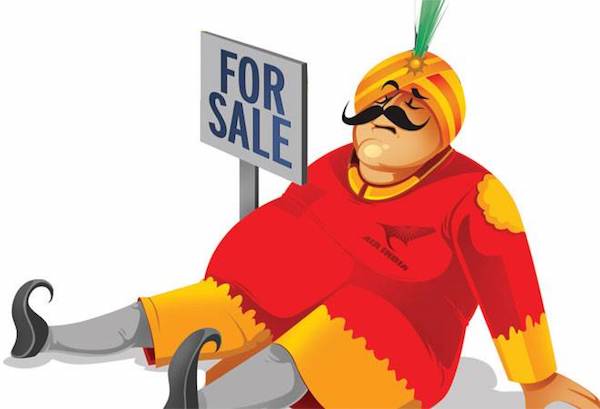
    But what if the present proposal does not attract meaningful bids? Should we act in haste and sell the Maharaja for a song? As the experience of Alitalia and Japan Airlines has shown, there is no guarantee that once an airline is in private hands, the government will be able to wash its hands off and let it sink if it is no longer viable. Merely because we have tried and failed to turn AI around in the past, we should not compound the error and settle for a distress sale. Having waited so long, it is better to bide time. By all means sell AI, fully. But make haste, slowly!

    (The author is an economist and former central banker)

  • Creating history, Air India flies Delhi-Israel direct flight via Saudi airspace

    Creating history, Air India flies Delhi-Israel direct flight via Saudi airspace

    NEW YORK TIP):  Saudi Arabia opened its airspace for the first time to a commercial flight to Israel with the inauguration on Thursday, March 22, of an Air India route between New Delhi and Tel Aviv.

    Air India 139 landed at Tel Aviv’s Ben Gurion Airport after a flight of over 7 and a half hours.

    “This is a really historic day that follows two years of very, very intensive work,” Israeli Tourism Minister Yariv Levin said in a radio interview, adding that using Saudi airspace cut travel time to India by around two hours and would reduce ticket prices.

    The Air India Boeing 787-8 Dreamliner entered Saudi airspace at around 1645 GMT and overflew the kingdom at 40,000 feet for about three hours, coming within 60 km (37 miles) of the capital Riyadh, according to the Flight radar monitoring app. It then crossed over Jordan and the occupied West Bank into Israel.

  • Eminent  Women deliver Message on International Woman’s Day celebration at Indian Consulate in  New York

    Eminent Women deliver Message on International Woman’s Day celebration at Indian Consulate in New York

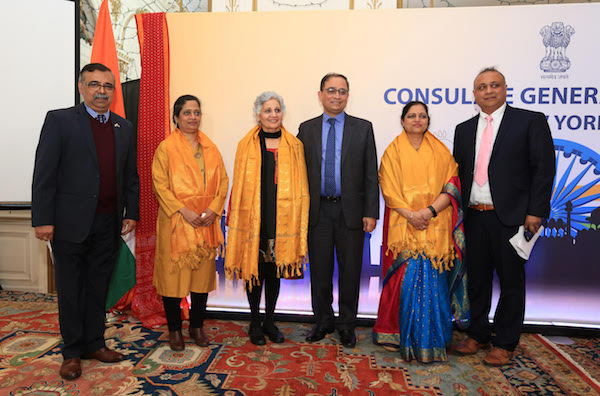
    NEW YORK CITY (TIP): A grand program for Woman’s Empowerment was planned by the FIA at Indian Consulate, New York on March 8. Five prominent women addressed more than 100 guests. Women from social, economic, industrial, music and educational fields as well as some successful women who created their own place in communities graced the occasion.

    The program started with lighting of the lamp by  FIA Chairman Ramesh Patel,  President Srujal Parikh, TV anchor Nisha Mathur, writer Mayra Godfrey, social worker Ishita Chakrabarti, musician and successful Industrialist Chandrika Tandon, celebrated professor Gayatri Chakravorty Spivak, violinist Daisy Joplin, and Consul General  Sandeep Chakraborty and his wife Dr. Taruna Chakraborty.

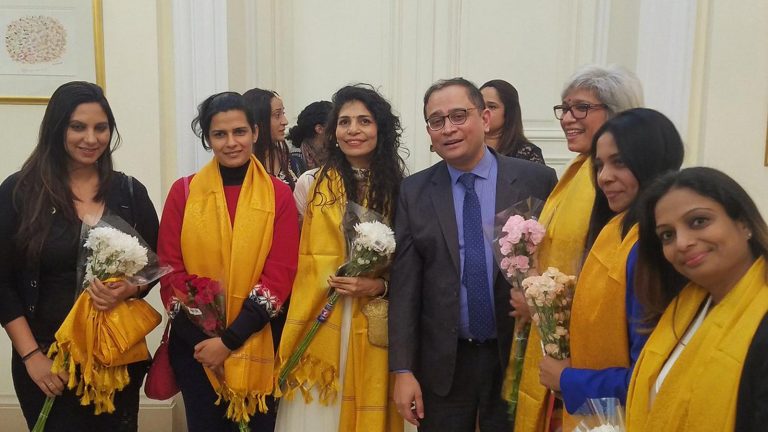
    Miss India USA, women pilots and co-pilots from Air India were also invited specifically to attend this program. Women who created their unique  place in different fields were honored by Ambassador  Sandeep Chakraborty.

    The program organizer and president of FIA Srujal Parikh, addressing  the gathering  said, “I am surrounded by women with  strong talent every day- my mother, my wife, my daughter, and my friends.” He thanked the women brigade of FIA in particular for making it possible for FIA to organize the Woman’s Day celebrations.

    Consul General Sandeep Chakraborty introduced the panel and talked about impressive percentage of women employees at the consulate. He also mentioned about Air India employing one eighth of woman pilots as compared to one in twenty in the industry. 8 woman pilots of Air India were also present at the event. Ambassador Chakraborty said:  “I want to congratulate every woman on this special day, who has made her own special place with her hard work and courage.”

    Speaking on the occasion, Nisha Mathur, a TV producer said, “Whether you are a man or woman, we all have the ability to share and inspire”

    Myra Godfrey shared her struggle on various fronts. She found a way to heal herself through understanding herself in totality. Her spiritual understanding of life helped her regain her strength and positive perception of life. She said, negative thinking affects digestion; our mental health demands taking care of emotions.

    Ishita Chakrabarti opined that political empowerment is necessary. Only about a quarter of the positions belong to women. Women of Indian origin have not been represented, and upholding right values requires that we assimilate with main stream.

    “If we women put our minds together we can make a difference. We should initiate change towards global empowerment of women.”

    Daisy Jopling said, “When a woman lights up, she lights up the whole world”.

    She played violin, energetic and full of joy. She uplifted the packed hall by her music with complete absorption.

    Chandrika Tandon, a philanthropist, said: “We have 41 percent of women in the engineering class of NYU Tandon school of engineering “

    She talked about the usual way that prevents people from realizing their dreams. She talked about how she overcame her fears. She said, we need to break free from low self- esteem.

    Her single message was “I am perfection, you are perfection, we all are perfection.” “I salute feminine energy in the form of love, in the firm of peace”, she added.

    Padma Bhushan Prof Gayatri Chakravorty said: “I am a hand in activist with very poor woman. I am 76-year-old, happy old lady but I try to bring top and bottom together. I tell my students that in order to save the work, we have to work. Gender equality need not be confused with sameness.  “Ya Devi Sarvi bhuteshu…” “Feminism forever is my title, not because of race and class but this work has to be approached with newness by every generation.  I work all over the world, feminism is education strategy against prism of truth. We must learn that we don’t represent all women. She talked about tape culture and bribe culture. She drew attention towards people who are still facing discrimination based on gender.

    She said, Enforcement and punishments alone don’t lead to just society; feminist education should be forever. It is an important part for creating social justice. Our world is full of hope. She remembered her mother and her social work.it is in her memory that I shall remain fearless and mention unpleasant facts.”

    Those recognized on the occasion included Shashi Vishnu of Manavi and Dr Raman Kaul of AWAKE.

    Miss Uma Narayan of Sneha could not come from Connecticut to receive her award.

    (With inputs from Ashok Vyas and FIA)


  • Indian Consulate New York honored to host  Air India’s all-women-crew pilots

    Indian Consulate New York honored to host Air India’s all-women-crew pilots

    New York (TIP): Air India marked this year’s International Women’s Day by flying all-women-crews to various cities – Washington DC, Newark, Chicago & San Francisco. The national carrier flew four flights to the US with women pilots as its commanders.

    Supporting the initiative, the Indian Consulate in New York honored the eight pilots.

    “Literally with high flying women. All 4 Air India flights into US today, JFK, Newark, Chicago & SFo were commandered by women pilots. We were delighted to honour 8 women pilots at the Consulate on #Internationalwomensday .Big thanks to Vandana Sharma of @airindiain & FIA,” tweeted Consul General of India, New York, Sandeep Chakravorty.

    In addition to the four flights to the US, the airline flew all-women-crew flights to destinations including Milan, Frankfurt, and Singapore.

    “The national carrier has planned several flights on its domestic and international sectors operated only by its women employees to salute woman power,” the airliner had said last week in a press release. It had announced that the all-women-crew flights that the company intends to operate to celebrate this year’s International Women’s Day will have women pilots in addition to women cabin crew, check-in staff, doctor, commercial staff, ground operators to technicians, engineers, flight dispatchers and even safety and quality auditors.

    Air India reiterated that by flying all-women-crew in its flights it wants to stress on its constant efforts to encourage women by giving them an equal opportunity in the workplace.

    The schedule for the crews was also planned by a woman – Amrita Sharan, Executive Director Integration and Industrial Relations and in charge of Crew Management, announced the carrier.

  • Air India announces flights to Israel over Saudi Arabia

    Air India announces flights to Israel over Saudi Arabia

    NEW YORK (TIP): Saudi Arabia has given Air India approval to fly through its airspace on flights between Israel and India, an airlines spokesperson tells The Times of Israel.

    The agreement would shorten the current flight path by some two hours and mark a significant achievement as Jerusalem attempts to upgrade its relationship with Riyadh.

    The 7-hour 10-minute flight between Tel Aviv and Mumbai will launch March 22.

    Air India says it will operate the flight three times a week.

  • Air India Regional Accounts Manager Sangeeta Singh Promoted as Regional Finance Controller

    Air India Regional Accounts Manager Sangeeta Singh Promoted as Regional Finance Controller

    Friends and Colleagues give a warm send off at dinner hosted by Prof. Saluja

    RICHMOND HILL, NY (TIP): Air India Regional Accounts Manager Mrs. Sangeeta Singh was promoted and transferred to Mumbai. She takes over as Regional Finance Controller, Western Zone. Mrs. Singh stayed in New York for over 2 years.

    Mrs Sangeeta Singh and her husband, Mr. Kaltar Singh, a director finance with a company in Mumbai, were given a warm send off on February 9 at Richi Rich Palace.

    Ms Vandana Sharma speaks about Air India and Mrs. Sangeeta Sing

    Present on the occasion were colleagues of Mrs Singh who included Ms Vandana Sharma, Regional Manager (Americas), Mr. Angie, Manager, and Mr. Mohan Kothekar, Manager.

    Mr. Krishnamoorthi, Consul Visa & Passports, Community Affairs Consul Mr. Devdasan Nair, and Consul (political) graced the occasion as did a couple of community leaders. Dr. Ajay Lodha, a former president of National AAPI, Dr. Narendra Hadpawat, a former President of IALI and RANA, Dr. Jagdish K Gupta, President of AAPI-QLI, Dr. VM Chakote, Former President of AAPI-QLI, Mr. Gobind Munjal, President of AIA,, Mrs. Gunjan Rastogi, President,  India Association of Long Island and her royal consort Mr. Rastogi, Mr. George Abraham, Vice Chairman of Indian Overseas Congress and his wife  Mrs. Lona Abraham, community leader Ms. Anu Jain, Ms Neeta Bhasin, President of ASB Communications,  PTC TV  Country Heads Mr. Davinder Singh and  Ms Jaya Sharma, TV anchors and producers Ms Renee Lobo and Mr. Ashok Vyas, Mr. Moazzam Sarker and his niece, Mr. Jarnail Singh Gilzian, Chitagam Saluja, The Indian Panorama assistant editor, among others.

    Mrs. Sangeeta Singh and her husband Mr. Kaltar Singh were received warmly with a bouquet. Later, they were presented parting gifts by Prof. Indrajit Saluja and Davinder Singh. Mr. Jarnail Singh Gilzian, the owner of Richi Rich Palace where the party was organized made a brief appearance and presented a bouquet to Mrs, Singh.

    Mr. Davinder Singh and Ms Jaya Sharma of PTC TV presenting a gift to Mrs. Sangeeta Singh
    Mrs. Sangeeta Singh sharing her feelings

    Speaking on the occasion, Mrs. Singh said she was “overwhelmed” by the affection showered on her. She described her stay in New York as a pleasant one and thanked Ms Vandana Sharma for her love and guidance in her work. She also thanked her husband who allowed her to work in New York and “looked after two children singlehandedly in Mumbai.

    Ms Vandana Sharma described Mrs. Singh as a conscientious worker who did her best to keep the air India flag flying. She said she would miss Mrs. Singh. Ms. Sharma spoke about Air India’s growth in recent years. She said she was happy Air India was connecting India with a number of locations in the US. Besides New York and New Jersey from where there are 17 flights a week, there are 3 flights from Washington, 6 flights from San Francisco, and from Chicago. She said there were plans to connect some more locations in the US with India.

    Ms Sharma exhorted the Indian American community to patronize Air India, as it was their own airline and offered better services and competitive rates.

    Dr. Ajay Lodha giving his best wishes
    Dr. Narendra Hadpawat described how he and Dr. Lodha helped in delivery of a child aboard an Air India flight
    Dr. Jagdish Gupta recounted his happy experience with Air India.

    Dr. Ajay Lodha, Dr. Narendra Hadpawat and Dr. Jagdish K Gupta also spoke on the occasion.

    Mrs. Sangeeta Singh who had relinquished charge on Jan 31 left for Mumbai on Feb 13.

    The gathering

  • The Grounding of Air India

    The Grounding of Air India

    By Pulapre Balakrishnan

    “If Air India, nationalized in the 1950s, is now privatized, we would have come full circle. However, its case is more symbolic than substantive. Today there is no dearth of air-travel service providers in India, and the public airline reportedly has less than 15% market share. This is not the case in some other areas of the economy where public provision is fundamental. Take rail travel, which has no substitute. For it to serve its public purpose, the financial health of the Indian Railways is vital”.

    Having announced its decision to sell Air India, the government is making arrangements to do so. The move itself has come after multiple efforts by successive governments to resurrect the national airline. Though there has been news of it finally turning in an operating profit under a determined CEO, its debt, reportedly a staggering $8.5 billion, must weigh on the minds of a public drawn into a discussion of its future.

    The beginnings

    It is unfortunate that so iconic an entity, once feistily steered by J.R.D. Tata, has met this fate, but it is not uncommon in the history of India’s public sector. To understand this ending, we would have to start at the beginning, and that was with the transformation of the economy attempted in the 1950s. While there were monumental gaps in that attempt, there were also creative innovations, the most important being the public sector. By design, the public sector was to exist along with a private one resulting in what had been referred to as ‘the mixed economy’. To those hankering after institutional purity this was no more than a joke, an arrangement that had strengths of neither full-bodied American-style capitalism nor of out-and-out Soviet-era communism. Half a century later, the Soviet empire imploded and for a brief moment in 2008, the American one teetered on the brink, having been taken there by its vanguard, finance capital. We can now see that the mixed economy, combining the public and private sectors, is superior to one located at either extreme.

    So, if the public sector is a force for the good, why is it that we see Air India, and a section of the rest of the Indian public sector, in so unsound a financial condition? In its early days, the public sector had been quite healthy. This need hardly come as a surprise when we recognize the then Indian leadership’s motive for building one. Stripped of its somewhat ideological construction as straddling ‘the commanding heights’ of the economy, it was to have a central role in the quickening of the economy after 1947. Wrecked by two centuries of colonialism, India’s economy was moribund. The post-colonial Indian leadership had envisaged the public sector as the ship that would steer the economy out of the morass. And they were not wrong.

    Under Nehru, India’s economy rose spectacularly, and public investment was the principal engine of growth in that remarkable phase. Used as we are to Air India having to, at times, borrow even to finance its working capital, it may come as a surprise to know that it was still making profit into the second half of the 1960s. As for the public sector as a whole, during the Nehru era its savings had grown faster than that of the private corporate sector. Actually, to an extent India’s public sector had financed itself.

    Nehru’s speech at the inauguration of the second plant of the Hindustan Machine Tools (HMT) in Bangalore in 1962 is instructive in this regard. He congratulated the workers of HMT for having produced a second plant entirely out of the surplus of the first one. In one stroke, this conveys the rationale imagined for India’s public sector at the moment of its conception. It had been imagined as a source of investible funds for the public purpose. Underlying this was the belief that the private sector may not generate the necessary surplus, especially if the economy was not first quickened through public investment.

    It is noteworthy that in the heyday of the public sector, India’s private corporate sector had not done badly at all. Its investment rose at least much as that of the public, demonstrating that claims of its suppression due to the license-permit raj are exaggerated. It is true that some entities had been excluded by licensing. Licensing was necessary to ensure that resources were used in accordance with the plan for industrialization, but it was the case that private firms receiving licenses benefited greatly from the expansion of the market resulting from public investment. It is perhaps not known widely enough that in the Nehru era India grew faster than China.

    What went wrong?

     So, if the public sector had such a central role in lifting India out of a morass, why are we where we are today? Why is Air India awaiting the gavel? This has entirely to do with politics. Politics underwent a sea change in the second half of the 1960s and with this the de facto status of the public sector was to change. It became the handmaiden of Indira Gandhi’s attempt to gain absolute control. Performance no longer counted, and the public sector was now validated by its very existence. Intimation of the changed policy stance appears in the form of an entry in an ‘Economic Survey’ from the 1980s emphasizing that a large section of employees of the public sector were those absorbed from loss-making units. This was to be a point of no return as the public sector was no longer treated as the fulcrum of the economy but as a political instrument. It was not as if some successes, such as of Maruti Udyog, were not to come yet but the original sense of purpose was lost.

    If Air India, nationalized in the 1950s, is now privatized, we would have come full circle. However, its case is more symbolic than substantive. Today there is no dearth of air-travel service providers in India, and the public airline reportedly has less than 15% market share. This is not the case in some other areas of the economy where public provision is fundamental. Take rail travel, which has no substitute. For it to serve its public purpose, the financial health of the Indian Railways is vital.

    We have reason to believe that this is threatened. The present Minister for Railways has announced that the decay of the capital stock has contributed to reduced safety. In particular that the recent spate of derailments has to do with inadequate signaling equipment and damaged tracks. Scarcity of funds for proper maintenance of the capital stock is directly related to populism. The replacement in 2012 by his party supremo Mamata Banerjee of a Railways Minister who had raised passenger fares demonstrates the role of politics in running India’s public sector into the ground. Unlike the airlines, the railways are a life-line for a large number of Indians, and maintaining their good health is vital to their interest. It is naïve to imagine that the public sector can remain immune to inflation in the economy.

    Meanwhile, an effort to turn around the public sector has come from an unlikely section. The Communists of Kerala, prone to rationalizing inefficiency when it suits their politics, have now embarked upon a revival of the State’s public sector undertakings. This has met with success in a short time, with at least some loss-making units turning profitable. The parlous state of public finances may have forced this political party’s hand but the move itself shows maturity. Hopefully it will serve as a model for the rest of the country. The public sector would be a jewel when worn in the public interest. When it is not, as was the case with Air India, it turns into a millstone around our necks.

    (The author is Professor of Economics of Ashoka University and Senior Fellow of the IIM Kozhikode)


  • On Privatization of Air India: Ready for sale

    On Privatization of Air India: Ready for sale

    The decision to allow 49% foreign stake in Air India sets the stage for its privatization

    The Union Cabinet has approved a series of changes in foreign direct investment norms as the government prepares to enter the last lap of its economic policy-setting phase ahead of the 2019 election. Key among these was the decision to allow up to 49% overseas ownership, including by a foreign airline, in Air India. This comes just a little more than six months after the Cabinet Committee on Economic Affairs gave its nod for a strategic disinvestment of the airline. The relaxation in ownership norms clears the decks for possible bidders such as the Singapore Airlines-Tata combine and Jet Airways — with its overseas equity and route partners — to make a more detailed commercial assessment of the investment opportunity the state-owned flag carrier presents. For the fiscally constrained government, the decision couldn’t have come sooner. With the Union Budget due soon and the government woefully short of its budgeted strategic disinvestment goal for the current financial year — as of end-November, only 28% of the targeted ₹15,000 crore had been realized — the hope must be for an accelerated timetable for the stake sale. Still, the fulfilment of a necessary condition for a strategic sale doesn’t automatically become sufficient grounds for a successful privatization. Given the carrier’s accumulated debt of about ₹50,000 crore and the fact that the interest of potential investors is likely to be focused on Air India’s lucrative long-haul international routes and its fleet of more than 40 wide-bodied aircraft, disinvestment will be neither easy nor guaranteed. At the very least, the government needs to set a clear, unambiguous road map for the sale process.

    The other reform cleared by the Cabinet was the crucial decision to put 100% FDI in Single Brand Retail Trading under the ‘automatic’ route, accompanied by the long-sought relaxation of mandatory local sourcing norms. This had been a major issue with potential investors including Apple, which had repeatedly urged the government to take a more benign view given the level of technological advancement incorporated in its products and the difficulty in finding local sources of supply at the requisite scale. The five-year holiday on the 30% local-sourcing requirement is expected to give companies setting up shop here adequate time to identify, train and even technologically assist in the creation of local supply chains. If this decision was going to be made, it is surprising it was not done in November 2015, when the Centre changed tack and opened up single brand retail to 100% FDI. An early decision would have helped, given the sector’s potential for job-creation and technology upgradation. Still, better late than never.

    (The Hindu)

  • Passengers hail Team Air India at JFK

    Passengers hail Team Air India at JFK

    Prakash M Swamy (Who traveled on AI-102 to Delhi)

    NEW YORK (TIP): Tormented by snow storm and suffering from nature’s fury with a delayed flight for over 12 hours, India-bound passengers of Air India 102 to New Delhi en route to Mumbai from JFK Airport on Saturday found a caring and consoling soul in Vandana Sharma, Regional Manager (Americas) of Air India.

    Sharma not only was sitting with the passengers throughout the agony communicating with the top officials of the Port Authority of NY-NJ, Air India headquarter and Ministry of Civil Aviation but ensured that the passengers were provided food and water. More than that, her soothing words and ever-smiling face in the face of adversity endeared her to the hearts of the passengers.

    The unprecedented snow storm uprooted the schedules of Air India and caused untold suffering and hardship to passengers. The incoming flight from New Delhi Air India 101 that landed in JFK at 6:30 am on Saturday could not be brought to the gate. Passengers were forced to sit in the aircraft for over four hours after arrival. When there were no indications of getting a gate at terminal to disembark, Air India was forced to off-load the passengers and crew on the taxi-way in the cold subzero temperatures and bring them by bus to the terminal. Their agony did not end there. The baggage could not be taken out from the aircraft.

    As a result of this and other contributing factors, the outbound aircraft was delayed for over 12 hours. The stranded passengers, though cursing their fate and timing of their travel, appreciated the commitment of the national career and cooperated with the airline staff. But the entire Air India team decided to stay put and stayed with the passengers for well over 72 hours without any rest.

    There were anxious passengers asking questions repeatedly about their connecting flight, baggage claim and medical attention. Many were attending weddings back home and were upset to miss the auspicious occasions. One elderly lady sobbed, and Sharma went and hugged her and consoled her saying that she would ensure her safe departure and instruct Air India staff at Delhi airport to assist her to her destination.

    A couple of young techies probed Sharma the reason for delay and wondered why Air India could not convince the Port Authority to expedite allotment of bay. She answered all their queries with conviction and smile. She was there to assist every single passenger and made them feel that the national career would not abandon them and be with them in the time of crisis.

    The entire team stayed at the airport for the past four days surmounting the insurmountable. The JFK Terminal 4 Airport Authorities did not help Air India. None of the 360 plus passengers shouted or abused AI as they are aware the delays and cancellations are due to nature’s fury and human beings are helpless.

    Problems hit Air India from all directions from denial of bay by JFK Terminal 4 Airport Authorities, to pipes bursting in the baggage hold area, and even oxygen pressure dropping as the arriving aircraft stood in extremely cold weather of minus 30 degrees in open for the whole day. The AI ground handling personnel could not take out the baggage from the incoming aircraft as aircraft did not come to gate. Equipment to get additional containers from warehouse was frozen.

    Since Thursday’s AI 102 was cancelled, both Thursdays and Fridays flights left on Friday, one after the other. The AI staff had to worry about security, crew fatigue, piling baggage, ordering food at right time, dealing with effects of bursting hot water pipes in baggage holds, frozen pipes for cleaning lavatories, lack of space for passengers to sit in the airport as the entire airport was swarmed with passengers.

    Both the Air India staff and passengers were clueless as no one knew when the JFK Terminal 4 Airport Authorities would give clearance for departure gate. The Air India aircraft finally came to the gate by 9.00 PM. Passengers rejoiced to see the aircraft finally come to gate.

    The entire Air India team right from Airport Manager Ashok Gupta, to Manager New York Anji, and the Dy. APM Amarjit Singh, Duty Manager Ms. Mildred Thivalapil pitched in and looked after passengers and all that had to be done.  At hand also was AI Airport Security Manager Ajit Manvatkar who supervised the security arrangements of passengers and also ensured that the aircraft is safe and secured for travel. Vandana and Manvatkar saw off every single passenger standing near the door of the aircraft before they moved to other tasks at hand.

     “We always blame Air India for the alleged poor service, but no one appreciates when they perform exceedingly well in times of crisis,” said Neil Patel traveling to Surat. When reached for comments Vandana said she was simply doing her job to ensure that all the passengers were safe in the toughest times and reach their destinations with minimum difficulties.  “Air India always treats passengers like an extended family and this is least we can do to make them feel at home in times of adverse nature’s fury,” she said with a justifiable pride on her face having accomplished the impossible.

  • Air India Celebrates Inaugural Flight  from Dulles International to Delhi

    Air India Celebrates Inaugural Flight from Dulles International to Delhi

    July 7, 2017

     Three Weekly Nonstop Flights Connect U.S. and Indian Capitals

    Washington Dulles International Airport and Air India celebrated the first-ever nonstop flight connecting the National Capital Region and Delhi, India, on Friday with delegations from the Embassy of India, the Commonwealth of Virginia and the District of Columbia.

    The inaugural events, which included a ceremonial water cannon salute, traditional gate-side Indian prayer ceremony, press conference, ribbon cutting and gala luncheon, commemorate Air India’s new three weekly nonstop, roundtrip flights between Indira Gandhi International Airport and Washington Dulles International Airport.

    Air India Inaugural at Dulles, July 7th, 2017. Photography by J. David Buerk: www.jdavidbuerk.com www.facebook.com/jdbphoto @DavidBuerkPhoto


    The new Air India service represents another milestone in the growing relationship between the National Capital Region and India. “Today, we celebrate an important partnership and welcome Air India’s direct air service to Dulles,” said Governor McAuliffe. “Virginia is committed to expanding and growing our relationships with the international community, especially our friends in India. We look forward to the opportunities this new route will provide for people in Virginia and India alike. This will be an important avenue for business, tourism and educational opportunities between our two great countries.”

    “This inaugural launch highlights our work with the international community to drive business and tourism to the D.C. region,” said District of Columbia Mayor Muriel Bowser. “Here in the nation’s capital, we are delighted to invite many more visitors from India to explore the sights and sounds that make Washington, D.C., the greatest city in the world.”

    Sabre Global Demand Data shows that for the year ending March 2016, the Washington, D.C., area welcomed more than 281,000 Indian visitors—making India the fourth largest overseas travel market for the region.

    “With international visitation between India and the Washington, D.C., area expected to double by 2025, the Airports Authority’s partnership with Air India, the Commonwealth of Virginia and the District of Columbia is just one way we’re working to enhance the level of service offered at Dulles International,” said Jerome L. Davis, executive vice president and chief revenue officer of the Metropolitan Washington Airports Authority.

    “India currently represents a 6 percent market share of all international travelers to the Commonwealth and is Virginia’s fourth largest market,” said Todd Haymore, Secretary of Commerce and Trade. “With projected growth, this new direct route to Dulles International will not only help to boost visitation from this high growth market, but also introduce the Commonwealth to new Indian audiences, including businesses, tourists and students.”

    Flight service between Dulles International and Delhi is also estimated to bring in an additional 30,000 leisure and business travelers and $30 million in total economic impact annually to the National Capital Region.

    “According to Travel Market Insights, visitation from India to D.C. has grown 40 percent since 2013, and 70 percent to the region,” said Elliott Ferguson, president and chief executive officer of Destination DC, the official destination marketing organization for the nation’s capital. “We’re excited about the potential for even more Indian business and leisure travelers to experience Washington D.C.’s dynamic neighborhoods and free attractions as well as the diverse experiences throughout the capital region.”

    “Serving 7.5 million international travelers annually with nonstop service to more than 50 international destinations in more than 40 countries, Dulles International Airport is the region’s gateway to the world,” said Margaret McKeough, executive vice president and chief operating officer of the Airports Authority. “Air India’s service launch adds our 33rd capital-to-capital connection—linking the world’s oldest democracy with the world’s largest democracy.”

    “The Washington, D.C., metro is Air India’s fifth U.S. destination after New York, Newark, Chicago and San Francisco, and it reinforces our commitment to providing the most convenient service between the United States and India,” commented Ashwani Lohani, chairman and managing director of Air India Limited.

    As part of an effort to stimulate travel to Virginia through Dulles International Airport, the Commonwealth of Virginia approved an incentive package over a three-year period beginning in fiscal year 2018 to support Air India. In addition, the District of Columbia plans to provide incentive funding this year to support the partnership. Tourism marketing support will be provided by the Virginia Tourism Corporation, Capital Region USA and Destination DC.

    For more information on Air India’s new nonstop service from Dulles International to Delhi, visit flydulles.com.


    About Air India

    Air India is the flag carrier of India and a member of the Star Alliance group. Air India transports passengers, baggage and cargo across a network of 66 domestic Indian destinations and 34 international destinations in the United States, Europe, Australia, Far-East and South-East Asia and the Gulf. Air India flies one of the youngest aircraft fleets—including the wide-body Boeing B777, B747 and B787 Dreamliner, as well as the narrow body Airbus A321, A320 and A319. Air India plans to operate a Boeing 777-200LR, with eight first class, 35 business class and 195 economy seats, on service to Washington Dulles International Airport. For more information, visit airindia.in.

     About Virginia Tourism

    Tourism is an instant revenue generator in the Commonwealth. For every dollar invested in tourism marketing, Virginia Tourism returns $7 in state tax revenue. In 2016, visitors spent $24 billion, which supported 230,000 jobs and contributed $1.7 billion in state and local taxes. To learn more about Virginia Tourism Corporation, please visit virginia.org.

     About MWAA          

    The Metropolitan Washington Airports Authority operates Ronald Reagan Washington National Airport, Washington Dulles International Airport, the Dulles Airport Access Highway and the Dulles Toll Road and also manages construction of the Silver Line project, a 23-mile extension of the Washington region’s Metrorail public transit system through Fairfax County and into Loudoun County, Virginia. More than 45 million passengers a year pass through the two airports. The Airports Authority generates more than 387,000 jobs in the National Capital Region.


  • Air India Delhi Washington Inaugural Flight arrives at Dulles Airport few minutes before time

    Air India Delhi Washington Inaugural Flight arrives at Dulles Airport few minutes before time

    WASHINGTON (TIP): Air India Delhi – Washington Inaugural Flight arrives at Dulles Airport few minutes before time as expected on Friday, July 7.

    Air India’s inaugural flight is the first nonstop route between the National Capital Region and New Delhi, directly connecting the world’s strongest democracy and the world’s largest democracy with three weekly round-trip flights.

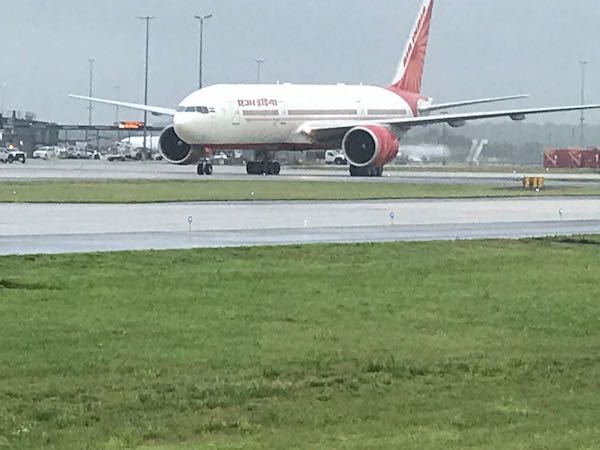
    The flight received an Escorted Airside Arrival.

    The Press Conference is scheduled to start at 8:30 a.m.

    Here are a few glimpses of the history in the making.

  • Air India to Celebrate Inaugural Flight from Dulles International to New Delhi

    Air India to Celebrate Inaugural Flight from Dulles International to New Delhi

    Governor McAuliffe, Mayor Bowser Join Indian Ambassador to the U.S. and MWAA Officials for Morning Flight Arrival and Press Conference

    WASHINGTON (TIP): Washington Dulles International Airport and Air India will host a delegation from the Commonwealth of Virginia, the District of Columbia and the Indian Embassy on Friday, July 7, to celebrate the first ever nonstop connection between New Delhi and the National Capital Region. The morning event will include escorted airside views of the Boeing 777-200LR arrival, a ceremonial water cannon salute and a press conference with Indian Ambassador Navtej Sarna, Governor Terry McAuliffe and Mayor Muriel Bowser.

    PROGRAM

    Morning of Friday, July 7, 2017

    o    Escorted Airside Arrival: Arrival is scheduled for Friday, July 7, at 7:15 a.m., though an early arrival is expected. Media planning to attend for the escorted airside arrival must check-in at the Main Terminal by 6:00 a.m. RSVP by 3:00 p.m. on Thursday, July 6, to publicaffairs@mwaa.com or (703) 417-8370.

    Press Conference: Scheduled to start at 8:30 a.m.

    Press conference will include remarks from: –

    o    H.E. Navtej Sarna, Ambassador to the United States, Government of India

    o    Terry McAuliffe, Governor, Commonwealth of Virginia

    o    Muriel Bowser, Mayor, District of Columbia

    o    Ashwani Lohani, Chairman and Managing Director, Air India

    o    Pankaj Srivastava, Director of Commercial, Air India

    o    Margaret E. McKeough, Executive Vice President and Chief Operating Officer, MWAA

    o    Jerome L. Davis, Executive Vice President and Chief Revenue Officer, MWAA

    o    Mike Stewart, Vice President of Air Service Development, MWAA

     Air India’s inaugural flight is the first nonstop route between the National Capital Region and New Delhi, directly connecting the world’s strongest democracy and the world’s largest democracy with three weekly round-trip flights.

  • Air India hosted Awards night for Midwest Partners with Vandana Sharma, Regional Manager, Air India

    Air India hosted Awards night for Midwest Partners with Vandana Sharma, Regional Manager, Air India

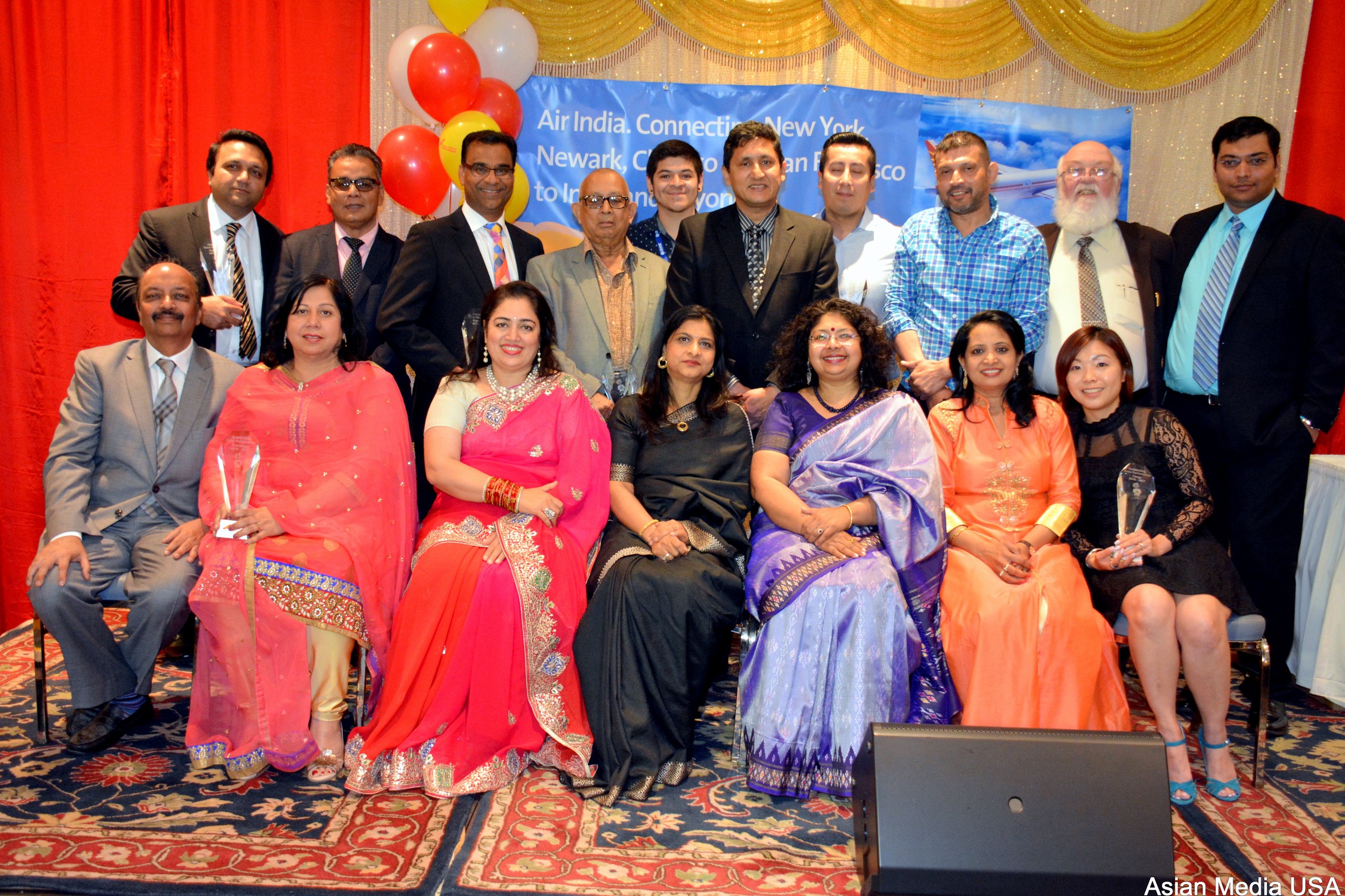
    CHICAGO, IL (TIP): “Air India Chicago, held an awards night of celebration and gaiety for about 150 Midwest partners on June 8, 2017 to thank its travel partners and airport service providers for their welcome support at the Ashyana Banquets, 1620 75th Street Downers Grove, IL.

    Ms. Vandana Sharma, Regional Manager, Air India was the Chief Guest. She applauded the Air India Midwest Partners for their commitment and wholehearted support to Air India as business partners.  Ms Sharma added that Air India will be having as many as 40 flights per week operating between India and US in the near future, as the demand increases.

    Ms. Neeta Bhushan, Consul General of India in Chicago was the Guest of Honor. She stated that ‘Air India is pride of India and we feel proud to travel by Air India’.  While continuing her address she added, Air India has been an icon of India, be it hospitality, innovation, capabilities and as a member and representative of India, she feels proud to associate with the national flag carrier.  ‘Air India has always been an important feature of my posting where ever I have been posted’ said Ms. Bhushan whilst referring to her earlier stints in Japan, Germany and the UAE.  She added that the Maharaja Logo was extremely famous round the world and Air India has a great network to fly with whilst congratulating Ms. Vandana Sharma.

    Mr. Nakul Chand, Air India Manager-Midwest welcomed the guests and thanked all the Midwest Partners for their committed support to Air India.

    The highlight of the evening was the presentation of the Awards Trophy to the top 10 Passenger Travel Agents and top 5 Cargo Agents of the Midwest who had generated the most revenues for Air India during Fiscal Year 2016-17.  The awards were jointly presented by Ms. Neeta Bhushan, Consul General of India, Ms. Vandana Sharma, Regional Manager, Air India and Mr. Nakul Chand, Manager-Midwest, Air India.  The top Awardees included Skybird offices of Chicago, Detroit and Houston, Riya Travel, Air Tours, GTT, Sky Pass Travel, Natraj Travel, R K Travel, Devon Travel, Crane Worldwide Logistics, Freight Systems, Agility Logistics, Air Cargo Express and Hellmann Worldwide.

    Air India was represented by its team from the city office, airport and cargo including Mr. Joseph Vincent, Security Manager, Mr. Chetan Patel & Mr. Chirag Patel, Airport Duty Managers, Ms. Katherine Thorat, District Sales Manager and Mr. Tom Dempsey, District Cargo Sales Manager.

    The guests were regaled with great entertainment program consisting of social hour, dance, singing and photo-session, followed by a sumptuous dinner.”

    Singing sensation Sameer Saini rocked the stage with catchy Bollywood numbers that kept the event going on high energy. He mesmerized the crowd with flawless and most upbeat music and truly proved that he is the best in town and had everyone on their feet.

    (Photograph and Press release / Asian Media USA)

  • NOTE BAN ALONE NOT TO BLAME FOR GROWTH SLUMP, SAYS JAITLEY

    NOTE BAN ALONE NOT TO BLAME FOR GROWTH SLUMP, SAYS JAITLEY

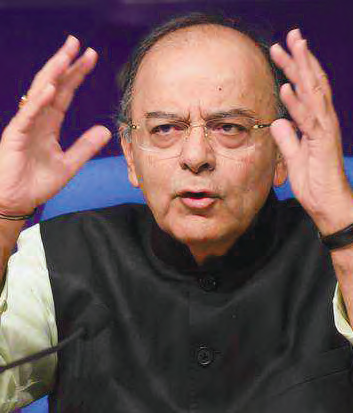
    NEW DELHI (TIP): Finance Minister Arun Jaitley has said demonetisation alone was not responsible for the fall in the GDP growth in the fourth quarter and said 7-8% growth in the current global context is “reasonable by Indian standards”.

    The Finance Minister blamed cumulative factors for the fall in growth, including the weak global economic scenario and slowdown in global economy even prior to the demonetisation. The fourth quarter number of 6.1% surprised economists who said the note ban has hurt growth and India lost the tag of the fastest-growing economy to China in the March quarter which pulled down the 2016-17 expansion to 7.1%.

    The Finance Minister said demonetisation has established a ‘new normal’. It has helped the government to promote digitisation of transactions, increased the base of taxpayers and sent a strong message that it is no longer safe to deal in cash.

    Jaitley said the slowdown in the fourth quarter was due to both domestic and global factors. “There are several factors which can contribute to GDP in a particular quarter. There was some slowdown visible given the global and domestic situation even prior to demonetisation last year,” Jaitley said while addressing a press conference on completion of three years of the Modi government.

    After the third quarter GDP numbers of 7% were announced, the government had maintained that claims of a slowdown due to demonetisation are exaggerated. With growth slipping to 6.1% after the government has made many structural reforms would be cause for worry in the third year of the government.

    “I do believe that in the current global situation a 7-8% growth, which is at the moment Indian normal, is fairly reasonable by Indian standards and good by global standards”. Sticking to the GST implementation deadline of July 1, the Finance Minister said there is a state of preparedness and GST itself will boost growth.

    However, several analysts say there will be a blip again in growth after GST is rolled out and while it would lead to creation of an integrated market, a major fallout will be the shift of trade and market share from the unorganised sector to the organised sector leading to job losses.

    On the proposed privatisation of Air India, the Finance Minister said the Niti Aayog has already given its recommendations to the Civil Aviation Ministry to explore various options. “It is for the Civil Aviation Ministry to explore various options,” he added. Oil companies’ merger issue is also being looked at by the ministry concerned, he added.

    Source: The Tribune

  • Laughing Buddha

    Laughing Buddha

    Laughing Buddha

    PARVEEN CHOPRA

    MANAGING EDITOR, THE SOUTH ASIAN TIMES

    Two days before destiny and a brutal accident snatched him from us, I had the good fortune of enjoying Karan Beri’s hospitality at his welcoming home in Bangalore, India. Before that too I had met him many times in New York as his father-in-law, Prof Indrajit S. Saluja is a family friend.

    Professionally, Karan was a tech-savvy businessman who seemed to wield a magic wand to transform his clients’ business online to catapult them to top of line. But my enduring impression of him is two-fold: his encyclopedic knowledge and his (sometimes outrageous) sense of humor.

    Even before meeting him I had started noticing his bylined articles in The Indian Panorama, edited and published by Prof Saluja. Having lived and worked in America before returning to India, he was well versed in US affairs. Starting with the time Donald Trump was considered only an entertaining presidential candidate, Karan was employing his analytical skills in op-eds to expose the billionaire’s unsuitability to be the leader of the free world – calling a spade a spade. Then, realizing that saturation media attention was feeding Trump’s candidacy, Karan stopped writing about him.

    From politics to emerging tech trends to what happens at Proms in US high schools, Karan could marshal facts and figures to astonish you.

    That impressed me, but what endeared Karan to me was his ability to elicit laughs — at any cost. He would insert himself into any conversation or discussion to crack a joke. Anything for a laugh was his philosophy – even sexual innuendo or double entendre was not beyond him. Such jokes amid family and friends would often embarrass his audience.

    His to-and-fro and matching wits with Prof Saluja would make me roll with laughter. Laughter Therapy, I used to call those times spent with the duo who were buddies more than father-in-law and son-in-law. In my eyes, Karan was Laughing Buddha.

    Yet, behind all that wit and humor, Karan was a kind, considerate man ever willing to help you. I remember how at a fundraiser for Dr VK Raju’s Eye Foundation of America, organized by Prof Saluja, Karan promised to help the charity’s digital effort, even setting up and managing their Kickstarter crowdfunding campaign, all pro bono. Good soul and lovely company that Karan was, the Almighty called him early.

    Karan’s moments  in pictures:

    At the Indian American Press Club Gala on March 4, 2017 where Karan’s father-in-law Prof. Indrajit S Saluja was installed as President of
    IAPC. Seen in the picture,
    from L to R: Prof. Indrajit S Saluja; Master Kabir Raj Beri; Jaskiran Beri; Nassau County
    Comptroller George Maragos
    presenting a citation to
    Jaskiarn; Anny; Chitagam
    Saluja, and Karan Beri
    Joining in to honor the
    eminent eye surgeon Dr. VK Raju on December 13, 2016 in New York. Seen in the picture, from L to R: Ms Vandana Sharma, Regional Manager America, Air India;
    Prof. Indrajit S Saluja; Dr. VK Raju; HR Shah; Karan Beri
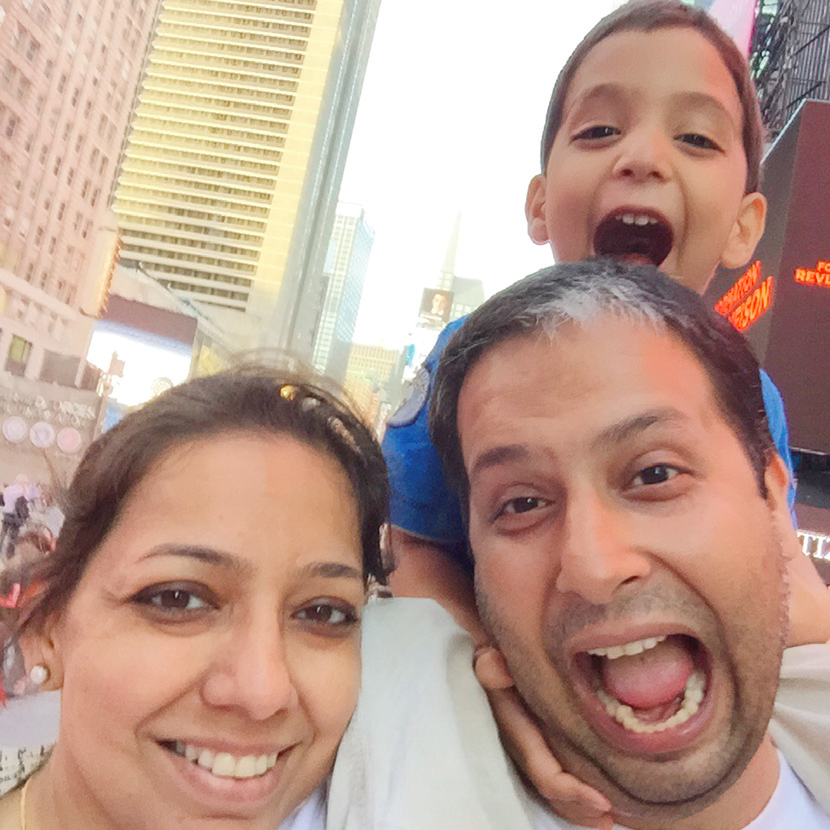
    Fun time – Having fun at Times Square, New York
    The Happy Family-Karan,
    Jaskiran & Kabir in New
    York
    The doting couple: Jaskiran and Karan
    Karan Beri got married to Jaskiran Saluja on May
    20, 2016. Also seen in the picture (center) is
    Jaskiran’s youngest brother Chitagam Saluja, now
    settled in the US.
    Loving Dad- Karan with son Kabir at Dave &
    Buster’s in New York
  • Direct AI flights between Colombo and Varanasi from August

    Direct AI flights between Colombo and Varanasi from August

    Direct AI flights between Colombo and Varanasi from August: Modi


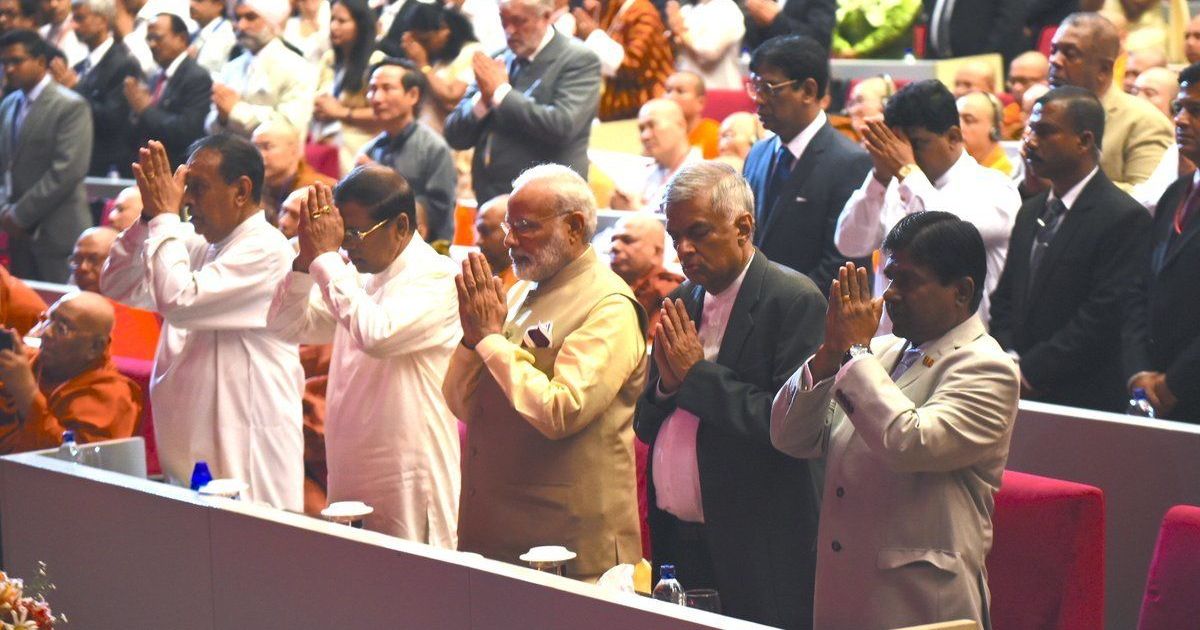
    COLOMBO (TIP): Prime Minister Narendra Modi announced, May 12, that India’s flag carrier Air India would begin direct flights between Colombo and the holy city of Varanasi from August. Modi, who is on a two-day visit to Sri Lanka, made the announcement of the beginning of the flights during his address at the inauguration of the International Vesak Day, the biggest festival of Buddhists.

    He said the flights will allow “my Tamil brothers and sisters” to visit Varanasi, the land of Kashi Viswanath. At a distance of 10 kilometres from Varanasi, lies Sarnath, one of the most revered Buddhist pilgrimage centres. It is believed that after attaining the enlightenment at Bodh Gaya in Bihar, it was in Sarnath that Lord Buddha preached his first sermon, sanctified as Maha Dharm Chakra Parivartan.

    The direct flights will aid pilgrims from Sri Lanka, a Buddhist-majority country, to visit Sarnath. Varanasi in Uttar Pradesh is the parliamentary constituency of the prime minister, from where he contested the 2014 Lok Sabha election. This is Modi’s second visit to Sri Lanka in two years. He arrived yesterday primarily to attend the International Vesak Day celebrations and his visit is aimed at reinforcing the traditional connect between India and Sri Lanka.

    (Source PTI)


  • It’s time airlines took a tough line against unruly VIP behavior

    It’s time airlines took a tough line against unruly VIP behavior

    “Air rage” – or sudden and violent behavior by a passenger affecting those who work on flights or associated people – is a menace that has led to civil aviation authorities issuing strict guidelines on deterrence and punishment for those responsible for such acts.

    In India, while the laws on unruly and disruptive behavior in an airliner are clear, they are difficult to enforce when the perpetrators take the cover of their positions of power.

    The outrageous conduct of Ravindra Gaikwad, the Member of Parliament from Osmanabad who belongs to the Shiv Sena, with Air India staff after seeking a business class seat in an all-economy flight from Pune to Delhi, required more than just a legal response by the airline.

    The Air India cabin crew had its task cut out but handled the incident well as can be gleaned from raw video images of what transpired on March 23.

    The consequent steps taken by the national carrier and members of the Federation of Indian Airlines to put him on a “no-fly list” is a welcome one.

    While the Aircraft Rules of 1937 have outlined a course of actions to be taken after such disruptive behavior, the application of a “no-fly list” is a new development and is in line with similar practices adopted in many countries. This practice should deter such outrageous actions by anyone, irrespective of whether the malefactor is in a position of power or not.

    Such behavior is, unfortunately, not uncommon among legislators. In 2015, a Jet Airways woman cabin crew member complained about alleged misbehavior by Bihar MLA Pappu Yadav during a Patna-Delhi flight.

    In November 2015, a case was registered against YSR Congress Party MP P. Mithun Reddy and others for allegedly assaulting an Air India station manager at Tirupati airport. These incidents are symptomatic of a culture of entitlement that pervades many in power today and, sadly, gives credence to the flawed notion that political representatives are a law unto themselves. Mr. Gaikwad’s actions were compounded by the fact that he brazenly justified his behavior – of hitting an airline employee with his slippers after the latter said that he would complain to the Prime Minister.

    While the Shiv Sena has said it does not condone his actions, its leader and MP, Sanjay Raut, has in bizarre fashion put the onus on Air India, asking it to think over “what would happen if the public decides to blacklist the airline”. The Shiv Sena has a history of high-handedness and use of political muscle. Party president Uddhav Thackeray had sought to move away from the rough-arm tactics of the past and to align his party to a new form of provincial politics. Mr. Gaikwad’s behavior suggests that the party is no closer to that goal.

  • Air India Washington-Delhi Service from July 7

    Air India Washington-Delhi Service from July 7

    Only Airline to offer Nonstop Flights from Washington, D.C., to Delhi, Service Will be Three Times a Week on Boeing 777

    "Air India is committed to making service faster and more convenient for our customers, whether traveling for business or leisure," said Ms. Vandana Sharma, Air India's Regional Manager-Americas
    “Air India is committed to making service faster and more convenient for our customers, whether traveling for business or leisure,” said Ms. Vandana Sharma, Air India’s Regional Manager-Americas

    NEW YORK (TIP): Air India announced that it is increasing its services to India from the U.S. to 33 flights per week with the launch of the only nonstop service out of Washington Dulles International Airport (IAD) to Delhi (DEL), starting July 7, 2017.

    The Boeing 777-200LR flights will depart Washington three times a week, on Wednesday, Friday and Sunday, with a flying time of just 14 hours – more than two hours faster than its nearest competitor. Flight No. AI-104 will depart Washington at 11:00 AM and arrive in Delhi at 10:30 AM the next morning.

    The westbound flight AI-103 will depart Delhi at 1:15 AM on Wednesday, Friday and Sunday and arrive in Washington at 7:15 AM the same day.

    Washington Dulles is Air India’s fifth U.S. destination, which also includes Chicago O’Hare, New York JFK, Newark Liberty, and San Francisco International Airports. For passengers traveling beyond Delhi, Air India also offers convenient connections to major cities across India, including Bengaluru, Mumbai, Amritsar, Hyderabad, Chennai, Kochi and more. Like Air India’s other nonstop flights, the Washington-Delhi flights will feature First, Business, and Economy Class service, all offering a choice of Continental or Indian cuisine.

    “Air India is committed to making service faster and more convenient for our customers, whether traveling for business or leisure,” said Ms. Vandana Sharma, Air India’s Regional Manager-Americas. “Our expanding service also addresses the growing demand of customers living and working in Indo-American communities throughout the U.S. that are looking for fast, direct service with seamless connections to cities across India, and the added convenience of customs and immigration formalities at the final destination. We are proud and privileged to fill that need.”

    For more information on Air India’s new Washington – Delhi service and for reservations, contact your travel agent or call 1-800-223-7776.

    About Air India

    Air India, India’s national airline, has been in operation since 1932. Today, the airline serves 35 international destinations on four continents, and 66 cities across India. The airline’s fleet of 118 aircraft, including B787 Dreamliners and B777LR’s and ER’s, is one of the world’s youngest. Air India is also a member of the Star Alliance. For more information about the airline, visit www.airindia.in.

  • Air India to get 4 more Dreamliners this year

    Air India to get 4 more Dreamliners this year

    NEW YORK (TIP): Air India is scheduled to take delivery of the four remaining dreamliners – Boeing 787-8 planes – this year with the last one to be delivered in October. The airline has acquired 23 dreamliners from September 2012 to January 9, 2017, Minister of State for Civil Aviation Jayant Sinha told the Lok Sabha, acknowledging the aircraft ‘have experienced technical reliability issues’ since induction.

    Terminals at 4 ports for cruise tourism: To boost cruise tourism, the government has developed terminals at four major ports – Mumbai, Mormugao, New Mangalore and Cochin – and also allowed foreign vessels to call without licence from the Director General of Shipping, Parliament was informed . Also, a new cruise terminal is under development at Chennai Port and scheduled to be completed by February.