Tag: Ajay Jain Bhutoria

  • Indian American fundraiser of Kamala Harris receives racists messages

    Indian American fundraiser of Kamala Harris receives racists messages

    WASHINGTON, D.C. (TIP) : An Indian American fundraiser of Vice President Kamala Harris and the Democratic Party has been receiving racist and threatening messages on his phone asking him to leave the county and go to India.

    “You claim that you are doing what’s best for Americans, but you aren’t doing anything for Americans, and you don’t care about America. You are Indian. You only care about Indians. You do what’s best for India. Why are you here? Stop being a beggar in America and become a leader in India,” Ajay Jain Bhutoria was told in a text message that he received on Sunday from an unknown number.

    Ajay Bhutoria is the Deputy National Finance Chair DNC and National Finance Committee, Harris-Walz campaign. He is also one of the Commissioners to the President’s Advisory Commission on Asian Americans, Native Hawaiians, and Pacific Islanders. In this role, he was instrumental in addressing several issues of the legal immigrant community.

    “Trump supporters asking me to go back to India to fight for green card backlog,” Bhutoria told PTI.
    “Stop being a beggar in America and to be a leader in India,” he was told in the text message. Some of these messages were posted by Bhutoria on social media platforms.

  • Indian-American community leader urges US lawmakers to remove the 7 per cent country limit on green cards

    Indian-American community leader urges US lawmakers to remove the 7 per cent country limit on green cards

    WASHINGTON, D.C. (TIP): An eminent Indian-American community leader from Silicon Valley has urged US lawmakers to remove the prevailing seven per cent cap on green cards, observing that the country-specific limit on the most sought-after residency document has created extensive backlogs.

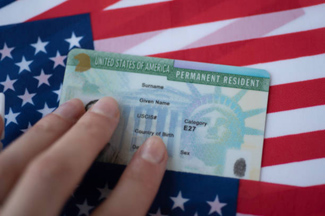
    A Green Card is a document issued to immigrants to the US as evidence that the bearer has been granted the privilege of residing in the country permanently. Speaking at the US-India summit held at the US Capitol on Wednesday, April 26, Ajay Jain Bhutoria, an entrepreneur and community leader, asked why there was a cap on the Green Card if not on an H-1 visa.

    “When we do not have a country’s limit on giving an H-1 visa to support our companies, businesses and economy. Why should we have a country cap limit on green card issuance,” Bhutoria said at the summit organised by Indian-American Congressman Ro Khanna in his capacity as Co-chair of the Congressional India Caucus.

    The per-country caps are numerical limits on the issuance of green cards to individuals from certain countries.

    Immigration law provides for approximately 140,000 employment-based green cards to be issued each year.

    However, only seven per cent of those green cards can go to individuals from a single country annually.

    If the number of individuals being sponsored from a single country is greater than seven per cent of the annual available total, a backlog forms and the excess approved petitions are not considered until a visa becomes available and their petition falls within the initial seven per cent per-country cap.

    “These country-specific caps have created extensive backlogs, forcing individuals from certain countries—primarily India and China in the employment-based categories— to wait much longer than average to receive their green cards, simply because of their country of origin,” he said. “We estimate that more than 880,000 people, including dependent spouses and children, are waiting in the US in employment-based green card backlogs.

    “In some categories, applicants who began the process in 2012 are just now able to file formally, meaning they may have waited more than a decade to join their families, even though they were already qualified to do so. These wait times are projected to extend up to 50 years if the law is not changed,” Bhutoria said.

    Making a detailed presentation, Bhutoria said that the number of students coming to the US from India on average is around 180-190 thousand per year. There are 85,000 H-1B work visas issued every year and out of which nearly 60 per cent of H-1B visas are issued via a fair lottery system to tech workers from India, so around 51,000-60,000 H-1B visas. The number of employment-based green cards issued to people from India is roughly around 7,000-8,000 per year due to the seven per cent country cap limit.This 7,000-8,000 includes dependents of primary applicants, so roughly 2,000 Individual H-1B applicants get green cards every year for people of India.

    Bhutoria said 180-190 thousand students from India come here to study, 50,000-60,000 get H-1B and only roughly 2,000 get green cards every year due to the country’s seven per cent cap limit, the rest applicants continue to live an uncertain life. “So the request is to remove the seven per cent country limit,” Bhutoria said.
    (Source: PTI)

  • Indian-American named Democratic Party Deputy National Finance Chair

    Indian-American named Democratic Party Deputy National Finance Chair

    WASHINGTON, D.C. (TIP): Eminent Indian-American and major fund raiser Ajay Jain Bhutoria has been named as Deputy National Finance Chair of the ruling Democratic party.
    Silicon Valley-based Bhutoria is a successful entrepreneur and is considered to be one of the major fund raisers for the Democratic Party and US President Joe Biden.
    With a proven track record and decades of combined experience raising the resources to elect Democrats up and down the ballot, Bhutoria is the only Asian-American to hold this role this year, a media release said.
    Bhutoria also serves on the President’s Advisory Commission on Asian Americans, Native Hawaiians and Pacific Islanders (US HHS).
    An influential and passionate champion for the South Asian and greater AAPI community, he has fought tirelessly to advance equity, justice, and opportunities for AAPIs across the nation, with a strong focus on small business growth, strong education, tackling hate crimes, advancing technology and fair immigration, the release said.
    Bhutoria has been recognized by numerous US Congressmen, US Senators, California Legislators, as well as the State governors and former US presidents. For his service to the community, he has also received the South Asian Global Leadership Award and the AAPI Community Hero Award.

    (Source: PTI)

  • US Presidential commission votes to process all green card applications within 6 months

    US Presidential commission votes to process all green card applications within 6 months

    WASHINGTON, D.C. (TIP): A presidential advisory commission has unanimously voted to recommend President Joe Biden to process all applications for green cards or permanent residency within six months. To be sent to the White House now for approval, recommendations of the President’s Advisory Commission on Asian Americans, Native Hawaiians, and Pacific Islanders (PACAANHPI) if adopted is likely to bring cheers to the hundreds and thousands of Indian Americans and those waiting, some for even for decades, for a Green Card.

    A proposal in this regard was moved by eminent Indian American community leader Ajay Jain Bhutoria during the meeting of the PACAANHPI, during which all its 25 commissioners unanimously approved it.

    The proceedings of the meeting here in the national capital was webcast live last week.

    To reduce, pending green card backlog, the advisory commission recommended US Citizenship and Immigration Services (USCIS) to review their processes, systems, policies and establish new internal cycle time goals by streamlining processes, removing redundant steps if any, automating any manual approvals, improving their internal dashboards and reporting system and enhancing policies.

    The recommendations aim to reduce the cycle time for processing all forms related to family based green card application, DACA renewals, all other green card applications within six months and issue adjudicate decisions within six months of application received by it.

    The commission recommended National Visa Center (NVC) State Department facility to hire additional officers to increase their capacity to process green card applications interviews by 100 per cent in three months from August 2022, and to increase Green card applications visa interviews and adjudicate decisions by 150 per cent – up from capacity of 32,439 in April 2022 — by April 2023.

    “Thereafter Green Card visa interviews and visa processing timeline should be a maximum of six months,” it said.

    Aimed at making it easier for the immigrants to stay and work in the country, the commission recommended that USCIS should review requests for work permits, travel documents and temporary status extensions or changes within three months and adjudicate decisions.

    Only 65,452 family preference green cards were issued in fiscal 2021 out of the annual 226,000 green cards available, leaving hundreds of thousands of green cards unused (with many likely to be permanently wasted in the future), and keeping many more families needlessly separated.

    There were 421,358 pending interviews in April compared to 436,700 in March, said the policy paper by Bhutoria.

    Noting that while the US population has grown substantially in recent decades, the immigration system has not changed to keep pace, he said. The annual levels of immigration were established in the early 1990s and have remained largely unchanged since, he said.

    To make matters worse, the method used to calculate the annual number of employment-and-family-based immigration is deeply flawed, and has led to family-based immigration levels being set at their absolute minimum every year for the past 20 years, while hundreds of thousands of green cards for family members go wasted, never used by any individuals, when they could be used to reunite families instead, Bhutoria said.

    “The extraordinary wait time for a green card to be available causes significant hardship for American families forced to wait decades to reunite with their loved ones, even though those individuals are already qualified to immigrate right now. “Family separation takes a terrible emotional toll on families, and it imposes clear logistical, economic, and emotional hardships on families, and the growing nature of the backlogs makes the process uncertain and future planning impossible,” he said. Among other things, the commission also recommended USCIS to expand premium processing to additional employment-based green card applications, all work permit petitions, and temporary immigration status extension requests, allowing applicants to pay $2,500 to have their cases adjudicated within 45 days in a phased approach.

    (Source: PTI)