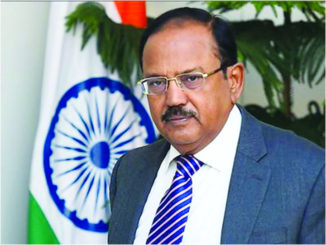
National Security Adviser (NSA) Ajit Doval expressed concern over rising Sikh radicalisation in Britain and the need for London to rein them while co-chairing the India-UK Strategic Dialogue with his UK counterpart Tim Barrow on Thursday. Doval had also flagged his concerns on the issue during earlier meetings with Barrow, especially during the strategic dialogue in July last year.
New Delhi is concerned over radicalisation, especially after the attack on the Indian High Commission by Khalistani elements and the allegations raised by radicals against India after the unnatural death of Khalistan Liberation Force leader Avtar Singh Khanda.
The focal point of their talks was the technology and security initiative, a pivotal bilateral platform aimed at bolstering collaboration in critical and emerging technologies between India and the UK, said MEA spokesperson Randhir Jaiswal.
Both NSAs discussed a roadmap to take forward the initiative to address shared security challenges. They also deliberated on bilateral issues of mutual interest and exchanged views on regional and global matters, said Jaiswal. Later, Barrow met External Affairs Minister S Jaishankar who posted on X, “Good to meet UK NSA Tim Barrow today in Delhi. Discussed a range of regional and global issues of importance. Also reviewed the progress in our bilateral ties.’’
Tag: Ajit Doval
-
Rein in pro-Khalistan elements on British soil, Ajit Doval tells counterpart
-

Lurking menace in Punjab
AAP government yet to find its feet on the security front
It is the police capitulation to the radical preacher that will come back to haunt the administration. I see the hand of the political leadership in this surrender to unlawful demands. There is no way the CM was kept out of the loop. It is evident that the AAP government led by Bhagwant Mann is still to find its feet on the security front. It could be its Achilles’ heel.
“The opportunity to nip the trouble in the bud having been lost, the task of the leadership, both political and police, will now be made difficult. The AAP government should seek Doval’s help. He can do so behind the proverbial curtain without announcing his role of adviser. A double-pronged approach would be required. The bulk of the population, the Jat Sikh farmers in the villages, had suffered the ravages of terrorism in the 1980s and early 1990s. They can be won over by well-reasoned arguments on multiple fora.”

By Julio Ribeiro Described as a ‘radical preacher’, Amritpal Singh aspires to be the next Bhindranwale. That aim will not be easy to achieve. Bhindranwale was the product of political machinations gone awry. Amritpal obviously wants to exploit the current gloomy mood of Punjabi youth, caused by unemployment and the rising prices of essential commodities, and aggravated by the Russia-Ukraine conflict with its implications for global economy.
Amritpal can’t be allowed to become larger than life. He has to be contained before he assumes an aura of invincibility.
According to media reports, the police had arrested one of his associates, Lovepreet Singh ‘Toofan’, for allegedly kidnapping and assaulting Varinder Singh of Chamkaur Sahib. Amritpal had also been named in the FIR lodged at the Ajnala police station. Amritpal announced a march to the police station to demand Lovepreet’s release. Anticipating trouble, police personnel were drawn from neighboring police stations and deployed at Ajnala.
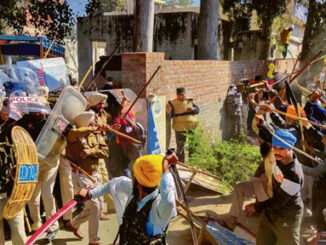
Barricades had been set up, yet a massive crowd of supporters of Amritpal and his Waris Punjab De outfit, armed with swords and a few with guns, stormed the barricades, entered the police station and caused extensive damage to government property. A hundred trained policemen, given implicit instructions on what they should do if attacked by a mob, should normally have been able to deal with the mob and disperse it. But if they had not been told clearly of the type and extent of force they could use to counter violence by the mob, the situation was destined to get out of control, and it did! I would squarely categorize the response as a failure of the police leadership and the state’s political leadership for not making its intention clear.
I would frown at armchair criticism of the police when dealing with piquant situations. On the ground, it is never easy to take quick decisions as events unravel in front of the police officer in charge on the spot. If he is a confident individual with his wits about him, the public should accept the decision, even if the results turn sour. It is the intent of the decision-maker that should matter.
Senior IPS officers turned up later, according to the reports, and held talks with Amritpal. He seemed to have convinced the Police Commissioner of Amritsar and the Ajnala SSP that Lovepreet was not the man involved in kidnapping Varinder! The senior officers agreed to release Lovepreet. This capitulation is what will trouble the police and the political leadership henceforth.
Lovepreet had been named by Varinder in his initial complaint. What the police needed to do was to check whether there actually had been a kidnapping. Who thrashed Varinder? It was reported that he had objected to Amritpal’s utterances, and, if that is true, a motive for the assault was available.
The Ajnala police would have kept their supervising officers in the loop on such an important political happening. Deputing extra forces from neighboring police stations could have been ordered only by an officer with authority over all five police stations. If reserves were deputed from the armed battalion, the order could only have been issued from the state DGP’s office. There is no way the seniors can claim that they were not in the know of the decision to arrest the men named in the FIR. It is the police capitulation to the radical preacher that will come back to haunt the administration. I see the hand of the political leadership in this surrender to unlawful demands. There is no way the CM was kept out of the loop. It is evident that the AAP government led by Bhagwant Mann is still to find its feet on the security front. It could be its Achilles’ heel.
An even worse scenario now is the possible recrudescence of terror in this sensitive border state. Our neighbor, mired in an economic morass, will try to fish in troubled waters across the border. In the 1980s, it had provided training and given shelter to Khalistani terrorists. It had also facilitated the movement of arms across the border. The neighbor will touch base with Amritpal, if it has not done so already. NSA Ajit Doval is best placed to intervene. He knows what to do, how it has got to be done and who should be entrusted with the task. Amritpal cannot be permitted to become larger than life. He has to be contained before he assumes an aura of invincibility. He has tasted victory in Ajnala. Consequently, support to him in Punjab will increase.
The Union Government may try to leverage the state government’s failure in Ajnala to gain political advantage in a state that has not welcomed the BJP. It will be a mistake to do so. The AAP was voted to power with a massive majority. Mann was propelled to the CM’s chair as the Sikh face of the AAP. The BJP has its own Sikh face in Capt Amarinder Singh, but he is a spent force. The wiser option for the Modi government is to leave this state alone lest it should burn its fingers.
An even worse option would be to play politics because Mann and his party have been pushed into a corner by a tyro who till last year was a clean-shaven Sikh living a nondescript life in Dubai. Sensing an opportunity for his latent talents, he grew a beard, started wearing clothes that imitated those of Bhindranwale and made his supporters carry Guru Granth Sahib to deter the police from acting.
The opportunity to nip the trouble in the bud having been lost, the task of the leadership, both political and police, will now be made difficult. The AAP government should seek Doval’s help. He can do so behind the proverbial curtain without announcing his role of adviser. A double-pronged approach would be required. The bulk of the population, the Jat Sikh farmers in the villages, had suffered the ravages of terrorism in the 1980s and early 1990s. They can be won over by well-reasoned arguments on multiple fora.
At the same time, as the communication lines with the masses are developed, a quick rounding up of Amritpal and his cronies should be effected. All laws the BJP governments use against their political opponents and critics should be used against this looming menace before it bites both the state government and the Centre.
(The author is a former governor and a retired IPS officer)
-

Doval meets Blinken, exchanges views on wide range of global and regional issues
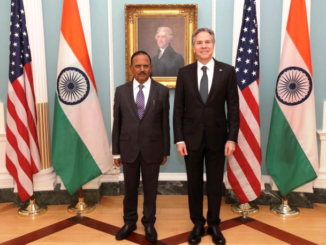
WASHINGTON, D.C. (TIP): National Security Advisor Ajit Doval has met US Secretary of State Antony Blinken during which they exchanged views on a wide range of global and regional issues and discussed deepening the bilateral strategic partnership. Blinken, who has just arrived from a trip to the Middle East, including Israel and Egypt, met Doval on Wednesday, February 1. The United States is expanding cooperation with India to address global challenges, Blinken said in a tweet after the meeting.
“I had a good meeting with Indian National Security Advisor Ajit Doval today to discuss deepening our strategic partnership, Blinken tweeted.
Both sides exchanged views on a wide range of global and regional issues of mutual interest and how to further strengthen the #India- US Comprehensive Global Strategic Partnership, the Indian Embassy here said in a tweet.
Doval is leading a high-powered delegation to the US.
He also met his American counterpart Jake Sullivan on Tuesday.
During their meeting, India and the United States elevated their strategic partnership with the launch of the initiative on Critical and Emerging Technology or iCET.
The discussions held during the visit of Doval form the basis for intensifying India-US cooperation in cutting-edge sectors and are truly reflective of the maturity of a comprehensive and global strategic partnership, the Indian embassy said in a statement on Tuesday.
Doval and Sullivan co-chaired the inaugural iCET meeting at the White House on Tuesday, translating into action the announcement made by Prime Minister Narendra Modi and President Joe Biden during their meeting in Tokyo in May 2022.
iCET aims to position the two countries as trusted technology partners by building technology value chains and supporting the co-development and co-production of items. It also aims to address regulatory restrictions, export controls and mobility barriers through a standing mechanism, the embassy said.
During the meeting, the US side also assured support to ease export barriers to India in a few critical areas, including through efforts towards legislative changes. Emphasis was placed on strengthening linkages between the startup ecosystems and building innovation bridges in key sectors between the two countries, through expos, hackathons and pitching sessions, according to the statement.
-

India in history this Week-January 14, 2022, to january 20, 2022
14 JANUARY
1741: Third war of Panipat started between Marathas and Afghans.
1964 Test bowler Rameshchandra Gangaram Nadkarni set a record for throwing 21 maiden overs.
1977 Narayan Karthikeyan, the first Indian to fill the Formula One race, was born on this day.
2016 Social activist and famous litterateur Mahashweta Devi was born.
15 JANUARY
1784 Establishment of the Asiatic Society of Bengal.
1934 An earthquake measuring 8.7 struck India and Nepal. About 11,000 lives were lost in this earthquake.
1988 Former India bowler Narendra Hirwani, taking historic feat, took 16 wickets in his debut Test match against West Indies.
2012 India’s first female photo journalist Homi Vairala died.
16 JANUARY

2009 On this day, Kalpana Chawla filled the space shuttle Columbia, spent 372 hours in space
1769 Pondicherry was annexed by the British from the French.
1681 The grand coronation of Sambhaji, son of Kshatrapati Shivaji, took place at Raigad Fort in Maharashtra.
1938 Death of noted Bengali litterateur Sharat Chandra Chattopadhyay.
17 JANUARY
2008 The Central Government approved a scheme of Rs 1800 crore for providing jobs to the disabled.
2009 Randhir Singh, the general secretary of the Indian Olympic Association, resigned from his post.
2010 The Supreme Court of India has given a pro-active definition of the right to self-defense in the event of unlawful assault, saying that people who follow the law do not have to be cowardly. Its two-member bench set a 10-point directive on the right to self-defense, stating that a person cannot be criminalized under these circumstances, even if he had caused the attacker’s death.
18 JANUARY
1996 Andhra Pradesh Chief Minister NT Rama Rao died on 18 January 1996.
1955 On this day in 1955, the famous Urdu writer and poet Sadat Hasan Manto said goodbye to this world.
1991 After 62 years of business, in 1991, today the Eastern airline was closed for economic reasons.
2003 Famous Hindi writer and poet Harivansh Rai Bachchan died in 2003.
1930 In 1930 Rabindranath Tagore visited the Sabarmati Ashram.
1997 In 1997, Nafisa Joseph became Miss India.
20 JANUARY
1988 Abdul Ghaffar Khan, the greatest activist of Pashtun independence and called Frontier Gandhi, was born.
1817 Hindu college was established in Calcutta (now Kolkata).
1945 National Security Advisor Ajit Doval, who is considered the master mind of surgical strike, was born.
-

NSA Doval calls for action plan against Pakistan-based terror groups
New Delhi (TIP): India has proposed an action plan against terror outfits like Lashkar-e-Taiba (LeT) and Jaish-e-Mohammed (JeM) as part of the framework of the Shanghai Cooperation Organisation (SCO), which also includes as its members Pakistan and China. India’s proposal was put forth by National Security Adviser (NSA) Ajit Doval at the 16th meeting of NSAs at Dushanbe in Tajikistan. India also pressed for full implementation of UN resolutions and sanctions against UN-designated terrorists and terror entities, sources said. Doval also proposed adoption of international standards to counter terror financing, including an MoU between the SCO and FATF. At the moment, Pakistan is the only SCO member that is on FATF’s grey list and a decision whether it will remain on its watch list will be announced on Friday. The NSA also suggested the need to monitor new technologies used by terrorists, including drones for smuggling of weapons and misuse of dark web, artificial intelligence, blockchain and social media.
-

Delhi-Dhaka ties move beyond symbolism, seek to power growth and connectivity
New Delhi (TIP): Prime Minister Narendra Modi laid the foundation for his neighbourhood visit well before he took oath on May 26, 2014 when he asked Ajit Doval, the then director of Delhi-based think tank Vivekananda International Foundation, to request leaders of Saarc countries to attend the swearing-in ceremony at the Rashtrapati Bhavan forecourt. Prime Minister Sheikh Hasina couldn’t make it. She had a scheduled visit to Japan at that time and conveyed through her interlocutors that Bangladesh Parliament Speaker Shirin Sharmin Chaudhury would represent Dhaka at the event. As PM Modi landed in Dhaka on Friday to begin a two-day visit to remember ‘Bangabandhu’ Sheikh Mujibur Rahman, the father of the nation of Bangladesh, and celebrate the golden jubilee of the 1971 liberation war, India’s ties with Bangladesh has gone way beyond symbolism. It is part of an integrated vision of PM Modi for the development of eastern India, particularly the North-East with the help and support of Bangladesh. What started with a historical 2015 Land Boundary Agreement (LBA) to settle legacy issues with Bangladesh has developed into a close partnership with India making it a priority to supply Covid-19 vaccine to Dhaka under the “Vaccine Maitri” initiative. PM Modi has made it clear to all that Bangladesh, like Bhutan, Nepal and Myanmar, occupy a special place in Indian diplomacy and all help should be extended to them for mutual growth and security. Since 2014, the bilateral relationship with Dhaka has achieved the following milestones:
– Land Boundary Agreement
– Restoration of pre-1965 rail links with India. Five out of six have been completed.
– Reviving the protocol on inland water and trade transit.
– Agreement on the use of Chittagong and Mongla ports for trade and transit.
– Building of the Maitree Bridge on the Feni river.
– Agreement to export power including building a transmission line from Berhampur in India to Bheramara in Bangladesh
– Supply of diesel to Bangladesh from Numaligarh refinery.
While Bangladesh is the key to connectivity to north-eastern India, it also fits into the calculus of trans- Asian highways that will link India to Vietnam by road and could become an economic engine for growth in Myanmar, Thailand, Cambodia, Laos and Vietnam.
The development and growth of India’s eastern flank will not only contribute to its GDP with tourism holding a vast potential in North-East but also politically stabilise the region with the Bharatiya Janata Party is a major political force on the eastern front.
The development of ties with immediate neighbours is also a priority with PM Modi, now that legacy issues like Article 370 and 35 A have been resolved and Kashmir is no longer the permanent stick for adversaries to beat India. When PM Modi becomes the first foreign leader to visit the Bangabandhu mausoleum at Tungipara tomorrow, he will be taking the next steps to cement ties with Dhaka under Sheikh Hasina’s leadership. Source: HT
-

US Defense Secretary’s Visit to India: Signposts and Markers

By Prabhu Dayal “It may be pointed out that Lloyd Austin is the Secretary of Defense, and within the US set up, matters such as human rights and democracy overseas do not come under his domain. However, while responding to a question during a media briefing, Austin said that he had raised issues of human rights of the country’s minorities with members of the Indian cabinet as “partners need to be able to have those kinds of discussions”. Asked specifically if he had raised the violation of human rights of India’s minorities as the first member of the Biden administration to meet Prime Minister Narendra Modi, Austin replied that he “did not have an opportunity to talk with him about that issue during their meeting,” adding: “Having said that, I did have a conversation with other members of the cabinet on this issue. I think we have to remember that India is our partner and a partner whose partnership we value, and I think partners need to be able to have those kinds of discussions. And certainly, we feel comfortable in doing that, and you can have those discussions in a very meaningful way and still make progress,” Austin said.”
In diplomacy, timing matters a lot, and the timing of the visit was very significant. It came on the heels of the US-China acrimonious talks in Alaska which have been described by the BBC as’ an unusually undiplomatic sparring match’. Moreover, it was just a week after the Quad summit had been convened by President Biden, and which PM Modi had attended.

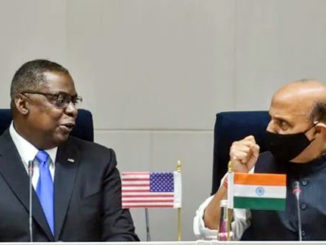
US Secretary of Defense Lloyd J Austin inspects the Tri-Services’ Guard of Honor at the Vigyan Bhawan lawns, in New Delhi (Photo : Courtesy ANI) Gen. (Retd) Llyod Austin, the US Secretary of Defense, visited India from March 19-21. As would be expected, the Indian Government rolled out the red carpet and gave the visit a very high degree of importance. He met Prime Minister Modi, Defense Minister Raj Nath Singh, National Security Adviser AjitDoval and External Affairs Minister S. Jaishankar. What are the key takeaways from this visit? What are the markers and signposts which can help understand where the relationship is headed?
In diplomacy, timing matters a lot, and the timing of the visit was very significant. It came on the heels of the US-China acrimonious talks in Alaska which have been described by the BBC as’ an unusually undiplomatic sparring match’. Moreover, it was just a week after the Quad summit had been convened by President Biden, and which PM Modi had attended.
It was also the first overseas visit by a senior member of the Biden Administration, and it came right after his own visits to Japan and Korea–both key allies of the US. Clearly, the visit was aimed at strengthening the strategic partnership between India and the US.
US Defense Secretary Austin had stated unequivocally during his Senate confirmation hearing on January 19 that “If confirmed, my overarching objective for our defense relationship with India would be to continue elevating the partnership”. The fact that India figured in the list of countries during his first visit abroad shows that he is keen to translate his commitment into action. Working closely with India has become an important aspect of US foreign policy, and US policy planners envision that it is in their country’s interest to augment the bilateral proximity in the present global scenario.
The importance attached by President Biden to working with India was emphasized by his Administration from the very start. Just two days after the Presidential inauguration, Jen Psaki, the White House Press Secretary said at a news briefing that “President Biden, of course has visited India many times, respects and values the long, bipartisan, successful relationship between leaders in India and the United States. He looks forward to a continuation of that.” Again, on March 9, Psaki said that Biden has made the Quad summit on Friday March 12 one of his earliest multilateral engagements, and that it shows the importance which the US is giving to closer cooperation with its allies in the Indo-Pacific region.” Thus, the White House had sent clear signals that it would seek to strengthen Indo-US relations.
Of course, China’s territorial and economic expansionism is serving as a catalyst in this regard. Early on, there were signs that the Biden administration saw the US-China relationship in less hostile terms as compared to the Trump Administration. However, as the days rolled by, there was a perceptible hardening of the Biden Administration’s attitude towards China. Slowly, it became more upfront in being publicly critical of Beijing. When he delivered a virtual address at the Munich Security Conference on 19th February, Biden said “We have to push back against the Chinese government’s abuses and coercion that undercut the foundations of the international economic system”. In his blunt opening statement at the Alaska meeting on 18th March, Secretary of State Antony Blinken said the US side would “discuss our deep concerns about actions by China, including in Xinjiang, Hong Kong, Taiwan, cyber-attacks on the United States, economic coercion of our allies”, adding “each of these actions threatens the rules-based order that maintains global stability.”
The US approach was also spelt out recently by Blinken and Austin in their joint op-ed in the Washington Post on 15th March–just three days before the Alaska meeting and Austin’s visit to India. They wrote:” The United States is now making a big push to revitalize our ties with friends and partners — both in one-to-one relationships and in multilateral institutions — and to recommit to our shared goals, values and responsibilities.” They also wrote: “The Indo-Pacific region is increasingly the center of global geopolitics. It is home to billions of the world’s people, several established and rising powers, and five of America’s treaty allies. Plus, a great deal of the world’s trade travels through its sea lanes It is strongly in our interests for the Indo-Pacific region to be free and open, anchored by respect for human rights, democracy and the rule of law.”
About the threat from China, they wrote:” Not all countries share this vision. Some seek to challenge the international order — that is, the rules, values and institutions that reduce conflict and make cooperation possible among nations. As countries in the region and beyond know, China in particular is all too willing to use coercion to get its way. Here again, we see how working with our allies is critical. Our combined power makes us stronger when we must push back against China’s aggression and threats. Together, we will hold China accountable when it abuses human rights in Xinjiang and Tibet, systematically erodes autonomy in Hong Kong, undercuts democracy in Taiwan or asserts maritime claims in the South China Sea that violate international law. If we don’t act decisively and lead, Beijing will.” Underscoring the importance of working with like-minded nations, they wrote that “it’s the most effective way to meet the challenges we face today, few of which can be solved by us acting alone.”
In this context, working closely with India makes good sense to US policy makers. After Austin’s meetings with PM Modi and NSA Doval, the US Embassy said ““Both sides exchanged perspectives on shared challenges confronting the region and committed to further strengthen their broad ranging and robust defense cooperation.” On its part, India reciprocated the sentiment. PM Modi tweeted after the meeting ““India and the U.S. are committed to our strategic partnership that is a force for global good.” The Ministry of External Affairs also said in a statement ““The Prime Minister welcomed the warm and close relationship between the two countries, which is rooted in shared values of democracy, pluralism and commitment to a rules-based order.” In this context, working closely with India becomes more intrinsic to US policy formulation.
At the same time, another aspect of Defense Secretary Austin’s visit should not be overlooked. The Pentagon sees India as a potential purchaser of advanced weapons systems and this makes it even more necessary for Biden to seek a closer relationship with the Indian political establishment. The on-going India-China standoff at the LAC continues to be seen by the US as a great opportunity to sell weapons and other defense-related items which India needs to acquire at such a difficult time.
Both countries have increased their defense partnership in recent years and signed four key foundational defense pacts. The General Security of Military Information Agreement (GSOMIA) was signed by the government of Atal Bihari Vajpayee back in 2002. It aims to protect the military information shared by the US. The Logistics Exchange Memorandum of Agreement (LEMOA) was signed a full 14 years later in 2016, and it aims to provide mutual logistics support around the world. The Communication Compatibility and Security Agreement (COMCASA) was signed in 2018, and it aims to facilitate communication between the weapons platforms of the two armed forces. Finally, the Basic Exchange and Cooperation Agreement was signed at the Indo-US 2+2 meeting in October 2020 and it largely pertains to geospatial intelligence, sharing information on maps and satellite images for defense. BECA will provide Indian military systems with a high-quality GPS to navigate and missiles with real-time intelligence to precisely target the adversary. It will also give access to topographical and aeronautical data and products that will aid navigation and targeting.
In this context, it may be noted that India has substantially increased its acquisition of US defense equipment. Indian forces are operating US-sourced platforms such as P-8s, C-130Js, C-17s, AH-64s, CH-47s, Precision Guided-Excalibur Munitions, and M777 howitzers. In February, India agreed to acquire Apache and MH-60R multi-mission helicopters worth $3.1 billion, and is considering other US systems. A deal for 30 armed drones, 10 each for the army, air force, and navy, estimated at $3 billion, is close to being approved by the Indian defense ministry. In November 2020, the Indian Navy acquired two Sea Guardian unarmed drones from the U.S. on a one-year lease. India has plans also to buy six additional P-8I long range maritime patrol aircraft in addition to the 12 already contracted. During the Trump Administration, amidst all the din about the US standing alongside India to ward off the Chinese threat, there was an unmistakable sales pitch that was clear as daylight. US media reports made no secret of the fact that during the 2+2 dialogue in October 2020, Mike Pompeo and Mark Esper had tried to push India to purchase MQ-9 Reaper drones. From the beginning, Trump had made arms sales a central component of his foreign policy.
It cannot be doubted that the Biden Administration will also push for arms-sales to India, and Defense Secretary Austin undoubtedly saw this as a priority item on his agenda during his visit.
However, some irritants in the Indo-US bilateral relationship cannot be overlooked. Prior to his visit to India, US Senate Foreign Relations Committee chair Bob Menendez had written a letter to him asking him to raise concerns about India “trending away” from shared democratic values, including the Indian government’s handling of the farmers’ protest and a crackdown on journalists and critics. “In meetings with Indian counterparts during your upcoming visit, I strongly encourage you to make clear that in all areas, including security cooperation, the US-India partnership must rest on adherence to democratic values,” Menendez said in his letter.
In his capacity as Chairman of the Senate Foreign Relations Committee, Menendez plays a key role in influencing the country’s foreign policy and national security. Among his predecessors include President Joe Biden, who occupied this position during former president George Bush’s administration and former secretary of state John Kerry. It may be pointed out that Lloyd Austin is the Secretary of Defense, and within the US set up, matters such as human rights and democracy overseas do not come under his domain. However, while responding to a question during a media briefing, Austin said that he had raised issues of human rights of the country’s minorities with members of the Indian cabinet as “partners need to be able to have those kinds of discussions”. Asked specifically if he had raised the violation of human rights of India’s minorities as the first member of the Biden administration to meet Prime Minister Narendra Modi, Austin replied that he “did not have an opportunity to talk with him about that issue during their meeting,” adding: “Having said that, I did have a conversation with other members of the cabinet on this issue. I think we have to remember that India is our partner and a partner whose partnership we value, and I think partners need to be able to have those kinds of discussions. And certainly, we feel comfortable in doing that, and you can have those discussions in a very meaningful way and still make progress,” Austin said.
In this regard, the thinking of some key players in the Biden Administration is no secret. In 2019, soon after the Centre stripped Jammu and Kashmir of special status under Article 370 and split it into two Union Territories, Kamala Harris did not mince words. “We have to remind Kashmiris they are not alone in the world,” she said. “We are keeping a track on the situation. There is a need to intervene if the situation demands.” Again, in the Biden campaign’s agenda for Muslim Americans, India’s National Register of Citizens and Kashmir featured in the list of threats to Muslim populations across the world. “In Kashmir, the Indian government should take all necessary steps to restore rights for all the people of Kashmir,” said the campaign agenda. “Restrictions on dissent, such as preventing peaceful protests or shutting or slowing down the Internet, weaken democracy.”
Freedom House, a US-based, US-funded Non-Governmental Organization said in its recent report ‘Democracy under Siege’ that Civil liberties in India have been in decline since PM Narendra Modi came to power in 2014. The report downgraded India’s rating to ‘partly free’. Trump had maintained a tactical silence in regard to India’s Citizenship Amendment Act and the human rights situation in Jammu and Kashmir. While the Biden Administration may also find it necessary to maintain a similar tactical silence on these internal matters of India, during closed-door meetings with the Indian side, such reports are likely to be cited as instances of ‘independent’ studies calling on India to undertake a course-correction. Something of this nature appears to have been done by Austin. On their part, senior Indian officials have said that human rights and values were discussed as shared strengths of the two countries. However, this irritant is likely to keep raising its head from time to time.
There is another and perhaps more serious danger to the US-India relationship lurking on the scene and it relates to CAATSA (Combating America’s Adversaries Through Sanctions Act). On India’s reported plan to purchase the Russian S-400 missile defense system, Senator Menendez said in his letter to Defense Secretary Austin that if India chooses to go forward with its purchase, that act will clearly constitute a sanctionable transaction with the Russian defense sector under provisions of CAATSA. “I recognize that India is not a US treaty ally and has historical ties with the Soviet and Russian militaries. However, if India chooses to go forward with its purchase of the S-400, that act will clearly constitute a significant and therefore sanctionable, transaction with the Russian defense sector under Section 231 of CAATSA,” Menendez wrote. “It will also limit India’s ability to work with the US on the development and procurement of sensitive military technology. I expect you to make all of these challenges clear in conversations with your Indian counterparts,” he said.
Defense Secretary Lloyd Austin did raise the issue of India’s planned acquisition of the S-400 air defense system from Russia and stressed that allies and partners should avoid “any kind of acquisitions that will trigger sanctions”.
It may be recalled that In October 2018, India had signed a USD 5 billion deal with Russia to buy five units of the S-400 air defense missile systems, despite a warning from the then Trump administration that going ahead with the contract may invite US sanctions. In 2019, India made the first tranche of payment of around USD 800 million to Russia for the missile systems which are expected to be delivered later this year.
The United States had in January 2021 imposed sanctions on Turkey, a NATO ally for purchasing S-400 surface-to-air missile systems from Russia. However, it had done so only after Turkey took the delivery of the first shipment. Briefing the media, Austin said that the question of CAATSA or sanctions against India is not on the table as India has not taken delivery of the system. He, however, did not elaborate on what will happen when India will take delivery of the system later this year. Summing up, one cannot ignore these potential roadblocks for the Indo-US relationship. They cannot be wished away because they are very much real. There is a great deal of affinity being shown by US policy makers towards India, but it may lessen considerably if they can sort out their difficulties on trade-related issues with China. The signposts and markers in the unfolding scenario will have to be watched closely to understand where the relationship is heading.
(The author is a retired Indian diplomat. He can be reached atprabhu_dayal70@hotmail.com )
(Courtesy OPOYI)
-
Ajit Doval meets Afghan President Ashraf Ghani in Kabul, visit unannounced
Kabul (TIP): National Security Adviser Ajit Doval on Wednesday met Afghan President Ashraf Ghani and his counterpart Hamdullah Mohib during an unannounced two-day visit to Kabul.
“Both sides discussed expansion of cooperation in countering terrorism and strengthening regional consensus on the Afghan peace process,” said Afghan President’s spokesman Sediq Sediqqi. “The Afghan National and Defence Security Forces are the righteous pillars of Afghanistan’s stability, the front lines against regional and global terrorism… in collaboration with NATO and the US could achieve more success in the fight against terrorism,” the President said.
Doval arrived in Kabul days after US Afghan envoy Zalmay Khalilzad, followed by a top US military official, met Pakistan Army officials at Rawalpindi. “The two sides held extensive conversations on issues of strategic mutual interest, including on synchronising efforts to combat terrorism and build peace,” said a statement from the Afghan NSA’s office. Mohib also met Chinese Ambassador Wang Yu. TNS