Tag: Akal Takht

  • A Wound That Refuses to Heal: On the 41st Anniversary of Operation Blue Star

    A Wound That Refuses to Heal: On the 41st Anniversary of Operation Blue Star

    By Prof. Indrajit S Saluja
    By Prof. Indrajit S Saluja

    In the summer of 1984, a tragic and defining chapter unfolded in Indian history—Operation Blue Star, a military action ordered by the Indian government under Prime Minister Indira Gandhi, to flush out Sikh militants, including the leader Jarnail Singh Bhindranwale, who had taken refuge in the Golden Temple complex in Amritsar. What was executed as a counterinsurgency operation turned into a national trauma, especially for the Sikh community. Four decades on, its memory remains raw, its pain festering like an open wound.

    The operation was launched on June 1, 1984, and reached its devastating peak between June 5 and 8, with the Indian Army storming the holiest shrine of the Sikhs—the Harmandir Sahib, popularly known as the Golden Temple. The timing of the operation—coinciding with the martyrdom anniversary of Guru Arjan Dev, when the temple was thronged with pilgrims—added to the grief and shock experienced by the community.

    The Toll: Lives Lost and Sanctity Violated

    Official figures of casualties remain controversial. The Indian government at the time claimed around 492 civilian deaths, including militants and pilgrims. However, independent estimates and Sikh organizations argue the number was significantly higher, with figures ranging from 3,000 to 5,000 civilians, many of whom were unarmed worshippers trapped inside the complex. 83 Indian Army personnel also lost their lives, and over 200 were injured.

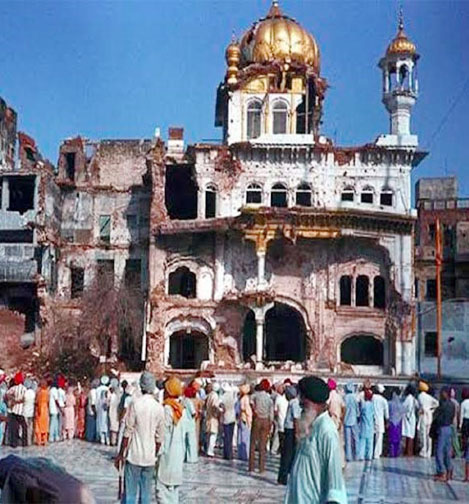
    The damage to the Akal Takht, the highest seat of temporal authority for the  Sikhs, was particularly heart-wrenching. The historic structure was reduced to rubble, its walls perforated by bullets, its sanctity desecrated by tanks and artillery fire. Rare manuscripts, scriptures, and artworks were destroyed, a loss that can never be compensated.

    The Psychological and Civil Fallout

    The immediate aftermath of Operation Blue Star saw Punjab placed under virtual martial law, with strict curfews, mass arrests, and widespread surveillance. Thousands of Sikh youths were detained without charge or trial under preventive detention laws such as the National Security Act and the Armed Forces (Special Powers) Act. Families were broken, civil liberties suspended, and a climate of fear hung over the state for years.

    The Sikh community across India and abroad was devastated. The wounds deepened with Operation Woodrose, a lesser-known but equally brutal military campaign in rural Punjab that followed Blue Star, aimed at rooting out “suspected militants.” Thousands of young Sikh men “disappeared” or were extrajudicially killed, their bodies never returned to their families.

    Betrayal of a Community

    The Sikhs, who make up just about 2% of India’s population, have contributed far beyond their numbers to the defense and development of the nation. They fought valiantly for India’s freedom, and after independence, they stood at the nation’s borders, defending it in every war. Yet in 1984, they were made to feel like outsiders in their own land.

    The very sanctum sanctorum of Sikhism was turned into a battlefield by those entrusted with safeguarding the country’s unity and diversity. The barbarity of storming a sacred shrine, especially when peaceful alternatives had not been fully exhausted, felt to many Sikhs like a deliberate provocation, a message that their faith and heritage were dispensable in the pursuit of state power.

    Many Sikhs ask, rightly: Would such an operation have been carried out in any other place of worship with similar force and timing? The sense of betrayal remains intense. What compounded the trauma was the lack of accountability, no official apology, and the subsequent anti-Sikh pogroms in November 1984 after Indira Gandhi’s assassination, where thousands more were murdered in cold blood—with state complicity and impunity.

    A Memory that Refuses to Fade

    For Sikhs around the world, Operation Blue Star is not just history—it is lived memory. It is their Holocaust moment, a violent rupture that has shaped the community’s relationship with the Indian state ever since. Just as the Jewish people have not forgotten the Holocaust, the Sikhs have not forgotten Blue Star. It is their green wound, unhealed and perhaps unhealable.

    Memorials in gurdwaras, stories passed from generation to generation, and annual commemorations serve not only as acts of remembrance but as assertions of identity and resistance against forgetting. While governments have changed and political narratives evolved, no amount of time has dulled the pain of watching tanks roll into the most sacred site of Sikhism.

    A Call for Justice and Healing

    Even today, many Sikhs feel that the state has not adequately acknowledged the enormity of what was done. Truth-telling, accountability, and real justice have been scarce. There is an urgent need for the Indian state to engage in genuine reconciliation, not through token gestures, but through institutional reform, historical honesty, and an apology that truly acknowledges the depth of hurt inflicted.

    Operation Blue Star was more than a military operation—it was a violation of trust, a rupture in the secular promise of India. Whether the movement led by Bhindranwale was right or wrong is a debate for historians and political scientists. What is beyond debate is that the handling of the situation was catastrophic, and the brutality inflicted on an entire community has left scars that remain visible even today.

    As India celebrates its democratic credentials, it must also confront the ghosts of its past. For the Sikhs, 1984 is not over. It is a continuous echo, a festering sore that demands to be seen, acknowledged, and remembered.

  • Akali crisis: Acid test of Akal Takht’s resolve to reform SAD

    The current ferment in Akali politics reflects a fierce tussle for the control of premier Sikh institutions. Tensions have been simmering since December last year, when the Akal Takht awarded religious punishment to Shiromani Akali Dal (SAD) leader Sukhbir Singh Badal and others for the ‘mistakes’ committed by the party when it was in power in Punjab from 2007 to 2017. The intrigue and one-upmanship have intensified of late, and it seems that things are coming to a head.

    Last week, the Shiromani Gurdwara Parbandhak Committee (SGPC) dismissed Giani Harpreet Singh as the Jathedar of Takht Sri Damdama Sahib after accepting the report of a panel that had probed allegations against him in an old domestic dispute. The controversial decision triggered a sharp response from Akal Takht Jathedar Giani Raghbir Singh, who said the ‘highly condemnable’ step would undermine the autonomy of the Takhts. Following the scathing criticism, SGPC chief Harjinder Singh Dhami resigned on ‘moral grounds’ and reaffirmed his allegiance to the Akal Takht, the highest temporal seat of the Sikhs. The rift widened when former SGPC president Kirpal Singh Badungar resigned from a committee set up by the Akal Takht to oversee the SAD’s membership drive and the election of office-bearers.

    The Badals have controlled the SGPC for decades, but the party’s plummeting political fortunes – closely linked to the lingering anger within the Sikh community over the sacrilege cases of 2015 – has weakened their hold in recent years. Sukhbir and his party colleagues are hoping that their atonement would help them start afresh and regain the trust of the aggrieved Panth. However, their task has become even more difficult with the launch of a political outfit, Akali Dal (Waris Punjab De), by supporters of jailed radical MP Amritpal Singh. The multiplicity of rivals might prompt SAD to revive its alliance with the BJP, which is itself bent on making major inroads into Punjab. The developments will test the Takht’s resolve to reform and revitalize the beleaguered SAD.
    (Tribune, India)

  • Operation Bluestar And Punjab

    Operation Bluestar And Punjab

    Thoughts on the 39th anniversary of Operation Blue star: The game is for power not for Punjab

    By Prabhjot Singh

    Thirty-nine years after the traumatic Operation Blue Star, Punjabis in general and Sikhs in particular, continue to ponder what makes all ruling parties at the Centre to betray

    them. All agitations in this border State have ended in trading of power without anything being said about its long-standing demands, be it territorial rights, dams and water works, prime

    institutions and its people. Sikhs have been in the habit of hawking newspaper headlines for reasons that extend beyond the geographic boundaries of their motherland for whose independence they made nearly 80 per cent of the total sacrifices. Of late some of the world leaders while eulogizing the contributions this minute minority community has made in the Corona pandemic went to the extent of saying that there should be a gurdwara – Sikh temple –everywhere to look after the suffering humanity.

    It is that institution of gurdwara that has been making the Sikh community seek answers from the Central Government in India in general and the national political parties in particular.

    Questions about the attack on their sancta sanctorum have either been ignored or they remained mired in controversies. The Sikhs, a global community, have every reason to nurse a grouse both against the Congress – for engineering attack on their sancta sanctorum besides depriving the State of its rightful territorial and rivers water rights – and the Bharatiya Janata Party (BJP) for not assuaging their hurt psyche without taking any action to mitigate it.

    Wreaked by two politics-engineered partitions, this once affluent State continues to struggle to get its long-standing demands, including territorial sovereignty and rightful claim over its rivers waters, met. While the first partition in 1947 played havoc with the life and property of this border province, the second partition took away whatever little progress or gains it had made since independence. All major projects, including its capital, dams and water works and institutions, were taken away and brought under control of the Centre.

    It is all the more agonizing for the Sikhs when they look back at the history. Before the 1947 partition, says historian Research Professor Rajmohan Gandhi, the then British rulers tried to appease all major communities of northern India – the majority Hindu community and the minorities Muslims and the Sikhs. Though he did not say in many words that while the Hindus got India and the Muslims Pakistan, the Sikhs had to swallow false promises.

    After partition, their agitation for a Sikh Homeland ended in a truncated State they got which was without a capital, most of its dams and water works and many Punjabi speaking areas.

    While they were still trying to come out of the trauma of the two partitions, came the Operation Blue star. Whatever are the causes or reasons behind the “Dharam Yudh” morcha that made the Sikhs launch a struggle to get autonomy for States after adopting the Sri Anandpur Sahib resolution of August 1977.

    Agreed, violence has no place in any civilized society in general and liberal democracies in particular, Punjab has never been at peace with itself for a continuous period of 30 or more years. To be precise, Sikhs have always been at war, if not with the powers at the Centre then among themselves. And even in their struggle, political, religious or social, they have always pioneered a number of initiatives, both in and outside India. It is here where the role of journalists, as members of the fourth estate, becomes crucial in highlighting injustices done to the State or its people, Journalists are eyes and ears of a society as they play a critical role in preserving democracy. They are mandated to act as watchdogs in liberal democracies as while weaving their stories, they not only understand the importance or significance of Rule of Law but also keep the public good above everything else. While judging a journalist or his or her work, especially in the context of Punjab, it is important to understand the trying circumstances in which they worked. The State had the longest spell of President’s rule besides promulgation of draconian laws to contain militancy. A State that was once acknowledged as the sword arm or sports arm of the country besides serving as the food bowl of the country is now tottering at the brink.

    Some experienced journalists, both from within and outside the country, would invariably use objectivity and verification combined with storytelling skills to make a subject both credible and newsworthy. But journalists from Punjab remain suspects in the eyes of the Centre. Punjab has had more spells of curfew than any other State in the country. It is not to suggest that what a journalist writes has general acceptance.

    Objectivity itself is subjective. Like everything else, criticism of journalistic works often has political dividends. Increasing attacks by politicians on the credibility of a journalist or a media house have often been part of a conscious strategy to weaken both the accountability and credibility of journalism in general and a journalist in particular.

    Of late, we all have been a witness to a collapse of the notion that politically relevant facts can be discerned by news professionals, reiterating the general belief that journalists are no more apolitical leaving their readers uncertain about ingesting the messages communicated to them as credible. These changing perceptions and thoughts apart, there are old timers who are continuing to discharge their role as torchbearers. They religiously follow professional ethics and discharge their duties as ears and eyes of the society they represent. A couple of years ago, I reviewed a book by one of my friends, Jagtar Singh, for The Tribune, an institution with which remained associated for 37 years.

    As a veteran journalist and columnist, Jagtar Singh, remained an eyewitness from the very beginning of the fight for Sikh Homeland, to the present. His latest book “The Khalistan Struggle: Rivers on Fire” is the story of militant struggle in the border state of Punjab. It tells students of history as to what sparked this struggle, which were the people in the beginning and how this discourse shaped up as a fight for a separate Sikh state.

    Not only this, several other books about the Sikh religio-political discourse in synergy of both the peaceful and militant struggle from the earlier days, have taken up only selective militant actions, as these were the incidents as these shaped the discourse at crucial moments.

    For Sikhs, it is not only their emotive bondage with the institution of gurdwara in general and the sanctum sanctorum in particular but has acted as a catalyst to prove to the world that the Sikh gurdwara which the Indian defense forces attacked with mortar, grenades and guns in 1984, are the shelter homes for those in distress.

    And these spiritual centers-cum-shelter homes do not discriminate with beneficiaries on the grounds of their ethnicity, color, creed, religion or language. No Sikh would ever take or accept any attack on its place of worship.

    Most of those who have done work or written essays on developments in Punjab since 1947 have documented their works well. However, a few important revelations made in the book, including one about the assassination of the then Prime Minister Indira Gandhi, need corroboration. The author says that the names of all those who gunned down Indira Gandhi and those who were part of the design to kill her were in public domain. At least three more people besides all those known names were part of the plan to avenge Operation Bluster.

    This revelation has not been substantiated as he mentions that one of the three names – Manbir Singh Chaheru – purchased a plot in Mohali for Bimal Kaur Khalsa, wife of Delhi Police Sub Inspector Beant Singh, one of the two assassins of Indira Gandhi. It appears to be a post-action (assassination) association that brought Bimal Khalsa in contact with Manbir Chaheru and Damdami Taksal. All said and done, it was the religious hurt that made Beant and Satwant kill Indira Gandhi. The revelation cannot be dismissed, as corroboratory evidence may have remained unexplored.

    Incidentally, I covered most of the militant actions, including assassinations of Indira Gandhi and Beant Singh, besides Operation Bluestar, Kapuri Morcha and the Dharam Yudh morcha.

    Coming to the emotive issue of rivers waters, it has been proved that the State Assembly never ratified none of these awards. The assembly took up the issue twice, first during the Akali Government of Surjit Singh Barnala that annulled the 1981 award, and the second by the Congress Government of Capt Amarinder Singh that set aside all water agreements. It may sound strange that none of these Legislative pronouncements could become effective. The issue has been once again thrown open by the Apex Court necessitating the Centre to get back to the rigmarole of holding meetings with the Chief Ministers of Punjab and Haryana. When the Barnala government annulled the 1981 award (Indira-Darbara award), the State Assembly simultaneously endorsed the Rajiv-Longowal accord that mandated the setting up of a Tribunal to resolve the water sharing problem. And the Tribunal so set up – Eradi Tribunal – after submitting its interim report in 1987, failed to give its final report even after

    24 years costing the state exchequer several crores. When we talk of Punjab Rivers’ waters issue, reference to Riparian principle or law becomes imminent. Going by Encyclopaedia Britannica, “In property right doctrine pertaining to properties adjacent to a waterway that

    (a) governs the use of surface water and

    (b) gives all owners of land contiguous to streams, lakes, and ponds equal rights to the water, whether the right is exercised or not.

    The riparian right is un-usufructuary, meaning that the landowner does not own the water itself but instead enjoys a right to use the water and its surface”.

    Going by the basic philosophy of the Riparian Law or principle, the actual rights rest with the people who live adjacent to waterways. Intriguingly, in the case of Punjab, the actual beneficiaries were uprooted and the State or the center claimed ownership rights over the waters. And select powerful people, holding high positions both in the state and the center, forget about the water awards without ever getting to the beneficiaries, the people, for their endorsement.

    Now coming back to the Operation Blue star, after 39 years, there is no credible or authentic version of the whole unfortunate episode that reveals actual drills of the operation, exact total casualties, the fate of the archives, artifacts, books and documents that were there in the SGPC museum damaged during the attack on Golden Temple as a part of Operation Blue star.

    Complicity of other powers, including the British government, in the events leading to the Operation Blue star, is still to be told. The only conclusion that can be safely drawn is that the people of Punjab have suffered immensely. And their agony continues unabated.

    (Prabhjot Singh is a veteran journalist with over three decades of experience of 14 years with Reuters News and 30 years with The Tribune Group, covering a wide spectrum of subjects and stories. He has covered Punjab and Sikh affairs for more than three decades besides covering seven Olympics and several major sporting events and hosting TV shows.)

  • Gurbani telecast from Golden Temple: SGPC fails to comply with Akal Takht directive

    Gurbani telecast from Golden Temple: SGPC fails to comply with Akal Takht directive

    AMRITSAR (TIP): The SGPC has failed to comply with the directions of the Akal Takht to prepare its Information Technology (IT) wing to facilitate world-wide live telecast of Gurbani from the Golden Temple ‘within a stipulated time’. Akal Takht Officiating Jathedar Giani Harpreet Singh had ordered the SGPC to work on the modalities of launching its channel, and written directions were issued on April 8. In response, the SGPC had sought a week to equip its IT wing as cameras, wiring and other relevant infrastructure were to be arranged, but to no avail.

    Irked, some SGPC members submitted a complaint with the Takht Secretariat over non-compliance of its directions. A complainant, SGPC executive member Gurpreet Singh Randhawa, said contrary to Takht’s directions, neither could the SGPC start its IT’s web channel nor take steps to stop the controversial private channel from broadcasting Gurbani. Takht had ordered the SGPC to make stopgap arrangements by equipping its existing web channel being run by the IT wing to telecast the Gurbani. Even CM Bhagwant Mann had offered to bear the cost of setting up the infrastructure. Rejecting the offer, SGPC chief Harjinder Singh Dhami had termed it politically motivated. Dhami said a five-member panel was formed to study the feasibility of launching a channel. “It had conducted two meetings. Since it required raising of technical infrastructure, the panel is working on it. It will also look into legal aspects as the SGPC is in a pact with the channel on telecast rights till February 2023. As soon as we receive its report, we will table it in the executive and take further action,” he said.

    (Source: TNS)