Amarnath Yatra is among the most revered pilgrimage circuits among Hindus. This annual event starts in July and goes on till mid-August every year. This holy Yatra lasts for around 45 days and is undertaken by thousands of people from all over the country.
This year, the Amarnath Yatra starts from June 29 and will end on August 19.
Nestled in the lap of the mighty Himalayas in the Anantnag District of Kashmir, Amarnath Cave is one of the most celebrated Hindu shrines that hold spiritual significance among the devotees.
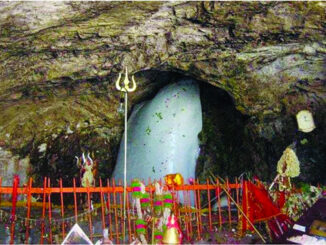
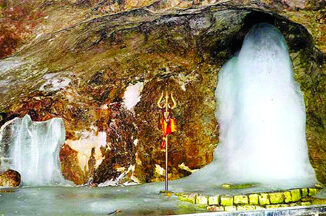
Situated at an altitude of 3,888 m above sea level, Amarnath Cave houses an ice stalagmite that symbolizes the mythical power of Lord Shiva. This ice Shiva Lingam is the prime attraction of the Amarnath Cave, which shrinks and grows with the phases of the moon.
This prominent Hindu shrine is dedicated to Lord Shiva, which has many lore and legends related to pilgrimage and Amarnath Yatra.
Here is the religious significance of Amarnath Yatra along with the significance and history of the shrine and Yatra.
Amarnath History: Who discovered the Amarnath Cave?
According to the local folklore, the Amarnath Cave was discovered by a Muslim shepherd Buta Malik in 1850. According to the lore, he was roaming with his herds in the mountains, and a saint met him there.
The saint gave him a bag full of coal, and when he reached home, he opened the bag, and he found a bag full of gold instead of coal. He was overjoyed and ran back to the same place to thank the saint, but he did not find the saint. Instead, he found the cave and the ice Lingam.
He informed the villagers about this and shared this story, after which the pilgrimage to Amarnath Cave started.
According to myths, the Kashmir Valley was submerged underwater, and Sage Kashyap drained it through a series of rivers and creeks. After this incident, Rishi Bhrigu was the first to have discovered Amarnath.
He has had a darshan of Lord Shiva at Amarnath, and after listening to this story, people started to undertake the pilgrimage circuit to Amarnath Cave.
Legends and Mythology of Amarnath Cave
There are numerous legends related to the Amarnath Cave. Among them, there is a most famous legend, which depicts that Lord Shiva has chosen this place to share the secret of immortality and the process of formation of the universe with Goddess Parvati.
He shared the story with Goddess Parvati about why he wears a bead of heads and what it implies. He told her that the head in the bead increases every time she is reborn. To this, Goddess Parvati asked about the reason behind Lord Shiva’s immortality.
He told her that she demanded to hear Amar Katha, which is a difficult task to listen for a human in one go and without sleeping.
She keeps insisting on Lord Shiva narrating the story, and then after a long time, he agrees to tell her the story at this place. For this, he was looking for a lonely place where no one could hear the story except for Mata Parvati.
On the way to Amarnath Cave, he left all these belongings en route, including his snake at Sheshnag Lake, Nandi bull at Pahalgam, his moon at Chandanwari, his son at Mahagunas Parvat, and at Panjtarni he left his five elements (Earth, Fire, Water, Air, and Sky).
Lord Shiva entered the holy cave with Goddess Parvati, sat on the deerskin, and took a Samadhi. To ensure that there was no one in the cave, he created a Rudra named Kalagni and ordered him to set the cave ablaze so that everything living there will be destroyed.
He then started narrating the story of immortality to the Goddess Parvati. But, Lord Shiva was unaware that there was an egg that remained protected under the deerskin on which the Lord was sitting.
A pair of pigeons were born out of that egg and allegedly became immortal after listening to the story while in the egg form.
Today, after all these years, the pilgrims can see the pair of pigeons while going towards the Amarnath Cave. They are fondly referred to as ‘Amarnath Pigeon,’ and it is believed that they are the same pigeons who have listened to the story of immortality.
Significance of Amarnath Temple
The most prominent feature of Amarnath Cave Temple is the Shiva Lingam, which is 40 m inside the cave. It is formed due to the dripping of freezing water from the cave’s ceiling and grows vertically on the cave floor to form the Lingam.
As per scientific terms, it is a stalagmite. As per Hindu mythology, the Lingam comprises the mythical energy of Lord Shiva. It is believed that the Shiva Lingam grows and shrinks as per the phase of the Moon, although there is no scientific proof for the same. Apart from the main Linga, two other ice formations can be seen in the cave, which is believed to be Goddess Parvati and Lord Ganesha.
Now, you have gained knowledge about the religious and mythological significance of Amarnath Yatra. As Amarnath Cave is where Lord Shiva narrates the Amar Katha or story of immortality to Goddess Parvati, it is one of the holiest pilgrimage sites for devotees.
Plan your pilgrimage to Amarnath cave and witness the spiritual charm of Baba Barfaani. This serene place’s breathtaking landscape and mystical vibes can leave anyone captivated and awe-struck.
Due to heavy snowfall and extremely bad weather throughout the year, devotees can access the cave only for 2 months, which are July and August. According to the Hindu calendar, the month of Shravan is when the cave becomes accessible, and the Ice Shivling is at its fullest. This trek, which has two routes, one via Pahalgam (45 km long route) and the second via Baltal (14 km shorter but steep route), witnesses devotees from 13 to 70 years of age walking with the same zeal and enthusiasm. Both routes will take you through beautiful snow-capped mountains and breathtaking views and will challenge you physically and mentally as well.
Tag: Amarnath Yatra
-

Amarnath Yatra
-

Amarnath Yatra
Amarnath Yatra is among the most revered pilgrimage circuits among Hindus. This annual event starts in July and goes on till mid-August every year. This holy Yatra is undertaken by thousands of people from all over the country.
This year, the Amarnath ji Yatra will commence on 1 July 2023 and will culminate on 31 August 2023.
Nestled in the lap of the mighty Himalayas in the Anantnag District of Kashmir, Amarnath Cave is one of the most celebrated Hindu shrines that hold spiritual significance among the devotees.
Situated at an altitude of 3,888 m above sea level, Amarnath Cave houses an ice stalagmite that symbolizes the mythical power of Lord Shiva. This ice Shiva Lingam is the prime attraction of the Amarnath Cave, which shrinks and grows with the phases of the moon.
This prominent Hindu shrine is dedicated to Lord Shiva, which has many lore and legends related to pilgrimage and Amarnath Yatra.
Who discovered the Amarnath Cave?
According to the local folklore, the Amarnath Cave was discovered by a Muslim shepherd Buta Malik in 1850. According to the lore, he was roaming with his herds in the mountains, and a saint met him there.
The saint gave him a bag full of coal, and when he reached home, he opened the bag, and he found a bag full of gold instead of coal. He was overjoyed and ran back to the same place to thank the saint, but he did not find the saint. Instead, he found the cave and the ice Lingam.
He informed the villagers about this and shared this story, after which the pilgrimage to Amarnath Cave started.
According to myths, the Kashmir Valley was submerged underwater, and Sage Kashyap drained it through a series of rivers and creeks. After this incident, Rishi Bhrigu was the first to have discovered Amarnath.
He has had a darshan of Lord Shiva at Amarnath, and after listening to this story, people started to undertake the pilgrimage circuit to Amarnath Cave, which takes place in July and August.
Legends and Mythology of Amarnath Cave
There are numerous legends related to the Amarnath Cave. Among them, there is a most famous legend, which depicts that Lord Shiva has chosen this place to share the secret of immortality and the process of formation of the universe with Goddess Parvati.
He shared the story with Goddess Parvati about why he wears a bead of heads and what it implies. He told her that the head in the bead increases every time she is reborn. To this, Goddess Parvati asked about the reason behind Lord Shiva’s immortality.
He told her that she demanded to hear Amar Katha, which is a difficult task to listen for a human in one go and without sleeping.
She keeps insisting on Lord Shiva narrating the story, and then after a long time, he agrees to tell her the story at this place. For this, he was looking for a lonely place where no one could hear the story except for Mata Parvati.
On the way to Amarnath Cave, he left all these belongings en route, including his snake at Sheshnag Lake, Nandi bull at Pahalgam, his moon at Chandanwari, his son at Mahagunas Parvat, and at Panjtarni he left his five elements (Earth, Fire, Water, Air, and Sky).
Lord Shiva entered the holy cave with Goddess Parvati, sat on the deerskin, and took a Samadhi. To ensure that there was no one in the cave, he created a Rudra named Kalagni and ordered him to set the cave ablaze so that everything living there will be destroyed.
He then started narrating the story of immortality to the Goddess Parvati. But, Lord Shiva was unaware that there was an egg that remained protected under the deerskin on which the Lord was sitting.
A pair of pigeons were born out of that egg and allegedly became immortal after listening to the story while in the egg form.
Today, after all these years, the pilgrims can see the pair of pigeons while going towards the Amarnath Cave. They are fondly referred to as ‘Amarnath Pigeon,’ and it is believed that they are the same pigeons who have listened to the story of immortality.
Significance of Amarnath
The most prominent feature of Amarnath Cave Temple is the Shiva Lingam, which is 40 m inside the cave. It is formed due to the dripping of freezing water from the cave’s ceiling and grows vertically on the cave floor to form the Lingam.
As per scientific terms, it is a stalagmite. As per Hindu mythology, the Lingam comprises the mythical energy of Lord Shiva. It is believed that the Shiva Lingam grows and shrinks as per the phase of the Moon, although there is no scientific proof for the same.
Apart from the main Linga, two other ice formations can be seen in the cave, which is believed to be Goddess Parvati and Lord Ganesha.
Now, you have gained knowledge about the religious and mythological significance of Amarnath Yatra. As Amarnath Cave is where Lord Shiva narrates the Amar Katha or story of immortality to Goddess Parvati, it is one of the holiest pilgrimage sites for the devotees.
There are two ways to complete this Yatra. One starts from Pehelgaam and another one from Sonmarg Baltaal. The route from pehelgaam is simple and convenient. The route from Sonmarg is just 14 KM but it is very difficult and has security concerns also. People following this route do it at their own risk and also govt of India is not responsible for any mishap on this route.
Pehelgaam is at a distance of 315 KM from Jammu. The Yatra on foot starts from here. The first stop is at Chandanbadi which is at 8 KM from Pehelgaam. The devotees spend the first night here. On the next morning, they resume the Yatra for Pissoo Ghati along Lidder river. This part of Yatra is simple as compared to the rest of the Yatra.
The next stop from Chandanbadi is Sheshnaag. The route is dangerous and has steep height. One can see pissoo ghati here. This area is very dangerous. There are many beautiful lakes of blue water coming out of hills. The devotees spend night here and resume their third day Yatra from here.
Panchtarni is at a distance of 8 miles from Sheshnaag. One has to cross Baivwell and Mahagunass on the way to Sheshnaag. The place gets its name because of five small rivers flowing here. It is surrounded by high hills from all the sides. The devotees have to be extra careful here because of lack of oxygen at this place.
The holy cave is at a distance of only 8KM from here. The whole of route is filled with ice all along the way. This route is very difficult. One forgets all the tiredness as soon as he reaches the holy cave and attains spiritual bliss on witnessing the the Shiva-linga made of natural ice.
Age Limit for Amarnath Yatra
There are also some age restrictions for the Amarnath Yatra. No one below 13 years of age or above 75 years of age can take part in Amarnath Yatra. There is a ban on Amarnath Yatra for women who are more than 6 weeks pregnant. -

Amarnath Yatra: The legend and pilgrimage
Amarnath Cave is one of the most revered pilgrimage sites among Hindus. Situated at a height of 3,888 m in Jammu and Kashmir, Amarnath Cave is considered one of the holiest shrines of Lord Shiva. Every year thousands of devotees undertake the Amarnath Yatra, which is organized by Shri AmarnathJi Shrine Board. Formed due to the melting of ice from the roof of the cave to the floor, Amarnath Cave contains Shivling that people from all across the country visit to seek blessings from Lord Shiva.
Significance of Amarnath Temple
As you already know there is a block of ice formed Shivling inside the Amarnath Cave. On one hand, science says that it has been formed due to the dripping of ice from the roof of the cave, the Hindus believe that it is the presence of Lord Shiva in the form of a Lingam. Not only this but it is also believed that this Lingam expands and contracts according to the phases of the moon. Though, there is no scientific proof till now. Along with Shivling, you can also witness two other ice formations which are said to be of Goddess Parvati and Lord Ganesha.
Amarnath Temple History
It is said that there was a shepherd named Buta Malik who first discovered the cave. However, there is a mention of Amarnath Temple (Amareshwar) in the book “Rajatarangini” and people believe that Queen Suryamathi gave a present of Trishul, banalingas, and sacred emblems to Amarnath Temple back in the 11th century AD. And when in the 15th century, Buta Malik rediscovered the cave, the story of Quess Suryamthi was disremembered.
With that being said, Buta Malik received a bag full of coal from a saint and when he got back home, he was surprised to see gold coins instead of coal. He was grateful but overwhelmed. And to say thank you to the saint he went back to the place where he met him but found the cave with Shivling inside instead. This led to the discovery of Amarnath Cave. From then onwards, it became a major place for pilgrimage among Hindus.
There are some other epics that tell a different story. It says that the valley of Kashmir was underwater and Kashyap Rishi drained it through various rivers and rivulets. During the same timeline, Bhrigu Rishi visited the Himalayas and was the first to have the darshan of the holy Amarnath Cave. When villagers heard about this, it quickly became Shiva’s abode and a center of pilgrimage. Since then, a large number of devotees undertook the Amarnath Yatra through rugged terrain to seek eternal happiness.
Amarnath Temple Story
Many tourists who visit Amarnath Temple wonder what is the mythology behind Amarnath Cave? Well, as per a Hindu legend, it is believed that when Parvati asked Shiva the secret of life and eternity. At first, he refused but she insisted, so he decided to reveal the secret to her.
He left Mount Kailash along with Goddess Parvati and left his belongings at various places. For instance, Nandi, the Bull at Pahalgam, Moon from hair at Chandanwari, and snakes on the banks of Lake Sheshnag. Lord Ganesha was left at Mahagunas Parvat also called Mahaganesh Mountain.
Plus, the five elements of nature – Earth, Water, Air, Fire, and Sky were left at Panchtarni. As he sacrificed his belongings, he performed the Tandava Dance. And later, enter the cave with Parvati. To ensure no one was listening, he created fire to demolish all the life around him. But a pigeon under Lord Shiva remained and heard the secret of immortality.
They were born and even today, devotees who visit Amarnath Temple can see a pair of pigeons inside the cave nesting. And because the secret of immortality was told here by Lord Shiva, the cave was called Amarnath.
Shiva followers thus, take the Amarnath Yatra with true hearts and feelings and present to Lord Shivain hope of a righteous living, health, prosperity, and purity of the sins. Families, friends, and companions are often seen traveling together to Amarnath Temple in Jammu and Kashmir despite it being 36 to 48 km long and difficult to enlighten themselves by Shiva’s true light. Amarnath Yatra is organized every year but in 2022, it will be starting on 30 June and will end on 11 August due to Sawan Purnima. There are 2 routes – Pahalgam and Baltal you can choose to go on. This can be covered in 4 to 5 days (Pahalgam) or 2 to 3 days (Baltal). Most devotees prefer the longer and more traditional route from Srinagar though. Elderly citizens can choose to ride on a horse too.
Source: TourismOfIndia