Tag: American Rescue Plan

  • Nassau County Executive wants to Send $375 Direct Payments to Homeowners

    Nassau County Executive wants to Send $375 Direct Payments to Homeowners

    MINEOLA, NY (TIP): Nassau County executive has a bold new proposal to distribute $100 million in direct cash payments to homeowners.

    Laura Curran hopes her new plan to stimulate the economy of Nassau County will get approval from the County Legislature to give $375 payments to residents.

    “This is to benefit the middle class,” Curran said Monday, May 17. “It is my hope that people who receive this check spend this money in Nassau – go to your downtown restaurants, go to the movies, she said.

    The county is projected to receive roughly $380 million from the American Rescue Plan passed by Congress in March, $200 million of which is getting to Nassau County this year, Curran said. She wants half of that money to go directly into the pockets of county residents.

    “In order for us to have a strong economic recovery we must continue to address the economic impact of the virus. Since day one of this crisis Nassau County has focused on providing relief to taxpayers whenever possible,” she said.

    Under the Nassau County Homeowner Assistance Program, eligible households would be determined by Basic and Enhanced STAR data. Curran estimates 300,000 homeowners in the county would benefit from the program.

    The executive highlighted dropping virus cases and increasing vaccination rates in the county’s long road back from the pandemic. Nassau County’s COVID-19 positivity rate now sits below 1% and health officials recorded four days last week without a single virus death, she added.


  • 2 million more Economic Impact Payments disbursed under the American Rescue Plan; total reaches approximately 161 million as payments continue

    2 million more Economic Impact Payments disbursed under the American Rescue Plan; total reaches approximately 161 million as payments continue

    WASHINGTON(TIP): The Internal Revenue Service, the U.S. Department of the Treasury, and the Bureau of the Fiscal Service announced, April 22, they are disbursing nearly 2 million payments in the sixth batch of Economic Impact Payments from the American Rescue Plan. Today’s announcement brings the total disbursed so far to approximately 161 million payments, with a total value of more than $379 billion, since these payments began rolling out to Americans in batches as announced on March 12. The sixth batch of payments began processing on Friday, April 16, with an official payment date of April 21, with some people receiving direct payments in their accounts earlier as provisional or pending deposits. Here is additional information on this batch of payments:

    In total, this batch includes nearly 2 million payments with a value of nearly $3.4 billion. Nearly 700,000 payments, with a value of more than $1.3 billion, went to eligible individuals for whom the IRS previously did not have information to issue an Economic Impact Payment but who recently filed a tax return. This batch also includes additional ongoing supplemental payments for people who earlier this year received payments based on their 2019 tax returns but are eligible for a new or larger payment based on their recently processed 2020 tax returns. This batch included nearly 700,000 of these “plus-up” payments, with a value of nearly $1.2 billion. Another 600,000 payments went to Social Security beneficiaries and Supplemental Security Income recipients, including those with foreign addresses. Overall, this sixth batch of payments contains about 900,000 direct deposit payments (with a total value of $1.5 billion) and nearly 1.1 million paper check payments (with a total value of nearly $1.8 billion). Additional information is available on the first five batches of Economic Impact Payments from the American Rescue Plan, which began processing on April 9, April 2, March 26, March 19 and March 12. The IRS will continue to make Economic Impact Payments on a weekly basis. Ongoing payments will be sent to eligible individuals for whom the IRS previously did not have information to issue a payment but who recently filed a tax return, as well to people who qualify for “plus-up” payments.

    Special reminder for those who don’t normally file a tax return

    Although payments are automatic for most people, the IRS continues to urge people who don’t normally file a tax return and haven’t received Economic Impact Payments to file a 2020 tax return to get all the benefits they’re entitled to under the law, including tax credits such as the 2020 Recovery Rebate Credit, the Child Tax Credit, and the Earned Income Tax Credit.  Filing a 2020 tax return will also assist the IRS in determining whether someone is eligible for an advance payment of the 2021 Child Tax Credit, which will begin to be disbursed this summer. For example, some federal benefits recipients may need to file a 2020 tax return – even if they don’t usually file – to provide information the IRS needs to send payments for a qualifying dependent. Eligible individuals in this group should file a 2020 tax return as quickly as possible to be considered for an additional payment for their qualifying dependents.

    People who don’t normally file a tax return and don’t receive federal benefits may qualify for these Economic Impact Payments. This includes those experiencing homelessness, the rural poor and others. Individuals who didn’t get a first or second round Economic Impact Payment or got less than the full amounts may be eligible for the 2020 Recovery Rebate Credit, but they’ll need to file a 2020 tax return. See the special section on IRS.gov: Claiming the 2020 Recovery Rebate Credit if you aren’t required to file a tax return.

    Free tax return preparation is available for qualifying people. The IRS reminds taxpayers that the income levels in this new round of Economic Impact Payments have changed. This means that some people won’t be eligible for the third payment even if they received a first or second Economic Impact Payment or claimed a 2020 Recovery Rebate Credit. Payments will begin to be reduced for individuals making $75,000 or above in Adjusted Gross Income ($150,000 for married filing jointly). The payments end at $80,000 for individuals ($160,000 for married filing jointly); people with Adjusted Gross Incomes above these levels are ineligible for a payment.

    Individuals can check the Get My Payment tool on IRS. gov to see the payment status of these payments. Additional information on Economic Impact Payments is available on IRS.gov.

  • President Biden signs $1.9 trillion American Rescue Planinto Law

    President Biden signs $1.9 trillion American Rescue Planinto Law

    $1,400 for individuals, billions to help schools and colleges reopen, funding for vaccine distribution, and support to small businesses

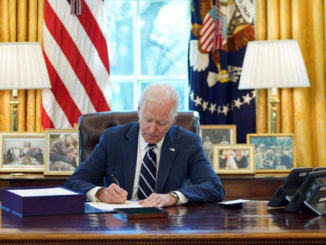
    WASHINGTON(TIP): President Joe Biden on Thursday, March 11, signed into law a $1.9 trillion American Rescue Plan, hours before he planned to address the nation to begin an extensive outreach campaign explaining the massive spending package. The measure includes direct payments of up to $1,400 for individuals, billions to help schools and colleges reopen, and funding for vaccine distribution – along with many other measures aimed at helping America recover from the pandemic. “I believe this… historic legislation is about rebuilding the backbone of this country and giving people of this nation – working people, middle class folks, people that built the country – a fighting chance,” Biden said, before signing the bill from the Oval Office as Vice President Kamala Harris stood behind him. “I’m going to have a lot more to say about that tonight and the next couple days.”

    Shortly after, White House press secretary Jen Psaki said the direct payments could start showing up in people’s bank accounts as early as this weekend.

    The White House moved up the bill signing to Thursday from Friday after Congress finalized the bill sooner than expected.

    “We want to move as fast as possible,” Ron Klain, Biden’s chief of staff, tweeted when the new time was announced.

    Biden will still hold a celebratory signing event with congressional leaders on Friday.

    The signing comes days before a federal boost to unemployment benefits was set to expire on Sunday, March 14.

    No Republican voted for the legislation, which passed the House on Wednesday, March 10, and the Senate on Saturday. One Democrat, Rep. Jared Golden of Maine, voted against it.

    Republicans complain the bill is too expensive and is packed with provisions not directly related to combating the pandemic. House Minority Leader Kevin McCarthy, R-Calif., criticized the bill as a “laundry list of leftwing priorities that predate the pandemic and do not meet the needs of American families.”

    Democrats say it is one of the largest anti-poverty bills in a generation, aiming to deliver on Biden’s promise to send aid to millions of Americans grappling with the effects of the COVID-19 pandemic.

    Biden said an “overwhelming percentage” of the American people support the package.

    The benefits include:

    • Giving most Americans earning up to $75,000 a $1,400 check.
    • Extending a $300 weekly federal boost to unemployment benefits through August.
    • Sending $350 billion to state and local governments whose revenue has declined because of COVID-19’s impact on the economy.
    • Allocating $130 billion to help fully reopen schools and colleges.
    • Allotting $30 billion to help renters and landlords weather economic losses.
    • Devoting $50 billion for small-business assistance.
    • Dedicating $160 billion for vaccine development, distribution and related needs.
    • Expanding the child tax credit up to $3,600 per child.
    • Expanding premium subsidies for people who buy health insurance on their own instead of getting it from an employer or a government program like Medicare or Medicaid.

    The road trips by members of the administration, which the White House is calling the “Help is Here tour,” will include a visit by Biden and Harris to Georgia next week.

    Biden is also expected to travel to Pennsylvania on Tuesday.

    First lady Jill Biden is heading to New Jersey on Monday, March 15, while Harris and second gentleman Douglas Emhoff travel to Nevada.

    Harris and Emhoff are going to Colorado on Tuesday, March 16, with Emhoff also visiting New Mexico on Wednesday, March 17.

    “They’re eager to get out there on the road,” Psaki said Thursday.

    (Agencies)