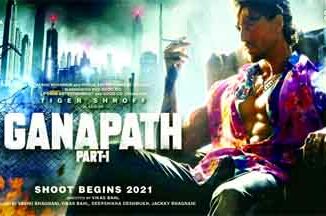
Upcoming dystopian action film, “Ganapath” has booked its release date. On Wednesday, the makers of the film revealed the release date of the film with a power-packed video featuring Tiger Shroff in a rugged avatar.
The film will be released around Dussehra on October 20, in five languages – Hindi, Telugu, Tamil, Malayalam, and Telugu. Tiger Shroff was recently spotted in Mumbai donning a new tattoo on his forearm, which was the big reveal for the announcement of the release date. The film also stars Kriti Sanon and veteran superstar Amitabh Bachchan, who will be playing an important character in the film. This will be the first time when the audience will see Amitabh Bachchan and Tiger Shroff together on the silver screen. On the occasion, producer Jackky Bhagnani said: “I have always been a fan of seeing this new world through the lens of cinema, that’s what really excited me about this film. And I am thrilled, excited and can’t wait for the audiences to witness and visually experience this new dystopian world of ‘Ganapath’.” “As always, it’s been our endeavor to bring to the audience larger than life cinema and ‘Ganapath’ will surely enthrall you with its unique and picturesque storytelling.” Pooja Entertainment presents “Ganapath” in association with Good Co. Directed by Vikas Bahl, the film is produced by Vashu Bhagnani, Jackky Bhagnani, Deepshikha Deshmukh, and Vikas Bahl. Source: IANS
Coinciding with 75 years of Independence, noted film critic Murtaza Ali Khan scanned for The Indian Panorama the 75 years of Indian Cinema. The article here will give readers a fairly good idea of the beginnings and the growth of Indian Cinema, the impact of government policies, the contribution of the Indian Diaspora, the influence of the NRI film makers, the difference the rise of web and the OTT platforms made to mainstream Indian Cinema, and the contribution of certain film makers. The author has also dwelt on the historical phases in the Indian cinema’s 75-year journey. Please send in your comments to murtaza.jmi@gmail.com – EDITOR
Satyajit Ray behind the camera. (Photo: courtesy Ray Society)
Storytelling is undeniably one of the most powerful tools known to mankind. It also happens to be one of the oldest art forms. Storytelling is not merely a means of indulgence but also a great source of learning. Since times immemorial, storytellers have spun yarns with the hope of delighting mankind. Be it the Iliad and the Odyssey of Homer, the Jataka tales, the Mahabharata of Vyasa, the One Thousand and One Nights, or the plays of Shakespeare, each of these sprawling sagas, above all, has proven to be a consummate manifestation of the human expression. Storytelling shares an intimate relationship with performing arts. As far as India is concerned, the history of performing arts can be traced back to Bharatmuni’s Natya Shastra, which describes art as the search for truth. Human life too is a pursuit for truth and happiness. It is this connection that makes life and art inseparable. While discussing art in the context of the 20th and the 21st centuries, it is essential to explore cinema as a mass medium of storytelling that’s often looked upon as the definitive art form that seamlessly combines elements of storytelling, performing arts, and science.
Post-Independence, Indian cinema started evolving at a breakneck pace. While the film industry did suffer huge losses in terms of actors, writers, and technicians who decided to move to Pakistan, the industry greatly gained from the nation building campaigns helmed by Jawaharlal Nehru. For, many of these campaigns revolved around film stars whose mass appeal was leveraged upon by Nehru to give impetus to what came to be known as the Nehruvian idea of India. There is no denying that we have come a long way as a nation over the last 75 years: from bullock carts to jeeps to airplanes to space to the internet. As far as cinematic storytelling is concerned, OTT is the new buzz word, even as the jury is still out on whether cinema the way we know it would survive or not. So, let’s take a look at the journey of cinema since independence.
The origins of the cinematic medium
At the turn of the 19th century, cinema became a phenomenon across Europe thanks to the exploits of the Lumière brothers who conducted private screenings of projected motion pictures in the world’s major cities such as Paris, London, New York, Montreal, and Buenos Aires. It was in July 1896 that the Lumière films finally got screened in Bombay (now Mumbai). A couple of years later, an Indian photographer named Hiralal Sen made India’s first short film, A Dancing Scene, from the scenes of a stage show, The Flower of Persia. It was followed up by H S Bhatavdekar’s The Wrestlers (1899) – a recording of a wrestling match at the Hanging Gardens in Mumbai – which was also India’s first documentary film. In 1912, Dadasaheb Torne made a silent film titled Shree Pundalik – a photographic recording of a popular Marathi play.
A year later in 1913, Dadasaheb Phalke made India’s first feature-length motion picture – a silent film in Marathi titled Raja Harishchandra. Phalke, who is often referred to as the Father of Indian Cinema, had mastered the art of integrating centuries old narrative techniques, borrowed from the indigenous epics, with the emerging technique of making motion pictures. In 1916, R Nataraja Mudaliar made Keechaka Vadham, the first silent film in Tamil. Bangla motion pictures soon followed. The year 1931 proved to be a landmark for Indian cinema as it marked the end of the silent era with Ardeshir Irani making India’s first sound film Alam Ara, made in Hindi/Urdu.
A Still from India’s First Feature Film Raja Harishchandra.
Unfortunately, there is no surviving print of the same. And that’s what brings to me to this wonderful documentary by Shivendra Singh Dungarpur called Celluloid Man about the erstwhile director of the Nation Film Archive of India (NFAI), P K Nair who devoting his life collecting and preserving films. Of course, in the documentary we learn how Ardeshir Irani’s son disposed off the Alam Ara reels himself, after extracting silver from them. It would be due to the efforts of Nair that prints of Raja Harishchandra could be retrieved from Phalke’s daughter kept in Phalke’s Nasik house in a wooden box. Sometimes Nair world look for films in cowsheds and godowns. Of course, now we are becoming more aware about the importance of film preservation. The National Museum of Indian Cinema (NMIC) was inaugurated by the Indian Prime Minister. Narendra Modi on 19th January, 2019 at the Films Division Complex, Pedder Road, Mumbai.The Museum is open to the public from Tuesday to Sunday (11 AM to 6 PM) and is closed on Mondays and Public Holidays. It is housed in two buildings – the New Museum Building and the 19th century heritage building, Gulshan Mahal. The Museum showcases history of India Cinema and has ample artefacts, digital elements including kiosks, interactive digital screens, information-based screen interfaces, etc. It is frequently visited by leading personalities from the world of cinema. Film properties and costumes, vintage equipment, posters, copies of important films, promotional leaflets, soundtracks, trailers, transparencies, old cinema magazines, statistics covering film making & distribution etc. are displayed in a systematic manner depicting the history of Indian cinema in a chronological manner. NMIC not only provides a store house of information to the laymen, but also help filmmakers, students, enthusiasts and critics to know and evaluate the development of cinema as a medium of artistic expression.
Independence and further
On 15 August 1947 India became independent from the British Empire. The early commercial success of Phalke’s films not only paved the way for more such motion pictures but also set the ball rolling for cinema as a commercial art form. In the years to come, cinema in India evolved further as a potent art form capable of mirroring socio-political and economic issues plaguing India with films like Achhut Kanya (1936) and Sujata (1959). Hindi cinema gained international visibility with Chetan Anand’s Neecha Nagar (1946) and Bimal Roy’s Do Bigha Zamin (1953), which won the Grand Prix and Prix International awards at the Cannes Film Festival in 1946 and 1954, respectively.
Nehruvian socialism and post-independence Hindi cinema
(L to R): Madhubala, Nargis, and Meena Kumari
National Award-winning film critic, M K Raghavendra, highlights in his book, The Politics of Hindi Cinema in the New Millennium: Bollywood and the Anglophone Indian Nation, how Hindi cinema, post-independence, played a big part in helping Indians imagine themselves as an entity binding them together – the Indian nation. Evidently, the first couple of decades after independence saw the influence of Nehruvian socialism on Hindi cinema. It is sometimes argued that popular films of the 1950s failed to capture the prevalent reality of the times owing to the filmmakers’ compulsion to fortify the nationalistic myths created by the newly appointed Jawaharlal Nehru government. However, if one tries to closely examine some of the most important films made during this period such as Raj Kapoor’s Awaara (1951), Bimal Roy’s Do Bigha Zamin (1953), Mehboob Khan’s Mother India (1957), and Guru Dutt’s Pyaasa (1957), it becomes evident that the Hindi films of this period were not always in harmony with Nehru’s vision of India. But, it is also true that other important films from this era like Andaz (1949), Naya Daur (1957), and Howrah Bridge (1958) did succeed in depicting the dichotomy associated with Nehru’s ideals of modern India – the good side of modernity shown through the doctors, engineers, etc. and the bad side through the caricatures of the gamblers, cabaret dancers, etc.
Guru Dutt
Vasanth Kumar Shivashankar Padukone, better known as Guru Dutt, is lauded for his artistry, notably his usage of close-up shots, lighting, and depictions of melancholia. He is often referred to as the Orson Welles of Indian cinema. He directed a total of 8 Hindi films, several of which have gained a cult following internationally. This includes Pyaasa (1957), which made its way onto Time magazine’s 100 Greatest Movies list, as well as Kaagaz Ke Phool (1959), Chaudhvin Ka Chand (1960), and Sahib Bibi Aur Ghulam (1962), all of which are frequently listed among the greatest films in Hindi cinema.
Raj Kapoor
Raj Kapoor is often described as the Charlie Chaplin of Indian cinema. He was greatly inspired by Charlie Chaplin and played characters based on The Tramp in films such as Awaara (1951) and Shree 420 (1955). The song ‘Awara Hoon’ (which translates to I am a Vagabond/Tramp) from his movie Awaara becoming an anthem for protest against oppression in so many places across the globe: In China, in Soviet Union, In Middle East. It’s popularity led to creation of localized versions of the songs in Greece, Turkey, Romania, Soviet Union, and China. It is still considered a timeless song in South Asia, Balkans, Russia, and Central Asia.
Speaking of the leading ladies, Suraiya, Madhubala, Meena Kumari, Nargis, Wahida Rehman, Vyjayanthimala, Nanda, Nutan, Hema Malini, Rekha, Sridevi, Madhuri Dixit, Kajol, Aishwarya Rai, Vidya Balan, Deepika Padukone, Kangana Ranaut, and Alia Bhatt are amongst the most important Bollywood actresses to have graced the silver screen.
Indian cinema’s leading men Dilip Kumar, Raj Kapoor, and Dev Anand with India’s First Prime Minister Pandit Jawaharlal Nehru
Indian cinema beyond Nehru
While these trends continued, Hindi cinema never eschewed from capturing the nerve of the important historical events in post-colonial India such as highlighting the gloomy reality of the Sino-Indian war, the euphoria associated with green revolution of the mid-1960s, Indira Gandhi’s meteoric rise in the late 1960s, her growing populism in the 1970s and her crushing defeat in the 1977 general elections following the 21 dark months of Emergency, emergence of regional conflicts during the 1980s like the Khalistan movement, and the economic liberalization during the early 1990s under the prime minister ship of P V Narasimha Rao, ushering in a new era of globalization.
Satyajit Ray and Indian Neo-Realism
Bengali filmmaker Satyajit Ray, the father of Indian neo-realistic cinema, is widely regarded as one of the greatest auteurs of the 20th century. It wouldn’t be a hyperbole to call Satyajit Ray the most consummate filmmaker of all time, for when it came to the different aspects of filmmaking, he himself practically took care of everything: be it casting, scripting, direction, music, cinematography, art direction, editing, or marketing and publicity. An alumnus of Nobel Laureate Rabindranath Tagore’s Visva-Bharati University at Santiniketan, Ray was born in a Calcutta based Bengali family noted for their long legacy of art and literature. It was in Santiniketan that Ray, under great painters like Nandalal Bose and Benode Behari Mukherjee, fell in love with the Oriental art. However, Satyajit Ray’s love for cinema and Indie filmmaking was sparked by his interaction with the legendary French filmmaker Jean Renoir who had come to Calcutta to scout locations for his forthcoming movie. After establishing Calcutta Film Society in 1947, Ray embarked on a six-month-long trip to Europe, as part of his job assignment in an advertising agency, during which he religiously explored the different facets of cinema, watching as many as 100 international films including Vittorio de Sica’s neorealistic masterpiece Bicycle Thieves (1948). Greatly inspired by the concept of realistic cinema that promoted a whole new degree of realism through the use of an amateur cast in place of a professionally trained one and real shooting locations instead of the custom-built sets and studios, Ray was more determined than ever to start a new chapter in Indian Cinema.
After facing many hardships including a major financial crunch, Ray finally managed to complete his adaptation of Bibhutibhushan Bandyopadhya’s celebrated novel Pather Panchali in 1955. The movie was presented with several international awards, including Best Human Documentary at the 1956 Cannes film festival. Just like Akira Kurosawa had managed with Rashomon in 1950, Ray succeeded in introducing the Indian Cinema to the whole world with Pather Panchali. Pather Panchali is the first part of Ray’s now world renowned The Apu Trilogy—the other two being Aparajito [The Unvanquished,1956] and Apur Sansar [The World of Apu, 1959]—that chronicles the troubled, poverty-stricken life (from childhood to maturity) of the movie’s protagonist, Apu, in the backdrop of the early 20th century Bengal. During the next few decades, Satyajit Ray continued with his merry ways making influential movies like Jalsaghar [The Music Room, 1958], Postmaster (1961), Abhijan [The Expedition, 1962], Mahanagar [The Big City, 1963], Charulata (1964), Days and Nights in the Forest (1969), and Pikoo [Pikoo’s Diary, Short, 1980] that dealt with the cultural, religious and socio-economic ambiguities of the Indian middle class. In the 70s, Ray went on to make the Calcutta trilogy: Pratidwandi [The Adversary, 1970], Seemabaddha [Company Limited, 1971] and Jana Aranya [The Middleman, 1975]. In 1977, Ray made his first Hindi film named Shatranj Ke Khiladi [The Chess Players], an adaptation of a story by the famous Hindi novelist Munshi Premchand. In 1980, Satyajit Ray made Hirok Rajar Deshe [The Kingdom of Diamonds], a political allegory written in the backdrop of Emergency to castigate the totalitarian political regime under Mrs. Indira Gandhi. During his long and illustrious career, Ray was a beneficiary of a multitude of meritorious awards, national and international, including the Bharat Ratna (Republic of India’s highest civilian award) and an Academy Honorary Award (an Oscar for his lifetime contribution to cinema) in 1992. Such has been the extent of influence of Ray’s multifaceted humanistic works that even today the global audience relates to the Indian Cinema mostly through the means of his oeuvre.
Ritwik Ghatak
Satyajit Ray’s contemporary, Ritwik Ghatak is best known for his films such as Nagarik (1952), Ajantrik (1955), Madhumati (1958), Meghe Dhaka Tara (1960), Subarnarekha (1965), and Titash Ekti Nadir Naam (1973), among others.
Ghatak’s cinema is primarily remembered for its meticulous depiction of social reality, partition and feminism. Ghatak moved briefly to Pune in 1966, where he taught at the Film and Television Institute of India (FTII). His students included filmmakers Mani Kaul, Kumar Shahani, Adoor Gopalkrishnan, Saeed Akhtar Mirza, andJohn Abraham. Although his stint teaching film at FTII was brief, his students who would go on to become noted filmmaker themselves such as Mani Kaul, John Abraham, and especially Kumar Shahani, carried Ghatak’s ideas and theories, which were elaborated upon in his book ‘Cinema and I,’ which was described by Satyajit Ray as a book that covers all aspects of filmmaking. As opposed to Ray who succeeded in creating an audience outside India during their lifetime, Ghatak and his films were appreciated primarily within India. But, it has changed in the recent decades as Ghatak’s work continues to get discovered globally.
Mrinal Sen
Along with Satyajit Ray and Ritwik Ghatak, Mrinal Sen pioneered the parallel cinema movement in India, as a counterpoint to the mainstream fare of Hindi cinema. Sen’s cinema is primarily known for its artistic depiction of social reality.
Sen is one of the very few filmmakers to have won an award or recognition at all the major cinematic forums. In addition to a barrage of National Awards, Mrinal Sen’s immensely thought-provoking films have been recognized at Cannes Film Festival (Jury Prize for Kharij, 1983), Berlin International Film Festival (Grand Jury Prize for Akaler Sandhane, 1981), Venice Film Festival (Honourable Mention for Ek Din Achanak, 1989), Montreal World Film Festival (Special Prize of the Jury for Khandhar, 1984), Moscow International Film Festival (Silver Prize for Chorus, 1975), Cairo International Film Festival (Silver Pyramid for Best Director for Aamaar Bhuvan, 2002), Chicago International Film Festival (Gold Hugo for Khandhar, 1984), etc.
In 1981, the Government of India awarded him with the Padma Bhushan. In 1985, President Francois Mitterrand, the President of France awarded him the Commandeur de Ordre des Arts et des Lettres the highest civilian honor conferred by that country. In 2005, he was conferred with the Dadasaheb Phalke Award. In 2000, President Vladimir Putin of the Russian federation honored him with the Order of Friendship.
Regarded by many as Sen’s greatest film, Bhuvan Shome’s sardonic humor and its realistic depiction of rural India made it a landmark of Indian cinema. In his Calcutta trilogy, Sen explored the civil unrest in contemporary Calcutta through stylistic experiments and fragmented narratives. Sen examined middle-class morality in his films Ek Din Pratidin and Kharij.
A recipient of countless national and international film awards, Sen was instrumental in drawing youth to theatre as a member of the Indian People’s Theatre Association. Unlike his contemporaries, Sen succeeded in breaking the language barrier by making films in languages other than Bangla. Some of his prominent films are in Oriya and Telugu, as well as in Hindi. Sen is regarded as the pioneer of political cinema in India. Before Sen, filmmakers usually stayed away from politics, thinking it to be a taboo subject. But Sen never eschewed from depicting the unrest, angst and deprivation of the Indian society. And perhaps that’s what inspired his successors to make films heavily laced with socio-political commentary.
Tapan Sinha
Tapan Sinha was one of the most prominent Indian film directors of his time forming a legendary quartet with Satyajit Ray, Ritwik Ghatak and Mrinal Sen. He was primarily a Bengali filmmaker who worked both in Hindi cinema and Bengali cinema, directing films like Kabuliwala (1957), Louha-Kapat, Sagina Mahato (1970), Apanjan (1968), Kshudhita Pashan and children’s film Safed Haathi (1978) and Aaj Ka Robinhood.
Amitabh Bachchan and the Rise of the Angry Young Man
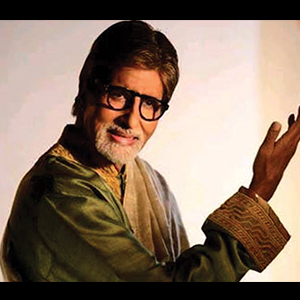
Amitabh Bachchan in a still from Yash Chopra’s DeewaarAmitabh Bachchan
While during the late ’60s and early ’70s Hindi cinema witnessed the dominance of romantic movies with actors like Dev Anand, Rajesh Khanna, Shashi Kapoor, Dharmendra and actresses like Sharmila Tagore and Asha Parekh becoming household names, by the mid-1970s a new kind of hero emerged who was not identified by his chocolate boy image but by his rugged machismo. Popularly described as the ‘Angry Young Man’, this new protagonist actually represented the anger and frustration of an entire generation exploited by those in power. For, this was a period of political, social, and economic upheaval in India with the issues of poverty, unemployment, and political violence plaguing the common man more than ever.
While Amitabh Bachchan made this character his own (with the grand success of films like Zanjeer, Deewaar, and Sholay) through the ’70s and the ’80s, actors like Anil Kapoor and Sunny Deol carried the mantle forward into the ’90s. The ’70s and ’80s also marked the advent of the Indian New Wave or Parallel Cinema with films like Ankur (1973), Nishant (1975), Manthan (1976), and Saaransh (1984). Mrinal Sen’s Bhuvan Shome (1969) is widely considered as the starting point of this movement. Shyam Benegal, Mani Kaul, Ketan Mehta, and Govind Nihalani are some of the prominent names of the Indian New Wave.
The ‘90s and the Khan Trio
Kajol and Shah Rukh Khan in Dilwale Dulhaniya Le Jayenge.
The late ’80s and the ’90s witnessed commercial Hindi cinema go from strength to strength with blockbusters like Mr. India (1987), Tezaab (1988), Qayamat Se Qayamat Tak (1988), Maine Pyar Kiya (1989), Khiladi (1992), Darr (1993), Mohra (1994), Hum Aapke Hain Koun..! (1994), Karan Arjun (1995), Dilwale Dulhaniya Le Jayenge (1995), Raja Hindustani (1996), Dil To Pagal Hai (1997), Kuch Hota Hai (1998), Pyaar To Hona Hi Tha (1998), and Mann (1999) setting new box office records. Many of these films starred Anil Kapoor, Shah Rukh Khan, Salman Khan, Akshay Kumar, Aamir Khan, Ajay Devgan, Madhuri Dixit, Karisma Kapoor, and Kajol.
Kangana Ranaut and R. Madhavan in Anand L. Rai’s Tanu Weds Manu
At the turn of the 21st century, parallel cinema underwent a revival of sorts with the arrival of filmmakers like Ram Gopal Varma, Madhur Bhandarkar, and Anurag Kashyap, whose cinema mainly dealt with depiction of organized crime. The success of Satya (1998), Chandni Bar (2001), Company (2002), Black Friday (2004), and Sarkar (2005) proves beyond doubt the changing tastes of the Hindi film audiences during this phase.
The growing influence of the Indian Diaspora on Bollywood filmmakers
If we study Hindi cinema closely, we observe that the 1990s proved to be the tipping point with Nehruvian socialism making way for economic liberalization in India. As the Indian economy gradually opened up to the world, the Hindi cinema underwent an Anglicization of sorts owing to the growing influence of the Indian Diaspora – a trend that is best demonstrated by films like Dilwale Dulhania Le Jayenge (1995), Pardes (1997), Kabhi Khushi Kabhie Gham (2001), and Namastey London (2007). During this period, Bollywood started catering more and more to the English-speaking Indians. The trend perpetuated with the multiplex boom.
Subsequently, filmmakers like Vishal Bhardwaj, Anurag Kashyap, and Tigmanshu Dhulia made efforts to bring about a change to this trend by making films such as Matru Ki Bijlee Ka Mandola (2013), Gangs of Wasseypur (2012), Paan Singh Tomar (2012), etc.
Bollywood and the 100 Crore Club
During this phase, Hindi cinema continued to take new leaps in terms of revenue generation but there appeared to be a stagnation of sorts in terms of creative thinking. The success of a Hindi film started depending on whether it entered the ‘100 Crore Club’ or not. Even the most successful films would run only for a few weeks as opposed to the ‘Jubilee Era’, when success was measured in terms of the number of weeks a movie ran in the theatres: 25 weeks (Silver Jubilee), 50 weeks (Golden Jubilee), or 75 weeks (Platinum Jubilee).
Hindi cinema and the Hindi heartland
Manoj Bajpayee as Bhikhu Mhatre in Ram Gopal Varma’s Satya
Building on the trend that was started by the likes of Anurag Kashyap, Tigmanshu Dhulia, Vishal Bhardwaj, and Aanand L. Rai, Hindi films subsequently started focusing consciously on stories based in the Hindi heartland. The diaspora no longer remained the primary target of Hindi filmmakers and as a result as the industry witnessed a surge in the number of films that are set in north-central India which enjoys a Hindi-speaking majority. But, a lot of the mainstream Hindi films since Lagaan (2001) seemed to lack the impetus needed to march in the global arena. It is true that there have been Hindi films like Miss Lovely (2012), Titli (2014), and Masaan (2015) which have made it to the Un Certain Regard Section at Cannes.
The rise of web and the OTT platforms
Speaking of the audiences, the rise of various OTT platforms has had a dramatic impact on the nature of content produced. Today, we have audiences with such diverse tastes that content creators are forced to create content targeted at different segments of audiences. The COVID-19 pandemic has further given a fillip to OTT platforms. With cinemas indefinitely shut down more and more viewers are forced to shift to one or more of these platforms for their daily dose of entertainment. This has also given rise to what is described as binge-watching. But before we try and examine this in detail, it is first important to decipher the nuances of binge-watching. For the uninitiated, binge-watching is a way of consuming content all in one go as opposed to consuming it in serialized weekly installments. It’s an effective way to watch plot-heavy shows. Now that we have a basic understanding of this novelty we will try and analyze its various aspects. For years cinema has been enjoying an undisputed status over its poor cousin television. While one agrees with the classification of cinema and television as two different mediums it cannot be denied that with the advent of new age content the line between the two is fast fading. In fact, today we can easily look at the majority of binge-worthy international television / web series as 8 or 10 hour films and that’s primarily because of the topnotch production values and the cinematic grammar associated with them.
A still from SonyLiv show Rocket Boys
The advent of streaming services like Netflix and Amazon Prime has given rise to Indian original shows like Delhi Crime, The Family Man, Special Ops, Sacred Games, Scam 1992, Rocket Boys, Mirzapur, Apharan ,Inside Edge, Panchayat, Undekhi, Aashram, and Kota Factory, among others. The rapid emergence of binge-worthy content is proving to be a real game changer for the Indian entertainment industry at large. This is in stark contrast to some of the daily soaps we have grown accustomed to watching on Indian television over the years. But there is an interesting flip side to this trend. Often the viewer is in such a hurry to finish off a season that he / she often ends up overlooking some important details. Perhaps, this is a price that most viewers are willing to pay.
The emergence of binge culture is not just impacting the end consumers it is also pushing the artists to expand their horizons. The rise of binge culture poses a big challenge for the artists to make themselves platform agnostic. Putting together an 8 to 10 hours of quality content for every season requires a different level of creative commitment. However, at the same time, it provides them with a wonderful opportunity to reinvent themselves as per the changing needs of time. Now, India’s entertainment industry has a great scope for embracing new trends, the rise of binge culture is bound to have a strong impact on cinema viewing in the longer run once normalcy returns post-pandemic. While the opinions surrounding binge culture may widely vary, even the staunchest critics wouldn’t deny that the rise of new platforms like Netflix has led to greater accessibility, reach, and creative freedom.
The contribution of NRI filmmakers to Indian cinema
A still from Tirlok Malik’s Khushiyaan
While discussing Indian cinema post-independence one would be remiss to overlook the contributions of NRI filmmakers whose multifaceted work offers a unique blend of cinema that binds the Indian Diaspora with the general populace. Emmy-nominated Indian-American filmmakerTirlok Malik is best known for making films about Indian immigrants in the US. Malik’s filmmaking journey started with his pioneering work Lonely in America (1990) which he wrote and produced while also acting in it. The film was shown in over 70 countries and screened at several leading festivals all across the globe. Since then he has made several other films about issues pertaining to the Indian diaspora such as Love Lust and Marriage, On Golden Years, and Khushiyaan which he shot in India with an ensemble cast that featured the likes of Jasbir Jassi, Tisca Chopra, Kulbhushan Kharbanda, and Rama Vij. Many internationally acclaimed filmmakers have also contributed wholeheartedly to the growth and development of Indian cinema in the global arena—most notably Mira Nair (Salaam Bombay!, Kama Sutra: A Tale of Love, Monsoon Wedding, The Namesake, The Reluctant Fundamentalist, A Suitable Boy), Deepa Mehta (Fire, Earth, Midnight’s Children, Leila), and Gurinder Chadha (Bend it Like Beckham, Bride and Prejudice, Viceroy’s House, Beecham House). Also, filmmakers Raj & DK deserve a special mention here as they too started their filmmaking journey outside India with their 2003 film Flavors about Indian immigrants living in America. In the recent years, Raj & DK have emerged as two of the most sought-after filmmakers in India. Their Amazon Prime Video web show The Family Man starring Manoj Bajpayee in the role of an Indian intelligence officer named Srikant Tiwari has emerged one of the most popular shows in the Indian web space.
The journey of Indian cinema since 1947 has had its share of ebbs and flows and the path forward is laden with difficulties and challenges. While there are opportunities galore, there are also many obstacles. Amit Khanna, the writer, director, and producer who has been an integral part of the Hindi film industry for the last five decades, recollects how he convinced his filmmaker friends to join him for a meeting he had set up with Federation of Indian Chambers of Commerce & Industry (FICCI) during the early ‘90s which proved to be instrumental in helping Bollywood get an industry status. “After our studio system got dismantled around WWII, it took us almost five decades to once again get a little organized and corporatize things. I remember when I took my close friends such as Yash Chopra, Manmohan Shetty, Ramesh Sippy and others to a meeting with FICCI they all questioned the rationale behind it. Then over time the people realized the importance of the corporate connect. Back then I was the lone voice pushing for institutional financing and recognition as an industry. Through repeated representations with the government and relentless efforts we finally succeeded in securing the industry status that paved the way for the entry of the larger corporate players while some of the smaller ones also started getting institutionalized as funding became a lot more transparent,” explains Khanna who began his career as an executive producer with actor-producer Dev Anand’s Navketan Films in 1971. “In the ‘70s the video came in and kind of disturbed the equilibrium. There was a lot of resistance from producers and distributors against video. Also, there was a video piracy which continued well into the ‘80s. From a peak cinema screen count of 13,000 the number went down drastically by the ‘90s to less than 9,000. It was only towards the end of the 90s with the multiplex boom that things changed,” recollects Khanna.
Award-winning filmmaker and author Dr. Bhuvan Lall feels that the rich diversity that the Indian cinema continues to enjoy is seen nowhere else in the world. “A healthy cinema culture with regional flavors can only exist in a democratic setup where the artists are free to speak. India is a striking example of the largest producer of content on earth today. There is no denying that despite all the problems that we face as a country, our film industry is totally secular, totally based on Indian ethos, and capable of producing a vast array of content ranging from realism to fantasy. Here people love to say what they want to say. In any other country this is not possible as the population size doesn’t allow it. At the end of the day, you need to have a market for such diverse content and most countries in the world don’t enjoy the same luxury,” explains Lall.
Noted Indian critic Ajit Rai, however,feels that European audiences need to know more about Indian cinema, especially beyond the works of Satyajit Ray. In the past, most of our commercial films to have tasted global success outside of the Indian Diaspora actually had a strong melodramatic appeal which greatly worked to their advantage,” opines Rai whose book on the Hinduja Family and the Indian Cinema titled ‘Hindujas and Bollywood,’ which tells the untold story of the global journey of over 1200 Hindi films as undertaken by the Hinduja brothers, starting with the 1950s, establishing Bollywood as a global brand, was launched in London, back in July 2022.
(Murtaza Ali Khan is an Indian Film & TV Critic / Journalist who has been covering the world of entertainment for over 10 years. He tweets at @MurtazaCritic and can be mailed at: murtaza.jmi@gmail.com).
Veteran actor Arun Bali, best known for his work on TV show “Swabhimaan” and blockbuster hit “3 Idiots”, died on Friday morning at his residence in suburban Mumbai. He was 79. Bali’s son Ankush said his father was suffering with Myasthenia gravis, an autoimmune disease caused by communication failure between nerves and muscles, for which he was admitted to a hospital early this year. Ankush said his father was responding well to the treatment but passed away at around 4.30 am.
“My father left us. He was suffering from Myasthenia gravis. He had mood swings for two-three days. He told the caretaker he wanted to go to the washroom and after coming out he told him he wanted to sit down and he never got up then,” he told PTI. Bali made his acting debut with noted filmmaker Lekh Tandon’s TV show “Doosra Keval” as superstar Shah Rukh Khan’s uncle and went on to work in TV shows such as period drama “Chanakya”, “Swabhimaan”, “Des Mein Niklla Hoga Chand”, “Kumkum – Ek Pyara Sa Bandhan”, and “P.O.W. – Bandi Yuddh Ke”.
Some of his popular films include “Saugandh”, “Raju Ban Gaya Gentleman”, “Khalnayak”, “Satya”, “Hey Ram”, “Lage Raho Munna Bhai”, “3 Idiots”, “Ready”, “Barfi”, “Manmarziyaan”, “Kedarnath”, “Samrat Prithviraj”, and “Laal Singh Chaddha”.
His last film “Goodbye”, also featuring Amitabh Bachchan and Rashmika Mandanna, released on Friday. Source: PTI
EDISON, NJ (TIP): To express their love and admiration for Bollywood megastar Amitabh Bachchan, an Indian American family has come up with an out-of-the-box idea and installed a life-size statue of their “God” outside their home in the Edison City of New Jersey. Some 600 people gathered outside the house of Rinku and Gopi Seth in Edison, often called ‘Little India’ for being home to a significantly large Indian-American population, when the statue was formally unveiled by eminent community leader Albert Jasani. The statue is placed inside a large glass box. The ceremony was accompanied by the bursting of fire-crackers and an impromptu dance by a fan club of the 79-year-old Indian superstar. “He is nothing less than a God to me and my wife,” Gopi Seth said. “The biggest thing that inspires me about him is not only his reel life, but also the real-life … how he manages himself in public, how he conveys and communicates …”
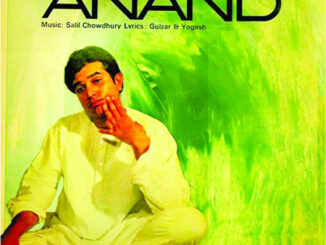
Filmmaker Hrishikesh Mukherjee’s classic ‘Anand’, starring the then superstar Rajesh Khanna and Amitabh Bachchan, is set for a remake helmed by Sameer Raj Sippy, grandson of the film’s original producer, N.C. Sippy, and Vikram Khakhar. The director and cast of the film, which is in its scripting stage, are yet to be finalised.
Sharing his excitement on the development, producer Vikram Khakhar said in a statement: “Digging into our own classics, we will find invaluable gems rather than scouting for stories, internationally or regionally. Placing Anand in the post-Covid era, where we emphasise on the value of life, will enhance the story of Anand.”
The 1971 original featured Rajesh Khanna as a terminally ill cancer patient, Anand Sehgal, the onus of whose treatment is taken by Amitabh. However, destiny has its own plans as Anand’s cancer reaches its final stage and he passes away but not before touching the lives of many people whom he spent time with, including a total stranger Isa Bhai Suratwala played by the legendary Johnny Walker. Producer Sameer Raj Sippy feels that such stories need to be told to the new generation, as they should be made aware of our cinematic heritage. He said: “Keeping in mind the sensibilities of the original film and the emotions attached, I felt the current generation needs to be retold many stories that are so relevant today and especially when there is a great appetite for good content.”
Filmmaker Nagraj Manjule‘s sports drama Jhund, headlined by megastar Amitabh Bachchan, is set to have its digital premiere on ZEE5 on May 6. The film featured Bachchan as Vijay Barse, a Nagpur-based retired sports teacher who pioneers a slum soccer movement. Jhund released theatrically in March but couldn’t translate its glowing reviews to box office glory. Manish Kalra, Chief Business Officer, ZEE5 India described Jhund as an inspiring film that sends a “powerful message to our youth”.
“The stories right from the heartlands resonate with audiences and I am happy to bring it exclusively to our ZEE5 audiences. As a customer-first brand, we will continue to invest in understanding our viewers and their interest areas to build a slate of real, authentic and relatable content.
“The roster for the next few months is strong and we are hopeful, Jhund will drive in much love and appreciation from the audiences,” Kalra said in a statement on Thursday. Jhund, which marked the Hindi debut of Manjule after acclaimed Marathi films like Sairat and Fandry, was produced by Bhushan Kumar’s T-Series.
Kumar said the story of Jhund transcended boundaries. Source: PTI
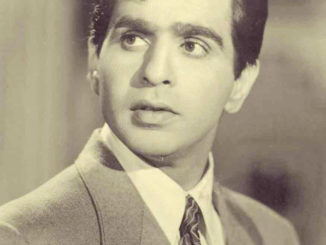
MUMBAI (TIP): Dilip Kumar, the Bollywood icon, hailed as the “Tragedy King” and one of Hindi cinema’s greatest actors, died Wednesday, July 7, in a Mumbai hospital after a prolonged illness. He was 98. “Dilip Kumar will be remembered as a cinematic legend. He was blessed with unparalleled brilliance, due to which audiences across generations were enthralled. His passing away is a loss to our cultural world,” Indian Prime Minister Narendra Modi said in a tweet.
“An institution has gone,” Bollywood superstar Amitabh Bachchan tweeted. “Whenever the history of Indian Cinema will be written, it shall always be ‘before Dilip Kumar, and after Dilip Kumar’.”
The passing of Dilip Kumar, the king of melancholia on the silver screen, signals the final break from the early days of Hindi film ‘talkies’, when actors were beginning to shed the exaggerated theatricality of stage drama and learning to love the camera. In the 1930s and 1940s, Ashok Kumar, Motilal Rajvansh and Balraj Sahni were among the handful of actors taking pioneering steps towards natural, realistic acting. They were eschewing the preceding style that — with its hand-waving, over the top gestures and facial expressions — seemed affected and artificial. Then came Dilip Kumar, the Pathan from Peshawar, who went a step further, deep into the skin of the character he was playing. He didn’t make a mark in his earliest movies, but collaborating with Nitin Bose in 1946 proved a turning point. He began to develop the finer nuances of his craft and, in his own words, ‘evolved a method’ — a method actor without training.
Through the 1940s to 1960s, in a newly-independent country brimming with hope but grappling with new challenges, Dilip Kumar played an impressive range of characters — a dapper young man in Andaz, a farmer in Mela and Naya Daur, an unbounded adventurer in Azaad and Kohinoor, the prince in Mughal-e-Azam, a dacoit in Ganga Jamuna. But the role that epitomized his ‘Tragedy King’ persona was as Devdas in Bimal Roy’s film of the same name in 1955. Deep-diving into tragic characters caused him to be depressed, and the light-hearted, swashbuckling roles he played in the mid-1950s were part of efforts to cheer his spirits.
By the 1970s, with Dilip Kumar in his 50s, his charm as the leading man began to fade and he made an impressive transition into character roles — the most memorable role of this phase was as a police officer in Shakti (1982), in which he is clearly the giant among Amitabh Bachchan, Smita Patil and Kulbhushan Kharbanda. His brooding style, however, began to seem dated by the time he did his final films. He long outlived his two foremost rivals and friends, Raj Kapoor and Dev Anand — but at 98, it is time for the finest actor of his time to take the final bow.
Amitabh Bachchan had his legion of fans worried as he revealed on Saturday night that he has undergone a surgery. The actor didn’t reveal many details in his blog post. On Monday morning, the 78-year-old actor wrote in a lengthy post that he had undergone a ‘delicate procedure’ for his eyes. “Thank you for all the concern and the wishes for the medical condition. Eye surgeries at this age are delicate and need precision handling. The best is being done and one hopes all shall be well. The sight and the recovery is slow and difficult so if there are typing errors they are to be excused. Right now, I feel like Gary Sobers, the West Indian great and his narration of a cricket story which apparently he went through. The details of which shall be given in time. It is a story heard whether or not it is authentic is questionable.” He also revealed that another surgery will happen shortly. “My love to all… progress is slow and there is yet another eye to go. So it’s a long haul, hoping of course that it all gets well in time for my schedule which begins in a few… the new film with Vikas Bahl, tentatively titled ‘GoodBye’.”
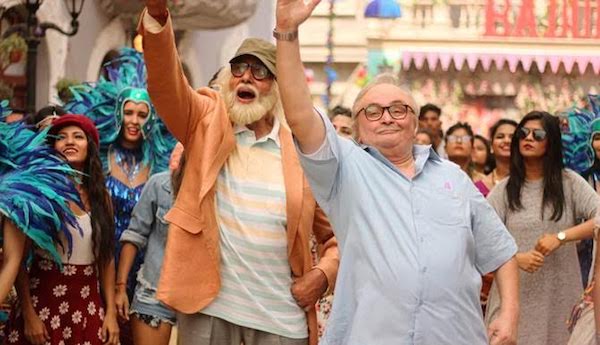
BADUMBAA IS OUT NOW! AMITABH BACHCHAN & RISHI KAPOOR SHOW OFF THEIR DANCE MOVES IN 102 NOT OUT’S LATEST SONG!
NEW YORK CITY(TIP): Get ready to dance! The latest song from the upcoming film 102 Not Out has been released – the high energy number ‘Badumbaa’.
The vibrant song is composed by the inimitable Amitabh Bachchan himself and sung by Bachchan and Rishi Kapoor. The video sees the energetic 102-year-old Dattatraya (Bachchan) dancing in the streets as a carnival takes place and encouraging his grumpy 75-year-old son Babulal (played by Kapoor) to join in the festivities.
The quirky song is a fun filled ride full of music and dance, with the video featuring a dynamic collection of festival colors and grooving dance moves. Both Bachchan and Kapoor show that they are more than able to keep up with their animated surroundings.
The song was launched at a special event which saw Bachchan and Kapoor joined by fellow 102 Not Out actor Jimit Trivedi and director Umlesh Shukla.
102 Not Out is a comedy-drama produced by Treetop Entertainment and directed by Umesh Shukla. 102 years young Dattatraya Vakharia (Amitabh Bachchan) lives life to the fullest and wants to break the record of oldest living man- that’s held by a 118 years old Chinese. Dattatraya wants to live a stress-free life in order to become the oldest living man. However, there is only one hinderance- his 75-year-old son Babulal (Rishi Kapoor) who has resigned himself to a life of old age stuck in drudgery.
Dattatraya now must find means and ways to change Babulal’s sad and grumpy demeanor so that he doesn’t become a deterrent in breaking the record.
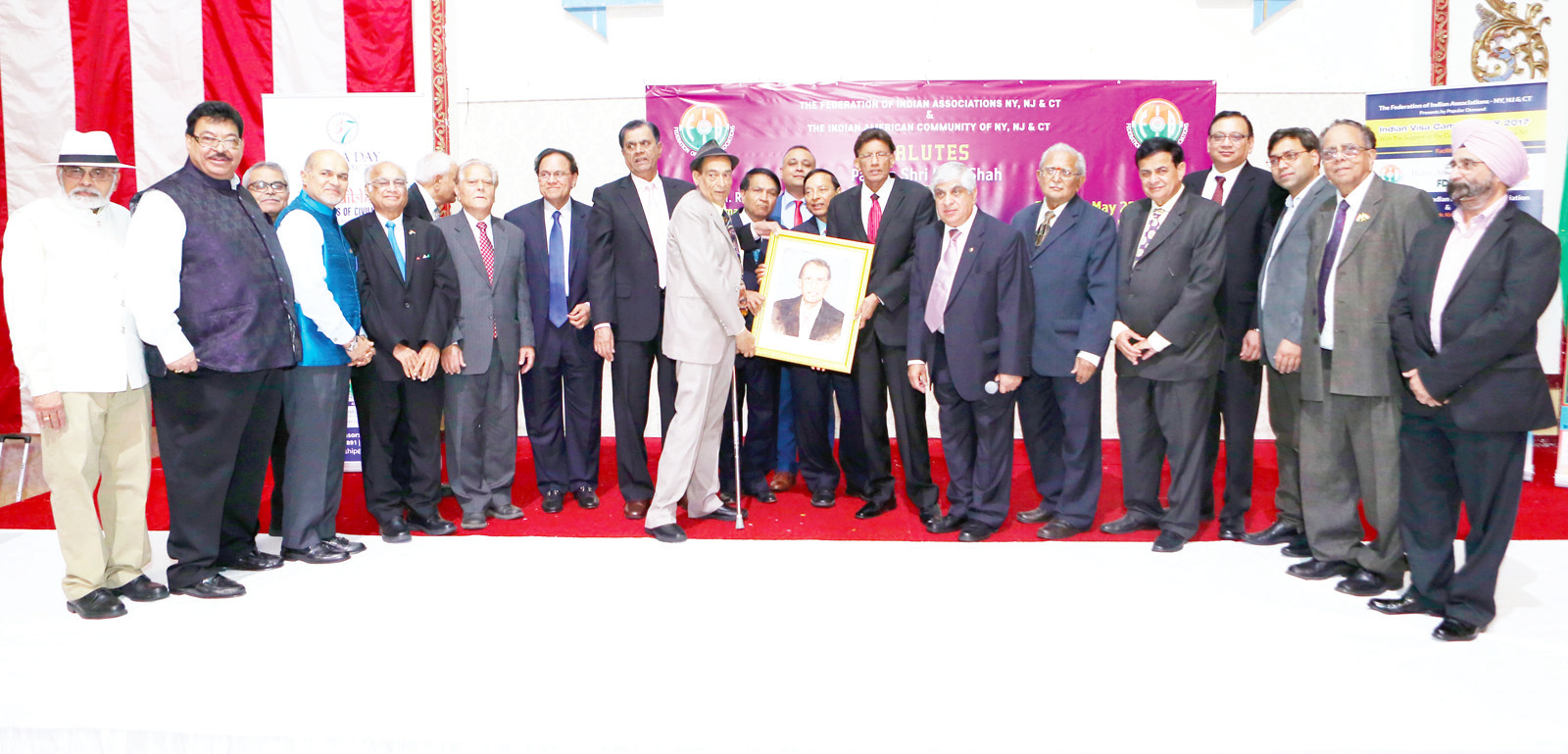
Ambassador Riva Ganguly Das appreciated the contribution of HR Shah
Dozens of speakers including Ambassador Riva Ganguly Das, Consul-General of India in New York, paid glowing tribute to HR Shah, Chairman and CEO of TV ASIA, who recently received the PadmaShri award from the President of India in New Delhi.
The event was organized by the Federation of Indian Association at Royal Albert’s Palace in Fords, New Jersey.
Shah has been associated with numerous social and cultural organizations in USA including being the founder member of Global Organizations of
People of Indian Origin and a past president and trustee of the Federation of Indian Associations (FIA). Congratulating Shah for being the recipient of the Padma Award, Consul-General Das said, “Shah is a deserving person whose contributions are well recognized in USA and in India. The Government of India recognized his services for the community and for the people of Indian origin. He made remarkable contribution towards strengthening the Indo- US ties”.
“The Government of India has recognized Shah as a leading personality who helped uplift the status of literature, journalism, and entertainment world.”, said Dr. Sudhir Parikh, Chairman of Parikh Worldwide Media. Parikh, himself a recipient of PadmaShri. Parikh commented that Shah’s generous attitude towards the Indian-American community has been well recognized by the Government of India.
Dr. Navin Mehta, a fellow trustee of Bharatiya Vidya Bhavan (USA), complimented Shah for his hard work as an entrepreneur and philanthropist. Mehta was the only speaker who delivered his speech in Hindi at the event. He pointed out that Shah, with his nature, was a busy person always contemplating new ideas. He is a true role model for the community”.
Shah is the Chairman and Trustee of Bharatiya Vidya Bhavan (USA), which dedicated an auditorium, “Romanti Auditorium”, in memory of H.R. Shah’s late daughter.
Andy Bhatia, president of FIA, said that Shah made untiring efforts to strengthen various activities for improving the image of India in USA. “One such activity is the India Day Parade in New York City, launched many decades ago with the active support of H. R. Shah.”
In an emotionally charged speech, HR Shah thanked the community for their love
Shah, who made an emotional speech at the event, said that his life has been a difficult journey that taught him many lessons. “I faced financial losses in my previous enterprises, but was able to turn around the business at TV Asia with hard work”, he pointed out. “I am dedicated to my people and my community. I have great interest in literature and journalism which propelled me to the current level of recognition.”
Shah has received numerous awards and honors in the past including the prestigious Ellis Island Medal of Honor, the highest award conferred to honor the immigrant communities. The medal is presented to prominent persons who display significant contributions to their own communities and to the United States at large.
Shah is the first NRI to run a 24/7 TV Channel, TV Asia, coast-to-coast throughout North America since 1993, reflecting his diverse interests. The channel was founded by Bollywood super star Amitabh Bachchan. TV ASIA has been a pioneer, produced in America, with local coverage (English, Hindi, Gujarati) in all major cities of the United States, Canada and the Caribbean. TV Asia is viewed on Echo Star (Dish Network) as well as various cable platforms. Shah has also launched a 24/7 free broadcast ethnic Radio Station called “Radio Chai,” all over USA.
Shah was nominated the first Chairman of the Board of Trustees for the Asian American Retailers Association, that represented more than 50,000 retailers in the United States.
Others who spoke on the occasion included Albert Jassani, Ramesh Patel and trustees of the FIA.
The nation was left shocked today morning when the news broke that 59-year old actress, Reema Lagoo passed away. The Maine Pyar Kiya star suffered a heart attack last night and was admitted to Kokilaben Dhirubhai Ambani Hospital in Mumbai. However, she passed away at 3 am in the morning today (May 18). With no reports of the actress’ ill health till today, the news stunned all. The news was confirmed by her manager and since then, Twitterati has been mourning her death.
Reema was one of the best in her league of actors and has done quite a few memorable films in the industry. She was close to many actors and celebrities in Bollywood and hence, several eminent personalities did not believe when they heard about the news. Rishi Kapoor, Riteish Deshmukh, Mahesh Bhatt sent out heartfelt condolences on Twitter early in the morning. And now Priyanka, Amitabh and Alia have expressed their shock. See their reaction right here:
Priyanka Chopra: RIP #ReemaLagoo such a loss to art and cinema. You are and will always be our favourite screen mom. My condolences to the family.
Amitabh Bachchan: T 2428 – Just heard the shocking and unbelievable news about Reema Lagoo’s passing .. such a fine talent and gone so young ! Very SAD !!
Alia Bhatt: So so sad to hear about Reema Lagoo ji!Such a phenomenal actor & a lovely warm person! I have always loved & admired her work. Shocked!!
Arjun Kapoor: #ReemaLagoo ji, you will be hugely missed! Strength and courage to your family and friends. RIP
Parineeti Chopra: Shocked!!! Reema Lagoo ji was one of the most lovable moms on screen!!! Rest in peace.
Sidharth Malhotra: Very sad to know about #ReemaLagoo ji passing away, the warmest n most loved mother on screen RIP
Supriya Pilgaonkar: What an actor ! What grace ! What passion ! Learnt so much from her. May her journey towards light be celebrated RIP Saasu Ma #ReemaLagoo
Anushka Sharma: Grew up watching d warmth & love #ReemaLagoo ji brought out on screen. Saddened by her sudden demise.Heartfelt condolences to her family…
Madhuri Dixit-Nene: Saddened. RIP #ReemaLagoo. She radiated talent, beauty and such warmth. She will be missed. Condolences to her family.
May her soul Rest in Peace. The industry shall miss her.
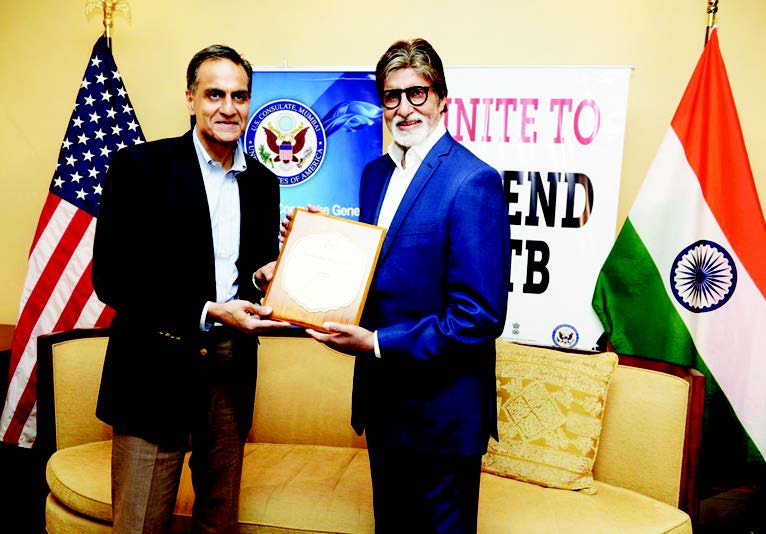
NEW DELHI (TIP): Megastar Amitabh Bachchan has been honored by the US Embassy to acknowledge his immense contribution to the India-US ties on tuberculosis. The award was presented on January 8 by US Ambassador to India Richard R Verma to the 74-year-old actor, who himself is a TB survivor and brand ambassador for the cause.
After receiving the award, Bachchan went live on Facebook with Verma to discuss the cooperation between the two nations to spread awareness about the much-feared disease.
Remembering his first encounter with Verma, Bachchan said that they have been associated since 2015, when the latter was awarded the Padma Vibhushan.
Bachchan adds, “Within a week later, I received a letter from the ambassador (citing that) … We are looking at doing something about tuberculosis in India. Would you be kind enough to entertain in joining this effort? And I readily agreed.” The “Pink” actor also said that it was embarrassing that India is the largest carrier of TB in the world.
Recounting his “Kaun Banega Crorepati” days, when he experienced excruciating pain in the spine, he said, “I survived on 8-9 painkillers every day. In 2002, it was discovered in a general investigation that I was suffering from the tuberculosis of the spine.”
Bachchan added, “Without immodesty, I can say that if it (TB) can happen to me it can happen to anyone. If it is detected in time, there is a cure.” The actor was especially impressed with the involvement of women in spreading awareness and busting myths about the disease under this initiative. He said that it was inspiring how they fought both with the disease and fear of alienation due to the social stigma about the disease.
On giving the award to Bachchan, Verma said, “We are proud to give you this award for your leadership and everything that you have done.”
The US ambassador also said that the US government has been working with the Indian government for over 20 years on tuberculosis.
“Over USD 100 million have been invested… we have treated over 15 million people with our Indian partners, saved millions of lives from the disease,” he added. (PTI)
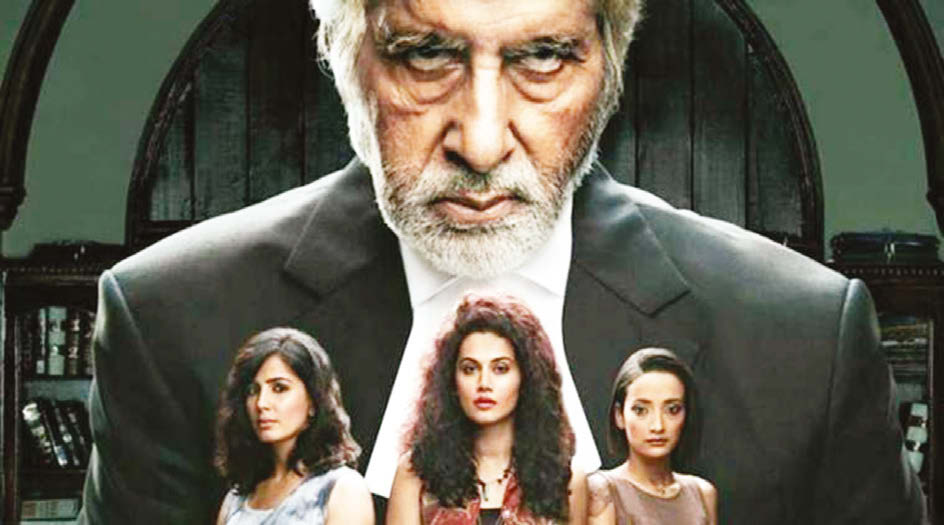
NEW YORK (TIP): Amitabh Bachchan-starrer PINK, which dealt with crime against women, has been invited for a special screening at the United Nations headquarters in New York.
The 73-year-old Bollywood actor, who plays a lawyer in the film, announced the news on Twitter, saying, “‘PINK’ invited for a special screening of the film at UN Headquarters, in New York… by Assistant Secretary General… honoured!”
The courtroom drama reflects on the plight of women in today’s world and the blatant discrimination they face.
Directed by Aniruddha Roy Chowdhury, the film also starred Taapsee Pannu, Andrea Tariang and Kirti Kulhari in lead roles.
It released on September 16 in India. The film was widely appreciated by the audience and the critics alike.
Awards go up in public esteem if given on merit, and decline if extraneous considerations prevail.
Of all the Padma awardees this year the most controversial is the choice of veteran actor Anupam Kher. That his wife is a BJP MP can be ignored. What cannot be forgotten and forgiven is his doublespeak. In 2010 he said, “Awards in our country have become a mockery of our system. There is no authenticity left in any one of them. Be it films, national or now Padma.” After getting a Republic Day award this year, he tweeted: “Happy, Humbled & Honoured to share that I have been awarded The PADMA BHUSHAN by the Govt. of India. Greatest news of my life:) #JaiHind” (sic).
Anupam Kher is a hugely talented actor who fully deserves the award. But the timing is wrong. Getting awarded soon after leading a pro-BJP drive to counter the political fallout of the nationwide debate on intolerance and the return of awards by distinguished citizens from various fields reduces the significance of the honour. The impression has gained ground that he has been rewarded for the political services he has rendered rather than for his acting talent. The Modi government could have escaped the charge of politicisation of awards had it also chosen one of its critics in the intolerance debate – be it Shah Rukh Khan, Aamir Khan or Karan Johar instead of say Madhur Bhandarkar, the maker of “Calendar Girls”. A once secular, highly professional film industry stands divided today – those who see India as a tolerant nation under Modi and those who do not. The “Incredible India” campaign has been taken away from Aamir Khan and handed over to Amitabh Bachchan and Priyanka Chopra.
Whether newspaper owners, journalists, retired bureaucrats and CAGs should accept awards is debatable. There are some who do not feel any sense of guilt in being partial towards a politician or a party, or flaunting their political connections and lobbying for favours, while others – and their number is shrinking – maintain a distance from politicians and governments in a bid to remain independent and objective.
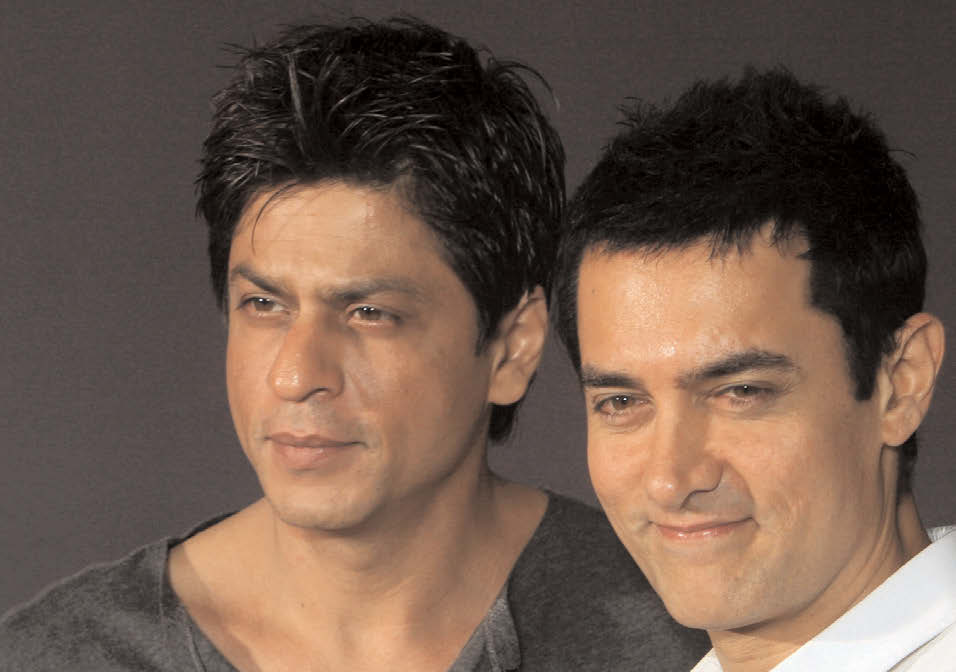
MUMBAI (TIP): MumbaiPolice have trimmed or withdrawn the security cover of 40 Bollywood celebrities including Aamir Khan and Shah Rukh Khan in what it called a “routine” procedure. Senior officials said the step was taken after an assessment review which revealed the Bollywood celebs were no longer facing a threat.
Shah Rukh and Aamir’s security was heightened after the Bollywood stars commented on “rising intolerance” in India. They were given armed protocol and vehicles after right-wing organisations protested their comments, Indian Express reported.
While Aamir had said his wife, Kiran Rao, wondered whether they should leave India in the face of rising intolerance, Shah Rukh had said not being secular was the worst crime as a patriot.
However, after the assessment, the Khans will now get only two armed constables shadowing them in two shifts, the daily reported.
Security has been fully withdrawn from filmmaker Vidhu Vinod Chopra, director Rajkumar Hirani, director Farah Khan and producer siblings Ali and Karim Morani.
The officials said reviewing security cover of celebrities is a routine practice and there is nothing new in it. They also pointed out that the move was aimed at trimming unwanted security cover. Only 15 Bollywood celebs will get security cover from the Mumbai Police including actors Amitabh Bachchan, Akshay Kumar and producer Mahesh Bhatt.
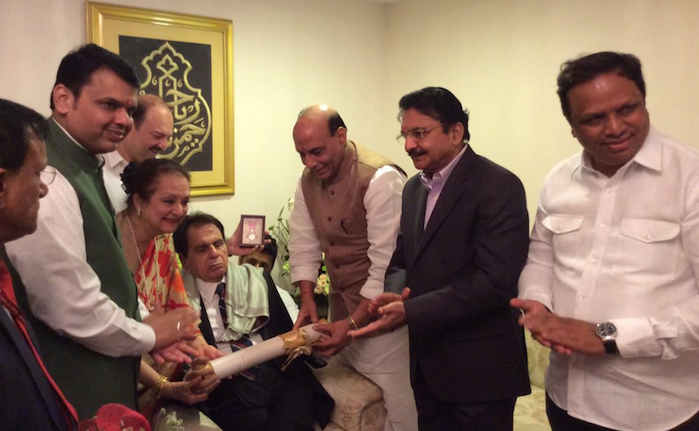
Mumbai: Ailing legendary actor Dilip Kumar, 93, was on Sunday, December 13, presented the Padma Vibhushan — India’s second highest civilian award — by Union Home Minister Rajnath Singh at the thespian’s residence in suburban Bandra for his contribution to the Hindi cinema spanning over six decades.
Famously known as the tragedy king, the veteran actor has immortalised films like Devdas, Mughal-e-Azam, Naya Daur, Madhumati, Ram Aur Shyam and Saudagar with his brilliant performance.
The 93-year-old legend was presented a medal, a certificate and a shawl by Singh, in the presence of the actor’s wife Saira Bano.
Kumar, in a black suit, could barely open his eyes and was helped by Saira when the national honour was conferred on him. He has given sterling performances in over 60 Hindi films.
Maharashtra Governor C Vidyasagar Rao, Chief Minister Devendra Fadnavis, were among other dignitaries present at the actor’s home when he received the award.
The announcement to honour Bollywood veterans Kumar, Amitabh Bachchan and a few others with the prestigious Padma Vibhushan award was made by the government on the eve of Republic Day on January 25, 2015.
However, Kumar, due to ill-health, could not attend the special function held at the Rashtrapati Bhavan in April when other Padma awardees were honoured by President Pranab Mukherjee.
Born as Muhammad Yousuf Khan in Peshawar(Pakistan), Kumar made his debut as an actor in the film “Jwar Bhata” produced by Bombay Talkies in 1944.
He starred in films of a variety of genres such as the swashbuckling Aan (1952), the comical Azaad (1955), the historical Mughal-e-Azam (1960) and the social Ganga Jamuna (1961).
He also did films like Ram Aur Shyam (1967), Kranti (1981), Shakti (1982), Karma (1986) and Saudagar (1991) and others. His last film was Qila (1998).
The Government of India honoured him with the Padma Bhushan award in 1991, the Dadasaheb Phalke Award in 1994 and the Padma Vibhushan earlier this year, for his exceptional and distinguished contribution to the Indian cinema.
NEW DELHI (TIP): Legendary Bollywood actor Amitabh Bachchan became a co-owner of the International Premier Tennis League (IPTL) team OUE Singapore Slammers.
“One of the most well known faces and voices of global cinema, Amitabh Bachchan, announced today that he will be co-owner of the OUE Singapore Slammers alongside the local company UD Group who acquired the team earlier this year,” Singapore Slammers said in a statement.
Bachchan will make a courtside appearance on December 20 at the Singapore Indoor Stadium on the final day of the season. He will also be interacting with fans during the course of the day.
The OUE Singapore Slammers, co-owned by the UD Group and Bachchan, are one of the five teams competing in the second edition of the IPTL. Singapore will host the final leg of the competition from December 18-20 to determine who will be the league champion for 2015.
“My work schedule allows me to only be there for one day, but I’m confident the Singapore Slammers will be playing in the final. I’m also really looking forward to hanging out with members of our clan, the
#SlammersNation. I’d like to invite my fans and tennis fans alike to come spend the day with me at the Singapore Indoor Stadium,” Bachchan said in a statement.
Joining the OUE Singapore Slammers at the Singapore Indoor Stadium will be the UAE Royals, Indian Aces, Philippine Mavericks and Japan Warriors — the newest addition to the season — bringing 35 of the world’s top tennis stars into town for the three-day league climax.
In the wake of UP FSDA finding monosodium glutamate and lead in excess of the prescribed limit in the instant noodles, a district court in Bihar’s Muzaffarpur directed the police today to register an First Information Report or FIR against two Nestle officials and film stars Amitabh Bachchan, Madhuri Dixit and Preity Zinta, who have featured in the Maggi advertisements and arrest them if required.
Additional Chief Judicial Magistrate Ramchandra Prasad directed Kazi Mohammadpur Police Station to register the FIR and investigate the complaint.
The court also directed the police to make arrests if required in the course of investigation.
The case has been filed under IPC sections 270 (malignant act likely to spread infection of disease dangerous to life), 273 (sale of noxious food or drink), 276 (sale of drug as a different drug or preparation) and 420 (cheating and dishonesty).
The government on Monday had said Maggi brand ambassadors will also be liable for action if the advertisements for the snack are found to be misleading.
G. Gurucharan, Additional Secretary (Consumer Affairs) had said everybody associated with the “misleading ad” put out on the nutritive value of Maggi Noodles was liable for action under the Food Safety and Standards Authority of India (FSSAI), but that the final decision will be taken by the courts.
According to Food and Consumer Affairs Minister Ram Vilas Paswan, everybody associated with the “misleading ad” put out on the nutritive value of Maggi Noodles was liable for action under the Food Safety and Standards Authority of India (FSSAI).
WASHINGTON (TIP): The summons issued to Amitabh Bachchan by a federal court in Los Angeles in an alleged human rights violation case has been served to the superstar’s Hollywood manager Feb. 23, according to a Sikh rights body.
New York-based Sikhs for Justice had filed a lawsuit against Bachchan claiming that he had instigated violence against the Sikh community by raising “blood for blood” slogans in 1984.
The movie star has consistently and stoutly denied such allegations.
Bachchan’s manager in Hollywood, David A. Unger, was served with a copy of the federal court summons and complaint by the SFJ Feb. 23.
Unger is a prominent talent agent and co-owner of Three Six Zero Group.
As per federal rules of civil procedure, Bachchan has 21 days after the service of summons to respond to the charges of human rights violations.
“If the defendant fails to respond by Mar. 17, we will move the court for entry of default judgment imposing compensatory and punitive damages against Bachchan for instigating violence which took the lives of thousands of innocent Sikhs during November 1984,” said Gurpatwant Singh Pannun, legal advisor to SFJ.
So far, the Sikh rights body has unsuccessfully filed human rights violation lawsuits against several Indian leaders, including Prime Minister Narendra Modi and his predecessor Manmohan Singh.
NEW DELHI (TIP): Like every year, the Indian government has announced the highly prestigious Padma Awards for the year 2015 on the occasion of Republic (26th January).
Padma Awards, which are one of the highest civilian Awards of the country, are conferred in three categories – “Padma Vibhushan”, “Padma Bhushan” and “Padma Shri”.
“Padma Vibhushan” is the second highest civilian award after “Bharat ratna” given for exceptional and distinguished service to the nation in any field; “Padma Bhushan” is the third highest civilian honor conferred to recognize distinguished service of high order in any field and “Padma Shri” is the fourth highest civilian award given to Indian citizens to acknowledge their distinguished service in various spheres of activity.
The Padma Awards are awarded to distinguished individuals for their exceptional contribution in various disciplines including art, social work, public affairs, science, trade, medicine, literature and education, sports, civil service, etc.
The President of India Pranab Mukherjee approved conferment of Padma Awards on 104 individuals. On 26th January 2015, the 2015 list of Padma Awardees was announce which comprises of 9 Padma Vibhushan awardees, 20 Padma Bhushan and 75 Padma Shri awardees. Out of these 104 awardees, 17 are women and 4 are Posthumous awardees. Also, 17 of the Padma Awardees are from the category of foreigners, NRIs, PIOs.
Following is the list of 104 persons with their Discipline/State/Domicile who are receiving Padma Awards this year:
Padma Vibhushan 1 LK Advani- Public Affairs- Gujarat 2 Amitabh Bachchan- Art- Maharashtra 3 Prakash Singh Badal- Public Affairs- Punjab 4 Dr D Veerendra Heggade- Social Work- Karnataka 5 Mohammad Yusuf Khan alias Dilip Kumar- Art- Maharashtra 6 Jagadguru Ramanandacharya Swami Rambhadracharya- Others- Uttar Pradesh 7 Prof Malur Ramaswamy Srinivasan- Science and Engineering- Tamil Nadu 8 Kottayan K. Venugopal- Public Affairs- Delhi 9 Karim Al Hussaini Aga Khan (Foreigner)- Trade and Industry-France/UK
Padma Bhushan 1 Jahnu Barua- Art- Assam 2 Dr Vijay Bhatkar- Science and Engineering- Maharashtra 3 Shri Swapan Dasgupta- Literature and Education- Delhi 4 Swami Satyamitranand Giri- Others- Uttar Pradesh 5 N Gopalaswami- Civil Service- Tamil Nadu 6 Dr Subhash C Kashyap- Public Affairs- Delhi 7 Dr (Pandit) Gokulotsavji Maharaj- Art- Madhya Pradesh 8 Dr Ambrish Mithal- Medicine – Delhi 9 Sudha Ragunathan- Art- Tamil Nadu 10 Shri Harish Salve- Public Affairs- Delhi 11 Dr Ashok Seth- Medicine- Delhi 12 Rajat Sharma- Literature and Education- Delhi 13 Satpal- Sports- Delhi 14 Shivakumara Swami- Others- Karnataka 15 Dr Kharag Singh Valdiya- Science and Engineering- Karnataka 16 Prof Manjul Bhargava (NRI/PIO)- Science and Engineering- USA 17 David Frawley (Vamadeva) (Foreigner)- Others- USA 18 Bill Gates (Foreigner)- Social Work- USA 19 Melinda Gates (Foreigner)- Social Work- USA 20 Saichiro Misumi (Foreigner)- Others- Japan
Padma Shri
1 Dr Manjula Anagani- Medicine- Telangana 2 S Arunan- Science and Engineering- Karnataka 3 Kanyakumari Avasarala- Art- Tamil Nadu 4 Dr Bettina Sharada Baumer- Literature and Education- Jammu and Kashmir 5 Naresh Bedi- Art- Delhi 6 Ashok Bhagat- Social Work- Jharkhand 7 Sanjay Leela Bhansali- Art- Maharashtra 8 Dr Lakshmi Nandan Bora- Literature and Education- Assam 9 Dr Gyan Chaturvedi- Literature and Education- Madhya Pradesh 10 Prof (Dr) Yogesh Kumar Chawla- Medicine- Chandigarh 11 Jayakumari Chikkala- Medicine- Delhi 12 Bibek Debroy- Literature and Education- Delhi 13 Dr Sarungbam Bimola Kumari Devi- Medicine- Manipur 14 Dr Ashok Gulati- Public Affairs- Delhi 15 Dr Randeep Guleria- Medicine- Delhi 16 Dr KP Haridas- Medicine- Kerala 17 Rahul Jain- Art- Delhi 18 Ravindra Jain- Art- Maharashtra 19 Dr Sunil Jogi- Literature and Education- Delhi 20 Prasoon Joshi- Art- Maharashtra 21 Dr Prafulla Kar- Art- Odisha 22 Saba Anjum- Sports- Chhattisgarh 23 Ushakiran Khan- Literature and Education- Bihar 24 Dr Rajesh Kotecha- Medicine- Rajasthan 25 Prof Alka Kriplani- Medicine Delhi 26 Dr Harsh Kumar- Medicine- Delhi 27 Narayana Purushothama Mallaya- Literature & Education- Kerala 28 Lambert Mascarenhas- Literature and Education- Goa 29 Dr Janak Palta McGilligan- Social Work- Madhya Pradesh 30 Veerendra Raj Mehta- Social Work- Delhi 31 Tarak Mehta- Art- Gujarat 32 Neil Herbert Nongkynrih (Art), Meghalaya 33 Chewang Norphel- Others- Jammu and Kashmir 34 TV Mohandas Pai- Trade and Industry- Karnataka 35 Dr Tejas Patel- Medicine- Gujarat 36 Jadav Molai Peyang- Others- Assam 37 Bimla Poddar- Others- Uttar Pradesh 38 Dr N Prabhakar- Science and Engg- Delhi 39 Dr Prahalada- Science and Engg- Maharashtra 40 Dr Narendra Prasad- Medicine- Bihar 41 Ram Bahadur Rai- Literature and Education- Delhi 42 Mithali Raj- Sports- Telangana 43 PV Rajaraman- Civil Service- Tamil Nadu 44 Prof JS Rajput- Literature and Education- Uttar Pradesh 45 Kota Srinivasa Rao- Art- Andhra Pradesh 46 Prof Bimal Roy- Literature and Education- West Bengal 47 Shekhar Sen- Art- Maharashtra 48- Gunvant Shah- Literature and Education- Gujarat 49 Brahmdev Sharma- Literature and Education- Delhi 50 Manu Sharma- Literature and Education- Uttar Pradesh 51 Prof Yog Raj Sharma- Medicine- Delhi 52 Vasant Shastri- Science and Engg- Karnataka 53 SK Shivkumar- Science and Engg- Karnataka 54 PV Sindhu- Sports- Telangana 55 Sardara Singh- Sports- Haryana 56 Arunima Sinha-Sports- Uttar Pradesh 57 Mahesh Raj Soni- Art- Rajasthan 58 Dr Nikhil Tandon- Medicine- Delhi 59 H Thegtse Rinpoche- Social Work- Arunachal Pradesh 60 Dr Hargovind Laxmishanker Trivedi- Medicine- Gujarat 61 Huang Baosheng- Others- China 62 Prof Jacques Blamont- Science and Engg- France 63 Late Syedna Mohammad Burhanuddin- Others- Maharashtra (Posthumous) 64 Jean-Claude Carriere- Literature and Education – France 65 Dr Nandrajan ‘Raj’ Chetty- Literature and Education- France 66 George L Hart- Others- USA 67 Jagat Guru Amrta Suryananda Maha Raja- Others- Portugal 68 Late Meetha Lal Mehta- Social Work- Rajasthan (Posthumous) 69 Tripti Mukherjee- Art- USA 70 Dr Dattatreyudu Nori- Medicine- USA 71 Dr Raghu Rama Pillarisetti (Medicine), USA 72 Dr Saumitra Rawat- Medicine- UK 73 Prof Annette Schmiedchen (Literature and Education), Germany 74 Late Pran Kumar Sharma alias Pran- Art- Delhi (Posthumous) 75 Late R Vasudevan- Civil Service- Tamil Nadu (Posthumous)
The Padma Awards 2015 will be handed over to the award winners by Indian President Pranab Mukherjee at a ceremonial function due to be held in March/April 2015 at Rashtrapati Bhavan in New Delhi.
PADMA AWARDS 2015 TO RAMDEV, AMITABH BACHCHAN, RAJINIKANTH, ADVANI, OTHERS: REPORTS NEW DELHI (TIP): Yoga exponent Baba Ramdev, Bharatiya Janata Party patriarch LK Advani, spiritual leader Shri Shri Ravi Shankar and veteran actors Amitabh Bachchan and Rajinikanth are among this year’s recipients of the prestigious Padma awards that recognises lifelong service to the country, according to a report.
The awards this year, to be conferred on Republic Day, has several names seen as sympathetic to the ruling party, including lyricist and adman Prasoon Joshi, who worked on the BJP’s advertisement campaign for the Lok Sabha elections, and journalists Swapan Dasgupta and Rajat Sharma. Economist Bibek Debroy, a member of the newly instituted NITI Aayog, is also on the list.
Padma awards, given since 1954 on Republic Day in honour of contributions in wide-ranging pursuits, have often been subject of controversy due to the arbitrary nature of the selection process and inevitable charges of favouritism by the government and the ruling party. They are given in three categories–Padma Shri, Padma Bhushan and Padma Vibhushan, in ascending order of distinction. It’s unclear which names have been picked for which awards.
Punjab Chief Minister Prakash Singh Badal and Advani are the only two politicians in the list of 148 recipients, the report stated.
Yoga exponent Ramdev, whose dedicated yoga television channel and camps are popular, is nonetheless a controversial figure, having said in the past that he can “cure” homosexuality, among other things. His company Patanjali Ayurveda makes consumer products such as soaps, oil and breakfast cereals and in five years had sales worth Rs. 450 crore, with a turnover expected to touch Rs. 2,000 crore.
Actor Dilip Kumar, director Sanjay Leela Bhansali and scriptwriter Salim Khan, badminton player P V Sindhu, wrestler Sushil Kumar and Arunima Sinha, the first woman amputee mountaineer to climb Mount Everest, are among those honoured.
Badminton player Saina Nehwal, who had kicked up a storm about not being nominated and was subsequently included in the list of contenders, has not been awarded, if reports are accurate. The official list is expected to be out today or tomorrow.
T V Mohandas Pai, the Chairman of Manipal Global Education and a former director of Infosys, shares the honour with former bureaucrat N Gopalaswami (ex chief election commissioner), K S Bajpai and P V Rajaraman.
Eminent vocalists Sudha Raghunathan, A Kanyakumari, Girija Devi and Malini Awasthi, actor Smriti Biswas, music directors Anu Malik and Ravindra Jain and Assamese film director Jahnu Barua are said to be on the list. This year two scientists from ISRO–S Arunan of the Mars Mission and S K Shivkumar of Chandrayaan–will also be felicitated, the Express report said.
Padma Awards not yet announced: Govt
The Ministry of Home Affairs on January 23 said that the government has not yet announced any names for the Padma Awards, 2015, and added that the names appearing in the media are speculative.
“Government has not yet announced Padma Awards for 2015. These awards are announced on 25th of Jan every year, on the eve of the Republic Day,” it said.
“The names appearing in the media are speculative and there is no official confirmation for the same,” it added.
Media 3reports have been speculating that spiritual guru Baba Ramdev, actor Amitabh Bachchan and BJP veteran L K Advani may be conferred the Padma awards on Republic Day.
NEW YORK (TIP): Yes, it is Narendra Modi, Prime Minister of India. All Indian Americans are familiar with that name, for good or for bad, mostly for good, though.
Modi was in New York from September 26 to 29th afternoon, before he left for Washington to enjoy the hospitality of US President Barack Obama in the evening and a bilateral talk the next day, before flying back to India.
Much before he arrived in the US, Indian Americans had set out to give him a hero’s welcome. A trusted friend of Modi, Dr. Bharat Barai, was tasked with arranging a massive community reception to Modi which he did, with the help and cooperation of a devoted band of people. It was a colossal effort to have around 20,000 people come to Madison Square Garden to give a rousing reception to Modi, an icon for many, particularly from his community and place, Gujarat, a state which he governed with appreciable growth for around 12 years.
And why not! Modi was coming as Prime Minister of India to a country which had denied him a Visa since 2005 for his alleged role in not preventing killings of people from a particular community in Gujarat when he was the chief minister of that state in 2002. His admirers here gloated that US had no option but to welcome him now that he was coming to the United Nations as India’s Prime Minister, whose party had got a massive support of the people of India and was catapulted in to power, with total command over government, without having to depend on allies’ support as was the case when Atal Behari Vajpayee formed a BJP led government in 1999 which lasted its full term of 5 years, to 2004.
So, here was a man who represented a democratic country -the largest democracy in the world- with 1.25 billion people. How could the US ignore Modi whose country was poised to become an Asian giant and the second largest economic power in the world by 2050? No way! So, Obama invited Modi over to the White House for a private dinner. It was another matter that the invited dignitary was fasting on account of Hindu festival of Navratras and he would not eat. By the way, Modi has been observing Navratra fasts for the past 40 years, insiders said.
So, Prime Minister Narendra Modi arrived on September 26. He was given a rousing welcome at the JFK airport in New York. My good friends, Narain Kataria, Arish Sahani and Jagdish Sewhani arranged to have a large number of people gather at the airport to give a warm welcome to Modi. So, we had the chant of “Modi, Modi” which surely pleased the man, given to showmanship, which explains his admiration for film actors, like Amitabh Bachchan, and of course, some others.
And while in New York, Prime Minister of India, Narendra Modi left no one in doubt that he was a better performer than any in the world. A perfect juggler, a consummate magician, a pied piper of India.
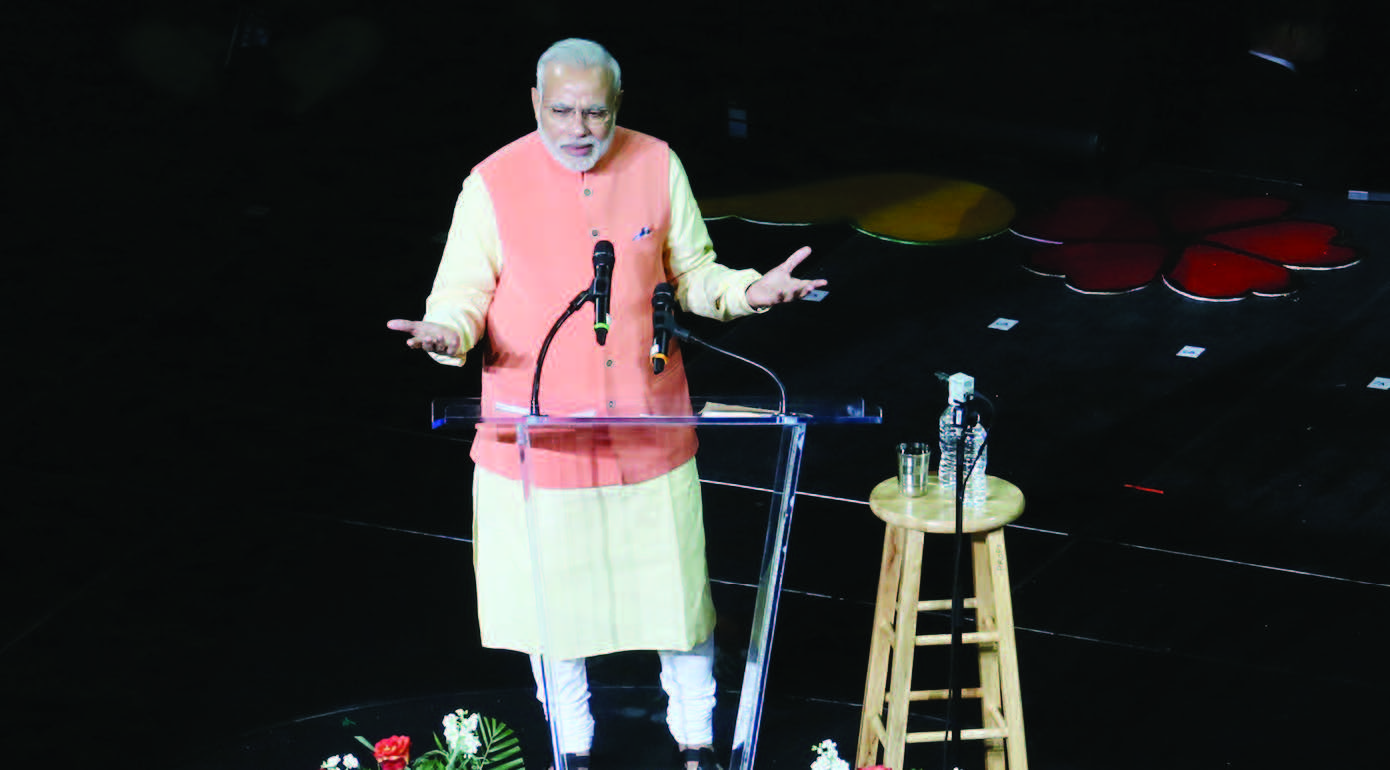
I found many acknowledging Modi’s felicity of expression which allowed him to connect with people immediately. He speaks in the language and diction that people at all levels commonly understand. He relies on simple words and home truths to deliver his ideas home. Again, he has mastered the art of delivery. His body language is extremely expressive and impressive. During the more than 90 minutes speech he delivered at the Madison Square Garden on September 28th, not a soul could have looked at the watch. Not one could have yawned, out of boredom. None would have thought of anything but what Modi was saying. The eyes of all remained fixed on the man in the center of the arena. Such was the grip of the man. And whatever he said seemed to come straight out of his heart. He pumped into his speech his heart, his mind and his vocal cords-delivering the “very best”.
Now see what he said. First, India can and will achieve the greatness that it once had. Second, we have a huge human resource capital in the form of a young India, with 60% of population under the age of 35. No other country in the world has such human resource. Third, we have brains. Example, our scientists succeeded in the Mars mission in the first attempt itself, a feat which even US could not perform. Modi took pride in mentioning that India’s Mars mission cost peanuts when compared with the money spent by countries like USA on similar missions.
Yes, we can. But how can we do it? He did offer Namo Mantra for that. He spoke of the defects in the system in the country and said the system that stood in the way of quick progression had to be demolished. He spoke of the futile, cumbersome and irrelevant laws which needed to be consigned to dust bin. He spoke of the massive investment required for development. And he invited Indian Americans as also the whole world to come and invest in India. Also, he gave a call to “make in India”.
Modi was particularly appreciative of the Sikhs, in his speech. He spoke of the great sacrifices the Sikh Gurus had made. He also recalled the sacrifices of the Sikhs in the freedom struggle of India. He spoke of the brave Sikh soldiers in the Indian armed forces and said the nation is proud of the Sikhs who have always stood by their motherland, come what may.
Modi simply created a vision. He came up with ideas that won attention and admiration of many. He wove dreams that all would love to own. He assured the gathering of around 20,000 at the famous Madison Square Garden which somebody christened as “Modison” Square Garden that India was on a fast track to development. Then he made some announcements to please the locals, too. He told them he was taking care to ensure there is no harassment at the airports in India of Indian Americans visiting India. He also said he knew of problems with getting visas. He said there will be no delays any more in obtaining a visa. Also, he said the clubbing together of OCI and PIO was being worked out and soon the problems arising out of OIC/PIO will be over. He also announced visa on arrival for US nationals on the pattern of some 9 countries whose citizens are entitled to get tourist visa on arrival in India. Surely, the local crowd was pleased.
The magician Modi wielded his wand for more than 90 minutes and left the gathering charmed and captivated. Yes, he came, he spoke , he conquered the hearts of Indian Americans who had come from far and near to have his darshan and hear him speak. But before he left, the gathering burst in to Modi chant, just as it had when he had arrived. And, believe me, Modi must have enjoyed the chant. The “Modi” chant must have been music to his years.
During the course of his stay in New York from 26th September to 29th September afternoon, Modi attended a large number of events, met a number of people from all walks of life which included world leaders, his counterparts from neighboring countries Sri Lanka and Nepal, US lawmakers and officials, captains of business and industry, community leaders, religious leaders and eminent people- both Indian Americans and others, and discussed a variety of issues.
We bring our readers here a few pictures of Modi’s New York visit. All pictures have been provided by The Indian Panorama special photo journalist Mohammed Jaffer.
Direction: Nitesh Tiwari Genre: Drama Duration: 2 hours 35 minutes
STORY: Our good-hearted ghost with a dost is back. This time he’s all set for some social seva by contesting elections and befriending a street-smart slumboy.
REVIEW: ‘Knock Knock!’ ‘Who’s there?” ‘BOO!’ ‘Boo, who?’ Don’t wet your chads, kiddos. It’s just ‘Ghostbuster’ time with a 70-year old bhoot – mushy as marshmallow – gearing up to play ‘peek-a-BOO’ once again. After his last visit to earth (prequel), Bhoothnath (Bachchan) goes back to exotic Bhoothworld, where ghosts lavishly live it up. Though it’s run like a sarkari organization with departments like ‘Reincarnation Section’, ‘Bhooth Mail’, et al. Lol!. ‘BN’ is ridiculed by his gang-of-ghosts at his inability at scaring kids. While there’s a long wait for reincarnation (longer if you want to be reborn as Aamir’s dog. Bhoots love Bollywood too!), ‘BN’ gets one final chance to descend to earth for another kiddie scarefest. There he meets the zesty, tapori slumboy, Akhrot (Parth) who’s the only one who can see ghosts.
They form an inseparable team of ghostbusters – evicting haunting bhooths from buildings, and other earthly endeavours (like cleaning up garbage on the streets and inside the system). Soon they meet the conniving politician Bhau (Boman), and after some awakening ‘BN’ agrees to contest elections as the first ever bhooth candidate. He turns into a celebrity ghost, posing for media interviews, and teaming up with filmys.
But will Bhoothnath’s ghostly powers be able to match up to the ghastly politics of humans? Tiwari’s sequel sets off with a lot of promise, entertainment, laughs and endearing camaraderie between a bhooth and a boy. The first-half has wittily written scenes – strung with satire and emotion, but the story slowly turns into a tedious vocational course on voting. The preaching distracts from some superb performances and inadvertently loses humour, but the story does have its heart in the right place.
‘BN’ makes a comeback at a perfect time – bang on with our Indian elections, and packs a powerful message, albeit with potholes in the plot. Bachchan is brilliant as the bhooth having a ball at his bhootiyapa, but his booming spiels are sometimes banal; it’s the one-liners that score. Boman is ‘predictably’ good but OTT in parts; and Mishra (lawyer) enthuses with an effortless act.
The leader of this party is unquestionably child artist Parth. His confidence, charm and energy are incredible. He has the best lines in the film, adding as much gusto (if not more) to this ghost-story.
MUMBAI (TIP): Megastar Amitabh Bachchan was conferred India’s Global Icon of the Year award at the NRI of the Year awards here. The 71-year-old, who has been ruling the film industry for over four decades now, dedicated the award to the younger generation of actors in the film industry.
“I want to thank Times Now (news channel) and ICICI Bank for honouring me with this (NRI) award,” Big B said. “I think I am not the only one person who should be honoured with this award. In fact, there are many of my friends in the entertainment world, especially the actors of the younger generation because of whom our film industry is known in the whole world, so I would like to dedicate this award to them,” he added.
The awards, presented by Times Now in association with ICICI Bank, were given to the achievers who have made their mark internationally. Meanwhile, Big B, who made his movie debut with Saat Hindustani in 1969, recalled his early career and said: “During that time (when I started my career) I didn’t have much releases, but I started doing the stage shows (the world over) around 1980s and then I came to know how much we (actors) are loved by them (people outside India) and how much we love them.”
“Since then it is still continuing and…I would like to thank them all,” he added. Currently, the megastar is busy promoting his next Bhootnath Returns, slated to release April 11. Directed by Nitesh Tiwari, the sequel to 2008 film Bhootnath, also features Shahrukh Khan and Ranbir Kapoor in cameos.
Signup to our Newsletter!
Don’t miss out on all the happenings around the world