Tag: Antonio Guterres

  • UN chief on ‘erosion’ of international law: ‘Charter not à la carte menu’

    UN chief on ‘erosion’ of international law: ‘Charter not à la carte menu’

    In the wake of the US military action in Venezuela, the 2022 Russian invasion of Ukraine as well as other geo-political challenges, UN Secretary General António Guterres said the world is brimming with conflict, impunity, inequality and unpredictability

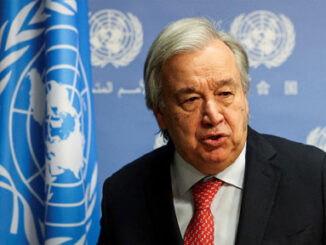
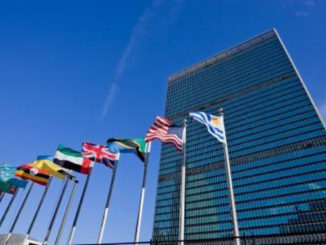
    UNITED NATIONS (TIP): Asserting that the UN Charter is not “à la carte menu”, UN chief denounced nations for brazenly violating international law, saying when leaders “pick and choose” which rules to follow, they undermine global order and set a “perilous” precedent.

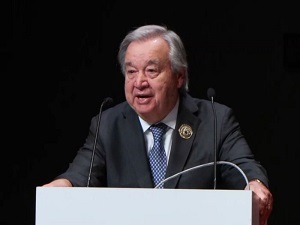
    As Guterres enters the final year of his tenure as UN Secretary General, he told the 193-member General Assembly on Thursday , January 15, that he will make every day of 2026 count and remains fully committed and determined to keep working, fighting, and pushing for a better world.

    Against the backdrop of the recent US military action in Venezuela, the 2022 Russian invasion of Ukraine as well as other geo-political challenges, Guterres said the world is brimming with conflict, impunity, inequality and unpredictability.

    “A world marked by self-defeating geopolitical divides… brazen violations of international law… and wholesale cuts in development and humanitarian aid. These forces and more are shaking the foundations of global cooperation and testing the resilience of multilateralism itself,” he said.

    “That is the paradox of our era: at a time when we need international cooperation the most, we seem to be the least inclined to use it and invest in it. Some seek to put international cooperation on deathwatch. I can assure you: we will not give up,” the UN chief said.

    UN Secretary General’s second five-year term at the helm of the world body comes to an end on December 31, 2026.

    He made the remarks in his traditional address to the General Assembly on his priorities for the year ahead.

    Guterres has expressed deep alarm at the escalation between the United States and Venezuela culminating in the capture of the country’s President Nicolas Maduro, and had said that the developments constitute a “dangerous precedent” and expressed concern that rules of international law have not been respected.

    Guterres, who has also consistently spoken out against the Russian invasion of Ukraine, told the General Assembly that no effort must be spared to stop the fighting in Ukraine and achieve a just and lasting peace in line with the UN Charter, international law and UN resolutions.

    He, however, strongly criticized nations for violating international law and not adhering to the UN Charter, which he said is a “compact” that “binds us all.”

    Underlining that the UN Charter is not an “à la carte menu” but is “prix fixe”, Guterres said, “We must adhere to the UN Charter – fully and faithfully. No ifs … no ands … no buts.”

    “The Charter is the foundation of international relations – the bedrock of peace, sustainable development, and human rights,” he said.

    Emphasizing that while he is honored to serve as custodian of the Charter, Guterres told the 193 UN Member States and their leaders that “each one of you has signed up to be a custodian of the Charter, too.

    “When leaders run roughshod over international law – when they pick and choose which rules to follow – they are not only undermining global order, they are setting a perilous precedent,” he said.

    Guterres expressed concern that the erosion of international law is not happening in the shadows but is “unfolding before the eyes of the world, on our screens, live in 4K.”

    He said people everywhere are witnessing, in real time, the consequences of impunity – “the illegal use and threat of force; attacks on civilians, humanitarian workers and UN personnel; unconstitutional changes of government; the trampling of human rights; the silencing of dissent; the plundering of resources.”

    The UN chief also lamented that the dangers do not stop with states or warring parties but are being amplified by “bottomless” greed and inequality in a world where the top one per cent holds 43 per cent of global financial assets and the richest 500 individuals added $2.2 trillion to their fortunes in the last year alone.

    “Increasingly, we see a world where the ultra-wealthiest and the companies they control are calling the shots like never before – wielding outsized influence over economies, information, and even the rules that govern us all.

    “When a handful of individuals can bend global narratives, sway elections, or dictate the terms of public debate, we are not just facing inequality – we are facing the corruption of institutions and our shared values,” he said.

  • Trump sets a perilous precedent

    Trump sets a perilous precedent

    The use of force by the US in Venezuela raises doubts about the legitimacy of its actions

    “The fact that the US action flouts international law related to state sovereignty and humanitarian rights protocols has been highlighted worldwide and even within the US — but to little avail. The Trump doctrine (Donroe is specific to Latin America) boils down to bludgeoning any interlocutor who does not toe the “Donald line”, and the use of tariffs as a weapon is all too familiar.”

    By C Uday Bhaskar

    The outcome of the UN Security Council’s emergency meeting on the US military operation, which resulted in the outrageous abduction of Venezuelan President Nicolas Maduro and his wife, was predictable. Strategic timidity in the face of the intimidation unleashed by US President Donald Trump is the dominant orientation of the global community. The famed horseshoe table did not issue any statement. Given that the spotlight was on the US, with its veto power as a permanent member of the UNSC, Washington would not have allowed any censure of its Operation Absolute Resolve.

    Panama was subjected to a similar action in 1989. There are notable parallels between the US capture of Panamanian leader Manuel Noriega on January 3, 1990, and the kidnapping of the Venezuelan President on the same day in 2026. The latter is the most direct US military intervention in Latin America since the Panama operation.

    In both cases, heads of state — sitting (Maduro) and de facto (Noriega) — have been indicted on federal drug trafficking charges; Noriega for racketeering and cocaine smuggling, and Maduro for narco-terrorism and related conspiracies that were deemed inimical to US national security. This action is being interpreted as the first step to implement the new doctrine unveiled by President Trump that builds on the 1823 Monroe doctrine and has been dubbed the Donroe doctrine.

    However, notwithstanding Trump’s assertion that Latin American affairs are now a top US security priority and that he would authorize military action and intervention at will, rumblings of dissent were evident at the UNSC’s January 5 meeting.

    The deliberations reflected the widespread international condemnation of the US action as a violation of international law, sovereignty and the UN Charter’s prohibition on the use of force against a state’s territorial integrity or political independence. Despite the distinctive backdrop, UN Secretary-General António Guterres was not present at the meeting; his statement, which was read out by an official, emphasized that “the power of the law must prevail” and called for inclusive democratic dialogue respecting human rights and Venezuela’s sovereignty. To his credit, Guterres was the first to condemn the US action and voiced the overwhelming global shock and anguish.

    At the UNSC meeting, two of the permanent members, Russia and China, along with Brazil, Colombia (which made a request for the meeting), Cuba and Mexico denounced the operation as an act of aggression, armed attack or “imperialist” intervention. Some demanded Maduro’s immediate release and rejected unilateral actions.

    Even US allies such as France and Denmark criticized the move for undermining the principles of international order, though some acknowledged Maduro’s repressive rule and the need to address drug trafficking and human rights issues through lawful means.

    In response, Mike Waltz, US Ambassador to the UN, defended the action as a “surgical law enforcement operation” against indicted “narco-terrorists”, not an act of war or occupation, and stated that the US had no plans to occupy Venezuela. This was not accepted by the global community. It is instructive that no nation, except Argentina and Ecuador, has unambiguously endorsed the belligerent US action against Maduro.

    The fact that the US action flouts international law related to state sovereignty and humanitarian rights protocols has been highlighted worldwide and even within the US — but to little avail. The Trump doctrine (Donroe is specific to Latin America) boils down to bludgeoning any interlocutor who does not toe the “Donald line”, and the use of tariffs as a weapon is all too familiar.

    Hence, most nations have chosen prudence in response to the US military operation. India, Japan and many other countries have issued anodyne statements that do not directly condemn the US action or uphold any normative principle of international law.

    The operation has raised disturbing questions. If the US arrogates unto itself the right to abduct/kidnap the head of another state for perceived transgression of American laws, is any global leader safe from such predatory action? Will leaders attending the UN General Assembly meeting in New York be sanguine about their own safety?

    The use of force by the US in Venezuela raises doubts about the legitimacy of its actions. At least 115 deaths were reported from US military strikes on alleged drug-smuggling boats (including go-fast boats and semi-submersibles) in the months leading to Operation Absolute Resolve.

    These strikes were part of a campaign that began in early September 2025 and targeted vessels primarily in the Caribbean Sea and eastern Pacific Ocean. A total of 36 vessels were struck on the suspicion of carrying drugs. Should the US military have been part of such an operation against unarmed small vessels? The January 3 operation itself reportedly caused 70-80 fatalities, mostly Venezuelan and Cuban personnel tasked to protect Maduro.

    There is little doubt that the US has an impressive array of trans-border military capability that includes delivery of lethal precision-guided ordnance, pinpoint surveillance accuracy, strategic airlift and overwhelming cyber capabilities. All this was demonstrated both in Abbottabad (the killing of Osama bin Laden in 2011) and in the audacious capture of President Maduro. But Trump’s resolve to discipline Venezuela will remain tainted for blurring the Weberian dictum about the legitimacy of the use of military force.

    More such resolute actions have been mooted — Colombia, Cuba, Iran and even Mexico have been threatened by Trump. Fall in line or else face US ire. Greenland may provide the ultimate Alice in Wonderland scenario. If the next Trump move is to ‘acquire’ Greenland, and Denmark invokes Article VI of the NATO provisions, it is possible that troops of the US military will defend a NATO ally against the occupying US forces!

    Welcome to Trumpland, and all hail Emperor Donroe!

    (C Uday Bhaskar is Director, Society for Policy Studies)

  • The US Has Yet to Notify the UN About Washington’s Withdrawal From Entities

    The US Has Yet to Notify the UN About Washington’s Withdrawal From Entities

    WASHINGTON, D.C. (TIP): The United Nations says that beyond the social media announcement from the United States government on Jan. 7 about its withdrawal from 66 international and UN entities, the information has not been officially communicated to the world body. Washington has also not followed the legal process required for a country to dissociate from binding international treaties it has signed and ratified, such as the UN Framework Convention on Climate Change.

    “I checked with our legal counsel earlier today, we had not received any official letter,” Stéphane Dujarric, the spokesperson for UN Secretary-General António Guterres, told journalists on Jan. 8. “We have not received any further official communication beyond what was posted on the White House website.”

    Washington announced in the evening of Jan. 7 on social media that it is withdrawing from a broad slate of international organizations and UN bodies, substantiating the threat by President Trump to separate with UN bodies that do not serve his country’s interests or that the US considers a waste of Americans’ taxpayer money.

    The decision by the US to cut ties to 66 international organizations, treaties and UN entities was apparently a result of a review conducted under Executive Order 14199, one of the wide-ranging executive orders signed by Trump in February 2025. The review could be a prelude to the US Congress releasing more funding to the UN general operating budget now that the review is done.

    UN reacts

    On Jan. 8, when the UN released its first official response to the news, Guterres expressed “regrets” over the US announcement but added that “all United Nations entities will go on with the implementation of their mandates as given by Member States.”

    “The United Nations has a responsibility to deliver for those who depend on us,” the statement, conveyed from Dujarric by email to the media, continued. “We will continue to carry out our mandates with determination.”

    Of the 66 organizations, 31 are linked to the UN. They include the Department of Economic and Social Affairs, an organ led by a Chinese national; various regional economic and social commissions; the Office of the Special Representative of the Secretary General for Children in Armed Conflict and the Office of the Special Representative of the Secretary-General on Sexual Violence in Conflict; the UN Framework Convention on Climate Change; and peace-building agencies as well as others that promote international law, sustainable environmental practices and gender rights, such as UN Women. The UN Population Fund, also listed, was severed by the US in early 2025. (A list of the UN bodies and their roles is explained at the end of this story.)

    Since the Trump administration has taken the reins in 2025, the US has turned its back on matters at the UN related to gender equality, climate change, diversity/equity/inclusion as well as the Sustainable Development Goals.

    Vanessa Frazier, who leads the office on children and armed conflict, which aims to protect children’s rights amid war, said in a post on X that “ it is quite unfortunate that the US now seems to be of the opinion that children being collateral of war is OK”

    According to the US, “withdrawal” from UN entities is defined as ceasing participation and/or funding to the extent permitted by law.

    “Poorly run”

    US Secretary of State Marco Rubio said in a statement on Jan. 7, as the White House released the list of 66 entities it was cutting off, the organizations were “redundant, mismanaged, unnecessary, wasteful, or poorly run,” and in some cases “captured by the interests of actors advancing agendas contrary to US national interests.” He added that continued participation in such bodies was incompatible with American sovereignty and prosperity.

    The move marks a major escalation in Washington’s shift from multilateral engagement, prompting concern and bewilderment across diplomatic, legal and academic communities. Trump pulled out of some high-profile UN agencies during his first term and again in the beginning of his second term, such as the Human Rights Council and the World Health Organization, but the Jan. 7 actions are more far reaching in scale. And the moves will worsen the dire financial crisis the organization is struggling to manage.

    The US released $2 billion at the end of 2025 to fund UN-coordinated humanitarian aid for a select list of countries as the US is still withholding at least two years of mandated dues to the organization’s regular budget, totaling approximately $1.3 billion.

    It is unclear whether the withdrawals from UN bodies will impact the US paying its assessed contribution — if it does so — but Dujarric said Washington is obligated to pay regardless of unilateral withdrawal from a UN agency or program.

    Many of those the US said it would withdraw from are funded by UN assessed contributions paid by member states. Dujarric said some of the agencies rely on funding from “the regular budget, with the vast majority of their work then being funded voluntarily.”

    “Member states who signed on, joined this club have to pay the dues,” he said. “We can, we can, the Charter is not à la carte, as we said, and . . . we know we’re not going to renegotiate the Charter. The UN is an organization of 193 member states, two observer states [the Holy See and Palestine]. It is in the interest of all these member states and the two observers to defend the principles that they themselves have created.”

    According to Article 19 of the UN Charter, a member state risks losing its vote in the 193-member General Assembly if its arrears equal or exceed the amount due for the previous two years, but it is unclear what happens in the Security Council when a permanent member runs afoul of Article 19. A European diplomat told PassBlue, however, that even small US contributions to certain entities over the last few years could mean it is meeting some level of its legal financial obligations.

    Picking and choosing

    Ronny Patz, an independent analyst on the UN, said that while US engagement with the UN peace-building architecture has historically been limited, the departure of a permanent member of the Security Council from peace-building work represents a symbolic, practical setback for collective conflict-prevention efforts.

    Patz warned that the move risks normalizing what he described as “à la carte multilateralism,” whereby states choose which international organizations to support. “Once selective disengagement is tolerated,” Patz said in a post on LinkedIn, “all member states could refuse to fund or participate in the parts they dislike, weakening the UN’s role as a multipurpose organization built on cross-domain compromise.”

    Theodoros Rousopoulos, president of the Parliamentary Assembly of the Council of Europe, expressed concern over the withdrawal from the Council’s Venice Commission, an advisory body on constitutional matters, as the rule of law is pressured globally.

    In the US, Democratic members of the House Foreign Affairs Committee criticized the Trump decision, saying that participation in international organizations allows Washington to shape global norms, strengthen alliances and counter adversaries. “America first = America alone,” the committee posted on its X page.

    Ben Saul, the UN specialist on human rights and counterterrorism, said that the withdrawal from the International Law Commission “weakens efforts to forge cooperative global solutions to common human challenges.”

    He added: “The US will weaken global counterterrorism efforts by withdrawing from the Global Counterterrorism Forum and the International Institute for Justice and the Rule of Law.”

    Dujarric summed up Guterres’s attitude despite the latest US setbacks, saying on Jan. 8: “I spent quite a time with him this morning, and he is determined as ever to continue his work and continuing to defend the Charter and continuing to defend this international institution.”

    What the UN organizations do

    Department of Economic and Social Affairs (DESA): Acts as the UN’s policy engine on global development, producing data and analysis on population trends, inequality, sustainable development goals and public administration. Governments rely on its statistics and guidance to shape domestic policy.

    Economic Commission for Africa (ECA): Supports African governments with research and policy advice on economic growth, industrialization, trade integration and climate resilience, often shaping regional development strategies.

    Economic Commission for Latin America and the Caribbean (ECLAC): Known for its economic research, ECLAC analyzes inequality, growth and fiscal policy in Latin America and the Caribbean and advises governments on development planning.

    Economic and Social Commission for Asia and the Pacific (ESCAP): Works on inclusive growth, infrastructure, disaster risk reduction and digital connectivity across the Asia-Pacific, the world’s most populous region.

    Economic and Social Commission for Western Asia (ESCWA): Focuses on development challenges in the Arab world, including economic reform, social protection, water scarcity and post-conflict recovery.

    International Law Commission: A body of legal experts tasked with developing and clarifying international law, including treaties governing diplomacy, state responsibility and the laws of war.

    International Residual Mechanism for Criminal Tribunals: Handles remaining legal responsibilities from the Rwanda and former Yugoslavia war crimes tribunals, including appeals, witness protection and sentence enforcement.

    International Trade Centre (ITC): Helps small businesses and exporters in developing countries access global markets, providing technical assistance on trade rules, quality standards and supply chains.

    Office of the Special Adviser on Africa: Advises the UN Secretary-General on political, security and development trends in Africa and helps coordinate international support for the continent.

    Office of the Special Representative for Children in Armed Conflict: Documents and advocates against the recruitment, abuse and killing of children in war zones, pressing governments and armed groups to comply with international law.

    Office of the Special Representative on Sexual Violence in Conflict: Works to prevent sexual violence used as a weapon of war, supporting survivors and pushing for accountability in conflict and post-conflict settings.

    Office of the Special Representative on Violence Against Children: Addresses violence against children beyond conflict zones, including abuse, exploitation and harmful practices, often working with national governments on child-protection laws.

    Peacebuilding Commission: Brings together donors, governments and regional actors to support countries emerging from conflict, aiming to prevent relapse into violence.

    Peacebuilding Fund: Provides rapid, flexible funding for peacebuilding efforts in fragile states, often filling gaps where traditional aid is too slow.

    Permanent Forum on People of African Descent: An advisory body focused on addressing racism, discrimination and development challenges faced by people of African descent worldwide.

    UN Alliance of Civilizations: Promotes dialogue across cultures and religions, aiming to counter extremism and reduce polarization through education, media and youth programs.

    UN Programme on Reducing Emissions from Deforestation and Forest Degradation (REDD+): Helps developing countries protect forests by linking conservation to climate finance and sustainable land use.

    UN Conference on Trade and Development (UNCTAD): Provides research and policy advice on trade, debt, investment and technology, often advocating for fairer global economic rules for developing nations.

    UN Democracy Fund: Finances grassroots projects that support democratic participation, civil society and human rights, particularly in fragile democracies.

    UN Energy: Coordinates the UN’s work on access to affordable, reliable and clean energy, aligning agencies around global energy goals.

    UN Entity for Gender Equality and the Empowerment of Women (UN Women): Leads UN efforts on women’s rights, gender equality and violence prevention, advising governments and supporting programs on the ground.

    UN Framework Convention on Climate Change (UNFCCC): The treaty body that oversees global climate negotiations, including the Paris Agreement, and tracks countries’ emissions commitments.

    UN Human Settlements Programme (UN-Habitat): Focuses on sustainable urban development, housing policy and slum upgrading as cities grow rapidly worldwide.

    UN Institute for Training and Research (UNITAR): Trains diplomats, civil servants and emergency responders, particularly from developing countries, on governance, diplomacy and crisis management.

    UN Oceans: Coordinates UN action on ocean conservation, fisheries management and marine pollution across multiple agencies.

    UN Population Fund (UNFPA): Works on reproductive health, maternal care and population data, often operating in fragile or humanitarian settings.

    UN Register of Conventional Arms: Encourages transparency in international arms transfers to build confidence and reduce the risk of conflict escalation.

    UN System Chief Executives Board for Coordination: Brings together the heads of UN agencies to align strategy, budgets and policy priorities across the system.

    UN System Staff College: Provides professional training for UN staff and partners, focusing on leadership, coordination and complex crises.

    UN Water: Coordinates global efforts on freshwater access, sanitation and water management across UN agencies.

    UN University: A network of research institutes producing academic work on peace, sustainability, technology and development, often advising governments and the UN itself.
    (Source: Pass Blue)

  • UN chief calls on Israel to reverse NGOs ban in Gaza

    UN chief calls on Israel to reverse NGOs ban in Gaza

    Israel says the new regulation aims to prevent bodies it accuses of supporting terrorism from operating in the Palestinian territories

    UNITED NATIONS (TIP): UN Secretary General Antonio Guterres called on Friday, January 2, 2026, for Israel to end a ban on humanitarian agencies that provided aid in Gaza, saying he was “deeply concerned” at the development, a Reuters report says.

    Mr. Guterres “calls for this measure to be reversed, stressing that international non-governmental organizations are indispensable to life-saving humanitarian work and that the suspension risks undermining the fragile progress made during the ceasefire,” his spokesperson Stephane Dujarric said in a statement.

    “This recent action will further exacerbate the humanitarian crisis facing Palestinians,” he added.

    Israel on Thursday suspended 37 foreign humanitarian organizations from accessing the Gaza Strip after they had refused to share lists of their Palestinian employees with government officials.

    The ban includes Doctors Without Borders (MSF), which has 1,200 staff members in the Palestinian territories — the majority of whom are in Gaza.

    NGOs included in the ban have been ordered to cease their operations by March 1.

    Several NGOS have said the requirements contravene international humanitarian law or endanger their independence.

    Israel says the new regulation aims to prevent bodies it accuses of supporting terrorism from operating in the Palestinian territories.

    On Thursday, January 1, 18 Israel-based left-wing NGOs denounced the decision to ban their international peers, saying “the new registration framework violates core humanitarian principles of independence and neutrality.”

    A fragile ceasefire has been in place since October, following a deadly war waged by Israel in response to Hamas’s unprecedented October 7, 2023, attack on Israel.

    In November, authorities in Gaza said more than 70,000 people had been killed there since the war broke out. Nearly 80 percent of buildings in Gaza have been destroyed or damaged by the war, according to UN data, leaving infrastructure decimated.

    About 1.5 million of Gaza’s more than two million residents have lost their homes, said Amjad Al-Shawa, director of the Palestinian NGO Network in Gaza.

  • The UN Can Survive Without the US

    The UN Can Survive Without the US

    Next week world leaders will gather for the General Assembly’s annual high-level debate, and that despite the Trump administrations’ scorn of multilateralism, “the world can’t afford to abandon the mission of the UN simply because its founding architect has retreated.”

    By Chris Lu

    One year ago, against the backdrop of deep geopolitical divides, the United Nations came together to adopt the Pact for the Future and its companion agreements, the Global Digital Compact and the Declaration on Future Generations. These landmark agreements were designed to strengthen the UN’s ability to address conflict prevention, sustainable development, humanitarian assistance, human rights and emerging technologies, such as artificial intelligence.

    Eleventh-hour compromises left no country fully satisfied. Yet the adoption of these agreements, despite divisions caused by the wars in Gaza and Ukraine, testified to the enduring promise of the UN and the importance of collective action. It was proof that multilateralism, while badly battered, was not broken.

    The road to those agreements was neither smooth nor inevitable. During the yearlong negotiation process, the United States played a critical role in bringing it to a successful outcome. From day one, the Biden administration understood that an effective multilateral system contributed to US security by stabilizing regions, advancing democratic norms, coordinating global crises and opening markets. The UN couldn’t be allowed to fail.

    A year later, the political landscape at the UN has shifted dramatically under the Trump administration. The US has pulled back billions of dollars of financial contributions to the UN. The US now routinely denounces the Sustainable Development Goals (SDGs) — the central organizing principle for the UN’s work over the past decade. And USAID, the largest funder of development assistance in the world, has been dismantled, endangering the lives of millions of people and undercutting decades of progress on human rights, democracy promotion and inclusive development.

    Looking back, the adoption of the Pact for the Future may be remembered as a fleeting triumph for multilateralism — a moment of collective resolve that briefly cut through geopolitical divides — before more paralysis and discord set in.

    Next week, world leaders will gather in New York City for the UN’s high-level week. It should be a time not just for reflection on what’s been lost, but also for resolve about what can still be saved. The world can’t afford to abandon the mission of the UN simply because its founding architect has retreated.

    If the UN is to endure, it must rethink how to do its work and who funds it. At least for the next three years, the international community must learn to operate without US funding — and US moral leadership. This effort will require genuine reform and belt-tightening. Beyond across-the-board budget cuts, agencies must be consolidated or eliminated when their functions are duplicative or don’t align with the UN’s core mission.

    The UN also must rethink its funding system and broaden the donor base, requiring wealthier emerging economies to shoulder more responsibility. An equitable and effective UN can’t rely on its top two donors for over 40 percent of its funding.

    The rest of the world will also need to step up more forcefully to address global issues without waiting for Washington’s blessing. We have already seen encouraging examples in 2025. At the UN Ocean Conference in Nice, France, which the US government did not attend, over 170 countries adopted an action plan with more than 800 commitments, including the creation of one of the world’s largest Marine Protected Areas.

    At the fourth Financing for Development conference in Sevilla, Spain, following the withdrawal of the US from the negotiations, more than 190 countries approved major pledges on debt relief, domestic resource mobilization and climate finance.

    While no entity can fully make up for the absence of the US government, the UN needs to radically rethink its approach to an often-forgotten party: the private sector. The combined revenues of the world’s top 500 companies rival the budgets of all governments worldwide. If more private-sector involvement could be unlocked, it would drive progress on global challenges. Multinational companies understand that addressing poverty, conflict and climate change isn’t charity; it’s an investment in creating stable, growing markets on which long-term business success depends.

    Private sector engagement is about more than funding — it’s also about harnessing expertise that can make UN programs smarter and more effective. By leveraging advanced data tools to sharpen how aid is targeted, world-class logistics to accelerate humanitarian supply chains, fintech to streamline cash assistance and renewable energy to reduce the cost and risk of fueling peacekeeping missions, the UN can deliver results that are more scalable and sustainable.

    Nowhere is the case for private sector expertise stronger than in artificial intelligence. Last year, Secretary-General António Guterres noted that AI could help advance nearly 80 percent of the SDGs. A year later, that prediction may well underestimate its potential.

    In agriculture, new private sector AI projects are optimizing irrigation and boosting crop yields. In health care, AI is being used to diagnose medical conditions in regions where doctors are scarce. In climate change, AI is helping to model sea-level rise, monitor deforestation and predict floods and wildfires. These aren’t futuristic scenarios. They are operating today, and they show the kind of innovation the UN could scale globally, if there is a commitment to responsible AI development and deployment. The adoption of the first UN resolution on AI in March 2024 — an initiative led by the Biden administration — was a crucial step in that direction.

    To be clear, there is no substitute for the resources and moral authority that Washington can bring to global challenges. But the rest of the world can’t wait for a change in the White House before acting. The climate crisis won’t pause. The humanitarian needs of displaced populations won’t diminish. The technological revolution won’t slow down. These challenges demand urgency, and many of the tools for addressing them are still available.

    At high-level week, the choice before the global community is stark: allow the Pact for the Future to become a historical footnote or use it as a base for a new kind of multilateralism — one that can withstand even the withdrawal of its most powerful member. The Pact was never meant to be an end in itself. It was always intended as a roadmap for bringing more parties and tools to the table to solve the world’s most serious problems. One year on, that vision is threatened, but not beyond saving.

    (Chris Lu was the US ambassador to the United Nations for management and reform (2022-25) and is now the James R. Schlesinger Distinguished Professor at the University of Virginia Miller Center.)
    (Source: PassBlue)

  • UN Security Council backs Guterres after Israel bars him from country

    UN Security Council backs Guterres after Israel bars him from country

    UNITED NATIONS (TIP): The United Nations Security Council on Thursday, October 3, 2024,  expressed its full support for Secretary-General Antonio Guterres after Israel’s foreign minister said he was barring him from entering the country. The 15-member council said in a statement that “any decision not to engage with the U.N. Secretary-General or the United Nations is counterproductive, especially in the context of escalating tensions in the Middle East.” ‘Sickening cycle of escalation’ in Mideast must stop, says UN chief Antonio Guterres

    The statement did not name Israel. Such statements by the council are agreed by consensus.

    Israel’s Foreign Minister said on Wednesday, October 2, 2024,  that he was barring U.N. Secretary-General Antonio Guterres from entering the country because he had not “unequivocally” condemned Iran’s missile attack on Israel.

    Mr. Guterres on Tuesday, October 1, 2024,  issued a brief statement referencing only the “latest attacks in the Middle East” and condemning the conflict “with escalation after escalation”. Earlier on Tuesday, October 1, 2024, Israel had sent troops into south Lebanon.

    Earlier Wednesday, October 2, 2024,  Israel declared Mr. Guterres “persona non grata” as they think he didn’t specifically condemn Iran’s missile attack when he condemned on Tuesday the “broadening conflict in the Middle East.”


    UN chief Antonio Guterres called on Wednesday, October 2, 2024,  for an end to the “sickening cycle of escalation” in the Middle East, while specifically condemning Iran over its latest missile attack after facing harsh criticism from Israel.

  • Calls for revenge echo at Haniyeh’s funeral; Tehran vows ‘punishment’

    Calls for revenge echo at Haniyeh’s funeral; Tehran vows ‘punishment’

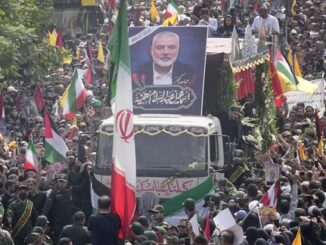
    TEHERAN (TIP): Iran held a funeral ceremony on August 1 with calls for revenge after the killing in Tehran of Hamas political chief Ismail Haniyeh in a strike blamed on Israel.

    Thousands of mourners paid respects to Haniyeh as the Israeli military confirmed that an air strike in Gaza last month killed the Hamas military chief, Mohammed Deif.

    Iran’s Supreme Leader Ayatollah Ali Khamenei led prayers for Haniyeh ahead of his burial in Qatar, having earlier threatened a “harsh punishment” for his killing.

    In Tehran’s city center, crowds, including women shrouded in black, carried posters of Haniyeh and Palestinian flags in a procession and ceremony that began at Tehran University.

    Iran’s Revolutionary Guards announced the day before that Haniyeh and a bodyguard were killed in a pre-dawn strike on Wednesday, July 31, on their accommodation in Tehran.

    It came just hours after Israel killed a top Hezbollah commander, Fuad Shukr, in a retaliatory strike in the south of Lebanon’s capital Beirut, raising fears of a wider regional conflict as the Israel-Hamas war in Gaza continues.

    Senior Iranian officials including President Masoud Pezeshkian and the Islamic Revolutionary Guard Corps chief, General Hossein Salami, attended the ceremony for Haniyeh, state TV showed. Qatar-based Haniyeh had been visiting Tehran for Mr. Pezeshkian’s inauguration ceremony on Tuesday. Khalil al-Hayya, Hamas’s foreign relations chief, vowed during the funeral ceremony that Haniyeh’s message will live on and “we will pursue Israel until it is uprooted from the land of Palestine”.

    Mr. Pezeshkian later told Mr. Hayya that Iran “will continue to support with firmer determination on the Axis of Resistance”, Iran-aligned regional groups that include Hamas, the official IRNA news agency said.

    Iran’s parliamentary speaker Mohammad Bagher Ghalibaf said, “It is our duty to respond at the right time and in the right place.” UN Secretary-General Antonio Guterres said the strikes in Tehran and Beirut represented a “dangerous escalation”.

    All efforts, he said, should be “leading to a ceasefire” in Gaza and the release of hostages taken during Hamas’s October 7 attack on southern Israel.

    US Secretary of State Antony Blinken also said Wednesday, March 31, that a ceasefire in Gaza was still the “imperative”, with White House National Security Council spokesman John Kirby later adding that the twin killings “don’t help” regional tensions.

    The killings come with regional tensions already inflamed by the war in Gaza, a conflict that has drawn in Iran-backed militant groups in Syria, Lebanon, Iraq and Yemen.

    One of those groups, Yemen’s Huthi rebels, “declared three days of mourning” for Haniyeh, with political leader Mahdi al-Mashat expressing “condolences to the Palestinian people and Hamas” over his killing, according to the group’s Saba news agency.

    Saudi Foreign Minister Prince Faisal bin Farhan, meanwhile, spoke by phone after the attack with his acting Iranian counterpart Ali Bagheri to discuss “the latest developments in the region”.

    The UN Security Council also convened an emergency meeting Wednesday, March 31 at Iran’s request to discuss the strike, with Tehran’s envoy Amir Saeid Iravani urging members to take “immediate action to ensure accountability for these violations of international law”.

    Hamas has for months been indirectly negotiating a truce and hostage-prisoner exchange deal with Israel, with Egypt, Qatar and the United States facilitating the talks.

    Analysts told AFP that Haniyeh was a moderating influence within the Islamist group, and that while he would be replaced, the dynamics within Hamas could change.

    Israeli Prime Minister Benjamin Netanyahu has vowed to destroy Hamas in retaliation for the October 7 attack that ignited war in Gaza.

    That attack resulted in the deaths of 1,197 people, mostly civilians, according to an AFP tally based on official Israeli figures.

    Militants also seized 251 hostages, 111 of whom are still held captive in Gaza, including 39 the military says are dead.

    Israel’s retaliatory campaign against Hamas has killed at least 39,445 people in Gaza, according to the Hamas-run territory’s health ministry.

    The prime minister of key ceasefire broker Qatar said Haniyeh’s killing had thrown the whole mediation process into doubt. “How can mediation succeed when one party assassinates the negotiator on the other side?” Sheikh Mohammed bin Abdulrahman Al-Thani said in a post on social media site X.
    (Source: AFP)

  • Gaza ceasefire: Security Council must act on UN chief’s appeal

    Two months after Hamas attacked Israel, triggering a fierce retaliation, UN chief Antonio Guterres has invoked the rarely used Article 99 of the United Nations Charter to appeal to the Security Council to facilitate a humanitarian ceasefire in Gaza. The Article states that ‘the Secretary-General may bring to the attention of the Security Council any matter which in his opinion may threaten the maintenance of international peace and security.’ Guterres has warned that the situation in Gaza is fast deteriorating into a catastrophe with ‘potentially irreversible implications’ for Palestinians as well as for peace and security in the region.

    According to Gaza’s Health Ministry, over 16,000 people have lost their lives in Israeli military action during the ongoing war. About 1,200 Israelis were killed when Hamas and other Palestinian armed groups carried out lethal strikes on October 7. Around 240 people had been taken hostage, of whom more than half are still in captivity. A Qatar-brokered truce, which saw Hamas release dozens of hostages in exchange for hundreds of Palestinian prisoners and Israel allowing humanitarian assistance to flow into Gaza, had raised hopes of a de-escalation and an early end to the war. However, the truce lasted just a week and Israel has intensified its attacks since then.

    Even as Qatar has claimed that it is making efforts to bring about a comprehensive ceasefire, the Security Council needs to pay heed to the UN Secretary-General’s fervent plea to avert a humanitarian catastrophe. The UN has been under fire for its failure to prevent the situation from spinning out of control. It remains to be seen whether Guterres’ invocation of Article 99 — which was last mentioned in a report by then UN chief U Thant amid the India-Pakistan war of 1971 — will make any visible difference of the ground.
    (Tribune, India)

  • UN chief uses rare power to warn Security Council of impending ‘humanitarian catastrophe’ in Gaza

    UN chief uses rare power to warn Security Council of impending ‘humanitarian catastrophe’ in Gaza

    UNITED NATIONS (TIP): UN Secretary-General Antonio Guterres has used a rarely exercised power to warn the Security Council of an impending “humanitarian catastrophe” in Gaza and urged its members to demand an immediate humanitarian cease-fire.

    His letter to the council’s 15 members on Wednesday, December 6, said Gaza’s humanitarian system was at risk of collapse after two months of war that has created “appalling human suffering, physical destruction and collective trauma,” and he demanded civilians be spared greater harm.

    Guterres invoked Article 99 of the UN Charter, which says the secretary-general may inform the council of matters he believes threaten international peace and security. “The international community has a responsibility to use all its influence to prevent further escalation and end this crisis,” he said.

    UN spokesman Stephane Dujarric said he expects the secretary-general to address the Security Council on Gaza this week and to press for a humanitarian cease-fire. A short draft resolution circulated to council members late on Wednesday by the United Arab Emirates, the Arab representative on the council, would act on Guterres’ letter under Article 99. It demands “an immediate humanitarian cease-fire” and expresses “grave concern over the catastrophic situation in the Gaza Strip and the suffering of the Palestinian civilian population.” Earlier on Wednesday, the 22-nation Arab Group at the UN strongly backed a cease-fire.

  • G20 Summit in India opportunity to act on reforming global financial system amid crushing debt crisis: U.N. chief Guterres

    G20 Summit in India opportunity to act on reforming global financial system amid crushing debt crisis: U.N. chief Guterres

    UNITED NATIONS (TIP): U.N. Secretary-General Antonio Guterres has said that the G20 Summit to be hosted under India’s Presidency provides an opportunity to take action on debt relief and reform the global financial system, as he voiced concern over the “crushing debt crisis” in the world.

    Speaking at the launch of a U.N. report ‘A World of Debt’ here on Wednesday, July 12, Guterres said, “Some 3.3 billion people – almost half of humanity – live in countries that spend more on debt interest payments than on education or health. Half our world is sinking into a development disaster, fueled by a crushing debt crisis,” he said. Mr. Guterres said that because most of these unsustainable debts are concentrated in poor countries, they are not judged to pose a systemic risk to the global financial system.

    “This is a mirage,” he warned, adding that 3.3 billion people is more than systemic risk.

    “It is a systemic failure. Markets may seem not (to) be suffering – yet. But people are. Some of the poorest countries in the world are being forced into a choice between servicing their debt or serving their people,” the secretary-general said. Noting that deep reforms to the global financial system will not occur overnight, Mr. Guterres said that many steps can be taken now.

    “Our proposals include an effective debt workout mechanism that supports payment suspensions, longer lending terms, and lower rates, including for vulnerable middle-income countries,” he said.

    Mr. Guterres said that governments can agree to scale up development and climate finance by increasing the capital base and changing the business model of Multilateral Development Banks.

    “They can enable much stronger coordination between the banks, to transform their approach to risk without losing their triple-A credit rating, so that they can massively leverage private finance at an affordable cost to developing countries,” he added. “The Bridgetown Agenda led by Prime Minister Mia Mottley of Barbados and the recent summit hosted by President Macron of France generated other important proposals. The upcoming G20 Summit is an opportunity to take these ideas forward,” Mr. Guterres said.

    India assumed the year-long presidency of the G20 on December 1, 2022, and is hosting over 200 meetings and related events in cities across the country.

    These events will culminate in a Global Leaders’ Summit in New Delhi on September 9-10, later this year, to be attended by over 40 Heads of State, Heads of Government and international organizations.

    A G20 Leaders’ Declaration is expected to be adopted at the conclusion of the New Delhi Summit, stating “Leaders’ commitment towards the priorities discussed and agreed upon during the respective ministerial and working group meetings.”

    Global public debt reached an all-time high of $92 trillion in 2022, and this five-fold surge in public debt levels since 2000 demands immediate action to tackle the escalating crisis affecting developing countries in particular.

    Mr. Guterres underlined that, on average, African countries pay four times more for borrowing than the U.S. and eight times more than the wealthiest European economies. “A total of 52 countries – almost 40 per cent of the developing world – are in serious debt trouble,” he said.

    “It is one result of the inequality built into our outdated global financial system, which reflects the colonial power dynamics of the era when it was created,” he added.

    The U.N. chief said that the system had not fulfilled its mandate as a safety net to help all countries manage the present cascade of unforeseen shocks – the pandemic, the devastating impact of the climate crisis, and the Russian invasion of Ukraine.

    While noting that debt is an essential financial tool that can drive development and enable governments to protect and invest in their people, Mr. Guterres said that when countries are forced to borrow for economic survival, debt becomes a trap that generates more debt.

    Mr. Guterres said some of the poorest countries in the world are being forced into a choice between servicing their debt or serving their people.

    “They have virtually no fiscal space for essential investments in the Sustainable Development Goals (SDGs) or the transition to renewable energy. Levels of public debt are staggering – and surging,” he said, adding that as global public debt reached a record $92 trillion dollars in 2022, developing countries shoulder a disproportionate amount.

    In a press release, the U.N. urgently called for a comprehensive reform of the international financial architecture, including the debt architecture, to foster a more inclusive system that empowers developing countries to participate in the global financial system’s governance actively.

    The U.N. asserted that addressing the high cost of debt and the mounting risk of debt distress is of utmost importance. It added that establishing a debt workout mechanism is crucial to expedite progress under the G20 Common Framework for Debt Treatment. This has faced challenges due to creditor coordination issues and the absence of automatic debt service suspension clauses.

    Developing countries, especially those with high debt burdens, require increased liquidity during times of crisis, the U.N. said, adding that a liquidity crisis risks turning into a debt crisis otherwise.

    “This can be achieved by expanding contingency finance. The global safety net must work. Measures such as enhancing the use of Special Drawing Rights, temporarily suspending IMF surcharges, and broadening access to emergency financing through increased quotas must be pursued,” the press release said.

    (Source: PTI)

  • Stop detaining and imprisoning journalists for doing their jobs: U.N. chief Guterres on World Press Freedom Day

    Stop detaining and imprisoning journalists for doing their jobs: U.N. chief Guterres on World Press Freedom Day

    World Press Freedom Day is observed annually on May 3

    UNITED NATIONS (TIP): U.N. Secretary-General Antonio Guterres on May 2 urged the international community to “speak with one voice” and call for stopping the detention and imprisonment of journalists for doing their jobs, as he sounded an alarm that freedom of the press is under attack in every corner of the world.
    Mr. Guterres underscored that “all our freedom” depends on press freedom.
    “Freedom of the press is the foundation of democracy and justice,” he said in his video message ahead of World Press Freedom Day 2023.
    World Press Freedom Day is observed annually on May 3.
    “On this and every World Press Freedom Day, the world must speak with one voice – Stop the threats and attacks. Stop detaining and imprisoning journalists for doing their jobs. Stop the lies and disinformation. Stop targeting truth and truth-tellers,” Guterres said in the message telecast in the UN General Assembly Hall here at a special event organized by UNESCO. Mr. Guterres voiced concern that in every corner of the world, freedom of the press is under attack. “Truth is threatened by disinformation and hate speech, seeking to blur the lines between fact and fiction, between science and conspiracy,” he said.
    He noted that at least 67 media workers were killed in 2022, an “unbelievable” 50 per cent increase over the previous years and nearly three-quarters of women journalists have experienced violence online and one in four have been threatened physically.
    “Journalists and media workers are directly targeted on and offline as they carry out their vital work. They are routinely harassed, intimidated, detained and imprisoned,” he said.
    The U.N. chief also added that the increased concentration of the media industry into the hands of a few, the financial collapse of scores of independent news organizations and the increase of national laws and regulations that stifle journalists are further expanding censorship and threatening freedom of expression.
    The event organized by UNESCO marks 30 years since the U.N. General Assembly’s decision proclaiming an international day for press freedom. This year’s theme for the Day is ‘Shaping a Future of Rights: Freedom of expression as a driver for all other human rights.’
    UNESCO Director-General Audrey Azoulay said hundreds of journalists globally have been attacked and imprisoned “just because they are doing their work. It is unacceptable.” She added that the level of impunity of crimes against journalists sends a “frightening” message and stressed that the security of journalists is a matter for society as a whole.
    Delivering the keynote address, Chairman and Publisher of The New York Times A.G. Sulzberger said that when the free press erodes in a society, “democratic erosion almost always follows.” He said all over the world, autocrats and those who aspire to join their ranks have used censorship, media repression and attacks on journalists to consolidate power. “That’s because gaining control of information is essential to gaining control of everything else.” He added that in countries where press freedoms were strong, including the United States, journalists now face systematic campaigns to undermine their credibility, followed by attacks on the legal
    protections that safeguard their work.
    In countries where press freedoms were already weak, journalists now face surging levels of violence, detention and harassment, he said adding that more journalists are being killed today for their work and the number of imprisoned journalists has reached a grim new record.
    “Spin a globe and you’ll find examples of these trends. In China, journalists are surveilled, intimidated and jailed…In Egypt, the government has used security services to buy up outlets and block uncooperative news sites…In India, authorities have raided newsrooms and treated journalists essentially as terrorists,” Sulzberger said.
    Referring to the situation in Russia, he said journalists who “dare to even acknowledge the war in Ukraine face long prison terms.” He called for the release of The Wall Street Journal reporter Evan Gershkovich, “who remains in Russian custody for sham charges.” Gershkovich was detained in March this year by Russian security services and is being held on an allegation of espionage.
    (Source: PTI)

  • Over 21,000 dead from quake in Turkey and Syria

    Over 21,000 dead from quake in Turkey and Syria

    ISTANBUL (TIP): More than 21,000 people have died in Turkey and Syria after earthquakes swept through the region Monday. Rescue workers are now racing against time to pull survivors from the rubble of collapsed buildings in freezing winter conditions. At least 78,124 people were injured across both countries, according to authorities.
    The 7.8 magnitude quake struck 23 kilometers (14.2 miles) east of Nurdagi, in Turkey’s Gaziantep province, at a depth of 24.1 kilometers (14.9 miles), the United States Geological Survey (USGS) said.
    The natural disaster is one of the deadliest earthquakes in two decades.
    Nations around the world working to get aid to Syria: France on Thursday, February 9, pledged to give 12 million euros ($12.92 million) to Syrians impacted by the quake, the foreign ministry said. The aid will be channeled through the United Nations and nongovernmental organizations “working directly with affected populations in all of the areas struck by the earthquake,” it said. Many Western nations have refused to send aid directly to the Syrian regime, which is under sanctions. The United Kingdom pledged an additional 3 million pounds ($3.64 million) in funding to the White Helmets to support rescue and emergency relief operations in northwest Syria. Britain has so far given a total of 3.8 million pounds ($4.62 million) to the White Helmets, a volunteer organization of humanitarian responders. The United States will provide $85 million for humanitarian assistance in Turkey and Syria. Indian Army’s field hospital has started functioning in quake-ravaged Turkey. India has sent more than 250 personnel, specialized equipment and other relief material amounting to more than 135 tons to Turkey on five C-17 IAF aircraft.
    UN working to open more pathways to deliver aid to Syria: A UN aid convoy crossed from Turkey into northwestern Syria on Thursday, February 9, for the first time since the earthquake hit. The six trucks carrying shelter items and Non-Food Items (NFI) drove through the Bab Al Hawa border crossing, according to the United Nations Office for the Coordination of Humanitarian Affairs. UN Secretary-General António Guterres said he is open to the idea of delivering aid via additional border crossings, other than the Bab al-Hawa, which is the only humanitarian aid corridor approved by the United Nations between Turkey and rebel-held areas of northern Syria.

    (Agencies)

  • World plagued by perfect storm on multiple fronts, we can work together to control damage: Guterres

    World plagued by perfect storm on multiple fronts, we can work together to control damage: Guterres

    Now more than ever, it is time to forge the pathways to cooperation in our fragmented world, he said

    DAVOS (TIP): The world is facing a perfect storm on multiple fronts and all that can be done now is working together to control the damage and seize the opportunities, UN Secretary General Antonio Guterres said on Wednesday, January 18. In a special address at the World Economic Forum Annual Meeting 2023 here, he also called for ending the addiction to fossil fuels, and stopping “our self-defeating war on nature.” “There are no perfect solutions in a perfect storm. But we can work to control the damage and seize opportunities,” he added.

    Now more than ever, it is time to forge the pathways to cooperation in our fragmented world, he said.

    “I am not here to sugarcoat the scale of that challenge, or the sorry state of our world. We can’t confront problems unless we look them squarely in the eye. And we are looking into the eye of a Category 5 hurricane,” he said.

    “Our world is plagued by a perfect storm on a number of fronts. Start with the short-term, a global economic crisis. The outlook is bleak. Many parts of the world face recession. The entire world faces a slowdown,” Guterres warned.

    He further said COVID-19 is still straining economies while the world’s failure to prepare for future pandemics is straining credulity. “Somehow, after all we have endured, we have not learned the global public health lessons of the pandemic. We are nowhere near ready for pandemics to come,” he said.

    In addition to that, there is an existential challenge with the world flirting with climate disaster, he said.

    “Every week brings a new climate horror story. Greenhouse gas emissions are at record levels. The commitment to limit global temperature rise to 1.5 degrees is going up in smoke. Without further action, we are headed to a 2.8 degree increase,” he added. “The consequences will be devastating. Several parts of our planet will be uninhabitable. And for many, this is a death sentence,” he cautioned.

    “But it is not a surprise. The science has been clear for decades… We learned last week that certain fossil fuel producers were fully aware in the 1970s that their core product was baking our planet,” he said.

    “Just like the tobacco industry, they rode rough-shod over their own science. Big Oil peddled the big lie. And like the tobacco industry, those responsible must be held to account. Today, fossil fuel producers and their enablers are still racing to expand production, knowing full well that their business model is inconsistent with human survival,” he said. Guterres said all these challenges, including violence and war, are inter-linked and they are piling up like cars in a chain reaction crash.

    “It would be difficult to find solutions to these global problems in the best of times — if the world was united. But these are far from the best of times, and the world is far from united,” he said.

    “We risk what I have called a Great Fracture — the decoupling of the world’s two largest economies,” he said, adding that it would result in a tectonic rift that would create two different sets of trade rules, two dominant currencies, two internets and two conflicting strategies on artificial intelligence. There are many aspects in which US-China relations diverge — particularly on questions of human rights and regional security. But it is possible and essential for the two countries to have meaningful engagement on climate, trade and technology to avoid the decoupling of economies or even the possibility of future confrontation, Guterres said.

    He also said that a “morally bankrupt financial system” is amplifying systemic inequalities and called for a new debt architecture that would provide liquidity, debt relief and long-term lending to enable developing countries to invest in sustainable development. According to him, the multilateral development banks must also change their business models and must concentrate on systematically directing private finance towards developing countries, providing guarantees and being first risk takers.

    (Source: Agencies)

  • Need for UN Security Council reform cannot be denied forever: Jaishankar

    Need for UN Security Council reform cannot be denied forever: Jaishankar

    WASHINGTON, D.C. (TIP): The need to reform the UN Security Council cannot be denied forever, External Affairs Minister S Jaishankar has said even as he noted that India never believed that revamping the top organ of the world body will be an easy process. India has been at the forefront of the years-long efforts to reform the Security Council, saying it rightly deserved a place as a permanent member in the United Nations.

    Currently, the UN Security Council has five permanent members—China, France, Russia, the UK and the US. Only a permanent member has the power to veto any substantive resolution.

    India, currently a non-permanent member of the 15-nation UN Security Council, will complete its two-year tenure in December this year. In the month of December, India will preside over the Security Council.

    “We have, we have never thought that it was an easy process. But we do believe that the need for reform cannot be denied forever,” Jaishankar told a group of Indian journalists here on Wednesday, September 28 while responding to a question on the seriousness on the part of the US on reforming the Security Council.

    “My understanding is that the position that President (Joe) Biden put forward, is the most explicit and specific articulation of the US support for reform of the UN, including the Security Council,” he said on the last day of his visit to the US.

    “So, I don’t think it’s a reiteration of something, I don’t think in that sense, it’s kind of business as usual. Now, how this advances, where it goes, I think, depends on all of us: the members of the UN, and where we take it,” he said.

    “It is not the responsibility of a single country, however powerful. I think it’s a collective effort that the members of the UN have to make. We have been pressing the reform effort, including through the Intergovernmental Negotiations (IGN). And you also know where the reluctance comes from and let’s stay focused on it,” Jaishankar said.

    Jaishankar said on Saturday that negotiations for the much-needed UN Security Council reforms should not be blocked by procedural tactics and naysayers cannot hold the process “hostage in perpetuity.” “India is prepared to take up greater responsibilities. But it seeks at the same time to ensure that the injustice faced by the Global South is decisively addressed,” Jaishankar said in his address to the General Debate of the 77th session of the UN General Assembly.

    “In our term, we have acted as a bridge on some serious but divisive issues confronting the Council. We have also focused on concerns such as maritime security, peacekeeping and counterterrorism,” he said.

    He also said that India believes that multipolarity, rebalancing, fair globalization and reformed multilateralism cannot be kept in abeyance. The call for reformed multilateralism – with reforms of the Security Council at its core – enjoys considerable support among UN members, he said in his UNGA address.

    Jaishankar and UN Secretary-General Antonio Guterres discussed reform of the Security Council as well as the situation in Ukraine and Myanmar during their meeting in New York.

    Jaishankar met Guterres at the United Nations headquarters on Saturday after he addressed the high-level UN General Assembly. “An extensive discussion on pressing global challenges with UN Secretary General @antonioguterres. Agenda included the Ukraine conflict, UN reform, G20, climate action, food security and data for development,” Jaishankar tweeted.

    (Source: PTI)

  • Death toll from Pakistan floods reaches 1,186

    Death toll from Pakistan floods reaches 1,186

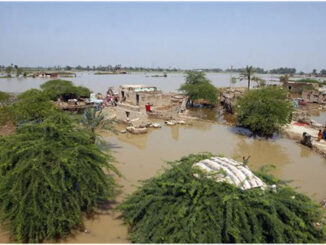
    Islamabad  (TIP): The death toll from flash floods triggered by record monsoon rains across much of Pakistan reached 1,186 on September 1, as authorities scrambled to provide relief materials to tens of thousands of affected people. Record monsoon rains in the last three decades triggered floods which inundated one third of the country, including most of Balochistan and Sindh provinces.

    “So far 1,186 people have died and 4,896 injured while 5,063 kms of roads damaged, 1,172,549 houses partially or completely destroyed and 733,488 livestock killed,” said the National Disaster Management Authority (NDMA), the main body dealing with calamities.

    On Thursday, the army said that some 50,000 people have been evacuated since rescue efforts began.

    Foreign Office spokesperson AsimIftikhar Ahmed said that more than 33 million people have been affected due to “colossal scale of devastation”.

    During a media briefing here, he said Pakistan mounted coordinated rescue and relief operations mobilising all possible resources but the sheer scale of the calamity “stretched our resources and capacities to the limit, thus necessitating support from the international community”.

    The cash-strapped Pakistan government on Tuesday teamed up with the United Nations to issue a flash appeal for USD 160 million to deal with the disaster in the country that has become the “ground zero” of global warming.

    “The Flash Appeal launch was well attended by Member States both in Islamabad and Geneva, Heads of UN agencies in Pakistan, representatives of international organizations, among others. Participants offered condolences and expressions of solidarity, and assured continued support for Pakistan,” the spokesman said.

    He also said that Pakistan faced a “climate-induced calamity” because the monsoons were not ordinary, “as the UNSG termed them ‘monsoons on steroid’.” UN Secretary-General Antonio Guterres will be visiting Pakistan on September 9-10 on an important visit to “express solidarity and international community’s support for Pakistan at this difficult time,” he said.

    Talking about the outpouring of relief supplies, he said till last night, Pakistan received flood relief goods through 21 flights notably from Turkey, UAE and China.

    He said a large number of countries and international organisations pledged to support and are extending cash or in-kind assistance including Australia, Azerbaijan, Canada, China, EU, France, Iran, Japan, Kazakhstan, Kuwait, New Zealand, Norway, Palestine, Qatar, South Korea, Saudi Arabia, Singapore, Turkiye, the UAE, United Kingdom, the United States, Uzbekistan, along with various international organisations including World Bank, Asian Development Bank and other UN Agencies. He said Pakistan on Wednesday signed the Green Framework Engagement Agreement with Denmark in Copenhagen, which marks the first step in creating stronger collaboration in areas such as climate change mitigation and adaptation, and a just and sustainable green transition.

    Separately, Prime Minister Shehbaz Sharif while addressing lawmakers of his Pakistan Muslim League-Nawaz asked them to visit the flood victims with relief goods. The prime minister said that he had never seen such a calamity before. “Water has wreaked havoc everywhere,” he said.

    He also asked Finance Minister Miftah Ismail to devise a plan to give relief to the flood-affected people with electricity bills. Army chief General Qamar JavedBajwa visited the Rohjan area of Punjab and met flood victims whom he assured that the Pakistan Army will help them to overcome their problems in these difficult times, the army said.

    He also directed ground troops to “take this responsibility as a noble cause and spare no effort to lessen the burden of flood-affected brothers and sisters”.

    Advisor to the Prime Minister on Kashmir and Gilgit-Baltistan Affairs Qamar Zaman Kaira said that Prime Minister Sharif would visit Gilgit-Baltistan on Friday and announce a relief package for the flood victims.

    Separately, the United Nations International Children’s Emergency Fund (Unicef) said in a statement that more than three million children were in need of humanitarian assistance in Pakistan and at increased risk of waterborne diseases, drowning and malnutrition due to flooding.

    “These floods have already taken a devastating toll on children and families, and the situation could become even worse,” the statement quoted Unicef representative in Pakistan Abdullah Fadil as saying.

    To add to worries, the Pakistan Meteorological Department (PMD) has forecast more rain in September, saying that La Nina conditions — responsible for recent spells of flood-triggering deluge in the country — would persist in September but become less intense.

    “Tendency for normal to above normal precipitation is likely over the country during September,” the Met Office said, predicting above-normal rainfall in northeastern Punjab and Sindh. (PTI)

  • Modi has externalized his  domestic agenda of spreading Islamophobia in India

    Modi has externalized his  domestic agenda of spreading Islamophobia in India

    Right now, India’s global reputation as a viable Democracy and a Secular nation is under scrutiny as it has descended into a major milestone of steep descent into darkness of bigotry and Islamophobia. Modi that is known to invoke values of pluralism abroad, has remained silent as Indian democracy is humiliated with international backlash. It looks like Modi has successfully externalized his domestic agenda of targeting minorities,  especially the 205 million Muslims with impunity and hate speeches, and  with official sanctions.  Prime example is Anurag Thakur who  was elevated from a Junior Minister to  Independent Minister after he made a remark in Jan 2020 targeting Muslims for protesting against Citizenship (Amendment) Act, “Desh ke gaddaron ko, goli maaro saalon ko (Shoot the traitors of the country)”

    By Dave Makkar

    For the first time in the 75 years history of Independent India, the government headed by BJP’s Modi is on the biggest diplomatic firefighting mission of apology to 15 Majority-Muslim nations and 57-member Organization of Islamic Cooperation (OIC) and the Gulf Cooperation Council (GCC) over the  derogatory remarks made on Prophet Mohammed by leaders of the ruling BJP. This time it was not just Indian Muslims speaking out and protesting on the streets all across India but on June 5, 2022 the governments of Qatar, Kuwait, Oman, Iran, Saudi Arabia, Jordan, Libya, Turkey, Maldives, Iraq, Indonesia, United Arab Emirates, Bahrain, Pakistan and Malaysia issued stinging statements condemning the comments. Some countries are demanding written apologies besides calling the Indian Ambassadors to register their protest. In some countries, there were massive street protests,  and in Qatar, “Boycott India” campaign was also trending on social media.

    Dinner to be hosted by Deputy Emir of Qatar for India’s VP Venkaiah Naidu was cancelled.  VP Naidu was on a 3-day state visit to Qatar.  Qatari Minister of State for Foreign Affairs  Al Muraikhi warned in a statement that “insulting remarks would lead to incitement of religious hatred and offend more than 2 billion Muslims around the world.”

    In response to this diplomatic row, the Indian embassy in Doha released a statement insisting that the comments were made by “fringe elements” and “do not, in any manner, reflect the views of the Government of India”.

    The 57-member OIC . condemned the remarks and said it came in a “context of intensifying hatred and abuse toward Islam in India and systematic practices against Muslims.” OIC also urged the United Nations to take necessary measures to ensure that the rights of minorities are protected in India. The Spokesperson for UN Secretary-General Antonio Guterres has called for a halt to any sort of violence, especially the one based on perceived religious differences and hatred, amidst protests in India over the controversial remarks against the Prophet by two now-suspended BJP leaders.

    This gigantic diplomatic backlash comes on the heels of US Secretary of State Antony Blinken naming India while releasing the State Department’s International Religious Freedom Report (USCIRF) on June 2, 2022. Blinken said: “in India, the world’s largest democracy and home to a great diversity of faiths, we have seen rising attacks on people and places of worship.” Rashad Hussain, the Ambassador-at-Large for IRF called out the Indian government officials, who he said are “ignoring or even supporting rising attacks on people and places of worship.”  The report also mentioned several Hindu extremist leaders; like Yati Narasinghanand, Maa Annapurna Bharti, Swami Paramatmananda, and BJP’s UP CM Yogi Adityanath, a close ally of PM Modi.

    USCIRF has recommended U.S. Government to designate India as a “country of particular concern,” or CPC, for engaging in and tolerating systematic, ongoing, and egregious religious freedom violations, as defined by the International Religious Freedom Act (IRFA); Impose targeted sanctions on individuals and entities responsible for severe violations of religious freedom by freezing those individuals’ or entities’ assets and/or barring their entry into the United States.

    “Desh ke gaddaron ko, goli maaro saalon ko (Shoot the traitors of the country)”: Anurag Thakur, Sports Minister of India.

    Right now, India’s global reputation as a viable Democracy and a Secular nation is under scrutiny as it has descended into a major milestone of steep descent into darkness of bigotry and Islamophobia. Modi that is known to invoke values of pluralism abroad, has remained silent as Indian democracy is humiliated with international backlash. It looks like Modi has successfully externalized his domestic agenda of targeting minorities,  especially the 205 million Muslims with impunity and hate speeches, and  with official sanctions.  Prime example is Anurag Thakur who  was elevated from a Junior Minister to  Independent Minister after he made a remark in Jan 2020 targeting Muslims for protesting against Citizenship (Amendment) Act, “Desh ke gaddaron ko, goli maaro saalon ko (Shoot the traitors of the country)”

    After assuming power in 2014, Modi has been allowing rather encouraging without punishment; Islamophobic remarks by members of his government, his Party BJP, state governments under BJP, Hindu organizations, Media & educational institutions.  In all the BJP ruled states Muslims & Christians are openly being denied basic human rights, right to justice as well as right to worship. Muslims,  especially male and female student leaders & activists are maliciously prosecuted under the directions from BJP ruled states or Modi’s central government.  They are beaten & lynched in broad daylight.  Muslim Houses are demolished in (Israeli style) Collective Punishment for valid protests termed as riots or turned into riots by BJP or RSS or other Hindu organizations or as unauthorized structures even if they are there for 30-40 years & some have government documents. Hindu owned houses with similar or worst status in the same vicinity are left untouched. On social media, female Muslim journalists, activist and social workers have been ferociously trolled and issued threats of the worst kind, including rape. Muslim women have been put up for sale in fake auctions. Islamophobic memes and hashtags,  taunting and  tainting Muslims in India has become the norm.

    Also, since 2014, Islamic structures including Mosques are being targeted under the excuse that they were built 5-9 centuries ago after demolishing Hindu Temples. UNESCO World Heritage Sites like Taj Mahal, Jama Masjid, Qutub Minar etc. are being disputed as built on Hindu temples. BJP ruled Karnataka that is referred as “Silicon Valley of India” has gone one step further and started doing surveys of Christian Churches also to establish if they were built after demolishing Hindu temples. Whereas “The 1991 Act says that a mosque, temple, church or any place of public worship in existence on August 15, 1947, will retain the same religious character that it had on that day – irrespective of its history – and cannot be changed by the courts or the government”.

    Fringe elements? Home Minister Amit Shah, Prime Minister Narendra Modi, Chief Minister of UP Yogi Adityanath.

    Modi’s government has maintained a studied silence or at the most has always blamed “fringe elements” for such actions. They do not hesitate even to include their own National Spokesperson currently Chairman of Tourism Department, “Sambit Patra as Fringe Element”.  All this appears to have emboldened ordinary Hindus to beat Muslims in public, go online and tarnish Muslims with impunity. They publicly cry about being the victim and think they are entitled to revenge for what happened from 7th to 17th century. This itself constitutes a grave danger to the protection of human rights and may lead to further prejudice and marginalization, which will create a cycle of violence and hate against Indian Muslims including public lynching.

    Role of Indian Media in spreading Islamophobia in India:

    The Godi Media of India

    Prime Time debates in India since 2014 have become a platform to encourage Hindu hate mongers to speak ill about other religions. The anchors encourage hatemongering and allow BJP or RSS or other Hindu organizations spokesperson to speak rubbish that is corrupting the moral and social fiber of the society and can incite violence against believers of other religions.

    These media houses are called as Modi’s Godi (lapdog), bikau (saleable), dalal (agent) and bharkau (inflammatory) Media This is how a major section of India’s mainstream media is labelled by most Indians, especially Muslims, Christians and low-caste Hindus, opposition parties, as well as ½ a dozen national media — all because of their brazen support for the ruling party BJP, its ideological parent RSS and the government.

    Their journalists and anchors routinely engage in spreading hatred towards the country’s 205 million Muslim population and Islam, thus nourishing Islamophobia. They also demonstrate a clear bias against the country’s low-caste Hindus, the poor, and less privileged and weaker sections of society. They openly favor the rich and powerful that owns or finance their channels. Shamelessly they promote Hindutva & Hindu Rashtra– an ideology that seeks to establish the hegemony of Hindus and the Hindu way of life — spearheaded by Rashtriya Swayamsevak Sangh (RSS), its ruling political front Bharatiya Janata Party (BJP).  Any criticism of the BJP is narrated as “anti-nationalist” and any individual challenging or demanding answers from the party is labelled “anti-Indian”.

     Here is Media ranking in descending order in spreading Islamophobia in India:

    Republic TV- co-founded and majority-owner Arnab Goswami is the channel’s editor and news anchor. Known for opinionated reporting in favor of BJP & RSS and their Hindutva-Hindu Rashtra agenda including uncritically reproducing government narratives, avoiding criticism of BJP/RSS figures, and presenting their political opponents in a negative light. He shamelessly shows his bias. He is the King; “No one can beat him in spreading hatred against Muslims and fake news”. On top of that no one can match him in shouting contest.

    CNN News 18 owned by Poster Boy of Gangster Capitalism, billionaire Mukesh Ambani. A supporter & 2nd top financier of Modi, RSS, Hindu Rashtra; owns 65 channels: English, Hindi and 14 regional language news, business, entertainment, music, movies, youth, Kids, factual entertainment and shopping channels.  Its star news anchor Amish Devgan is a Clone of Republic TV’s Arnab in shouting and arrogance, and routinely indulges in Muslim bashing and spreading fake news.

    Aaj Tak – Owned by Arun Purie’s India Today Group, Aaj Tak has three of the worst Islamophobic anchors in the Indian media — Anjana Om Kashyap, Rohit Sardana and Sweta Singh. They are notorious for their vitriolic attacks against Muslims and spreading communal hatred. They routinely indulge in Muslim bashing, while show ­deferential surrender to anything the BJP does.

    India Today (English) Also owned by Purie’s India Today Group with main anchors Rajdeep Sardesai and Rahul Kanwal. Rajdeep is mildly anti-BJP and a bit critical of Modi. Rahul Kanwal in 2020 became a full-time supporter of Modi, BJP & RSS and its ideology after a punishment for being openly critical of Modi. 

    Wion (World is One News) – operated by Essel Group, owns nearly two dozen Zee channels (some of them merged with Sony TV in Feb. 2022). Its chairman Subhash Chandra  was a  BJP supported Rajya Sabha MP till June 11, 2022. He has been promoting its Hindutva aka Hindu Rashtra agenda and  anti-Muslim tirades. His star prime time news anchor Sudhir Chaudhary was jailed for demanding  bribes for not publishing news; is also the editor-in-chief. He is the Hindi version of Republic TV’s Arnab as he openly supports the BJP, RSS and Modi.

    Times Now- owned by Pro BJP/RSS Sahu Jain family of Times of India News paper’s Group. Rahul Shivshankar Editor in Chief,  Navika Kumar Gp Editor; openly support BJP and RSS by promoting its Hindutva aka Hindu Rashtra and anti-Muslim agenda

    India TV – Founder Rajat Sharma and his wife Ritu Dhawan. Rajat was a member of ABVP (Student Wing of RSS) & very close friend of late Arun Jaitley, the most corrupt Modi’s BJP Finance Minister in the history of India.  He openly supports BJP and RSS by promoting its Hindutva aka Hindu Rashtra and anti-Muslim agenda.

    ABP News – Owned Pro BJP Aveek Sarkar of Anandabazar Patrika Group. It used to be neutral, but it turned pro-BJP a couple of years ago. after the Modi government objected to criticism of the BJP and Baba Ramdev by its star journalists Punya Prasoon Vajpayee and Abhisar Sharma.  Both were fired and Rubika Liyaquat joined to replace them to became the commander-in-chief of its news anchors. A Muslim, with angry rhetoric against Muslim leaders and do not allow any criticism of Modi or BJP or RSS or their policies.

    Republic Bharat — This sister channel of Republic TV is funded by the BJP and RSS. Its anchor Sucherita Kukreti, a  female version of Arnab Goswami in shouting and spitting the venom of hatred against Muslims.

    Sudarshan News — Its chairman, Suresh Chavhanke, knowingly disseminates anti-Muslim content and manufactures fake news with communal overtones, which has earned him titles such as “bigot” and “dangerous”. He was a long-term RSS volunteer and associated with ABVP. And prefers that the news programs over his channel be viewed as opinionated campaigns.

    News Nation – Deepak Chaurasia, the consulting editor of this channel, which is owned by News Nation Network, is known as a “puppet” of Modi. He always makes fun of all the political parties except the BJP and its allies. He is notorious for his over-the-top coverage of news issues and for being uncritical of the BJP government.

    News24 (India) – Owner B.A.G. Films and Media, promoters are Anurradha Prasad, sister of BJP Union Minister R S Prasad, along with her husband, Pro BJP Congress politician Rajeev Shukla.

    Ethnic Indian media in USA

    Unfortunately, 97% of the Ethnic Indian media in USA are like their counterparts in India. Their anchors are no less than Arnab Goswami or Amish Devgan or Sudhir Chowdhary or Navika Kumar or Anjana Om Kashyap etc. when it comes to spreading Islamophobia and fake news while promoting BJP & RSS’s Hindutva & Hindu Rashtra agenda in USA.

    A  glance over the few important Islamophobic incidents in last 31/2 years that has led to the unprecedented international outcry against India for the Islamophobic comments made by ruling party BJP’s 2 senior leaders about  Prophet Muhammad.

    June 2018, Michelin-starred chef  Atul Kochar was fired from JW Marriott Marquis, Dubai after he tweeted that followers of Islam had “terrorized” Hindus for 2,000 years.

    Sep. 2018 in a public meeting, India’s Home (Interior) Minister Amit Shah compared the illegal Bangladeshi Muslims  migrants with “Termites”.

     April 2019 Home (Interior) Minister Amit Shah in an election rally again said, “Infiltrators are like termites in the soil of Bengal.” “A Bharatiya Janata Party (BJP) government will pick up infiltrators one by one and throw them into the Bay of Bengal,” referring to illegal Muslim immigrants from neighboring Bangladesh.

    April 2019, BJP’s Communal & a Criminal Hindu Priest CM Adityanath Yogi of UP the most populous state of India, spoke about a “green virus” in an election speech in reference to Muslim voters who he said were being wooed by opposition parties. In another election speech he referred Muslims as the “Taliban”

    April 2019, BJP MLA Mayankeshwar Singh from UP’s Siddharthnagar in an election speech threatened Muslims with bodily harm for effectively just existing. “If Hindus in Hindustan wake up the beard will be pulled and made into a choti (a tightened braid). If you have to live in Hindustan you have to say ‘Radhe’ (chant Hindu God’s name), else, like those who went to Pakistan during the partition, you can go too… you have no use here,”

    Dec 2019, PM Modi made a Islamophobic remark targeting Muslims protesting over Citizenship (Amendment) Act (CAA); “those indulging in arson “can be identified by their clothes”.

    Feb. 2020, Modi’s Junior Minister Anurag Thakur while leading a pro CAA and National Register of Citizens (NRC) rally called a slogan, “Desh ke gaddaron ko, goli maaro saalo ko (Shoot the traitors of the country)” targeting the ongoing Muslim women’s 24X7 sit in protest against CAA & NRC at Shaheen Bagh, Delhi. After Thakur’s rally, the city saw deadly communal riots which left 53 dead and 700 injured – majority of them Muslims. Shaheen Bagh protest (Dec 15, 2019 to March 24, 2020) was a peaceful sit-in protest in Delhi lead by women only.  Anurag Thakur was rewarded and elevated to a Minister with independent charge in July 2021.

     Nov. 9, 2019,  Travesty of justice in Babri Masjid vs Ram Janma Bhumi; in a unanimous verdict the Supreme Court of India under CJ Ranjan Gogoi who was retiring on Nov. 17, 2019; awarded the land of disputed Babri Masjid to Hindus. However, the court added that the demolition of the Babri mosque was against the rule of law but do not propose any prosecution for those responsible for the demolition; basically acquitting all the 49 accused high ranking leaders of instigating the mob. Babri Masjid was built in 1528-29 and demolished by the Hindu mob under the top leadership of BJP, RSS, VHP & other militant Hindu organization in 1992. It led to riots in different parts of India that killed nearly 2,000 people. All the Hindu organizations led by BJP had started instigating the Hindus from 1989 to demolish the Mosque by making them believe that the land is the “Birthplace of Lord Ram”. On the other hand, Hindu scriptures say that “Kan Kan mei Vyape hein Ram” meaning “Lord Rama permeates every atom of this universe”. Ever since the Modi-led BJP came to power in 2014, India has seen deepening social and religious divisions. The demand for Ram Janam Bhumi became louder and clearer. Chief Justice Ranjan Gogoi was rewarded by Modi regime in March 2020 by making him Rajya Sabha (Upper House of Parliament) member after awarding a verdict in favor of Hindus in Dec 2019.

    April 2020, BJP MP Tejasvi Surya landed in a row for a tweet he had posted in 2015 with an “objectionable and disrespectful” comment about Arab Women. “95 percent Arab women never had orgasms in last few hundred years: Tarek Fatah.” Prominent businesspeople, lawyers and commentators in Dubai and Kuwait condemned his remarks. He deleted the tweet.

    April 2020, When Indians living in Dubai began posting anti-Tablighi Jamaat congregation in Delhi as a supper spreader of Covid, Princess Hend Al Qassimi warned that “anyone that is openly racist and discriminatory in the UAE will be fined and made to leave”. Under Modi’s Home Minister  Amit Shah, attendees of Tablighi Jamaat congregation in Delhi were accused of spreading the Covid-19 virus. Criminal cases were registered against several attendees including foreign nationals in the courts across India. in August 2020, the Bombay HC quashed three FIRs against 35 petitioners – 29 of them foreign nationals. The court observed: “A political government tries to find the scapegoat when there is pandemic or calamity and the circumstances show that there is probability that these foreigners were chosen to make them scapegoats. Some of the charge sheeted Muslims neither attended the Delhi congregation nor were they inclined to the Tablighi ideology, as evidenced in the case of eight charge sheeted individuals, whose case was dismissed by the Delhi’s Saket district court on 25 August 2020. The SC CJ Sharad Bobde observed “evasiveness” in that the Government of India’s affidavit filed in response to petitions challenging the discriminatory and communal coverage of the Tablighi Jamaat incident by some sections of the media. He termed it as “unnecessary, nonsensical” averments.   On 16 December 2020, Chief Metropolitan Magistrate of a Delhi Court, Arun Kumar Garg, acquitted the 36 foreign nationals from 14 countries of all the charges levelled against them.

    August 2021, BJP leader and Supreme Court lawyer Ashwini Upadhyay made anti Muslim slogans including calling for Muslims to be murdered, in a rally in favor of the uniform civil code, at Jantar Mantar, Delhi.

    Sep. 2021, BJP’s UP CM Adityanath Yogi in a public rally said that prior to his government’s formation in 2017, the ration (subsidized food grains) meant for the poor would get ‘digested’ by those who utter “Abba Jaan” as a communal reference to Muslims. In several parts of India, Muslims use the phrase “Abba Jaan” to refer to their fathers or as an endearment.

    Oct. 2021, Uttarakhand BJP president Mandan Kaushik told the media, “Our party line is clear that no [religious] conversion [from Hinduism] will be tolerated.”

    November 2021,BJP Leader Ashwini Upadhyay was featured on a panel on the imaginary bogey of ‘thook jihad (spit jihad).’ where he said, these thook (spitting) jihadis are either being taught all this by their parents or at their madrassas (schools).” He even suggested that Muslim men may be mixing other body fluids in the food they prepare for sale to Hindus.

    December 2021, Upadhyay was a notable BJP presence at the now-notorious Dharma Sansad which took place at Haridwar. Known Islamophobic Militant Hindu Priest Yati Narsinghanand called Muslims “demons”, threatened to “eliminate” them and said he is striving to create an India “free of Islam”.

     Swami Prabodhanand Giri said the country now belongs to Hindus. “This is why, like in Myanmar, the police here, the politicians here, the army and every Hindu must pick up weapons, and we will have to conduct this cleanliness drive,” he said while referring to Muslims. “There is no solution apart from this.”

     Maa Annapurna Bharti, alias Pooja Shakun Pandey, “Nothing is possible without weapons. If you want to eliminate their population then kill them. Even if 100 of us are ready to kill 20 lakhs of them (Muslims), then we will be victorious, and go to jail.”

     Suresh Chavhanke, owner of Militant Hindu channel “Sudarhan News”, administered an oath to turn India into a Hindu-first country. “We make a resolution until our last breath: We will make India a Hindu nation, and keep it a Hindu-only nation,” he said. “We will fight and die if required, we will kill as well.” He then tweeted a video of  the oath to his half a million followers.

    The event concluded with an oath-taking which called for the “protection” of the Hindu religion against all those who might pose a threat to it ‘by any means necessary.

    Feb. 2022, BJP MLA from UP’s Dumariganj,  in a video said, “Since I became an MLA, they (the Muslims) have stopped wearing skull caps. If you vote for me again, they will start wearing tilaks.” Again on February 15, 2022 panel on India TV, he interrupted a Muslim panelist to hurl religious slurs and abuses against him, threatening to feed pig’s milk (derogatory for Muslims) to the panelist, whom he described as a “b*****d dog and an illegitimate child of Hindus”.  He was seen in another video threatening Muslims and accused all Hindus who did not vote for him of being Muslims. He said, “Any Hindu who doesn’t vote for me has Miyan (Muslim) blood in his veins. He’s a traitor. He is a b*****d son of Jaichand. He’s a sinner son of his father…I am warning you this time…traitors of Hindu religion will be destroyed.” Further he goes on to threaten Muslims by saying, “Listen Muslims, if any Hindu is insulted and if you look at any Hindu girl, then I’ll get you beaten so much and cut so much…that…”. The latter part of his warning drowns out amidst ‘Jai Shri Ram’ chants.

    April 2022, Bihar BJP MLA Haribhushan Thakur Bachaul said that Muslims should be set ablaze just as Hindus burn Ravana effigies during the festival of Dussehra. Earlier in Feb 2022, he had also said that Muslims living in India should be stripped of “Voting Rights” and treated as second-class citizens.

    May 2022, 3 BJP MLA’s K.G. Bopaiah, Appachuranjan and Suja Kushalappa from BJP ruled Karnataka state Assembly were present at the “Arms training camp’ organized by the anti-Islam militant Hindu “Bajrang Dal”. A viral video on social media showed  youths, appearing to be minors, in possession of airguns, trishuls (Tridents) and other weapons.

    May 2022 in BJP ruled MP, a 65-year-old Hindu with cognitive disabilities Bhawarlal Jain, was beaten to death by a BJP worker Dinesh Kushwaha suspecting him to be a Muslim.

    NEW DELHI, INDIA – JANUARY 21: BJP candidate from New Delhi Constituency Nupur Sharma arrives at Jamnagar House to file her nominations for the upcoming Delhi Assembly Elections 2015 on January 21, 2015 in New Delhi, India. Polling in Delhi will be held on February 7 and the counting of votes will take place on February 10. (Photo by Saumya Khandelwal/Hindustan Times via Getty Images)

    May 27, 2022, BJP National Spokesperson & SC Lawyer Nupur Sharma’s made derogatory and insulting comments against Prophet Mohammad during a debate on Times Now  with Anchor Navika Kumar on the dispute over the Gyanvapi mosque. Pro BJP Navika Kumar allowed Sharma to make insulting remarks about the prophet and his marriage. The party’s Delhi media head, Naveen Kumar Jindal, subsequently tweeted another offensive comment about Prophet Muhammad, the most revered figure in Islam. This has incensed Indian Muslims and a week later outraged more than a dozen Islamic nations.

    Hindus claim that the Gyanvapi Mosque in the Hindu holy city of Varanasi is built on the ruins of a grand 16th Century Hindu shrine – destroyed in 1669 by Mughal emperor Aurangzeb – and some are now seeking a court’s permission to pray within the mosque complex.

    May 27, 2022, Former Karnataka Deputy CM and at present BJP MLA Eshwarappa issued a statement to media that 36,000 temples were destroyed to build mosques over them. He stated that all of them would be reclaimed by Hindus legally.

    June 5, 2022, repeat offender for Islamophobic comments including calling for genocide & derogatory comments against the Father of the Nation, Mahatama Gandhi; Maa Annapurna Bharti alias Shakun Pandey inked a letter “with her blood” to India’s President Kovind, asking him to take action against Friday Muslim prayers, which she claims are an “anti-Hindu congregation”. She said, “Friday is not a day for prayers. Instead, it is a day for terrorism. The Friday congregations by Muslims are not for worship but for the genocide of non-Muslims, loot, arson and sexual harassment. Hence, the Akhil Bharat Hindu Mahasabha demands that on Fridays, the entry of Muslims in small mosques should be restricted only to 10 Muslims while 25 Muslims should be allowed in bigger ones.

    If all the above Islamophobic actions were done by the “Fringe Elements” then who is promoting and supporting “Islamophobia” in India? The answer is not difficult to find. It is  India’s internationally known Hinduwadi and domestically known as Hindu Heart Throb aka Hindu Hriday Samrat aka Hindu King aka Prime Minister Narendra Modi…!! Under parliamentary system fashioned after the Westminster system the prime minister is the presiding and actual head of the government and head/owner of all the departments and executive power. The head of the state,  the president in India,    holds a largely ceremonial position, although often with reserve powers. In case of current President Kovind, it is a well-known fact that he only speaks the language of PM Modi.

    Poster Boys of Gangster Capitalism of India. L to R: Rattan Tata, Mukesh Ambani, and Gautam Adani

    The next question is who is financing Islamophobia and Modi that is representing each and every Hindu organization that wants to make India a “Hindu Rashtra” ? The answer is the gangster capitalist of India that is supporting Modi.  The current top 3 Poster Boys of Gangster Capitalism of India are Gautam Adani, Mukesh Ambani, and Rattan Tata. Their net worth under Modi’s 8 years rule has gone up by 175% to 350% and now they own all the major industries,  including defense and service sector of India.

    “Modi’s eminence is due to the surrounding flatness of India”.

     Unfortunately, here the flatness means; illiterate, communal & criminal Modi’s high reputation is only because of the terribly low morals, ethics, honesty and talents left in India these days. Since 2014, India under Modi has become a sad story. Over 60% Indians are gladly willing to pay Islamophobic Tax, even if it begets them unemployment, poverty, hunger and even starvation! No one can save a nation in death wish mode.

    (Compiled by Devendra Makkar from various internet sources & writings of prominent journalists)

  • Indian American policy advisor Gautam Raghav elevatedto key White House position

    Indian American policy advisor Gautam Raghav elevatedto key White House position

    WASHINGTON, D.C. (TIP): US President Joe Biden has elevated Indian-American political advisor Gautam Raghavan as the head of the White House Office of Presidential Personnel.

    White House Presidential Personnel Office (PPO), also written as Office of Presidential Personnel, is the White House office tasked with vetting new appointees. The PPO is one of the offices most responsible for assessing candidates to work at or for the White House. President Biden on Friday elevated Raghavan, who was currently posted as the PPO Deputy Director, to the key White House post after UN Secretary-General Antonio Guterres announced his intent to appoint Cathy Russell as the next executive director of UNICEF. Russell is currently the head of WH PPO. Under Cathy’s leadership, the PPO has broken records in both speed and diversity of hiring, working relentlessly to ensure that our federal government reflects America and delivers for the American people, Biden said. “I am also pleased that Gautam Raghavan, who has worked in tandem with Cathy from Day One, will become PPO’s new director — a seamless transition that will enable us to continue building a federal workforce that is efficient, effective, dependable and diverse,” he said in a statement.

    A first-generation immigrant, Raghavan was born in India, raised in Seattle and graduated from Stanford University. He is the editor of the book ‘West Wingers: Stories from the Dream Chasers, Change Makers, and Hope Creators Inside the Obama White House’.

    Raghavan, in his 40s, is openly gay. He lives with his husband and their daughter in Washington, DC.

    Raghavan has served as deputy assistant to the President and deputy director of the White House Office of Presidential Personnel since January 20, 2020. Previously, he was the first employee hired by the Biden-Harris transition team where he served as deputy head of Presidential Appointments.

  • Will Pakistan’s nuclear stockpile be the region’s Achilles heel?

    “Some non-nuclear States have historically opposed the resolution in response to India testing nuclear weapons and becoming a nuclear-armed State in 1998. India can and needs to do more to get countries to reconsider their opposition, especially in light of Taliban’s takeover of Afghanistan that has already led to rise in India-Pakistan tensions.

    “While there are enough pundits predicting that Taliban and Pakistan will make for the most volatile bedfellows, there is no denying that the region’s power dynamics have been dramatically and drastically altered. A change that has taken everyone by surprise only goes to show that nothing can be ruled out. So, speaking of Pakistan’s nuclear stockpile falling in the hands of Taliban is not as far-fetched as one would imagine.”

     By Priyanka Khanna

    The predictable India-Pakistan rhetoric during the United Nations General Assembly (UNGA) in New York and accusations flying right and left at the ongoing 48th session of the Human Rights Council (UNHRC) in Geneva are shadowing the simmering worry as to what will happen to Pakistan’s growing nuclear arsenal.

    Indian Prime Minister Narendra Modi has repeatedly raised doubts about Pakistan’s intentions
    (Photograph / Jay Mandal- on assignment)
    Pakistan Prime Minister Imran Khan is unmoved (Photograph / Jay Mandal- on assignment)

    The 140-150 nuclear warheads that are currently stockpiled in Pakistan’s central storage facilities in its southern parts remain outside both the Treaty on the Non-Proliferation of nuclear weapons (NPT) and the Comprehensive Nuclear Test Ban Treaty (CTBT).

    With the Afghanistan takeover by Taliban and given their bon homie with Pakistan, especially its intelligence, it is singularly worrying that Pakistan is the sole country that is blocking negotiations of the Fissile Material Cut-Off Treaty (FMCT).

    While there are enough pundits predicting that Taliban and Pakistan will make for the most volatile bedfellows, there is no denying that the region’s power dynamics have been dramatically and drastically altered. A change that has taken everyone by surprise only goes to show that nothing can be ruled out. So, speaking of Pakistan’s nuclear stockpile falling in the hands of Taliban is not as far-fetched as one would imagine.

    The UN is not doing enough to push Pakistan to undertake disarmament. (Photograph / Jay Mandal- on assignment)

    Which brings us to the question of why the UN is not doing enough to push Pakistan to undertake disarmament. In fact, according to the advocacy group – Unfold Zero – the UNGA was not even able to come together on nuclear disarmament resolutions. In the last nuclear disarmament UN meeting, nuclear risk-reduction was perhaps the only measure countries could come together for.

    A resolution reducing nuclear danger submitted by India received 127 votes in favor (mostly non-aligned countries). It failed to get support of nuclear-armed or European countries, primarily because it only calls for nuclear risk reduction measures by China, France, Russia, UK and USA – leaving out the other nuclear armed States – India, Pakistan, DPRK and Israel, according to unfoldzero.org.

    A resolution on decreasing the operational readiness of nuclear weapons systems submitted by a group of non-nuclear countries, was much more successful receiving 173 votes in favor, including from most of the NATO countries and from four nuclear armed States (China, DPRK, India, Pakistan).

    A resolution on the Treaty on the Prohibition nuclear weapons (TPNW) was supported by 122 countries. This is more than the number who have signed the Treaty, which is 68 (with 19 of these countries having now ratified). The vote indicates that more signatures are likely. However, the resolution was not supported by any of the nuclear-armed countries, nor any of the countries under nuclear deterrence relationships, i.e., NATO, Australia, Japan, South Korea. The opposition of nuclear-armed and allied States to the resolution is another indication that they do not intend to join the new treaty. In general, this means that they will not be bound by the treaty’s obligations. However, the customary law against the use of nuclear weapons which is re-affirmed by the treaty will apply to all States regardless of whether or not they join.

    India’s External Affairs Minister has voiced India’s concern about Pakistan’s stockpile of nuclear weapons to the world, including the Secretary General of the United Nations, António Guterres. (Photograph / Jay Mandal- on assignment)

    A resolution on the prohibition of the use of nuclear weapons submitted by India received 120 votes in favor, including from themselves and another three nuclear-armed States (China, DPRK and Pakistan). Some non-nuclear States have historically opposed the resolution in response to India testing nuclear weapons and becoming a nuclear-armed State in 1998. India can and needs to do more to get countries to reconsider their opposition, especially in light ofTaliban’s takeover of Afghanistan that has already led to rise in India-Pakistan tensions.

  • US suggests world leaders skip General Assembly in-person

    US suggests world leaders skip General Assembly in-person

    NEW YORK (TIP): The United States on Wednesday, August 18, urged the leaders of nearly 200 countries to consider giving video addresses at the United Nations General Assembly in September instead of traveling to New York where the event is being held to prevent a possible “super-spreader event.”

    In a memo from the U.S. Mission to the United Nations the U.S. called on 192 other member nations to consider giving video messages instead of traveling to the U.S. in the midst of a wave of new COVID-19 cases.

    The mission also suggested that all U.N.-hosted meetings and events be virtual, saying meetings that gather large groups of people together in places like New York “needlessly increase risk to our community, New Yorkers and the other travelers.”

    According to the media reports, the mission said that the Biden administration was particularly concerned about Secretary-General Antonio Guterres and the incoming General Assembly President Abdulla Shahid hosting events about climate change and vaccines.

    “The United States is willing to make every effort to make these important events on shared priorities successful in a virtual format,” the mission said.

    The 76th session of the U.N. General Assembly is expected to begin on Sept. 21 and end on Sept. 30. Last year’s assembly was not held in-person due to the COVID-19 pandemic, however, the U.S. decided to allow world leaders the option of attending in-person or virtually this year. The U.S. is currently experiencing a surge of new cases, with hospitalizations around the country rising. According to the Centers for Disease Control and Prevention (CDC), the national seven-day average for new cases is currently over 130,000. Around 86 percent of counties in the U.S. are rated as having a “high” rate of transmission, according to the CDC.

  • Antonio Guterres re-elected as UN Secretary-General for a second five-year term

    Antonio Guterres re-elected as UN Secretary-General for a second five-year term

    “India values Secretary General’s leadership of the United Nations”: India’s External Affairs Minister Jaishankar

    UNITED NATIONS (TIP): UN General Assembly on Friday, June 18, appointed Antonio Guterres as the UN Secretary-General for a second term beginning January 1, 2022, days after the powerful Security Council had unanimously recommended his name to the 193-member body for re-election.

    President of the 75th session of the UN General Assembly Volkan Bozkir announced that Mr. Guterres “has been appointed by acclamation Secretary-General of the United Nations for the second term of office beginning on January 1, 2022, and ending on December 31, 2026.” Mr. Bozkir then administered the oath of office to 72-year-old Guterres at the podium of the UN General Assembly Hall.

    On June 8, the 15-nation Council had held a closed meeting where it adopted by acclamation the resolution that recommended Mr. Guterres’ name to the General Assembly for a second five-year term as Secretary General from January 1, 2022-December 31, 2026.

    Estonia’s Ambassador to the UN Sven Jurgenson, President of the Council for the month of June, had told reporters after the meeting: “We have all seen actually the Secretary General in action. I think he has been an excellent Secretary General. He’s a bridge builder, his views on the conflict zones in the world and he’s able to speak to everybody. And I think this is something that is expected from the Secretary General, and he has proven worthy of the post already with the five years that he has been in office,” Mr. Jurgenson said.

    India had expressed its support for re-election of Mr. Guterres as UN Chief and welcomed the adoption of the resolution recommending his name.

    India’s Permanent Representative to the UN Ambassador T.S. Tirumurti tweeted “India welcomes the adoption of @UN #SecurityCouncil resolution recommending a second term to #UnitedNations Secretary-General @antonioguterres.” Last month, External Affairs Minister S. Jaishankar met Mr. Guterres at the United Nations headquarters and expressed New Delhi’s support to him for his second term as the world’s top diplomat.

    “India values UNSG’s leadership of the UN, especially in these challenging times. Conveyed our support for his candidature for a second term,” Mr. Jaishankar had said in a tweet after the meeting.

    Later a press release issued by the Permanent Mission of India to the UN also stated that Mr. Jaishankar “conveyed that India values Secretary General’s leadership of the United Nations, especially in these challenging times. He conveyed India’s support for his candidature for re-election for a second term.” Under the UN Charter, the Secretary-General is appointed by the General Assembly upon the recommendation of the Security Council. Each Secretary-General has the option of a second term if they can garner enough support from Member States.

    Mr. Guterres, the ninth Secretary-General of the United Nations, took over on January 1, 2017, and his first term ends on December 31 this year. Former Prime Minister of Portugal, Mr. Guterres served as the United Nations High Commissioner for Refugees for a decade from June 2005 to December 2015.

    Mr. Guterres, nominated by the Government of Portugal, has been the only official candidate for the position of Secretary General and his re-election was a given. There has been no woman Secretary General in the UN’s 75-year history and Mr. Guterres’ re-election will mean that any possibility of having a female lead the world organization can come only after 2026.

    In March, Mr. Guterres had circulated his vision statement and earlier in May, laid out his case for a second term to UN Member States during an informal interactive dialogue convened in the General Assembly Hall.

    Mr. Guterres was elected after a reformed selection process that included a public informal dialogue session in the General Assembly, involving civil society representatives, aimed at ensuring transparency and inclusivity.

    In his vision statement ‘Restoring trust and inspiring hope’, Mr. Guterres said that the imperatives for the next five years include mounting a massive and enduring response to the COVID-19 pandemic and its consequences in the short-term, leaving no stone unturned in the search for peace and security, making peace with nature and climate action, turbocharging the Decade of Action to achieve the Sustainable Development Goals and advocating for a more equitable world, ensuring the centrality of human rights, taking gender equality to the next level, focusing on people, rising to the challenge of digital transformation, advancing multilateralism and the common agenda, embarking on a ‘United Nations 2.0’ and rekindling shared commitment to enduring values.

    “As we emerge from the pandemic, the UN is more relevant than ever…We must act as a catalyst and a platform for more inclusive, networked and effective forms of multilateralism. Our direction of travel is clear on peace and security, climate action, sustainable development, human rights and the humanitarian imperative. Our power to transform the current situation into a better world and future for all depends on everyone everywhere and can only be done successfully if we are resolute and resolved to combine our efforts towards our common agenda for the benefit of humanity and the planet,” Mr. Guterres said in his vision statement.

    (Agencies)

  • Biden orders US to rejoin WHO; UN chief welcomes re-engagement

    Biden orders US to rejoin WHO; UN chief welcomes re-engagement

    Trump had cut off US funding to the WHO, saying it was “virtually controlled by China.”

     WASHINGTON / UNITED NATIONS(TIP):  The US rejoined the World Health Organisation (WHO) in one of the first official orders of the Joe Biden presidency, reversing a key foreign policy decision his predecessor Donald Trump took last year after accusing the UN health agency of incompetence and bowing to Chinese pressure over the coronavirus pandemic. In April last year, as the coronavirus pandemic was spreading across the globe, Trump cut off US funding to the WHO, saying it was “virtually controlled by China.” He then went further, triggering the process to pull the US completely out of the organisation.The withdrawal was due to go into effect in July this year, but Biden’s order will cancel it. Biden in a letter to UN Secretary-General Antonio Guterres on Wednesday, the first day of his presidency, said, “The United States intends to remain a member of the World Health Organisation.” “The WHO plays a crucial role in the world’s fight against the deadly COVID-19 pandemic as well as countless other threats to global health and health security. The United States will continue to be a full participant and a global leader in confronting such threats and advancing global health and health security,” Biden wrote.

    The UN Secretary-General welcomed the US’ re-engagement with the WHO, saying supporting the health agency is “absolutely critical” to combatting the COVID-19 pandemic. He said Washington joining the global vaccine initiative will boost efforts to ensure equitable access to vaccines for all countries.

    Guterres said now is the time for unity and for the international community to work together in solidarity to stop the virus and its shattering consequences.

    The US has been the largest funder to the WHO, contributing more than USD 450 million per annum. The US has been a party to the WHO Constitution since June 21, 1948.

    As the world reached a “heart-wrenching milestone” of two million COVID-19-related deaths less than a week ago, Guterres lamented that the deadly impact of the pandemic has worsened due to the absence of a global coordinated effort and said that “vocationalism” by governments is “self-defeating” that will delay a global recovery. Guterres has said the UN is supporting countries to mobilize the largest global immunization effort in history and the world organization is committed to making sure that vaccines are seen as global public goods – people’s vaccines.

    White House Press Secretary Jen Psaki said that Biden signed the executive order, reversing Trump’s decision to withdraw from the WHO. “This will strengthen our own efforts to get the pandemic under control by improving global health, and tomorrow we are not wasting any time,” she said.

    The WHO’s Executive Board has been meeting virtually this week, and the Biden administration announced that a US delegation, headed by Anthony Fauci, the government’s top infectious disease expert, will participate. Fauci will deliver a speech on January 21 to the WHO as head of a US delegation to lay out how the administration intends to work with the WHO on reforms, supporting the coronavirus response and promoting global health and health security

    “Once the United States resumes its engagement with the WHO, the Biden-Harris administration will work with the WHO and our partners to strengthen and reform the organisation, support the COVID-19 health and humanitarian response, and advance global health and health security,” the White House said in a fact sheet.

    Business Roundtable welcomed the decision of Biden to not to withdraw from the WHO. “We need international cooperation to get the COVID-19 pandemic under control here in America and around the world.

    Business Roundtable applauds President Biden’s decision to re-engage with the WHO to improve the international response to the pandemic and welcomes his commitment to WHO reform to prevent and better respond to future public health crises,” it said,

    (Source: PTI)

  • Buddha’s message of compassion timeless

    Buddha’s message of compassion timeless, says UN chief


    UNITED NATIONS (TIP): UN chief Antonio Guterres on Thursday, May 11, called on the global community to draw inspiration from the journey of Lord Buddha and embrace his message of compassion on the occasion of ‘Vesak Day’. Vesak marks the birth, enlightenment and death of Gautama Buddha.

    “Born a sheltered prince, Shakyamuni (Buddha) went out into the world to confront and overcome human suffering. This message of compassion is timeless,” the UN chief said. The UN Secretary-General also emphasized that in the current interconnected world, there can be “no peace as long as others  are in peril, no security as long as others suffer deprivation [and] no sustainable future until all members of our human family enjoy their human rights”. He called on the people of the world to celebrate the wisdom of Buddha by taking action for others with a strong spirit of solidarity.

    On the occasion, a special commemorative event was held yesterday at the General Assembly attended by UN ambassadors, diplomats and Buddhist monks. The event included sermons and a Buddhist musical interlude by a group of children from Sri Lanka. India’s Permanent Representative to the UN Ambassador Syed Akbaruddin told the gathering that Buddha’s key messages of truth, non-violence, peace and harmony continue to resonate across the world two and half millennia after his death.

    “The modern world continues to be beset with great human suffering, deepening inequalities violent conflicts and environmental degradation. The teachings of Buddha which essentially is a reaffirmation of a sustainable lifestyle, harmony with inner self and with nature, hold great promise for achievement of global sustainable development goals and to unite the world to fight climate change,” Akbaruddin said.

    Prime Minister Narendra Modi is also visiting Sri Lanka to attend the ‘Vesak Day’ celebrations in Colombo. In 1999, the UN General Assembly adopted a resolution in which it recognized the International Day to acknowledge the contribution that Buddhism, one of the oldest religions in the world, has made for over two and a half millennia and continues to make to the spirituality of humanity. ( PTI)


  • United Nations Security Council nominates Portugal’s Guterres as the next World Body Chief

    United Nations Security Council nominates Portugal’s Guterres as the next World Body Chief

    UNITED NATIONS (TIP): The United Nations Security Council on Thursday unanimously nominated former Portuguese Prime Minister Antonio Guterres to be the next Secretary-General, recommending that the 193-member General Assembly appoint him for five years from Jan. 1, 2017.

    The General Assembly is likely to meet next week to approve the appointment of Guterres, 67, who would replace Ban Ki-moon, 72, of South Korea. Ban will step down at the end of 2016 after serving two terms.

    Ban, speaking during a visit to Rome, described Guterres as a “super choice” as his successor.

    “I am sure he will carry the torch on the full range of key challenges, from strengthening peace operations to achieving sustainable development, upholding human rights and easing humanitarian suffering,” Ban told reporters.

    Guterres was prime minister of Portugal from 1995 to 2002 and served as United Nations High Commissioner for Refugees from 2005 to 2015. Guterres is due to speak to reporters in Lisbon later on Thursday.

    “He has great United Nations credentials … and being High Commissioner for Refugees means traveling the world and seeing some of the most gruesome conflicts we have to deal with and then of course he is a high-level politician,” said Russian UN Ambassador Vitaly Churkin, president of the council for October.

    “He is a person who talks to everybody, listens to everybody, speaks his mind, a very outgoing, open person so I think it was a great choice and I’m glad that we rallied around Mr. Guterres,” Churkin told reporters.

    The council met behind closed doors on Thursday to adopt a two-paragraph resolution recommending to the General Assembly that Guterres be appointed.

    “Antonio Guterres has shown … that he is the strongest candidate, he has a vision and a moral authority and integrity that put him at the top of the league table,” British UN Ambassador Matthew Rycroft told reporters.

    French UN Ambassador Francois Delattre said Guterres was “the right leader able to bring the nations and the community of nations together”.

  • Europe’s Refugee Crisis

    Europe’s Refugee Crisis

    Another major crisis is unfolding in Europe. Still struggling to find solutions for the Eurozone and Ukrainian crises, The European elite was hardly prepared to face a serious refugee and migration challenge. The problem has already been unfolding for some time. This year alone, more than 300,000 people have risked their lives to cross the Mediterranean Sea (including 200,000 to Greece). Over 2,600 did not survive this dangerous journey. More than 70 people were found dead in an abandoned truck in Austria. Even last year about 3500 people were reported dead or missing in the Mediterranean Sea. For years, these people were seen by many Europeans merely as economic migrants. The images of Syrian toddler Aylan Kurdi whose body was found on Turkish shores after a failed attempt to reach Greece finally shocked the Europeans and the world. Further, chaotic scenes in Budapest, where the Hungarian government tried to stop Syrian refugees’ journey towards Germany, forced the European media and its institutions to change the narrative. The UNHCR has clearly declared now that “this is a primarily refugee crisis, not only a migration phenomenon”.

    The way different EU governments have responded to the present crisis has again exposed structural flaws of common EU policies. The Dublin procedure established that the first EU country where a migrant or refugees enters, is responsible for processing his or her asylum claim. This obviously put tremendous pressure on countries like Greece and Italy where most asylum seekers arrived first. In recent months, Hungary has also joined frontline status as refugees are entering its territory from neigbouring Serbia. As most asylum seekers want to go to Germany, Sweden, France or Italy, questions are raised as to why register and house them in a country where they do not want to stay any way.

    To alleviate the problem, the EU proposed a quota system to distribute migrants among different nations. All 28 EU member states were required to accept asylum seekers in proportion to the size of their economy, unemployment rate and population. Although the plan was initially backed by Germany, France and Italy, they have now suggested many corrections. The UK was already out of the system. Many East Europeans say it will not work as most asylum seekers want to settle in West Europe. Spain has also rejected the plan. Some have objected to the principle itself. The Hungarian Prime Minister Victor Orban asserted that “the idea that somebody allows some refugees in their own country and then distributes them to other member states is mad and unfair”. Later he even added that “the problem is not European, it’s German. Nobody would like to stay in Hungary, neither Slovakia, Poland or Estonia”. The smaller nations in former Eastern bloc feel that policies are being imposed on them by bigger members.

    The number of asylum seekers in the EU has increased significantly in the last few years. Eurostat data shows that about 625,000 claimed asylum in the EU in 2014. The numbers were high but perhaps not as alarming as presented in European media. Europe has seen high numbers even before, particularly during the Yugoslav crisis. In 1992 alone, there were close to 700,000 applications. In the first half of 2015, close to 434,000 people have filed applications for asylum in Europe. Last year, the largest number of asylum seekers came from Syria (20%), followed by Afghanistan (7%), Kosovo (6%), Eritrea (5%), Serbia (3.5%) and Pakistan (3%). In fact, more people from Pakistan applied for asylum than from Iraq. About one third people applied for asylum in Germany only. One in four asylum seekers was a minor.

    As per the UNHCR, over 4 million Syrians are now refugees. It is not that all Syrians are moving towards Europe. About 1.9 million have taken refuge in Turkey. Similarly, about 1.1 million and 630,000 have found shelter in Lebanon and Jordon respectively. Only about 350,000 Syrians have applied for asylum in Europe.
    Europeans know that they cannot run away from their responsibility as many of these people have become refugees due to European involvement in shaping conflict outcomes in Syria, Iraq, Afghanistan, Libya and Kosovo. Both Russian and Turkish presidents have blamed the western world for their policies on this crisis.

    To tackle the crisis, the EU has urged member states to work out a common strategy based on responsibility and trust. So instead of accusing each other, can Europe’s nations agree on some joint action? Many new plans including EU-wide border protection force, destruction of smuggler ships, reallocation plan for already entered refugees, list of safe countries of origin (Balkan states, Bangladesh, Pakistan, Senegal etc) and reception centres closer to conflict areas will be discussed in the coming weeks. European Commission president Jean-Claude Juncker is soon going to outline his plans to relocate 160,000 asylum seekers across Europe over the next two years.

    In the meanwhile, Hungary is building 175 km fence on its border with Serbia. Germany has suspended Dublin rules for Syrian refugees. The Visegrad group (Hungary, Poland, Czech Republic and Slovakia) has declared that any proposal to introduce quota system is unacceptable to them.

    As political and military solutions to the conflicts in Syria and Afghanistan are nowhere in sight, the refugee crisis in Europe is not going to disappear in a hurry. UN High Commissioner for Refugees, Antonio Guterres has urged Europe to “reaffirm the values upon which it was built”. Many West European countries led by Germany have shown courage to accept large numbers of refugees this year. Still the message from the Hungarian prime minister to Syrian refugees was entirely different – “please don’t come. Why you have to go from Turkey to Europe? Turkey is a safe country. Stay there, it’s risky to come. We can’t guarantee that you will be accepted here”.

    (Gulshan Sachdeva is Chairperson, Centre for European Studies, School of International Studies, JNU)

    Views expressed are of the author and do not necessarily reflect the views of the IDSA or of the Government of India

  • UN calls for up to 200,000 refugees to be shared among EU states

    UN calls for up to 200,000 refugees to be shared among EU states

    GENEVA (TIP): The UN High Commissioner for Refugees called Friday on the European Union to admit up to 200,000 refugees as part of a “mass relocation programme” that would be binding on EU states.

    “People who are found to have a valid protection claim… must then benefit from a mass relocation programme, with the mandatory participation of all EU member states,” Antonio Guterres said in a statement.

    “A very preliminary estimate would indicate a potential need to increase relocation opportunities to as many as 200,000 places,” he added.

    His call came ahead of a meeting later Friday of EU foreign ministers to discuss the continent’s refugee crisis, of which Syrian toddler Aylan Kurdi, whose lifeless body was found face down in the surf on a Turkish beach on Wednesday, has become a searing symbol.

    Referring to the pictures of the dead child, which “had stirred the hearts of the world public”, Guterres said: “Europe cannot go on responding to this crisis with a piecemeal or incremental approach.”

    “No country can do it alone, and no country can refuse to do its part,” he declared.

    His appeal tallied with a call by France and Germany for binding EU quotas to share the burden of the influx of migrants and refugees, which has hit Greece, Italy and transit countries in southeastern and central Europe the hardest.

    A European source said that European Commission President Jean-Claude Juncker would next week unveil a plan for the relocation of at least 120,000 more refugees.