Tag: Apple News

  • The limits of India-US strategic partnership

    The limits of India-US strategic partnership

    China is willing to respond positively to US moves towards a limited détente

    “The US is vulnerable as it is involved in two wars, one in Europe and the other in West Asia. While it is engaged in a rivalry with China in the Indo-Pacific, there is as yet no ‘hot war’ there and the US would prefer to keep a lid on that possibility. For this to work, there must be a lessening of tensions with China. China faces its own economic headwinds and is willing to respond positively to US moves towards a limited détente. Public expressions of an anti-China front with India would run counter to this. The postponement of the New Delhi Quad summit, which would have brought President Biden to India, points in the same direction — of not alienating China at this critical juncture.”

    By Shyam Saran

    When India and the US concluded the historic Civil Nuclear Agreement in 2008, their bilateral relations were launched on a positive trajectory. Since then, there has been an across-the-board expansion in virtually all dimensions of the relationship — security, technology, defense, economy and commerce. There is today a broader and deeper relationship of unprecedented magnitude. This is undoubtedly anchored in enduring strategic convergence, particularly with respect to maintaining a balance of power in the Indo-Pacific but not limited to it. If there is a ‘quadrilateral’ platform which groups India together with the US and its military allies Japan and Australia in the Indo-Pacific, there is the I2U2 in the Gulf, bringing together India and Israel as well as the US and the UAE. A shared concern over the expansion of Chinese power on both the eastern and western flanks of India makes these security arrangements valuable to the country.

    These remarks, which appear to openly solicit US support as a supplicant in helping India cope with the military standoff with China on the border, are unusual.

    From the US standpoint, building up India’s economic, military and technological capabilities makes sense even if India is not its formal ally because New Delhi, for its own reasons, will pursue policies to deter the exercise of coercive power by China. This will reinforce the US objective of constraining Chinese power. Furthermore, India is the only country which has a scale matching China’s and can emerge as its peer rival. But it has always been clear that India is unlikely to participate in possible hostilities which might erupt between the US and China, say over Taiwan. Nor will the US put boots on the ground to support any Indian armed operations against China. These limits are well understood by both sides. Neither the US nor India, in their public pronouncements, suggest otherwise. It is also true that while China is a key component in the India-US strategic partnership, it is not the only one. The sheer breadth of the relationship has a logic of its own and India is right in asserting this.

    It is against this background that one was intrigued by the remarks attributed to India’s Defense Secretary Giridhar Aramane on the occasion of the convening of the second INDUS-X defense meeting with the head of the US Indo-Pacific Command, Admiral John C Aquilino, on February 21. He was quoted as saying: “In navigating the complex dynamics of this region, India and the US find themselves as key stakeholders, bound by shared values and common interests.”

    This was fine, but then he brought in the military standoff with China in Ladakh into his public remarks: “India is giving a face-off to our neighbor in almost all the fronts we have with them. Wherever there is a mountain pass, we are stationed there to face any eventuality. Wherever there is a road, we have to be ready there also. So, we are standing against a bully in a very determined fashion.”

    While this may have been conveyed in confidential deliberations in the past, it is the first time such remarks have been made publicly.

    It was even more surprising to read the Defense Secretary’s subsequent remarks: “And we expect our friend US will be there with us in case we need their support. It is a must for us and we have to do it together. We greatly appreciate the support and resolve from our friends in supporting us during such an event. The strong resolve that we will support each other in the face of a common threat is going to be of critical importance to us.”

    These remarks, which appear to openly solicit US support as a supplicant in helping India cope with the continuing military standoff with China on the border, are unusual. They may not have been appropriate to the occasion and even convey, perhaps inadvertently, that India is not capable of dealing with the Chinese threat on its border on its own. The US Department of Defense’s readout on the meeting contains neither a reference to these remarks nor any reaction from the US Indo-Pacific Commander. There may even have been some embarrassment on the US side over this public statement.

    Some days later, there was a media interview of Richard Verma, a former US ambassador to India and currently Deputy Secretary of State in charge of management and resources. The interviewer asked him whether in the backdrop of the Indian Defense Secretary’s reported remarks, “… Is the US standing with India?” His reply is most revealing and supports the view that the Indian official’s remarks may have embarrassed the Americans, who do not wish to give the impression that the US is ganging up with India against China. Listing all the principled reasons why the US-India relationship “stands on its own”, he added that “… this isn’t about any third country. When I think about this relationship, I think about it in bilateral terms and what we can do to strengthen the international architecture.”

    For good measure, he added: “And each of us will take our own path that I think fits what’s right for our people and for our societies. I would leave it at that.” This is more the kind of careful language India usually uses.

    The US is vulnerable as it is involved in two wars, one in Europe and the other in West Asia. While it is engaged in a rivalry with China in the Indo-Pacific, there is as yet no ‘hot war’ there and the US would prefer to keep a lid on that possibility. For this to work, there must be a lessening of tensions with China. China faces its own economic headwinds and is willing to respond positively to US moves towards a limited détente. Public expressions of an anti-China front with India would run counter to this. The postponement of the New Delhi Quad summit, which would have brought President Biden to India, points in the same direction — of not alienating China at this critical juncture.

    We should have read the runes correctly and avoided displaying our vulnerability to shifts in US geopolitical postures. This may also send a wrong message to China.

    (The author is a former Foreign Secretary of India)

  • Former President Donald J. Trump dominates Super Tuesday

    Former President Donald J. Trump dominates Super Tuesday

    “Former President Trump’s resounding triumph on Super Tuesday marks a remarkable political comeback following a significant defeat in 2020. This situation draws parallels with the victory of India’s late Prime Minister Indira Gandhi in 1980, after facing a humiliating defeat in 1977. It is crucial to acknowledge, however, that although there may be some general similarities, every political scenario is distinctive, with varying contexts, issues, and political dynamics. Comparisons should be approached with caution, taking into account the specific circumstances surrounding each leader’s political trajectory and resurgence.”

    By Dave Makkar

    The Super Tuesday primaries represent the most substantial voting day in the United States, second only to the November general elections. Nearly one-third of all delegates for the presidential nominating conventions are up for grabs on Super Tuesday, surpassing any other single day in significance. Consequently, the outcomes on Super Tuesday serve as a robust predictor of the probable presidential nominee for each political party.

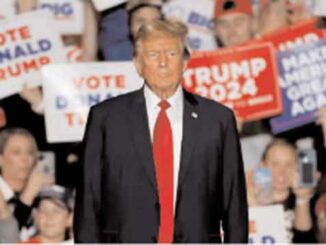
    On Super Tuesday, March 3rd, 2024, former President Trump asserted his influence across America by securing victories in 14 out of the 15 states where Republican Presidential Primaries or caucuses took place. He garnered substantial support, polling over 50-60% in several states and even reaching over 70-80% in others. Ambassador Nikki Haley, Trump’s sole opponent, managed to secure the lone liberal state of Vermont, preventing Trump from achieving a clean sweep on Super Tuesday. Notably, Trump’s 11-point win in New Hampshire marked his narrowest victory since the commencement of the primary season in January 2024.

    The Associated Press was the sole news reporting agency that declared Trump the winner in 14 states shortly after polls closed. Trump led Haley by a substantial margin of three or four to one in certain places.

    India’s Prime Minister Indira Gandhi at an election rally in India in 1980

    REPUBLICAN PRESIDENTIAL CONTESTS in 15 States with 854 DELEGATES at stake

    State-Run Primaries (13): Alabama (50 Delegates), Arkansas (40), California (169), Colorado (37), Maine (20), Massachusetts (40), Minnesota (39), North Carolina (74), Oklahoma (43), Tennessee (58), Texas (150), Vermont (17), Virginia 48).

    Party-Run Presidential Preference Votes and Caucuses (2):  Alaska Caucuses (29 delegates), Utah Caucuses (40)

    Trump, % of votes polled in the winning states: Alabama (83.2%), Alaska (87.6), Arkansas (76.9), California (78.5), Colorado (63.3), Massachusetts (60), Maine (72.8), Minnesota (69.1), North Carolina (73.9), Oklahoma (81.8), Tennessee (77.3), Texas (77.9), Utah (56.4), Virginia (63.1).

    Haley, % of votes polled in the winning states: Vermont (50.2)

    In the run-up to Super Tuesday, the Delegate Counts for the candidates as follows:

    • 1. Donald Trump: 1,044
    • 2. Nikki Haley: 89
    • 3. Ron DeSantis  :9
    • 4. Vivek Ramaswamy : 3

    No other candidate managed to secure any delegates. To clinch the Republican nomination, a candidate requires 1,215 delegates. Given the absence of any opposition to former President Trump, it is reasonable to assume that he is the presumptive nominee for the upcoming Presidential Elections in November 2024 for the Republican Party.

    If a candidate secures victories in 14 out of 15 states during the Super Tuesday Presidential Primaries, and in several of these states, attains an overwhelming majority, winning over 80% of the votes, it denotes robust and widespread support for that candidate among the voters. This performance suggests a strong appeal and resonance with a diverse range of voters across different states. The high percentage of wins in specific states indicates not only success but also a significant mandate from the electorate in those regions. Such outcomes often position the candidate as a frontrunner and establish a formidable foundation for their campaign as they head into the subsequent stages of the election, potentially ensuring their victory in the general election.

    All the pollsters, analytical experts, and mainstream media pundits who had prematurely written obituaries for Presidential Candidate Trump were compelled to retract their statements after the Super Tuesday results. None of these pundits attempted to compose an obituary for Ambassador Haley’s candidacy, funded by Democrats, by drawing parallels to John McCain’s 2012 campaign. Senator McCain sought the presidency based on his qualification of having spent five and a half years as a prisoner of war, a considerable portion of that time in solitary confinement in Vietnam.

    Ambassador Haley’s key argument was her relative youth compared to the Democratic and Republican frontrunners. She emphasized her two terms as governor of South Carolina and her role as the Ambassador to the UN in the Trump administration. However, throughout her campaign, she never articulated specific plans detailing how her presidency would differ from those of past presidents. Therefore, there is no reason to express sympathy for Haley’s withdrawal from the race.

    Former President Trump’s resounding triumph on Super Tuesday marks a remarkable political comeback following a significant defeat in 2020. This situation draws parallels with the victory of India’s late Prime Minister Indira Gandhi in 1980, after facing a humiliating defeat in 1977. It is crucial to acknowledge, however, that although there may be some general similarities, every political scenario is distinctive, with varying contexts, issues, and political dynamics. Comparisons should be approached with caution, taking into account the specific circumstances surrounding each leader’s political trajectory and resurgence.

    However, I can offer some general observations based on historical context:

    • Charismatic Leadership: Both Donald Trump and Indira Gandhi are known for their charismatic leadership styles. They have the ability to connect with a significant portion of the population and rally support around them.
    • Populist Appeal: Both leaders had a populist appeal, speaking to the grievances and aspirations of a broad section of the population. They positioned themselves as champions of the common people and tapped into populist sentiments.
    • Political Resilience: Indira Gandhi faced a significant defeat in the 1977 elections but made a political comeback in 1980. If Trump were to make a political comeback, it would also demonstrate a level of political resilience, overcoming setbacks and regaining popular support.
    • Political Strategy: Successful comebacks often involve strategic political maneuvers. Both leaders might have employed astute political strategies to rebuild their image, connect with voters, and navigate the political landscape.
    • Changing Political Context: In both cases, the political context played a crucial role. Indira Gandhi’s return in 1980 was influenced by changing dynamics in Indian politics. Similarly, any potential Trump’s comeback would likely be influenced by the political landscape at the time.

    Only time will reveal whether the remarkable momentum garnered by former President Trump in contrast to his rival, the incumbent President Biden, will prove sufficient to secure victory in the November 2024 election. The question lingers: will this momentum propel him to reclaim the presidency of the United States, the most powerful country on Earth, for another four years?

    (Dave Makkar is a social activist and a political analyst. He can be reached at davemakkar@yahoo.com)

  • Trump’s Unchallenged Rise: Analyzing His Dominance in the Republican Field

    Trump’s Unchallenged Rise: Analyzing His Dominance in the Republican Field

    By Prof. Indrajit S Saluja

    As the political landscape of the United States gears up for the upcoming 2024 presidential elections, the Republican Party finds itself under the undisputed shadow of one man: Donald J. Trump. The dynamics of the GOP race have proven to be a one-sided affair, with no Republican able to match the charisma and influence that Trump wields. Even formidable contenders like Nikki Haley and long-time adversary Mitch McConnell have had to bow to the overwhelming popularity of the former president.

    The Road to Trump’s Uncontested Dominance:

    The political landscape of the Republican Party has undergone a significant transformation since the tumultuous years of Trump’s presidency. Despite facing impeachment and contentious moments, Trump has retained a formidable grip on the party’s base, solidifying his status as a political force to be reckoned with. The lack of a viable challenger within the GOP has only further highlighted Trump’s influence, and the recent withdrawal of Nikki Haley from the race underscores this dominance.

    Nikki Haley’s Withdrawal:

    Nikki Haley, the former U.S. ambassador to the United Nations, was considered one of the potential challengers to Trump’s hold on the Republican Party. However, her decision to end her campaign reflected the harsh reality that Trump was far ahead in the race. Despite her credentials and experience, Haley recognized the uphill battle she faced against the towering figure of Trump. His loyal following and unmatched popularity within the party made it evident that challenging him would be an arduous task.

    Mitch McConnell’s Endorsement:

    Mitch McConnell, a seasoned politician and a prominent figure within the GOP, has had a tumultuous relationship with Trump. However, even McConnell, known for his strategic political maneuvers, had to concede to the overwhelming support for Trump within the party. His endorsement of Trump highlighted the pragmatic realization that opposing the former president would be futile. McConnell’s move further solidified the perception that Trump is, as of March 8, the de facto choice of Republicans.

    Trump’s Chances of Winning the Republican Nomination:

    Given the current landscape, it seems increasingly likely that Donald Trump will secure the Republican nomination for the 2024 presidential race. The lack of a formidable opponent and the widespread support within the party make Trump the default candidate for Republicans. However, the question remains: What are his chances of winning the presidency if he officially enters the fray?

    Factors Favoring Trump’s Victory:

    Loyal Base: Trump’s unwavering support among the Republican base is a significant advantage. His charisma and connection with his followers have created a fervent and dedicated voter base that remains steadfast in its allegiance.

    Populist Appeal: Trump’s populist appeal resonates with a considerable section of the American electorate. His ‘America First’ approach and promises to prioritize domestic interests strike a chord with many voters who feel disenfranchised by globalization and establishment politics.

    Economic Record: Trump can tout a pre-pandemic strong economy during his presidency. The emphasis on job creation, tax cuts, and deregulation could appeal to voters concerned about economic stability and growth.

    Media Presence: Trump’s ability to dominate media coverage is unparalleled. His provocative statements and unfiltered communication style ensure that he remains in the public eye, a factor that played a significant role in his previous electoral success.

    Fundraising Prowess: Trump has demonstrated a remarkable ability to raise funds, tapping into a network of enthusiastic donors. Financial strength is crucial in modern political campaigns, and Trump’s fundraising prowess gives him a significant advantage.

    Mobilization of Rural and Conservative Voters: Trump has successfully mobilized rural and conservative voters who may feel overlooked by mainstream politics. His focus on issues like gun rights, immigration, and traditional values resonates strongly with these demographics.

    Potential Challenges for Trump:

    Polarization: Trump’s divisive rhetoric has polarized the American electorate. While this approach energizes his base, it also alienates a significant portion of voters who may be crucial in a general election.

    Handling of COVID-19 Pandemic: Criticism of Trump’s handling of the COVID-19 pandemic could be a significant obstacle. While his supporters appreciate his emphasis on economic reopening, opponents may point to perceived missteps in the initial response.

    Legal and Ethical Concerns: Trump’s presidency was marked by legal controversies and ethical concerns. Opposition may leverage these issues to tarnish his image and question his suitability for a second term.

    Age and Health: Trump, born in 1946, would be 78 years old by the time of the 2024 election. Questions about his age and health may arise, especially considering the demands and stress associated with the presidency.

    The Indian Panorama’s Prediction:

    The Indian Panorama, having closely studied the mood of Americans, boldly predicts Donald Trump as the President in 2024. This foresight is grounded in several factors: 

    Historical Precedent: Trump has already demonstrated his ability to defy conventional political wisdom. His unexpected victory in 2016 serves as a precedent for overcoming the odds.

    Populist Appeal: The resonance of Trump’s populist appeal, combined with a lack of a strong, unified opposition within the Republican Party, positions him favorably in the eyes of many voters.

    Party Loyalty: The Republicans’ decision to rally behind Trump, even those who were once critical of him, signifies a unified front that could contribute to a formidable campaign. 

    Public Perception: Trump’s public image, despite controversies, remains resilient among his supporters. His larger-than-life persona continues to captivate a significant portion of the electorate. 

    Policy Continuity: Voters who align with Trump’s policies, especially on issues like immigration, trade, and foreign relations, may see him as a consistent advocate for their values and priorities.

    The dynamics of American politics have always been shaped by the concerns and priorities of the common citizens, and it seems that the everyday struggles of employment, healthcare, education, and social security are taking center stage. In this context, we delve into how Biden’s perceived shortcomings have indirectly contributed to the strengthening of Trump’s position, especially among independent voters who prioritize practical issues over grand geopolitical narratives. 

    Biden’s Lackluster Performance:

    President Joe Biden entered the White House with promises of unity, healing, and an ambitious agenda for the American people. However, as his presidency unfolds, there is a growing sentiment among common Americans that his administration has fallen short in addressing their most pressing concerns. The focus on achieving greatness on the world stage, while commendable, has not resonated strongly with the everyday worries of the average citizen.

    Economic Concerns: One of the primary drivers of discontent is the perceived lack of progress on economic fronts. Despite promises of job creation and economic recovery, many Americans find themselves grappling with concerns about job security, inflation, and rising living costs.

    Healthcare: The global pandemic highlighted the importance of robust healthcare systems. While the Biden administration has made strides in combating COVID-19, concerns remain about the accessibility and affordability of healthcare for all Americans.

    Education: Parents across the nation are concerned about the quality of education their children receive. Debates around school reopenings, remote learning, and educational disparities have heightened these concerns.

    Social Security: The Biden administration’s focus on social justice issues, while crucial, has not entirely alleviated concerns about the broader social security net for the average American. Questions about retirement benefits, affordable housing, and social safety nets persist. 

    Common Americans’ Priorities:

    Amidst the complexities of global geopolitics, the average American’s primary concerns revolve around their immediate well-being and that of their families. The desire for a steady income, access to quality healthcare, opportunities for good education, and the assurance of social security forms the crux of their worries. In this context, the Trump narrative gains traction.

    Steady Income: The promise of economic stability and job growth was a cornerstone of Trump’s previous campaign. Many Americans view Trump as a leader with a business background who can navigate economic challenges effectively.

    Healthcare: Trump’s emphasis on dismantling the Affordable Care Act was a controversial point during his presidency. However, for some Americans, the focus on reducing healthcare costs and increasing choice resonates with their concerns.

    Education: Trump’s advocacy for school choice and local control over education policies appeals to those who believe in a more decentralized approach to improving the education system.

    Social Security: Trump’s approach to economic policies and tax cuts has been viewed by some as a means to stimulate economic growth, potentially benefiting social security programs. 

    Independents: The Deciding Factor:

    While party loyalty remains a powerful force in American politics, the growing number of independent voters presents a unique challenge and opportunity in the 2024 election. Independent voters, not bound by party allegiance, are more likely to prioritize tangible results over political rhetoric. They play a pivotal role in deciding the outcome of an election, especially when party dissatisfaction is evident.

    Trump’s Appeal to Independents:

    Despite legal challenges and controversies surrounding Trump, his appeal to independent voters lies in his reputation as a disruptor. Independents, dissatisfied with the status quo, may be willing to take a chance on a leader who promises a departure from traditional politics. Trump’s track record of challenging established norms and his perceived focus on the everyday concerns of Americans could resonate strongly with this demographic.

    The evolving narrative of the 2024 presidential election reflects a shift in focus from grand geopolitical ambitions to the practical concerns of everyday Americans. While party loyalty remains a driving force, the dissatisfaction with President Biden’s performance has created a space for Donald Trump to reenter the political arena with a strong appeal to independent voters. The concerns of common Americans regarding employment, healthcare, education, and social security have become the focal points, and Trump’s positioning as a candidate who can address these issues has gained traction. As the nation anticipates the unfolding drama of the 2024 election, the dynamics of party politics, independent voter sentiments, and the ability of candidates to connect with the concerns of the average citizen will be decisive factors in shaping the future of the United States.

    (The author can be reached at salujaindra@gmail.com)

  • I believe in America’: Fired-up Biden uses State of the Union to skewer GOP, his ‘predecessor’

    I believe in America’: Fired-up Biden uses State of the Union to skewer GOP, his ‘predecessor’

    The president made the case for why he deserves a second term

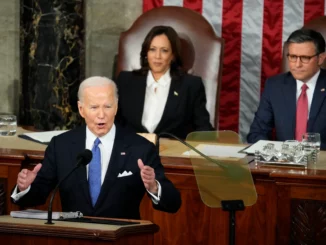
    WASHINGTON, D.C. (TIP): President Joe Biden delivered his State of the Union address at the U.S. Capitol on Thursday, March 7 night. The speech provided Biden one of his biggest audiences of the year as he made his case for a second term and contrasted his vision of the country’s future with Republicans ahead of what’s expected to be a lengthy general election fight with former President Donald Trump.

    Going into the evening, I think many viewers expected to hear something like a campaign speech from Biden, and that’s what he delivered. While he did ask Congress to pass a bipartisan immigration bill and spent time on other policy issues like abortion, housing and foreign policy, it was less a policy laundry list than most State of the Union speeches. He worked to paint himself as a brighter, more forward-thinking choice than Trump, whom he only referred to as “my predecessor.” Biden talked about his history in politics and tackled the issue of his age head on, but the end of his speech was about his hope for the future. By comparison, Alabama Sen. Katie Britt’s Republican response to the speech was bleak and painted a dark picture of the country, especially at the southern border.

    It echoed Trump’s “American carnage” inaugural address, though Britt avoided mentioning the former president by name. That’s a good preview of how the presidential race is likely to unfold: Republicans will paint Biden as a failure who has presided over a U.S. in decline, while Biden will work to focus attention on the progress he feels his administration has made and can continue to make.

  • 1 in every 10 women in the world lives in extreme poverty

    1 in every 10 women in the world lives in extreme poverty

    NEW YORK (TIP): On International Women’s Day, UN Women calls for the world to “Invest in Women, Accelerate Progress” as the best way to accelerate economic growth and build more prosperous, equitable societies. This is particularly urgent when war and crisis are eroding the achievements of decades of investments in gender equality. From the Middle East to Haiti, Sudan, Myanmar, Ukraine, Afghanistan, and elsewhere, women pay the biggest price for conflicts that are not of their making. The need for peace has never been more urgent.

    Climate change is accelerating persistent poverty gaps. As competition for scarce resources intensifies, livelihoods are threatened, societies become more polarized, and women bear an increasingly heavy burden:

    1 in every 10 women in the world lives in extreme poverty.
    The number of women and girls living in conflict-affected areas doubled since 2017, now, more than 614 million women and girls live in conflict-affected areas. In conflict areas, women are 7.7 times more likely to live in extreme poverty. Climate change is set to leave 236 million more women and girls hungry by 2030, twice as many as men (131 million).
    At prime working age, only 61 per cent of women are in the labor force versus 90 per cent of men.
    We cannot continue to miss out on the gender-equality dividend. More than 100 million women and girls could be lifted out of poverty if governments prioritized education and family planning, fair and equal wages, and expanded social benefits.

    Almost 300 million jobs could be created by 2035 through investments in care services, such as provision of daycare and elderly care. And closing gender employment gaps could boost gross domestic product per capita by 20 per cent across all regions.

    The current reality is far from this. Programs dedicated to gender equality represent only 4 per cent of official development assistance. An additional USD 360 billion in developing countries is needed per year to achieve gender equality and women’s empowerment. This is less than one fifth of the USD 2.2 trillion spent globally on military expenditure in 2022, for example.

    The areas needing investment are clear and understood. First and foremost, there must be an investment in peace. Beyond this, the investments needed include laws and policies that advance the rights of women and girls; transformation of social norms that pose barriers to gender equality; guaranteeing women’s access to land, property, health care, education, and decent work; and financing women’s groups networks at all levels.

    UN Women is also calling on Member States at the Commission on the Status of Women, starting in New York on 11 March 2024, to back up their commitments on gender equality with resources. The world’s leaders have this opportunity to develop concrete and progressive agreed conclusions that reflect the crucial need for financing gender equality, women’s empowerment, and women´s organizations. They must seize it for the sake of equality, our planet, and the Sustainable Development Goals.

  • Indian-American incumbents Ami Bera and Ro Khanna secured their seats.

    Indian-American incumbents Ami Bera and Ro Khanna secured their seats.

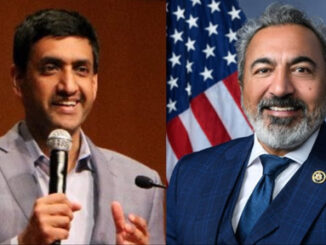
    WASHINGTON, D.C. (TIP): Ami Bera, a Democrat, secured his seventh term by advancing to the general election Ro Khanna, seeking his fifth term, won decisively against Republican Anita Chen Ash Kalra, a Democrat, emerged as the top candidate in the 25th Assembly District. It was a day of victories and defeats for Indian American candidates in the recent Super Tuesday primaries. The biggest day of this year’s primary campaign in the US approached as 15 states — plus American Samoa — voted in contests. Veteran Indian-American Congressmen Ami Bera and Ro Khanna successfully defended their positions against challengers.

    Ami Bera, a Democrat, secured his seventh term by advancing to the general election with 53.6% of the vote in California’s 6th Congressional District.
    Meanwhile, Ro Khanna, seeking his fifth term, won decisively over Republican Anita Chen in the 17th Congressional District, according to American Bazaar.

    In contrast, Indian-American engineer Rishi Kumar, a Democrat, lost his bid to run for Congress.

    With 50% of the vote counted, former San Jose Mayor Sam Liccardo was ahead with 22% of the vote, while Santa Clara County Supervisor Joe Simitian had nearly 18%. Both Liccardo and Simitian are Democrats. Kumar ended up in seventh place out of 11 candidates with 6.3% of the vote.

    This came amid Indian-American Republican challenger to former president Donald Trump, Nikki Haley, dropping out of the presidential race.

    Indian-American Republican Vin Kruttiventi advanced to the general election in Northern California’s 14th Congressional District, home to one of the largest populations of Indian-Americans in the nation, securing second place with 17.8% of the vote to incumbent Eric Swalwell with 64.5%, seeking his sixth term in the House of Representatives.

    According to reports from the Federal Election Commission, Kruttiventi, the founder and CEO of A5 Services, has invested $500,000 of his personal funds into his campaign.

    However, clinical psychologist Harmesh Kumar’s longshot bid for the vacant US Senate seat left by the late Senator Dianne Feinstein ended in disappointment.

    Additionally, Ash Kalra, a Democrat, emerged as the top candidate in the 25th Assembly District and will face fellow Democrat Lan Ngo in the general election.

    However, challenger Tara Sreekrishnan, a 30-year-old Indian-origin leader who has garnered significant endorsements for her bid, faced defeat in her race for California’s 26th district state Assembly seat.

    In other races, Democrat Darshana Patel will compete against Republican Kristie Bruce-Lane for California’s 76th district state Assembly seat, which covers a portion of San Diego.

    The most prominent of all the Indian-American candidates was Nikki Haley, the former governor of South Carolina. She conceded to Donald Trump after losing every state but one — Vermont — in Super Tuesday’s primary contests.

    In January, Indian-American billionaire entrepreneur Vivek Ramaswamy suspended his bid after Trump won the Iowa caucus. He later pledged support for Trump’s presidential bid.

  • Electoral bonds disclosure: Contempt plea against SBI for ‘defying’ Supreme Court order

    Electoral bonds disclosure: Contempt plea against SBI for ‘defying’ Supreme Court order

    NEW DELHI (TIP): The Association for Democratic Reforms (ADR) on Thursday, March 7, moved the Supreme Court with a contempt petition against the State Bank of India (SBI) for failing to disclose by March 6 details of electoral bonds encashed by political parties and instead seeking four months for it.

    Advocate Prashant Bhushan mentioned the ADR’s plea before a Bench led by CJI DY Chandrachud, which agreed to consider it after the petitioner completed the filing formalities. The matter was likely to be taken up on Monday.

    Citing “certain practical difficulties”, the SBI had on Monday, March 4, moved the Supreme Court seeking time till June 30 to disclose details of each electoral bond issued and encashed. “The timeline of three weeks fixed by the court in its judgment dated February 15 would not be sufficient for the entire exercise to be completed,” the SBI said in an application filed in the top court. In a landmark verdict, a five-judge Constitution Bench led by Chief Justice of India DY Chandrachud had on February 15 declared unconstitutional the electoral bonds scheme that allowed individuals and companies to make unlimited anonymous donations to political parties. Acting on a PIL filed by ADR, the top court had ordered the SBI to stop issuing electoral bonds immediately and submit all details by March 6 to the Election Commission which shall make all donations public by March 13.

  • Indian-American Nikki Haley suspends her presidential campaign against Trump; says ‘no regrets’

    Indian-American Nikki Haley suspends her presidential campaign against Trump; says ‘no regrets’

    WASHINGTON, D.C. (TIP): Indian-American politician Nikki Haley suspended her presidential campaign Wednesday after being “trounced” in 15 states across the US on Super Tuesday but stopped short of endorsing her only rival and former president Donald Trump, who is all set to be the Republican party’s presumptive nominee in the November elections.

    After Super Tuesday’s election results, Trump, 77, had established a commanding lead in the delegate count over his only Republican opponent, 52-year-old Haley, who denied him a full sweep by winning Vermont.

    “The time has now come to suspend my campaign,” she said on Wednesday in South Carolina.

    “I said I wanted Americans to have their voices heard. I have done that. I have no regrets,” she added. “Although I will no longer be a candidate, I will not stop using my voice for the things I believe in.”

    As Haley suspended her campaign Wednesday morning, Trump posted on social media that the former South Carolina governor got “trounced” on Super Tuesday and invited her supporters to join his political movement.

    “Nikki Haley got trounced last night, in record-setting fashion, despite the fact that Democrats, for reasons unknown, are allowed to vote in Vermont, and various other Republican Primaries. Much of her money came from Radical Left Democrats, as did many of her voters, almost 50%, according to the polls,” Trump posted.

    Haley congratulated her rival and former boss Trump during her announcement ending her presidential campaign but stopped short of endorsing him.

    “In all likelihood, Donald Trump will be the Republican nominee when our party convention meets in July. I congratulate him and wish him well. I wish anyone well who would be America’s president. Our country is too precious to let our differences divide us,” said Haley, a former US ambassador to the UN under the Trump administration.

    While her defeat can be seen as a humiliating one, she sounded a warning signal to the party’s leadership in particular Trump as she has consistently garnered a significant portion of Republicans behind her, ranging from 20 percent to 40 percent. In a closely contested election, this might become a critical factor in deciding the winner of the November presidential elections.

    “It is now up to Donald Trump to earn the votes of those in our party and beyond it who did not support him. And I hope he does that. At its best, politics is about bringing people into your cause, not turning them away. And our conservative cause badly needs more people. This is now his time for choosing,” Haley told her supporters.

    She quoted Margaret Thatcher on this and said the former British prime minister provided some good advice when she said, “Never just follow the crowd. Always make up your own mind.”

    In her brief speech lasting about four minutes, in front of a small group of supporters and a battery of reporters, Haley said when she began her campaign about a year ago, it grounded in her love of the country. “Just last week, my mother, a first-generation immigrant, got to vote for her daughter for president. Only in America. I am filled with gratitude for the outpouring of support we’ve received from across our great country,” she said.

    Stopping short of endorsing Trump, she reiterated the issues for which she was running for president. “Our world is on fire because of America’s retreat. Standing by our allies in Ukraine, Israel, and Taiwan is a moral imperative. But it’s also more than that. If we retreat further, there will be more war, not less,” she said.

    “I have always been a conservative Republican and always supported the Republican nominee,” she added.

    Trump now has 995 delegates to his kitty as against Haley’s 89. A candidate needs 1215 delegates to win the Republican presidential nomination, a landmark which he is expected to win in the multiple State primaries of March 12.

    Haley, a former South Carolina governor and UN ambassador, has not made a final decision as to whether or not she would endorse her ex-boss Trump.

    People who are close to Haley have different opinions. Some believe that it would be good for her to back Trump because she would be viewed as a team player. Others ardently oppose her endorsing him.

    During her campaign, Haley scripted history by becoming the first woman ever to win a Republican presidential primary. She is also the first Indian-American to have won either the Democratic or the Republican primaries. The three other previous Indian American presidential aspirants – Bobby Jindal in 2016, Kamala Harris in 2020 and Vivek Ramaswamy in 2024 – had failed to win even one primary.

    Of the more than 10 candidates in fray for the 2024 presidential race, Haley is the only candidate to have defeated Trump at the primary stage: in Washington DC and Vermont. She is also the first Indian American to have won any presidential primaries.

    Haley, whose parents moved to the United States in the 1960s, was born Nimarata Nikki Randhawa. She has long used her middle name Nikki and adopted the surname Haley after her marriage in 1996.

    During the campaign, Trump repeatedly referred to Haley as “Nimbra” in a rant on his Truth Social account, adding her to the list of foes he has targeted with racist attacks.

    Haley’s father, Ajit Singh Randhawa, is a professor of biology who got his PhD at the University of British Columbia and later moved to Bamberg, a segregated town where Haley was born, to teach at nearby Voorhees College — a historically Black university.

    Haley recently told Fox News that although she faced racism as a “Brown girl that grew up in a small rural town in South Carolina,” she became “the first female minority governor in history, who became a UN ambassador and who is now running for president.”

    Meanwhile, President Biden on Wednesday made a clear appeal to Haley’s supporters in the aftermath of her exit from the race, praising her “courage” in standing up to Trump.

    “Donald Trump made it clear he doesn’t want Nikki Haley’s supporters. I want to be clear: There is a place for them in my campaign,” Biden said in a statement moments after Haley suspended her campaign.

    Biden praised Haley for her role in her party: “It takes a lot of courage to run for President – that’s especially true in today’s Republican Party, where so few dare to speak the truth about Donald Trump.

    “Nikki Haley was willing to speak the truth about Trump: about the chaos that always follows him, about his inability to see right from wrong, about his cowering before Vladimir Putin,” Biden added.
    (Source: PTI)

  • RED BARAAT USHERS IN THE FESTIVAL OF COLORS

    RED BARAAT USHERS IN THE FESTIVAL OF COLORS

    • By Mabel Pais

    “This year’s ‘discovery’ [WOMAD UK Festival], though, was Red Baraat, a cacophonous bhangra funk band from Brooklyn. Think Punjabi weddings, Delhi street brass bands, modern jazz and rock.” – The Telegraph (UK)

    The World Music Institute (WMI) with Brooklyn Bowl, as part of WMI’s ‘LET’S DANCE’ Series, presents ‘Red Baraat – Festival of Colors’, a pioneering Indian bhangra band merging hard driving North Indian bhangra with elements of hip-hop, jazz and raw punk energy. The band will present its performance at the Brooklyn Bowl (61 Wythe Avenue, Brooklyn, NY 11211) on March 9, 2024 at 8 PM. This is a standing show with very limited seating. Doors open at 6 PM.

    Red Baraat (redbaraat.com), conceived by dhol player Sunny Jain is known for its signature blend of genres including elements of hip-hop, jazz, hard-driving north Indian bhangra and punk energy. The band’s mission is one of manifesting joy and unity in all people. Red Baraat’s annual ‘Festival of Colors’ sold out quickly when WMI presented it last year – This year too, the band will present this uniquely New York celebration of the Hindu holiday of Holi with its colorful array of South Asian sounds.

    Traditionally, Holi is marked by public gatherings of families and strangers sharing songs, dance, and the exchange of ‘colors’ – colorful dry powder or colored water playfully thrown amongst the crowds of revelers. It signifies the victory of good over evil, the arrival of spring, and for many, a festive day to meet others, play and laugh, forget and forgive, and repair ruptured relationships.

    Created with no less a purposeful agenda than manifesting joy and unity in all people, Red Baraat’s spirit is worn brightly on its sweaty and hard-worked sleeve.

    Listen to/watch their performance – youtu.be/k4PXlNoUmAk

    2018 also saw the band touring Kazakhstan, United Arab Emirates, US, Canada and Europe. They headlined the renowned WOMAD Festival in Cáceres, Spain in front of 10,000 people, performed the Vienna Konzerthaus (Philharmonie) in Austria and had the crowd jumping at Rudolstadt Festival in Germany. The release of Red Baraat’s 2nd album in 2013, Shruggy Ji, debuted at #1 on the Billboard World Music charts in the USA and propelled the band on a world tour that has yet to stop. They’ve performed at Bonnaroo, Austin City Limits, globalFEST, Lincoln Center, New Orleans Jazz Fest, and Colours of Ostrava, just to name a few. Along the way they sold out rooms as diverse as the Luxembourg Philharmonic and the New York City’s legendary rock club Bowery Ballroom, and performed at the request of The White House (Obama), TED and Olympic Games.

    The band’s 2018 album release, ‘Sound The People,’ hit the top 10 on the World Music Charts Europe and was heralded in the US as the anthem soundtrack for the South Asian diaspora by US hipster, indie-rock magazine, Stereogum: “The album is full of moments that hit with the force of a spiritual awakening…The funk, ska-punk, and other American forms that make their way into the music are layered intricately within the same threadwork as the ragas on which these songs are pulled from. Each piece is a gesture of cultural harmony, rendering not only genre irrelevant, but the geographic placement of those sounds.” — STEREOGUM

    Reemerging in 2021 with a renewed focus, energy and sound, Red Baraat headlined the Wolf Trap Performing Arts Center with master percussionist, Zakir Hussain, performed at the Dubai World Expo, and toured its 11th annual Red Baraat Festival of Colors.

    But even as it’s clear that Red Baraat has built a startling history of performances in iconic settings, the band’s bread and butter remains the sweaty clubs, festivals, packed performing arts centers, and college auditoriums that keeps the band on the road all over the world the last several years. It’s here where Red Baraat does what it does best – communing with their audience in a joyful, near hedonistic celebration of music and dance which, tellingly, draws a crowd even more diverse than the players on stage. The universality of what Red Baraat does is undeniable. And this is no happy accident. It is the product of intention and design. Says Jain, “The band…our songs…are addressing the multiplicity of viewpoints,” says Jain. “There’s ‘Zindabad,’ which means ‘Long Live’ in Hindi. In that song, we’re saying that we celebrate life, we celebrate devotion — but we also celebrate agitation and revolution. If we can unite people of all backgrounds and ethnicities to partake in the exuberance of life through the universal language of music, then life is that much sweeter.”

    “Their infectious rhythms roll over the audience like a hurricane and let the audience breathe only in a short ballad pause.” – — RHEIN MAIN PRESS (GERMANY)

    Samir LanGus (samirlangus.com) is a Grammy Award-nominated gnawa musician, born and raised in the city of Ait Melloule, Morocco whose passion for music stems from the variety of street sounds of his home city. Gnawa music is a body of Moroccan religious songs and rhythms. Its well-preserved heritage combines ritual poetry with traditional music and dancing. It is deeply hypnotic trance music marked by low-toned, rhythmic melodies played on a skin-covered lute called a sintir or guembri. The method involves call-and-response singing, hand-clapping, and cymbals.

    Currently based in NYC, LanGus adds his own contemporary spin to the traditional spiritual trance music, mixing jazz instrumentation and North African tradition with New York attitude. 

    PROGRAM

    6 PM – Doors and DJ / 8 PM – Samir LanGus / 9:30 PM – Red Baraat

    Standing show with very limited seating

    TICKETS

    For tickets, visit worldmusicinstitute.org/red-baraat-festival-of-colors-2024

    LET’S DANCE SERIES

    The LET’S DANCE series brings us all together on the dance floor moving our bodies to the infectious beats of DJs and live bands from around the world. 

    (Mabel Pais writes on The Arts and Entertainment, Social Issues, Spirituality, Education, Cuisine, Health & Wellness, and Business)

  • India in History This Week

    History This week – 01 March to 07 March

  • UPW hand Gujarat their third straight defeat

    UPW hand Gujarat their third straight defeat

    Bengaluru (TIP)- The Gujarat Giants’ disappointing streak in the WPL 2024 continued as they suffered their third consecutive defeat in the competition, losing to the UP Warriorz by 6 wickets on Friday, March 1. Led by Alyssa Healy, the Giants were restricted to setting a 143-run target, which the Warriorz easily chased down, courtesy of a heroic innings by Grace Harris.
    Matchday 8 at the M Chinnaswammy Stadium in Bengaluru saw the Warriorz win the toss and follow the consistent trend of teams opting to chase in the WPL 2024. The first innings saw the Warriorz’s bowling attack, spearheaded by Sophie Ecclestone, emerge as the clear winners over the Giants.
    Despite starting brightly in the powerplay of the first innings, Gujarat failed to keep up the momentum. Captain Beth Mooney (16) was the first to fall, trying to hit Ecclestone out of thr park. Her opening partner Laura Wolvaardt was the second batter to fall inside the 10-over mark, once again off Ecclestone who once again showed why she was the No. 1 T20 bowler in the world. The dip and turn of Ecclestone caught Wolvaadrt off guard and she handed a simple catch to Chamari Athapaththu at mid off.
    Apart from Giants wicketkeeper Phoebe Litchfield and Ashleigh Gardner, who scored 35 runs off 26 balls, and 30 off 17 respectively, none of the other batters in her team managed to contribute significantly to the scoreboard.
    The score was never going to be enough to tame the strong UP batting unit and that turned out to be true as a strong finish by Grace Harris propelled her side to 3rd place on the WPL table.
    The tournament is shaping up magnificently for Grace Harris, as her powerful and unbeaten knock of 60 runs off 33 balls has secured her the new owner of the orange cap in WPL 2024.
    Despite Warriorz being dealt a significant blow when their in-form opening batting pair failed to replicate their previous performance against the Mumbai Indians, Harris emerged as the hero of the highest order. Showcasing a beautiful array of shots, she boasted 9 fours and 2 sixes, rescuing her side from a difficult situation and leading them to victory.
    Having lost their opening two games of this edition of WPL against Royal Challengers Bangalore and Delhi Capitals, the Warriorz have bounced back in the most impressive fashion. This is something that the Giants will only hope to replicate in order to get their season running.

  • KL Rahul ruled out of Dharamsala Test, Jasprit Bumrah returns to team

    KL Rahul ruled out of Dharamsala Test, Jasprit Bumrah returns to team

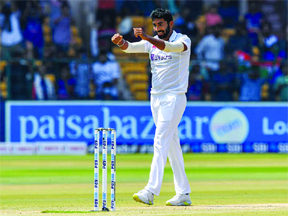
    New Delhi (TIP)- Senior India batter KL Rahul will not feature in the fifth and final Test against England in Dharamsala owing to an injury while pace spearhead Jasprit Bumrah will return to the team, the BCCI said on Feb 29. Rahul, who continues to feel sore in his right quadriceps, has travelled to London to get an expert opinion on his injury. The wicketkeeper-batter became unavailable after the series-opener in Hyderabad in January and as per the BCCI, he was 90 per cent fit before the third Test in Rajkot earlier this month.
    “KL Rahul, whose participation in the final IDFC First Bank Test was subject to fitness, has been ruled out of the fifth and final Test in Dharamsala. The BCCI Medical Team is closely monitoring him and coordinating with specialists in London for further management of his issue,” the Board said in a release.
    Meanwhile, Bumrah, who was released from the squad for the fourth Test in Ranchi in line with the team’s workload management policy, will link up with the squad in Dharamsala for the final Test, beginning March 7.
    India have already taken an unassailable 3-1 lead, following the victory in the fourth Test in Ranchi.
    Rahul’s absence from the final Test means Rajat Patidar remained with the squad but the MP batter can’t be sure of his place in the playing eleven, having aggregated only 63 runs in six innings.
    All-rounder Washington Sundar has also been released from the squad.
    “He will join Tamil Nadu for their Ranji Trophy semi-final fixture against Mumbai, starting March 2. He will join the India squad after the completion of the domestic fixture for the fifth Test, if need be,” the BCCI said.
    Rahul needs to be fully fit before the IPL where he will lead Lucknow Super Giants and is expected to bat in the middle order to bolster his chances of making the India squad for the T20 World Cup in the US and the Caribbean.
    It is the same quadriceps injury that had sidelined Rahul for almost four months last year.
    Having got injured during the IPL, Rahul returned to action during the Asia Cup in September last and made instant impact. In the Test tour of South Africa last year, Rahul was the only century-maker for India in the drawn series.
    The BCCI also said senior pacer Mohammed Shami is recovering well after undergoing a surgery on February 26 for his right heel problem.”He is recovering well and will soon head to the National Cricket Academy in Bengaluru to commence his rehabilitation process,” the Board said of Shami.
    India’s updated squad for fifth Test: Rohit Sharma (c), Jasprit Bumrah (vc), Yashasvi Jaiswal, Shubman Gill, Rajat Patidar, Sarfaraz Khan, Dhruv Jurel (wk), KS Bharat (wk), Devdutt Padikkal, R Ashwin, Ravindra Jadeja, Axar Patel, Kuldeep Yadav, Mohd Siraj, Mukesh Kumar, Akash Deep.
    Source: PTI

  • Copa del rey: Brothers of destruction sink Atletico as Bilbao make final

    Copa del rey: Brothers of destruction sink Atletico as Bilbao make final

    Brothers Inaki and Nico Williams teamed up with goals and assists to each other as Athletic Bilbao defeated Atletico Madrid 3-0 to reach their third Copa del Rey final in five seasons.
    Gorka Guruzeta also scored for Athletic as it advanced 4-0 on aggregate after having won the first leg 1-0 in Madrid three weeks ago. The Basque Country club will play the April 6 final in Seville against Mallorca, who eliminated Athletic rivals Real Sociedad on penalties. “Inaki and I have been getting along very well,” Nico said. “This victory goes to my parents who are in Ghana. Ghana will be a party.”
    Nico and Inaki are sons of Ghanaian parents who migrated to Spain before they were born. They are among the few Black athletes to ever play at the club that historically fields only players from Spain’s northern Basque Country region or adjoining areas. “We have fought hard to be able to enjoy things like this,” Inaki said. “It’s a night to enjoy and to be proud.”
    There was fan trouble ahead of the match, with Atletico saying one of its supporters was hospitalised with serious injuries after an altercation with Athletic fans. Source: AP

  • Sikkim: A window onto Himalaya

    Sikkim: A window onto Himalaya

    Sikkim is the second smallest state in India, and is wedged between Tibet, Nepal, Bhutan, and West Bengal, but encompasses an astounding range of pristine natural beauty of the Himalayas. A traveller’s guide to Sikkim explores the stunning beauty of this Himalayas hill town. The Sikkimese call their land ‘Ney Mayal Lyang’ that translates to ‘heaven.’
    Sikkim is located in the north eastern part of India, but is not a part of the Seven Sister states. The state is famous for dazzling waterfalls, virgin forests, Tibetan style Buddhist Gompas, alpine meadows, rhododendron flowers and more. Kanchenjunga (also Kanchendzonga) at 8598 m is the third highest peak in the world, and lies in Sikkim.
    More than 60 percent of the former Himalayan Kingdom of Sikkim is mountainous, and there are sizeable numbers of 6000 m peaks on the eastern and western borders of the state. Sikkim has an impressive literacy rate of more than 70 percent. It was merged with India in 1975, and is a prosperous state today.
    Weather in most parts of Sikkim is pleasant throughout the year (except in higher altitudes), and that makes it a favourite of holidaymakers from the Indian plains in the summer months. Bengalis throng the tourist towns of Sikkim during their holiday season of Durga Puja in October-November. The state abounds in a variety of flora and fauna, and lucky ones may also sight the endangered red panda.
    PELLING
    Pelling lies in West Sikkim, perched at an altitude of 2100 m and is approximately 120 km away from Gangtok. At first glance Pelling looks like a cluster of concrete hotels, but there are unparalleled views of the snowy peaks. Sunrise over the Kanchenjunga is Pelling’s biggest charm. With plenty of budget accommodation options, it also makes for a great base to explore other parts of West Sikkim.
    Chief sights in and around Pelling are Pemangyatse Monastery, built more than 300 years ago, which is beautifully located amid green gardens; a huge Buddha statue and statues of reincarnations of Padmasambhava; and Pemangyatse Monastery, famous for the Chaam dances (masked dances) held in February/March.
    YUKSOM
    The historic little town of Yuksom was the first capital of Sikkim when three Lamas converged from different directions and crowned the first Chogyal (King) in 1641. There is still a stone throne that marks the coronation spot, and is known as Norbugang Chorten, the site is called Norbugang Park. Yuksom has the charming feel of a hamlet; it is lower in altitude than Pelling and is situated in a valley. If you are coming to Yuksom (Also Yuksam) from Pelling, then a short detour will bring you to Rimbi Waterfalls which is quite a sight in the monsoon. Just 9 km before Yuksom, you will cross the Kanchenjunga Waterfall, which is a majestic waterfall falling from a great height.
    There is a small pond known by the name of Kathok Lake in Yuksom, a short walk will bring you to a ridge where once stood a palace of the King of Sikkim. There are also two new colourful Gompas above Yuksom, but the most beautiful monastery is the 1701 built Dubdi Monastery. The path to Dubdi Monastery is lined with prayer flags and is located amid lush greenery.
    TASHIDING
    If coming from Yuksom, you will come across one of Sikkim’s prettiest falls. The Phamrong waterfalls are around halfway on the Yuksom-Tashiding route. Tashiding is a small town located high above the confluence of the Rangeet and Rathong rivers. Tashiding Gompa is the most sacred monastery in Sikkim, the mere sight of Thongwa Rangdol Chorten – a chorten inside the complex, is said to cleanse every one of their sins. The monastery is said to have been built in 1641 and is set in an idyllic location surrounded by many ancient looking white chortens. Tall prayer flags in white (called Darchor) line up the staircase path to Tashiding Monastery, while the views from the Gompa are superb. Intricately carved mani stones with the Buddhist mantra, Om Mani Padme Hum are piled up on one another to form a mani wall near the monastery complex.
    RUMTEK MONASTERY
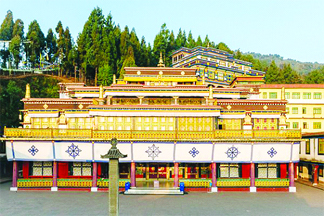
    Undoubtedly, this is Sikkim’s most famous monastery, and every visitor to Sikkim is likely to visit the Rumtek Monastery, even in a 3-4 day trip to Sikkim. Rumtek Village is 24 km away from Gangtok (Sikkim’s capital), and the monastery is the headquarters of the Black Hat Sect (one of the oldest sects of Tibetan Buddhism).There are two buildings of Rumtek Monastery, one is relatively newer (built in 1966), and the older Rumtek Monastery was founded in 1740 by the fourth Chogyal of Sikkim. A path leads to a shrine called Golden Stupa, it is a chorten made of silver and gold, and studded with precious stones such as turquoise, amber and coral. It is recommended to attend the morning prayers at Rumtek Monastery.
    TSOMGO LAKE
    Pronounced Changu, this scenic lake is perched at 3750 m above sea level and lies 40 km away from Gangtok on the way to Nathu La. The drive to Tsomgo Lake is spectacular, and the lake itself is a pristine water body surrounded by wildflowers for most of the year. A particularly mentionable tourist attraction is that visitors can go for yak rides near the periphery of the lake. Tsomgo Lake freezes in the cold winters, but can still be accessed if the road is open. A visit to the lake requires a special permit from the Tourism Office in Gangtok. The permit can be arranged by a travel agent for a small fee, and there are lots of taxis and shared taxis available for a visit to Tsomgo Lake.

  • Vijaya Ekadashi

    Vijaya Ekadashi

    Ekadashi is the eleventh day of the Shukla Paksha or the bright fortnight of waxing Moon and the Krishna Paksha or the darkish fortnight of the waning Moon, as consistent with the Hindu Lunar calendar. Occurring twice a month, Ekadashi is taken into consideration on an auspicious day with the aid of the Hindus who take a look at Vrat or speedy at the day and worship Lord Vishnu/Shri Krishna, to whom this holy day is devoted. Since ancient times fasting on Ekadashi has been observed to delight and receive the benefits of Lord Vishnu.
    Besides the Hindus, the Jains additionally take into account Ekadashi, a holy day. In Leap years, there are 26 Ekadashis and otherwise, there are 24. As in line with the Ekadashi rules, the day is to be spent chanting Lord Vishnu’s name, hearing the Ekadashi Vrat Katha and really essential to stay unsleeping in cognizance, at some point of the night of Ekadashi, making a song praises of Lord Vishnu. Each Ekadashi has its own tale or Vrat Katha, which suggests the strength of Ekadashi Vrat or rapid.
    Vijaya Ekadasi is found on the 11th day of Krishna Paksha or the dark fortnight/waning Moon section of the month of Phalguna (Hindu calendar), which falls in February-March. It is also known as Phalguna-Krishna Ekadasi.
    Those who examine the quick should ruin it after dawn tomorrow of Ekadashi. It is to be referred to that one ought to smash the quick (Parana) inside Dwadashi Tithi. Dwadashi ends at 5:10 PM on 10th March. Another essential attention is that one has to not smash the fast all through Hari Vasara that’s the fourth length of Dwadashi. The excellent time to interrupt the fast is pratah kala (morning).
    SIGNIFICANCE OF VIJAYA EKADASHI
    The term Vijaya means victory or to win. Observing an entire speedy on Vijaya Ekadasi meticulously together with the specified rituals for the day blesses the devotee to be victorious and a success in this existence and the following lifetimes.
    Lord Krishna has repeatedly stated to Yudhishtira, in His narrations of each of the Ekadasi testimonies and significance that even listening or reading the memories of of Ekadasi is enough to garner merits equal to acting a Horse sacrifice or Ashwamedha Yajna.Removes all of the misgivings, misdeeds and sins.
    – Gives clarity of thoughts and nullifies all of the guilt emotions.
    – Increases religious, emotional and intellectual strengths.
    THE STORY OF VIJAYA EKADASI
    The tale is from the antique Hindu text Skanda Purana. It is narrated by means of Lord Sri Krishna to Yudhishtira. The tale had been advised to Narad Muni by using Lord Brahma and is based totally on the epic Ramayana.
    When Lord Rama changed into exile in conjunction with His spouse Devi (Goddess) Sita and brother Laxmana, the demon King Ravana abducted Devi Sita. When Lord Rama and Laxmana found Devi Sita missing, Lord Rama (Lord Vishnu’s avatar), turned into crushed like any other common man. It became Jatayu, the vulture and devotee of the Lord who had attempted to save Devi Sita from being forcefully taken away with the aid of Ravana and got fatally injured. But before Jatayu breathed His ultimate, He conveyed the message of Devi Sita’s abduction to Lord Rama. Later Lord Rama met the King of monkeys, Sugriva who became geared up to aid the Lord with his navy of monkeys in His search for Sita Devi.
    Lord Hanuman, called absolutely the devotee of Lord Rama, turned into sent across to Lanka (now Sri Lanka), the dominion of Ravana to look for Sita Devi. Lord Hanuman did locate Sita Devi in Ashoka / Ashok Vatika(lawn). Lord Hanuman delivered the message of Lord Rama to Sita Devi and confirmed Her Lord Rama’s ring as a evidence of His authenticity as a messenger of Lord Sri Ram. On mastering that Sita Devi became indeed in Lanka as a captive, Lord Rama determined to wage battle in opposition to Ravana. So, Lord Rama, Laxmanjee alongside Sugriva and his military of monkeys reached the beaches of the ocean to pass over to Lanka. But the Lord immediately understood that the sea turned into too deep and perilous with crocodiles inhabiting it and crossing it would be a feat by itself.
    In this case, Lord Rama asked His loving brother Laxmanji to signify some approach via which he merits it without difficulty. On the notion of Laxmanji, Lord Rama visited the exceptional sage Bakadalbhya, who had His Ashram in a nearby island. The sage without delay understood that Lord Rama became none apart from Lord Vishnu, Himself and the all-understanding Supreme Lord became simply playing His role as an individual. So sage Bakadalbhya asked Lord Rama why the Lord needed to method a trifling sage-like Him? Lord Rama respectfully advised Him approximately the project of crossing the ocean with His monkey soldiers. Hearing this, Bakadalbhya Muni informed Lord Rama, that observing the auspicious Vijaya Ekadasi will make certain the success of crossing the sea as well as a victory over Ravana. Having stated that the sage went on to specify the rituals to be observed for the Vijaya Ekadasi.
    Lord Rama heard the rituals and accompanied each phrase of the ritual of the Vijaya Ekadasi as informed through Bakadalbhya Muni that gave Him the benefit of being able to cross over the ocean with the Vanar Sena (military of Monkeys) and ultimately defeating the powerful King Ravana of Lanka and get His loving spouse Devi Sita back with Him, in which She belonged.

  • Bitcoin surpasses $60,000 for 1st time in two years

    Bitcoin surpasses $60,000 for 1st time in two years

    Cryptocurrency Bitcoin on Thursday, Feb 29, surpassed $60,000 for the first time in more than two years. The jump comes amid surging optimism that demand for the token is widening beyond committed digital-asset enthusiasts, according to Bloomberg.
    On Feb 29, the token rose as much as 5.12% to $63,649 by 9:30 am (local time) in New York. Earlier, Bitcoin spiked to $63,968 on Wednesday but soon lost the gains to end at below $59,000.
    Bitcoin had last traded at the $60,000 mark in November 2021, after reaching an all-time high of almost $69,000 earlier that same month. According to Bloomberg, Bitcoin has jumped over 40% already this year atop the successful debut of the US ETFs (Exchange-Traded Fund), which directly hold the token.
    According to Chris Newhouse, a DeFi analyst at Cumberland Labs, Bitcoin is approaching new yearly highs off the back of increased spot demand and momentum traders taking positions after a week of consolidation. Besides this, a projected reduction in Bitcoin’s supply growth is also adding to the upbeat sentiment in the cryptocurrency market.
    “Optimism around Bitcoin is being driven by a few factors working together: the spot BTC ETF inflows in the US, the upcoming reduction of new Bitcoin issuance known as the halving, and overall renewed optimism around the crypto asset class as a whole,” Jonathon Miller, managing director of the Kraken Australia digital-asset exchange, told Bloomberg.

  • Reliance-Disney merger may face CCI scrutiny over dominance fears

    Reliance-Disney merger may face CCI scrutiny over dominance fears

    New Delhi (TIP)- Mukesh Ambani-led Reliance Industries and Walt Disney India’s merger could attract antitrust scrutiny, experts have predicted. The Reliance-Disney merger is set to create India’s biggest TV player with over 120 channels. The valuation of the entity is pegged at $8.5 billion. Lawyers have flagged concerns that the combined entity’s strong portfolio of cricket broadcast rights could impact advertisers. It has been estimated that the Reliance-Disney merger will have a 35 percent viewership share in Indian television. In the past, both Reliance and Disney have shelled out billions of dollars to win the telecast rights of cricket tournaments.
    While the overall TV space will be closely assessed by the Competition Commission of India (CCI), six antitrust lawyers said cricket rights are going to be in the spotlight as the regulators examine market share and the power of the combined entity.
    K.K Sharma, a former head of mergers at CCI, said the combined Disney-Reliance combo will raise eyebrows among regulators given the market power they will exert, especially in the cricket segment, requiring “deeper scrutiny.”
    Sharma, now a senior partner at Singhania and Co, told Reuters, “With Disney and Reliance together, hardly anything of cricket will be left. The regulator gets concerned even when there is a possibility of dominance. Here, it is not merely dominance but almost absolute control over cricket.”

  • Google starts removing 10 apps from Play Store for not paying service fee

    Google starts removing 10 apps from Play Store for not paying service fee

    New Delhi (TIP)- Google on Friday, March 1, began removing some apps, including popular matrimony apps, from its Play Store in India over a dispute on service fee payments.
    Google said that 10 companies in the country, including “many well-established” had avoided paying fees despite benefiting from the platform.
    It did not name the firms but a search of Play Store on android phones did not give results for matrimonial apps such as shaadi.com, matrimony.com and BharatMatrimony. Balaji Telefilms’ Altt (formerly ALTBalaji), audio platform Kuku FM, dating service QuackQuack, Truly Madly also disappeared from the Play Store.
    The dispute is over Google imposing a fee of 11 per cent to 26 per cent on in-app payments after anti-competition body CCI ordered scrapping of an earlier system of charging 15 per cent to 30 percent. Google went ahead to remove the apps not paying the fee after the Supreme Court did not provide interim relief to companies behind these apps in their battle against the search giant’s platform fees. While BharatMatrimony founder Murugavel Janakiraman described the move as “dark day” for the Internet in India, Kuku FM co-founder Vinod Kumar Meena in a statement said that Google was behaving like a ‘monopoly’. QuackQuack founder Ravi Mittal said the company would comply with rules to get back on the marketplace.
    Google previously sent notices of Play Store violations to matrimony.com, which runs the app BharatMatrimony, and Info Edge, which runs a similar app, Jeevansathi.
    Info Edge founder Sanjeev Bikhchandani said it had cleared all pending Google invoices in a timely manner and was compliant with its policies. “Indian companies will comply – for now. But what India needs is an App Store/ Play Store that is a part of digital public infrastructure – like UPI and ONDC. The response needs to be strategic,” he said in a post on X tagging Commerce and Industry Minister Piyush Goyal and his office.
    The Internet and Mobile Association of India (IAMAI), an industry association that represents some of the largest Indian startups as well as international firms, said in a statement that it has advised Google, an IAMAI member, to not delist any apps from Google Play. The industry body said it is able to confirm that Google had sent notices to at least four of the group’s members.
    In a blog post, Google said 10 Indian companies had chosen for an extended period of time not to pay for the “immense value they receive on Google Play”. “For years, no court or regulator has denied Google Play’s right to charge,” it said, adding that the Supreme Court on February 9 also “refused to interfere” with its right to do so.
    Google asserted that allowing a small group of developers to get differential treatment from the vast majority of developers who are paying their fair share creates an uneven playing field putting all other apps and games at a competitive disadvantage.
    “After giving these developers more than three years to prepare, including three weeks after the Supreme Court’s order, we are taking necessary steps to ensure our policies are applied consistently across the ecosystem, as we do for any form of policy violation globally,” Google said. It went on to say that enforcement of the policy, when necessary, can include removal of non-compliant apps from Google Play. Google, however, added that existing users will be able to continue to access the apps without interruption and that it continues “to offer our support to help developers get into compliance”.
    Source: PTI

  • India’s GST revenue up 12.5% to Rs 1.68 lakh cr in February

    Gross Goods and Services Tax (GST) revenue collected for February was Rs 1.68 lakh crore, a 12.5% increase compared to that in the same month last year. This growth was driven by a 13.9% rise in GST from domestic transactions and 8.5% increase in GST from import of goods. GST revenue net of refunds for February 2024 is Rs 1.51 lakh crore, a growth of 13.6% over that for the same period last year, stated an official news release.
    However, the revenue dipped by about Rs. 4,000 crore when compared to the intake of Rs. 1.72 lakh crore in January. GST collections in February missed becoming the fourth month in this financial year to cross Rs 1.70 lakh crore in collections.
    As of February 2024, the total gross GST collection for the current fiscal year stands at Rs 18.40 lakh crore, which is 11.7% higher than the collection for the same period in the last fiscal. The average monthly gross collection for fiscal `23-24 thus stands at Rs 1.67 lakh crore whereas the average was Rs. 1.5 lakh crore in the previous fiscal.
    GST revenue net of refunds as of February for the current fiscal is Rs. 16.36 lakh crore, a growth of 13% over that the same period last year. “Overall, the GST revenue figures demonstrate continued growth momentum and positive performance,” said the official news release. Source: TNS

  • Truecaller launches AI-powered call recording for iOS, Android users in India

    Truecaller launches AI-powered call recording for iOS, Android users in India

    Truecaller has brought its call recording and artificial intelligence (AI)-powered transcription features to India. The feature was initially introduced in the US in June 2023, but after less than a year, the company is expanding it to more regions. Both Android and iOS users will be able to record incoming and outgoing calls and transcribe them using the help of AI. It is being added as a premium feature and will only be available to the paid users of the app.
    In an announcement, Truecaller stated that this feature will allow users to directly record calls within the app, and will eliminate the need to use any third-party app for call recordings. Further, the company has leveraged AI to also offer a transcription feature that will provide full transcription of the recorded calls, once the call has ended. Interestingly, the app used to offer call recording earlier, but had to discontinue after Google added restrictions for apps using an API designed for accessibility features to record calls.
    The call recording part works differently for both iOS and Android. The iPhone operating system is more restrictive when it comes to third-party call recording, so Truecaller users will need to go to the Search page and tap Record a call, which will prompt the app to call a recording line, which the company says is a special number provided by them. After that, users can call the person they wish to record the call of, and click the option to merge both calls. Once the call is merged, recording will begin and the user will get a push notification. The app maker stated that all the recorded calls are stored locally on the device, however, users can create a backup on iCloud.
    On Android, the process is rather straightforward. The Truecaller dialler includes a dedicated recording button that can start and stop recording. If a user is not using the app’s dialer, they will see a floating button to record. For both platforms, once the call has ended, a push notification will indicate when the transcription is ready. Transcriptions are available in English and Hindi languages. Users can listen to recordings, rename them, delete unwanted ones, or share them with other apps.
    It should be noted that the Google Pixel 8 series and supported models from older generations, as well as Samsung smartphones supporting Galaxy AI already have an inbuilt feature to transcribe calls in real-time. However, users who do not have such a feature in their smartphone can use Truecaller at a cost. It is part of the app’s paid features, and users will need to subscribe to Truecaller’s Premium plan. In India, the paid tiers start at a monthly cost of Rs. 75 and a yearly price of Rs. 529.

  • Google Chat gets new feature to help users find out most important conversations

    Google Chat gets new feature to help users find out most important conversations

    Google Chat has received a new feature that is aimed at helping users understand priority conversations without having to read the messages. The new feature makes it easy for users to know the participants in unread threads to gauge what is more relevant to them. Google Chat was developed by the tech giant to replace its older (and now defunct) text messaging and video calling platform Google Hangout. While the text messaging feature went to it, Meet was promoted as the company’s sole video-calling platform.
    The new update was announced via a post on the Google Workspace blog which explained the feature further. In 2023, a feature was added to Google Chat’s Spaces, which is what the company calls groups. This feature allowed users to reply to a particular message via in-line reply threads. This was a convenient feature that allowed for separate and more focused discussions without derailing the main conversation. However, there was one challenge.
    If a user was returning to Spaces after a break, they would come across multiple threads, not knowing what was being discussed without manually opening them and going through the replies. The new update solves this problem by adding participant avatars to all unread threads to make it more apparent what the discussion is about. Google said, “In order to provide you with more context upfront, you will now see participant avatars for unread threads in the conversation view. Without having to click to open the thread side panel, it will now be much easier to decide which threads to read and reply to.”
    This feature will be available to all Google account holders, including Google Workspace customers, Workspace Individual subscribers, and users with personal accounts. The Google Chat feature does not require any admin control (for Workspace users) and will remain on by default. It will also be available on the web, Android, and iOS. The tech giant started its rollout on Monday, Feb 26, but it may take up to two weeks to reach all users.
    Recently, Gboard, Google’s keyboard app for smartphones, also received a new feature called the “Scan Text” mode that allows users to click a picture of text and insert it into the text field. It uses optical character recognition (OCR) technology to extract the text and insert it into Gboard’s app.

  • Samsung unveils Galaxy Ring with health-tracking features

    Samsung unveils Galaxy Ring with health-tracking features

    Samsung Electronics on Monday unveiled the long-awaited Galaxy Ring smart device for the first time at the ongoing Mobile World Congress (MWC). The ring-type digital healthcare device was showcased in three colours and nine sizes at the South Korean company’s booth on the opening day of this year’s MWC, which kicked off at Fira Gran Via in Barcelona, Spain, according to Samsung.
    Galaxy Ring will be comfortable to wear while sleeping, and the ring’s inner surface will wrap around the user’s finger to measure detailed health data, said the company.
    But Samsung Electronics said it has no plan to disclose details of specifications until the official launch, reports Yonhap News Agency. Also, the wearable devices were presented within transparent boxes, limiting the hands-on experience for visitors.
    The disclosure of Galaxy Ring came about a month after Samsung Electronics teased the new ring-type device during the Galaxy S24 Unpacked event held in California last month.

  • Your smart watch isn’t a medical device – but it is tracking all your health data

    Your smart watch isn’t a medical device – but it is tracking all your health data

    For millions of people, smartwatches aren’t just a piece of technology. They can use them to take control of their health in ways never thought possible. As you go on your morning run, a smartwatch can monitor the rhythmic pounding of your feet and your heart’s steady beat. The watch can record the distance covered and the intensity of your workout, guiding you towards your fitness goals.
    During lunch, you can use it to log calories for a BLT sandwich. As deadlines loom, they can offer gentle reminders to take a moment for yourself. And as you doze off, they might pick up instances of apnoea or other sleep disturbances.
    But some users could also conflate health tips with medical advice. Device and app developers have consistently made it clear that their products cannot replace a professional medical doctor’s advice or treatment.
    A smartwatch is not a medical device as defined by law. In the UK, medical devices are strictly regulated in a way that other devices such as smartwatches are not. These regulations provide users with better legal protections and clarity as well as providing for resolution in the event of a mishap.
    What qualifies
    The key legal framework in the UK is the Medical Devices Regulations 2002 (UK MDR). Once a product has been identified as a medical device under UK MDR, further classification of it takes place, ranging from low risk (stethoscopes and wheelchairs) to high risk (pacemakers, heart valves, implanted cerebral simulators).
    If a device is designed to go inside the body, or if it contains medicinal substances, it is more likely it is treated as high risk. Depending on the risk classification, the law then imposes stringent standards to protect users from harm. These include obligations on the manufacturers and developers to ensure their devices are safe, through conducting risk impact assessments, periodic audits and other actions.
    All matters relating to medical devices in the UK fall under the responsibility of the Medicines and Healthcare Products Regulatory Agency (MHRA). The MHRA conducts surveillance of medical devices available in the UK and has the authority to make decisions regarding their marketing and distribution. It is also the MHRA’s duty to ensure that manufacturers and developers are complying with the regulations.
    Pursuit of wellness?
    An important question is how one distinguishes a device, digital tool or app as one used for a medical purpose – which is how the UK MDR defines a medical device – versus one that is used for general health and wellness. The latter would include, for example, meditation apps or step counters.
    Traditionally, smart watches have been treated as smart, wearable technology. On the face of it, they offer users insight into their general health and wellness, helping them make necessary lifestyle adjustments to improve their health or fitness goals. Source: PTI

  • Foods to avoid as post-workout meals

    Foods to avoid as post-workout meals

    Certain foods may not be ideal choices for post-workout meals due to factors such as slow digestion, high fat content, or potential to cause digestive discomfort. Continue reading as we share a list of foods you should avoid post-workout.
    Fried foods
    High in unhealthy fats and can be hard to digest, slowing down the absorption of nutrients. Instead try grilled or baked lean protein sources like chicken or fish.
    Sugary cereals
    Sugary cereals have high sugar content that can lead to an energy crash after an initial spike in blood sugar. Whole-grain cereal with added protein (such as Greek yogurt or milk) for sustained energy may be a better alternative.
    High-fat foods
    High-fat foods slow down digestion which may cause discomfort during exercise, and fats can slow down the absorption of nutrients. Opt for moderate amounts of healthy fats, such as avocados or nuts, consumed a few hours before the workout.
    Soda or sugary drinks
    These drinks have high sugar content and empty calories without providing essential nutrients. Water, coconut water, or a protein shake with water or low-fat milk are encouraged instead.
    Spicy foods
    Spicy foods may cause digestive discomfort and heartburn during physical activity. Choose milder seasonings and spices for post-workout meals.
    High-fibre foods
    High-fibre foods that have too much fibre can cause bloating and gas during exercise. Opt for moderate amounts of easily digestible fibre, such as from fruits or whole grains. Source: NDTV