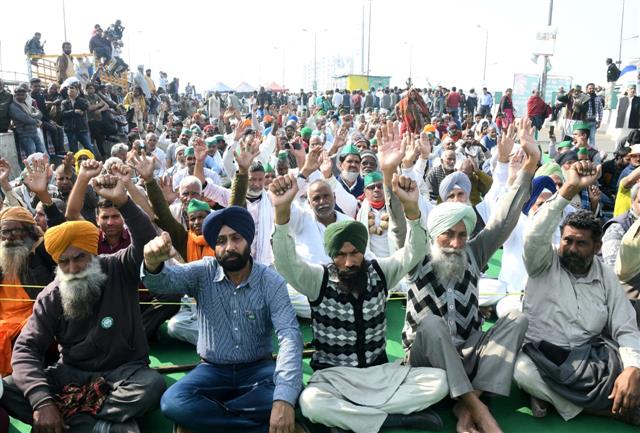
Farmers decide to continue their agitation till farm laws are formally repealed
NEW DELHI (TIP): Prime Minister Narendra Modi, in an address to the nation on November 19 announced that the three contentious farm laws introduced in 2020 will be repealed.
“We haven’t been able to explain to our farmers. This is not a time to blame anyone. I want to tell you that we have taken the farm laws back,” said the Prime Minister, urging farmers to return to their homes and fields.
The decision comes ahead of key state elections, over a year after farmers began protesting the laws. PM Modi said his government did its best to educate and inform the farmers about the laws and will continue to keep working for their betterment. Prime Minister said the laws would be repealed in the upcoming winter session of Parliament and a panel formed to make the MSP regime more effective. “Apologizing to the people with a sincere and pure heart, I want to say that something must have been lacking in our dedication that we could not explain to farmers what was as clear as the light of a diya,” said the PM, describing the three laws as “enactments made with full integrity, clear conscience and with the best interest of farmers at heart.”
Acknowledging chinks in government’s outreach to farm unions (11 rounds of talks starting December 3, 2020, failed to break the deadlock), the PM said, “Today is Gurpurb. This is not the time to blame anyone. I have come before the country to say that we have decided to withdraw all three agricultural laws. In the Parliament session starting later this month, we will complete the constitutional process to repeal these three agricultural laws.” The rollback announcement comes ahead of elections in five states, including Uttar Pradesh and Punjab, early next year and a week ahead of the first anniversary of farmers’ protests on November 26. Before announcing the climbdown, the PM justified the three legislations as “sacred things, absolutely pure, a matter of farmers’ interest. “…we left no stone unturned in our attempt to understand the farmers’ concerns,” he said.
The PM also appealed to agitators to return home from Delhi borders and urged them to go in for a “new beginning and a fresh start”.
The Prime Minister’s 18-minute address to the nation was high on symbolism as he invoked both Guru Nanak Dev and Guru Gobind Singh to underline NDA’s commitment to farmers. He spoke of his government’s “highest priority to agriculture, breaking past procurement records, effecting a five-fold budget increase and ensuring over Rs 1.25 lakh crore annual spending on the sector.” The PM, however, lamented that the government had failed to convince all farmers about the benefits of the laws “despite its best efforts” and said the sole objective was to ensure a fair price for farm produce and maximum selling options.
The announcement, seen as the government’s massive outreach to farmers ahead of elections, also carried PM’s assurance on legal guarantee for MSP — a demand farm union leaders repeated today.
The Prime Minister said a committee with representatives of the Centre and state governments, agricultural economists and farmers would soon be formed to suggest ways of making the MSP more effective and transparent. Also, to suggest cropping pattern changes to achieve the goal of zero-budget farming.
The PM signed off his speech with Guru Gobind Singh’s revered hymn, “Deh Shiva bar mohe ihai, shubh karman te kabhu na tarun” (Grant me this boon O’ God, may I never refrain from righteous act), assuring farmers, a major political constituency, of NDA’s “continuous support”.
Meanwhile, the Samyukt Kisan Morcha announced that the agitation will continue till farm laws are formally repealed.The SKM on Saturday, November 20, decided to go ahead with the pre-decided programs of the farmers’ agitation till November 29. It includes the Lucknow Mahapanchayat on November 22, observing the anniversary of the agitation on November 26 and the tractor march to the Parliament on the first day of the Winter Session.
RICHMOND HILL, NY (TIP): An impressive Parade (Nagar Kirtan) was taken out by the Sikh community of the Tri-State of New York, New Jersey and Connecticut on November 13 in celebration of the 552nd Birth anniversary of Shri Guru Nanak Dev Ji, the First Master of the Sikhs.
Thousands followed the Guru Granth Sahib, the Holy Book considered to be the Living Masteratop a motorized vehicle, with the priests attending and singing hymns (shabad kirtan). All along the 3-mile route of the parade, a number of organizations and individuals served food and beverages, called langar (free food) to each and everyone. Langar (free food) is a unique feature of Sikhism.
Sikhism is the youngest and the fifth most followed religion of the world. The Sikhs, known for their enterprise, are present in every part of the world, and contribute richly to their nations of adoption. The U.S. Canada, UK, account for a larger percentage of the Sikh population. The annual Guru Nanak parade is organized by Gurdwara Baba Makhan Shah Lobana Sikh Center in Richmond Hill in cooperation with the Sikh Gurdwaras and the Sikh organizations in the Tri-State area. The 2021 parade was into its 21st year.
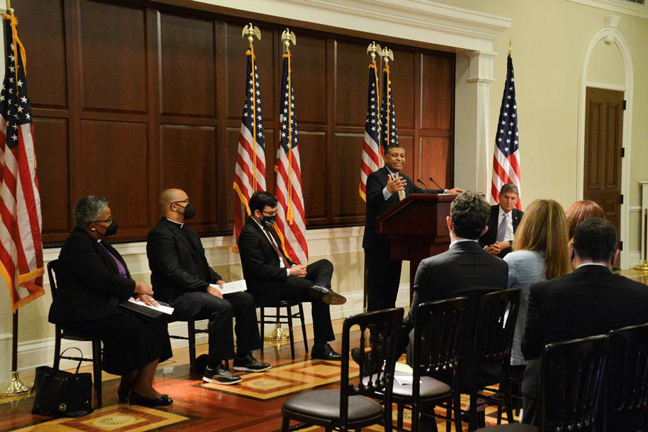
WASHINGTON, D.C. (TIP): Dr. Rahul Gupta on Thursday was sworn in as the director of the Office of National Drug Control Policy. His nomination was confirmed by the U.S. Senate on Oct. 28. The swearing-in ceremony took place at the White House. Sen. Joe Manchin, D-W.Va., delivered the oath. “I myself had the honor of working with Dr. Gupta when I was Governor and he served as the director of the Kanawha County Health Department,” Manchin said. “His advice and expertise helped guide Charleston and Kanawha County through difficult times, and I will always be grateful for his help and continued friendship.” Manchin and Sen. Shelley Moore Capito, R-W.Va., spoke favorably of Gupta during a Senate Judiciary Committee hearing in September. Gupta is the first physician to preside over the office. Here are some excerpts from Dr. Gupta’s Remarks at Ceremonial Swearing in at the White House on November 19, 2021. I’ve been a practicing primary care physician for more than 25 years – I’ve served in towns as small as 1,900 residents and cities as large as 25 million. I was the Health Commissioner for West Virginia under two governors, and I’ve seen firsthand the heartbreak of the overdose epidemic. I’ve learned that an overdose is a cry for help, and for far too many people, that cry goes unanswered.
I’ve witnessed the challenges that people, providers, and communities face in responding to addiction and overdoses. And at the same time, I’ve seen how public safety and public health leaders can work together to develop strategies that save lives…and how evidence and data are critical to developing and implementing effective policy. And I commit to you that during my tenure, the Administration’s drug policies will continue to be based on the best evidence and data available to us. We will continue the work underway to expand access to high-quality, evidence-based prevention, harm reduction, treatment, and recovery supports while also reducing the supply of harmful substances in our communities. Our work will be centered on supporting the people affected by this epidemic – the victims and their families, and those who currently have a substance use disorder and need care.
My focus at the beginning will include four specific areas that align with the Administration’s drug policy priorities:
First: Making sure that naloxone is available at every overdose incident… I firmly believe that no one should die of an overdose simply because they didn’t have access to naloxone. But sadly, today, that is happening across the country and access to naloxone depends a great deal on your zip code. To help reduce these deadly disparities, yesterday, ONDCP announced a new model law for state policymakers to consider that would ensure all states have consistent policies on naloxone.
Next: Scaling up treatment so our capacity meets the needs of everyone seeking care. Too many people seeking care are not able to access it today, despite the progress we have made in the last decade. We need more providers who are ready to support people with substance use disorder on their path to recovery.
Third: Getting more timely, actionable data to guide our overdose response strategies. Our policies are based on evidence and data, but as we’ve seen with the COVID pandemic, the timeliness and accuracy of data are critical… I will work closely with our interagency partners to do everything we can to improve this so we can make informed policy decisions that will help us save lives.
And finally: Cracking down on illicit finance… Drug trafficking organizations exploit the finance system to move illicit profits and support their operations. We must prioritize dismantling these financial resources in order to weaken their capabilities and reduce the supply of illicit drugs entering our country.
These elements of the Biden-Harris drug policy priorities are critical to reducing the number of overdose deaths as soon as possible while also strengthening our nation’s addiction infrastructure. As the first physician to lead this office, I know that we must build a better addiction infrastructure, centered on individuals, families, and bringing communities together…from public health to law enforcement to faith-based organizations and the private sector, so we can meet people where they are and save lives. I said earlier that an overdose is a cry for help. The Biden-Harris Administration is working to make sure these cries are heard…and answered.
Addition of local agrarian demands into the call for the repeal of the farm laws may have forced the Government’s hand
“The Union government’s response to the protests were appalling and marked by hubris. Its focus was on controlling and positivizing the narrative. Efforts were made to break, divide, buy out, demean, denigrate, demonize and shame the protesters, who were conveniently branded as terrorists and Khalistanis. Sedition cases were filed against the protesters. Teargas shells rained on the protest marches, and officials publicly asked the police to smash the heads of protesters. In Lakhimpur Kheri, Uttar Pradesh, a vehicle was driven into a peaceful demonstration, killing several persons. That the protests endured and survived such brutal responses is indeed salutary.”
The repeal of the three farm laws by the Union government, on Friday, November 19, marks a historic victory for the farmer’s movement in India. For more than a year, thousands of farmers had barricaded Delhi, and their protests were gradually evolving into a pan-Indian movement of resistance. The belated, though wise, decision by the Government to repeal the laws brings down the curtains on the agitation in Delhi but is unlikely to douse the political fervor it has left behind. The Union government’s response to the protests were appalling and marked by hubris. Its focus was on controlling and positivizing the narrative. Efforts were made to break, divide, buy out, demean, denigrate, demonize and shame the protesters, who were conveniently branded as terrorists and Khalistanis. Sedition cases were filed against the protesters. Teargas shells rained on the protest marches, and officials publicly asked the police to smash the heads of protesters. In Lakhimpur Kheri, Uttar Pradesh, a vehicle was driven into a peaceful demonstration, killing several persons. That the protests endured and survived such brutal responses is indeed salutary.
The broader context
“Reforms” in agriculture, advocated by right-wing economists after 1991, were focused on dismantling the institutional support structures in Indian agriculture that were established after the 1960s. These support structures — in prices, subsidies, credit, marketing, research and extension — were instrumental in India’s achievement of food self-sufficiency between the 1960s and the 1980s.
In agricultural marketing, the focus of attack was the mandis governed by the Agricultural Produce Market Committee (APMC) Acts passed by State Assemblies. It was argued that if India needs to diversify its cropping pattern into export-oriented and high-value crops, mandis need to give way to private markets, futures markets and contract farming. The APMC Acts discriminated against farmers by not allowing them to interact directly with the big corporate buyers and exporters. So, the APMC Acts must be amended so that any private market or rural collection center can freely emerge anywhere without approval of the local mandi or the payment of a mandi tax, and so that contract farming can be popularized. Similarly, the advocacy for the amendment to the Essential Commodities Act, 1955 rested on the view that private corporate investment can be incentivized into storage and warehousing if stock limits are relaxed for traders. It was a long-held constitutional consensus in India that agricultural marketing was the legislative arena of State governments. Thus, in 2003, the Union government prepared a Model Act on agricultural marketing and sent it to States for passage in State Assemblies. This was followed by the preparation and circulation of two other Model Acts, in 2017 and 2018. Reception to these Model Acts was neither dismissive nor welcoming. Many States selected a few clauses, which they found attractive and suitable to their contexts, and accordingly amended their APMC Acts between 2003 and 2020. Only one State — Bihar — used the occasion to completely annul its APMC Act in 2006.
Laws were unconstitutional
The consensus was broken in 2020, when the Union government took up on itself the task of legislating on agricultural marketing and passed the farm laws. Federal principles were violated as the Union government invoked Entry 33 of the Concurrent List to intervene into matters in Entry 14, Entry 26 and Entry 27 of the State List. The farm laws even interfered with Entry 28 of the State List, which were not subject to Entry 33 of the Concurrent List. Thus, to begin with, the farm laws were reasonably and justifiably argued to be unconstitutional.
However, the Supreme Court of India refused to act swiftly on petitions filed before it. Instead, without consulting the protesting farmer’s organizations, it appointed, in January 2021, a committee of four persons, all of whom had publicly declared their support for the farm laws. Farmer’s organizations, on their part, distanced themselves from the committee and continued with their agitation.
Apart from constitutionality, the contents of farm laws were also widely criticized. Bihar’s example showed that private investment was unlikely to flow into agricultural markets even if APMC Acts were annulled. In fact, the exploitation of farmers by unscrupulous traders intensified in Bihar after 2006. Kerala never had an APMC Act.
Yet, there was little presence of private investment in its agricultural markets. Maharashtra delisted fruits and vegetables from the ambit of APMCs in 2016. Still, the inflow of private investment into agricultural markets was only marginal. Thus, what was likely was that a formal and regulated market might fragment itself into an informal and unregulated market if the APMC Acts were weakened. Furthermore, two other problems were highlighted. One, mandi taxes were used to invest in rural infrastructure in States such as Punjab. If mandis are weakened, what would substitute for such investments? Two, even if private markets emerged, how would they address the structural problem of poor farm-gate aggregation of the produce of small and marginal farmers? Would one middleman be simply substituted by another? Proponents of farm laws had no convincing answers.
The grievance redress mechanisms for contract farming also came up for criticism. The obliteration of the power of civil courts and their substitution with a weak mechanism led by the sub-divisional magistrate threatened to be a serious impediment to a just redress of complaints. It was feared that this may benefit corporate sponsors more than the contracting farmers.
It pointed towards corporates
Finally, the overall thrust of the farm laws appeared to encourage the participation of larger corporate players in agricultural markets rather than farmer-friendly organizations, such as cooperatives or Farmer Producer Companies (FPC). Especially in the case of the amendment of the Essential Commodities Act, there was reasonable suspicion that a handful of corporate players were to substantially benefit from investments in logistics, storage and warehousing.
The farmers’ protests began from States such as Punjab and Haryana where the mandis were deeply rooted institutions in the local economy and society. However, as days passed, the agitation spread to western Uttar Pradesh and from there to many other States. In a few months, the agitation threatened to grow into a pan-Indian phenomenon with a constant addition of local agrarian demands into the larger demand for the repeal of farm laws. Such local customization of the agitation immensely helped in the cause of mobilization. An unusually large number of women actively participated in the protests. In regions such as western U.P., the protests also threatened to bridge and repair the communal fault lines that were consciously cultivated after the Muzaffarnagar riots of 2013. Numerous protesters perished on the protest grounds, but support for the protests grew not just domestically, but also globally.
A mindset of intolerance
It was not just hubris that marked the Government’s response, but also infantilism. When pop star and celebrity Rihanna tweeted a rather innocent comment about the protests, the entire machinery of the ministry of external affairs was awoken for an extraordinarily disproportionate response. Indian embassies were asked to spread the word that she and other celebrities were propagandists who had irresponsibly ganged up to discredit progress in India. These responses showed nothing but a deeply disturbing official mindset of intolerance and insecurity.
The repeal of the farm laws has, at least temporarily, put an end to an ugly and eminently avoidable chapter of confrontation between the Union government and the farmers. However, the momentum that the agitation has left behind would surely linger on. The agitation has led to a positive politicization of several agrarian demands, including the need for stable markets and remunerative prices. A confidence has grown that committed struggles matter and even aggressive governments can be made to kneel. New rural mobilizations around demands to address the larger and persistent agrarian crisis are likely to emerge and grow. We surely are in for interesting times.
(The author is Professor at the Tata Institute of Social Sciences, Mumbai)
Novak Djokovic secured a semi-final place at the ATP Finals with a 6-3 6-2 victory over Russian Andrey Rublev on Wednesday, Nov 17, his 50th match win of the year, while Stefanos Tsitsipas withdrew from the tournament due to an elbow injury. The Greek world number four was replaced in Turin by British world number 12 Cameron Norrie, who took Casper Ruud to three sets on his debut in the late match before the Norwegian prevailed 1-6 6-3 6-4.
Djokovic, who won his opening match against world number eight Ruud, was in early trouble in his first career meeting with Rublev when he was broken in the first game.
The Serb, looking for his sixth title at the season-ending event, was given an immediate reprieve when Rublev double- faulted to bring up two break points, the second of which Djokovic converted.
The pair were on an even keel until the eighth game when Djokovic pounced on a heavy volley from Rublev and sent a winning pass beyond the Russian to claim the vital break on his way to taking the first set.
The second was more assured from the world number one, forcing his opponent into errors that helped Djokovic to victory in 68 minutes, his 40th win at the ATP Finals.
The 34-year-old and 20-times Grand Slam winner tops the Green Group standings with two wins from two.
Djokovic will play Norrie on Friday while Rublev and Ruud meet in what amounts to a straight shootout for the last semi-final place.
“The good thing is that I qualified for semi-finals, so I won’t have that much pressure to win the match… but obviously every match matters, so I will go with the intention to win,” said Djokovic.
Ruud allowed the first set to get away from him before coming back strongly but Norrie still saved three match points in the final game to come back from 40-0 before the Norwegian served out.
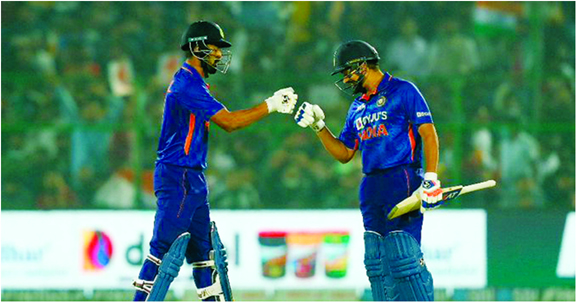
Jaipur (TIP): Skipper Rohit Sharma and Suryakumar Yadav produced sublime knocks as India bungled towards end before recovering in time to fashion a five-wicket win over New Zealand in the opening T20 International ushering in a new era in Indian cricket. Martin Guptill (70 off 42) and Mark Chapman (63 off 50) took New Zealand to 164 for six on a good batting surface. India’s chase was set up by Rohit (48 off 36), who made his full-time captaincy debut, and Suryakumar Yadav (62 off 40) who came in at number three in place of rested Virat Kohli.
The home team was cantering to a comfortable win but messed up the chase in the final four overs. In the end, with New Zealand running out of bowling options, the job was done in the 20th over bowled by part-time pacer Daryl Mitchell. Debutant Venkatesh Iyer hit his first ball in international cricket for four before Rishabh Pant got the winning runs. The game marked the start of a new chapter in Indian cricket with Rohit as T20 skipper and Rahul Dravid as head coach. With both teams resting some of their key players as part of workload management, it was very much an even contest before the first ball was bowled.
India raced to 50 for no loss in five overs with Rohit playing some delightful shots. He got going with back to back fours off Tim Southee in the third over before unleashing his signature front pull on the final ball of the over.
The seasoned pace duo of Southee and Trent Boult were put under pressure upfront by both the openers. K L Rahul (15 off 14) got into the act with a massive six over deep square leg off Boult before Rohit hit another pull shot to collect 21 from the over.
Rahul fell to a soft dismissal on the first ball of Mitchell Santer’s spell to give New Zealand a wicket against run of play. Suryakumar meant business from ball one and the most memorable shot of his innings was the pick up stroke off Lockie Ferguson to get to his third T20 fifty. Both Rohit and Suryakumar should have gone on to finish the game but that didn’t happen. From a straight forward 23 off the last 24 balls, India made it complicated by making the equation to 10 runs off the last over. Earlier, Guptill and Chapman ensured New Zealand were well placed for a 180 plus total on a batting beauty but Ravichandran Ashwin’s double strike in one over put the brakes on the scoring rate. Ashwin was the pick of the bowlers for India, taking two for 23 in four overs while senior pacer Bhuvneshwar Kumar (2/24 in four overs) too got his swing back. Expecting heavy dew later in the evening, Rohit opted to field. Venkatesh was expectedly handed a debut while New Zealand made four changes to the playing eleven that played the T20 World Cup final on Sunday as part of workload management.
British researchers said they had identified proteins in the coronavirus that are recognised by T-cells of people who are exposed to the virus but resist infection, possibly providing a new target for vaccine developers.
Immunity against COVID-19 is a complex picture, and while there is evidence of waning antibody levels six months after vaccination, T-cells are also believed to play a vital role in providing protection.
The University College London (UCL) researchers examined 731 health workers in two London hospitals during the first wave of the COVID-19 pandemic, and found that many had not tested positive despite likely exposure to the original coronavirus.
They found that, while a subset of the workers did not generate antibodies or test positive with PCR tests, they had still generated a large and broad T-cell response following possible exposure. This suggests that rather than the workers avoiding exposure to the coronavirus altogether, the T-cells had cleared the virus before there were any symptoms or positive test result – a so-called “abortive infection”, the researchers said.
“We know that some individuals remain uninfected despite having likely exposure to the virus,” said Leo Swadling, lead author of the study, which was published in science journal Nature.
“What is really informative is that the T-cells detected in these individuals, where the virus failed to establish a successful infection, preferentially target different regions of the virus to those seen after infection.” Current vaccines, which provide high protection against severe disease but do not fully stop transmission or re-infection, target the spike protein of the coronavirus. In contrast, the T-cell responses that led to abortive infections in the UCL study recognized and targeted instead “replication proteins”. The researchers said that while such T-cells were associated with protection from detectable infection, they were not necessarily sufficient for protection alone, and the study did not look at whether people had protection on re-exposure.
In today’s time, the most searched topic on the internet is how to take care of oily skin. To take care of oily skin depends on many factors, including your daily diet, lifestyle, the weather of the city where you live, medication, and beauty products you use. Meanwhile, it is very important to effectively manage your skin. The skin gets oily when it produces too much sebum. Sebum is an oily substance that plays an important role in keeping our skin healthy and hydrated. However, too much sebum can lead to clogged pores and acne.
However, using a serum can help you get rid of excess sebum and help nourish your skin.
Apart from changing lifestyle and diet, adding serums to your daily skincare routine can be a simple and effective treatment for oily skin.
Serums are water or emulsion-based formulations, which are non-sticky like gel or water. Serum provides hydration, keeps skin moisturized.
To reap the benefit of serum, you need to use the right formula as per your skin. High-performing serums which contain skin energizing ingredients like hyaluronic acid, salicylic acid, and vitamin C are recommended.
Hyaluronic acid keeps dull and dehydrated skin fit. Salicylic acid is oil soluble and helps clear out excess sebum from pores and reduce oil. Vitamin C acts as an antioxidant, leading to skin rejuvenation.
Oily skin needs hydration too and serum is best for oily skin as it is made up of smaller molecules that penetrate deeper into the skin and nourish the skin than an average cream or moisturizer. The serum is one and maybe only beauty product that can eliminate the need for skincare products like creams or moisturizers.
An easy-to-use serum is a skincare product that you apply after cleansing your face. A few drops of this beauty tonic give your skin the necessary nourishment and prepare you for the whole day.
Gently apply the serum to your face and neck and use your fingers to lightly tap, pat, and apply. When you’re dealing with oily skin, just turn to your most effective beauty product, a serum, and watch your skin change.
You just love how just a single pair of eyelashes can add drama to your whole eye makeup, don’t you? And with adding extensions, you definitely don’t need to worry about putting on a lot of makeup as they can make a statement by themselves. But while applying it, we have to be extra careful while putting them on as you don’t want to affect your real lashes. And as they make a bigger impact, volumizing your lashes, go easy with your eye makeup.
These extensions may seem a cakewalk but they are surely not. To make them long-lasting, they require proper care as they can easily fall off from your eyes if not given a little TLC. So here are a few tips on giving them the little attention they need.
Clean your Lashes
Before applying those falsies, make sure your own lashes are free of any dirt or makeup. If not, wash them because they will stick much better.
Don’t get them wet
After getting your lashes done, wetting them for at least 24 hours is a huge no-no. The glue hasn’t dried off and having water on them make cause them to fall off.
Avoid Steam
Yes, that means no sweaty workout session either. No swimming, no saunas too. You should avoid moisture in all cases because the first 24 hours is crucial.
Avoid Oily Products
Oils in your makeup or skincare products can bring down the glue in your lashes so it would be better to avoid them.
Brush Them
Maintaining your extensions is to give them a proper brush daily so as to retain their natural shape as they mean to get tangled sometimes.
Do not pull or rub
The first and foremost rule after getting your lashes done is not to rub, pull or tug in it any way. Just keep your hands off them, give them the time to dry so you could look your fab best.
Say No to Mascara
We know how you love applying mascara but this will only lead to a breakdown in the adhesive of your lashes. Source: Pinkvilla
1 tablespoon olive oil, 1 large onion, chopped, 2 cloves minced garlic, 2 teaspoons grated fresh ginger, 1 green chile pepper, chopped, 1 tablespoon ground cumin, 2 teaspoons paprika, 1 teaspoon ground coriander, 1 teaspoon garam masala, 1 teaspoon ground turmeric, ½ teaspoon ground cayenne pepper, 4 cups chopped tomatoes, 4 cups cooked chickpeas (garbanzo beans), ½ cup tomato sauce, ½ cup plain yogurt, 1 lemon juiced, ½ teaspoon salt,
Directions
– Heat oil in a large saucepan over medium heat. Saute onion, garlic, ginger, and green chile pepper in hot oil until onions are translucent, about 10 minutes.
– Season onion mixture with cumin, paprika, coriander, garam masala, turmeric, and cayenne pepper; stir. Cook onion with spices until fragrant, 1 to 2 minutes. Add tomatoes, chickpeas, and tomato sauce; stir and simmer until the tomatoes soften, about 5 minutes.
– Stir yogurt into the mixture until the color of the mixture is even; simmer until again hot, about 5 minutes more. Remove pan from heat; stir lemon juice and salt into the mixture.
Tulsi Vivah is a Hindu festival in which a ceremonial marriage of Tulsi with Lord Shaligram or Amla branch, which are personifications of Vishnu, is held. This year, Tulsi Vivah was celebrated on November 15, 2021. The Tulsi wedding signifies the end of the monsoon and the beginning of the wedding season in Hinduism.
Legend
According to Hindu scripture, the Tulsi plant was a woman named “Vrinda” who was the wife of Asura Jalandhar and was a great devotee of Vishnu. Her devotion made her husband invincible, not even Gods could defeat him. One time, when Vrinda was praying for her husband’s victory, Vishnu disguised himself as Jalandhar and went in front of her. She stopped her prays and went to touch Jalandhar/Vishnu’s feet. This took away the real Jalandhar’s powers and then he was killed by Shiv. When Vrinda heard about it, she cursed Visnu that he would become Shaligram and he would get separated from his wife, Laxmi. Visnu turned into Shaligram and was separated from Sita in his Ram avatar.
After that, Vrinda walked into the ocean and drowned herself. The Gods turned her into the Tulsi plant. Visnu had promised her that he would marry her in the next life. So he marries Tulsi in the form of Shaligram. Hence, this day is celebrated as Tulsi Vivah.
Celebrations
The marriage of Tulsi with Vishnu/Krishna resembles the traditional Hindu wedding. The marriage ceremony is conducted where a fast is observed on the Tulsi Vivah day until evening when the ceremony begins. A mandap is built around the courtyard of the house where the Tulsi plant is usually planted. It is believed that the soul of Vrinda resides in the plant at night and leaves in the morning. The bride Tulsi is clothed with a sari and the groom, an image of Vishnu or the Shaligram is clothed with dhoti. The couple is linked with a cotton thread in the ceremony. People burst firecrackers and distribute sweets on this day.
A day of fast, feast and ‘tulsi vivah’
The much-awaited wedding season begins as Hindu deities wake up from their deep sleep and are all set to bless the newlyweds from Monday. The day is celebrated as Dev Uthani Gyaras or Prabodhini Ekadashi or Chhoti Diwali. The most important ceremony of the day is ‘tulsi vivah’.
The ritual involves ceremonial marriage of holy basil (tulsi) plant to Lord Shaligram (Lord Vishnu). This day is considered auspicious and weddings take place on this day. All auspicious functions that cannot be performed during ‘chaturmas’ will begin on this day. Almost all local marriage gardens have been booked for weddings tomorrow. Many devotees will observe fast and stay on fruit diet. This day helps people in detoxification of bodies. Sugarcanes will be sold in large quantities during the day.
Preparing for celebrations, Gera family bought decorative items, puja goods and new cloth from market. “In our family, ‘tulsi vivah’ is organised as a proper wedding and celebrated with music, prayers and feast,” businessman Vasudev Gera said. He bought sugarcane, red shiny cloth, havan goods and a large earthen lamp.
“Earthen lamp is lit at night. It burns all night to commemorate the start of new season and bright future,” Gera said. Besides, earthen lamps are lit all around the house like on Diwali. Hospital administrator Ashish Ramnani also talked about importance of sugarcane. ‘Tulsi vivah’ will be organised at temples in Khajrana, Vijay Nagar and other places. ISCON temple will also hold the ceremony
The Devi Bhagavata Purana regards Tulsi as an manifestation of Lakshmi, the goddess of wealth and principal consort of Vishnu. Once upon a time, King Vrishadhvaja-a devotee of the god Shiva-banned worship of all other deities except for that of his patron god. An agitated sun god Surya cursed him that he would be abandoned by Lakshmi. Upset, Shiva pursued Surya, who fled, finally seeking shelter with Vishnu. Vishnu said to the deities that years had passed on earth. Vrishadhvaja and also his heir-son were dead and his grandchildren-Dharmadhvaja and Kushadhvaja-were now worshiping Lakshmi to gain her favor. Lakshmi rewarded their efforts by being born as their daughters Tulsi (literally “matchless”) to Dharmadhvaja and Vedavati to Kushadhvaja, respectively. In time, Tulsi gave up all her royal comfort and went to Badrinath to perform penance to gain Vishnu as her husband. The god Brahma was pleased with her penance but told her that she would have to marry the daitya Shankhachuda before she could marry Vishnu.
Curse of Tulsi & Lord Vishnu
Shankhchuda was Sridama reborn. Though he was a devotee of Shri Krishna, he detested Shri Radha. He considered Prema as Vilas. Once on his visit to Golok, Shri Krishna asked him to guard the gate of His palace and not allow anyone to enter. Following the order, he stopped Shri Radha from entering Shri Krishna’s palace as He was resting. They got into a heated argument. In a fit of anger, he cursed Shri Radha that she would forget all about Shri Krishna and would abandon Golok and live on Lok (Prithvi) for a hundred years. He was made to realise that Radha-Krishna’s prema is the foundation of the universe. He too was cursed to be born on Prithvi as Shankhchuda.
This mighty daitya underwent terrific tapa and penance and pleased Brahma. Brahma blessed him with a boon of invincibility. Shankhachuda pleased Brahma with his penance, was granted the Vishnu-Kavacha (armour of Vishnu) and he blessed shankhachuda that as long as Vishnu-Kavacha was on his body, no one could slay him. Shankhachuda and Tulsi were soon married. He practiced the laws of dharma religiously but was also prone to commit mistakes and sins for the sake of community. Therefore, after victory over the three worlds, he drove out gods from various celestial kingdoms. To rescue the universe, Shiva challenged Shankhachuda to war. Vishnu appeared in his true form and urged Tulsi to abandon her earthly body and return to his celestial abode. In her anger and grief, she cursed Vishnu to be turned into stone. Vishnu turned into a stone and reside on riverbank Gandaki River. People and devotees will call it a chunk of Shaligrama. Tulsi’s mortal remains decayed and became the Gandaki River, while her hair transformed into the sacred Tulsi plant.
Vrinda and Jalandhara
A variant of the legend replaces the name Tulsi with Vrinda (a synonym of the Tulsi plant) and in this legend, Tulsi is distinct from Lakshmi. She was daughter of Kalanemi, an asura. Vrinda was very pious and a great devotee of god Vishnu. Jalandhara, a demon born from lord Shiva’s rage, married her. After Jalandhara took control of the three realms, he had a conflict with lord Shiva. To protect her husband from death, Vrinda performed a penance which made him immortal. The later part of the story concentrates on the tale of Vishnu destroying Vrinda’s chastity to lead to the death of Jalandhara by Shiva. Different texts suggest different methods used by Vishnu. Some say that Vishnu, disguised as Jalandhara, performed a ritual belonging to married couples, others say that Vishnu broke Vrinda’s fast or slept with her. The legend ends with Vrinda cursing Vishnu to become a stone, turning him the Shaligram stone (which are found only in the Kali Gandaki River of Nepal) and Vishnu transforming Vrinda into the Tulsi plant. In a variant, Vrinda immolated herself in her husband’s funeral pyre (see sati) but Vishnu ensured that she got incarnated in the form of tulsi plant on the earth. In both versions, she gain the status of a goddess named Tulsi, while her earthly form is the Tulsi plant.
Ace investor Rakesh Jhunjhunwala-backed Akasa Air on Wednesday announced signing an agreement to purchase CFM LEAP-1B engines to power its Boeing 737 MAX airplanes and the overall deal is estimated to be worth $4.5 billion. The announcement comes a day after the upcoming ultra low-cost carrier said it would buy 72 Boeing 737 MAX planes from Boeing Co. With this purchase and services agreement, Akasa Air will have from day one of its operations an innovative and comprehensive maintenance programme delivered by CFM, the airline said. The pact was signed with CFM at the ongoing Dubai Airshow. The deal, which includes spare engines and long-term service agreement, is estimated to be worth $4.5 billion at list price. “We are pleased to partner with CFM International as we embark on an exciting journey to launch the greenest, most affordable and most dependable airline in India.
The U.S., European Union and Japan will announce Wednesday they will renew their trilateral partnership to address the challenges posed by the non-market policies and practices of countries such as China, according to two people familiar with the matter. The three plan to meet on the sidelines of the upcoming WTO ministerial meeting taking place in Geneva, Switzerland, at the end of the month where they will aim to set out a work program for the following weeks, one of the people said.
The talks, which are built on a Trump-era initiative with the EU and Japan, aim to establish new international rules to restrict the market-distorting behavior of state-owned enterprises, confront harmful subsidy practices and deter forced technology transfers and intellectual property theft.
A spokesman for the office of the U.S. trade representative didn’t immediately respond to a request for comment. An EU spokesperson couldn’t be immediately reached for comment.
The initiative seeks to rein in China’s massive state aid to strategic domestic industries — like steel and aluminum — through tax benefits, government grants, energy subsidies, preferential lending and financing, under-priced inputs and cheap land-use fees.
The announcement comes days after U.S. President Joe Biden met virtually with Chinese leader Xi Jinping. In the 3 1/2-hour sit-down on Monday evening, Biden made clear his concerns with China’s non-market economic practices, U.S. officials said.
Officials in Washington estimate the Chinese government offered more than $500 billion in state aid to key industrial sectors via the Made in China 2025 and related industrial plans.
The trilateral effort was endorsed earlier this year by trade ministers from the world’s seven largest advanced economies, who said they want to bolster regulations on industrial subsidies and curb actions by state-owned companies that distort trade.
The Group of Seven’s goal in the talks, which have been ongoing since 2017, is to produce an agreement that might eventually be adopted by the members of the World Trade Organization.
But getting China to join the talks, which are ostensibly aimed at restricting Beijing’s state-led economic model, remains a major hurdle.
In July China’s ambassador to the WTO said there’s scope for Beijing to participate in the initiative but said new international trade rules should not be negotiated in China’s absence and then presented as a fait accompli.
If China plays ball, the negotiations could represent the most significant attempt to rewrite WTO rules since the ultimately unsuccessful Doha Round of trade negotiations was launched in 2001.
Apple will now allow users to carry out Do-It-Yourself (DIY) repairs on certain iPhone and Mac computers.
It starts sometime next year with the new Self Service Repair option, which will roll out in the US and other countries.
It will allow users to access – in other words, buy – genuine parts and tools for iPhone and Mac repairs on the new Apple Self Service Repair Online Store, thereby doing away with the need to go to a service centre.
It makes Apple the first smartphone brand, and indeed a computing device maker, to offer a self-repair option to its consumers. In the first stage of this DIY repair adoption, parts and tools will be available for the iPhone 13 and iPhone 12 series. That’ll be followed by parts and tools for Mac computing devices, the recent ones powered by the M1 chips, including the new MacBook Pro 14 and the iMac 24-inch.
Numerous macro indicators suggest that the economic recovery is now taking hold after the beating it has taken during the pandemic, but for growth to be sustainable and reach its potential, private capital investment has to resume, the Reserve Bank Governor said on Tuesday.
RBI Governor Shaktikanta Das said the economy has the potential to grow at a reasonably high pace in the post-pandemic scenario, provided private capital investment resumes.
Despite many economists revising down their growth forecasts between 8.5 and 10 per cent for the current fiscal, the central bank has not changed its forecast of 9.5 per cent for the year so far.
Addressing a banking function—which he said is his first since the pandemic begin in March 2020, the governor asked banks to be investment-ready when the investment cycle picks up, which the RBI feels to begin from the next fiscal.
It can be noted that since 2013, private capital has been missing from the economy and many are of the view that this should begin from mid-next fiscal.
Shares of One 97 Communications, the parent company of digital payments company Paytm, debuted on the stock market on Thursday. The stock was opened for trading at Rs 1,950 on the NSE, marking a drop of 9.3% or Rs 200 from its issue price of Rs 2,150. Paytm shares extended losses after l opening, with the stock falling 21% from the issue price, reaching an intraday low of Rs 1,705.
Paytm’s 18,300 crore IPO, which was the largest in the country, was underwritten 1.89 times last week. On BSE, the Paytm share was opened for trading at Rs 1,955.
Despite the decline in Paytm shares in its early days, the company recorded a valuation of over Rs 1 lakh crore.
Analysts said Paytm’s expensive valuations were the reason for the stock price plummeting in its first trading session.
The IPO of Paytm consisted of a new issue of Rs 8,300 crore and an offer to sell (OFS) by existing shareholders valued at Rs 10,000 crore. Paytm awarded shares worth Rs 8,235 crore to more than 100 institutional investors, including the Singapore government, ahead of the country’s largest stock exchange listing.
Paytm has attracted the interest of 122 institutional investors who bought more than 3.83 crore of shares for Rs 2,150 a piece, according to a regulatory document dated November 3.
Engineering graduate Vijay Shekhar Sharma founded Paytm in 2010 as a mobile top-up platform. The company grew rapidly after ride-sharing company Uber listed it as a fast-payment option in India and its use increased further in late 2016 after the shock ban on high-value banknotes boosted digital payments.
Paytm’s success made Mr. Sharma, the son of a schoolteacher, a billionaire with a net worth of $ 2.4 billion according to TSWT. Its IPO also struck hundreds of new millionaires in a country where per capita income is less than $ 2,000.
Google bans malicious apps from its Google Play Store whenever it finds them there or comes to know about them when security companies point it out. This kind of action goes a long way in protecting users from scams on the internet. In the latest such instance, the company has banned two new smart TV-based apps from the Google Play Store. These two apps are ‘Smart TV remote’ and ‘Halloween Coloring’. Out of these, the former has been downloaded at least 1,000 times. The information comes courtesy of Kaspersky’s security analyst Tatyana Shishkova who took to Twitter to disclose the names of two malicious apps on the Google Play Store. Shishkova says that these apps come with Trojanised Joker malware.
Notably, Joker malware is known to subscribe users to premium content without their knowledge. Earlier this year, over 5,00,000 Huawei devices were found to be infected with Joker malware. Bleeping Computer also analysed the code of these malicious apps, that is, ‘Smart TV remote’ and ‘Halloween Coloring’ and it found out that it exists in the “resources/assets/kup3x4nowz” file within the Smart TV remote app.
The International Space Station(ISS) performed a brief manoeuvre to dodge a fragment of a defunct Chinese satellite, Russian space agency Roscosmos said. On November 12, 2021, a fragment of the Fengyun-1C spacecraft will approach the International Space Station at about 4 am Moscow time, Roscosmos added.
The station crewed by seven astronauts climbed 1,240 metres higher to avoid a close encounter with the fragment and settled in an orbit 470.7 km (292 miles) above the Earth, Roscosmos said. It did not say how large the debris was.
“In order to dodge the ‘space junk’, (mission control) specialists…have calculated how to correct the orbit of the International Space Station,” the agency’s statement said adding that the minimum distance between the object and the ISS was just over 600 meters.
An ever-swelling amount of space debris is threatening satellites hovering around Earth, making insurers leery of offering coverage to the devices that transmit texts, maps, videos and scientific data.
Over the station’s 23-year orbital lifetime, there have been about 30 close encounters with orbital debris requiring evasive action. Three of these near-misses occurred in 2020. In May this year there was a hit: a tiny piece of space junk punched a 5mm hole in the ISS’s Canadian-built robot arm.
This week’s incident involved a piece of debris from the defunct Fengyun-1C weather satellite, destroyed in 2007 by a Chinese anti-satellite missile test. The satellite exploded into more than 3,500 pieces of debris, most of which are still orbiting. Many have now fallen into the ISS’s orbital region.
To avoid the collision, a Russian Progress supply spacecraft docked to the station fired its rockets for just over six minutes. This changed the ISS’s speed by 0.7 metres per second and raised its orbit, already more than 400km high, by about 1.2km.
Orbit is getting crowded Space debris has become a major concern for all satellites orbiting the Earth, not just the football-field-sized ISS. As well as notable satellites such as the smaller Chinese Tiangong space station and the Hubble Space Telescope, there are thousands of others.
As the largest inhabited space station, the ISS is the most vulnerable target. It orbits at 7.66 kilometres a second, fast enough to travel from Perth to Brisbane in under eight minutes.
A slow laptop on your hands can be a primary cause of loss of productivity and focus. It can also be extremely frustrating when you’re in the middle of important work only to find yourself waiting more and doing less of the work. However, there are simple tips you can follow to see a quick performance boost on your machine, which can be handy when you’re out with your laptop and need to get stuff done fast.
Quit foreground, background programs that are not in use
Programs that are not in use right now, but are running regardless, are the prime reasons for your laptop’s resources being spent for the wrong task. Close any program windows that are not necessary to the work at hand and you should see an almost immediate increase in performance, especially if you have an older, not-so-powerful machine. Not all programs can be simply closed by hitting the ‘X’ button. You may also want to keep an eye on what’s running in the background. You can do this by hitting Ctrl+Shift+Esc and seeing what’s running in the Windows task manager. You can also check your system tray by hitting the upward facing arrow on the right side of your taskbar to see if any programs are running in the background.
Close unnecessary browser tabs
If your work involves having a browser open at all times, you may want to keep the number of open tabs at a minimum if your machine is not fast enough. Remember that the more tabs that are open in a browser window, the heavier the toll on your RAM and processor.
Restart your laptop
A simple restart once a while can do your older laptop more good than you think. Restarting clears the temporary cache memory and allows your laptop to quite literally start fresh. Note that if you have programs that start along with Windows, simply restarting could be counterproductive unless you do something about those programs first.
Keep an eye on startup apps
Startup apps will silently build up over time and will not only affect your laptop’s boot time, but its general performance as well. These programs also mean your resources will be used behind these programs, probably without you realising it.
Apple’s future AR/VR headset could be in the price range of $2000, according to Bloomberg’s Mark Gurman who has mentioned new details in his newsletter PowerOn. Gurman expects Apple’s headset to make an appearance in 2022, and he’s predicting it will come just a few months after Meta (formerly Facebook) launches its own headset, which is so far known as Project Cambria. Gurman says both devices will be direct challengers for users looking to jump into the metaverse. Zuckerberg had given a glimpse of Project Cambria during the Meta announcement. He had said that the product would be more expensive, and come with the more “advanced technologies.” In a blog post the company had said the headset would include “improved social presence, colour Passthrough, pancake optics,” and this was not a successor to the existing Oculus Rift 2 or 3.
It said Project Cambria was designed “for people who want to start testing out a new kind of computing on the cutting edge of what’s possible today.”
Meanwhile, Gurman’s newsletter also notes that Apple and Meta could compete in fitness watches as well given the latter is supposed to launch its own smartwatches next year. This has been previously reported by The Verge as well, which had stated that Meta’s smartwatch would come with two camera options.
The report had said that while one camera would be geared for video calling, the other detachable camera would be capable of recording video at full HD or 1080p resolution.
Situated in the Anantnag district of Jammu & Kashmir Valley, Pahalgam is a beautiful hill station and a popular tourist attraction. Pahalgam is located on the banks of the Liddar River and is famous for adventure activities like hiking, trekking, fishing. Pahalgam serves as the base of one of the most important pilgrimages in India – the Amarnath Yatra. Chandanwari, located 16.6 km. away from Pahalgam is the actual base camp of the Amarnath. Kolhoi Glaciers trek via a beautiful village named Aru is one of the most popular treks in the region. The local people also offer sledging on the frozen glaciers. In addition, the long stretches of rivers in Pahalgam are the perfect site for people who enjoy trout fishing.
Pahalgam is where the famous Bollywood movie Betaab, starring Sunny Deol and Amrita Singh, was shot. The valley was consequently named Betaab Valley after that. Sheshnag Lake, situated near Pahalgam, is another bliss altogether. When in Pahalgam, buy authentic Kashmiri saffron from Pampore.
Must Visit Places Aru Valley
Juxtaposed against the snow-covered Himalayan peaks, Aru Valley is an enthralling village in Kashmir. Located around 11 km from Pahalgam, it is the base camp for trekking to the Kolhoi Glacier and the Tarsar-Marsar Lake. Aru lies beside the Aru river, a tributary of the Lidder river, and is known for its scenic meadows and activities like horse riding, hiking and trekking.
During the winter months, Aru Valley becomes a winter wonderland covered with snow as far as the eyes can see. This makes it a perfect place for skiing. There is an entry fee for Aru Wildlife Sanctuary but it doesn’t have any fauna.
Chandanwari
Chandanwari, located 15 km from Pahalgam, is the starting point of the famous Amarnath Yatra. It is also famous for the snow sledging on a snow bridge. Surrounded by snow-dusted mountains and the Lidder River flowing by, Chandanwari is perfect to enjoy a picnic with your family and enjoy the natural beauty.
Chandanwari remains covered in snow from November to May which makes it ideal for sledging. However, the best time to visit Chandanwari is April to June as the weather is perfect for sightseeing during this time.
Betaab Valley
Betaab Valley is one of the most popular tourist attractions in Pahalgam which is a breathtaking combination of picturesque surroundings encircled by tall deodar trees and pine forests, with the Lidder River flowing right through it. The valley is located at a distance of 15 kilometres from Pahalgam in the Anantnag district of Jammu and Kashmir. Betaab Valley got its name from the Bollywood movie Betaab starring Sunny Deol and Amrita Singh shot here. The valley falls between Pahalgam and Chandanwadi on the way to the Amarnath Temple Yatra and is one of the three angelic valleys of Pahalgam, the other two being Aru and Chandanwadi. Sprawling fertile pastures, snow-capped mountains and meandering streams are characteristic of Betaab valley. Apart from being well-known for this stunning landscape, the valley is also a renowned as a famous trekking base and camping site for travellers who want to explore the nearby regions or set out for the Amarnath Yatra.
Baisaran
Baisaran is a beautiful destination 6 kms away from Pahalgam in Jammu & Kashmir. With tranquil meadows, pristine lakes and picturesque setting, you can just stroll down the area or sit down to have a picnic. The place also has very many options of fun games and rides, pony rides, zorbing etc. The place is a popular tourist attraction in the area and you should definitely stop by if you are visiting here.
Lidder River
Located in the picturesque beauty of Jammu and Kashmir, the Lidder River is a 73-kilometre long glacial river that originates from the Kolhoi glacier. Flowing through the valleys of Pahalgam, Lidden River is a quaint picnic spot. Other adventure sports that you can indulge in are white water rafting, angling, horse riding, and fishing. Considered as one of the most important tributaries of the Indus, the Lidder River is the main water source for the nearby Anantnag region, which is only accessible by trekking.
Kolahoi Glacier
Situated over the Lidder River, Kolahoi glacier is a hanging glacier known for its breath taking views. While the only way of reaching this glacier is though trekking, one can also hire ponies or horses for some parts of the journey.
The terrains to reach the glacier are extremely challenging and are not advised to be undertaken by inexperienced trekkers.
Bollywood actress Taapsee Pannu has heaped praises on Mithali Raj, who is the first-ever Indian woman cricketer to receive the Major Dhyan Chand Khel Ratna Award. Taapsee will be seen playing Mithali Raj, who has the distinction of being the highest ODI run-getter in women’s cricket, in the biopic titled ‘Shabaash Mithu’, directed by Srijit Mukherjee. Posting a video of the women’s cricket team captain being bestowed the honour by President Ram Nath Kovind, Taapsee tweeted: “Just by hearing this exhaustingly long introduction of her accolades I feel she actually deserves a series made on her, not just a film.” She added: “So inspiring.” The actress has wrapped up shooting for ‘Shabaash Mithu’. She also treated her fans to a picture of her in the film.
Young Bollywood star Bhumi Pednekar is on a roll with a lineup of films such as ‘Bheed’, ‘Badhaai Do’, ‘Govinda Naam Mera’ and ‘Raksha Bandhan’, and calls herself lucky to find scripts that are distinct right from her debut in 2015 with ‘Dum Laga Ke Haisha’. Bhumi said: “My slate of films will give audiences a unique theatrical experience with every project. I will have five releases on the big screen next year and all of them are super diverse and different from each other. “I have been lucky to have always found scripts that are distinct right from my debut and next year I will be able to give audiences five very different sides to my personality through the characters that I’m playing on screen.” She added that she is really excited about these films. Bhumi is happy that the theatres are bouncing back to business. “This is the best news for the industry that has suffered a lot because of covid-19. People want to see good cinema and the success of ‘Sooryavanshi’ proves just that. I was always confident that people will return to the theatres and people are feeling safe to do so now.
Rajkummar Rao on Monday, Nov 15, tied the knot with his longtime girlfriend Patralekhaa. Rajkummar and Patralekhaa, who have been dating for over a decade, got married in a traditional ceremony with only their family members and close friends in attendance. The Citylights actors had a destination wedding in New Chandigarh’s The Oberoi Sukhvilas Spa Resort.
Sharing photos from the wedding, Rajkummar wrote, “Finally after 11 years of love, romance, friendship and fun, I got married to my everything today, my soulmate, my best friend, my family. Today there is no greater happiness for me than being called your husband @patralekhaa. Here’s to forever .. and beyond ??”
Patralekhaa too shared a post. It read, “I got married to my everything today; my boyfriend, my partner in crime, my family, my soulmate…My best friend for the last 11 years! There is no greater feeling than to be your wife! Here’s to our forever…@rajkummar_rao.”
For the wedding, Rajkummar Rao opted for a traditional off-white sherwani paired with a pink dupatta. He matched his turban with his wife’s red attire. Patralekhaa looked stunning in her bridal avatar. While she chose a red lehenga with gold detailing, what stood out was her dupatta which had Bengali words embroidered on it.
The dupatta featured the words, “Amaar pran bhora bhalobasha aami tomay somporna korilam.” It can be loosely translated as ‘I pledge all my love to you’, which could perhaps be one of her wedding vows.
Sanjay Leela Bhansali’s Gangubai Kathiawadi, starring Alia Bhatt in the lead role, has a new release date. Bankrolled by Pen Studios, the film will release on February 18, 2022. Gangubai Kathiawadi was earlier supposed to release in January 2022 when it would have clashed with RRR, starring Jr NTR, Ram Charan, Ajay Devgn and Alia, as well as Prabhas-starrer Radhe Shyam.
Pen Studios took to Twitter and made the announcement, “Watch her rise with power, courage & fearlessness. #GangubaiKathiawadi coming to take over 2022 on 18th February, in cinemas near you.” The film has been produced by Sanjay Leela Bhansali and and Dr Jayantilal Gada from Pen Studios. Gangubai Kathiawadi was initially scheduled to release on July 30 this year, but got pushed due to production delays. The Pen India Ltd had recently assured that Gangubai Kathiawadi will release in theatres on January 6, 2022 after there was speculation about it heading for a digital premiere.
Gangubai Kathiawadi is a biographical crime-drama chronicling the life of a girl named Gangubai from Kathiawad who became one of the most powerful, loved and respected women from Kamathipura during the 1960s.
Signup to our Newsletter!
Don’t miss out on all the happenings around the world