Bollywood actress Richa Chada loved shooting for the series ‘Candy’ in the mountains so much that she’s planning to shoot her first production ‘Girls Will Be Girls’ in Uttarakhand. Directed by Shuchi Talati and produced through the banner Pushing Button Studios, the story is set in a Himalayan boarding school in a hill station in northern India. Richa said: “I loved shooting for ‘Candy’ and not only because it’s a gripping narrative but because of the location in which we were shooting. It was so peaceful and serene that I found it easier to focus than in the city.” The plot of the film revolves around the coming of age of a 16-year-old girl and her relationship with her mother. Source: IANS
Tag: Apple News
-

Nobel Prize in Chemistry 2021 jointly awarded to Benjamin List and David W.C. MacMillan
The Nobel Prize in Chemistry has been jointly awarded to Benjamin List and David W.C. MacMillan for the development of asymmetric organocatalysis. Speaking on the occasion, Johan Åqvist, chair of the Nobel Committee for Chemistry said, “This concept for catalysis is as simple as it is ingenious, and the fact is that many people have wondered why we didn’t think of it earlier.” Several industries, as well as research areas, are dependent on chemists’ ability to construct molecules to form elastic and durable materials, store energy in batteries or inhibit the progression of diseases. Catalysts are essential for their progression as they control and accelerate chemical reactions, without being a part of the final product. Human bodies also contain thousands of catalysts in the form of enzymes that chisel out the molecules essential for life.
The researchers for long believed that there were only two types of catalysts– metals and enzymes, but in 2000, Benjamin List and David MacMillan, independent of each other, developed a third type– asymmetric organocatalysis. This impacted pharmaceutical research positively, thereby making Chemistry greener.
-

Nobel Prize in Physics 2021 jointly awarded to Syukuro Manabe, Klaus Hasselmann and Giorgio Parisi
The Nobel Prize in Physics has been jointly awarded to Syukuro Manabe, Klaus Hasselmann and Giorgio Parisi for their groundbreaking contributions to help us understand complex physical systems.
One half of the prize has been awarded to Syukuro Manabe and Klaus Hasselmann for the physical modelling of Earth’s climate, quantifying variability and reliably predicting global warming.
The other half has been awarded to Giorgio Parisi for the discovery of the interplay of disorder and fluctuations in physical systems from atomic to planetary scales.
Speaking on the occasion, Thors Hans Hansson, chair of the Nobel Committee for Physics said, “The discoveries being recognised this year demonstrate that our knowledge about the climate rests on a solid scientific foundation, based on rigorous analysis of observations. This year’s Laureates have all contributed to us gaining deeper insight into the properties and evolution of complex physical systems.”
-

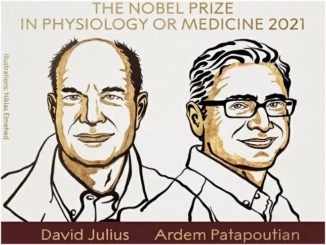
Nobel Prize in Physiology or Medicine 2021 jointly awarded to David Julius and Ardem Patapoutian
The Nobel Prize in Physiology or Medicine 2021 was jointly awarded to David Julius and Ardem Patapoutian for their discoveries of receptors for temperature and touch.
Speaking on the occasion, the Nobel jury said, “The groundbreaking discoveries…by this year’s Nobel Prize laureates have allowed us to understand how heat, cold and mechanical force can initiate the nerve impulses that allow us to perceive and adapt to the world around us.”
David Julius utilized capsaicin, a pungent compound from chilli peppers that induces a burning sensation to identify a sensor in the nerve endings of the skin that responds to heat.
Ardem Patapoutian used pressure-sensitive cells to discover a novel class of sensors that respond to mechanical stimuli in the skin and internal organs. Both the Nobel laureates have identified the missing links to help us understand the complex interplay between our senses and the environment. Their discoveries are being used to develop treatments for a wide range of diseases such as chronic pain.
-

Pune: Queen of Deccan
Sitting atop the Deccan Plateau with the Mutha River flowing alongside is the popular city Pune. This is the second largest city in Maharashtra. Also known as the “Queen of Deccan”, this hilly city has a royal history of being home to the Rahstrakuta Dynasty taken over and ruled by the mighty Chhatrapati Shivaji. Besides the boom in Industrial and IT zones within the city, the last few decades have seen a rapid growth in the sector of tourism in Pune. Boasting of being the second city after Hyderabad to offer “high quality of living” and attracts travellers for its historic monuments, culture, traditions, mouth watering street food and natural beauty offered by small hill tops, gardens and parks. Above all, for Mumbai-based individuals trapped in the daily schedule of work life, Pune, barely four hours away offers the best sought after place to visit. A general holiday guide to Pune suggest the same with special mention of the famous Sawai Gandharva Sangeet Mahotsav, that is an Indian classical music festival staged during the month of December every year. Ardent classical music enthusiasts can plan a trip during this season to enjoy a blend of the modern life and its century’s old musical heritage. Being home to the prestigious Pune University, considered as the “Oxford of the East”, Pune is the ideal higher education destination of many students. Short vacations or admission months bring about family to some of Pune’s popular tourist places such as the Chaturshringi temple of Goddess Ambareshwari, Ambedkar museum, Parvati temple, Rajiv Gandhi Zoological Park,
Dagaduseth Halwai Ganpati temple, rock carved Pataleshwar temple, Aga khan palace where Mahatma Gandhi was kept under house arrest and the famous Shaniwar wada built during the time of Bajirao Peshwa.
The outskirts of Pune also have several sightseeing places such as the Shinde chatri memorial and the Empress garden with beautiful floral diversity. To seek out mental refreshment some of Pune’s tourist attractions include the commercial theatre, Osho International Meditation resort of Koregaon Park, and forts exhibiting awe inspiring Maratha architecture. Pune trip is incomplete without pampering one’s taste buds with the Maharashtrian delicacies such as Puran Poli, Misal Pav and Mastani milkshake among many others. This place is easily the most favoured travel destination in Maharashtra, which if visited for a long stay allows weekend shuttle trip to twin cities Lonavala and Khandala, Mahabaleshwar, Nashik, Matheran, Shirdi and world heritage sites Ajanta and Ellora caves.
A good travelling guide makes the entire journey memorable and fun filled. To discover the 6th century old civilization of Pune within its “smart” city life, one can join the Pune tour with Tour My India. With various packages you can actually enjoy a world class vacation that gifts unmatched expeditions and breathtaking sights to capture.
Osho Ashram
There are many things for which Pune is globally renowned but it’s the Osho Ashram that is synonymous with the city’s image. A heady mix of spiritualism, and ancient, and modern idea of relaxation, the brains behind this unique organization was the late guru Bhagwan Shree Rajneesh or OSHO. Even after his demise in 1990, his well-appointed ashram continues to attract devotees from America and Europe. Located at the Koregaon Park of the North Pune, the Ashram offers many meditation programs that bring infinite intelligence, and joy.
Mainly a center of meditation, thus the biggest facility here is a soundproof auditorium, where different kinds of meditation keep on happening using various techniques. For all those, who are looking forward to a stay in the Ashram can book their stay at the OSHO International Meditation Resort. With plush interiors, reflecting the meditation qualities of the Gautam Buddha, the resort has tastefully decorated guest houses with ventilated AC rooms with attached bathrooms. The spiritual retreat also has a swimming pool, Jacuzzi, Gym, Large indoor saunas, Tennis Courts, and Table Tennis table. Evening parties are quite prominent in the resort.
Pu La Deshpande Garden
Amidst the hustle-bustle of the city life stands the tranquil Pu La Deshpande Garden. Inspired by the renowned 300-year-old Okayama Korakuen Garden of Japan, Pu La Deshpande Garden is developed by Ikeda royal family in the 12 spacious hectares. The garden is named after Purushottam Laxman Deshpande, a Marathi writer who is also a Padma Bhushan awardee. Beautiful yet prestigious – Pu La Deshpande Garden is spread over 10 hectares with tiled passages flanked by the luscious grasses thronged with migratory birds. Walking on the lawn is strictly not allowed as it destroys the grass. With a variety of colorful flowers and other plants and water bodies, the garden showcases nature at its best.
Rajiv Gandhi Zoological Park
Commonly known as the Katraj Snake Park, Rajiv Gandhi Zoological Park is prominent zoo cum snake park in Pune. Spread over 130 acres, it is divided into three parts – an animal orphanage, a snake park, and a zoo; also there’s a lake. In the snake park, one can see over 22 species of snakes and 10 other species of reptiles comprising over 150 individuals, including a King Cobra. In this section of the park, one can visit the library too that tells about all the vital information related to snakes. So as to engage more tourism, the park keeps on organizing festivals and snake awareness programs. The zoo in the complex features animals like leopard, sloth bears, sambars, barking deer, black bucks, monkeys, and elephants.
Parvati Hill
Pune regions Parvati Hill is a prominent hill lock with a good number of historical vestiges and temples at an altitude of 2100 feet. Devdeveshwar temple (Shiva and Parvati), Kartikeya Temple, Vishnu Temple, Vitthal Temple, and Rama Temple are some of the famous temples that can be seen on the hilltop. It is said that all these temples were built during by the Peshwas. View of the Pune city from the top of the hill is mesmerizing.
-

Durga Puja
Durga Puja, also known as Durgotsava, or Sharodotsava, is an annual Hindu festival originating in the Indian subcontinent which reveres and pays homage to the Hindu goddess, Durga.
It is particularly popular and traditionally celebrated in the Indian states of Bihar, West Bengal, Assam, Odisha, Tripura, and the country of Bangladesh. The festival is observed in the Indian calendar month of Ashwin, which corresponds to September-October in the Gregorian calendar, and is a ten-day festival, of which the last five are of significance.
The dates of Durga Puja 2021
– Shashti – 11th October 2021
– Maha Saptami – 12th October 2021
– Maha Ashtami – 13th October 2021
– Maha Navami – 14th October 2021
– Viajaya Dashami – 15th October 2021
The puja is performed in homes and in public, the latter featuring a temporary stage and structural decorations (known as pandals). The festival is also marked by scripture recitations, performance arts, revelry, gift-giving, family visits, feasting, and public processions. Durga puja is an important festival in the Shaktism tradition of Hinduism.
As per Hindu scriptures, the festival marks the victory of goddess Durga in her battle against the shape-shifting asura, Mahishasura.[Thus, the festival epitomizes the victory of good over evil, though it is also in part a harvest festival celebrating the goddess as the motherly power behind all of life and creation. Durga puja coincides with Navaratri and Dussehra celebrations observed by other traditions of Hinduism,in which the Ram Lila dance-drama is enacted, celebrating the victory of Rama against Ravana, and effigies of Ravana are burnt.
The primary goddess revered during Durga Puja is Durga but celebrations also include other major deities of Hinduism such as Lakshmi (the goddess of wealth and prosperity), Saraswati (the goddess of knowledge and music), Ganesha (the god of good beginnings), and Kartikeya (the god of war). In Bengali and Odia traditions, these deities are considered to be Durga’s children and Durga puja is believed to commemorate Durga’s visit to her natal home with her beloved children. The festival is preceded by Mahalaya, which is believed to mark the start of Durga’s journey to her natal home. Primary celebrations begin on the sixth day (Shasthi), on which the goddess is welcome with rituals. The festival ends on the tenth day (Vijaya Dashami) when devotees embark on a procession carrying the worshipped clay sculpture-idols to a river, or other water body, and immerse them, symbolic of her return to the divine cosmos and her marital home with Shiva in Kailash. Regional and community variations in celebration of the festival and rituals observed exist.
Durga puja is an old tradition of Hinduism, though its exact origins are unclear. Surviving manuscripts from the 14th-century provide guidelines for Durga puja, while historical records suggest that the royalty and wealthy families were sponsoring major Durga puja festivities since at least the 16th-century.The prominence of Durga Puja increased during the British Raj in the provinces of Bengal, Odisha and Assam.
In today’s time, the importance of Durga puja is as much as a social and cultural festival as a religious one, wherever it is observed.
Over the years, Durga Puja has become an inseparable part of Indian culture with innumerable people celebrating this festival in their own unique way while pertaining to tradition.
Rituals and practices
Durga puja is a ten-day event, of which the last five days involve certain rituals and practices. The festival begins with Mahalaya, a day on which Hindus perform tarpa?a by offering water and food to their dead ancestors. The day also marks the advent of Durga from her mythological marital home in Kailash. The next significant day of the festival is the sixth day (Sashthi), on which devotees welcomes the goddess and festive celebrations are inaugurated. On the seventh day (Saptami), eighth (Ashtami) and ninth (Navami) days, the goddess along with Lakshmi, Saraswati, Ganesha, and Kartikeya are revered and these days mark the main days of worship with recitation of scriptures, puja, legends of Durga in Devi Mahatmya, social visits to elaborately decorated and illuminated pandals (temporary structures meant for hosting the puja), among others.
Durga puja is, in part, a post-monsoon harvest festival observed on the same days in the Shaktism tradition of Hinduism as those in its other traditions. The practice of including a bundle of nine different plants, called navapatrika, as a symbolism of Durga, is a testament practice to its agricultural importance. The typically selected plants include not only representative important crops, but also non-crops. This probably signifies the Hindu belief that the goddess is “not merely the power inherent in the growth of crops but the power inherent in all vegetation”. The festival is a social and public event in the eastern and northeastern states of India, where it dominates religious and socio-cultural life, with temporary pandals built at community squares, roadside shrines, and temples. The festival is also observed by some Shakta Hindus as a private home-based festival. The festival starts at twilight with prayers to Saraswati. She is believed to be another aspect of goddess Durga, and who is the external and internal activity of all existence, in everything and everywhere. This is typically also the day on which the eyes of the deities on the representative clay sculpture-idols are painted, bringing them to a lifelike appearance. The day also marks prayers to Ganesha and visit to pandals temples.[
Day two to five mark the remembrance of the goddess and her manifestations, such as Kumari (goddess of fertility), Mai (mother), Ajima (grandmother), Lakshmi (goddess of wealth) and in some regions as the Saptamatrikas (seven mothers) or Navadurga (nine aspects of Durga). On the sixth day major festivities and social celebrations start. The first nine days overlap with Navaratri festivities in other traditions of Hinduism. The puja rituals involve mantras (words manifesting spiritual transformation), shlokas (holy verses), chants and arati, and offerings. These also include Vedic chants and recitations of the Devi Mahatmya text in Sanskrit.The shlokas and mantras praise the divinity of the goddess; according to the shlokas Durga is omnipresent as the embodiment of power, nourishment, memory, forbearance, faith, forgiveness, intellect, wealth, emotions, desires, beauty, satisfaction, righteousness, fulfillment and peace. The specific practices vary by region.
-

Asian shares rise as Chinese markets return from break
HONG KONG (TIP): Asian shares rose on Friday, October 8, as Chinese shares returned from a one week holiday upbeat, tracking a global rally, while investors also eyed key U.S. jobs data for any fresh insight into the timing of Federal Reserve tapering.
MSCI’s broadest index of Asia-Pacific shares outside Japan rose 0.5%, after rallying 2.1% the day before, its biggest daily gain since August. Japan’s Nikkei index advanced 1.8%.
Chinese blue chips gained 0.56% as they resumed trading after being closed for the National Day holiday, while Hong Kong , which has been open all week, gained 1%.
Elsewhere, Australian shares rose 0.84%, helped by mining stocks amid surging commodities prices.
Over the past three months, Chinese shares have been battered by regulatory changes, turmoil in the property sector, and more recently a power crunch, but some investors are now starting to see a buying opportunity.
“The debate on China is shifting a bit away from being very negative. People are asking ‘Is there a way beyond the regulatory uncertainty? How much of this is reflected in prices?’,” said Herald van der Linde, Asia Pacific head of equity strategy at HSBC.
“We’re neutral, we tell people not to be too negative because valuations are low.”
The focus remains on the property market as investors wait to see whether regulators take action to contain the contagion from cash-strapped China Evergrande Group’s debt problems.
U.S. futures rose 0.16% after the U.S. Senate approved legislation to temporarily raise the federal government’s $28.4 trillion debt limit and avoid the risk of a historic default later this month.
Overnight, on Wall Street, the Dow Jones Industrial Average gained 0.98%, the S&P 500 rose 0.83% and the Nasdaq Composite moved up 1.05%.
Investors are also keeping an eye on U.S. employment data for September due later on Friday. They expect employment figures that are near consensus will lead the Federal Reserve to indicate at its November meeting when it will begin tapering its massive stimulus program.
U.S. Treasury yields rose ahead of those figures, with volatility at the shortest end of the curve easing as the plan to avoid a default on government debt emerged.
In Asian hours, the benchmark 10-year U.S. Treasury yield rose 1.6 basis points to 1.58887%, its highest since June when it touched 1.594%.
In currency markets, the dollar index, which measures the greenback against a basket of its peers, was little changed at 94.206, not too far from a 12-month high of 94.504 hit in late September, as traders awaited the jobs data.
CBA analysts said it was possible the jobs data could surprise investors by being lower than expected, but “we think it would take a larger miss than we are anticipating to stop the [Federal Reserve] from announcing a taper in November.”
“A strong payrolls print can support USD because it will signal an imminent … taper.” Source: Reuters
-

Fitch cuts India’s growth forecast from 10% to 8.7%
New Delhi (TIP): Fitch Ratings has cut India’s economic growth forecast to 8.7% for the current fiscal but raised GDP growth projection for FY23 to 10%, saying the second Covid wave delayed rather than derail the economic recovery.
In its APAC Sovereign Credit Overview, Fitch Ratings said India’s ‘BBB-/Negative’ sovereign rating “balances a still-strong medium-term growth outlook and external resilience from solid foreign- reserve buffers, against high public debt, a weak financial sector and some lagging structural factors”.
The ‘Negative’ outlook, it said, reflects uncertainty over the debt trajectory following the sharp deterioration in India’s public finances due to the pandemic shock.
Fitch said it has further lowered India’s GDP forecast for the fiscal year ending March 2022 (FY22) to 8.7% from 10% in June as a result of the severe second virus wave.
It had in June cut the growth forecast from 12.8%. The projections for 2021-22 fiscal compares to a contraction of 7.3% recorded in the last financial year and a 4% growth in 2019-20.
“In our view, however, the impact of the second wave was to delay rather than derail India’s economic recovery, reflected in an upward revision of our FY23 (April 2022-March 2023) GDP forecast to 10% from 8.5% in June,” it said.
High-frequency indicators point to a strong rebound in the second quarter of the current fiscal (April 2021-March 2022), as business activity has again returned to pre-pandemic levels.
Fitch, however, saw a wider fiscal deficit. “We forecast a 7.2% of GDP (excluding disinvestment) Central government deficit in FY22,” it said. The government on June 28 announced a fiscal package worth about 2.7% of GDP. Much of this consists of loan guarantees, with only 0.6% of GDP in higher on Budget spending. Source: PTI
-

Tata Motors in talks to buy Ford’s Gujarat, Tamil Nadu units
Tata Motors is in early talks with Ford to buy the latter’s units in Tamil Nadu and Gujarat, according to a report in TOI. If the transaction materialises, it will be Tata Motors’ second asset purchase from the US major.
In March 2008, the Indian company bought Jaguar Land Rover from Ford for $2.3 billion.
For Tata Motors, which is changing gears to eco-friendly vehicles, the addition of Ford’s manufacturing facilities in TN and Gujarat will augment its capabilities in the automotive industry. Tata Motors currently has three passenger vehicle-making plants in the country (one is a joint venture with Fiat Chrysler).
-

Reliance Retail to launch 7-Eleven stores in India
Adding to its burgeoning retail empire, billionaire Mukesh Ambani’s Reliance Retail will bring 7-Eleven convenience stores to India, days after Future Retail ended its deal with the US chain.
The first 7-Eleven store will open in Mumbai on October 9 and will be followed by a further “rapid rollout”, Reliance Retail said in a statement, without providing financial details. 7-Eleven will add to the expansion spree of Reliance, which already has around 13,000 stores across the country. “The 7-Eleven stores aim to provide shoppers with a unique style of convenience, offering a range of beverages, snacks and delicacies specifically curated to appeal to local tastes, along with a refill of daily essentials, having affordability and hygiene at its very core,” said RRVL.
-

GOPIO-CT HOSTS NEW STUDENTS FROM INDIA ENROLLED AT UCONN BUSINESS SCHOOL
STAMFORD, CT (TIP): Global Organization of People of Indian Origin Connecticut Chapter (GOPIO-CT) organized a program of welcoming new students from India at the Univ. of Connecticut, School of Business from its Stamford and Hartford campuses with a networking dinner on Friday, Sept. 24th at the Hampton Inn and Suites in Stamford. While it was networking event for the students and the Indian American community, it also served as an interactive session with a high-profile panel of Indian American Corporate Achievers and entrepreneurs.
The program started with a welcome by GOPIO-CT President Ashok Nichani who told the students to consider GOPIO-CT as their big family and that they could seek help from the chapter. GOPIO International Chairman and GOPIO-CT Trustee Dr. Thomas Abraham moderated the interactive panel session.
The panelists included Anand Chavan, founder and CEO, GuardX, Inc. (New York, NY); Ramya Subramanian, Co-Founder and COO of Docty Inc. (Stamford, CT); Pradeep Govil, Program Manager, ASML (Wilton, CT); Sunita Menon, Global Data Advisor & Adjunct Prof. at U. of Florida and formerly with IBM Data-Driven Business (Stamford, CT); Prasad Chintalapudi, Vice President, Panzer Solutions (Norwalk, CT); Siddharth (Sid) Jain, President, AAAUM (OM)/Co-Founder, HVB 88 Angels LLC (Pelham, NY) and Prof. Rajasekhar Vangapaty, Registrar, Fashion Institute of Technology (FIT), SUNY (New York, NY).
Extending a warm welcome to the new students, most of them joining only in early September, Dr. Abraham said, “America is the greatest country which provides opportunity to open up your mind and you can be whatever you want to become, whether a professional in a large corporation, or help to manage a hedge fund or as a scientist or professor or as an entrepreneur, so, go and grab the opportunities awaiting you.” Dr. Abrahm also added that although, he is a nanotechnologist, his passion was building community institutions since he came in 1973 as a student at Columbia University.
Each of the panelists were asked to comment on two sets of questions on their journey to where they reached today and how earlier career choices lead them to where they are now as well as their first “win” that made them confident and the biggest challenge to achieving that success. The panelists provided personal experience to their success. The panelists also provided guidance and inputs on educational preparation, necessary prior experience, what skills are the most important and transferable skills to acquire so as to market oneself to the American job market.
GuardX CEO Chavan, who had over 18 years of industry experience in multiple software development, technology leadership and as strategist role with Amaranth, UBS, Citi, Credit Suisse, JP Morgan and Bear Stearns, told the students on what skill set he would look for in hiring and the hot sectors which are hiring in the next few years.
Former IBM executive and global data advisor Sunita Menon said, “Be curious about finding the WHY! That brings the creativity, challenge and innovation into your work, no matter what field you are in. It will build new paths for you and also inspire others around you.”.
Docty Co-Founder Subramanian who was trained as an Electrical and Electronics Engineer, and started her remarkable journey as a businesswoman from home in 2008, when she founded her IT Solutions & Services company, Arka Informations advised the students to “Find YOUR strength and surround yourself with people with what you work on and be open to learning, Find YOUR passion so work does not seem like work and Find YOUR niche in whatever you choose.”
Semiconductor giant ASML’s project manager Pradeep Govil emphasized importance of skills needed to be successful in gaining fruitful employment & in life, specifically, employers looking for evidence of skills gained like problem solving, critical thinking, communication, presentation, innovation, listening ability, community involvement & outreach, and lifelong learning. He suggested to use Bragg Book like tool to show evidence of proficiency in skills learned through course work, project work, term papers, novel solutions to problems, participation in seminars, internships and presentations to gain acceptance to one’s ideas and proposals.
Panzer Solutions, an IT and recruiting company Vice President Prasad Chintalapudi said, “Being able to communicate effectively in is perhaps the most important of all life skills and as well managerial skill. It is what enables us to pass information to other people in spoken and writing and also listening skill will improve to understand what is said to us.”
AAAUM (OM) President Sid Jain said, “Enjoy the student life exploring the culture and camaraderie with those around you. One skill to perfect is communication in all forms: – verbal, non-verbal, written and reading.”
FIT Registrar Prof. Rajasekhar Vangapaty told the students that America is the land of opportunity, aim high! “Your education should not be limited to learning facts, rather you should train yourself to think unconventionally and to look at the world through an inquisitive and investigative lens pushing you out of your comfort zone!”
“Be hungry and committed to your goals. It is not your fault if you do not know the path to your goal, but it is your fault if you do not enquire and learn of the path to your goal,” Prof. Vangapaty added.
Sid Jain further added that since quotas for H1-B to Green Cards via EB-2 (Master’s Degree) | EB-3 ( Bachelor’s Degree) are not expected to advance within the current administration, Masters Students should contemplate getting their advanced Degrees such as Ph. D and get published in reputed journals to get a chance to getting qualified as EB-1 category and faster track to Green Card then EB-2 or EB-3 as of date.
All the students at the event were introduced and some of them asked questions to the panelists. “It was a highly successful program with a larger participation of the students this year,” said Dr. Abraham.
The event was sponsored by Foreseer.AI, an AI enabled platform for information extraction from unstructured data which was built by GuardX.
Over the last 15 years, GOPIO-CT, a chapter of GOPIO International has become an active and dynamic organization hosting interactive sessions with policy makers and academicians, community events, youth mentoring and networking workshops, and working with other area organizations to help create a better future. GOPIO-CT – Global Organization of People of Indian Origin – serves as a non-partisan, secular, civic and community service organization – promoting awareness of Indian culture, customs and contributions of PIOs through community programs, forums, events and youth activities. It seeks to strengthen partnerships and create an ongoing dialogue with local communities.
-

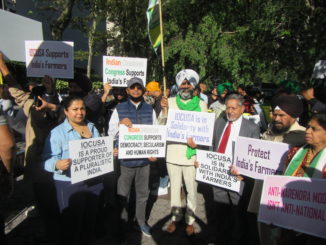
Indian Overseas Congress USA stages protest against Modi policies at the United Nations
NEW YORK (TIP): The Indian Overseas Congress, USA, an advocacy organization that promotes democracy, human rights, and equal justice together with its supporters and friends, held a protest rally in front of the United Nations on Saturday, September 25, 2021, as Prime Minister Narendra Modi was delivering his address to the General Assembly.
“Although we have no issues with a Prime Minister of India visiting the U.S. or the U.N. and promoting better bi-lateral relations or promoting world peace, it is imperative to let him know at the same time that we do not approve of his misgovernance in dealing with COVID epidemic or undermining the democratic institutions,” said George Abraham, Vice-Chairman of the IOCUSA. “If there is to be genuine economic progress and social development in India, political tranquility and social harmony is a pre-requisite without which there would be very little hope for the future. Let us, at the minimum, raise our voices, no matter how feeble it may be, because one day our next generation might ask where you have been when India took a turn towards authoritarianism and fascism,” Abraham added.
“I am glad to state that IOCUSA stands firmly behind India’s farmers who have been denied their rightful voice and concerns to be heard by the Modi government which has pushed a set of bills through the parliament for the benefit of the crony capitalists and to the detriment of our farmers” Mr. Mohinder Singh Gilzian, President of the IOCUSA said. “We want Modi to know that the NRI voice will continue to be raised in support of their protest unless and until he resolves these issues,” Mr. Gilzian added.
The protesters carried slogans and chanted examples to point out the failures of the Modi government, e.g., “Anti-Narendra Modi isn’t anti-national,” “We are all Indians. Stop discrimination based on religion, caste and language”, “Protect India’s constitution”, “IOCUSA supports democracy, freedom, and human rights”,” IOCUSA supports India’s farmers”, “IOCUSA -proud supporter of pluralistic India” and so forth.
Mr. Mohinder Singh Gilzian, President of the IOCUSA, Mr. Harbachen Singh, Secretary-General, Mr. George Abraham, Vice-Chairman, Mr. John Thomas, Ms. Sophia Sharma, General Secretary, Vice-President, Ms. Leela Maret, President, Kerala Chapter, Mr. Amar Singh Gulshan and President, Haryana Chapter were among those who took part in the protest.
-

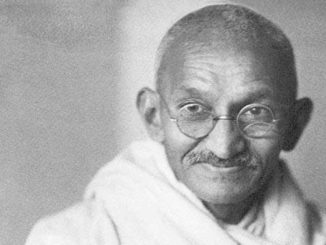
Mahatma Gandhi and the Indian Freedom Movement
Remembering the Father of the Indian Nation on his 152nd birthday anniversary
“It has been my experience, living and working with Gandhiji that what he achieved by his Satyagraha appeared at the time to be small but the rest was subsequently accomplished through the combination of various circumstances. It is also true that if the first small step had not been taken by Gandhiji the other forces that brought about the final result might have remained dormant for a long time”. – Acharya Kriplani

Billions of Indians identified themselves with the scantily covered Mahatma Gandhi The British Empire’s most talented and Powerful pro-consul in India, Lord Curzon has said, “India is the pivot of our British empire. If the Empire loses any other part of its, we can survive, but if we lose India, the sun of our Empire will set.” Even Churchill said, “the loss of India would mark and consummate the downfall of the British empire from such a catastrophe there should be no recovery.” One can understand how difficult it was to secure Independence from dominion of Britishers.
Gandhi’s advent and Rise:
1919 was a twilight year in the history of Indo-British relations. The harsh Rowlett act met with Universal opposition in the Imperial legislative council and outside. Gandhi was challenged with such a situation. There was the Jallianwala Bag massacre. An armed rebellion was out of question in a country forcibly disarmed and deliberately emasculated for about a century. Gandhi changed this situation into an opportunity.
The unique weapon
- The strategy of Satyagraha i.e., non-violent direct action was preferred by Gandhi.
- This strategy of Satygraha is no oriental mystic doctrine baffling the oriental mind but a hardheaded mass pressure technique to ensure social, political and economic change. Satyagraha demands public spirit, self-sacrifice, organization, endurance and discipline for its successful operation.
Three pillars of Satyagraha
- Sat implies openness, honesty and fairness.
- Ahimsa- non –injury is refusal to inflict injury to others. Ahimsa is an expression of our concern that our own and other’s humanity be manifested and respected; and we must learn to genuinely love our opponents in order to practice Ahimsa.
- Tapasya – willingness for self-sacrifice:
A Satyagrahi (one who practices Satyagraha) must be willing to shoulder any sacrifice which is occasioned by the struggle which they have initiated, rather than pushing such sacrifice or suffering onto their opponent. The goal is to discover a wider vista of truth and justice, not to achieve victory over the opponent.
NON-COOPERATION- 1920-22
The weapon of Non-cooperation was designed and developed in order to further the inter-related aims of inculcating Satyagraha among as many Indian social groups as possible. The reaction of the British to this unusual non-violent struggle was best summed up by the then Governor of Bombay, George Llyod: “Gandhi gave us a scare. Gandhi’s was the most colossal experiment in world history, and it came within an inch of succeeding. “The first experiment with non-violent direct action on a national scale suffered an abortive end. Although it failed to obtain its immediate objective, it was immensely successful in awakening India to the consciousness of her own potential power. Moreover, the experience gathered during the non-cooperation movement paved the way for India’s next great movement of 1930.
CIVIL DISOBEDIENCE MOVEMENT – 1930-1934
The radical youth groups and the labor organizations were not convinced of the compelling power of non-violent direct action. However, the ideology of Satyagraha aroused widespread academic interest and discussion. The conspicuous success of the Bardoli Satyagraha of 1928 had already infused new hope in the people and revived a general confidence in Gandhi’s method. The absence of any Indian representative on the Simon commission drew the Liberal and the Moderate elements to the Congress fold. It clearly appeared that the nation was again full of all energy and enthusiasm.
Gandhi decided to initiate Civil Disobedience movement by a dramatic breach of the salt law. This was a law which affected all and for many years, Gandhi had considered taxation on one of the vital needs like salt to be an immoral law. The incidence of tax was a symbol of human oppression and through this little gesture Gandhi transcended the limitation of human condition.
After a full year of struggle, the Government gave in and began negotiations with the Congress high command. Gandhi and the members of the working committee of the Congress were released and Gandhi was invited to Delhi.
For the first time in history on March 5, 1931, the representative of His Majesty signed a treaty with Gandhi. The main demands of the people were granted in the treaty, thereafter, known as the “Gandhi-Irwin Pact act” and the stage was set for further negotiations with a view to evolving of Free India.
But then he found his pact with Irwin violated by the Government. He also discovered that the bureaucracy was in a belligerent mood and did not mean to carry out the terms of the Pact. Thereupon Gandhi was forced to revive Satyagraha.
THE QUIT INDIA MOVEMENT
The Second World War was real life and death struggle for the British people. In the year 1940-41 they made their last heroic stand as a world power. Gandhi’s revulsion from the great slaughter and desire for the universal peace and his hostility to the raj further soured his relations with the British rulers.
Then Gandhi initiated the Individual Civil Disobedience movement, which was undertaken for the vindication of Freedom of Speech. Individuals carefully chosen by Gandhi himself were instructed to move from place to place on foot, explain to the people the implications of the formula. Sir Stafford Cripps with an offer of political settlement met the political leaders. The terms were however found unacceptable by all parties with the result that Cripps returned to England, disappointed. Soon after this event, Gandhi received a cable from England, in reply to which he gave expression, for the first time, to the demand for British withdrawal as an immediate necessity.

Gandhi was a charismatic leader who was loved and respected. A sea of humanity poured in to catch a glimpse of him and listen to his words. The city of Bombay, after experiencing an unusual wave of jubilation and fighting fervor, lay in the quiet of the exhausted in the early hours of August 9, 1942. On the previous day, Gandhi had electrified the masses attending the momentous August 8th meeting of the AICC by unequivocally demanding that the British should Quit India. His slogan was “Do or Die”. Gandhi however, cautioned his followers that it would be weeks before a civil disobedience could be launched.
Although more than 60,000 people were arrested, 18,000 kept in prison while 940 were shot dead and about 1630 injured by firing, the people’s violence was limited to objects which were considered to belong to Government, and it did not extend any further. There might have been defeat, but the people’s forces had succeeded in recovering and preserving their morale and this was no small gain. “The British Empire is a Satanic System and I have dedicated my life to destroy it” Gandhiji declared.
CONCLUSION
To conclude in the memorable words of Acharya Kriplani, the lifelong colleague of Gandhi, as a fitting tribute to the efficacy of Gandhi’s unique weapon of Satyagraha: “It has been my experience, living and working with Gandhiji that what he achieved by his Satyagraha appeared at the time to be small but the rest was subsequently accomplished through the combination of various circumstances. It is also true that if the first small step had not been taken by Gandhiji the other forces that brought about the final result might have remained dormant for a long time.”
(Compiled by Rajendar Dichpally and his colleagues. Mr. Dichpally is a General Secretary of Indian Overseas Congress USA. He can be reached at dichpally@aol.com)
-
Will Pakistan’s nuclear stockpile be the region’s Achilles heel?
“Some non-nuclear States have historically opposed the resolution in response to India testing nuclear weapons and becoming a nuclear-armed State in 1998. India can and needs to do more to get countries to reconsider their opposition, especially in light of Taliban’s takeover of Afghanistan that has already led to rise in India-Pakistan tensions.
“While there are enough pundits predicting that Taliban and Pakistan will make for the most volatile bedfellows, there is no denying that the region’s power dynamics have been dramatically and drastically altered. A change that has taken everyone by surprise only goes to show that nothing can be ruled out. So, speaking of Pakistan’s nuclear stockpile falling in the hands of Taliban is not as far-fetched as one would imagine.”
By Priyanka Khanna
The predictable India-Pakistan rhetoric during the United Nations General Assembly (UNGA) in New York and accusations flying right and left at the ongoing 48th session of the Human Rights Council (UNHRC) in Geneva are shadowing the simmering worry as to what will happen to Pakistan’s growing nuclear arsenal.

Indian Prime Minister Narendra Modi has repeatedly raised doubts about Pakistan’s intentions
(Photograph / Jay Mandal- on assignment)
Pakistan Prime Minister Imran Khan is unmoved (Photograph / Jay Mandal- on assignment) The 140-150 nuclear warheads that are currently stockpiled in Pakistan’s central storage facilities in its southern parts remain outside both the Treaty on the Non-Proliferation of nuclear weapons (NPT) and the Comprehensive Nuclear Test Ban Treaty (CTBT).
With the Afghanistan takeover by Taliban and given their bon homie with Pakistan, especially its intelligence, it is singularly worrying that Pakistan is the sole country that is blocking negotiations of the Fissile Material Cut-Off Treaty (FMCT).
While there are enough pundits predicting that Taliban and Pakistan will make for the most volatile bedfellows, there is no denying that the region’s power dynamics have been dramatically and drastically altered. A change that has taken everyone by surprise only goes to show that nothing can be ruled out. So, speaking of Pakistan’s nuclear stockpile falling in the hands of Taliban is not as far-fetched as one would imagine.

The UN is not doing enough to push Pakistan to undertake disarmament. (Photograph / Jay Mandal- on assignment) Which brings us to the question of why the UN is not doing enough to push Pakistan to undertake disarmament. In fact, according to the advocacy group – Unfold Zero – the UNGA was not even able to come together on nuclear disarmament resolutions. In the last nuclear disarmament UN meeting, nuclear risk-reduction was perhaps the only measure countries could come together for.
A resolution reducing nuclear danger submitted by India received 127 votes in favor (mostly non-aligned countries). It failed to get support of nuclear-armed or European countries, primarily because it only calls for nuclear risk reduction measures by China, France, Russia, UK and USA – leaving out the other nuclear armed States – India, Pakistan, DPRK and Israel, according to unfoldzero.org.
A resolution on decreasing the operational readiness of nuclear weapons systems submitted by a group of non-nuclear countries, was much more successful receiving 173 votes in favor, including from most of the NATO countries and from four nuclear armed States (China, DPRK, India, Pakistan).
A resolution on the Treaty on the Prohibition nuclear weapons (TPNW) was supported by 122 countries. This is more than the number who have signed the Treaty, which is 68 (with 19 of these countries having now ratified). The vote indicates that more signatures are likely. However, the resolution was not supported by any of the nuclear-armed countries, nor any of the countries under nuclear deterrence relationships, i.e., NATO, Australia, Japan, South Korea. The opposition of nuclear-armed and allied States to the resolution is another indication that they do not intend to join the new treaty. In general, this means that they will not be bound by the treaty’s obligations. However, the customary law against the use of nuclear weapons which is re-affirmed by the treaty will apply to all States regardless of whether or not they join.

India’s External Affairs Minister has voiced India’s concern about Pakistan’s stockpile of nuclear weapons to the world, including the Secretary General of the United Nations, António Guterres. (Photograph / Jay Mandal- on assignment) A resolution on the prohibition of the use of nuclear weapons submitted by India received 120 votes in favor, including from themselves and another three nuclear-armed States (China, DPRK and Pakistan). Some non-nuclear States have historically opposed the resolution in response to India testing nuclear weapons and becoming a nuclear-armed State in 1998. India can and needs to do more to get countries to reconsider their opposition, especially in light ofTaliban’s takeover of Afghanistan that has already led to rise in India-Pakistan tensions.
-

The Quad could end up running out of steam

By Happymon Jacob Coming on the eve of the first in-person Quadrilateral Security Dialogue (Quad) summit in Washington DC, the new Australia-U.K.-U.S. (AUKUS) trilateral security partnership appears to be sending a subtle message to the Quad: shape up or become irrelevant. The announcement of the AUKUS and the recent outcome of the Quad summit indicates that AUKUS will go on to form a key security arrangement of the Indo-Pacific region, thereby potentially forcing the Quad to recede to the background in a struggle for attention, political will, and resources. But before we get to the implications of AUKUS on the Quad, let us briefly examine how AUKUS is also useful to the Quad.
A reassurance to allies
Still reeling under intense international criticism in the way the United States withdrew its forces from Afghanistan resulting in a humanitarian disaster, AUKUS seeks to unambiguously signal U.S. President Joe Biden’s commitment to U.S. allies especially in the Indo-Pacific.
In some ways, AUKUS helps reassure its allies of the U.S.’s security commitments and underlines Washington’s pivot to the Indo-Pacific. Second, the deal and particularly the sharing of American nuclear submarine technology with Australia will help Canberra overcome past hesitations about taking on China with more conviction. Third, notwithstanding the point that AUKUS may set alarm bells ringing for the Quad, AUKUS is still a shot in the arm for the larger Indo-Pacific agenda of which India, the U.S., Japan, Australia, among others, are key partners. In other words, AUKUS will help the Quad’s declared aim of keeping the Indo-Pacific region free, open and inclusive thereby contributing to its core agenda.
No replacement, but…
AUKUS may not replace the Quad and yet it appears that AUKUS has ventured where the Quad has been reluctant to make forays into — the military domain. More so, AUKUS also exposes the inherent, also self-imposed, limits of the Quad, i.e., its inability and lack of desire to give itself any military role. The focus of the recently held Washington summit, on challenges ranging from COVID-19 to climate shows that the Quad is unlikely to take a security-dominated turn; that is precisely the vacuum AUKUS seeks to fill.
The larger question then is whether the Quad is losing its steam. For sure, the Quad seems to offer no clear purpose which, as a result, leads to too many items crowding the agenda. It neither has a secretariat or a charter, like the Shanghai Cooperation Organisation (SCO), nor a clear set of activities such as AUKUS. The ever-growing list of focal areas of the Quad will eventually make it a less than useful deliberative forum.
Put differently, with too many items on its agenda, the Quad faces the danger of becoming a talk shop with very little actual work. What is ironic is that all the Quad members have security/military considerations in mind vis-à-vis China while engaging the Quad platform, but no one seems to be keen on framing it in such a manner, as is evidenced by the summit’s joint statement (North Korea and Myanmar find mention in the statement though, not China). There is little interest in properly institutionalizing the Quad nor has the objective for ‘Quad Plus’ been purposefully pursued. Let me put this somewhat differently: Indo-Pacific remains a grand strategic vision, AUKUS has the potential to become a major military/security arrangement in the Indo-Pacific, and the Quad/Quad Plus could end up becoming a talk shop within the Indo-Pacific.
New Delhi’s hesitations
New Delhi has taken the stand that “there is no link between the AUKUS and the Quad” just as it had argued earlier that there is no link between the Malabar naval exercises and the Quad even though the Quad membership is replicated in the Malabar exercises and two-thirds of the AUKUS form 50% of the Quad.
Technically, New Delhi’s stand is accurate — just because there is a striking similarity in the membership of these forums, they are not the same institutional architecture. And yet, if one were to go beyond such technicalities, it is evident that these groupings share a larger vision about the Indo-Pacific, i.e., addressing the challenge from China, and the desire for an open and free Indo-Pacific. Be it AUKUS, which enables Australia to stand up to Chinese bullying or provides the United Kingdom — its aircraft carrier, HMS Queen Elizabeth, the flagship of the U.K.’s Carrier Strike Group, is in the region — with a more prominent, and desirable, role in the Indo-Pacific or the annual Malabar exercises which focus on the Indo-Pacific or the Quad, their common geopolitical theatre is the Indo-Pacific. So, while they are not technically related to each other, there is a broader reality that unites them all. There is no point in refusing to accept that self-evident reality.
There is also little doubt today that the Indo-Pacific is of great importance to India for a number of reasons. For one, given the continental challenges it faces including from the new developments in Afghanistan, New Delhi would do well to shift some attention to the maritime sphere. Second, at a time when India is continentally pressed against a rock and a hard place, an opportunity has presented itself for India — in the form of growing global interest in the Indo-Pacific — to be at the center of a new geopolitical churning which it must make use of for its own security and prosperity. Third, it is also a major way of bringing together like-minded states to check Chinese hegemony in the region.
Given this context, if AUKUS potentially overshadows the enthusiasm around the Quad, it would be disadvantageous to India’s interests in the Indo-Pacific region. Other Quad counties are either on the AUKUS or are alliance partners; India is neither. Eventually, therefore, the Quad faces the potential challenge of becoming a talking shop without an actionable mandate. More so, bereft of any defense arrangement, the material returns from the Quad over time would also be minimal.
Indo-Pacific engagement
This situation is made worse by India’s hesitation about joining major regional economic frameworks. India, for instance, is neither a member of the Regional Comprehensive Economic Partnership nor can its trade relations with the Indo-Pacific countries rival those of China. So, given our rather weak economic influence and performance in the Indo-Pacific region, what might help the country is being part of a security arrangement which can take care of its regional defense/security concerns. Even before AUKUS, India’s current engagement of the Indo-Pacific was neither capable of contributing to its national security nor promoting its economic influence in the region. And now, AUKUS may have further shrunk the potential space available for the Quad, and India, to play a serious role in the region’s security architecture.
Sources of India’s hesitations
Even though it is not just New Delhi which is hesitant about the Quad venturing into the security/military domain, India has been hesitant about the Quad moving beyond the non-military issues. So, what are the sources of New Delhi’s hesitation regarding a robust role for the Quad in the security/military domain? One could advance two hypotheses in this regard. One, India’s traditional reluctance about military alliances and the desire to maintain strategic autonomy. New Delhi fears that militarizing the Quad could undo this jealously guarded tradition. It is, however, possible to explore military utility for the Quad without making it a formal military alliance. More so, exploring mutually beneficial military and security cooperation within the Quad framework need not contradict the principles of strategic autonomy. The operative part of ‘strategic autonomy’ is autonomy, not strategic.
The second hypothesis has to do with domestic political considerations: The Narendra Modi government is keen to avoid any military overtones for the Quad due to potential Chinese reactions to it. Recall how India and Australia had for many years soft peddled the forum for fear of provoking China. Australia seems to have overcome its hesitation, but has India done so? For the Bharatiya Janata Party-led government, any heat on the Line of Actual Control with China in the run-up to crucial State elections next year and then the 2024 parliamentary election would be unwelcome. This seems, therefore, to be a case of domestic political considerations trumping the pursuit of strategic necessities.
(The author teaches at the Jawaharlal Nehru University, New Delhi and is the founder of the Council for Strategic and Defense Research)
-

Tunisia has the first woman Prime Minister
TUNIS (TIP): Tunisia’s President on Wednesday, September 29, named Raoudha Boudent Ramadhane as nation’s first woman Prime Minister, appointing her to lead a transitional government after her predecessor was sacked. President Kais Saied named Ramadhane, a 63-year-old professor at a prestigious engineering school, to the PM’s post in a surprise decision.
(Agencies)
-

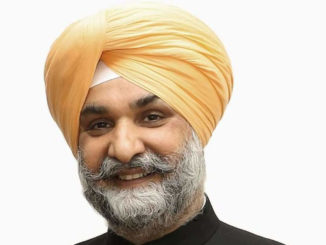
PM Modi had a very successful visit to US, says Ambassador Sandhu
Remarks by India’s Ambassador to the US, Taranjit Singh Sandhu, come at a dinner event hosted by Indiaspora
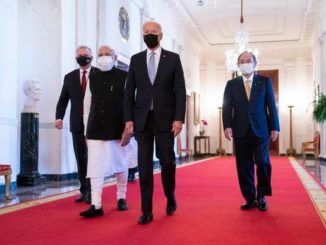
WASHINGTON, DC (TIP): Prime Minister Narendra Modi had a very successful visit to the US during which he held his maiden bilateral meeting with President Joe Biden and had a good candid and substantial exchange with like-minded Quad leaders at their first in-person summit, India’s envoy here has said.
Remarks by India’s Ambassador to the US, Taranjit Singh Sandhu, came at a dinner event hosted by Indiaspora on Wednesday, September 29. “We just had a very successful visit here,” Sandhu said. Eminent members of the Indian-American community had gathered for the first time in the national capital after the Covid pandemic hit the country. During the visit, there was an important bilateral meeting between President Biden and Prime Minister Modi, the first one since the Biden-Harris administration was inaugurated in January this year. The two leaders had earlier met in 2014 and 2016 when Biden was the vice president of the country. “So, it was not the first time they were meeting, but the bilateral meeting was very good,” Sandhu said in his first public appearance after last week’s visit of PM Modi.
The interaction with Vice President Kamala Harris went very well, he said. The Quad summit hosted by Biden at the White House and attended by Modi along with their counterparts from Japan and Australia “really went off very well”, he said.
“There was a good candid and substantial exchange between all the four leaders,” he said, adding that there are practical areas in which the corporation is moving quite ahead. “In fact, in vaccines, all the four countries are bringing their respective strengths together and we are on our way to producing one billion vaccines in 2022 which will be distributed over the Indo-Pacific particularly in Southeast Asia,” Sandhu said. During his stay in Washington DC, Prime Minister Modi had two other bilaterals with Prime Minister Scott Morrison from Australia and Prime Minister Yoshihide Suga of Japan.
During his trips, the US handed over 150 historic antiquities to India, which the prime minister took with him on his return to India. From Washington DC, the Prime Minister went to New York where he addressed the UN General Assembly.
Quickly running through some of the important areas during the trip in addition to the strategic ones, Sandhu said the prime minister had a good exchange on regional issues as well as other international challenges.
(Source: PTI)
-

New York State Takes Action to Address School Bus Driver Shortage
ALBANY, NY (TIP): New York officials are taking immediate steps to tackle a school bus driver shortage statewide. Governor Kathy Hochul announced a multi-agency plan this weekend to address the shortage: The plan includes steps to remove barriers and recruit people with traditional and non-traditional commercial driver’s licenses; expanding CDL testing opportunities and expediting processes designed to get more drivers into school buses, she said.
New York State is launching outreach to more than 550,000 CDL license holders, she said.
According to NY1.com, the shortages were sparked by the pandemic; many drivers who are older left their positions over COVID-19 fears; districts are now facing shortages of 15 to 20 percent. The post added that many did not know until recently that a state mandate to vaccinate or test school employees would include school bus drivers. The shortages have forced schools who have routes uncovered to seek alternatives, including asking parents to pick up their kids, the NY1 report said.
Steps for the long term include changes in regard to the training and licensing of drivers, as well as broader recruitment efforts, Hochul said. “Our schools and public health officials have moved mountains to ensure our children receive an in-person education this year, and we are leaving no stone unturned to make sure schools have adequate bus service to bring students to school and back,” Hochul said.
The shortage of school bus drivers is not unique to New York State, but the goal is to use “creative approaches” to get bus drivers into place as soon as possible, she said.
Creative approaches to recruitment include signing and retention bonuses, expansion of benefits to the drivers, and other options to recruit drivers in a nationally competitive market, Hochul said; schools can use federal funds to provide the benefits.
Interested drivers will be surveyed and their information then shared with local school districts seeking drivers; the schools will work through lists to recruit interested drivers in their areas, Hochul said.
The state will also target currently unemployed drivers through the Department of Labor and work with law enforcement, firefighters, military, and other organizations that have trained drivers in order to find more school bus drivers, Hochul said.
The New York State Department of Motor Vehicles is also removing the 14-day waiting period between the permit test and the road tests; through cooperation with county-run DMVs the state will also help to increase capacity to administer written exams and road tests. New York State is also opening new CDL driver testing sites by partnering with the State University of New York, the Thruway Authority, the New York Racing Association, and the Office of General Services to use large lots on their various sites for the road test. For school staff who currently hold a CDL, the state will set up expedited testing to obtain a permit to drive vans and buses temporarily, Hochul said.
Other plans include exploring alternative licensing entities and expanded partnerships with other state agencies, Hochul said.
Many school districts receive a significant percentage of those funds in reimbursement from the state and can therefore offer more competitive pay without absorbing the full cost at the local level, she said.
-

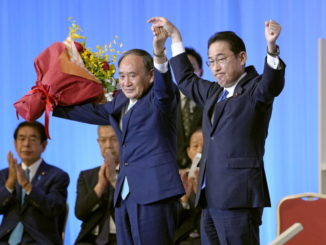
Fumio Kishida wins vote to become Japan PM
“I felt our democracy is in a crisis. I am determined to make an effort towards making a more open LDP and creating a bright future for Japan” – Fumio Kishida
TOKYO (TIP): Former Japanese Foreign Minister Fumio Kishida won the governing party’s leadership election on Wednesday and is set to become the next Prime Minister, facing the tasks of reviving a pandemic-hit economy and ensuring a strong alliance with Washington to counter growing regional security risks. Kishida replaces outgoing party leader PM Yoshihide Suga, who is stepping down after serving only one year. As new leader of the Liberal Democratic Party, Kishida is certain to be elected the next PM on Monday, October 4, in Parliament, where his party and its coalition partner control both Houses. In his victory speech, Kishida vowed to tackle “national crises”, including Covid-19, the pandemic-battered economy and the declining population and birthrate. He said he would pursue “important issues related to Japan’s future”.
(Agencies)
-

All eyes are on West Bengal by-polls
Mamata Banerjee is contesting from Bhabanipur, one of the three constituencies which go to poll
KOLKATA (TIP): Polling for the three assembly constituencies of West Bengal began at 7 am on Thursday, September 30. West Bengal Chief Minister Mamata Banerjee is contesting from the Bhabanipur seat. Besides Bhabanipur, the by-polls are being held in Jangipur and Samserganj seats in Murshidabad district. A total of 6,97,164 voters are eligible to exercise their franchise in the three constituencies.
Votes will be counted on October 3.
Banerjee, who lost from the Nandigram constituency in the Assembly election earlier this year, has to win this by-poll to retain the chief minister’s post. Polls had to be countermanded in Jangipur and Samserganj in April following the death of two candidates. As part of its elaborate security arrangements, the Election Commission has deployed 72 companies of central forces in the three constituencies, of which 35 are stationed in Bhabanipur alone, the officials said. Prohibitory orders under Section 144 of the CrPC have been imposed within 200 meters of the polling centers. Long queues were seen since early morning outside several booths across the constituencies. Voting will continue till 6 pm. The polling centers have been stocked up with masks and sanitizers as part of the Covid guidelines, the officials said. Banerjee, who is also the Trinamool Congress supremo, is pitted against BJP’s Priyanka Tibrewal and CPI(M)’s Srijib Biswas in Bhabanipur.
(Source: PTI)
-

The White House & Quad
Amid global realignments, India should secure its interests
The strategic reverberations of Narendra Modi’s September 24 double bill in Washington will be felt for long — a meeting with US President Joe Biden, followed by the first in-person Quad Summit where they were joined by the PMs of Australia and Japan. For starters, China was carefully omitted from the joint statements of both meetings. All opening statements by the President and the PMs suggested that the Quad had relegated the security aspect from its exertions. It was even felt that AUKUS, a security trilateral between the UK and two Quad partners, Australia and the US, had overtaken Quad by being more proactive in digging the trenches for a future battle with a new adversary.
However, the simultaneous presence of the Quad spy chiefs in Washington, and Quad’s commencement of joint work in emerging technology indicates China was the elephant in the room. The growing proximity of common purpose may help India access the currencies of tomorrow such as military drones, 6G, semiconductors and specialized solar panels. It was almost a decade back that South Block had ruled out Russia as an across-the-board partner in frontier areas. But it is also noteworthy that even during the UNGA address Biden did not name China. Biden also broke a long-running China-US stalemate by facilitating the release of Huawei executive Meng Wanzhou, and Beijing reciprocated by freeing two Canadians.
The challenge before India is to lean on the West to attain global standards in technological and military fields. Yet it must avoid being used as a proxy diplomatic weapon, for there is the risk of being left in the lurch if America’s priorities change. The Biden bilateral and the Quad Summit have promised much in regional infrastructure and co-development in frontier areas. But on the ground, India is yet to recover the trade concessions rescinded by Trump and the PM’s expectation of a generous immigration quota was merely acknowledged by Biden. India also can ill-afford to close all communications with two of its neighbors. In these fast-changing global realignments, India should steadfastly secure its own interests.
(Tribune India)
-

Beautiful Bengal
West Bengal boasts of different ethnicities, cultures, religions, people and languages which add to its beautiful landscapes, forests, coastal beauty as well as its heritage.
The beautiful state of West Bengal attracts a significant number of tourists every year as the state is jewelled with mesmerising landscapes, snow-clad mountains, gushing sea, blossoming tea gardens, enormous deltas, lush green forests, plentiful wildlife, ancient temples and magnificent British monuments. The Tiger Hill, the Howrah Bridge, the Tea Gardens are some of the famous tourist spots which offer an insight into the vast culture and history of the West Bengal. The culture of the state is adorned by colourful fairs and festivals every month. A vast number of famous pilgrimages also attract a large number of tourists of all faiths and beliefs.
Places to Visit Kolkata
Kolkata, India’s second biggest city, is a perpetually ongoing festival of human existence, concurrently luxurious and squalid, refined and frantic, pointedly futuristic, while beautifully in decay. A vibrant 350-year-old metropolis located on India’s Eastern Coast, the capital of West Bengal thrives on contradictions and imposing spectacles; nothing is commonplace in this city. Famously known as the City of Joy, Kolkata is, in every sense, the artistic, cultural and intellectual capital of the country. Kolkata’s streets are vivid, hectic, chaotic, and yet, brimming with life and creativity. Driven by the indomitable spirit of the self-made middle class, the city has created a beautiful juxtaposition of the old colonial-era charm with the nascent upcoming hipster culture that thrives amongst the city’s millennial residents. Starting from admiring the flourishing art scene in the city to going on rewarding gastronomical explorations to wandering amidst the countless bazaars to sitting by the banks of the Hooghly and enjoying a peaceful sunset, Kolkata is soaked in layers and layers of heritage and culture, and peeling off each layer to look beneath the hood is a very rewarding, once-in-a-lifetime experience. As the famous quote goes, “If you want a city with a soul, come to Calcutta”.
Formerly the capital of the British empire before the government was shifted to Delhi, Kolkata has a distinct tinge of its royal past lingering in every nook and cranny of the city. If you want to soak in some of the city’s regal past, take a walk along the streets of North Kolkata, which houses some of the oldest mansions in the city, swathed with vines and a persistent sense of aristocratic pride. Kolkata is home to Rabindranath Tagore’s ancestral house, which has now been converted into a museum and houses a staggering collection of family portraits and paintings. There are plenty of ghats all over the city where you can sit and enjoy a sunset while sipping on tea, one of the most noted of these being the Prinsep Ghat, which offers stunning views of the Vidyasagar Setu in the backdrop. Close by is Millennium Park, which is a beautified waterfront park from where you can avail boat rides and cruises.
Kolkata has a very lively nightlife, and the entire stretch along Park Street houses innumerable bars and pubs where you can party the night away. Kolkata’s street food is famous all across the country, and the city is lined with eateries and food stalls at every corner, where you can savour local Bengali food, or try out local snacks such as Jhalmuri, or Ghugni Chaat.
Darjeeling
Jaw-dropping locales, mesmerising sunrises, the untouched beauty of the hills, the old-world charm of the past, and the welcoming smiles of the local people all add up to make Darjeeling one of the most beautiful hill stations in Eastern part of India. Spread over a steep mountain ridge, nestled amidst acres of lush green tea plantations, Darjeeling stands at the height of 2,050 meters above sea level, thus boasting of cool climes all year round. This scenic hill station is the perfect getaway for a romantic honeymoon and is just around 700 kilometres away from Kolkata.
A respite from the hot and humid summers of India, Darjeeling is a popular tourist destination in North-East India. Providing a heady mixture of splendid tea gardens on rolling mountain slopes, meandering toy train rides through the picturesque city, and delectable traditional Tibetan cuisine, Darjeeling works wonders to cater to the gorgeous panorama of the Himalayas.
There is a reason the city is known as the ‘Queen of the Himalayas’. The lush green slopes dotted with women plucking tea leaves is a sight as mesmerising as no other. There are over 86 tea estates in Darjeeling that are responsible for producing the worldwide famous ‘Darjeeling Tea’. Have a cup of locally brewed chai at the tea estate, or get down amidst the plantations to pluck a few tea leaves yourself, you are free to take your pick!
Sundarbans
Known for hosting the biggest mangrove forests in the world, Sundarbans National Park is located in West Bengal, India. It is also a Tiger Reserve and a Biosphere reserve that provides a complete nature’s circle to the tourist right from ‘Royal Bengal tigers’ to roaring rivers and beautiful estuaries. Sundarbans National Park is a part of Sundarban delta that is covered with Mangrove Forest and the largest population of the Bengal Tigers. It is a UNESCO world heritage site with a large variety of birds and reptiles including salt-water crocodile.
Shared between India and Bangladesh, the Sundarbans meaning beautiful forest, have been declared a UNESCO heritage site. This area has a silent charm that manages to amaze one with the simplicity and naturalness of its ecological balance in spite of offering habitat to some of the most dynamic and awe-inspiring flora and fauna. They are in fact the last remaining stands of the mighty jungles which once covered the Gangetic plain and the sustainability of this natural structure is pretty majestic. Since 1966, the Sundarbans have been a wildlife sanctuary, and it is estimated that there are over 400 Royal Bengal Tigers and about 30, 000 spotted deer in the area.
-

Pitru Paksha Shradh
The full moon time of Bhadrapada and the Pratipada of Krishna Paksha of Ashwin month from Amavasya is called Pitru Paksha. In the year 2021, Pitru Paksha will commence from 20th September 2021 (Monday) till 6th October 2021 (Wednesday). According to Brahmpurana, before worshiping the Gods, a man should worship his ancestors because it is believed that the Gods are pleased of that. For this reason, the elders are honored and posthumously worshiped in Indian society. These offerings are in the form of Shradh which is to be performed on the tithi (date) of death, falling in Pitrupaksha and if the tithi is not known, then Ashwin Amavasya can be worshiped which is also called All Sovereign Amavasya. On Shradh we remember our ancestors by doing tarpan and offer food and dakshina to Brahmins or needy people.
Shradh Dates
– 20th September 2021 (Monday) – Purnima Shradh
– 21st September 2021 (Tuesday) – Pratipada Shradh
– 22nd September 2021 (Wednesday) – Dwitiya Shradh or Dooj Shradh
– 23rd September 2021 (Thursday) – Tritiya Shradh
– 24th September 2021 (Friday) – Chaturthi Shradh and Maha Bharani Shradh
– 25th September 2021 (Saturday) – Panchami Shradh
– 27th September 2021 (Sunday) – Shashti Shradh
– 28th September 2021 (Tuesday) – Saptami Shradh
– 29th September 2021 (Wednesday) – Ashtami Shradh
– 30th September 2021 (Thursday) – Navami Shradh
– 1st October 2021 (Friday) – Dashmi Shradh
– 2nd October 2021 (Saturday) – Ekadashi Shradh
– 3rd October 2021 (Sunday) – Dwadashi Shradh or Magha Shradh
– 4th October 2021 (Monday) – Trayodashi Shradh
– 5th October 2021 (Tuesday) – Chaturdashi Shradh
– 6th October 2021 (Wednesday) – Sarva Pitru Amavasya or Amavasya Shradh
As per the Hindu beliefs, these 15-16 days mark the presence of ancestors on the earth who come down to bless their offsprings and their children. Hindus offer foods to dogs, cows and crows as part of the ritual. It is believed that the food given to these animals and birds is fed to deceased ancestors.
The eldest member of the family, particularly the eldest son, begins the ritual by wearing clean clothes and a ring made of kush grass after a holy bath. Kush is a symbol of kindness and is used to invoke ancestors.
After that, a wooden table covered with a white cloth is kept in the south direction. Black sesame seeds and barley seeds are spread on the table and a picture of the ancestor is placed on it.
Devotees then invite their ancestors and offer ‘Pind’ in the form of rice balls which are usually made with ghee, honey, rice, goat’s milk, sugar and occasionally barley.
Pind is followed by ‘Tarpan’ where water mixed with flour, barley, kush and black sesame and offered. Once the Pind and Tarpan are done, the poor and needy people are offered food.
SIGNIFICANCE
As per Hindu Puranas, it is believed that Hindus owe a karmic debt to their ancestors and they try to pay that by performing ‘Pind Daan’ during Shradh. It is said that Pind Daan performed by the succeeding generations on earth fulfil their ancestors’ unfulfilled desires and ensure their entry to heaven.
Mistakes You Should Avoid During Pitru Paksha
The followers of Hindu religion perform many rituals and practices for the peace of the soul of their ancestors. Hindus offer food and water (tarpan) during Pitru Paksha for the salvation of their ancestors. According to the Hindu calendar, it is a 16–day lunar period spanning over the months of Bhadrapada and Ashwin. This year, Pitru Paksha will be observed from September 20 to October 6. In this period, Hindus remember their ancestors and perform ‘rituals like -Tarpan’, ‘Pind Daan’ and ‘Shradh’.
It is believed that by observing Pitru Paksha, Hindus get the blessings of their ancestors to get success, happiness and prosperity.
Saveral holy books of Hinduism describe mistakes that must be avoided during Pitru Paksha. According to scriptures and religious texts, Hindus are expected to avoid the following things during Pitru Paksha:
– Vegetarian food should be consumed during Pitru Paksha. If you consume non-vegetarian food and alcohol during the 16-days lunar period, then it may upset the departed soul and you are likely to face trouble.
– The member of the household who performs ‘Shradh’ rituals in Pitru Paksha should not cut his hair and nails during the 16-day lunar period. He should also follow celibacy.
– Shradh should be performed before sunset. It is considered inauspicious to perform Shradh after sunset.
– If any animal or bird comes to your door during the Pitru Paksha, then you must give food to them. It is believed that ancestors come to meet you in the form of animals and birds. If possible, you should give food to cows and crows during this period.
– It is considered auspicious to eat on the leaf in Pitru Paksha and feed Brahmins on the leaf during this period.
– Any auspicious work like marriage, engagement should not be done during Pitru Paksha at all. You should also avoid buying any new things during this period.
-

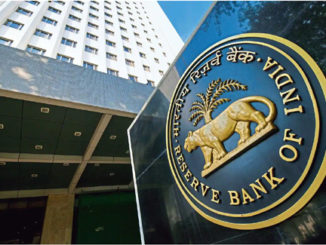
Banks can now sell fraud loans to ARCs
Mumbai (TIP): The Reserve Bank of India (RBI) on Friday, Sept 24, allowed banks to sell fraud loan exposures to asset reconstruction companies (ARCs). Banks will now be able to transfer to ARCs loan exposures classified as fraud as on the date of transfer, provided that the responsibilities of the bank with respect to continuous reporting, monitoring, filing of complaints with law enforcement agencies and proceedings related to such complaints shall also be transferred to the ARC. “The transfer of such loan exposures to an ARC, however, does not absolve the transferor from fixing the staff accountability as required under the extant instructions on frauds,” the RBI said in its master direction on transfer of loan exposures.
The guidelines said lenders must put in place a comprehensive board-approved policy for transfer and acquisition of all loan exposures. The board-approved policies of every lender on transfer or acquisition of stressed loans shall cover the norms and procedure for transfer, the valuation methodology to be followed, delegation of powers to various functionaries for taking decisions on the transfer of loans, stated objectives for acquiring stressed assets and the risk premium to be applied.
When negotiated on a bilateral basis, the negotiations must necessarily be followed by an auction through the Swiss challenge method if the aggregate exposure of lenders to the relevant borrower is Rs 100 crore or more. In all other cases, the bilateral negotiations shall be subject to the price discovery and value maximisation approaches adopted by the transferor as part of the board-approved policy, the RBI said.
-

Sensex scripts history, crosses 60,000 mark for first time; Nifty nears 18,000
Mumbai (TIP): The BSE Sensex made history on Friday, Sept 24, by reaching the 60,000 mark for the first time ever as investors continued to accumulate banking, finance and auto stocks despite lacklustre global cues and concerns over frothy valuations.
The 30-share benchmark rose 163.11 points or 0.27 per cent to its lifetime closing high of 60,048.47. Intra-day, it touched an all-time peak of 60,333.
Similarly, the NSE Nifty advanced 30.25 points or 0.17 per cent to close at a record 17,853.20. It soared to a lifetime high of 17,947.65 during the day.
It took a little over 31 years for the Sensex to traverse from 1,000 points to the historic 60,000 level.
The benchmark index was at 1,000 points back on July 25, 1990 and took nearly 25 years before it touched the 30,000 level on March 4, 2015. The Sensex has climbed from the 30,000 level to 60,000 in a little over six years, reflecting the overall bullishness in the market.
The last 10,000 points have come at a record pace, with the Sensex reaching the 50,000-level only in January this year.
“Sensex reaching 60,000 today is an indicator of India’s growth potential, as well as the way India is emerging as a world leader during COVID period in addition to worldwide monetary expansion and relaxed fiscal policies adopted by world powers,” said Ashishkumar Chauhan, MD and CEO, BSE.
Asian Paints was the top gainer in the Sensex pack on Friday, spurting 3.72 per cent, followed by M&M, HCL Tech, HDFC Bank, Bharti Airtel, Maruti and Infosys.
On the other hand, Tata Steel, SBI, Axis Bank, ITC, HUL, NTPC and Bajaj Finance were among the laggards, shedding up to 3.60 per cent.
“Market valuations are high but on the flip side the underlying economic growth is favourable. We would suggest not to be under-invested in equity.
“One can rebalance portfolios and revert to long term strategic allocation to large caps by exiting laggards and trimming the tail in mid and small caps, many of which may be overvalued right now,” said Nimish Shah, Chief Investment Officer – Listed Investments, Waterfield Advisors.
Sectorally, BSE telecom, realty, teck, IT and auto indices rallied up to 2.77 per cent, while metal, healthcare, basic materials and FMCG fell as much as 2.31 per cent.
Broader BSE midcap and smallcap indices underperformed the benchmarks, shedding up to 1.16 per cent. During the week, the Sensex rallied 1,032.58 points or 1.74 per cent, while the Nifty surged 268.05 points or 1.52 per cent.
“Even at 60k our advice for investors is to buy in select stocks (strong companies in terms of managing and growing companies) with a medium to long term view.
“Most of the time in the market it is proved that the level of the index is just a number and the actual market index is very different from the numbers. However, the buying is advisable in tranches/parts, do not lock your entire funds at current levels,” said Shrikant Chouhan, Head of Equity Research (Retail), Kotak Securities.
Global markets were on a weak footing on Friday on concerns over China Evergrande group after the real estate giant missed bond interest payments.
In Asia, bourses in Shanghai, Seoul and Hong Kong ended with losses, while Tokyo was positive.
Equities in Europe were also trading on a negative note in mid-session deals.
Meanwhile, international oil benchmark Brent crude rose 0.23 per cent to USD 77.43 per barrel.
The Indian rupee slipped 4 paise to close at 73.68 against the US dollar on Friday, following weaker Asian peers against the American currency.
Foreign institutional investors were net buyers in the capital market on Thursday as they purchased shares worth Rs 357.93 crore, as per exchange data. Source: PTI