Tag: Apple News

  • Long Island Indo-American Lions Club Gala a big draw

    LONG ISLAND, NY (TIP): Long Island Indo-American Lions Club hosted its 1St Annual Gala on August 29th at Leonard’sPalazzo, Great Neck, Long Island. It was a full house.

    The Program began with greetings & warm welcome by The Gala Chairs Gobind Bathija &ehra. They introduced the Emcees of the evening Event Chair-Anju Sharma and Program Coordinator Poojaa Makhajani. The Event was dedicated to Covid victims and Front-Line Heroes. A moment of silence was observed in the memory of victims and also Front-line workers were applauded for their commendable services.

    A beautiful prayer dance was presented by Khushi Oza, seeking God’s blessing for the wellness of all. As per Lions club protocol Pledge of Allegiance was said by Pradeep Tandon, Lion Club’s prayer was offered by Rita Shah and Toast was given by Sanju Sharma followed by Toast to the Queen by Krishna Maddipatla.

    President Indu Gajwani was introduced by Anju Sharma who highlighted her lifetime achievements,her dedication, services and leadership as club president. Indu Gajwani also welcomed all. She spoke about the club achievements, projects/events organized for community which included Food Drive, Clothes drive, Fight against blindness, Eyesight testing, Donation of Eyeglasses, Health Fair etc. The club also made contributions for Cancer Care, Kids toys and to many other organizations. As a whole the club has done a tremendous amount of work in a short period of time despite of no ‘in person’ activities during Pandemic.

    Among many honorable guests the event was graced by Lions Club Dignitaries, District governor- Paula UmreikoImmediate past district governor-Terri Oster, 1st VDG- Rupal Sehgal, PCC-Andy Umreiko, PDG-T.J. Anand, PDG-Anthony Paradiso, PDG-NJ-Nancy Jakubezyk & Harish Mehta.  President Indu Gajwani recognized her team. The members of the executive committee and chairs were honored for their dedication, hard work and support.  Raja Singh who represented Senator Thomas Kevin, were presented to the executive members. The Sponsors whose contribution helped in hosting this event and carry out various projects throughout the year were recognizedand honored by distinguish guests. We are Grateful to Dr. Purna Chandra Atluri, Nand Punjwani, Bobby Patel, Kanak Golia, Barathi Reddy, Thulasi Reddy, Naveen Shah, Dr. Jay Sarkar, Meena & Anil Shah, Gobind Bathija, Vijay Patel, Anupam Yadav, Dr. Kalpesh Amin for their generous contribution.  A moment of silencewas also observed in memory and honor of AfghanistanMartyrs led by Dr. Raj Bhayani and Mukesh Modi.  Nimesh Shah- Club secretary gave Vote of Thanks. He thanked the guests for gracing the Gala, Sponsors for their generous contribution, media for the coverage and fellow lions for their dedication and support.

    Raffle draw was a fun time. It was handled by Anju Sharma, Poojaa Makhajani and Sanju Sharma. The raffle prizes were donated by our club members. The Raffle team is grateful to Krishna Maddipatla, Kanak Golia, Saurabh Seth, Govind Oza, Indu Gajwani, Anju& Sanju Sharma, Nimesh Shah, Vijay Shah and Pradeep Gosalia for their generosity.A special Note of Thanks to Vandana Kumar & Yogini Oza for handling the sale of Raffle tickets. The winning tickets were drawn in public and winners were handed over prizes.Thanks to Sanju Sharma and Hement Chrisitian for the videos and pictures display during the event. Our appreciation and Thanks toReception team-Rita Shah, Shila Shah, Sital Shah for a fabulous job.  Thanks to Poojaa Makhajani, Anju Sharma, Sanju Sharma, Indu Gajwani, Vandana Kumar, Vijay Shah, Pradeep Gosalia, Saurabh Seth, Nimesh Shah for help in decoration and organizing Plaques/Awards.A big note of Thanks to Shyam Gajwani-backbone of the whole program. There areno words to express his dedication, contribution and hard work for the club.

    (Press Release issued by Indu Gajwani)

  • UCL T20 Night Tournament Final Cricket match: Anjuman defeat Deccan Heroes

    UCL T20 Night Tournament Final Cricket match: Anjuman defeat Deccan Heroes

    Anjuman Captain, Ayaz Patel receiving winning trophy

    CHICAGO (TIP): United Cricket League and Entertainment held its Night Tournament Closing Ceremony was on August 23, 2021 at Skokie Sports Park, 3459 Oakton St, Skokie, IL. 12 teams that participated are Anjuman, Chicago Indians, Cougars, Mavericks, American Eagles, Deccan Heroes, Deepark, Rogers Park, Gujju boys, Hawks, Kimball 11, and Maharishi CC.

    The two teams that played in the final are Anjuman and Deccan Heroes. Anjuman won the toss and the Captain, Ayaz Patel decided to bat first. Deccan Heroes captain Jibran led the team very well. Anjuman scored 206 runs and Deccan Heroes scored 115 runs. Anjuman won the final. Man of the Match was Ayaz Patel, and Man of the Series was Gul Khan.

    The chief Guests included Masood Chik, former cricketer of Pakistan, Pramod Shah: Skokie Village Clerk,Jim McCarthy: Skokie Caucus Party Chairman, Susan Aberman: Skokie Park Board President, Mike Reid: Skokie Park Board Vice President. Mike Shah: Skokie Planning Commissioner, Robert DeLeonardis: Sports park supervisor, Syed Mustaq Hussain: main advisor, and Syed Sikander: advisor. Other guests were Mohammed Afroz, Mohammed Anwar, Faheem Shehzad, Abdul Faheem, Mohammed Rafi, Sidiq Khan, Mohammed Yunus, Mukhram Mehmood, Ayaz Patel, Sufuyian Dukanwala, Syed Ehsan, and everyone who attended.

    The empires were Syed Shabbir, and Hanif Lala. UCL&E would like to thank their sponsors which includes Pepsi, PPG, Devon Discount Pharmacy, Sabri Nahari, NP Jewelers, Free Covid Care, AV Stone, Patel Brothers, Air Tour, Shalimar Banquet Hall, Little Ceaser Pizza, Noble Services, Lyca Mobile, and Okay Auto Repair.

    (Photographs and Press release / Asian Media USA)

  • US committed to safe passage for last 100-200 Americans left in Afghanistan: Biden

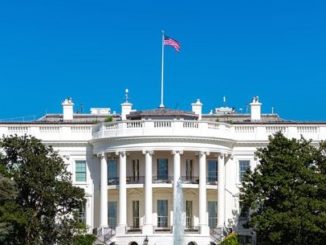
    WASHINGTON (TIP): The White House on Tuesday, August 31, said 98% of Americans who wanted to leave Afghanistan were able to do so, and President Joe Biden affirmed that the United States remained committed to helping the remaining 100 to 200 US citizens who had some intention to leave.

    Speaking at the White House, Biden told reporters that most of those people were dual citizens and longtime residents, who had earlier decided to stay in the country given their family roots in Afghanistan.

    “For those remaining Americans there is no deadline. We remain committed to get them out if they want to come out,” Biden said. In his remarks, he noted that 90% of Americans who were in Afghanistan and wanted to leave were able to leave. The White House later updated a transcript of his remarks to show that the correct figure was 98%.

    He told US Secretary of State Antony Blinken was leading continued diplomatic efforts to ensure safe passage for any American, Afghan partner or foreign national who wanted to leave Afghanistan after the August 15 takeover by the Islamist Taliban. Biden said the international community would hold Taliban leaders accountable for their promise to permit freedom of travel.

    “The Taliban has made public commitments, broadcast on television and radio across Afghanistan, on safe passage for anyone wanting to leave, including those who worked alongside Americans,” he said. “We don’t take them by their word alone, but by their actions, and we have leverage to make sure those commitments are met.”

    Biden said the US government had reached out 19 times to Americans in Afghanistan since March, offering to help them leave the country.

    After the US military-led evacuations began 17 days ago, US officials reached out again and identified around 5,000 Americans who had decided earlier to stay, but now wanted to leave, he said.

    In the end, the President said, more than 5,500 Americans were evacuated, along with thousands of citizens and diplomats from allied countries, as well as 2,500 locally employed staff at the US embassy and their families, and thousands of Afghan translators and interpreters and others who supported the United States.

  • Subversion of truth

    Subversion of truth

    Central agencies and police being misused to redraw political equations

    By Julio Ribeiro

    “The spectacle of leaders being arraigned for crimes when they are in the Opposition and getting let off when they cross over is making a mockery of the rule of law. Truth, which is, and should be, indivisible, simply does not matter. Police officers told to catch criminals now need a total revamp of what they are taught during their training. They have to simply know the political colorations of the accused to decide whether they are guilty or innocent. The truth is not relevant. The problem arises when the chameleon changes color once too often. Rewriting papers is not easy. It is a crime in itself. Only the culprits now will be the law-keepers.”

    Last week the police in Maharashtra was tasked with arresting a union minister, who was once the chief minister of the state. The Police Superintendent of Ratnagiri district was embarrassed to perform the task. A video released by the Opposition shows him arguing with Anil Parab, the state Transport Minister and a confidant of CM Uddhav Thackeray, pleading for a warrant for the arrest. The ongoing tussle between the BJP government at the Centre and the MVA government in Maharashtra is taking a predestined turn. The ED opened an inquiry against Parab soon after he was heard ‘ordering’ the Superintendent to arrest Narayan Rane. This tit-for-tat scenario will persist as long as the MVA government lasts.

    The Central investigation agencies and the Maharashtra Police will be roped in to settle political scores and redraw political equations. Is this what they are paid and trained to do? People should ask pointed questions and insist on answers. Unleashing the CBI, the NIA and the ED on its political opponents at opportune times has become standard practice today. This trend has become particularly prominent since the past two years. Last week, Kripa Shankar Singh, a former minister in the Congress regime in Maharashtra, and the Congress face in Mumbai’s northern suburbs where North Indians live, joined the BJP. Kripa Shankar had several Central agency inquiries pending against him. It is commonly known that he will be absolved of his sins now and the MVA, which includes the Congress, may ferret out commissions and omissions that it had failed to notice when he adorned its ranks.

    The spectacle of leaders being arraigned for crimes when they are in the Opposition and getting let off when they cross over is making a mockery of the rule of law. Truth, which is, and should be, indivisible, simply does not matter. Police officers told to catch criminals now need a total revamp of what they are taught during their training. They have to simply know the political colorations of the accused to decide whether they are guilty or innocent. The truth is not relevant. The problem arises when the chameleon changes color once too often. Rewriting papers is not easy. It is a crime in itself. Only the culprits now will be the law-keepers.

    Remember what the CBI did to the case against Suvendu Adhikari and the four other TMC ministers/legislators who were caught on camera accepting small-time bribes? Adhikari was accused of accepting Rs 5 lakh, his associates Rs 1 lakh each. But the CBI put up a charge sheet only against those who took Rs 1 lakh and left out Adhikari because he had joined the BJP. In West Bengal, the CBI and the state police have been searching for two different sets of culprits for the same offence. We will soon be saddled with policemen who know not the meaning of the word ‘truth’! The Delhi Police have approached the investigation of the Delhi riots with that mindset.

    Many years ago, when I was a DCP and the eastern suburbs of Mumbai City were in my charge, there was a street gang called the Harya-Narya gang in the limits of Chembur Police Station. The gang was named after its two leaders, Hanmantrao and Narayan. It was only after I had retired from service and returned to the city that a retired junior official who had worked at Chembur Police Station during my DCP days phoned to tell me that ‘Narya’ of the Harya-Narya gang had become the chief minister of Maharashtra!

    Rane, who has survived in politics by changing parties every few years, is now in the BJP. After a patient wait, he finally got his opening. Modi made him a cabinet minister in charge of micro, small and medium enterprises. And it was only when he attained this exalted position that he was finally taken into custody by the police of his parent state. Till then, as it now appears, he did not merit such attention.

    The present charge against him though is a trivial one from the public’s viewpoint, and mine. From the current CM’s viewpoint, it is very serious! And the CM’s viewpoint is shared by his cronies in the Shiv Sena party, particularly the transport minister. For Narayan Rane had pointed out that Uddhav Thackeray had committed a gaffe, an unpardonable one, in his August 15 speech to the people of the state, where he referred to the 75th anniversary of Independence (Amrut) as the 60th (Hirak). Quickly realizing his mistake, the CM turned to whisper to his aide standing behind him. Rane, during his ongoing Jan Ashirvad yatra that every newly inducted NDA Minister was tasked to perform in his own constituency, referred to the gaffe and said if he was the aide or if he was present at the spot he would have administered Uddhav a tight slap.

    The CM, who was conducting his office very well till then, apparently felt the sting of the verbal slap. Why he blundered on this occasion is beyond comprehension. He had much to lose by losing his cool. Rane, on the other hand, was attempting to make a comeback after years in the wilderness. The BJP’s principal opponent in the state, the Shiv Sena, originally its partner and friend, has given it a break that it may not have anticipated. If the events are closely examined, the BJP’s top brass will realize that Rane’s street-fighting credentials have given them an unexpected, albeit significant, victory in what can only be called a street skirmish.

    Rane has suddenly come into reckoning as a person of interest. His yatra would have passed off unnoticed. But with Rane accused of something as banal as a virtual slap, it was unwise of Uddhav and his cronies to order the police to arrest Rane, thereby anointing him with an importance that he had not savored for long.

    The BJP, with its control over agencies like the CBI, ED, NIA and NCB, routinely released them on the state in politically sensitive cases like the Sushant Singh Rajput suicide and the explosive-laden SUV outside the Ambani residence in an all-out bid to topple the MVA in Maharashtra. Success has evaded it till now. Rane’s arrest may give it a much-needed break.

    But in the race for power the competing politicians are destroying the very sanctity of truth on the basis of which alone justice has to be delivered.

    (The author is a celebrated retired Indian Police Service Officer)

  • AAPI Launches Adopt-A-Village – A Rural Health Initiative in India

    AAPI Launches Adopt-A-Village – A Rural Health Initiative in India

    Ambassador Taranjit Singh Sandhu & Consul Generals from all 5 Consulates in US applaud AAPI’s Efforts

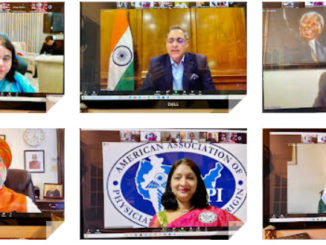
    CHICAGO (TIP): Continuing with its magnificent efforts to help their motherland, members of American Associati9on of Physicians of Indian Origin (AAPI), the premier medical organization in the United States initiated Adopt-A-Village, a Rural Health Initiative in India during a virtual launch event on Friday, August 27, 2021. Chaired by, Dr. Satheesh Kathula, the much needed and popular program has Dr. Anupama Gotimukula, Dr. Jagan Ailinani and Dr. Ram Singh as members of the Committee. In a rare show of support for AAPI, Consul Generals of Chicago, New York, Houston, Atlanta and the Deputy CG of San Francisco participated live during the launch of this noble initiative. Ambassador of India to US, Taranjit Singh Sandhu joined the meeting with his message and lauded the numerous efforts of AAPI for India, especially during the pandemic.

    Dr. Anupama Gotimukula, President, AAPI, in her welcome address, referred to the objectives of Adopt-A-Village. “A lot of efforts are being put into this initiative, “Adopt a Village” Project where AAPI in collaboration with Global TeleClinics, Inc., plans to adopt 75 villages in honor of 75 years of India’s independence,” she said.  “As India celebrates her 75th anniversary Independence Day celebrations, AAPI has planned to adopt 75 villages in India spread across the states of Andhra Pradesh, Gujarat, Karnataka, Tamil Nadu and Telangana, where the rural people of India will be offered ‘Free Health Screenings in 75 Rural Villages’ for Anemia (CBC), DM (HbA1C), High Cholesterol, CKD, Malnutrition, Kidney Disease, Malnutrition, Obesity, and Hypoxemia.  Results analyzed by GTC and further action recommended by their team of experts will be also, followed up. This is a small contribution from AAPI to Mother India in celebration of Azadi Ka  Amrut Mahotsav.” Dr. Anupama thanked the AAPI members for their generous support for this noble work of AAPI and for sponsoring their ancestral villages and going back to their roots.

    In his opening remarks, Dr. Satheesh Kathula, Chairman of AAPI’s Adopt A Village Program pointed out about the need for this noble initiative. He said, India has nearly 700,000 villages. Three out of four Indians and about 77 percent of the poor live in villages. The majority of the population has no access to safe drinking water and sanitation. The needs in these rural areas are unlimited and the scope to work are endless. “By adopting one village at a time and working with the government and NGOs, NRIs can make a difference,” he said. Dr. Kathula referred to some of the programs in place in several rural villages, including supply of Cloth mask, clean drinking water and free health care screening that has benefitted thousands of people Across India.

    Dr. Ravi Kolli, President-Elect of AAPI, said, “While India has made substantial progress in health care as evidenced by the fact that life expectancy in India at birth now is 71 years as opposed to 58 years in 1990 and 41 years in 1960, there are significant gaps and divergence in health metrics in different regions in India. India, thus needs to redouble and continue its efforts and dedicate resources to tackle these perennial challenges. The post graduate training of physicians specializing in Family Medicine in every teaching institution will create a motivated and well-trained family physicians to address these deficits and deliver accessible, affordable, economical and continuous preventive and primary care to rural as well urban poor populations to raise health outcomes substantially all across India,” he said.

    “An individual can make a tremendous difference in the lives of many in India by adopting a village,” said Dr. Jagan Ailinani, who was instrumental in founding this noble program and set an example by adopting his own birth village in the state of Telangana in India. “A majority of the NRI’s hail from villages and would like to do their part to bring progress to villages in our state and country.”

    Dr. Ram Singh said: “NRIs can adopt the village they hail from originally and make a significant contribution towards its development. There is a real will and desire on the part of governments, both at the state and the center to work with NRIs and NGOs to bring development to rural India.”

    Dr. Kusum Punjabi, Chair of AAPI BOT said, “Many of these projects and programs need regular funding, and management of resources. We are grateful to dozens of AAPI members who have committed to Adopting a village in India with an ongoing commitment for investment.”

    Ambassador Taranjit Singh, in his message to AAPI members, said, “As India is entering 75th year of independence, honoring men and women, who fought for the freedom, we rededicate ourselves to build an India where the dreams and aspirations of India’s 13 billion people are realized.” He urged the Diaspora community to come forward to honor INDIA by joining in the year-long celebrations.

    Dr. Jayesh Shah, past President of AAPI, introduced Consul General of India in Houston, Aseem Mahajan. In his address on “Indo-US Relationship In Healthcare -Rural Health Perspective” Ambassador Mahajan told the AAPI members: “You are true the heroes and partners with us, and you make us proud, especially during the critically vital Covid times.” Urging the Diaspora to contribute towards strengthening of India’s partnership with the US, Mr. Mahajan focused on India-US partnership on various health related issues, while stressing the many healthcare initiatives by the Government of India. “AAPI can play a big role in rural health, which has been a priority for the Government of India,” he said. He thanked and appreciated the many Doctors, who are already doing similar noble initiatives, helping the rural communities have access to clean drinking water. “We can work together, collaborating and sharing of knowledge and expertise, including Medical Education,” he told AAPI.

    Dr.  Suresh Reddy, past President of AAPI and currently an elected Trustee of Oakbrook Village in Illinois, after introducing the Consul General of India in Chicago, Amit Kumar, announced that he is adopting his native village in the state of Telengana. In his address, Mr. Kumar spoke about “Rural Health In India, The Current Situation,” and focused on technological areas in healthcare development in the rural parts of India. “Your activities and the message to spread awareness on Covid and for providing PPEs to India are highly appreciated,” he told AAPI members, pointing to the fact that India has vaccinated over 600 million people and he hoped that India will offer vaccines to majority of India’s vast population soon.

    Introduced by Dr. Sudhakar Jonnalagadda, immediate past President of India, Consul General of India in Atlanta Dr. Swati Kulkarni focused on “How AAPI and Doctors can Help India.” She said, “It’s important and laudable that you have undertaken to help India during the 75th anniversary of India’s Independence. Dr. Kulkarni shared her views on how AAPI and the government of India can collaborate in: Diplomacy for development, where “India needs overseas expertise, and you are best suited to offer,” she said, while calling upon Indian American Doctors to be part of India’s efforts to enhance the GDP. “India’s healthcare industry is growing rapidly there is more scope for growth with expanded pharma industry and medical tourism. She stressed the need for AAPI’s role in enhancing India-US political partnership, where AAPI is “a major stake holder,” she said.

    Dr. Mukesh Nigam introduced Consul General of India in New York, Randhir Jaiswal. In his address on “Rural Health in India: The Challenges and Solutions” Ambassador Jaiswal said, “This noble initiative by AAPI has become more meaningful especially during the 75th anniversary of India’s Independence.” Reminding AAPI members of Modi’s call to rebuild a new India, he said, “AAPI’s initiative is even more meaningful and fits well into PM’s vision for India.” He said, ‘We applaud and thank AAPI for coming forward to help India, especially during the covid pandemic.”

    Dr. Sujeeth Punnam, a renowned cardiologist introduced Deputy Consul General of India in San Francisco, Rajesh Naik. While speaking on “Rural Health, What India can learn from Developed Nations” Mr. Naik said, “AAPI has provided tremendous support as India and Indian community were struggling with the challenges of Covid. You rose to the occasion and came forward to help and support, which have been highly appreciated by the Diaspora.” During the 2nd Covid surge, AAPI stepped forward and have sent out Millions of Dollars of medical supplies to Indi, he said. While pointing to the many challenges of healthcare in rural India, Mr. Naik urged how AAPI could offer tele medical consultation in rural India, especially focusing on the preventive aspect of health in India.

    Dr. Anjana Samadder, Vice President of AAPI, said, “By adopting one village at a time and working with the government and NGOs, NRIs can make a huge difference in the lives of millions of people in India. Each project will involve a tripartite partnership between the NRI, state government and a local NGO.”

    Dr. Krishan Kumar, Treasurer of AAPI pointed out, “The cost for adopting a village depends on various factors, including the population of the villages, the services that are required and what one is willing to commit to for the welfare and progress of the village one is committing to adopt.”

    Dr. Lokesh Edara, chair for AAPI’s global initiative, while focusing on international medicine and how India is lagging behind in medical care, while urging the Government of India, pointed to how India needs to focus on Post Graduate Medical professionals rather than having Doctors with undergraduate degree alone.

    (Press Release issued by Ajay Ghosh)


  • India made its UNSC presidency count

    India made its UNSC presidency count

    Focused on maritime security, peacekeeping and counterterrorism during its presidency of the UN Security Council in August

    During the two years in the UNSC, the presidency gives an opportunity for focusing on critical issues beyond the regular work of the Security Council. Such special efforts draw attention to India’s role and interests. India has grasped the opportunity well and brought public visibility to issues of importance.

    “Undoubtedly, it was the pandemic-induced virtual mode that allowed the Prime Minister to participate in the session. It is unlikely that had the virtual opportunity not existed, the Prime Minister would have flown to New York to chair the session. It is significant that background diplomacy couched the presidential statement under “Maintenance of international peace and security”, which covered references to UNCLOS (United Nations Convention on the Law of the Sea) despite Chinese objections. The ASEAN countries, currently represented by Vietnam in the UNSC, must be grateful for keeping this reference as they deal with China over a code of conduct in the South China Sea. China is not fond of the UNCLOS. The USA has not ratified it yet.”

    By Gurjit Singh

    India held the month-long presidency of the United Nations Security Council (UNSC) during August. During the two-year term (2021-22), India will again have the opportunity to preside over the Security Council in December 2022. Three initiatives were taken during India’s presidency. These related to maritime security, UN peacekeeping and counterterrorism. This set agenda was effectively presented by India, as these are critical to the country’s current policies.

    Maritime security is a major issue, especially in the Indo-Pacific. The aggressive moves by China have led to the evolution of Indo-Pacific policies by several countries and the consolidation of the Quad. Keeping a rule-based order and preventing a hegemonistic role for China are critical for India’s continuing rise. For this end, maritime security was indeed a wise move to focus the attention of the UNSC.

    This was effectively communicated by the unique manner of having the Prime Minister himself chair the Security Council at that session. Never before has an Indian Prime Minister undertaken this role. It showed the seriousness with which India treated this at the UNSC, and the lead it intended to take. Thanks to the Prime Minister’s participation, leaders like Russian President Putin, President Kenyatta of Kenya, the PM of Vietnam and the US Secretary of State, French Foreign Minister and the UK Defense Secretary also participated. It gave ‘Enhancing maritime security’ a much higher profile than it would have acquired otherwise.

    Undoubtedly, it was the pandemic-induced virtual mode that allowed the Prime Minister to participate in the session. It is unlikely that had the virtual opportunity not existed, the Prime Minister would have flown to New York to chair the session. It is significant that background diplomacy couched the presidential statement under “Maintenance of international peace and security”, which covered references to UNCLOS (United Nations Convention on the Law of the Sea) despite Chinese objections. The ASEAN countries, currently represented by Vietnam in the UNSC, must be grateful for keeping this reference as they deal with China over a code of conduct in the South China Sea. China is not fond of the UNCLOS. The USA has not ratified it yet.

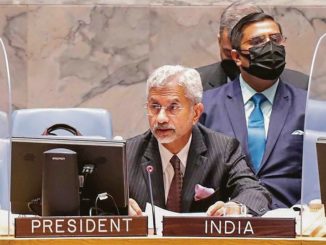
    A second initiative related to peacekeeping. India’s credentials for a larger role in the world, and a permanent seat in the UNSC were initially buttressed by its superb role in peacekeeping since its inception. For many years, India was the leading troop-contributing country, and remains an important one. Now, India has been a member of the Peacebuilding Commission from its inception in 2005. The session to discuss peacekeeping operations (PKO) was chaired by the External Affairs Minister (EAM) S Jaishankar, who specially flew to New York for this purpose.

    Prior to this, India announced a contribution of $1 million for supporting the African Union Mission in Somalia (AMISOM). Many recall that in the 1990s, India was a major contributor to the UN Mission in Somalia. India contributed $150,000 to the Peacebuilding Fund (PBF) this year, bringing the total to about $6 million since its inception.

    India’s initiative on peacekeeping operations focused on ‘Protecting the protectors. A resolution on ‘Accountability of crimes against UN peacekeepers’ and the first ever presidential statement on ‘Technology for peacekeeping’ were achieved.

    The third initiative related to counterterrorism. There is no doubt about the validity of this issue. India has consistently been talking about it in bilateral and plurilateral meetings. India has endeavored to focus the attention of the world community on countering terror effectively, the role of Pakistan, and the emerging situation in Afghanistan which are a deep cause of concern. They are not ameliorated by sufficient action by the international community. Hence, the focus on counterterrorism by India was well thought out and constructive. The EAM spoke about the situation in Kabul, adding to the importance of the issue. Holding the Taliban accountable was the focus of the resolution but due to the changed situation in Kabul, the reference to Taliban was omitted. Russia and China abstained from the resolution but it shows that the other powers too are ready to accommodate the Taliban and that is what India is cautious about.

    The UNSC agenda is not solely decided by the president for the month. Therefore, if India could achieve its three major initiatives and put them on the agenda for discussion, it should be considered a sign of success for Indian diplomacy. A pat to the Permanent Mission of India in New York is recommended.

    Obtaining agenda approval in a period of dynamic flux in international politics is by itself an achievement. Separately, India had to grapple with issues concerning Myanmar, Ethiopia, Mali and Sudan and the sudden turn of events in Afghanistan, where a calibrated US withdrawal by August 31 would have brought Afghanistan on the agenda in September. But the sudden takeover of Kabul by the Taliban brought the Afghanistan issue into prominence earlier than expected. The UNSC session on Afghanistan was chaired by Foreign Secretary Harsh Shringla on the last day of the Indian presidency.

    With Russia and China abstaining, a pattern emerged. Both were consistently voting together. India on occasion, say while discussing Africa, particularly Ethiopia, stood with Russia and China to avoid intrusive efforts by the UNSC. Ethiopia was very admiring of the balanced role of India.

    During August, four presidential statements were issued on PKO — peace consolidation in West Africa, maintenance of international peace and security, Sudan and South Sudan. In no month this year were so many issues raised by any presidency. Four resolutions were adopted on Somalia, Middle East, Mali and PKO. Some of the themes were also covered during India’s presidency of the UNSC in 2011-12 when Hardeep Puri was the Indian Permanent Representative to the UN. This shows that the UNSC is not successful in resolving issues. Its reform needs attention.

    During the two years in the UNSC, the presidency gives an opportunity for focusing on critical issues beyond the regular work of the Security Council. Such special efforts draw attention to India’s role and interests. India has grasped the opportunity well and brought public visibility to issues of importance.

    The themes set by India for its term on the UNSC included the 5S approach with Samman (respect), Samvad (dialogue), Sahyog (cooperation), Shanti (peace) and Samriddhi (prosperity). For this, India would stand with multilateralism, rule of law and a fair and equitable international system. Most of these objectives were highlighted through the month of the Indian presidency of the UNSC.

    (The author is a former ambassador)

  • Foreign Secretary Harsh Vardhan Shringla visits Washington for talks with U.S. officials

    Foreign Secretary Harsh Vardhan Shringla visits Washington for talks with U.S. officials

    Visit precedes a possible trip by Prime Minister Narendra Modi

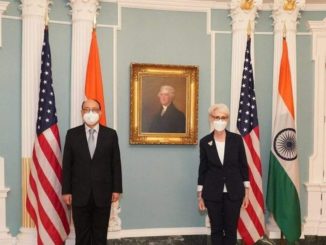
    WASHINGTON (TIP): Following his visit to New York where he chaired a meeting of the Security Council, Foreign Secretary Harsh Vardhan Shringla arrived in Washington for meetings with officials including one with his counterpart Deputy Secretary of State Wendy Sherman. The Foreign Secretary’s visit to the city precedes a possible month-end visit by Prime Minister Narendra Modi.

    Mr. Shringla and Ms Sherman held “substantive discussions on advancing the India-US Strategic Partnership across sectors including healthcare, defense & security, trade & investment, S&T [science and technology], climate change, clean energy and people to people ties,” Ministry of External Affairs Spokesperson Arindam Bagchi said in a tweet.

    The U.S. readout of the meeting between the two diplomats included, as discussion topics, “continued coordination on Afghanistan” and “strengthening Indo-Pacific cooperation through the Quad.”

    Mr. Shringla also met with U.S. Secretary of State Antony Blinken, with whom he discussed bilateral ties and Afghanistan, Mr. Bagchi wrote.

    Mr. Shringla’s delegation included Joint Secretary (Americas) of the Ministry of External Affairs Wani Rao and Joint Secretary (International Cooperation) from the Ministry of Defense Somnath Ghosh, both of whom led the Indian side at the India-U.S. 2+2 inter-sessional on Wednesday. The U.S. side was led by Assistant Secretary of Defense for Indo Pacific Affairs Ely Ratner and Principal Deputy Assistant Secretary of State for South and Central Asian Affairs Ervin Massinga.

    Bilateral agenda

    “Both sides took stock of the progress and developments in the bilateral agenda under the India-US strategic partnership, including defense, global public health, economic and commercial cooperation, science and technology, clean energy and climate finance, and people to people ties,” an MEA statement said.

    The inter-sessional included a discussion on strengthening multilateral cooperation among the U.S., India and “other like-minded partners”, according to a statement from the Pentagon.

    “The U.S. and Indian officials exchanged views on a range of regional issues of shared interest, including in South Asia, East and Southeast Asia, and the Western Indian Ocean and identified opportunities for enhanced cooperation on maritime security, regional connectivity, counterterrorism and humanitarian assistance and disaster relief,” the statement said.

    The two sides had committed to “driving greater interoperability” between their militaries and operationalizing bilateral initiatives on “information-sharing, logistics, defense industrial cooperation and joint doctrine engagement through liaison exchanges,” the Pentagon said.

    Prior to his Thursday engagements at the State Department, Mr. Shringla had dinner with U.S. officials including Ms. Sherman at India House, the official residence of India’s Ambassador to the U.S., Taranjit Singh Sandhu, as per a tweet from Mr. Sandhu.

    Others present at the dinner included Laura Rosenberger, Senior Director for China on the Biden National Security Council; Chief of Staff to Presidential Climate Envoy John Kerry; Uzra Zeya who is Under Secretary for Civilian Security, Democracy and Human Rights; Under Secretary for Arms Control and International Security Bonnie Jenkins and Under Secretary for Economic Growth, Energy and Environment Jose Fernandes.

    Possibility of Modi’s visit

    Wednesday’s inter-sessional precedes the annual 2+2 ministerial dialogue, slated to be held in Washington later this year. Also on the cards is the possibility of Mr. Modi visiting Washington for bilateral discussions with U.S. President Joe Biden and a summit level meeting of the Quad, following his address to the United Nations General Assembly on September 25.

    The in-person visit of Mr. Modi depends heavily on the ability of Japanese Premier Yoshihide Suga to do so. His attendance is not a given, with Japan’s ruling Liberal Democratic Party (LDP) scheduled to hold its leadership election on September 29.

    (Agencies)

  • Section of media gives communal color to news bringing bad name to nation, says Supreme Court

    Section of media gives communal color to news bringing bad name to nation, says Supreme Court

    Expresses serious concern over fake news on social media, including web portals and YouTube

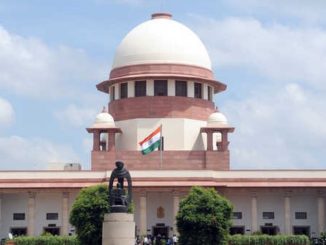
    NEW DELHI (TIP): Chief Justice of India N.V. Ramana on Thursday, September 2, said certain sections of the media communalized everything and this would ultimately result in giving the country a bad name.

    The remark from the CJI came while hearing petitions highlighting how some media outlets aired communal content linking the spread of the coronavirus to a Tablighi Jamaat meet held at Nizamuddin in Delhi.

    “The problem is, everything in this country is shown with a communal angle by a section of media. … The country is going to get a bad name ultimately,” Chief Justice Ramana, heading a three-judge Bench, observed orally.

    The hearing witnessed Chief Justice Ramana upbraid the lack of accountability on the part of social media platforms. The CJI said social media platforms only responded to “powerful people,” while complaints made by ordinary people, institutions and judges over content were ignored.

    “These web channels, Twitter, Facebook, YouTube… They never respond. There is no accountability. About the institution they write badly and then they do not respond… This is the condition of institutions, forget individuals… They consider only people who are powerful. Institutions, common man, judges, they do not… This is the reality,” Chief Justice Ramana noted.

    The court asked the government whether there was any regulatory mechanism in place for the web.

    Solicitor-General Tushar Mehta drew the court’s attention to the Information Technology (Intermediary Guidelines and Digital Media Ethics Code) Rules, 2021, which provide a redressal mechanism and timely resolution of grievances of users of social media and over-the-top platforms. The Rules require these platforms to appoint a grievance redressal officer who is a resident of India.

    The government recently asked the top court to transfer cases challenging the Information Technology Rules of 2021 from the various High Courts to the Supreme Court.

    In the case of complaints against broadcasters, Mr. Mehta referred to the Cable Television Networks (Amendment) Rules of 2021. He submitted that the Rules provide for a three-level grievance redressal mechanism — self-regulation by broadcasters, self-regulation by the self-regulating bodies of the broadcasters, and oversight by an Inter-Departmental Committee at the level of the Central government.

    “The real contest is between the freedom of the press and the right of citizens to get unadulterated news… We have tried to regulate, balance,” Mr. Mehta submitted.

    On September 24, 2019, hearing a petition filed by Facebook, the top court had shown deep concern at the utilization of social media for committing crime. It said the medium had become a source for pornography. Pedophiles use social media in a “big way”. Criminals exploit it to run weapons, drugs and contraband. Hate and violence were shared and spread through these virtual platforms. The court had even felt that some messages on social media may even threaten national sovereignty.

    It was in this context the court had called for a “properly framed regime” to allow the government to get information about first originators of messages from “significant” social media intermediaries with end-to-end encryption technology like WhatsApp.

    The IT Rules of 2021 mention this order of the Supreme Court as one of the reasons to justify their existence.

    (Agencies)

  • India’s External Affairs minister Jaishankar, Slovenian President discuss Indo-Pacific, Afghanistan crisis

    India’s External Affairs minister Jaishankar, Slovenian President discuss Indo-Pacific, Afghanistan crisis

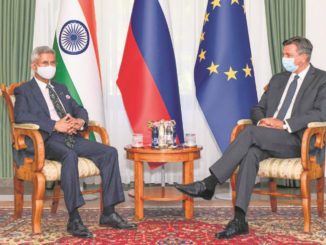
    LJUBLJANA (TIP): External Affairs Minister S Jaishankar on Thursday met Slovenian President Borut Pahor and discussed key challenges facing India and the European Union (EU). Slovenia holds the presidency of the Council of the European Union. Jaishankar is in the central European nation as part of his four-day visit to Slovenia, Croatia and Denmark to boost bilateral ties and strengthen India’s cooperation with the EU. Jaishankar in a tweet thanked President Pahor for his gracious welcome. “Deeply appreciate his long standing support for our relationship. Discussed key challenges facing India and EU,” he added, sharing a photograph of the meeting.

    Jaishankar also met with Slovenian counterpart Anze Logar during which the two leaders exchanged views on Afghanistan and the Indo-Pacific. “Excellent meeting with Foreign Minister of Slovenia @AnzeLog. Agreed to deepen our political and economic relationship. Welcome Slovenia’s Presidency of EU and confident it will take India-EU ties forward. Good exchange of views on Afghanistan and the Indo-Pacific,” he tweeted. The situation in Afghanistan is likely to figure prominently in Jaishankar’s meetings with his EU counterparts.

    (Source: PTI)

  • No rush for US to recognize Taliban: White House

    No rush for US to recognize Taliban: White House

    WASHINGTON (TIP) There is no rush to recognize the Taliban either by the United States or many of the countries that it has spoken to, the White House said, asserting that such a move would be dependent on what they deliver on the expectations of the global community.

    “There’s no rush to recognition from the United States or any country we have spoken with around the world. It will be very dependent on their behavior and whether they deliver on what the expectations are of the global community,” White House Press Secretary Jen Psaki told reporters at her daily news conference on Wednesday.

    At a separate news conference, the State Department echoed the same view. “We will continue to have conversations that serve our interests, as well as our allies and partners,” Under Secretary of State for Political Affairs Victoria J Nuland told reporters.

    “But the first thing we want is to see them live up to the obligations that they have under the UN Charter, as well as the public statements that they themselves have made about their expectation for an Afghanistan that respects human rights, respects international law, allows international citizens and Afghans who wish to leave,” she said in response to a question. The US obviously had contacts with the Taliban during the withdrawal, she said. “We had it during the effort that we were trying to midwife a negotiation. Those conversations have continued intensively to enable the evacuation of – that we undertook, and to try to get the kinds of guarantees of safe passage, etc., and tolerance, and to talk about the standard set in the UN Security Council resolution to talk about the terrorist threat as well because the expectation is that they claim to be able to control the security of Afghanistan,” Nuland said.

    The United States, she said, stands by the latest UN Security Council resolution. “Those are the international community’s expectations and the UNSC’s expectations for a Taliban-led government, and the way it will govern, and the way it will interact with the international system,” she said.

    (Source: PTI)

  • Dozens killed overnight in NYC, NJ during historic flooding

    Dozens killed overnight in NYC, NJ during historic flooding

    Life thrown out of gear in the region

    NEW YORK (TIP): Dozens of people were killed across New York and New Jersey — including a 2-year-old boy and his parents who drowned in a basement apartment in Queens — as the tail-end of Hurricane Ida ravaged the northeast, says a New York Post report.

    The storm knocked out power and flooded streets, homes and subways — prompting the first-ever flash flood emergency for the Big Apple and leaving a trail of devastation from Maryland to New York.

    Thirteen people in the five boroughs were reported killed by late Thursday evening, according to NYPD Chief of Department Rodney Harrison. Many of the victims became trapped in flooded basement apartments and one person was found dead in the backseat of their car on the Grand Central Parkway in Queens.

    “I don’t have an exact answer regarding how many people are actually missing, but we are going to continue to work hard throughout the day and the evening to identify everyone’s location,” the chief said.

    Cops were out in the hardest-hit areas Thursday evening knocking on doors to make sure the residents are safe, Harrison said.

    Suburban Westchester County reported three fatalities, including Fran and Ken Bailie, longtime computer science professors at Iona College who never made it home after teaching there Wednesday, school officials said. A Mount Kisco man found dead in floodwaters in Elmsford was identified as Rabbi Shmuel David Weissmandl, the son of a famed Jewish religious leader.

    At least 23 people died in the Garden State, including a family of three found in the same apartment complex, the state’s Gov. Phil Murphy said late Thursday.

    The rising death toll came as a state of emergency was in effect after the historic downpour knocked out power, closed roads and destroyed homes and businesses across the five boroughs.

    As recovery efforts continued throughout the day, rescuers were still searching for more stranded and missing people, bracing for a potentially higher death toll.

    “Our hearts go out to the victims,” NYPD Commissioner Dermot Shea said at a press briefing in Queens Thursday with Mayor Bill de Blasio and Gov. Kathy Hochul.

    “We pray that the number does not go up.”

    Among the dead was a family — 50-year-old Ang Gelu Lama, 48-year-old Mingma Sherpa and their son, two-year-old Lobsang Lama — who drowned inside their basement apartment in Flushing, Queens.

    The other deaths in Queens included Yue Lian Chen, 86; Phamatee Ramskriet, 43, and her 22-year-old son Khrishah Ramskriet; 48-year-old Darlene Hsu; and three others – two males and a female – who haven’t been identified, according to law enforcement sources and police. The body of 66-year-old Roberto Bravo was discovered in his flooded apartment in Cypress Hills, Brooklyn, cops said.

    The 23 who died in New Jersey included a 70-year-old man swept away in his car in Passaic and 31-year-old Dhanush Reddy, who died when he was sucked into a 36-inch storm sewer pipe, officials said.

    A Connecticut State Police trooper also died when his cruiser was swept away. Sgt. Brian Mohl had 26 years of service with the state police.

    Elsewhere along the East Coast, a 19-year-old man was found dead in a flooded apartment complex in Rockville, Maryland, and at least five people were killed in Pennsylvania, including one killed by a fallen tree and another who drowned in his car after helping his wife to escape.

    The storm also wreaked havoc on the region’s utility and transit systems.

    More than 200,000 electricity customers were still without power early Thursday across the northeast – mostly in Pennsylvania, New Jersey and New York, according to PowerOutage.US.

    New York’s FDR Drive and the Bronx River Parkway were flooded from the overnight torrential downpour, submerging cars up to their windows and forcing drivers to leave their vehicles behind.

    Subway tracks and stations were also submerged, prompting the Metropolitan Transportation Authority to suspend all service, which largely resumed with lingering delays by late afternoon.

    In New Jersey, the NJ Transit suspended rail services, except the Atlantic City Rail Line, and the Newark Light Rail was also halted. Newark International Airport shutdown overnight but restarted limited flights Thursday morning.

    New York Gov. Kathy Hochul, New Jersey Gov. Phil Murphy and Connecticut Gov. Ned Lamont all issued emergency declarations for their states as they reeled from the destruction and President Biden said he’d spoken to the governors, telling them Federal Emergency Management Agency personnel were on the ground to provide assistance.

    At a press conference in Queens, Hochul, New York’s newly sworn in chief executive, pledged to ensure the havoc and loss of life caused by flooding doesn’t occur in the future.

    “What happened yesterday –– trains were shut down, people were stranded. The fear that they must have experienced I cannot imagine,” she said. “I don’t want this to happen again.”

    The National Weather Service recorded 3.15 inches of rain fell in Central Park in an hour, from 8:51 to 9:51 pm — believed to be the most ever. At least 7.19 inches of rain fell there in total, the NWS said. Tropical Storm Henri dumped 1.94 inches in Central Park last month.

  • Noble intentions: On the U.N. and the Taliban

    The U.N. must ensure that the Taliban uphold human rights and give up terror tactics

    As India ended its month-long presidency of the U.N. Security Council this week, the government claimed a victory of sorts for chairing a session that resulted in the adoption of UNSC Resolution 2593, condemning terrorism and urging the Taliban to ensure human rights in Afghanistan. The government has said that the resolution — sponsored by the U.S., the U.K. and France — addressed key Indian concerns, calling for the Taliban to ensure safe evacuations of Afghans wishing to leave and not allowing Afghan soil to be used for terrorist activity. The passage of the resolution was timely, practically coinciding with the exit of the last U.S. troops from Kabul, and the Taliban’s declaration of complete victory. It also followed on three discussions held under India’s chairmanship that have set out the expectations from the new regime in Afghanistan: the importance of upholding rights; to push for an inclusive, negotiated political settlement for government, and condemning all acts of terror, including the recent attack on Kabul airport; preventing any future attacks, and combating of the presence of UN-designated entities. However, the resolution did not contain any consequential language that would give the UNSC’s stated intentions any real teeth, and appears to accept the Taliban regime as the default force in Afghanistan.

    While it is very early to consider more punitive action against the Taliban for violating their commitments by using the U.N. Charter’s “Chapter 7” mandate, that empowers the UNSC to maintain peace, it is disappointing that the India-chaired resolution does not contain language that would hold the new regime more accountable. The watered-down language was probably on account of severe opposition from Russia and China, who later decided to abstain. This divide in the P-5 nations will only prove to be counterproductive if the UNSC wants to remain “seized” of the situation, as the resolution affirms. It is hoped that the U.N. system acknowledges the powerful leverage it has in Afghanistan’s future and actualizes all mechanisms in its mandate to monitor the progress of government formation. A major tool is the India-chaired 1988 (Taliban) Sanctions Committee, due to meet soon, which needs to ensure that no designated leader of the Taliban and their associates are given recourse to funds, arms or travel permission unless they show a commitment to international principles. The renewal, on September 17, of the UN Assistance Mission in Afghanistan’s mandate is another lever. As a concerned neighbor of Afghanistan, one that could be drastically affected by an uptick in terrorism there, and a believer in the UN-led multilateral order, India still has a role in Afghan’s future. While it has decided to embark on talks with the Taliban in Doha, it must continue to play that role on the world stage.

    (The Hindu)

  • Erasing Nehru

    Erasing Nehru

    Poster on 75 years of Independence reeks of pettiness

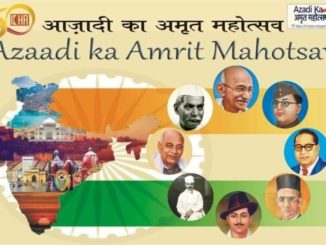
    Indian history has always been a battleground of identity politics and a contested territory of colonial, anti-colonial and post-modern historiographies. While the neo-colonial historians and intellectuals keep trying to belittle the national movement and to pit Gandhi against Ambedkar, creating a false binary to paint the former as some sort of a feudal casteist, the Hindutvavadi historians have been attempting to whitewash their icons and erase their ideological rivals. It is a miracle that the Mahatma has so far survived the Hindutva censorship scissors, for Gandhi and Nehru had all along been blamed for all that had gone wrong with the nation. The ‘what if’ history-writers have wanted Subhas Chandra Bose as India’s first Prime Minister and they finally seem to have succeeded in at least releasing a poster as part of Azadi Ka Amrit Mahotsav celebrations with the first President, Rajendra Prasad, to Gandhi’s left and Bose to his right, with Nehru completely absent.

    The erasure of Nehru and the inclusion of VD Savarkar ought to lead any history enthusiast to a ‘what if’ question: what if the Nehru government had vigorously prosecuted the Gandhi murder case and refused to accept the acquittal of Savarkar by the trial court? All those who celebrate Savarkar in the Indian Council for Historical Research poster should thank Nehru for not appealing against the trial court order. They ought to be grateful to Indira Gandhi too for legitimizing Savarkar’s memory by issuing a postage stamp just a year after the JL Kapur Commission probing the Gandhi assassination found that ‘all these facts taken together were destructive of any theory other than the conspiracy to murder by Savarkar and his group’. Nehru is not just the nation’s first and the longest serving Prime Minister, but a brilliant leader of the vanguard of India’s freedom struggle who spent about nine years in British prisons. He made mistakes, no doubt, but who hasn’t? When the government hails Savarkar and Ambedkar, who opposed the Quit India struggle, as heroes, it could be accused of political pettiness if it removes Nehru from the publicity material for the celebrations of 75 years of Independence.

    (Tribune, India)


  • Nostalgia – My early hockey days

    Nostalgia – My early hockey days

    By Prabhjot Singh

    When I played hockey for the first time, it was with a Khunda – a nicely chiseled out curved tree branch that resembled a plough. And the ball used in the game was made of a worn out piece of cloth held in shape by a large number of rubber bands cut from a discarded bicycle rubber tube.

    For the first several months, it was my favorite stick as boys of my age group from my immediate neighborhood would assemble every evening for a game that would at times continue for more than an hour.  Two broken pieces of bricks or even chappals (Slippers) would serve as goalposts at either end of the uneven playfield. The game was played barefoot. Gradually we all started mastering the skill of keeping the ball close to the stick while attempting to dribble past an opponent.

    Hard hitting was normally avoided as the ball would peel off with broken rubber bands scattered all over. The makeshift indigenous playing equipment, however, served the purpose well with teams of three to four players each.

    Since our “khundas” looked a little crude, we could not carry them to our school – Government Model Middle School (Jhullian Wala School) – for a game during the recess break.

    Our most memorable day came when we were in sixth standard. A couple of boys in my neighborhood, who also went to the same school, were all smiles when our PT teacher asked us who all play hockey. And all the hands of boys in my Section went up in affirmation. To our great surprise we were asked to go to another room where there was a huge steel box. The school peon, Bhajan Singh, was already there.

    After PT Madam arrived in the room, he opened the box and started taking out hockey sticks. Each one of us got a brand new stick. Thrilled and excited as we were, we immediately rushed to the school playfield for our first game with new hockey sticks and a leather ball. Since we were not used to holding the stick and playing with a regular ball, the first game turned out to be a mere hitting match. It was almost after a week of practice with the regular sticks and the leather ball, we all started playing well. Broken or damaged sticks were replaced on approval by the PT Madam.

    Those who played football were issued a couple of balls for regular practice. Interestingly, the football team also had most of the hockey players in it.

    An Inter-Middle Schools tournament was our first tryst with competitive hockey. We won the first two matches but lost the third to a better organized and professionally trained team.

    However, we had consolation as four members of our team were chosen for the Zonal team that was to play in Inter-Zonal for selecting a district team. Incidentally I was one of them. Other three included Gurdishpal Singh, who ultimately went on to represent India in international hockey, Sukhjit Singh and Manjit Singh.

    Hockey continued with most of us to our next institution – High School.

    The intervening break between the Middle and High School saw most of us joining an evening game of hockey at the neighboring Gujar Khan Khalsa High School. The school was later converted into an educational hub with a separate school for girls, a women’s arts college, a business school, and an English medium school besides a few other specialized institutions.

    The Gujar Khan Educational Centre is run by a Board of eminent people.

    On the sprawling Gujar Khan playfields, most of the promising sportsmen and women of the area would come for training. In addition to school and college teams, outsiders including cricket, hockey, football, basketball players and athletes used the playfields for their training.

    At times, the management would not take it lightly with outsiders using the playfields. The police would be called to chase away outsiders or players practicing there. It was an unending conflict as outsiders supported by their parents would maintain that the ground belonged to the society of which they all were members. Many students of the institutions run on the premises were also treated as outsiders in case they were not members of the regular teams of the Gujar Khan institutions. This unsavory aspect apart, it was Gujar Khan playfields that gave a major exposure to young and budding players of the area.

    The 1980 Olympic Gold winners

    Several senior hockey players, including alumni of the Gujar Khan institutions, would make it a point to attend the evening game. Among regular ones were Jagtar Singh and his brother, Raminder Singh (both sons of Mr. Mehar Singh, a leading criminal lawyer of his time. Both Jagtar Singh and Raminder Singh had the distinction of playing for India. Col Raminder Singh, son-in-law of Punjab CM Beant Singh had also led one of two Indian teams in an invitation tournament played at Ahmedabad. He also played for Signals and Services. Besides, he  served Punjab as Director of Sports), Gurainye (Devinder Singh Benepal, he was also in India’s camp for the 1975 World Cup but an alleged medical aberration saw him leave the camp), Golu (Ajit Singh, one of toughest hockey players of his time), Jawahari (Col Jawahar  Lal), Jagdeep Singh Phoolka (He was a goalkeeper of the 1966 Asian Games gold medalist Indian hockey team), Bau Ji, Dhiri (Randhir Singh), Dhobi (Durlabh Singh), Teja (Tejinder Singh Sandhu), Billa and Kala (brothers who played for Gujar Khan School team), Bubby (Col Jatinderpal Singh Ahluwalia, who later captained SCD Government College hockey team), Sheela (Sushil Kumar Gupta), Hari (Harjit Singh Dua of Deson group), Chhindi (Charanjit Singh), Sarabha and Bhutewalia (both from Guru Nanak Engineering College hockey team),  Kallu (Ajinderpal Singh, a promising center half with superb stickwork),Pinky (Gurdarshan Singh Mand now settled in Surrey) besides a few others. They all used to be regular for the evening game which was played over “shakanjavi”.

    Among other known faces to play there were Shiv Jagday (who later became national coach of both Canada and US hockey teams), Rajwinder Singh (played for India in World Cup), Dr Rajinder Pal Singh Bawa (now Vice Chancellor of Chandigarh University), and Jasjit Singh. After the game, most of them would head for the Bengali Sweets Shop in the Model Town Market and laze around there.

    Other than the regular evening game, this group, which was known outside as Model Town Lions Hockey Club, also used to invite teams from outside for friendly games.

    Corps of Signals (because of Col Raminder Singh) that had young MP Ganesh (who later captained India and also was the national chief coach), SN Pawar (member of the 1975 World Cup champion team), Maghar Singh and Gurdial Singh (deep defenders of Corps of Signals), was a regular. We as youngsters were lucky to watch MP Ganesh play barefoot on the dusty playfields of Gujar Khan and grow into an international star.

    BSF Jammu was another team that came for friendly games…

    We also used to wait for Sports School and Sports College teams from Jalandhar. Players like Hardyal Singh and his brother Hardev Singh besides Surjit Singh Rehal (they all later represented Kenya), Shiv Dutt aka Pandit Ji, Murthy and Kulwant Singh Mangu have all played at Gujar Khan school playfields.

    It was on this ground that the Lions Club started organizing Major Bhupinder Singh Memorial All-India Hockey Tournament that featured almost all top teams of north India. Donations of two annas, four annas, and one or two rupees, were collected from willing hockey fans to run the tournament. There were also a few regular sponsors and friends of the Club who extended financial and moral support to the organizing committee. Prominent among them were Mr. DS Bhogal, Mr. Inder Mohan Singh Grewal of Upper India Steel, Mr. Apinder Grewal (who later became Mayor of Ludhiana), and Mr. Surjit Singh of Punjab Agricultural University (He used to do the commentary and compering).

    After a few years, the venue of the tournament was shifted to Punjab Agricultural University grounds where well maintained lustful green playfields fascinated all players, officials and spectators.

    –To be concluded

    (Prabhjot Singh is a senior journalist and a well-known Sports commentator. He can be reached at prabhjot416@gmail.com)

  • RAGAMALA TRIOUSHER IN NEW SEASON

    Ranee Ramaswamy. (Photo : Grant Halverson)
    Aparna Ramaswamy. (Photo / Dariel Sneed)
    Ashwini Ramaswamy. (Photo / David Johnston.)

    By Mabel Pais

    The Ragamala Dance Company (founded under the leadership of Ranee Ramaswamy and Aparna Ramaswamy (mother-daughter duo) announces its 2021-22 season, featuring the world premiere of “Fires of Varanasi: Dance of the Eternal Pilgrim,” performances of choreographer-associate (daughter of Ranee Ramaswamy) Ashwini Ramaswamy’s “Let the Crows Come,” podcast episodes, and panel appearances. The Company will tour the country through April 2022 and will conclude the season with a residency at the Bogliasco Foundation in Bogliasco, Italy.

    Ranee and Aparna Ramaswamy’s award-winning, internationally recognized bharatanatyam dance ensemble will perform the world premiere of the Kennedy Center co-commission “Fires of Varanasi” on the REACH campus from September 11-12 as part of the Center’s 50th Anniversary weekends and Millennium Stage Summer Series, before bringing the piece to The Hopkins Center for the Arts at Dartmouth College on September 17-18 and The Joyce Theater in Manhattan from September 22-26.

    The performances have been hailed as “soulful, imaginative and rhythmically contagious… every gesture radiates joy or generosity or a sense of striving toward some higher form of being,” by The New York Times.

    Rooted in the expansive South Indian dance form of Bharatanatyam, Ragamala Dance Company manifests a kindred relationship between the ancient and the contemporary. In their latest evening-length performance, “Fires of Varanasi: Dance of the Eternal Pilgrim,” eleven dancers conjure a realm where time is

    suspended and humans merge with the divine. Award-winning creators Ranee Ramaswamy and Aparna Ramaswamy imagine a metaphorical crossing place that enters into a ritualistic world of immortality, evoking the birth-death-rebirth continuum in Hindu thought to honor immigrant experiences of life and death in the

    diaspora. The work features an original, recorded score and the lighting designs of French scenic and lighting designer Willy Cessa.

    Evoking mythography and ancestry, Ashwini Ramaswamy’s “Let the Crows Come” uses the metaphor of crows as messengers for the living and guides for the departed. This 60-minute work for three dancers with live music explores how memory and homeland channel guidance and dislocation. Featuring Ramaswamy (Bharatanatyam technique), Alanna Morris-Van Tassel (Contemporary/Afro-Caribbean Diasporic technique), and Berit Ahlgren (Gaga tech-nique), Bharatanatyam dance is deconstructed and recontextualized to recall a memory that has a shared origin but is remembered differently from person to person. Composers Jace Clayton (dj/rupture) and Brent Arnold extrapolate from Prema Ramamurthy’s original Carnatic (South Indian) score, utilizing centuries-old com-positional structures as the point of departure for their sonic explorations.

    2021/2022 SEASON SCHEDULE:

    “Returning to the Earth” (Virtual event)

    Pre-filmed online performance and panel discussion as part of the Just Festival in Edinburgh

    August 25, 2021 at 1:30PM ET, Edinburgh, Scotland

    “Fires of Varanasi,” Logo. (Photo : Ed Bock)

    World premiere of “Fires of Varanasi”

    September 11 and 12, 2021 at 7:30 PM, the Kennedy Center, Washington, D.C.

    (Rain Date: September 13 at 7:30 PM)

    “Fires of Varanasi” (proscenium stage premiere)

    September 17 at 7:30 PM and 18 at 2 & 7:30 PM ET, Hopkins Center for the Arts at Dartmouth College, New Hampshire

    “Fires of Varanasi” (New York premiere)

    September 22-26, 2021, The Joyce Theater

    For Tickets,visit joyce.org/performances/ragamala-dance-company

    “Let the Crows Come”

    October 2, 2021, Bryn Mawr College Performing Arts Series in Pennsylvania

    For Tickets, visit brynmawr.edu/performing-arts-series/ramaswamy

    “Let the Crows Come”

    November 20 and 21, 2021, Cowles Center in Minneapolis

    “Fires of Varanasi”

    December 2, 2021 at 7:30PM, Harris Theater, Chicago, IL

    For Tickets, visit harristheaterchicago.org/tickets/2021-2022-season/fires-of-varanasi

    “Subcontinuity: Voices from the South Asian Diaspora” podcast launches via PRX

    January 2022

    “Let the Crows Come”

    January 15, 2022 at 8PM, Scottsdale Center for the Performing Arts, Scottsdale, AZ

    For Tickets, visit scottsdaleperformingarts.org/event/ashwini-ramaswamy-let-the-crows-come

    Release of second “Subcontinuity” podcast episode\

    February 2022

    Ashwini Ramaswamy’s work-in-process work “Invisible Cities” Panel discussion and Artist Q&A

    January 31, 2022

    “Fires of Varanasi”

    February 26, 2022, Northrop in Minneapolis

    For Tickets, visit northrop.umn.edu/events/ragamala-dance-company-2022

    “Fires of Varanasi”

    April 9, 2022, The Soraya in North Ridge, CA

    Ramaswamys in residence

    April 19-May 20, 2022, The Bogliasco Foundation in Bogliasco, Italy

    The Ragamala Dance Company

    The Ragamala Dance Company was founded in 1992 by Ranee Ramaswamy and is under the leadership of Artistic Directors Ranee Ramaswamy and Aparna Ramaswamy, and Choreographic Associate Ashwini Ramaswamy (mother and daughters). Rooted in the South Indian dance form of Bharatanatyam, the company has been hailed by ‘The New York Times’ as “rapturous and profound.”

    Driven by the artistic vision of Ranee and Aparna, Ragamala Dance Company is the embodiment of an immigrant story. The company’s work — on stage, in the community, and educating the next generation — exemplifies the intercultural narratives of countless global citizens and evokes a shared sense of humanity.

    Ragamala engages in a collaborative practice rooted in the idea of Bharatanatyam as a sacred and dynamic living tradition. They embody the kindred relationship between ancient and contemporary that is urgently needed in today’s world. Ranee and Aparna’s training under legendary artist Alarmel Valli forms the bedrock of a creative aesthetic that springs from beauty, truth, and spirit. Ragamala is a pioneering, woman-led, intergenerational, family-run organization committed to the idea that while history is time bound, the stories we share are timeless.

    For more information, visit ragamaladance.org.

    ————————–

    GEENA DAVIS’S BFF LAUNCHES INCLUSIVITY ARM

    By Mabel Pais

    The BFFoundation which produces the Geena Davis-chaired Bentonville Film Festival in Arkansas is launching a production company, Bentonville Way Entertainment (BWE) that, like the foundation and fest will champion women and inclusive voices in filmmaking.

    The new Bentonville Way Entertainment already has a slate of films in the pipeline featuring alumni from past Bentonville fests: Amber McGinnis-directed “Buddy,” the Jennifer Gerber-directed “Has Been Beauty Queen” and “Dealing With Dad” written and directed by Tom Huang. Kristin Mann will serve as Head of Content.

    The three features are currently in pre-production and expected to go into production in late 2021 and early 2022.

    “We are excited that we can further the outcome of our mission by not only amplifying these voices through the festival each year, but also by supporting the production and distribution of inclusive content,” Davis said. “This will help create pathways for change in the industry for our alumni.”

    “With a focus on creating pathways for underrepresented filmmakers, BWE will continue to elevate BFFoundation and create meaningful change in the industry,” said Head of Content at Bentonville Way Entertainment, Kristin Mann.

    To learn more,visit bentonvillewayent.com

    (Mabel Pais writes on Social Issues, The Arts and Entertainment, Spirituality, and Health & Wellness)

  • FILMS ON DVD

    By Mabel Pais

    SUMMER OF 85

    DIR: François Ozon l 2020 l France l French w/Eng Subs l Color l NR l 1h 40m

    Summer of 85. (Photo : Music Box Films)

    “SUMMER OF 85,” from one of France’s most prolific and versatile filmmakers, François Ozon, is a wonderful and ardent reverie on first love and the impassioned influence it holds over those who experience it. It’s based on the landmark 1982 LGBT young adult novel “Dance on My Grave” by British author Aidan Chambers. Available on VOD (iTunes, Amazon Instant, Vudu and YouTube), DVD and Blu-ray with bonus features.

    View the trailer:youtu.be/bwsKhFw1iPQ

    For more information,visit summerof85film.com

    THE PERFECT CANDIDATE

    DIR: Haifaa Al Mansour l 2020 l Germany, Saudi Arabia l Arabic w/Eng subs l Color l NR l 1h 45m

    “a candid, often wryly amusing glimpse of life inside the Saudi kingdom”–Ann Hornaday, The Washington Post

    Perfect Candidate. (Photo : Music Box Films)

    In “THE PERFECT CANDIDATE,” acclaimed Saudi Arabian filmmaker Haifaa Al Mansour offers a revealing look at the changing roles of women in Saudi Arabia with her latest film. When Maryam, a hardworking young doctor in a small-town clinic, is prevented from flying to Dubai for a conference without a male guardian’s approval, she seeks help from a politically connected cousin but inadvertently registers as a candidate for the municipal council. Maryam sees the election as a way to fix the muddy road in front of her clinic, but her campaign slowly garners broader appeal. Maryam’s creative and ambitious campaign builds momentum, becoming a symbol for a larger movement.

    Available on all major digital platforms (AppleTV, Amazon, GooglePlay, Vudu, YouTube, Music Box Direct and more) and DVD with special bonus features.

    View the trailer: youtu.be/N8_W06eSm-I

    To learn more, visit musicboxfilms.com/film/the-perfect-candidate

    ————————————–

    UPCOMING RELEASES

    By Mabel Pais

    PBS-POV SHORTS

    POV Shorts, the newest series from American Documentary, debuts its fourth season on Monday, September 6, 2021, on PBS and streaming online at POV.org. POV Shorts will have Broadcast & Streaming Debut of 4th Season on PBS this Monday, Sept. 6 with Three Acclaimed Documentaries Including (Likely Oscar Contender) “A Broken House,” “Sing Me a Lullaby,” and “Joychild.”

    EPISODE 1:  Where I’m From: Stories on home and how it shapes us.

    Broadcast Date: This Monday, September 6, 2021

    “A BROKEN HOUSE” – DIR: Jimmy Goldblum

    Mohamad Hafez received a one-way ticket to the United States. Missing his homeland, he decided to create a stand-in. A story of love, loss and creating pathways home.

    “SING ME A LULLABY” – DIR: Tiffany Hsiung

    Spanning 14 years and two continents, a daughter searches for her mother’s birth parents in Taiwan, unraveling complex tensions between love and sacrifice. For the Trailer and more info, visit singmealullabyfilm.com.

    “JOYCHILD” – DIR: Aurora Brachman

    A young child tells their mother “I’m not a girl” for the first time.

    FINAL FREQUENCY

    DIR:  Tim Lowry l 2021 l USA l 1h 31m

    AWARDED THE TESLA SPIRIT AWARD GOLD MEDAL FROM THE TESLA SCIENCE FOUNDATION 

    In “FINAL FREQUENCY,” PhD student Esther connects unusual tremors in L.A. to rogue scientists, who are desperately seeking Nikola Tesla’s lost notebook. If captured, Tesla’s deadly research will enhance the destructive power of their master plan to manipulate thoughts and to manufacture an epic earthquake to take out world leaders during the G-20 World Economic Summit. The key is the professor, who has vanished along with the notebook. Esther and her crew of misfits are the only hope to find him before the G-20 is reduced to ashes and rubble. Watch the trailer – youtu.be/bwsKhFw1iPQ

    Available on VOD (VUDU, prime video, Apple TV)

    THE BIG SCARY “S” WORD

    DIR: Yael Bridge l 2020 l USA l Doc l Eng l 1h 25m

    The Big Scary “S” Word. (Photo : Greenwich Entertainment)

    “Yael Bridge’s ‘The Big Scary ‘S’ Word’ provides a persuasive analysis of the topic, as well as considerable argument for the notion that the basic principles of socialism are (as one interviewee here puts it) “‘as American as apple pie’.”

    – Dennis Harvey, ‘Variety’

    “The Big Scary “S” Word,” featuring new and archival interviews with Bernie Sanders, Alexandria Ocasio-Cortez, Cornel West, and Naomi Klein, explores the rich history of the American socialist movement. Weaving together hidden episodes of history and verité footage, the film shows that, contrary to popular belief, socialism is in fact deeply American and led to popular government programs such as public schools and Medicare. Activists and journalists explain how the 2008 financial crisis, the Wall Street bailout, the Occupy Movement, and the ascension of politicians like Sanders and Ocasio-Cortez have pushed a new generation to embrace the language of socialism.

    Watch the trailer: youtu.be/7yL9a6JwrUY

    In Theaters Nationwide & On Demand Everywhere Labor Day Weekend September 3

    SAVING PARADISE

    DIR: Jay Silverman l 2021 l USA

    Saving Paradise. (Photo :Vertical Entertainment


     “SAVING PARADISE” is an inspiring story based on true events. A ruthless corporate raider is forced to return to his small-town roots where he suddenly inherits his father’s nearly bankrupt pencil factory, which is the heart and soul of the depressed community. With the foreclosure deadline looming, he must decide to either let it close, or join the community’s fight to save it.

    Watch the trailer –youtu.be/2VYA3cg9V-Y

    Opening in Select Theaters and On Demand Everywhere on September 3

    BEING JAMES BOND

    “Being James Bond,” from Metro Goldwyn Mayer (MGM), will be exclusively available to stream on the Apple TV app as a free rental ahead of the theatrical release of the upcoming 25th film in the James Bond franchise, “No Time To Die.” * In this special 45-minute retrospective, Daniel Craig candidly reflects on his 15-year adventure as James Bond. Customers in over 30 countries and regions around the globe can rent the film for free and stream it exclusively on the Apple TV app from September 7 to October 7. Including never-before-seen archival footage from “Casino Royale” to the upcoming 25th film “No Time To Die,” Craig shares his personal memories in conversation with 007 producers, Michael G Wilson and Barbara Broccoli, in the lead up to his final performance as James Bond. “A lot of people here have worked on five pictures with me,” Craig noted during the conversation with the films’ producers in “Being James Bond.” “I’ve loved every single second of these movies, and especially this one because I’ve got up every morning and I’ve had the chance to work with you guys, and that has been one of the greatest honors of my life.”

    Said Broccoli in the film: “Daniel has just taken this, the character, the series, the whole thing, to a place that is so…extraordinary. And so emotionally satisfying.” “It’s also emotionally tough being Daniel’s last one. It’s tough on Barbara, it’s tough on me,” added Wilson.

    *Renting movies on the Apple TV app requires an Apple ID.

    (Mabel Pais writes on The Arts and Entertainment, Social Issues, Spirituality, and Health & Wellness)

  • Celebrating Teacher Extraordinaire Dr. Sarvepalli Radhakrishnan

    Celebrating Teacher Extraordinaire Dr. Sarvepalli Radhakrishnan

    Dr. Sarvepalli Radhakrishnan’s birthday on September 5 is celebrated in India as Teacher’s Day

    By Dr. V.K. Raju

    Margaret Mead, a great American Anthropologist, when she was a little girl, asked her father, who was a professor, “Father, who is a professor? He replied, “Professor is one who keeps learning, and teaches what he learned”. What an extraordinary and unusual reply!

    Dr. Radhakrishnanwas a teacher, scholar, philosopher and humanitarian par excellence. His birthday, September 5th, is celebrated in India as Teacher’s Day. I will essay to summarize Dr. Radhakrishnan’s life as a teacher.

    Plato’s concept of philosophy king and the Indian idea of Rajarishi have striking similarities. The idea was realized in Marcus Aurelius, Janaka, Emperor Ashoka and Akbar. In modern times Dr. Radhakrishnan exemplifies this concept when he was elected President of India in 1962. In 1964, the Pope conferred on Dr. Radhakrishnan, in a declaration, as one of the Chiefs of Golden Army of Angels.

    Early life

    Radhakrishnan was born on Sept 5th, 1888, in Thiruttani, a small town near Andhra Pradesh-Tamil Nadu border in a Telugu speaking family. Dr. Radhakrishnan’s family background coupled with his early demonstrated aptitude for learning took him in gradual stages to school and college. During his college days at Christian College, Madras, one of his senior cousins made him a gift of his old books-Stout’s psychology, Welton’s Logic, and Mackenzie’s Ethics. He chose philosophy as the main subject of his studies. He later reflects “the subject of philosophy I happened to take up by sheer accident. But when I look at the series of accidents that have shaped my life, I am persuaded that there is more in this life than meets the eye. Life is not a mere chain of physical causes and effects. Chance seems to form at the surface, but deep-down other forces are at work. If the universe is a living one, if it is spiritually alive nothing in it is merely accidental. The moving finger writes and having writ moves on.”

    The Christian atmosphere in Madras Christian College had both a positive and negative experiences on the mind of the young Radhakrishnan. He aquatinted himself with the teaching of the New Testament.

    Teacher at Madras & Rajahmundry

    Government Arts College Rajahmundry now known as Government College (Autonomous) is on the banks of River Godavari in Rajahmundry, Andhra Pradesh. It was established as a Zilla Parishad high school in 1853 and upgraded as a Provincial school of Madras Presidency in 1868. It became a college in 1885. It was affiliated to University of Madras in 1891 and reaffiliated to Andhra University in 1926. Dr. S. Radhakrishnan served as a professor here from 1916 to 1918.

    In the memory of the great teacher, the Goutami Eye Institute, Rajahmundry, AP and the Eye Foundation of America are sponsoring free eye examination to 100 teachers in the region on September 5, 2021.

    ———

     It has been said he used to give brilliant lectures, unsurpassed in brevity and clarity. According to a veracious source, Radhakrishnan in his twenties was a “bohemian and temperamental, not very disciplined and prone to occasional outbursts of anger,” but in later life he became free from all these tendencies and attained serenity and equipoise. In 1912 his lectures at Presidency were published as essentials of psychology- Oxford University press.

    He was such a prolific writer, that before he turned 27, he had already contributed a number of essays. His diversity of interest on such wide-ranging themes as ‘Karma and Free Will’, ‘Nature and Convention in Greek’, ‘Ethics of Bhagavad-Gita and Kant’, ‘Bergson’s Idea of God’, ‘Morality and Religion in Education’, ‘A View from India on the War I’. These appeared in journals of international repute, such as, The Monist, The Quest, Mind, Journal of Philosophy and The International Journal of Ethics. His Second essay on ‘A view from India on the War I’ was not allowed to be published by the censors. In 1916, Radhakrishnan  was promoted as a Professor and placed in the Provincial Grade and was posted at the Government Arts College, Rajahmundry. (AP) He soon became an inspiring and beloved teacher. He stayed in Rajahmundry till 1918. He later said these were the happiest and most fulfilling years of his life.

    It was during this period, he worked on the manuscript of his book “The Philosophy of Rabindranath Tagore “which was published in 1918. Describing Tagore’s philosophy, he says”Tagore’s supreme spirit is not an abstract entity residing at a safe distance from the world, but is the concrete, dynamic life at the center of things, giving rise to the roar of the wind and the surf of the sea…Rabindranath is a wholeness of vision which cannot tolerate any absolute divisions.”

    From Mysore to Calcutta

    Radhakrishnan was appointed as professor of IndianPhilosophy at Mysore University in 1916. It was during his Mysore days that he published a series of articles in Mind in which he often examined Bergson’s philosophy, attempted to prove that he was an Absolutist and wrote his second book, ‘The Reign of Religion in Contemporary Philosophy’ which was published in 1920. Examining the philosophies of thinkers like William James, Rudolf Eucken, James Ward, Leibnitz, and others. RK condemned such dominance of religion in philosophy and pleaded for the development of a philosophy in which religion is neither the basis, nor the motivating force.

    At University of Calcutta, he became successor to Brajendra Nath Seal (doyen of Indian Philosophy) perplexing many. In 1923, Radhakrishnan’s monumental work, Indian Philosophy Vol 1 was published. The impact of this book was tremendous. It resulted in the vivification of philosophical thought in Indian universities.

    Rashtrapati Dr. Sarvepalli Radhakrishnan at the Republic Day of India Parade with guests

    He was a Professor in a small town, big cities, Vice chancellor of Andhra University, Banares Hindu University, Spalding Professor at Oxford, Ambassador to Moscow, Vice President and President of India.One can go on and on about Dr. Sarvepalli Radhakrishnan as a great teacher and an extraordinary Philosopher and Humanitarian. It may be said of a philosopher or a scientist that “the essential in the being “of such a man lies “in what and how he thinks, not in what he does or suffers”. This is what Einstein said about himself. Radhakrishnan, for inscrutable reasons, said very little about himself (Acharya Devo Bhava).

    (VK Raju MD, FRCS, FACS is a US based Ophthalmologist, Regional Eye Associates; President and Founder, Eye Foundation of America; President and Founder, Goutami Eye Institute; Clinical Professor, West Virginia University; Director, International Ocular Surface Society; Adjunct Professor, GSL Medical School. He can be reached at vkraju@comcast.net. He can also be reached at Mobile / 1+ 304 2882080)


  • Indian American Republican Nikki Haley blasts Biden Administration over Taliban scenario

    Indian American Republican Nikki Haley blasts Biden Administration over Taliban scenario

    WASHINGTON (TIP):Leading Indian American Republican leader Nikki Haley has blasted the Biden administration for its execution in withdrawing troops from Afghanistan, saying it “completely surrendered to the Taliban.”

    “They’re not negotiating with the Taliban. They’ve completely surrendered to the Taliban,” Haley, first Indian American to get cabinet rank as US Ambassador to the United Nations under former President Donald Trump, said on Sunday. She was responding to a question on a leading New channel Show ” if she agreed with the Biden administration’s assertion that it is not negotiating with the Taliban as it continues to evacuate American citizens and allies. “They surrendered Bagram Air Force Base, which was a major NATO hub. They surrendered $85 billion worth of equipment and weapons that we should have gotten out of there,” Haley said.

    “They have surrendered the American people and actually withdrew our troops before they withdrew the American people. And they’ve abandoned our Afghan allies who kept people like my husband safe,” she said.

    However, Haley also acknowledged that the Biden administration must now do “whatever it takes to get our Americans out. This is an unbelievable scenario where literally the Taliban has our Americans held hostage.”

    Haley also shot back at arguments that the withdrawal from Afghanistan was put in place by the Trump administration and that blame must be shared between Biden and his predecessor.

    “Under four years of Trump, Afghanistan was safe. We made sure that we kept terrorism at bay, and we came from a position of strength,” Haley said.

    “There are times where you have to negotiate with the devil, but you negotiate with the devil from a point of strength. You don’t do it from a point of weakness. We literally have no leverage right now with the Taliban.”

    Haley called on the Biden administration to extend the Aug. 31 deadline for evacuations and said the US must make sure that the Taliban knows they’ve got to let people into the airport in Kabul safely.

    “We’ve got to get our Americans out. We’ve got to stay true to those Afghan allies that we made promises to. And we’ve got to make sure we do this in a very strong way going forward,” she said.

    Expressing her apprehensions on Afghanistan, Haley said, “You’re going to have sex slaves. You’re going to have child marriages. You’re going to have kids that are — girls that are no longer allowed in school.

    “You’re going to have our Americans. Any that are there will be in danger. And all of our Afghan allies will be killed if we don’t do something,” she said. Meanwhile, Indian American lawmaker Ro Khanna has said the strategic partnership between India and the US is more critical than ever in containing the Taliban and preventing terrorism. “The US-India strategic partnership is now even more critical in containing the Taliban and preventing terrorism,” Khanna, who represents Silicon Valley in the House of Representatives, said in a tweet. Khanna, Democratic Vice Chair of the Indian American Congressional Caucus, said he will be working with the leadership of the India Caucus to strengthen the India-US partnership on national security.

  • Indian American Congressman Ro Khanna emphasized upon India-US partnership in combating Taliban, terrorism

    Indian American Congressman Ro Khanna emphasized upon India-US partnership in combating Taliban, terrorism

    WASHINGTON (TIP): The strategic partnership between India and the United States is more critical than ever in containing the Taliban and preventing terrorism, an influential American lawmaker said on Friday, August 20. “The US-India strategic partnership is now even more critical in containing the Taliban and preventing terrorism,” Indian-American Congressman Ro Khanna said in a tweet. Khanna, who represents Silicon Valley in the House of Representatives, is Democratic Vice Chair of the Indian American Congressional Caucus in the House. Khanna said he would be working with the leadership of the India Caucus to strengthen the India-US partnership on national security.

  • Strawberry face packs for glowing skin

    Strawberry face packs for glowing skin

    We all love fruits, don’t we? Then it’s time to give a fruity treat not just for your palette but for your skin as well. Strawberries do wonders for your skin. Being rich in nutrients, you can expect Strawberry to perform miracles for your skin. These strawberry tales have been around since Roman and Egyptian eras and they used them for medicinal properties especially for acne treatment.

    Benefits of Strawberries for Skin :

    Today, scientifically it has been proven that strawberries with their anti-oxidants, astringent and anti-inflammatory properties help slowing down aging process, treat burns and offer best form of UV protection.

    Being rich in alpha-hydroxylic acid, Strawberries help get rid of dead skin cells.

    They have a high content of salicylic acid making them the ideal agents to treat acne.

    It also includes extensive Vitamin C content that boosts up collagen production and minimizes fine lines and wrinkles. Omega- 3 fatty acids found in strawberries lighten the skin tone and reduce dark circles.

    You can also use this fruit to tone your skin, improve skin texture, and lighten pigmentation and acne marks.

    Strawberries and Fresh Cream Mask :

    Take strawberry puree, mix with fresh cream (dry skin) or yogurt (oily skin) and add a tablespoon of honey. Apply all over face, and leave it on for 10 minutes and wash with warm water. You can deep freeze and store this mask like how I regularly do. This Mask helps reduce Acne.

    Strawberries & Lime Face Pack :

    Helps in de-tanning your skin and lightens pigmentation marks on your skin. Mix strawberries and a tablespoon of limejuice. Apply all over face for 15 minutes and wash off with warm water.

    Strawberry & Chocolate

    Mash strawberries along with a tablespoon cocoa powder and honey. Apply on face for 15 minutes and wash off with warm water.  It helps to make you skin glow and also makes it soft.

    Honey and Strawberry Face Mask :

    Mash few strawberries with fork until it turns into a smooth paste. Add a tablespoon of honey and apply this mask for 15 minutes and wash with warm water. Honey is an anti – oxidant that helps to fight skin impurities and acne.

  • Tokyo Paralympics: Paddler Bhavinaben Patel storms into final

    Tokyo Paralympics: Paddler Bhavinaben Patel storms into final

    Tokyo (TIP): Bhavinaben Patel continued to script history as she became the first Indian to enter the final of a table tennis event in the Paralympics with a hard-fought 3-2 win over China’s Miao Zhang in a class 4 semifinal here on Saturday, August 28. The 34-year-old Patel beat her world no. 3 Chinese opponent 7-11 11-7 11-4 9-11 11-8 in the semifinal showdown that lasted 34 minutes. She will take on world number one Chinese paddler Ying Zhou in the summit clash on Sunday. Competing in her maiden Paralympics, Patel lost the opening game in a tight contest. But, she made a strong recovery, claiming the next two games. In the fourth game, Zhang showed her class not giving Patel the bragging rights just yet as the match headed into the decider. In the deciding fifth game, Patel took a time out after which she notched up the win. In the quarterfinal on Friday, Patel had defeated 2016 Rio Paralympics gold winner and world number two Borislava Peric Rankovic of Serbia to clinch a medal and script history.

                    Source: PTI

  • Cheteshwar Pujara, Rohit Sharma lead India’s resistance

    LEEDS (TIP): Cheteshwar Pujara orchestrated India’s spirited resistance with an unbeaten career-reviving 91 but England remained on course for a series-levelling victory in the third Test at Headingley.

    Under pressure to save his place in the side, Pujara added 82 runs with Rohit Sharma and 99 with Virat Kohli to steer India to 215/2 when bad light stopped third day’s play.

    India are still 139 runs behind but it was a much-improved performance by the tourists who had wilted for 78 in their first innings to be on the back foot.

    Captain Kohli, who has had a subdued series so far, was batting on 45 and would hope to continue the good work when they resume on Saturday. Having conceded a massive lead of 354, India needed a strong start from their openers but Craig Overton denied them. Overton dismissed KL Rahul for eight inducing an edge and Jonny Bairstow dived to his left to pluck a stunning one-handed catch at second slip on the stroke of lunch.

    Rohit and Pujara refused to throw in the towel though in the wicketless post-lunch session. Rohit was content nudging the ball around but occasionally counter-attacked, like when he guided a rising Ollie Robinson delivery over the slip cordon for six.

    Pujara came out to bat with his team in dire straits and amid growing whispers about his future, having gone without a fifty in his previous 12 innings. As if to silence criticism of his modest strike rate, the batsman hit three early boundaries, going at a run-a-ball rate before putting his head down and focusing on the rebuilding job.

    Robinson ended the flourishing stand soon after the tea break when he trapped Rohit lbw for 59.           Source: Reuters

  • Cristiano Ronaldo back at Manchester United

    Cristiano Ronaldo back at Manchester United

    Football legend Cristiano Ronaldo left an emotional message for Juventus fans as he re-signed with Manchester United in a blockbuster deal on Friday. Ronaldo will be returning to Old Trafford after signing a two-year deal worth 25 million euros. The Portugal captain is headed back to the club where he won eight major trophies from 2003-2009. “Today I depart from an amazing club, the biggest in Italy and surely one of the biggest in all of Europe. I gave my heart and soul for Juventus and I’ll always love the city of Turin until my final days.

    “The “tiffosi bianconeri” always respected me and I tried to thank that respect by fighting for them in every game, every season, every competition. In the end, we can all look back and realize that we achieved great things, not all that we wanted, but still, we wrote a pretty beautiful story together.

    “I will always be one of you. You are now part of my history, as I feel that I’m part of yours. Italy, Juve, Turin, tiffosi bianconeri, you’ll always be in my heart,” Ronaldo posted on social media.

    Ronaldo, signed by Juve in 2018 for 100 million euros ($117.90 million) from Real Madrid in the hope of leading them to an elusive Champions League title, will leave the club with 101 goals, two league crowns and a Coppa Italia to his name.

    The 36-year-old won the Ballon d’Or as the world’s best player in 2008 at United alongside his team accolades, before sealing a then world record 80 million pounds move to Madrid.

    After telling Juventus coach Massimiliano Allegri on Thursday of his desire to leave Turin, widespread media reports claimed Ronaldo’s agent, Jorge Mendes, had agreed personal terms with Premier League champions Manchester City.

    But after City were said to have had a change of heart over the deal, rivals United got the transfer agreed.

  • Second Covid wave hiked banks’ asset risks, says Moody’s

    Second Covid wave hiked banks’ asset risks, says Moody’s

    Moody’s Investors Service on Thursday said second wave of Covid infections has increased asset risks for Indian banks, but a severe deterioration is unlikely.

    It said the second wave of coronavirus infections in India has exacerbated stress among individuals and small businesses that were hit the hardest by the initial outbreak. Still, a number of factors will prevent sharp increases in problem loans, and banks have sufficient buffers to absorb anticipated loan losses.

    “A severe deterioration of banks’ asset quality is unlikely despite an expected rise in new loan impairments. This is because government initiatives such as the ECLGS have been effective in providing immediate liquidity for businesses,” Moody’s vice-president and senior credit officer Alka Anbarasu said.

  • Half a trillion dollars wiped from China markets in a week as clampdowns shatter confidence

    Half a trillion dollars wiped from China markets in a week as clampdowns shatter confidence

    China’s tech shares slumped to new lows on Friday and Hong Kong’s benchmark index hit an virtually 10-month trough, as an unrelenting sequence of Chinese regulatory crackdowns crushed traders’ confidence.

    More than $560 billion in market worth has been wiped off Hong Kong and mainland China exchanges in a week as funds capitulate out of once-favoured shares, uncertain which sectors regulators will goal subsequent.

    The Hang Seng fell 1.8% and its weekly drop of 5.8% was the biggest because the peak of the pandemic panic in monetary markets in March 2020.

    Stocks in Shanghai additionally fell, whereas traders offered dangerous company debt and the Chinese forex. The yuan was poised for its largest weekly loss in two months as traders rushed to security amid international coronavirus issues.

    U.S.-listed shares of China-based tech-related firms gained floor as discount hunters took benefit of current sell-offs ensuing from Beijing’s ongoing regulatory crackdown, which has wiped half a trillion dollars from Chinese markets this week.Alibaba Holding Group, Tencent Music Entertainment Group, Didi Global and iQiyi Inc superior between 1% and 4.5%.

    “There isn’t really one trigger, but many bits and pieces that add to the narrative to stay away from China,” mentioned Dave Wang, a portfolio supervisor at Nuvest Capital in Singapore.

    “Almost on a daily basis you have negative news coming out, so it forms the impression there’s no end in sight.”

    This week alone China introduced more durable guidelines on competitors in the tech sector, summoned executives at property developer Evergrande to warn them to scale back the agency’s huge debt and state media reported looming rules for liquor makers, a favorite tipple for international fund managers.

    On the heels of crackdowns spanning from steelmaking to e-commerce and training, the strikes are sapping religion in a market that appears but to seek out a ground after months of promoting.

    The Shanghai Composite dropped 1.1% to its lowest shut in greater than two weeks on Friday and blue chips fell 1.9%, with liquor makers main losses.

    China Telecom was a uncommon brilliant spot and surged on its debut in Shanghai.

    The epicentre of the selloff has been the tech sector, which had been widespread with international traders who are actually afraid they cannot quantify the regulatory danger and are promoting in droves.