Tag: Apple News

  • iPhone 13 likely to feature Face ID that works with masks

    Tech giant Apple is likely to unveil all four models of its upcoming ‘iPhone 13’ lineup in September with larger batteries, an updated chipset and expanded mmWave 5G support.

    And now avid leaker Jon Prosser has claimed that the Cupertino-based tech giant maker is testing new Face ID hardware that would allow users to unlock their iPhone while wearing a mask or foggy glasses. According to Prosser, Apple is testing more advanced Face ID hardware using a case that fits snugly around an iPhone 12. The case allows the iPhone to bypass its built-in Face ID system to use that of the case instead, reports MacRumors.

    For the upcoming hardware, tests are being conducted with and without masks or glasses on a wide scale.

    Apple is also planning to bring sensor-shift optical image stabilisation to the entire iPhone 13 lineup.

    According to industry sources, the next-generation iPhones would come with sensor-shift stabilisation technology.

    According to Taiwanese research firm TrendForce, the new iPhones will have a smaller notch above the display but will otherwise have a similar outward design as iPhone 12 models.

    The devices will be powered by Apple’s next-generation A15 chip manufactured based on TSMC’s 5nm+ process.

    The entire iPhone 13 range is also expected to sport the LiDAR sensor. The sensor was first appeared in the latest generation iPad Pro in March this year followed by the iPhone 12 Pro and iPhone 12 Pro Max.

  • Shilpa Shetty admits to making ‘a mistake’ in cryptic new post

    Shilpa Shetty admits to making ‘a mistake’ in cryptic new post

    Actor Shilpa Shetty admitted to making a mistake, in a cryptic social media note that she shared on Thursday. Shilpa has been communicating via book excerpts recently, amid an ongoing controversy that her family is involved in. Shilpa’s husband, businessman Raj Kundra, is under the scanner for his alleged connection to a pornography racket, and was recently remanded in judicial custody for several days. The excerpt posted by Shilpa Shetty on Instagram Stories appears to be from the same book that inspired her to share a couple of other pictures from it. It begins with a quote by Sophia Loren, which reads, “Mistakes are part of the dues one pays for a full life.”

  • Emma Stone: Cruella de Vil character so much fun, intoxicating

    Emma Stone: Cruella de Vil character so much fun, intoxicating

    Academy award-winning actor Emma Stone will be seen playing the title role in the film ‘Cruella’. She described the character as “fun and intoxicating”.

    Talking about how she bagged the role, Stone said: “I met with the folks at Disney. They were playing around with the idea of an origin story of Cruella de Vil and wanted to know if I would be interested.”

    She added: “There was a lot to figure out and to see if it made sense to tell a story about her. But the character’s so much fun and so intoxicating, they had an interest in finding what that story could be.”

    Stone said that it is fun to “see the origins of Cruella”.

    “And we’ve had fun exploring what makes a villain. How people can be affected by the events that have happened in their lives, or how they can choose to kind of crumble underneath the weight of something, or rise up above it and maybe, not always, take it to the best or most ‘moralistic’ place.”

  • Black Panther Wakanda Forever star Letitia Wright injured during stunt

    Black Panther Wakanda Forever star Letitia Wright injured during stunt

    Actress Letitia Wright was injured overnight during production of Marvel’s “Black Panther: Wakanda Forever,” a source close to the production tells CNN.

    The news was first reported by Variety.

    “Letitia Wright sustained minor injuries today while filming a stunt for Black Panther: Wakanda Forever. She is currently receiving care in a local hospital and is expected to be released soon,” a spokesperson for Marvel told the publication on Wednesday.

    A representative for Wright told CNN on Thursday that she had been discharged from the hospital and was recuperating.

    The incident took place while filming in Boston. Wright’s injuries are not expected to impact the movie’s production schedule, according to the source.

    Wright is reprising her role as Shuri, a Wakandan princess and accomplished inventor. Ryan Coogler has returned to direct the sequel to the 2018 hit which starred the late Chadwick Boseman in the titular role.

  • Matrix 4: Keanu Reeves, Priyanka Chopra sci-fi film gets an official title

    The fourth chapter in the popular sci-fi film franchise The Matrix is titled Resurrections, studio Warner Bros has announced. The studio also unveiled the first footage of the film, fronted by Hollywood star Keanu Reeves, at a downsized CinemaCon, billed as “the largest gathering of movie theater owners from around the world” in Las Vegas. Lana Wachowski, one half of the Wachowskis who directed all the three films in the franchise with sister Lilly, has penned and directed the new project. Besides Reeves, original trilogy star Carrie-Anne Moss also returns for the fourth installment.

    According to The Hollywood Reporter, the trailer was played for the CinemaCon audiences but not released online.

    The trailer began with Reeves’ character Thomas Anderson, not Neo — his name in the original trilogy — in therapy, telling his therapist (Neil Patrick Harris), “I had dreams that weren’t just dreams. Am I crazy?”

    He senses something is off with the world, but has no memory of what The Matrix is. Later, he runs into a woman (Moss) at a coffee shop. They shake hands but neither one remembers the other. Meanwhile, Thomas spends his days taking prescription blue pills, and wondering why everyone is glued to their phones, him being the odd one out.

  • Luck shines on MP farmer for sixth time as he mines 6.47 carat diamond in Panna

    Luck shines on MP farmer for sixth time as he mines 6.47 carat diamond in Panna

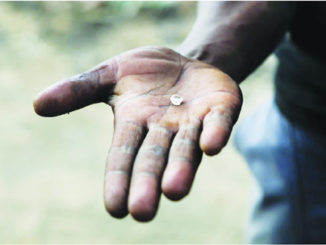
    Panna (TIP): For the sixth time in two years, a farmer in Panna district of Madhya Pradesh has mined a high-quality diamond – this time weighing 6.47 carat – in a land taken on lease from the government.

    Prakash Majumdar found the diamond from a mine at Jaruapur village on Friday, said Nutan Jain, in-charge diamond officer. The 6.47 carat diamond would be put up for sale in the upcoming auction and the price would be fixed as per the government guidelines, she said.

    Majumdar said he would share the amount received from the auction with his four partners engaged in quarrying the mine.

    “We are five partners. We got the diamond weighing 6.47 carat, which we deposited at the Government Diamond Office,” he told reporters on Friday.

    He said he had found a 7.44 carat diamond last year. Besides, he had also mined four other precious stones weighing 2 to 2.5 carat in the past two years. Officials said the raw diamond would be auctioned and the proceeds would be given to the farmer after deduction of government royalty and taxes.

    As per the private estimates, the 6.47 carat diamond is likely to fetch around Rs 30 lakh.

    Panna district is estimated to have diamond reserves of 12 lakh carat. The state government gives small patches of land on lease in Panna diamond reserve area to local farmers and labourers to mine diamonds and deposit them with the district mining officer.   Source: PTI

  • Govt introduces new registration mark under BH-series for new vehicles

    The Government introduced a new registration mark for new vehicles under the “Bharat series (BH-series)” to facilitate seamless transfer of vehicles, informed the Ministry of Road, Transport and Highways on Saturday. “Government has taken a host of citizen-centric steps to facilitate mobility. An IT-based solution for vehicle registration is one such effort. However, one of the pain points in the vehicle registration process that needed attention was re-registration of a vehicle while moving to another state,” said the Ministry in a statement. Station relocation occurs with both Government and private sector employees. Such movements create a sense of unease in the minds of such employees with regard to the transfer of registration from the parent state to another state as, under section 47 of the vehicles-act”>Motor Vehicles Act, 1988, a person is allowed to keep the vehicle for not more than 12 months in any state other than the state where the vehicle is registered, but a new registration with the new state- registering authority has to be made within the stipulated time of 12 months. A passenger vehicle user takes steps to re-register a vehicle including no objection certificate from the Parent State for assignment of a new registration mark in another state; Assignment of new registration mark after the road tax on pro-rata basis is paid in the new State and Application for refund of the road tax in the parent State on pro-rata basis. This provision to get a refund from the parent State on a pro-rata basis is a very cumbersome process and varies from one State to another.

  • BRICS nations call for differentiated responsibilities on climate change

    BRICS nations call for differentiated responsibilities on climate change

    New Delhi (TIP): The BRICS nations—Brazil, Russia, India, China and South Africa, released a New Delhi Statement on Environment at the 7th meeting of BRICS environment ministers on Friday, Aug 27, emphasising the principle of Common but Differentiated Responsibilities and Respective Capabilities (CBDR-RC) that means countries will act on climate change based on their respective capabilities.

    The statement said BRICS countries will cooperate closely ahead of the critical UN climate change negotiations (COP 26) and underlined that developed countries will have to honour their financial commitment of USD 100 billion per year to developing countries for climate change mitigation. “We agree to cooperate closely in the run up to the 26th Conference of the Parties to the United Nations Framework Convention on Climate Change (UNFCCC COP26) in the United Kingdom and the 15th meeting of the Conference of Parties to the Convention on Biological Diversity (CBD COP15) in China. We took note of the Intergovernmental Panel on Climate Change (IPCC) Working Group 1 contribution to the Sixth Assessment Report and noted that it is a clarion call for rapid, sustained and effective science-based responses to climate change,” the statement said.

    “We underscored the need to honour the commitments made by developed countries in the pre-2020 period even as we have moved into the post-2020 era, including the yearly US$ 100 billion goal for climate finance. We noted with grave concern the proposals for introducing trade barriers, such as unilateral carbon border adjustment, that are discriminatory,” it added. On March 10, the European Parliament adopted a resolution titled: “A WTO-compatible EU carbon border adjustment mechanism” which will put a carbon price on imports of a targeted selection of products so that ambitious climate action in Europe does not lead to ‘carbon leakage,’ according to the European Commission.

    The ministers acknowledged the importance of global action against climate change by recognizing the “fundamental equality of all people in accessing economic growth and sustainable development.” The statement also acknowledged the need to address marine plastic litter, cleaning of rivers, biodiversity and forest cover management.

    Union environment minister, Bhupender Yadav who chaired the meeting stated that India gives great importance to BRICS—”2021 is a very crucial year not only for the BRICS but for the whole world as well, as we have UN Biodiversity COP 15 in October and UNFCCC COP 26 in November. BRICS Countries can play a very significant role in addressing the contemporary global challenges of climate change, biodiversity loss, air pollution, marine plastic litter, etc.”         Source: HT

  • Air taxis will be possible in coming days under drone rules

    Air taxis that will traverse the airspace instead of roads will be very much possible in the coming days under the drone rules announced on Thursday, Civil Aviation Minister Jyotiraditya Scindia said. “Air taxis are being researched and invented globally and many startups are coming up,” the minister said during a press conference here. “That time is not far when taxis, like the ones of Uber etc that you see on roads, you will see in the air under the drone policy. I believe this is very much possible,” he added. The minister said that the Defence Ministry, the Home Ministry and BCAS (Bureau of Civil Aviation Security) have been working together so that “counter rogue drone technology” can be developed and adopted quickly. In a notification dated August 25, the Ministry of Civil Aviation eased the rules regarding drone operations in the country by reducing the number of forms that need to be filled to operate them from 25 to 5 and decreasing the types of fees charged from the operator from 72 to 4.

  • Chhattisgarh Congress crisis: Bhupesh Baghel CM for now, shows his strength but not all-clear yet

    Bhupesh Baghel will continue as Chief Minister of Chhattisgarh “for the time being” and the proposal to replace him with T S Singh Deo, in line with the formula of rotational chief ministership agreed upon by the two in 2018, was “not a closed chapter,” sources in the Congress said Friday after Baghel met Congress leader Rahul Gandhi for more than three hours amid an unprecedented show of strength by him in New Delhi. The Congress leadership, sources said, was miffed with the Chief Minister for bringing over 40 MLAs including ministers — one of them claimed they totalled 51 — to New Delhi to demonstrate his support despite a clear direction from the high command not to do so. The Congress has 70 MLAs in the 90-member Assembly. Baghel was told to send back the MLAs immediately, sources said. Neither Gandhi nor AICC general secretary (organisation) K C Venugopal met the MLAs. All eyes are now on Gandhi, who the Chief Minister said will be visiting Chhattisgarh next week. Sources said the party leadership is still keen on implementing the rotational chief minister formula and hopes that Baghel will honour it. “He will continue as Chief Minister for the time being,” a senior leader told The Indian Express when asked about the outcome of the meeting. On the rotational chief minister formula, the leader said “it is not a closed chapter.”

  • With 46,759 Covid-19 cases, India sees highest single-day rise in 2 months

    With 46,759 Covid-19 cases, India sees highest single-day rise in 2 months

    New Delhi (TIP): India on Saturday, Aug 28,  reported 46,759 new cases of coronavirus disease—the highest in nearly two months—pushed mainly by the surge in Kerala, according to the Union ministry of health and family welfare. The fresh infections have now taken the nationwide tally to 32,649,947, while the death toll climbed to 437,370 with 509 daily fatalities, the health ministry data showed. This is the third consecutive day that India is seeing more than 40,000 daily Covid-19 cases.

    Union health secretary Rajesh Bhushan has asked Kerala and Maharashtra to consider night curfews in areas with high infection numbers. The southern state logged 32,801 cases on Friday, up from 30,007 on Thursday and the test positivity rate stood at 19.22 per cent, an increase from 18.03 per cent on August 26. Kerala has accounted for more than half of the total active cases, followed by 16 per cent in Maharashtra.

    Active cases rose by 14,876 to stand at 359,775 in the same period, according to data released by the health ministry at 8am. Active cases constitute 1.06 per cent of total cases, the lowest since March 2020, and the national Covid-19 recovery rate stands 97.6 per cent, the Union health ministry said.

    As many as 17,61,110 Covid-19 tests were conducted on Friday, taking the total number of tests conducted so far to 51,68,87,602. The number of people who have recuperated from the disease surged to 31,852,802 while the case fatality rate stands at 1.34 per cent, it said.

    Meanwhile, India on Friday administered more than 10 million doses of the Covid-19 vaccine in a single day across the nation for the first time since the start of the mass inoculation programme on January 16, according to data on the Union health ministry’s Co-WIN dashboard. “Record vaccination numbers today! Crossing 1 crore is a momentous feat. Kudos to those getting vaccinated and those making the vaccination drive a success,” Prime Minister Narendra Modi tweeted on Friday night.

    More than 40.5 million Covid-19 vaccine doses are still available with states and Union territories for inoculation, the Union health ministry said on Friday. Over 588.6 million vaccine doses have been provided to the states and Union Territories so far, the ministry said in a statement. The Covid-19 vaccination drive has been ramped up through the availability of more vaccines, advanced visibility of vaccine availability to states and Union Territories for enabling better planning by them and streamlining the vaccine supply chain.    Source: HT

  • Installation of Shri Guru Granth Sahib

    Installation of Shri Guru Granth Sahib

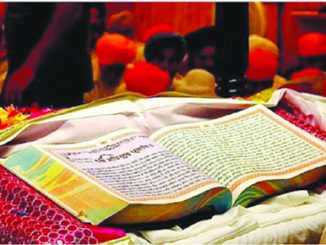
    The compilation of the Sikh scripture Shri Guru Granth Sahib  was completed on 29 August, 1604, and was first  installed inside the Golden Temple in Amritsar on 1 September, 1604

    One of the classic simplifications of Sikh history pertains to the preparation of the sacred scripture, the Guru Granth Sahib. The event is generally described in the briefest terms.

    The Holy Volume was compiled by Guru Arjan (A.D. 1563-1606) and the first copy was calligraphed by Bhai Gurdas at his dictation-this is all we learn from most of the sources.

    What amount of planning, minute attention to detail and labour went into this work is slurred over. An old text which gives some detailed information is the Gurbilas Chhevin Patshahi. Written in AD. 1718, this, in fact, is the oldest source. Although it does not go into the technical and literary minutiae, it narrates the entire process from the beginning of the transcription of the Holy Volume to its installation in the newly built Harmandir Sahib (Golden Temple) at Amritsar.

    Why Guru Arjan undertook the task is variously explained. One commonly accepted assumption is that the codification of the Gurus’ compositions into an authorized volume was begun by him with a view to preserving them from garbling by schismatic groups and others. According to the Mahima Prakash (AD. 1776), he set to work with the announcement : As the Panth (Community) has been revealed unto the world, so there must be the Granth (Book), too. The bani, Gurus’ inspifed utterance, had always been the object of highest reverence for the Sikhs as well as for the Gurus themselves. It was equated with the Guru himself. The bani is the Guru and the Guru bani, sang Guru Ram Das in measure Nat Narain. By accumulating the canon, Guru Arjun wished to affix the seal on the sacred word. It was also to be the perennial fountain of inspiration and the means of self-perpetuation for the community.

    Guru Arjan called Bhai Gurdas to his presence and expressed to him the wish that the compositions of the Gurus as well as those of some of the saints and sufis be collected. Massages were sent to the disciples to gather and transmit to him the hymns of his predecessors.

    Baba Mohan, son of Guru Amar Das, Nanak III, had two manuscript collections of the Gurus’ hymns inherited from his father. Bhai Gurdas travelled to Goindwal to bring these pothis, but the owner refused to see him. Bhai Buddha, one of the oldest Sikhs from Guru Nanak’s days, was similarly turned away from his door. Then Guru Arjun went himself. He sat in the street below Mohan’s attic serenading him on his tambura. Mohan was disarmed to hear the hymh. He came downstairs with the pothis and presented these to the Guru. As says the Gurbilas, the pothis were placed on a palanquin bedecked with precious stones. The Sikhs carried it on their shoulders and Guru Arjun walked behind barefoot. He refused to ride his horse, saying that the pot his were the very spirit of the four Gurus-his predecessors.

    The cavalcade brokejourney at Khadur Sahib to make obeisance at shrines sacred to Guru Angad. Two kos from Amritsar, it was received by Hargobind, Guru Arjan’s young son, accompanied by a large number of Sikhs. He bowed at his father’s feet and showered petals in front of the pot his. Guru Arjan, Hargobind, Bhai Gurdas and Bhai Buddha now bore the palanquin on their shoulders and marched towards Amritsar, led by musicians, with flutes and drums. In Amritsar, Guru Arjun first went to the Harimandir to offer karah prasad in gratefulness.

    The making of the Granth was no easy task. It involved sustained labour and a rigorous intellectual discipline. Selections had to be made from a vast amount of material. Besides the compositions of the four preceding Gurus and the Guru Arjan who him self was a poet with a rare spiritual insight, there were songs and hymns by saints, both Hindu and Muslim. What was genuine had to be sifted from what was counterfeit. Then the selected material had to be assigned to appropriate musical measures and transcribed in a minutely laid out order.

    Guru Arjan carried out the work with extraordinary exactness. He arranged the hymns in thirty different ragas, or musical patterns. A precise method was followed in setting down the compositions. First came sabdas by the Gurus in the order of their succession. Then came chhands, vars, and other poetic forms in a set order. The compositions of the Gurus in each raga were followed by those of the Bhaktas in the same format. Gurmukhi was the script used for the transcription.

    A genius, unique in spiritual insight and not unconcerned with methodological design, had created a scripture with an exalted mystical tone and a high degree of organization. It was large in size-nearly 7,000 hymns, comprising compositions of the first five Sikhs Gurus and fifteen Bhaktas and sufis from different parts of India, including Shaikh Farid, Kabir and Ravidas. The Sacred Volume consisted of 974 leaves, or 1948 pages, 12×8, with several blank ones at the end of a raga when there were not sabdas enough to fill the section assigned to it. The site of these marvellous labours is now marked by a shrine called Ramsar.

    The completion of the Granth Sahib was celebrated with much jubilation. In thanksgiving, karah prasad was prepared in huge quantities. Sikhs came in large numbers to see the Holy Book. They rejoiced in their hearts by a sight of it and bowed before it in veneration. Among the visitors was Bhai Banno, who had led a group of Sikhs from Mangat, in western Punjab. Guru Arjan, who knew him as a devoted Sikh, instructed him to go to Lahore and have the Book bound. Banno sought the Guru’s permission to be allowed to take the Granth Sahib first to Mangat for the Sikhs there to see it. The Guru allowed this, but enjoined him not to tarry at Mangat, or at any other place, more than a night.

    As Banno left Amritsar with his sacred charge, it occurred to him o have a second copy transcribed. The first copy, he argued, would remain with the Guru. There must be an additional one for the sangat. The Guru’s direction was that he should not stay longer than one night at a place, but he had said nothing about the time to be spent on the journey. So he proceeded with his plans and sent a Sikh to purchase paper. He proposed to his companions that they should travel by easy marches of five miles a day. The time thus saved was utilized in transcribing the holy text. Sikhs wrote with love and devotion and nobody shirked his duty whether it was day or night. By the time they reached Lahore, the second copy was ready. But Banno had added to it some apocryphal texts. He had both volumes bound and returned to Amritsar as fast as he could.

    At Amritsar, he was received with due ceremony, though Guru Arjun was not a little surprised to see two volumes instead of one. Bhai Banno spoke truthfully: Lord, there is nothing that is hidden from you. This second copy I have had made for the sake of the sangat. But the Guru put his seal only on the volume written by Bhai Gurdas’s hand. He enjoined the Sikhs to own the Granth equal with the Guru and make no distinction between the two. He who would wish to see the Guru, let him see the Granth. He who would seek the Guru’s word, let him read the Granth with love and attention.

    Guru Arjan asked his Sikhs where the Granth Sahib be installed. Bhai Buddha said, You are omniscient, Master! But there is no place more suitable than the Harimandir. The Guru was happy to hear these words like one who has sighted the new moon. He then recited the praise of the Harimandir: There is nothing like it in all the three worlds. Harimandir is like the ship-the means for the people to cross over the worldly ocean triumphantly. A new joy pervades here every day. A sight of it annuls all sins.,’

    It was decided to spend the night at Ramsar and return to Amritsar the next morning. The Granth Sahib rested on a seat under the canopy, whereas the Guru and the Sikhs slept on the ground.

    A disciple had to be chosen to take charge of the Granth Sahib. As says the Gurbilas, Guru Arjan lay awake through the night reflecting on the question. His choice finally fell on Bhai Buddha whose devotion was universally applauded. As they awoke, the Guru and his Sikhs made ablutions in Ramsar. The former thereupon practised his wonted meditation. At dawn, the entire sangat marched towards Harmandir Sahib. Bhai Buddha carried the Holy Book on his head and Guru Arjun walked behind swinging the whisk over it. Musicians sang sabdas. Thus they reached the Harimandir. The Granth Sahib was ceremonially installed in the centre of the inner sanctuary on Bhadon Sudi 1, 1661 BK/August 16, 1604. Bhai Buddha opened it with reverence to obtain from it the divine command, as Guru Arjan stood in attendance behind.

  • Global COVID-19 caseload tops 215 mn

    Global COVID-19 caseload tops 215 mn

    Washington (TIP): The global coronavirus caseload has topped 215 million, while the deaths have surged to more than 4.48 million and vaccinations soared to over 5.12 billion, according to the Johns Hopkins University.

    In its latest update on Saturday, Aug 28,  morning, the University’s Center for Systems Science and Engineering (CSSE) revealed that the current global caseload, death toll and vaccination tally stood at 215,357,973, 4,484,434 and 5,123,427,298, respectively.

    The US continues to be the worst-hit country with the world’s highest number of cases and deaths at 38,700,164 and 636,667, respectively, according to the CSSE. In terms of infections, India follows in the second place with 32,603,188 cases.

    The other worst countries with over 3 million cases are Brazil (20,703,906), France (6,778,133), Russia (6,747,681), the UK (6,697,770), Turkey (6,311,607), Argentina (5,167,733), Colombia (4,901,163), Iran (4,869,414), Spain (4,831,809), Italy (4,517,434), Indonesia (4,056,354), Germany (3,925,190) and Mexico (3,291,761), the CSSE figures showed. In terms of deaths, Brazil comes second with 578,326 fatalities.

    Nations with a death toll of over 100,000 are India (436,861), Mexico (256,287), Peru (198,031), Russia (176,904), the UK (132,566), Indonesia (130,781), Italy (129,002), Colombia (124,648), France (114,291), Argentina (111,270) and Iran (105,287).

  • Over 3,000 Covid cases reported across LA schools

    More than 3,000 coronavirus cases have been reported across Los Angeles County K-12 schools, the county’s public health director reported on Thursday, Aug. 26, offering an early snapshot of the status of local schools in protecting against on-campus transmission of the delta variant.

    “The early data we have on schools is somewhat sobering,” said Public Health Director Barbara Ferrer during a public briefing. The data, measured between Aug. 16 and Aug. 22 as students came back to campus en masse for the first time in more than a year, revealed that most of county’s new cases were reported in the mammoth Los Angeles Unified School District. At LAUSD sites, 2,666 cases were reported, with another 484 posted at K-12 sites across the county, officials said.

    Most school sites reported only one case. But 15 LAUSD sites — where all students are tested weekly, per the district’s assertive policies aimed at slowing the virus’ spread — and 48 other school sites reported two cases; 84 LAUSD school sites and 39 other school sites across the county reported three or more cases.

    So far, even the schools that have reported at least three cases have not necessarily been determined to be outbreak sites, as defined by county Public Health.

  • Simple ways to reduce stress in the workplace

    Simple ways to reduce stress in the workplace

    Stress is one of the most daunting obstacles to employee engagement in the modern workplace. Workload, lack of job security, and personnel problems gang up on and overwhelm employees, dragging down their satisfaction levels. In fact, the negative consequences from stress are so strong that it has been declared a World Wide Epidemic by the World Health Organization. Greater physical activity at the office can help reduce psychological stress during after work hours, a new study reveals. Workers in open office seating had less daytime stress and greater daytime activity levels compared to workers in private offices and cubicles, according to new research led by the University of Arizona. This is the first known study to investigate the effects of office workstation type on these objective measures. The study evaluated 231 people who work in federal office buildings and wore stress and activity sensors around the clock for three workdays and two nights. The intent was to evaluate the workers’ activity and stress levels both inside and outside of the office environments. The study showed that workers in open bench seating arrangements were 32% more physically active at office than those in private offices and 20% more active than those in cubicles. Significantly, workers who were more physically active at office had 14% less physiological stress after working hours as compared to those with less physical activity at work. “This research highlights how office design, driven by office workstation type, could be an important health-promoting factor,” said senior study author Sternberg. Office workers are at a particularly high risk for low levels of physical activity and the associated poor health outcomes. According to a 2015 report published by the U.S. Centers for Disease Control and Prevention, workplace-related illnesses cost the U.S. economy more than 225 billion USD a year.

  • Kale pakoda chaat

    Ingredients

    –              Kale leaf 400gms

    –              Mint chutney 50gms

    –              Saunth chutney 50gms

    –              Yoghurt 50gms

    –              Sugar syrup 20 ml

    –              Red chili powder 5 gms

    –              Chat masala 5gms

    –              Besan (Chickpea flour) 100gms

    –              Rice flour 50gms

    –              Corn flour 25gms

    –              Salt to taste

    –              Pomegranate seeds 20gms

    –              Sev 10gms

    –              Green coriander to garnish

    –              Ajwain 5gms

    –              Turmeric powder 5gms

    –              Refined oil for fry

    Method

    –              Batter – Add besan, rice flour and corn flour in a bowl and mix well. After mixing, add salt, turmeric powder, red chilli powder and ajwain. Add water and make a smooth batter of the mixture.

    –              Blanch the kale leaves, cool it in ice water and then dry with paper towel. Heat oil in a frying pan. Fry the leaves with batter till it become crispy and golden brown. Mix yogurt with sugar syrup, to make the yogurt sweet.

    –              Chaat – Keep the fried kale leaves in a serving plate. Pour mint chutney, tamarind chutney and sweet yoghurt on top. Sprinkle chaat masala.

  • Chilli garlic noodles

    Chilli garlic noodles

    It is a popular indo-chinese noodles recipe prepared with fresh hakka noodles with garlic and chilli flavour. it is a perfect starter recipe for your next party or for any birthday celebrations. it is ideally served by itself without any side dish but tastes good with chilli paneer or gobi manchurian gravies.

    Ingredients

    –              Noodles – 1/2 cup, cooked

    –              Onions – 1/2 cup, chopped

    –              Carrot – 1/2 cup, grated

    –              Ginger Garlic Paste – 1 tblsp

    –              Chilli Paste – 1/2 tblsp

    –              Coriander Leaves – handful, chopped

    –              Oil – 2 tblsp

    –              Salt – as per taste

    Method

    –              Heat oil in a pan over moderate flame.

    –              Add the onions, carrot, ginger garlic paste, salt and chilli paste.

    –              Stir to mix well.

    –              Add the noodles and mix well to combine all ingredients. Garnish with coriander leaves.

    –              Serve warm.

  • ‘He is full of energy, let him flourish’: Boycott calls India pacer Siraj an ‘asset’

    ‘He is full of energy, let him flourish’: Boycott calls India pacer Siraj an ‘asset’

    The Indian bowlers put up quite the show on the final day of the Lord’s Test which helped the team bundle England out for 120 in chase of 272. India required 51.5 overs to skittle the hosts and register a memorable win at Lord’s to go 1-0 up the five-Test series with Mohammed Siraj and Jasprit Bumrah sharing seven wickets to inflict the bulk of the damage.

    Ravindra Jadeja once again went wicketless in the match, which means this was only the third instance in history – twice in two matches – that all 20 wickets in a Test match were claimed by India’s pacers. If at Trent Bridge, it was Bumrah who made the noise by picking up a five-for in the second innings and thus, finishing the match with a nine-wicket-haul, at Lord’s, it was pacer Siraj, who shone through.

    Siraj picked up eight wickets in the Test – 4/94 and 4/32 – to emerge as India’s standout bowler. Watching the youngsters excel has left former England captain Geoffrey Boycott highly impressed. Siraj is not even a year into his Test career but Boycott feels the fast bowler has turned into an ‘asset’ for the team.

    “I like Siraj. He is full of energy. No one should tell him to curb anything. Let him flourish in his own way. He’s an asset for India, although he is fairly new,” Boycott told mid-day from the UK on Wednesday.

    Boycott reflected on the atmosphere that exists within the Indian team, adding that the positivity around the unit is amazing to watch. This was most visible when India’s ninth-wicket pair of Jasprit Bumrah and Mohammed Shami – who had added an unbeaten 89-run partnership – headed back to the change room during the lunch interval on Day 5, as the group of Indian players had come down from the balcony to welcome the batting pair with claps and cheers.

    “I liked the way the Indian team rallied around each other. When Mohammed Shami and Jasprit Bumrah were batting [during their match-defining 89-run stand], the whole team was shouting from the balcony. They even came down to receive them. These things bring about solidarity,” Boycott pointed out.

    Source: HT

  • Australia name full-strength squad in search of elusive T20 World Cup title

    Steve Smith, David Warner and Pat Cummins were on Thursday recalled as Australia named a full-strength squad in search of an elusive ICC T20 World Cup title later this year.

    The 15-man Australia squad for the showpiece, to be held in Oman and the UAE in October, is a mixture of pace, spin and hard-hitters keeping in mind the slow, spin-friendly conditions of the pitches in the UAE.

    The trio had opted out of Australia’s limited overs tour of the West Indies and Bangladesh recently.

    In a major development, Australia has included uncapped Josh Inglis as a backup to wicketkeeper Matthew Wade.

    Inglis, who is yet to make his international debut, has been chosen ahead of Alex Carey and Josh Philippe.

    Having dominated the ODI World Cup with record five titles and two runner-up finishes, Australia would be eager to break their jinx in the T20 World Cup.

    Australia has endured a poor run in the T20 format of late, losing back-to-back series to West Indies and Bangladesh recently.

    But the return of Marcus Stoinis, Glenn Maxwell, Warner, Cummins, Smith and Kane Richardson after opting out of recent white-ball tours of the West Indies and Bangladesh, will add much-needed firepower to Australia’s team.

    Smith has been included despite his ongoing elbow injury, while limited overs skipper Aaron Finch, who missed the Bangladesh series to undergo knee surgery, is expected to be fit on time for the tournament.

  • U20 World championship: Indian 4×400 quartet wins bronze

    U20 World championship: Indian 4×400 quartet wins bronze

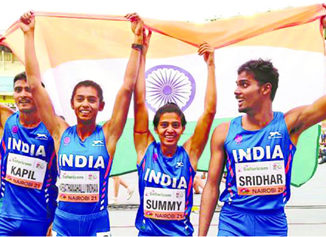
    New Delhi (TIP): The mixed relay team of Barath S, Priya Mohan, Summy and Kapil gave the Indian contingent a perfect start at the athletics U20 World Championships in Nairobi, Kenya, on Wednesday, August 18.

    The quartet opened India’s account with a season’s best timing of 3 minutes, 20.60 seconds to clinch a creditable bronze medal in the mixed 4×400 metres relay event.

    The Nigerian team won the gold medal with a championships record of 3:19.70, while the Polish quartet won the silver medal with a season’s best timing of 3:19.80.

    Interestingly, the final was the third race for both Priya and Summy. After running the first heats as part of mixed team, where the team briefly held the championship record with a timing of 3:26.36, the duo also took part in the women’s 400m individual heats. “We were OK after the first heat in the morning. I only pushed my body 80 per cent,” Priya said during the press meet organised by the Athletics Federation of India (AFI).

    “I felt a little tightness after the second race but our team physio and support staff got us ready for the race and I was happy and proud to win this medal as this was a first final for many of us,” she added.

    The Indian team switched Abdul Razak Rasheed, who ran in the morning heats, with Barath for the finals and it paid off for the team. Chief coach Kamal Ali Khan said Rasheed was a shade slower than Barath and it was necessary to change the team for the finals.

    “We knew that we would be on the podium with a start of 47 seconds in the final. Rasheed has been clocking 48 seconds throughout and so we had to change the team. The strategy worked and I want to thank AFI for giving me the freedom to make the change,” Khan said.

    Barath, who is the Federation Cup junior champion, had been carrying an ankle injury and had to be patched up by the support staff before the race.

    “I was told not to run but the support staff worked throughout the day to get me ready for this race. If not for them I would not have realised my dream of winning a medal for the country,” he said.

  • Plasterers Recruit Apprentices

    WHITESTONE, NY (TIP):  Northeast District Council of the OPCMIA apprenticeship fund will conduct a recruitment from September 20, 2021 through October 1, 2021 for one Plasterer apprentice, the New York State Department of Labor announced, July 1, 2021.

    Applications must be completed on site at the OPCMIA apprenticeship fund office, 150-50 14th Road, NY, from 9:00 a.m. to 2:00 p.m., Monday through Friday, during the recruitment period. This is a limited-application recruitment. Only 100 applications will be distributed, on a first-come, first-serve basis. The recruitment will be offered for 10 business days or until 100 applications have been issued, whichever comes first.

    The Committee requires that applicants:

    Must be at least 18 years old. Proof will be required after selection and prior to enrollment in apprenticeship.

    Must have a high school diploma or a high school equivalency diploma (such as TASC or GED).

    Must pass a physical agility test by scoring at least 28 out of 35 possible points. The test includes:

    Lifting two “legs” (4x4x8 Lumber, Total 52lbs), placing them on a shoulder, carrying them for approx. 75 feet and placing them neatly back on floor.

    Lifting two ribs (3x4x14 Lumber 70lbs), placing them on a shoulder, carrying them for approx.75 feet and placing them neatly back on floor.

    Lifting two #8 bars (One inch in diameter steel rods 85lbs) placing it on a shoulder, carrying it approx.75 feet and placing it neatly back on floor.

    Lifting one bag of Portland cement (94lbs), placing it on a shoulder, carrying it approx.75 feet and placing it neatly back on floor.

    Lifting one rubber concrete pump hose (60lbs), placing it on a shoulder, carrying it approx.75 feet and placing it neatly back on floor.

    Lifting one steel concrete pipe (80lbs), placing it on a shoulder, carrying it approx.75 feet and placing it neatly back on floor.

    Filling a 16 cubic foot wheelbarrow with ¾’ gravel, walking with it approx. 50 feet and dumping it neatly back into the original pile.

    Must have reliable transportation to and from job sites and required classes at the approved school.

    Must pass a drug screening, at the expense of the sponsor, after selection and prior to enrollment in apprenticeship.

    Must provide DD Form 214, Certificate of Release or Discharge from Active Duty, if applicable, after selection and prior to enrollment in apprenticeship program.

    For further information, applicants should contact OPCMIA apprenticeship fund at (718) 357-3750. Additional job search assistance can be obtained at your local New York State Department of Labor Career Center (see: https://dol.ny.gov/career-centers).

    Apprentice programs registered with the Department of Labor must meet standards established by the Commissioner. Under state law, sponsors of programs cannot discriminate against applicants because of race, creed, color, national origin, age, sex, disability, or marital status. Women and minorities are encouraged to submit applications for apprenticeship programs. Sponsors of programs are required to adopt affirmative action plans for the recruitment of women and minorities.

  • Sri Lanka to impose 10-day nation-wide lockdown from Friday night

    Sri Lanka to impose 10-day nation-wide lockdown from Friday night

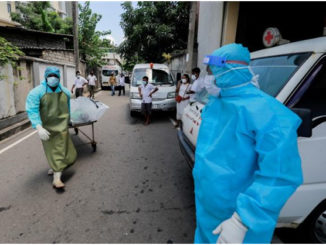
    Colombo (TIP): Sri Lankan President Gotabhaya Rajapaksa has ordered a 10-day nation-wide lockdown from August 20 night, amidst mounting pressure from medics and the powerful Buddhist clergy to curb the raging third wave of Covid-19 infection.

    The National Operations Centre for Covid Prevention said that the lockdown would start from August 20 10 pm till 4 am of August 30.

    “The quarantine curfew will be in force from 10 pm tonight until 4 am on August 30,” Army chief Gen. Shavendra Silva, who is also the head of National Operations Centre for Covid Prevention, told reporters here. Rajapaksa earlier refused to heed to calls by medics as coronavirus infections overwhelmed hospitals, morgues and crematoriums. He held that closing down the country was badly impacting the island’s fragile economy. However, he was compelled to relent as the powerful Buddhist clergy and his own political alliance members demanded the lockdown in view of the grave situation facing the island nation.

    On Thursday, the daily death toll due to Covid-19 hit a record 186. The country also reported 3,800 fresh cases, another record.

    Official figures show 6,790 people have died of the virus while 373,165 have been infected so far.

    Health experts say the Western province with the capital district of Colombo was the worst hit. Over 75 per cent of the cases in Colombo were from the rapidly spreading Delta variant.

    This will be the first time since mid-June that the country will be re-imposing a lockdown. The ongoing third wave of infections is blamed on the traditional Sinhala and Tamil New Year celebrations held in mid-April.

    The stepped up vaccination drive was another reason why the government was not keen on re-imposing a lockdown.

    Over 5 million out of the 21 million population have been given two doses of a vaccine.

    Sri Lanka, which has witnessed a series of lockdowns and curfews to contain the spread of Covid-19 in the country, has been impacted in terms of its economy. Tourism sector, which generates a huge quantum of revenue for the island nation, has seen a drastic fall. — PTI


  • Pak’s ‘iron lady’, who treated hundreds of victims of crisis situations, calls it a day

     Karachi (TIP): Its curtains down for Pakistan’s “iron lady” Dr Seemin Jamali, who has treated hundreds of victims of terror attacks and other crisis situations in her over three decades of service and takes pride in how she has been able to tide over all the challenges she has faced during her tenure.

    Having served at the state-run Jinnah Postgraduate Medical Centre (JPMC) in various capacities for 33 years, her name is synonymous with the emergency ward at the hospital located near the central cantt area of Karachi in Sindh province.

    “It has been a very fulfilling journey for me because while we saw hundreds of lives sniffed out, we also saved thousands in the emergency ward,” she said during her retirement ceremony on Thursday.

    During her service, she has treated hundreds of bomb blast, terror attack, building collapse victims in the emergency ward.

    Dr Jamali, who is also known as the “bullet lady” or “bomb-proof lady”, has also faced threats to her life, attacks and targeted campaigns aiming to malign her because of her position.

    “I don’t think I would have been able to manage all these years without the support of my family,” Jamali, who retired as the Executive Director at the JPMC, said adding that her life was in the emergency ward.

    JPMC is the city’s largest tertiary care hospital and its emergency ward treats up to 2,000 patients on an average daily and almost all are tended to free of charge.

    “It is not only about the daily care at the emergency ward. I am proud of the way we have responded when hundreds of people have been brought here from bomb blasts, terror attacks, plane crashes, building collapses, fires or mob violence,” she said.

    “It is about how we did respond when under pressure dealing with angry relatives, families, political parties, shortage of medicines, beds and what not,” she said.

    She was also diagnosed with colon cancer last year but she continued working and successfully managed to get treatment and defeat it as well. PTI

  • Nepal’s largest communist party splits

    Kathmandu (TIP): Nepal’s main opposition CPN-UML, the largest communist party in the country, has officially split, with one of its factions led by dissident leader Madhav Kumar Nepal applying for registering a new political party after the government backed a controversial ordinance to make it easier for political parties to split.

    Nepal on August 18 submitted an application at the Election Commission (EC), for registering a new political party named CPN-UML (Socialist). Earlier on August 18, on the recommendation of the Council of Ministers, President Bidya Devi Bhandari issued an ordinance to amend the Political Parties Act, 2017, aimed at easing the procedure for political parties to split. The amendment ordinance stipulates that 20 per cent or more members of the parliamentary party and the central committee of a political party can split their mother party. — PTI

  • Malaysia ex-Dy PM poised to clinch premiership

    KUALA LUMPUR (TIP): Former Malaysian Deputy PM Ismail Sabri Yaakob moved closer on August 19 to forming the next government after securing a parliamentary majority from the same coalition that collapsed earlier this week. Muhyiddin Yassin resigned as PM on Monday after conceding he had lost support from his alliance, bringing to an end a fraught 17 months in office and throwing the country into further political chaos amid a Covid surge and economic slump.

    – Reuters