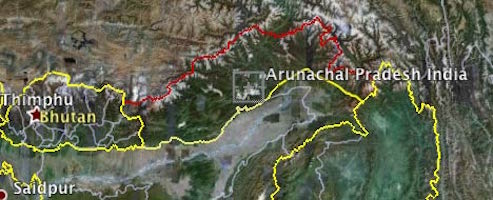
US Ambassador Eric Garcetti described Indo-US ties as “not an additive relationship but a multiplicative relationship” and criticised China for renaming places in Arunachal Pradesh.
Stating that China has no business renaming places that are part of India’s territory, Garcetti fully backed New Delhi and said its defence cooperation with Washington was reaching unprecedented levels so as to deter aggressive authoritarian rival countries. As two democracies, the US and India thought and felt alike about the threat posed by dictatorial regimes like that of China and that the convergence of values was the key factor driving Washington and New Delhi closer.
During an interactive session with students of the Sonepat-based OP Jindal University, Garcetti also took questions regarding comments made by US officials about internal developments in India. “The US is a unique democracy where every branch of government, the news media and civil society has its own views and opinions about different countries. These opinions are frequently aired publicly as part of the open American political system,” he explained.
Garcetti claimed that the US was ready to also take criticism from other countries as part of this liberal ethos.
Tag: Arunachal Pradesh
-

China has no biz renaming sites: US backs India on Arunachal Pradesh
-
India Gears Up for Historic General Elections: A Test of Democracy’s Integrity

By Prof. Indrajit S Saluja As India braces itself for what is anticipated to be the largest and longest general election in its history, the significance of the democratic process reverberates not only within the nation’s borders but resonates globally. With the Election Commission’s notification for the 18th Lok Sabha elections, slated to span from 19th April 2024 to 1st June 2024, India is poised to witness a monumental exercise in democratic participation.
The sheer scale of these elections is unprecedented. Covering a vast electorate of approximately 960 million eligible voters out of a population of 1.4 billion, this election surpasses any previous in terms of sheer magnitude. Seven phases will unfold over 44 days, excluding the first general election in 1951–52, marking a testament to the democratic ethos entrenched within the Indian polity.
Key to this election is the incumbent Prime Minister Narendra Modi, seeking a third consecutive term in office. Having completed two terms, Modi’s leadership faces scrutiny and endorsement from the Indian electorate once again. However, amidst the fervor of electoral campaigns and political rallies, a crucial aspect has emerged — the integrity of the electoral process.
In recent times, doubts have been cast upon the fairness of elections, with concerns surrounding Electronic Voting Machines (EVMs) and allegations of tampering to sway electoral outcomes. The Election Commission, tasked with safeguarding the sanctity of the electoral process, has faced mounting pressure to address these concerns. Calls for voter verification mechanisms and enhanced transparency in the electoral process have gained traction, echoing across the political spectrum.
Even India’s sitting Supreme Court Chief Justice, Chandrachud, has underscored these concerns, emphasizing the imperative of ensuring a transparent and accountable electoral process. In a democracy, elections serve as the cornerstone of representation, reflecting the will of the people. Thus, ensuring the integrity and fairness of elections is paramount to upholding the democratic fabric of the nation.
Simultaneously, the general elections coincide with legislative assembly elections in several states, including Andhra Pradesh, Arunachal Pradesh, Odisha, and Sikkim. These concurrent elections further underscore the magnitude and complexity of the electoral exercise, as millions of voters across the country prepare to cast their ballots. Moreover, the inclusion of by-elections for 35 seats across 16 states adds another layer of significance to the electoral landscape. These by-elections present an opportunity for constituents to voice their preferences and influence the composition of legislative bodies at both the state and national levels.
As the world watches with anticipation, the spotlight shines brightly on India, heralded as the largest democracy in the world. The forthcoming elections are not merely a domestic affair but hold implications for global democracy and governance. The manner in which India conducts its elections sets a precedent for other democracies worldwide, reaffirming the principles of transparency, accountability, and electoral integrity.
In the lead-up to the elections, political parties are engaged in a frenetic battle of ideas, canvassing support and articulating their vision for the future of the nation. From grassroots mobilization to high-profile rallies, the electoral landscape is awash with fervent political discourse and spirited campaigning.
However, amidst the cacophony of electoral politics, it is imperative to prioritize the integrity of the electoral process. Electoral malpractices, tampering with EVMs, and disenfranchisement of voters undermine the very foundation of democracy. Therefore, all stakeholders, including political parties, the Election Commission, and the incumbent government, must demonstrate a collective commitment to ensuring free, fair, and transparent elections.
Furthermore, the role of civil society, media, and international observers assumes heightened significance in safeguarding the integrity of the electoral process. Vigilance, accountability, and transparency must be upheld at every stage of the electoral cycle, from voter registration to the declaration of results.
The forthcoming general elections in India represent a pivotal moment in the nation’s democratic journey. As the world’s largest democracy, India has a responsibility to uphold the sanctity of the electoral process and set a precedent for democratic governance globally. With the eyes of the world upon it, India stands at the cusp of history, poised to reaffirm its commitment to democracy, justice, and the rule of law. As the electorate prepares to exercise its franchise, let us collectively strive to ensure that these elections reflect the true spirit of democracy — a celebration of diversity, inclusion, and the power of the people.
-

Assam: The land of blue hills, green valleys
Assam is a land of blue hills, green valleys and a red river — the majestic and sacred Brahmaputra. It is known for its famous tea, its silk and its biodiversity, and is also rich in archeological heritage. Assam is in the north eastern region of India, just below the eastern Himalayan foothills. It is surrounded by the states of Arunachal Pradesh, Nagaland, Manipur, Mizoram, Tripura and Meghalaya, which together with Assam are known collectively as the seven sisters, and by the nations of Bhutan and Bangladesh. The borders of China and Myanmar are within the range of 80 to 100 km.
THINGS TO DO
EXPERIENCE FESTIVAL CHEER
The festivals of a particular region are the mirrors that reflect the life and cultural orientation of the people. And thanks to a massive diverse cultural milieu and numerous habitant communities, Assam hosts a bevy of festivals across the year. These fiestas are the perfect time to be in the state as they offer the ideal opportunity to mingle with the locals and get close to their lives and habits. The main festival of Assam is Bihu and there are three distinct ways to celebrate it within a year – one in January, one in April and the other in September-October. The significance of Bihu lies in the fact that it is not a religious festival but a way to celebrate mother nature and the various stages of harvesting. Apart from Bihu, the people of Assam celebrate various other festivals – witness Kamakhya Temple in full glory during the Ambubachi Mela (June); be a part of the lives of the Bodos (one of Assam’s main tribes) in Baishagu (April) and enjoy the Mising (another tribe) hospitality in Ali Aye Ligang (mid February). Apart from these celebrations, Assamese people observe all the major Indian and global festivals like Diwali, Holi, Eid and Christmas; but yes, with a tinge of local flavor!
Embark on a Spiritual Sojourn
Assam with all its natural beauty and mystic charm is home to a unique spiritual mix. Not a frontline pilgrimage destination, the state, nevertheless has its set of temples, mosques, gurdwaras and churches. All the major religious faiths co – exist in the land and have grown into full – fledged ways of living with a set of indigenous spiritual leaders.
The tiny town of Hajo is an eternal example of communal harmony with Hinduism, Islam and Buddhism – all co – existing peacefully. Visit the Hayagriva Madhava Mandir, which is reminiscent of the Jagannath Temple in Puri; pay your respect at the Powa Mecca and witness the power of Shakti in Kamakhya Temple. Sikhism is not much prevalent in Assam but the town of Dhubri at the bank of the Brahmaputra houses a gurdwara (often called Dhubri Saheb) founded by Guru Teg Bahadur in 17th century. Find solace amid all these peaceful abodes and experience serenity.
Mystery hunt in Mayong
Who does not love a good tale of mystery with open ending? And the films of Christopher Nolan are not the only answer to it. Despite the growing information flow about the life and living in Assam, there is still a section of society as well as a section of travelers who are either apprehensive or intrigued by the scattered tales of the indescribable and indefinable. These stories are everywhere in the state but two places commend special mention if we talk about the unexplained mystery trail of Assam – Jatinga and Mayong.
A 40-km drive from Guwahati will lead you to the quiet and peaceful village of Mayong in Morigaon district; but the serenity of this place is more a veil of mystery than anything else. Often referred to as India’s magic capital, Mayong is (in)famous for the tales of people vanishing into thin air, fierce beasts being tamed as if they were a puppy and not a beast or humans being converted into animals and vice a versa. An outlaw of a place for many years, Mayong, of late, has gained prominence as a tourist destination and adventure seekers from all parts of the globe visit this eerie village. Another sleepy hamlet Jatinga is known for the mass bird suicides that take place from September to November every year.
Take the Heritage trails
An ancient land of myths and legends, it is no surprise that Assam has a rich repertoire of historical monuments with numerous mythological references attached to them. A cultural heritage aficionado or a history lover will have a field day while living some of the lesser known episodes and tales from Assam’s past amid ruined palaces and quiet architectural marvels. Icing on the cake – many of these remnants of the past have been keeping a low profile in the midst of soul – soothing natural beauty or fitness – testing highlands!
To warm up, you can start with a heritage walk along the alleys of old Guwahati and then move 41 kms north to Baihata Chariali that houses an archaeological site called Madan Kamdev. Take a trip to the culturally rich town of Sivasagar and stand witness to the finer side of the Ahom dynasty amid the Rang Ghar, the Charaideo hillock, Joy dol, Shiva dol, Kareng Ghar, Talatal Ghar and Sivasagar tank. Assam’s cultural capital, the town of Jorhat, is witness to many historical events in the state and is still a must – visit for a history chaser. The present town of Tezpur finds frequent reference in The Mahabharata and the love story of princess Usha (King Baana’s Daughter) and prince Anirudha (grandson of Lord Krishna) tickles the romantic hidden inside you; not to mention other tourist points like Agnigarh hill, Cole Park, Mahabhairab Temple and Hazara Pukhuri.
River cruise on the Brahmaputra
The river runs through the entire length of Assam but the stretch that touches Guwahati is the most highlighted one, courtesy the city’s commercial and political status and the famous Saraighat Bridge. The Brahmaputra divides the city into two parts while on its imposing journey from the Himalayan glaciers to the Bay of Bengal. After the completion of Saraighat Bridge, these waters were traversed just for fishing and coastline trading but the scene has changed drastically in the past decade or so. Now several ferry service providers offer laid-back river cruises for the travelers.
The Bharalu ghat and the Kachari ghat in the city are the main places from where you can book a cruise. Usually operated in the afternoon, these cruises last for two to three hours and take you along the majestic waters of the Brahmaputra. These ferries have sitting area for the guests and one can avail the food and beverage services onboard. Imagine yourself on one of these ferries with a cup of tea standing witness to the sunset on the crimson western sky!
Heritage walks in old Guwahati
There is a reason why the phrase – old is gold – exists in our vocabulary and the old Guwahati area further cements that saying. Though there is no specific new Guwahati on either maps or local lingo, we can recommend certain localities that will bring back the old world charm once you set foot in them. And we are referring to the literal meaning of the word ‘foot’ here as these vintage parts are best explored if you walk down its alleys and corridors. The major areas that fall under this bracket are?the academic hub of Panbazar, the colonial remnant Uzanbazar, the roads of Kharghuli, the entire area of Digholipukhuri and some parts of Aambari area. -

Arunachal is India’s part, says US resolution; condemns China’s aggression
Washington (TIP)- A bipartisan resolution was introduced in the US Senate on Thursday, February 16, to recognise Arunachal Pradesh as an integral part of India, pushing back against Beijing’s military aggression to change the status quo along the Line of Actual Control. The resolution condemns additional Chinese provocations, including China’s use of military force to change the status quo along the Line of Actual Control, construction of villages in contested areas, publication of maps with Mandarin-language names for cities and features in the Indian state of Arunachal Pradesh, and expansion of Beijing’s territorial claims in Bhutan.
The resolution says that China claims Arunachal Pradesh as its own territory, which it calls ‘‘South Tibet”, and has invoked these claims as part of its increasingly aggressive and expansionist policies.
“The United States recognises the state of Arunachal Pradesh not as a disputed territory but as an integral part of the Republic of India, and this recognition is not qualified in any way,” says the bipartisan resolution introduced by Senator Jeff Merkley, a Democrat, and Bill Hagerty, a Republican.
Senator John Cornyn, Co-Chair of the India Caucus, has co-sponsored the resolution. Pushing back against Chinese claims that Arunachal Pradesh is its territory, which is part of Beijing’s increasingly aggressive and expansionist policies, the Senate resolution reaffirms that the US recognises the McMahon Line as the international boundary between China and the Indian state of Arunachal Pradesh.
The line that was agreed to by Britain and Tibet as part of the 1914 Simla Accord is named after Sir Henry McMahon, foreign secretary of the British-run Government of India and the chief negotiator of settling disputes with China.
Source: PTI
-

Places to visit in September
Wondering about the best places to visit in September in India? If yes, then this is your quick guide to the best that India has on offer. And believe us, you will have a tough time choosing. Right from the misty, rolling hills of Munnar and the high Himalayas of Ladakh to the backwaters of Kerala and the ancient monasteries of Arunachal Pradesh, you can choose it all. While some surprise rain showers in September can set the roads just right for those scenic drives, the weather remains pretty much clear all along the month to make your vacation hassle-free.
Gangtok
Nestled in the lower Himalayas, the city of Gangtok has grown over the mountains and in the valleys. Seen from the skies or even from the ropeway, Gangtok shows a colourful facade against the backdrop of the snow-clad mountains. At one time, Gangtok was an important stop on the trade route between British India and Tibet. The Nathu La pass saw a constant stream of traders and travellers come across mountains on either side, bringing not only goods but religious texts and beliefs too. All that came to an end with the Indo-China war of 1962, which ended the independence of Tibet and closed its borders with India. In recent times, the situation has improved with the pass being opened for trade at regular intervals, and also with the route to Kailash being opened through this side. Things are looking up for Sikkim, and especially Gangtok. There is so much to see and do, that tourists are pouring in! Here are 10 places you must visit, if you are in Gangtok!
Nainital
You can choose from a myriad things to do in Nainital, Kumaon’s famous tourist destination. While boating at Naini Lake is a quintessential Nainital experience, you can go for a session of stargazing at the Aryabhatta Research Institute of Observational Sciences, ride up the ropeway to Snow View, go trekking up to Tiffin Top or get a sneak peek into Himalayan wildlife at the lesser known GB Pant Zoo. Evening strolls by the lakeside is, of course, a must do.
Gokarna
Gokarna, a sleepy little beach town, lies secluded off the national highway 17, which makes its way to Goa. Located very close to the Karnataka- Goa border, Gokarna has been a popular destination since the 70s and 80s when hippies found this hamlet to be more peaceful and serene than the vibrant Goa. It was then only known as a spiritual town on the western coast of Karnataka, which was popular for its Mahabaleshwar Temple. With the incessant flow of tourists, backpackers and foreign hippies, Gokarna has carved a niche for itself in the Indian travel circuit. Its serene and secluded beaches, tucked away from the crowd are the major attractions that bring hordes of visitors to this beach hamlet. Though there are many beaches, some accessible only through a trek or a catamaran ride, Om Beach has been extremely popular. With numerous shacks, hotels and cafes lined on Om Beach and Kudle Beach, Gokarna is an ideal place to relax and break away from the monotony of life.
Kullu-Manali
From the snowy delights of Rohtang Pass to the soothing warmth of the surrounding thermal springs, there are several places to visit in Kullu Manali for nature lovers and thrill seekers. With its picturesque views of snow-clad mountains, river valleys, charming cafes and laidback vibe, this hill station in Himachal Pradesh is an immensely popular vacation spot with both domestic and foreign tourists. Its widespread appeal draws everyone from adventure sport enthusiasts and vacationing families and honeymoon couples and hippie backpackers. Here are seven places you must visit during your holiday.
Munnar
There are plenty of interesting places to visit in and around Munnar. While nature lovers must visit places like Echo Point, Eravikulam National Park and Kundala Lake, there is a lot for culture buffs as well. The dolmens and rock paintings at Marayur near Munnar, and the Tea Museum that is one of the biggest tea estates in town, are great for some cultural and historical insight. Other than these, the lush green tea estates that line the roadside in Munnar are a no less attraction for those who can marvel at picture perfect scenic beauty.
Arunachal Pradesh
Arunachal Pradesh is one of the Seven Sister states in the lesser explored region of North East India. I had the pleasure of exploring this state for 11 days and seeing the best of the best! I’ve lived in and travelled India for three years, but this has been my absolute favourite place that I’ve visited so far. There is a variety of people and cultures in Arunachal Pradesh. The northwest area is inhabited by Monpa people who are Buddhist and Tibetan in culture, while some areas are of Hindus and others are of Christians. The villages throughout the state have tribal people with many different beliefs such as worshipping the sun and the moon. With such a mixed bag, you might find it daunting to plan your itinerary, but you need not worry as here are some of the things to see in Arunachal Pradesh that must be a part of your list.
Ladakh
The rugged terrain of Ladakh is dotted with innumerable monasteries or gompas as the majority of its population practice Buddhism as their religion. These monasteries not only attract visitors for religious and cultural significance but also for architectural splendour. Old scriptures, thangkas, murals and other relics effortlessly capture the attention of visitors. Besides, the peaceful ambience of these gompas has a rejuvenating effect. To believe that you have seen it all by visiting just one monastery would be wrong as each monastery is unique in one way or the other.
-

China raises heat on Arunachal Pradesh, names 15 more sites
New Delhi (TIP) : A day after China announced its own standardised names for 15 more places in Arunachal Pradesh, which it claims as “South Tibet”, Delhi reacted sharply and said the state is an integral part of India and “assigning invented names to places… does not alter this fact”.China’s Ministry of Civil Affairs announced Wednesday, Dec 29, that it had standardised in Chinese characters, and the Tibetan and Roman alphabet, the names of 15 places in Zangnan, the Chinese name for Arunachal Pradesh, the state-run Global Times reported. This is in accordance with regulations on geographical names issued by the State Council, China’s Cabinet, the report said.
Among the official names of the 15 places, with longitude and latitude, eight are residential areas, four are mountains, two are rivers and one is a mountain pass, the report said. This is the second batch of standardised names of places in Arunachal given by China, after six other places in 2017.
Responding to China’s latest move, Ministry of External Affairs’ official spokesperson Arindam Bagchi said: “We have seen such reports. This is not the first time China has attempted such a renaming of places in the state of Arunachal Pradesh. China had also sought to assign such names in April 2017. Arunachal Pradesh has always been, and will always be, an integral part of India. Assigning invented names to places in Arunachal Pradesh does not alter this fact.”
The India-China border dispute covers the 3,488 km long LAC, and Beijing regularly protests visits of top Indian leaders and officials to Arunachal Pradesh to reaffirm its claim.
The eight residential areas in China’s second batch of names are Sêngkezong and Daglungzong in Cona County of Shannan Prefecture; Mani’gang, Duding and Migpain in Medog County of Nyingchi; Goling and Damba in Zayu County of Nyingchi; and, Mejag in Lhunze County of Shannan Prefecture, the Global Times reported. The four mountains are Wamo Ri, Dêu Ri, Lhünzhub Ri and Kunmingxingzê Feng, it said. The two rivers are Xenyogmo He and Dulain He, and the mountain pass is named Se La, the report said.
China assigning names of places in Arunachal Pradesh is part of its strategy to reiterate territorial claims with India. In the past, Beijing has always objected to visits by Indian leaders – Presidents, Prime Ministers and senior ministers – to the north-eastern state. In recent months, there are reports of China establishing villages along the Line of Actual Control. The naming is part of the country’s aggressive expansionist approach.
Source: Indian Express
-

Plan a trip to Ziro Valley in Arunachal Pradesh
Ziro Valley in Arunachal Pradesh sits at 1,500 metres above sea level. Located 15 kilometres from Itanagar, it is ornate with dense foliage of pine and bamboo trees. The hills in the valley are studded with around 300 bird and 170 butterfly species. Ziro Valley is famous for its paddy fields, pine forests, bamboo groves, Apatani tribes, and fish farms. The valley is also famous for hosting the Ziro Music Festival, an outdoor music festival that sees more than 40 bands performing.
How To Reach
By Air
Lilabari, Assam is the nearest airport. It is 123 kms from Ziro. The second nearest airport is at Jorhat, 195 kms away. You can also reach Ziro from Tezpur airport, which is around 272 kms from Ziro.
By Road
You can take a bus from Guwahati to Ziro. Guwahati is situated 470 kms away, and takes about seven hours to reach. There are direct buses from Itanagar organised by the state government of Arunachal Pradesh. These buses are affordable, but might not be very comfortable, so you can also opt to hire a taxi.
By Rail
The nearest railway stations from Ziro are Naharalagun, 100 kms away, and North Lakhimpur that is 117 kms away .You can also take trains to Naharlagun and Kathal Pukhuri from Guwahati. You can hire a taxi to reach Ziro from all these stations.
Special permissions
Indian nationals need to take special permission, the Inner Line Permit (ILP) issued by the Arunachal Pradesh government, to enter the state. This permit is accessible online and available at airports at Kolkata, Guwahati or Tezpur.
Apart from the visa, foreigners are required to have a Protected Area Permit (PAP) to visit Arunachal Pradesh. The PAP is issued for 10 days and you can extend it for another seven days.
Things to do
The beautiful landscape of Ziro Valley makes for amazing trekking experiences. The most popular spots are the Dolo Mando hillocks. Midey is also famous for its blue pine trees. Talley Valley is a centre for biodiversity and also has a wildlife sanctuary with diverse flora namely bamboo, fir trees, rhododendron, and ferns. Situated 32 kilometres east of Hapoli, Talley Valley also has rare butterflies, Bhutan glory, Kaiser-i-Hind, and brown gorgon. The valley also provides a good camping experience. If you are looking for more adventure and thrill, be sure to trek the Kile Pakho Ridge that has stunning views of mountains and the beautiful Ziro Plateau. Ziro Valley is also famous for its biking and walking trails.
The original inhabitants of Ziro Valley, the Apatani continue to live here. The major villages where the tribe live are Hong, Bamin and Hija. The women still follow authentic customs of face tattoos and putting cane plugs on the sides of their nose. Cultivating paddy is one of the major occupations in Ziro Valley. You can visit these lush plantations that are surrounded by pine and bamboo trees. Different fish are farmed in the paddy fields.
Best time to visit
Ziro Valley in Arunachal Pradesh has a pleasant climate during summer that fills the place with tourists. The best time to visit Ziro Valley is between April and June.
The Ziro Music Festival is an important attraction that pulls in huge crowds to Ziro Valley in Arunachal Pradesh. The Ziro Music Festival is a four-day event that takes place in September every year. Invited bands play a variety of music ranging from alternative, pop-funk, post-rock, to jazz, hip hop and electronic. The Ziro Music Festival also has local cultural events and cuisine that celebrate the region. The festival has a day and a night stage. The day stage or Daynii or Apatani for Sun has a lot of acoustic songs and folk music that create a melodious and warm atmosphere. The night stage or Pillo Apatani for Moon comes alive with the beats of heavy metal, electronica, alternative rock, and more.
Dos And Don’ts
Ziro Valley In Arunachal Pradesh is home to around 26 indigenous tribes. When you visit them make sure to treat them with respect and follow their code of conduct.
When you visit a religious site make sure to not enter the place with any footwear. Dress appropriately.
Take special care of nature as the area’s biodiversity is to be protected. Do not litter or harm the environment.
Stay away from unauthorised travel agents and exchange your currency from government approved vendors only.
Local Experience
Ziro Valley in Arunachal Pradesh is also known for its delicious food. A must-try delicacy is bamboo chicken. Arunachal Pradesh is also known to eat distinctive food like rats and silkworms, so if you feel adventurous or experimental, do try. You must also try the local rice beer that adds to the unique flavours of Ziro Valley.
Source: Travel.earth
-

China renames towns in Arunachal Pradesh to support its claim
BEIJING (TIP): China has released “standardised” names of six towns of Arunachal Pradesh in Mandarin Chinese and Tibetan languages to buttress its claim over what it regards as “South Tibet”.
The ministry tried to explain that it was a routine administrative work and part of an ongoing census on names of localities. But a Chinese expert, Xiong Kunxin, a professor of ethnic studies at the Minzu University of China in Beijing, contradicted the foreign ministry saying that the renaming exercise was aimed to “reaffirm Chinese sovereignty” over the area that belongs to India.
The ministry of civil affairs in Beijing issued an order on April 14 saying that, “The official names of the six places using the Roman alphabet are Wo’gyainling, Mila Ri, Qoidengarbo Ri, Mainquka, Bumo La and Namkapub Ri”. It did not give the existing names of the six towns in Arunachal Pradesh.
China had used a similar ploy naming islands in South China Sea or pulling out ancient records showing old Chinese names of islands to support its claims over the sea areas, and fight back similar claims from other countries including Vietnam, Indonesia and Philippines. China also began announcing weather forecasts of the disputed area to prove that they are part of Chinese territory.
The new names will be shown in the international diplomatic arena as proof of China’s claims, informed sources said. China might even pull out old maps and records to show that these names existed for hundreds of years. At present, it has scant historical record to support its claims besides the fact that the 6th Dalai Lama was born in Tawang in Arunachal Pradesh, and the Tawang monastery was linked to monasteries in China in the past.
“The standardization came amid China’s growing understanding and recognition of the geography in South Tibet. Naming the places is a step to reaffirm China’s territorial sovereignty to South Tibet,” the state backed Global Times quoted Xiong in an article on April 20, 2017.(PTI)
-

INDIA REFUSES CHINESE NAMES FOR ARUNACHAL SITES
NEW DELHI (TIP): India on Thursday dismissed China’s recent move to rename six places in Arunachal Pradesh and thus, to tacitly assert its claim on the state.
New Delhi reiterated that Arunachal Pradesh was an integral part of India and China’s move to rename some places in the state would not alter the facts on the ground.
“Assigning invented names to the towns of your neighbour does not make illegal territorial claims legal. Arunachal Pradesh is and will always be an integral part of India,” official spokesperson of the Ministry of External Affairs Gopal Baglay told journalists in New Delhi.
The Ministry of Civil Affairs of the Chinese Government had “standardised in Chinese characters, Tibetan and Roman alphabets, the names of six places in South Tibet, which India calls ‘Arunachal Pradesh’, in accordance with the regulations of the state council”, the Global Times, a state-run newspaper of the communist country, reported earlier this week.
“The official names of the six places using the Roman alphabet are Wo’gyainling, Mila Ri, Qoidêngarbo Ri, Mainquka, Bümo La and Namkapub Ri,” the report stated.
‘Arunachal is integral part’
Arunachal Pradesh is an integral part of India and China has no business on it, said Union Information and Broadcasting Minister M Venkaiah Naidu here on Thursday,
“If you look at history, Arunachal Pradesh is with India. India is a sovereign country and there is an elected government in Arunachal Pradesh. There is no dispute in it,” Naidu said.