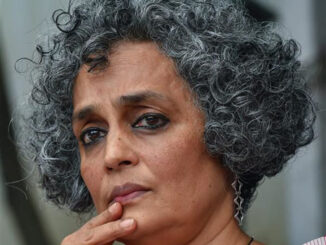
NEW DELHI (TIP): Delhi Lt Governor V K Saxena has accorded sanction to prosecute author Arundhati Roy and a former professor in Kashmir under the stringent Unlawful Activities (Prevention) Act (UAPA) for allegedly making provocative speeches at an event here in 2010, Raj Niwas officials said on Friday, June 10.
The FIR against Roy and former Central University of Kashmir professor Sheikh Showkat Hussain was registered following the orders of the Court of Metropolitan Magistrate, New Delhi, they added.
The FIR in the matter was registered on a complaint made by Sushil Pandit, a social activist from Kashmir, on October 28, 2010.
Last October, the LG had granted sanction to prosecute them under section 196 of CrPC for commission of offences punishable under different sections of the Indian Penal Code: 153A (promoting enmity between different groups on grounds of religion, race, place of birth, residence, language, etc., and doing acts prejudicial to maintenance of harmony), 153B (imputations, assertions prejudicial to national-integration) and 505 (statements conducing to public mischief).
Roy and Hussain had allegedly made provocative speeches at a conference organized under the banner of ‘Azadi – The Only Way’ on October 21, 2010 at LTG Auditorium, Copernicus Marg, here.
“The issues discussed and spoken about at the conference propagated the separation of Kashmir from India,” said the official.
Those who delivered speeches at the conference included Syed Ali Shah Geelani, SAR Geelani (anchor of the Conference and prime accused in the Parliament attack case), Arundhati Roy, Dr. Sheikh Showkat Hussain and Varavara Rao.
The complainant filed a complaint under Section 156(3) of CrPC before the Metropolitan Magistrate Court, New Delhi, who disposed the complaint on November 27, 2010 with the directions to register an FIR.
Accordingly, an FIR was registered and investigation was carried out, they said.
(Source: PTI)
The harassment of social activists in India continues unabated, with the latest development involving the sanctioning of prosecution against renowned writer and social activist Arundhati Roy under the Unlawful Activities (Prevention) Act (UAPA). This move, authorized by the Lieutenant Governor of Delhi, is a troubling reflection of the increasingly repressive environment for dissenting voices in the country.
The FIR against Roy and another individual, Sheikh Showkat Hussain, was filed following an order from the Court of Metropolitan Magistrate, New Delhi. The charges stem from their alleged participation in a conference titled “Azadi — The Only Way” held in 2010 at the LTG Auditorium on Copernicus Marg, New Delhi. At this conference, the speakers reportedly made provocative speeches that advocated for the separation of Kashmir from India, a highly contentious issue that has long been a flashpoint in Indian politics.
This case highlights several critical issues concerning freedom of speech and the treatment of activists in India. Firstly, it underscores the misuse of draconian laws like the UAPA to stifle dissent. The UAPA, originally intended to combat terrorism, has increasingly been used to target activists, journalists, and intellectuals whose views diverge from the official narrative. The application of such severe legislation to prosecute a writer and academic for their speech at a public conference raises serious questions about the commitment of Indian authorities to uphold democratic principles and human rights.
Arundhati Roy, an internationally acclaimed author and outspoken critic of the Indian government’s policies, has faced numerous legal challenges and public attacks for her views, particularly regarding Kashmir. Her participation in the “Azadi — The Only Way” conference is part of her broader engagement with the Kashmir issue, where she has consistently advocated for the right to self-determination for the people of Kashmir. While her stance is controversial and has attracted significant opposition, the use of UAPA against her is disproportionate and suggests a deliberate attempt to silence her voice.
The charges against Roy and Hussain also bring to light the broader context of shrinking space for civil society in India. In recent years, there has been a noticeable increase in the harassment, intimidation, and arrest of activists, journalists, and scholars. Many have been accused of sedition or terrorism-related charges, often based on flimsy evidence or for merely expressing dissenting opinions. This pattern indicates a worrying trend towards authoritarianism, where dissent is not tolerated, and critical voices are systematically suppressed.
Additionally, the timing of the FIR and the subsequent prosecution raises questions about the motives behind these actions. The conference in question took place in 2010, and the FIR was filed many years later. This delay suggests that the charges may be politically motivated, aiming to discredit and neutralize critics of the government. It also reflects a broader strategy of using legal harassment as a tool to deter other activists and intellectuals from speaking out.
The issue of Kashmir remains a highly sensitive and polarizing subject in India. The region has experienced decades of conflict, violence, and political turmoil. While the Indian government maintains that Kashmir is an integral part of India, many Kashmiris and some Indian activists argue for greater autonomy or independence for the region. The government’s response to these calls has often been heavy-handed, involving military action, curfews, and restrictions on civil liberties. The prosecution of Roy and Hussain can be seen as part of this broader strategy to control the narrative on Kashmir and silence those who challenge the official stance.
It is imperative for the Indian government to recognize that true democracy thrives on diverse opinions and robust debate. The use of draconian laws to stifle dissent only serves to undermine the democratic fabric of the nation. Instead of prosecuting activists like Arundhati Roy and Sheikh Showkat Hussain, the government should engage in constructive dialogue with all stakeholders, including those with differing views on contentious issues like Kashmir.
‘A mature constitutional democracy ought not to prosecute speech, which by itself has no direct causal connection to violence or disorder,’ says PUCL statement
“A reminder of the broader threats to free speech and dissent in India”, says Journalists Beyond Borders
NEW DELHI / NEW YORK (TIP): The People’s Union for Civil Liberties (PUCL) on Thursday, October 12, condemned the decision of Delhi Lieutenant-Governor (L-G) Vinay Kumar Saxena to allow Delhi Police to prosecute writer Arundhati Roy and Sheikh Showkat Hussain, a former Professor of International Law at the Central University of Kashmir, in a 2010 case.
Urging that the prosecution against Ms. Roy and Dr. Hussain be withdrawn with immediate effect, PUCL leaders Kavita Srivastava and V. Suresh said in a statement that Ms. Roy was being prosecuted for “worrying the edges of the human Imagination” for writing as if “the only thing worth globalizing is dissent” and believing that dissent is “India’s best export”. “This is a tragedy for a country which prides itself as being the ‘mother of democracy’,” the statement added.
The PUCL said it was baffling that a 2010 related case is now on the front burner, with sanction being granted by the L-G, almost 13 years after the alleged incident. “A mature constitutional democracy ought not to prosecute speech, which by itself has no direct causal connection to violence or disorder. It is shameful that an FIR [First Information Report] was even registered for speech which by all accounts did not incite or provoke any form of violence,” the statement added.
PUCL leaders said such an action did great disservice to the Narendra Modi government’s belief that India is the ‘mother of democracy’, when the ‘mother’ prosecutes one of her most illustrious children. “Ms. Roy is one of India’s most eminent writers who has used her writing to amplify the concerns of those whose voices are ignored or muted. In her writing be it on the Indian nuclear tests, the dams on the Narmada or of the US war on Iraq she has sought to remind Indians and indeed the inhabitants of the world of the human costs of nuclear technology, development and war,” they said.
In a statement to The Indian Panorama, Journalists Beyond Borders President Prof. Indrajit S Saluja said : “The decision of government of India to reopen a criminal case against Arundhati Roy is deeply troubling and raises serious concerns about the state of justice, freedom of expression, and democracy. Arundhati Roy, a celebrated author, activist, and one of the most prominent voices for social justice in India, has consistently voiced her opinions on a range of political and social issues. The reopening of a case against her is not only an attack on her individual rights but also a stark reminder of the broader threats to free speech and dissent in India.”
Prof. Saluja called upon the government of India to stop harassing writers and journalists who, in the best interest of India and the people of India, criticize government policies. He demanded immediate withdrawal of the case against her which is a politically motivated attempt to silence and intimidate her and other activists who challenge the government’s policies. In a democratic society, the freedom to express dissent and engage in open discourse is a fundamental right. Such actions undermine the principles of democracy and the rule of law.
Signup to our Newsletter!
Don’t miss out on all the happenings around the world