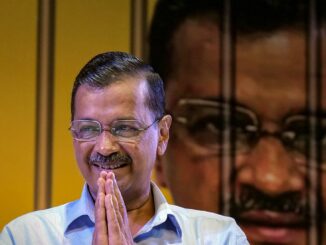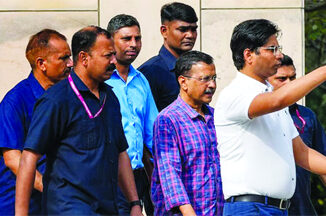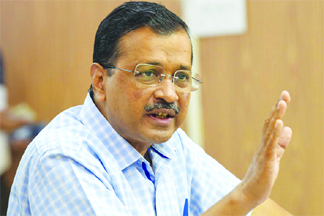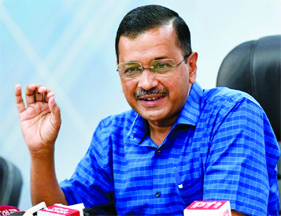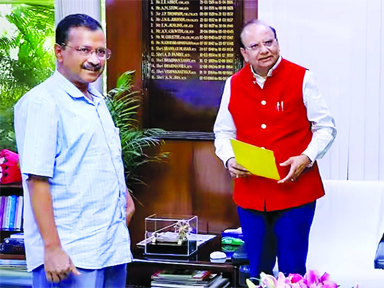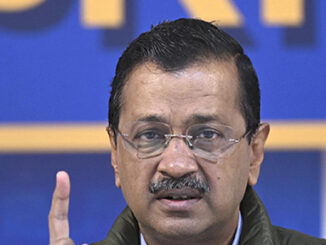
NEW DELHI (TIP): Delhi Police on Friday, March 28, 2025, informed a court here that it has lodged an FIR against former chief minister Arvind Kejriwal and others for allegedly misusing public money by putting up large hoardings in the national capital in 2019.
The police made the submission in its compliance report filed before Additional Chief Judicial Magistrate Neha Mittal. The Judge on March 11 directed police to lodge the FIR on a complaint that has alleged violation of Prevention of Defacement of Property Act. The court has listed the matter for April 18 for the next hearing after police sought time to investigate the matter.
Aside from Mr. Kejriwal, the court had ordered the FIR against former MLA Gulab Singh and then Dwarka councilor Nitika Sharma, for installing “large-sized” banners.
The complaint filed in 2019 alleged that Kejriwal, then Matiala MLA Gulab Singh (AAP) and then Dwarka A ward councilor Nitika Sharma “deliberately misused public money by putting up large-sized hoardings” at various places in the area.
Kejriwal accepts his party’s defeat, congratulates the BJP
I.S. Saluja NEW DELHI (TIP): The Bharatiya Janata Party (BJP) is all set to form the government in Indian capital Delhi after 27 years as it scripted an impressive election victory over the Aam Aadmi Party (AAP) which commanded a formidable majority in two 5-year terms.
The Bharatiya Janata Party (BJP) has won or is leading in 48 seats in the 70-member legislative assembly, while the incumbent Aam Aadmi Party (AAP) has won or is ahead in 22 seats, according to data from the Election Commission of India (EC).
A party that wins 36 seats can form the government. “Development wins, good governance triumphs,” Modi wrote on X, adding that his party would leave “no stone unturned” in developing Delhi. The Aam Aadmi Party (AAP) national convenor Arvind Kejriwal on Saturday, February 8, 2025, conceded his party’s defeat in the high-stakes Delhi Assembly elections.
The AAP is heading towards a big defeat in the 70-member Assembly with the Bharatiya Janata Party (BJP) leading on 47 seats, leaving the AAP to just 23 seats. AAP supremo Arvind Kejriwal and his number two Manish Sisodia have already lost to BJP’s Parvesh Verma and Tarvinder Singh Marwah, respectively. In a video message, AAP supremo said, “We accept people’s mandate with humility, and I congratulate the BJP for its victory and also hope that it will fulfil the expectations of the people of Delhi.”
Mr. Kejriwal said the AAP will play the role of a constructive Opposition, saying, “In the next five years, the AAP will not only play the role of a constructive Opposition, but will also be available to the people of Delhi. We are not in politics for power, instead we consider it as a medium to serve people,” Mr. Kejriwal claimed in the video message. In the end, the AAP chief thanked all his party workers. “I thank all the AAP workers for their hard work during the elections and we fought a good election.” While the AAP has dominated the political landscape in Delhi for the past 10 years, the BJP has been out of power in the city since 1998.
The Congress, which governed Delhi from 1998 to 2013 and was hoping for a resurgence, seemed headed for its third straight washout.
(With inputs from agencies)
In any democratic election, one of the most consistent patterns observed globally is the desire for change. Voters often seek a fresh government, hoping for a better deal, more responsible leadership, and greater responsiveness to their needs. This trend is universal, whether in the US, UK, Canada, India, or any other democracy. As a result, the incumbency factor — the tendency of voters to vote against the party in power — plays a significant role in shaping electoral outcomes. The longer a government remains in power, the greater the chances it will face defeat unless it has consistently delivered exceptional governance.
This pattern was evident in the recent Delhi Assembly elections, which saw a significant shift in the political landscape of the capital. For years, the Aam Aadmi Party (AAP) has been in power in Delhi, having won a historic majority in 2015 and retaining power in 2020. However, in the latest election, the Bharatiya Janata Party (BJP), which had been out of power in Delhi for over 30 years, managed to achieve a sweeping victory, ending AAP’s reign.
AAP’s victory in the 2015 election was nothing short of an upset. The party defeated the Congress, a long-standing political powerhouse, and emerged as a major force in Delhi politics. AAP’s success was fueled by a combination of factors: a public sentiment against the Congress, the party’s promise of corruption-free governance, and its focus on improving basic services like education and healthcare. AAP’s leader, Arvind Kejriwal, became a prominent figure and Delhi’s Chief Minister, with the party securing a resounding 67 out of 70 seats in the Delhi Assembly.
However, by the time of the most recent elections, the political climate had shifted. AAP’s time in power had led to some degree of complacency, and many voters began to feel that the promises made by the party were no longer being fulfilled. The incumbency factor began to work against them. Despite having delivered several significant reforms, such as improvements in education and healthcare, AAP faced growing criticism over issues such as the cost of living, unfulfilled promises, and its inability to deal with the rising challenges in governance.
On the other hand, the BJP, under the leadership of Prime Minister Narendra Modi, had been steadily building its influence in Delhi. The party’s rise to power was not just about local issues but also about its increasing prominence at the national level. The BJP’s success was bolstered by its image as a party that promotes Hindutva and its commitment to creating a Hindu nation, which resonated with a significant portion of the electorate. The consolidation of Hindu votes worked strongly in the BJP’s favor, helping it win over a large section of the population that felt disconnected from AAP’s secular rhetoric.
One of the significant factors behind BJP’s victory was the party’s ability to promise financial allurements and freebies. While AAP had initially made its mark in the 2020 elections with promises of free electricity and water, the BJP capitalized on this by offering even more attractive schemes. Voters, often swayed by such promises, found these assurances hard to resist, despite the fact that the BJP had not always delivered on its past promises, such as the return of black money from abroad or providing a “pucca house” for every family by 2022. Nonetheless, the allure of “Acche Din” (Good Days) continued to hold strong among many voters, echoing Modi’s 2014 slogan that resonated with the hopes of millions.
The BJP’s victory in Delhi can also be attributed to the diminishing influence of the Congress party, which has been in disarray in recent years. Once a dominant force in Indian politics, the Congress has now been relegated to irrelevance in Delhi. With the Congress struggling to find its footing, voters turned to the BJP as the only viable alternative to AAP, despite any reservations they might have had about the BJP’s past record.
The electoral outcome in Delhi serves as a reminder of the fickle nature of politics and the complex dynamics at play. While AAP’s defeat signals the end of an era of governance in Delhi, it also presents a challenging future for the party. With leaders like Arvind Kejriwal and Manish Sisodia facing legal battles, the AAP may struggle to regain its footing in the short term.
For the Congress, this defeat of AAP could serve as an opportunity to rebuild itself. The party once ruled Delhi for many years and has a deep-rooted connection with the electorate. While it may currently be on the backfoot, it still holds the potential to regroup and emerge as a force in the future.
However, how the BJP governs Delhi will play a crucial role in determining the next chapter in Delhi’s politics.
The year 2024 was significant for Indian politics as the Election Commission carried out the world’s largest electoral exercise with 642 million people voting to decide who would rule the nation for the next five years.
The elections were carried out in seven phases between April and June with thousands of government functionaries — who were manned by an even greater number of security forces — managing a whopping 10.5 lakh polling booths across the country.
The year also witnessed several states electing their new governments, with all but two retaining those in power. The opposition also got a new lease of life this year despite being on the losing side in the general elections.
Congress leader Rahul Gandhi became the Leader of Opposition in Lok Sabha as his party won 99 seats, nearly double the number it had scrambled to in 2019. The grand old party celebrated the performance like a win against the larger-than-life figure of Narendra Modi, who became the Prime Minister for the third consecutive time, though with figures far below the BJP’s expectations.
In the national capital, the tug of war between the Centre and the elected Aam Aadmi Party government witnessed strong pulls and drags this year. The tension peaked when AAP chief Arvind Kejriwal was jailed in March for his alleged role in the Excise Policy Scam. He functioned as Delhi Chief Minister behind bars for the next seven months until the Supreme Court granted him bail with conditions, following which he quit, paving the way for his party leader Atishi to take over as Delhi CM.
The resignation, arrest, and return of Hemant Soren in Jharkhand, the fall of the Biju Janata Dal government in Odisha after 24 years, the return of Chandrababu Naidu as Andhra Pradesh Chief Minister, the maiden Assembly Elections in the Union Territory of Jammu and Kashmir, and the NDA’s landslide victory in Maharashtra Elections were some of the other major political developments the country witnessed in 2024.
Here is a sneak peek into these and other landmark events in Indian politics this year.
Hemant Soren’s Fall And Rise
Four-time Jharkhand Chief Minister, Hemant Soren dogged it out against the central government in the very first month of 2024 but managed to retain power amid a high-decibel political drama at the fag end of the year.
The gripping political potboiler saw Soren quitting as chief minister hours before he was arrested by the Enforcement Directorate in a land scam case on January 31. Ahead of his arrest, the agency could not confirm his whereabouts for around 24 hours before he showed up in Ranchi. Soren claimed the charges against him were nothing but a vindictive action on the part of the BJP-led central government.
His chosen replacement Champai Soren functioned as Jharkhand CM for barely five months till Hemant was released on bail on June 28. Less than a week later, Champai Soren resigned as CM, making way for Hemant who took oath as CM on July 4. The move did not go down well with Champai Soren who quit JMM and joined the BJP on August 30.
In the November Assembly Elections, Hemant Soren signed off the year with flying colours as the JMM-led alliance won 56 seats, the party’s best performance since inception. Soren was unanimously elected as leader of the legislature party and again took oath as Chief Minister on 28 November.
Delhi CM Arvind Kejriwal Is Jailed
Embroiled in controversies that saw him running the Delhi government from behind bars for several months, Aam Aadmi Party National Convener Arvind Kejriwal was on a political roller-coaster in 2024.
With several of his key party members and ministers in the Delhi government already arrested in the alleged excise policy scam, Kejriwal also was on the Enforcement Directorate’s radar.
He managed to dodge multiple summons by the central agency before he was arrested on March 21 after the Delhi High Court rejected his plea for anticipatory bail. Kejriwal knew his arrest was around the corner and had time and again mentioned it in his prior public speeches.
The BJP were all but sure of him resigning from his post but Kejriwal stayed put and ran the Delhi government from jail for several months. He attempted to get bail from the Delhi High Court however the same was rejected multiple times.
During his jail time, Kejriwal’s legal battles took several twists and turns. He was granted interim bail by the Supreme Court from May 10 to June 1, 2024, to allow him to campaign for the Lok Sabha elections. After his interim bail expired, Kejriwal surrendered at Tihar Jail on June 2.
Delhi Rouse Avenue Court granted him bail on June 20. However, the Enforcement Directorate challenged the trial court order before the Delhi High Court which stayed the bail order on June 21. Five days later, the CBI arrested Kejriwal in a different case linked to the alleged excise policy scam.
The Supreme Court granted Kejriwal interim bail on July 12, but he remained in jail due to the CBI arrest. He was finally granted bail by the Supreme Court on September 13, 2024, after spending over five months in prison.
The bail, however, came with certain conditions including prohibiting him from making public statements about his arrest by the CBI. He was also ordered not to enter the office of the Delhi Chief Minister and sign any official files in his capacity as the Chief Minister.
Just four days later, on September 17, Kejriwal resigned as the Chief Minister of Delhi. He made it clear that he would only consider taking up the role again if he received a public mandate. On September 21, Atishi, the Delhi education minister till then, replaced Kejriwal as the youngest woman CM of Delhi.
2024 General Elections:
A Mammoth Exercise
India witnessed its 18th general elections this year as the entire country voted to choose the next central government. Of the 96.8 crore (968 million) people who were eligible to vote, 64.2 crore exercised the right including 312 million women, the highest-ever participation by female voters.
The 44-day electoral exercise was the second longest in country after the first parliamentary elections of 1951-52, which lasted for more than four months. The polls were conducted in seven phases beginning April 19 and ending June 1. The results were declared on June 4.
The BJP-led NDA alliance won the elections with Narendra Modi returning as Prime Minister for the third consecutive time. The BJP’s performance, however, was below expectations and it had to heavily rely on two main allies—the Telugu Desam Party of Andhra Pradesh and Janata Dal (United) of Bihar—to form a coalition government.
Eyeing 400 of the 543-seat Lok Sabha, BJP managed to win only 240 while its main partners TDP and JD(U) won 16 and 12 seats respectively. Overall, the NDA won 293 seats.
In 2019, the BJP won 303 seats with the NDA’s final tally at 353. In contrast, Congress recorded a turnaround winning 99 seats, nearly double its 2019 tally of 52, thereby coming back as a potent opposition.
Narendra Modi Takes Oath As PM For Third Consecutive Time
On June 9, Narendra Modi took oath as the Prime Minister of India for the third consecutive time after his BJP-led NDA alliance registered a victory in the 2024 Lok Sabha elections.
The ruling party’s rallies ahead of the elections were powered by the ‘Modi ki Guarantee’ campaign, which managed to help it win 240 seats, a lacklustre performance but strong enough to form a coalition government with the BJP as its most powerful constituent.
Three days after the results were declared on June 4, Modi confirmed the support of 293 MPs to President Droupadi Murmu after which he was sworn-in as the Prime Minister for the third time on June 9.
As for his individual performance from the Varanasi Lok Sabha seat, PM Modi had a shocking start on the result day as Congress’ Ajay Rai was seen leading in the first hour of vote counting.
PM Modi raced past in the second half defeating Rai by a margin of 1,52,513 votes. It was the second-lowest-ever victory margin (in percentage points) for a sitting prime minister and a steep fall for Modi compared to his 2019 margin of 4.5 lakh votes.
In his victory speech, Prime Minister Modi pledged to work with all states, regardless of the party in power, to build a developed India. He also laid out his vision for the third term saying it would be a tenure of big decisions and a key emphasis would be on uprooting corruption. He thanked TDP supremo Chandrababu Naidu and Bihar Chief Minister Nitish Kumar, his NDA allies for the electoral successes in Andhra Pradesh and Bihar.
Rahul Gandhi’s Resurgence As LoP, Priyanka’s Debut in Parliament
Ridiculed as ‘Shehzada’ and dismissed as ‘Pappu’, Congress leader Rahul Gandhi had the last laugh in the 2024 Lok Sabha election as he managed to gain big even though his party lost the elections.
Gandhi contested from Kerala’s Wayanad and Uttar Pradesh’s Rae Bareli, winning the southern seat by 3.64 lakh votes against his nearest rival Annie Raja of CPI and the northern one by 3.9 lakh votes against BJP’s Dinesh Pratap Singh. Rahul retained Rae Bareli and his sister Priyanka fought and won from Wayanad by an even greater margin in the by-elections later in the year, making her Parliament debut as she took oath as Lok Sabha MP on November 28.
Congress credited its spirited performance in the general elections to Rahul Gandhi for a campaign that focussed on people’s issues and welfare measures. The party lauded Gandhi for creating a new narrative through his Bharat Jodo Yatras, the on-foot marches he undertook from one end of the nation to another during which he was seen meeting people on the ground and getting to know about the real issues facing mainland India.
Even the harshest of his critics would concede that Gandhi’s 2024 campaign was by far his best one as he focussed on bread-and-butter issues and the party’s welfare guarantees which struck a chord with a section of the voters.
With Congress winning 99 seats in the elections (more than the requisite 55 or 10 per cent of the 543 seats), it meant that for the first time since 2014, it had the opportunity to pick a Leader of Opposition (LoP) in Lok Sabha. As an obvious choice, the party nominated Gandhi who was appointed the LoP on June 24, his maiden constitutional position since his entry into politics in 2004.
As LoP Gandhi was accorded a Cabinet Minister’s rank, enhancing his position in the protocol list. The work of the Leader of the Opposition in the Lok Sabha is opposite to that of the Leader of the House.
TDP Wins Andhra Elections,
Naidu Returns As CM
Andhra Pradesh saw a power transfer in 2024 as the ruling YSR Congress party lost the Assembly Elections to Telugu Desam party-led NDA. The elections were held in a single phase on May 13 with counting of votes on June 4. The polls were held simultaneously with the Lok Sabha elections.
The incumbent Jagan Mohan Reddy’s YSRCP faced a crushing defeat as it won just 11 seats against 151 in 2019. In contrast, the TDP won 135 seats in the 2024 elections against just 23 in 2019.
TDP Chief N Chandrababu Naidu returned as Chief Minister, taking oath on June 12. His last term as CM was from 2014 to 2019. Before the state bifurcation, he served as the CM of United Andhra Pradesh twice – 1995-99 and 1999-2004.
The other highlights of the 2024 Andhra Elections were Naidu’s son Nara Lokesh and Janasena leader Pawan Kalyan entering the Assembly for the first time. The BJP got a much-needed boost with the NDA alliance winning 21 out of the total 25 Lok Sabha seats in the state. YSRCP got just four MP seats.
Analysts said strong anti-incumbency coupled with a united fight by the opposition parties routed the ruling YSRCP. Though the Reddy-led government shelled out Rs 2.60 lakh crore towards doles over the last five years, there was no perceivable development in the state.
BJP Wins Odisha, Naveen
Patnaik’s 24-Year Rule Ends
Odisha crossed a political milestone in the 2024 Assembly Elections as the electors voted for the BJP, ending the 24-year Biju Janata Rule (BJD) rule. Naveen Patnaik’s party could manage only 54 seats in the elections, a huge dip from 113 in the previous elections.
BJP, on the other hand, secured a simple majority, winning 78 seats in the 147-seat Legislative Assembly. Held simultaneously with Lok Sabha elections, the elections were carried out in four phases with the first on May 13 and the last on June 1. The BJP also made significant gains, winning 20 out of 21 Lok Sabha seats in Odisha marking one of the strongest wins for the saffron party in the general elections.
As for Naveen Patnaik, the BJD leader contested from two seats – Hinjili and Kantabanji. He won from Hinjili with 66,459 votes, defeating BJP candidate Sisir Kumar Mishra by a narrow margin of 4,636 votes.
The election campaign by the BJP was intense, with Prime Minister Narendra Modi addressing several rallies and holding two road shows in Bhubaneswar and Puri. The BJP’s high-profile electioneering seemed to overshadow the BJD’s campaign, which was largely led by Patnaik and his aide VK Pandian.
2024 Tripura Peace Accord
On September 4, India’s northeast region witnessed a historic moment when the 35-year-long insurgency in Tripura came to an end following the signing of an agreement between the Centre, the Tripura government and two insurgent outfits of the state–the National Liberation Front of Tripura (NLFT) and All Tripura Tiger Force (ATTF).
The agreement was signed at North Block in the presence of Union Home Minister Amit Shah, Tripura Chief Minister Dr Manik Saha, and top leaders of both NLFT and ATTF. As per the agreement, the Centre sanctioned a special economic development package amounting to Rs 250 crore for a period of four years to be implemented by the state government for the overall development of tribals of Tripura.
“The Government of India and the Government of Tripura have been making concerted efforts to engage the tribal armed groups of Tripura in order to bring peace and harmony in the state, and rehabilitate the cadres so as to enable them to lead a normal life in the society,” the agreement stated.
The agreement stated that NLFT and ATTF would not extend any support to any other militant or armed groups by way of training, supply of arms, providing protection or in other manner.
Jammu And Kashmir UT Gets Maiden Elected Government
The Union Territory of Jammu and Kashmir flipped a page in its political history in 2024 as it witnessed its first assembly elections after the abrogation of Article 370 and downgrading of the state into two federally controlled territories in 2019.
The long-pending elections were finally carried out in three phases from September 18 to October 1 with counting of votes on October 8. They were held in the backdrop of the Supreme Court direction in December 2023 in which it had asked the Election Commission to “restore the democratic process” in the union territory by September 2024.
The opposition bloc led by the National Conference in the Union Territory won the elections bagging 49 of the 90 Assembly seats. NC emerged as the single largest party winning 41 seats followed by BJP (29) and Congress (6). Mehbooba Mufti-led PDP was able to win only three seats, the worst performance by the party since it was founded by Late Mufti Sayeed 25 years ago.
Former CM and National Conference leader Omar Abdullah was sworn in as the first Chief Minister of the J&K UT on October 16. Interestingly, a few months before the election dates were announced, the Ministry of Home Affairs increased the powers of the L-G Manoj Sinha-led administration by amending the Jammu and Kashmir Reorganisation Act, 2019.
The amendment entrusted more powers to the L-G for making decisions on police, all-India services officers and appointment of advocates and other law officers. He was also given powers for sanctioning prosecution in certain cases and taking decisions on anti-corruption bureau-related matters.
BJP’s Hat-Trick In Haryana
Buoyed by its success in Odisha, BJP recorded a hat-trick win in Haryana leaving the opposition stunned while managing to overcome anti-incumbency with ease.
The single-phase elections were held on October 5 and the votes were counted on October 8. The victory in Haryana was a significant milestone for the BJP as, despite predictions of a Congress-led alliance win, the saffron secured a majority with 48 seats in the 90-member Assembly, marking its third consecutive win in the state.
The election saw a high voter turnout of 67.90 per cent, with the BJP winning 39.94 per cent of the popular vote. The Congress, led by Bhupinder Singh Hooda, won 37 seats with 39.09 per cent of the popular vote.
Nayab Singh Saini, the 54-year-old OBC leader who was made CM in March to replace Manohar Lal Khattar in an unexpected appointment, took oath as the new Haryana Chief Minister for the second term on October 17.
The BJP’s victory was attributed to its strong campaign and the popularity of its leaders. The party’s decision to contest the election without a chief ministerial face also seemed to have worked in its favour.
The Congress, on the other hand, faced internal conflicts and was unable to capitalize on the anti-incumbency factor. The party’s alliance with the Communist Party of India (Marxist) also failed to yield the desired results.
The Jannayak Janta Party (JJP), which had allied with the BJP in the previous election, contested the election alone but failed to win any seats. The Indian National Lok Dal (INLD) also failed to make a significant impact, winning only two seats.
Mahayuti’s Landslide Victory In Maharashtra, Fadnavis Returns As CM
The BJP-led Mahayuti alliance registered a landslide victory in Maharashtra as the key western state went to polls on November 20. In the 288-seat Legislative Assembly, the BJP won 132 and its allies Shiv Sena and NCP bagged 57 and 41 seats respectively. The opposition Maha Vikas Aghadi (MVA) was handed one of the worst defeats in recent history as the three main constituents of the alliance could manage wins in just 50 seats–Congress 16, Shiv Sena (UBT) 20, and NCP (SP) 10.
The BJP was at the forefront of this spectacular performance, comprehensively managing to buck the anti-incumbency and emerge as the largest party in the state pocketing 132 of the 149 seats it contested in the politically significant western state. BJP’s success was led by its senior leader and state deputy CM Devendra Fadnavis, who eventually became the Chief Minister for the third time after some hiatus on the part of the Eknath Shinde-led Shiv Sena.
Fadnavis’ name was finalised for the Maharashtra Chief Minister post at a key meeting on December 4. A day later, he took an oath as the Chief Minister for the third time. The swearing-in ceremony was attended by Prime Minister Narendra Modi and other top political figures of the country. The results came as a fillip for the BJP after the unprecedented hat-trick in Haryana and helped the party overcome some of its setbacks in the general elections where it bagged just 240 seats.
Voters in the politically significant western state of Maharashtra, which sends 48 MPs to the Lok Sabha and gave the MVA a decisive 30 seats, clearly decided to go against the trend of that parliamentary victory just five months ago.
In a high-stakes political battle, Congress has fielded Sandeep Dikshit, son of the late Sheila Dikshit, as its candidate for the New Delhi Assembly constituency in the upcoming Delhi elections.
This move is set to reignite a historic rivalry in a constituency that witnessed Sheila Dikshit, the three-time Chief Minister of Delhi, losing to Arvind Kejriwal in 2013 and 2015. For Sandeep, this election is more than just a political contest; it is a chance to reclaim his family’s legacy and settle old scores.
Sandeep Dikshit, a former MP known for his vocal criticism of Arvind Kejriwal and the Aam Aadmi Party (AAP), is expected to wage a fierce campaign. The New Delhi seat, held by Kejriwal since 2013, is set to be the epicentre of the battle, promising high-voltage drama and intense competition. Adding another layer of intrigue to this contest is the possibility of a BJP heavyweight joining the fray.
Speculation is rife that former West Delhi MP Parvesh Sahib Singh Verma, son of former Chief Minister Sahib Singh Verma, could be fielded from the seat.
NEW DELHI (TIP): The Supreme Court on Thursday, September 5, 2024, reserved judgment on Delhi Chief Minister Arvind Kejriwal’s petitions for bail and quashing of arrest by the Central Bureau of Investigation (CBI) in the excise policy case, shrugging off the Central agency’s pitch that he must first knock on the doors of the trial court.
The apex court reminded the CBI of a comment made in a recent judgment granting bail to Mr. Kejriwal’s former deputy, Manish Sisodia, in the same liquor policy case. The court, in that judgment, had concluded that asking Mr. Sisodia to go back to the trial court for bail would be like “making him play a game of snakes and ladders”. It had after all taken Mr. Sisodia 17 months and multiple trips up and down the court hierarchy to finally get bail.
Justice Ujjal Bhuyan, part of the Bench headed by Justice Surya Kant, clarified to the CBI that the ‘snakes-and-ladders’ remark in the August 9 judgment allowing Mr. Sisodia bail was not meant as a “charitable observation” about the prosecution in the excise policy case.
In fact, grounds like prolonged incarceration, no possibility of completion of trial in the near future, and “process becoming the punishment” were cited as grounds for grant of bail to Bharat Rashtra Samithi (BRS) leader K. Kavitha and Mr. Sisodia in the excise policy case. The court further did not take kindly to the CBI’s claim that bail to the Chief Minister would “demoralize” the Delhi High Court. The High Court had, on August 5, upheld his arrest and told him to knock on the doors of the trial court for bail.
Justice Kant asked the probe agency, represented by Additional Solicitor General S.V. Raju, to not second guess what the Supreme Court would do. “Whatever we do in this case, be sure it would not be to the detriment of the institution,” Justice Kant told Mr. Raju.
Senior advocate A.M. Singhvi, for Mr. Kejriwal, said his case was “unique”. He had secured bail thrice in the money-laundering case linked to the excise policy ‘scam’ — twice from the Supreme Court and once in the trial court.
Mr. Singhvi questioned the need for the CBI to arrest the Chief Minister on June 26 when he was already in judicial custody at the time on money laundering charges. “He was the most captive interrogatee,” the senior advocate said.
He said the CBI’s sole justification for arresting a Chief Minister was that he appeared “evasive and non-cooperative” to them when confronted with evidence.
“But does he not have a fundamental right against self-incrimination? When they say he was not cooperating, they actually meant he was not declaring himself guilty,” the senior lawyer argued.
Mr. Singhvi said the High Court was only required to employ the triple test in Mr. Kejriwal’s case for bail.
The Chief Minister was a constitutional functionary and hardly a “flight risk”. Besides, he had been an undertrial for a “sufficiently long time” since his arrest by the Directorate of Enforcement (ED) in March. Thirdly, there was no question of tampering as “lakhs of documents” relevant to the case were already filed in court, many in electronic form. Mr. Raju countered that an agency’s power to arrest was part of its power to investigate.
He submitted that Mr. Kejriwal was arrested by the CBI on the basis of permission given by the trial court. He said the application made by the CBI for permission to arrest Mr. Kejriwal was never challenged by him. The procedure for his arrest was duly followed. He was given the grounds for his arrest in writing and was represented by a legal counsel. The Supreme Court could intervene only if a constitutional right was violated. Mr. Sisodia and Ms. Kavitha had done the grind of the trial courts before appealing to the Supreme Court for bail. Mr. Kejriwal could not act like a “privileged person”, Mr. Raju said.
The Additional Solicitor General said persons linked to the Assembly election in Goa, where the excise policy pay-offs were allegedly laundered, had come forward as witnesses. “If the court gives him (Kejriwal) relief now, they will all turn hostile. At least some time should be given for their statements to be recorded,” he urged.
NEW DELHI (TIP): In a significant development, the Supreme Court on Friday, July 12 granted interim bail to Delhi Chief Minister Arvind Kejriwal in the case registered under the Prevention of Money Laundering Act (PMLA) over the liquor policy case, while referring his petition challenging the arrest by the Enforcement Directorate (ED) to a larger bench.
A bench comprising Justices Sanjiv Khanna and Dipankar Datta referred Kejriwal’s petition to a larger bench to examine the question whether the need or necessity of arrest must be read as a condition into Section 19 of the Prevention of Money Laundering Act.
Kejriwal will however remain in custody since he was arrested by the CBI under the Prevention of Corruption Act in relation to the same liquor policy case on June 25.
Reading the excerpts from the judgment in open court, Justice Khanna held that the “reasons to believe” for arrest meet with the parameters of S.19 of the PMLA, which gives the power of arrest to ED officers. “However, having said so, we have raised an additional ground which relates to the need and necessity of arrest…we felt that this issue whether the ground of need and necessity of arrest must be read into Section 19, especially in view of the doctrine of proportionality. We have referred those questions to the larger bench,” Justice Khanna said.
We have also held that mere interrogation does not allow you to arrest. That is not a ground under S.19,” Justice Khanna added.
While referring the matter to the larger bench, the present bench chose to grant him interim bail considering his incarceration so far. The bench clarified that the question of interim bail can be modified by the larger bench.
In another crucial development, Kejriwal has challenged before the Delhi High Court his arrest by CBI and 3 days of police remand. He has also filed a plea seeking bail in the CBI case. Both matters are fixed for hearing on July 17.
Timing of Kejriwal’s arrest hints at bad faith, eagerness to deny him freedom
The arrest of Delhi Chief Minister Arvind Kejriwal by the CBI in the Delhi excise policy corruption case is unwarranted and appears tainted by bad faith. It was effected just before the Supreme Court of India was due to hear an appeal against a Delhi High Court order that had stayed the bail granted to him by a lower court in a money-laundering case related to the same allegation. The High Court had stalled his release on a plea by the Enforcement Directorate, but reserved its detailed order. The Supreme Court had deferred its hearing to June 26 to await the outcome. However, the High Court, by a detailed order, formalized the stay on the grant of bail. On June 26 morning, the CBI effected his formal arrest and sought his custody for interrogation in a CBI court. It is quite strange that it decided on this particular day and circumstance to formally arrest someone who has been in custody since March 21, save for a brief interlude during which he was granted interim bail. It is difficult to escape the conclusion that the sole purpose was to deny him the possibility of freedom, if the Court had restored the bail order.
The allegation that Mr. Kejriwal was a beneficiary as well as a prime mover behind the controversial excise policy that allegedly procured windfall profits for favored liquor manufacturers is quite serious. However, the investigation has been going on for nearly two years, and suspects have been arrested from time to time. The evidence largely consists of statements made by accused persons who were subsequently granted pardon and made approvers. In these circumstances, the vacation judge who granted bail in the money-laundering case came to a reasonable conclusion that someone cannot be indefinitely incarcerated in the hope that a money trail and direct evidence would soon emerge to justify the action. Unfortunately, the High Court concluded that this verdict was arrived at without considering the entire material available and without affording sufficient opportunity to the prosecution. The picture of an accused having to go from the lowest to the highest court for bail and facing favorable and adverse orders alternately reflects poorly on a system that has been weaponized by the current regime to target political opponents. A truly impartial agency should not rush to arrest anyone, leave alone those holding high political office, but instead approach the trial court with a strong and well-documented case, and leave it to the courts to decide on the guilt or innocence of the accused. Mr. Kejriwal, on his part, should have resigned immediately on arrest to avoid the perception he could influence witnesses or tamper with the evidence.
(The Hindu)
NEW DELHI (TIP): The Delhi High Court on June 21 commenced hearing on the Enforcement Directorate’s (ED) plea challenging the trial court order granting bail to Chief Minister Arvind Kejriwal in the money laundering case linked to the alleged excise scam.
A Vacation Bench of Justice Sudhir Kumar Jain is hearing the arguments advanced by Additional Solicitor General S.V. Raju on behalf of the ED. Thereafter, the court will hear arguments on behalf of Mr. Kejriwal’s lawyers.
The ED’s counsel sought a stay of the bail order, granted by a trial court on June 20, saying he was denied full opportunity to complete his argument by the trial court.
Commencing his arguments, the ASG argued that the trial court’s order, which has been made available today, is “perverse”.
The High Court on Friday said the trial court order shall not be given effect to till it hears the ED’s plea challenging the relief granted in the money laundering case.
The ED mentioned its plea for an urgent hearing before a Bench of Justices Sudhir Kumar Jain and Ravinder Dudeja, which said the case file will come before it soon and till then the trial court order shall not be acted upon.
Additional Solicitor General S.V. Raju, representing the ED, sought a stay on the trial court order contending that the agency was not given a proper opportunity to argue its case.
He said the trial court pronounced the order around 8 p.m. on June 20 and the order is not yet made available to them. Even after passing of the order when the ED lawyers urged the trial court to keep its order in abeyance for 48 hours to enable them to approach superior courts, the prayer was not considered, the ASG contended.
“I was not allowed to argue fully. I was not given proper time of 2-3 days to file written submissions. This is not done. On merits, I have an excellent case. The trial court said finish of in half an hour as it wanted to deliver the judgment. It did not give us full opportunity to argue the case,” the ASG contended, “I am making the allegations with full seriousness,” he added.
“Let the order be stayed and the plea be heard as early as possible. That order cannot be allowed to stand even for a day,” the law officer said.
Allegations made by the ED counsel ‘incorrect’: Kejriwal’s lawyers
The plea was opposed by senior advocates Abhishek Singhvi and Vikram Chaudhari, representing Mr. Kejriwal, submitting that the allegations made by the ED counsel were patently incorrect and it was astonishing that they cannot accept anything with grace.
“The noise and heat is not going to solve this problem,” Mr. Singhvi said.
He said there are 10 judgements of the Supreme Court which say cancellation or reversal of bail is radically different from grant of bail.
Advocate Chaudhari said, “This person (Kejriwal) was released by the Supreme Court. The Supreme Court granted him liberty. This would be a travesty of justice. We are on caveat here and we should be given opportunity to be heard. We would address arguments. An ex-parte order of such a nature…”
To this, Justice Jain said, “File is coming to me in 10-15 minutes after proper numbering, thereafter, you can start your arguments. You can argue for as much time as you want to argue”.
The ED had arrested Mr. Kejriwal on March 21, shortly after the Delhi High Court refused to grant him protection from arrest on his petition challenging summonses issued to him.
While pronouncing the order on Thursday, the trial court ordered Mr. Kejriwal’s release on a personal bond of ₹1 lakh and imposed certain conditions, including that he will not try to hamper the investigation or influence the witnesses.
On May 10, the Supreme Court had granted interim bail to the AAP supremo till June 1 to campaign in the Lok Sabha elections, saying he will have to surrender and go back to jail on June 2. Kejriwal had surrendered before Tihar jail authorities on June 2 and has been there since then.
Dictatorship has crossed all limits: Delhi CM’s wife
Responding to the development, the Delhi CM’s wife Sunita Kejriwal said, “Even before Kejriwal’s bail order was uploaded, the ED reached HC. They are behaving as if he is a terrorist.”
AAP leader Sanjay Singh accused Prime Minister Narendra Modi of making a mockery of the justice system after the Delhi High Court put on hold the trial court order granting bail to Arvind Kejriwal.
Taking to X, Mr. Singh said in a post in Hindi, “Look at the hooliganism of the Modi government, the trial court’s order has not yet come, even a copy of the order has not been received, so Modi’s ED reached the High Court to challenge which order? What is happening in this country? Modi ji, why are you making a mockery of the justice system? The whole country is watching you?” the AAP MP said.
The extensive campaigning tours and related events undertaken by Delhi Chief Minister Arvind Kejriwal indicate that he does not appear to be suffering from any serious or “life threatening” ailment, a Delhi court has held while denying him interim bail.
In yet another setback to Kejriwal, the court on June 5 dismissed his application for interim bail on medical grounds in the money laundering case linked to the alleged excise policy scam, as reported by the PTI.
“The extensive campaigning tours and related meetings or events undertaken by Arvind Kejriwal as highlighted during the course of arguments indicate that he does not appear to be suffering from any serious or ‘life threatening’ ailment so as to entitle him to the benefit,” Special Judge Kaveri Baweja said. The judge also extended Kejriwal’s judicial custody till June 19. The court is scheduled to take up on June 7 his application seeking default bail in the case.
In the order, the judge further held that grant of interim bail for conducting tests in order to determine if high ketone levels or the stated weight loss could have caused Diabetic Ketoacidosis “stands on an even weaker footing than a medical ground”.
New Delhi (TIP)- Delhi Chief Minister Arvind Kejriwal has moved two pleas in the Rouse Avenue court — one seeking regular bail in the money laundering case related to the excise policy “scam”, and another for a seven-day extension on his interim bail on medical grounds. Special Judge Kaveri Baweja will hear the interim bail plea on June 1, and the regular bail plea on June 7.
Kejriwal is currently out on interim bail till June 1, granted by the Supreme Court, following which he will have to surrender. On Wednesday, the apex court registry had refused to list Kejriwal’s plea to extend his interim bail by a week to undergo certain medical tests.
The registry is learnt to have communicated to Kejriwal’s counsel that the plea is not maintainable as the court which reserved its order on his petition, challenging his arrest on May 17, had already given him permission to approach the trial court for regular bail.
A vacation bench of Justices J K Maheshwari and K V Viswanathan earlier said that it would refer Kejriwal’s request to list the application for urgent hearing to Chief Justice of India D Y Chandrachud for appropriate orders.
The CM was arrested by the Enforcement Directorate (ED) on March 21 in the Delhi excise policy case, becoming the first sitting CM to be held.
He was granted interim bail until June 1 for election campaigning.
The bench of Justices Sanjiv Khanna and Dipankar Datta, which granted him interim bail on May 10, directed him to surrender on June 2.
Seeking an extension in the interim bail, Kejriwal stated that he lost six to seven kgs during the period of his arrest and could not regain weight even after his release.
The CM further said that the sudden and unexplained weight loss, coupled with high ketone levels, could be indicative of kidney damage, serious cardiac ailments and even cancer, and early detection was essential for preventing further progress of any disease and associated life risks.
The ED had earlier said that Kejriwal was “directly involved in the formulation” of the now-scrapped Delhi excise policy, which was drafted “considering the favours to be granted to the ‘South Group’ — a group of individuals from the southern part of India — which the ED claims “secured uninhibited access, undue favours, attained stakes in established wholesale businesses, and multiple retail zones (over and above what was allowed in the policy)”, and paid Rs 100 crore to AAP leaders in return. The agency also alleged that bribes received from the ‘South Group’ were funnelled into the AAP’s Goa Assembly poll campaign in 2021-2022.
Other AAP leaders arrested in the same case include former Deputy Chief Minister of Delhi, Manish Sisodia and Member of Parliament Sanjay Singh.
While Sisodia is still in judicial custody, Singh is out on bail.
Source: The Indian Express
The Supreme Court on Thursday, May 16, steered clear of the political talk about it having made an exception for Delhi Chief Minister Arvind Kejriwal in granting him interim bail for campaigning in the Lok Sabha polls but said “critical analysis of the judgement is welcome”.
A bench of Justices Sanjiv Khanna and Dipankar Datta refused to consider claims and counter-claims by advocates for the Enforcement Directorate (ED) and Kejriwal on statements related to grant of interim bail to the Aam Aadmi Party (AAP) national convener.
“We have not made any exception for anybody. We said in our order what we felt was justified,” the bench said.
Appearing for the ED, Solicitor General Tushar Mehta objected to Kejriwal’s speeches in poll rallies that if people voted for AAP, he would not have to go back to prison on June 2.
“It is his assumption, we cannot say anything,” the bench told Mehta.
It added, “Our order is very clear about when he has to surrender. It is the order of the Supreme Court. The rule of law shall be governed by this order.”
Mehta alleged that Kejriwal had violated the bail condition by his assertion.
“What is he trying to imply? It is like a slap on the institution,” the Solicitor General said.
Justice Khanna said the court’s order is clear that he has to surrender on June 2.
“We have not said anything in the order that he cannot speak about the case,” the bench said.
Without naming Union Home Minister Amit Shah, senior advocate Abhishek Singhvi, who was appearing for Kejriwal, referred to an interview where he said many believe the court accorded “special treatment” to the AAP leader.
The bench told Singhvi it would not go into that.
The senior lawyer denied that Kejriwal had made any statement about having to go back to jail if people did not vote for his party. Singhvi said he can swear an affidavit to that effect.
The top court was hearing Kejriwal’s plea against his arrest by the Enforcement Directorate in a money-laundering case stemming from the alleged excise scam.
On May 10, the apex court had granted Kejriwal interim bail till June 1, the last day of the seven-phase general election, and directed him to surrender and go back to jail on June 2.
The Delhi chief minister was arrested on March 21.
The court had, however, barred Kejriwal from visiting his office or the Delhi secretariat, and signing official files unless absolutely necessary for obtaining the lieutenant governor’s approval.
The matter relates to alleged corruption and money-laundering in the formulation and execution of the Delhi government’s now-scrapped excise policy for 2021-22.
Source: PTI
Bench posts the matter for further hearing on May 7
NEW DELHI (TIP): Noting the hearing on Delhi Chief Minister Arvind Kejriwal’s petition challenging his arrest in a money-laundering case linked to excise policy scam was likely to take time, the Supreme Court on Friday, May 3, said it may consider granting him interim bail in view of the ongoing Lok Sabha polls.
“It appears we can’t complete it today. We will post it on Tuesday, May 7 morning itself. Mr Raju one more thing… If it’s going to take time, and it does appear it may take time, we may then consider the question of interim bail because of the elections. We may hear on that part because of elections,” a Bench led by Justice Sanjiv Khanna told Additional Solicitor General SV Raju who represented the ED.
The Bench, which had earlier asked the ED to explain the timing of Kejriwal’s arrest, asked the ASG to be considerate and take instructions from the probe agency on the issue of interim bail to the AAP chief.
The Bench asked Raju to suggest the conditions the ED would like to impose on Kejriwal in case he was granted interim bail. It also asked the probe agency to spell out if the Delhi Chief Minister can be allowed to sign files from jail and posted the matter for further hearing on May 7.
The Bench, however, said, “We are not commenting on it either way. We may or may not grant (interim bail)… Don’t read anything into it,” the Bench said, even as Raju said he would oppose interim bail to Kejriwal.
Drawing the court’s attention to statements being made by AAP MP Sanjay Singh after the top court ordered his release on bail, the ASG said, “Look at the kind of statements he is making.”
Currently lodged in Tihar Jail in the National Capital under judicial custody after his arrest on March 21. the Delhi Chief Minister has challenged the Delhi High Court’s April 9 verdict upholding his arrest in a money-laundering case linked to the Delhi excise policy “scam”.
Earlier, the top court had on April 2 granted bail to senior AAP leader Sanjay Singh in connection with a money-laundering case related to the Delhi excise policy scam after the ED said it had no objection to his release on bail. However, it had clarified that the concession given to Singh will not be treated as a precedent.
The ED alleged that an employee of businessman Dinesh Arora delivered Rs 2 crore to Singh’s house on two occasions. Singh was arrested by the ED on October 4, 2023 following allegations made by Arora, who has turned approver in both the ED and CBI cases related to Delhi excise scam.
The Bench had, however, noted that no money had been recovered from Singh and there were nine exculpatory statements given in his respect by Arora. Two other senior AAP leaders – former Delhi Deputy Chief Minister Manish Sisodia and former Delhi Health Minister Satyendra Jain – continue to be in jail in separate money-laundering cases.
During the arguments on Friday, Singhvi said Kejriwal was not an accused till 16 March. What changed drastically… that he was arrested on March 21, he wondered as he sought to emphasize that the probe agency had no new material to justify the arrest.
However, the Bench was skeptical about his argument that a political party can’t be covered under the PMLA. “It is a little difficult…a society is also an association of individuals. Can it be said that a society won’t come under the provision?” Justice Khanna asked.
The Bench sought to know if the ED was bound to disclose the entire material collected during the probe or only a part of such material.
“If we record everything in writing, it would be voluminous. That is not what is expected. It is not necessary that irrelevant material has to be reflected. Else charge sheet cannot be filed within 60 days at all. Writing will run into thousands of pages even one or two lines is about each material. Investigating officers would be bogged down,” the ASG replied.
As Raju said, “This is not a case where there is no material against the accused”, the Bench said “He (Kejriwal) was not expecting to get arrested.”
“We (ED) called him nine times… Evasive answers cannot be ground for arrest, yes. But cumulatively, we can take that into consideration,” the ASG said.
(Source: TNS)
New Delhi (TIP)- Is Delhi Chief Minister Arvind Kejriwal “deliberately” eating mangoes and sweets to spike sugar level? A Delhi court will deliver its verdict on the chief minister’s fresh plea seeking permission to allow him to consult a doctor for 15 minutes daily on Monday, April 22.
During a court hearing on Friday, the court observed that there appears to be a “deviation” from what Kejriwal was allowed to eat in home-cooked meals and what was supplied to him. “The deviations are certainly there. And they are without order of the court,” the court was quoted by Live Law as saying.
What’s the case?
Kejriwal filed a fresh plea on Friday, seeking direction to jail authorities to administer insulin and allow him to consult his doctor through video conferencing daily for 15 minutes. He also sought to allow his wife to join and remain present on the video call.
The development came a day after his counsel said he would withdraw the earlier petition and “will file a better one”. The Delhi chief minister said that since the beginning of his judicial custody, his blood sugar levels have fluctuated at an alarming rate due to acute diabetes, which is posing a high risk to his health.
The court had asked the jail authorities on Thursday to submit a report on Kejriwal’s diet in Tihar jail, including the medicines taken by him.
Arvind Kejriwal is currently in judicial custody and lodged in Tihar jail in connection with a probe into the alleged ‘scam’ linked to the now-scrapped Delhi’s excise policy. He was arrested by the Enforcement Directorate (ED) on March 21 and sent to judicial custody till April 15, after being in the ED custody for some time. His judicial custody was later extended to April 23.
The ED had claimed on Thursday that Kejriwal is “deliberately eating mangoes and sweets” in jail, despite being a diabetic, to increase his sugar level in a bid to create a medical ground to get bail.
However, Kejriwal’s counsel denied the allegation levelled by the Enforcement Directorate.
While the ED claimed on Friday that “the content of his [Kejriwal’s] diet does not match the prescribed diet of the doctor”, the Delhi CM’s lawyer argued that “out of 48 meals sent from home, mangoes were there only three times.
Advocate Zoheb Hossain, appearing for the ED, told the court, “Please see the diet prescribed to him. It has no reference to any sweet or fruits or sweet items. It is on that basis the submission was made. On that limited submission the report was called.”
Reacting to this, Kejriwal’s counsel Abhishek Singhvi was quoted by Bar and Bench as saying, “No mangoes have been sent after April 8. The mangoes have been made to look like sugar bullets. Their sugar level is much less than brown rice or white rice.”
“They said I used sugar with tea. I used sugar-free in my tea. Because I am a diabetic. How petty and political and ridiculous ED can get…I am asking the court to direct the jail superintendent to ensure adequate treatment is provided. It doesn’t mean that I am a prisoner I’ve no right to health.” Kejriwal’s counsel said.
“Is he a gangster? Is he a hardcore criminal? That he cannot get 15 minutes VC daily (with his doctor),” the counsel added.
The counsel for jail authorities alleged that Kejriwal stopped taking insulin sometime back. “On the whole, blood sugar levels have been maintained. Although he is claiming he is getting home-cooked food, as rightly pointed out by the ED, the prescription has no stipulation that there should be some fruits etc. He is not following the prescribed diet in the food sent from his home,” the counsel was quoted as saying.
The lawyer also presented the AIIMS report before the court and said, “The food that has to be avoided are mangoes, bananas, chiku etc. Home cook food should follow this diet prescribed by AIIMS.”
Noting these claims, the court told Kejriwal’s counsel, “There is a diet chart filed on April 1. Are you aware? And home cooked food was permitted as per that chart. I want a few clarifications, (whether) food was sent as per the diet chart or not.”
Singhvi then argued on behalf of Kejriwal, “I don’t think it’s the law, that the jail authorities argue an application that the applicant cannot get home-cooked food. I followed the diet chart with a small exception that mangoes were sent three times and one time alloo poori in prashad.”
New Delhi (TIP)- The Delhi High Court’s verdict upholding the legality of Delhi Chief Minister Arvind Kejriwal’s arrest in a money-laundering case linked to the excise policy scam has wider ramifications for political parties as it ruled that a political party can be prosecuted under the Prevention of Money Laundering Act (PMLA).
While dismissing Kejriwal’s petition challenging his arrest by the Enforcement Directorate, Justice Swarana Kanta Sharma held that the definition of ‘political party’ under the Representation of Peoples Act and definition of ‘company’ under the PMLA were identical.
After examining the two definitions, Justice Sharma said, “This Court is of the opinion that the definition of ‘political party’ as per Section 2(f) of the Representation of Peoples Act is that a political party means an ‘association or body of individuals’. As per Explanation-1 of Section 70 of PMLA, a ‘company’ also means an ‘association of individuals’.”
It upheld Kejriwal’s arrest as he was the National Convenor of AAP which has been accused of using proceeds of the crime in the 2022 Goa Assembly polls.
“Thus, at this stage, the material placed on record, the statement recorded under Section 50 of PMLA of Sh. N.D. Gupta and the reply of the petitioner Sh. Kejriwal dated 18.01.2024 to the summons issued by the Directorate of Enforcement prima-facie make it clear that Sh. Kejriwal is in charge of and responsible for the conduct of the business of Aam Aadmi Party, and prima facie would be liable for affairs of the party so as to attract Section 70(1) of PMLA,” the High Court said in its April 9 judgment.
Justice Sharma, however, noted that “as per proviso of Section 70(1), the petitioner Sh. Kejriwal will have the right to prove, at the appropriate stage, that he did not have any knowledge of the contravention of provisions of PMLA committed by his party or that he had exercised due diligence to prevent the same. This right, however, is not available as in all other criminal cases at the stage of arrest or remand as per existing law of the country.” The HC accepted the ED’s arguments that by virtue of Section 70 of PMLA, a ‘company’ also included within its ambit an ‘association of individuals’ and a political party was an association of individuals/citizens as per the RPA and thus, APP would be deemed to be a company for the purpose of Section 70 of PMLA. Kejriwal being its National Convenor would be in-charge of and responsible for its business, making him liable under Section 70(1) of PMLA.
It rejected senior counsel AM Singhvi’s arguments on behalf of Kejriwal that the ED’s argument was misplaced. “… in his capacity as the National Convenor of Aam Aadmi Party as per Section 70(1) of PMLA, for use of proceeds of crime of Rs 45 crore in the election campaign of Aam Aadmi Party in Goa Elections 2022, which are prima facie apparent from the material relied upon by the respondent in this regard as well as the statement recorded on 08.03.2024 of one of the candidates of Aam Aadmi Party in Goa Elections 2022…,” the HC said. Source: TNS
New Delhi (TIP)- Noting that it’s a personal call of Arvind Kejriwal, the Delhi High Court on Thursday, April 4, refused to entertain a PIL seeking his removal from the post of Delhi CM following his arrest in a money laundering case related to the Delhi excise policy scam.
“At times, personal interest has to be subordinate to national interest. But that’s his (Kejriwal’s) personal call,” a Bench led by Acting Chief Justice Manmohan said, turning down the second PIL within a week for Kejriwal’s removal as Delhi CM.
“If he (Kejriwal) does not want to do that (resign), it’s up to him. We are a court of law… Do you have any precedent that President’s rule or Governor’s rule has been imposed by the court?” it asked petitioner Vishnu Gupta’s counsel.
Gupta, who was forced to withdraw his Public Interest Litigation, had sought directions for Kejriwal’s removal as Delhi CM with effect from March 21, the day he was arrested. Currently lodged in Tihar Jail under judicial custody, Kejriwal has refused to resign as Delhi CM.
Maintaining that the court can’t decide such an issue, the Bench said it’s up to the Delhi Lt Governor or the President to take a call on Kejriwal’s removal. “How can we declare that the Delhi Government is not functioning? The Lieutenant Governor is fully competent to decide it. He (Lieutenant Governor) does not need our guidance. We are no one to advise him. He will do whatever he has to in accordance with law,” it said.
It said, “Constitutional morality will be considered by the LG. He will consider it… and the PM. They are the authorities. Everything cannot be done by the courts. We don’t administer the State.”
On March 28 also, the Delhi HC had dismissed a Public Interest Litigation filed by one Surjit Singh Yadav seeking Kejriwal’s removal from the post of Delhi CM. “This court is of the view that there is no scope for judicial interference vis- a-vis the relief sought for in the PIL. The PIL is dismissed. We have not commented on the merits,” a Division Bench had said, dismissing Yadav’s PIL.
Kejriwal’s life in Tihar jail: ‘Seems dazed’, sweeps his cell
Delhi chief minister Arvind Kejriwal, who was sent to Tihar Jail after a court remanded him in judicial custody in a money laundering case linked to the now-scrapped excise policy, is spending most of his time meditating, reading books and doing yoga in his cell, reports claimed.
Arvind Kejriwal wakes up early, sweeps his cell, which also has an extension area where a television set has been mounted on a wall, and then does yoga. He takes two slices of bread and tea for breakfast and then walks around the area, The Print reported citing jail sources.
“He (Arvind Kejriwal) seems dazed, (and) a little confused. He is still trying to adjust to his surroundings inside the prison,” a prison source told the news portal.
New Delhi (TIP)- Foreign Office spokesperson Randhir Jaiswal again hit back at its American counterpart for doubling down on his comments on Delhi CM Arvind Kejriwal and for also making observations on the tax authorities freezing the Congress’ bank accounts.
Jaiswal also felt the US, a fellow democracy with similar methods of governance as India, should have no difficulty in appreciating the fact that “legal processes here are driven only by rule of law”. He termed the comments by the US State Department for the second day running as “unwarranted” and said “any such external imputation on our electoral and legal processes is completely unacceptable. The MEA, he reminded, had already lodged a strong protests on his observations on Kejriwal’s arrest made on Wednesday.
“India is proud of its independent and robust democratic institutions. We are committed to shielding them from any external influences. Mutual respect and understanding form the foundation of international relations and states are expected to be respectful of sovereignty and internal affairs of others,” the spokesperson said.
Despite the South Block serving a demarche on Washington for its comments on the arrest of Delhi Chief Minister Arvind Kejriwal, the US State Department in its latest media briefing late on Wednesday night not only repeated its comments but opened another front by commenting on the IT department freezing the bank accounts of the Congress.
On the Congress issue, US State Department spokesperson Matthew Miller said, “We are also aware of the Congress’ allegations that tax authorities have frozen some of their bank accounts in a manner that will make it challenging to effectively campaign in the upcoming elections, and we encourage fair, transparent, and timely legal processes for each of these issues.”
Miller was asked to respond to the recent political turmoil in India, including the freezing of the Opposition party’s bank account, and if the crackdown on the Opposition had “reached a crisis point ahead of national elections”. Source: TNS
New Delhi (TIP)- The Delhi high court on March 28 dismissed a petition seeking Kejriwal’s removal as chief minister over his arrest by the Enforcement Directorate (ED), saying it failed to show any legal bar against his continuation in the post. It added that, if any “constitutional failure” exists due to the arrest of a sitting chief minister, it is for the President to act on it rather than the court.
“Let the executive branch examine it, whatever they have to do, they will do. We should not be getting into this political thicket,” said a bench headed by acting chief justice Manmohan while dismissing a public interest litigation (PIL) filed social activist Surjit Singh Yadav.
Yadav sought Kejriwal’s removal from the post of chief minister following his arrest by ED on March 21 over his alleged involvement in the now-scrapped 2021-22 state excise policy. A city court on Thursday allowed ED to retain the CM’s custody till April 1.
“If there is a constitutional failure, the President will act on it or the [lieutenant] governor will act on it. We will not act on it. Article 239AB (Provision in case of failure of constitutional machinery) is not to be exercised by the high court. It is to be exercised by the Governor. Governor will exercise and it will go to the President. Whether it (government) will function or not function, that is something we can’t comment on,” said the bench also comprising justice Manmeet Pritam Singh Arora.
Yadav’s petition said that the CM, while being in jail, was incapable of transacting any business that the law enjoined upon him. It added that any material, irrespective of its secretive nature, would have to be scanned thoroughly by the prison authorities before it reaches the hands of Kejriwal. Yadav also submitted that the continuation of Kejriwal as Delhi’s CM would lead to obstruction of due process of law, disrupt the course of justice, and result in the breakdown of constitutional machinery in the state.
The plea sought a response from the Centre, the Delhi government, and the principal secretary to the lieutenant governor (LG) to answer the authority under which Kejriwal is holding the post of CM.
The bench told the petitioner that the situation is being examined by LG VK Saxena and that the executive may take some time to arrive at a conclusion. “We have read today’s newspaper. LG is examining this issue. It will go to the President for examination and that is up to them. That belongs to a different wing. They’ll take their time and arrive at a conclusion. It may take some time. Probably this situation was not envisaged, whatever it was,” the bench said.
The court further underscored that Yadav failed to put forth any legal bar that prevented Kejriwal from continuing as CM, and was only pointing out to the practical difficulties that could be incurred by the latter while running the government from prison.
“There may be difficulties, we accept all those. There may be practical difficulties but the question is, is there any legal bar? Any prohibition. You show us any legal bar, you are pointing out practical difficulties and Article 239AB is not something that we will consider. That the LG has to consider, the President of India has to consider, the council of ministers have to consider. Why should we pass [an order]?” the court remarked. Source: HT
Arrest of a CM days after the notification of the General Election is a stunning blow to the credibility of elections
Elected legislators, or for that matter nobody, should be locked up for an inordinately long time. Bail, and not jail, ought to be the norm.
“The investigating agencies have not been able to open overflowing lockers stashed with cash or seize properties in Kejriwal’s or his family’s name. Kejriwal may well have devised some new methods, but what are they? Elected legislators, or for that matter nobody, should be locked up for an inordinately long time. Bail, and not jail, ought to be the norm. Indefinite detention will only be perceived as pre-conviction punishment. Coupled with the freezing of the Congress’ accounts by the Income Tax Department, Kejriwal’s arrest by the ED will only mar the credibility of the elections that PM Modi is poised to win.”
By Rajesh Ramachandran
In the past two decades, I have closely watched Arvind Kejriwal grow from a small-time activist in his tiny Patparganj shop-turned-office to the Delhi Chief Minister in his palatial bungalow on Flagstaff Road. As a non-political social activist, his dedication in ensuring government-subsidized food to a working-class East Delhi colony and his commitment to making the public distribution system work were admirable. It was exhilarating to drive around Delhi in a rickety Maruti 800 with him, seeking documents to expose the attempted privatization of the drinking water supply in Delhi under a World Bank scheme.
Elected legislators, or for that matter nobody, should be locked up for an inordinately long time. Bail, and not jail, ought to be the norm.
His remarkable growth trajectory as an activist demanding the right to information with complete self-belief in tackling corruption through information touched its apogee when he pawned his activist capital for a political career, scripting the downfall of the UPA government. The UPA had retained power in 2009, with the Opposition BJP getting reduced in size. Only a new kind of political activism could have discredited a government that had won a second term. Kejriwal’s anti-corruption crusade offered that platform, with Kisan Baburao Hazare from Ralegaon putting on the Gandhian act, rousing TV audiences into a stupefied search for a messiah.
Behind the scenes, Kejriwal was attending conferences held at the pro-BJP think tank, the Vivekananda International Foundation. Meanwhile, politics was being practiced on social media for the first time. Then Prime Minister Manmohan Singh’s media advisers did not even have a social media account, let alone know how to target rivals on these platforms to create a false or alternative political narrative. In short, Kejriwal turned out to be the master of perception management on social media and in mainstream media. He kindled idealism in those who couldn’t be bought and struck a chord among those who wanted to bring the government down. And this eminently suited then BJP-led Opposition.
His stunning performance in the 2013 Delhi elections proved the efficacy of politics reduced to perception without a grassroots-level organization. The RSS cadre had indeed worked hard to drum up support for the Hazare-Kejriwal protests, but the election victory was entirely Kejriwal’s. And he refused to share his party or his newfound power with colleagues who helped him build the party. In that sense, he had an acute understanding of the dynamics of power, which he proved when his party won the Delhi Assembly elections repeatedly and later even the Punjab polls. He could offer a credible alternative to the behemoths within the existing power structure.
In a way, his achievements were magical. He could have taken the easier path of joining the Sangh Parivar forces that were helping him bring down the UPA government. His social agenda was always soft towards Hindutva — he was one of the first non-BJP Chief Ministers to visit the Ram Temple along with Punjab CM Bhagwant Mann. Kejriwal was a genuine political entrepreneur who had immense faith in his startup. His Aam Aadmi Party (AAP) was the only decacorn (of course, a political enterprise can’t be valued in business terms) to emerge from the politics of protest and social media in the new millennium, and he wasn’t going to give it away to a bigger party for a seat at the high table. He was going to build a new high table and such was his blinding self-belief.
All founders of indefatigable startups fail when their self-belief overrides social realities — objective conditions, as the Marxists would explain. AAP’s only USP was its anti-corruption plank that catapulted it to successfully make claims of good governance and effective delivery of services — electricity, water and schools — for the poorest segments of the voters. But the new liquor policy stretched the limits of its own political credibility. In one fell swoop, a new system was brought in, which made AAP vulnerable to obvious allegations of favoring new players, who replaced the earlier ones.
Till the story of the liquor policy scam allegations was playing itself out into a campaign weapon against AAP, the BJP’s political script was running fine. But the arrest of a sitting Chief Minister five days after the notification of the General Election is a stunning blow to the poll process. The country’s democratic credentials get questioned when a prominent Opposition leader, who holds a constitutional post, is arrested after the commencement of the poll process. This is not a new case. Delhi’s former Deputy Chief Minister Manish Sisodia was arrested by the Enforcement Directorate (ED) in the same case on March 9, 2023; AAP’s senior leader and Rajya Sabha MP Sanjay Singh on October 4, 2023; and its communication chief Vijay Nair in November 2022.
In a case that has been dragging on for over a year and a half, there was absolutely no hurry to arrest a CM after the beginning of the process that gives the stamp of authority to the winning party to govern 140 crore people. This is by no means an attempt to give the clean chit to Kejriwal or AAP, which may or may not have indulged in a conspiracy resulting in the party receiving Rs 100 crore in bribes. This is about the timing of the arrest.
The investigating agencies have not been able to open overflowing lockers stashed with cash or seize properties in Kejriwal’s or his family’s name. Kejriwal may well have devised some new methods, but what are they? Elected legislators, or for that matter nobody, should be locked up for an inordinately long time. Bail, and not jail, ought to be the norm. Indefinite detention will only be perceived as pre-conviction punishment. Coupled with the freezing of the Congress’ accounts by the Income Tax Department, Kejriwal’s arrest by the ED will only mar the credibility of the elections that PM Modi is poised to win.
The Opposition has been crying itself hoarse about an undeclared emergency for long. It didn’t wash all this while, simply because all top Opposition politicians of the country were free to profess their politics. Now, the election-eve arrest of Kejriwal has a chilling effect.
(The author is the editor-in-chief of Tribune India group of newspapers)
AAP says it has moved Supreme Court court to quash the arrest; Plans nationwide protests
NEW DELHI (TIP): Delhi Chief Minister Arvind Kejriwal, who was arrested by the Enforcement Directorate (ED) on March 21, will be produced before a special court on March 22. A high-paced drama that ensued for a couple of hours after the ED team arrived at Mr. Kejriwal’s residence, culminated in his arrest. ED then took him to its headquarters in central Delhi.
The ED has arrested him on charges of corruption and money laundering in the formulation and execution of the Delhi government’s excise policy for 2021-22, which was later scrapped.
Two AAP leaders, Manish Sisodia, former deputy chief minister and MP Sanjay Singh have already been arrested in the same case. Telangana Chief Minister’s daughter Kavitha has also been arrested in the case .
The Aam Aadmi Party (AAP) said that it has moved the Supreme Court to quash the arrest of Kejriwal and has asked for an urgent hearing after the Delhi High Court declined to grant him immediate protection.
AAP plans a big protest in Delhi. In order to foil the protest, Delhi Police on Friday, March 22 morning beefed up security with heavy personnel deployment and multi-layer barricading on roads leading to BJP headquarters where AAP leaders and workers will stage protest against the arrest of Chief Minister Arvind Kejriwal.
Paramilitary personnel in anti-riot gear have also been deployed to maintain law and order situation in the area.
The traffic police have requested commuters to avoid routes leading to central Delhi in anticipation of huge gathering of AAP workers. Roads leading to the BJP headquarters and ED office in central Delhi have been closed.
AAP leaders have asked party workers to reach the BJP headquarters and commence a protest at 10 am on Friday against Kejriwal’s arrest. In Punjab, Aam Aadmi Party plans big protests against Arvind Kejriwal’s arrests on March 22. Party has asked its supporters to reach Amb Sahib Gurdwara by 12 noon, to start the protests. Amb Sahib Gurdwara is in Mohali. Chief Spokesperson of AAP, Punjab, Malvinder Singh Kang, said that volunteers have already started reaching Mohali for the protests. The protest will be led by the state unit’s working president, Budh Ram. Punjab Chief Minister Bhagwant Mann is leaving for Delhi to participate in protest there.
It is a developing story.
Prime Minister should follow in Lord Rama’s footsteps to ensure justice for all
“Ram Mandir has succeeded in restoring Hindus’ pride in their religion. That is a positive development. What’s left is for Modi to follow the principles of good governance associated with Lord Rama for dispensing justice to all. There were no Muslims and Christians in Bharat in those ancient times. But they are there now. Their only prayer to Modiji is that they be counted as equal citizens of Bharat, as Lord Rama, the epitome of justice and good governance, would have done.”
By Julio Ribeiro
It was awe-inspiring to watch the consecration of the Ram Janmabhoomi temple in Ayodhya. PM Narendra Modi stole the show with his march to the spot where the idol of Ram Lalla was installed and his unforgettable address to the 7,000-odd guests.
I was moved to instruct my domestic help to light a diya, as our Prime Minister had requested. Even I, normally a critic of the government, was carried away by the moment!
The sheer magic of the occasion, the unmistakable devotion on the faces of the invitees and the pride in being a Hindu that was reflected on the countenance of the diaspora worldwide lent a new dimension to the dharma of our people and our ancestors. I was moved to instruct my domestic help to light a diya, as our Prime Minister had requested. Even I, normally a critic of the government, was carried away by the moment!
The temple will be completed in a year or so, but it has been consecrated ahead of the Lok Sabha elections. It is expected to play the role that the Balakot airstrikes did for the BJP in the 2019 Lok Sabha elections. PM Modi is expected to win a third term.
If the INDIA bloc does not get its act together soon, the ‘mother of democracy’ (our PM’s words) will metamorphose into an autocracy. Even after Rahul Gandhi hinted that Congress chief Mallikarjun Kharge would lead the coalition, Mamata Banerjee announced that the Trinamool Congress would fight the Lok Sabha polls in West Bengal on its own.
Nitish Kumar had expected himself to be anointed as ‘primus inter pares’ (first among equals). He is frustrated because he has to share the honor with Kharge. Arvind Kejriwal wants an all-India footprint for AAP. He demands seats in Gujarat, Haryana and Goa, where his party has a small presence.
Even Akhilesh Yadav, who has been eclipsed by CM Yogi Adityanath in Uttar Pradesh, thought that his Samajwadi Party was entitled to representation in Madhya Pradesh. All in all, the INDIA bloc is hopelessly placed against the BJP’s juggernaut. And with the Ram Temple being projected as Modi’s baby instead of Lal Krishna Advani’s, to whom it legitimately belongs, the battle can be written off as far as INDIA is concerned.
Yogi has captured the imagination of the residents of Uttar Pradesh (which has 80 Lok Sabha seats) with one major achievement — he has brought the state’s criminals to heel. In the beginning of his reign, he encouraged the use of unconventional, even illegal, methods to instill fear in the minds of the law-breakers. Wiser counsel later advised him to change tack. To all appearances, it seems that conventional methods (except the bulldozer) are currently at play.
A newspaper article by a young IPS officer, Vrinda Shukla, currently SP of Bahraich (UP), quotes figures from the National Crime Records Bureau to show that because of “scaled-up monitoring at all levels”, conviction was obtained by the UP police in 71 per cent of the cases of crimes against women in which the trial was completed. The corresponding figures for Rajasthan and Maharashtra are 37.2 per cent and 11.2 per cent, respectively. Public prosecutors, who had stopped taking ownership of the cases and become unaccountable, have begun feeling the heat generated by Yogi, says Vrinda.
Those who dream of forming a government in any state will need to adopt the UP CM’s attitude to corruption and the legal steps he has put in motion to control crime and criminals. More than ‘development’ that our Prime Minister harps on, citizens want security of life and property. He or she who can provide this will win.
In the meantime, Modi will milk the devout Hindu’s devotion to Lord Rama for electoral gains. A politician can hardly be blamed for exploiting public sentiment to influence voters. The only regret a sensitive BJP follower can possibly have is that the originator of the Rath Yatra, Advani, was left out in the cold. But these are games ambitious politicians play. They dump their rivals in their own party when the opportunity beckons. Politics, after all, is a cut-throat enterprise. Only one who is adept at the game comes out on top.
The media shows Modi feeding cows at his home and visiting temples in Kerala and Andhra Pradesh, both southern states where he is keen to open his party’s account. Public memory is notoriously short. The voter may forget our PM’s piety and opt for the communists or the Congress in Kerala and for CM Jagan Mohan Reddy or his sister YS Sharmila, who has taken on the responsibility of resuscitating the Congress in Andhra Pradesh.
A group of 200-odd retired diplomats, civil servants and police officers, called the Constitutional Conduct Group (of which I am a part), had drafted an open letter to the PM, lamenting that he involved his high constitutional office and government agencies in the run-up to the idol’s installation in the Ayodhya temple. A secular country, constitutionally mandated to strictly separate religion from the State, had been subjected to the spectacle of its PM performing puja in South Indian temples and finally in Ram Mandir.
There is no objection to the PM visiting and praying to his god as an individual. But to do so as the country’s pre-eminent elected leader and committing government resources to such an event is neither constitutionally acceptable nor ethical or moral. The Election Commission should decide whether this is permissible under the election laws on the use of religion for garnering votes.
The founders of Pakistan used religion to secure for the Muslims a separate country. The military regime of Gen Zia-ul-Haq Islamized it to the hilt. The results of such religiosity are for all of us to see. Pakistan today needs the US and China to keep itself functioning. There are not many nations today that incorporate religion into governance. Those that follow this path have not prospered.
Ram Mandir has succeeded in restoring Hindus’ pride in their religion. That is a positive development. What’s left is for Modi to follow the principles of good governance associated with Lord Rama for dispensing justice to all. There were no Muslims and Christians in Bharat in those ancient times. But they are there now. Their only prayer to Modiji is that they be counted as equal citizens of Bharat, as Lord Rama, the epitome of justice and good governance, would have done.
(The author is a former governor and a highly decorated retired Indian Police Service (IPS) officer )
New Delhi (TIP)- Delhi chief minister Arvind Kejriwal on Thursday skipped summons by the Enforcement Directorate (ED) in connection with the now-scrapped excise policy and flew to poll-bound Madhya Pradesh to address a rally, alleging that the agency was acting at the behest of the Bharatiya Janata Party (BJP) to malign his image.
Kejriwal was summoned to appear before ED at its headquarters in connection with its money laundering probe in the excise policy. On April 16, the Central Bureau of Investigation (CBI) questioned Kejriwal in a parallel probe it is conducting into allegations of irregularities in the same policy. But the Aam Aadmi Party (AAP) chief wrote a letter to ED, saying that the summons were politically motivated and didn’t clarify whether he was called as a witness or an accused, as the chief minister of Delhi or the AAP chief.
“It is apparent that the said summons was leaked to select BJP leaders to malign my image and reputation and has been issued at the behest of the ruling party at the Centre,” Kejriwal wrote in the two-page letter. “…please recall the said summons, which is to say the least, is vague and motivated and I am advised, unsustainable in law.”
Kejriwal also wrote that the summons failed to do three things — clarify in what capacity he was being asked to come, as a witness or a subject in the investigation, provide reasons why he was summoned, and specify whether he was called in his individual capacity or official role as CM or AAP convener — and called it a “fishing and roving” inquiry.
ED did not respond to Kejriwal’s letter.
In the afternoon, he flew to Singrauli in Madhya Pradesh, which goes to the polls on November 17, and addressed a road show.
“On the day of counting (December 3), I do not know whether I will be in jail or outside but wherever I will be everyone should say that Arvind Kejriwal had come to Singrauli and the people of Singrauli gave (AAP) a historic victory,” Kejriwal said, flanked by Punjab CM Bhagwant Mann and local AAP candidates.
Kejriwal’s decision to skip the summons sparked a political controversy with the AAP calling it a “conspiracy” to keep the CM from campaigning in poll-bound states and the BJP alleging that he was “running away” from ED.
New Delhi (TIP)- Following heavy rain in its upper catchment areas, the Yamuna has been flowing above the danger mark in Delhi for the past five days. As the overflowing Yamuna disrupted daily life in parts of the national capital, a regulator of the Delhi Irrigation and Flood Control Department suffered damage near the Indraprastha bus stand and the WHO Building on Drain No 12, exacerbating the already dire situation. The compromised regulator allowed the Yamuna water to flow back towards the city, intensifying the challenges faced by residents. Chief Minister Arvind Kejriwal swiftly took action, directing immediate reinforcements to be dispatched to the site, according to a statement.
The Cyclone Warning Centre has issued a red alert for the Yamuna in Faridabad. The Indian Meteorological Department (IMD) has predicted light showers in Delhi on Friday. A yellow alert has been issued for Saturday in the national capital.
Over the past three days, the ferocious river turned roads into streams, parks into watery labyrinths, and homes and shelters into submerged realms, severely disrupting daily life in the national capital. The water level, however, stabilised after reaching 208.62 metres, smashing the all-time record set 45 years ago by a significant margin.
As water from the Yamuna inundated more areas of Delhi and rescue efforts intensified, the city stared at a drinking water shortage. The Delhi government said the inundation of a pump house at Wazirabad impeded operations at Wazirabad, Chandrawal and Okhla water treatment plants, leading to a 25 per cent drop in water supply.
Central Water Commission Director Sharad Chandra said the rate of water flow rate at the Hathnikund barrage in Haryana dropped to 80,000 cusecs at 4 pm.
“The water level has stabilised … It is expected to drop to 208.45 metres by 3.00 am on Friday, July 13,” he told PTI.
The Delhi Disaster Management Authority on Thursday directed that non-essential government offices, schools and colleges be closed till Sunday.
The city government has banned the entry of heavy goods vehicles, barring those carrying essential items, into the city from the four borders, including Singhu. Source: PTI
New Delhi (TIP)– Chief Minister Arvind Kejriwal on Friday, May 26, sought time to meet Congress president Mallikarjun Kharge and Rahul Gandhi to get party’s support in Delhi services ordinance issue.
Kejriwal tweeted: “Sought time this morning to meet Cong President Sh Kharge ji and Sh Rahul Gandhi ji to seek Cong support in Parl against undemocratic n unconstitutional ordinance passed by BJP govt and also to discuss general assault on federal structure and prevailing political situation.”
West Bengal chief minister Mamata Banerjee on Tuesday, May 23, said that she would support her Delhi counterpart Arvind Kejriwal’s efforts to fight against the Union government’s ordinance to retake control of appointments and transfers of bureaucrats working for the NCT government.
Shiv Sena (UBT) leader Uddhav Thackeray and NCP president Sharad Pawa have also extended complete support to Kejriwal. Kejriwal has pitted this battle as a semi-final to the 2024 Lok Sabha elections. “If the BJP loses this in the Rajya Sabha, then Modi won’t come to power in India next year,” Kejriwal said in Mumbai.
Last week, a five-judge constitution bench headed by Chief Justice DY Chandrachud, in a unanimous verdict, put an end to the dispute between the centre and the Delhi government running since 2015.
Later, the centre issued a special order – known as an ordinance – to create an authority for the transfer and posting of senior officers in Delhi. The ordinance seeks to set up a National Capital Civil Service Authority for the transfer of and disciplinary proceedings against bureaucrats.
In a statement attributed to “government sources”, it said it was forced to issue the order because of the Delhi government’s regular “instigation” and “acrimonious attacks” on the centre and the city’s unique character.
New Delhi (TIP)– Stating that in a democracy, “the real power of administration must reside in the elected arm of the state”, the Supreme Court Thursday, May 11, held that the state government will have legislative and executive control over administrative services in the National Capital Territory of Delhi (NCTD) except with regard to public order, police and land.
The Supreme Court also sought to distinguish NCTD from other Union territories. “NCTD, having a sui generis federal model, must be allowed to function in the domain charted for it by the Constitution. The Union and NCTD share a unique federal relationship. It does not mean that NCTD is subsumed in the unit of the Union merely because it is not a ‘State’,” a five-judge Constitution bench chaired by Chief Justice of India DY Chandrachud said in a unanimous decision.
“The Legislative Assembly of NCTD has competence over entries in List II (state list) and List III (concurrent list) except for the expressly excluded entries of List II,” the Supreme Court said. The excluded entries are related to public order, police and land. Further, “the executive power of NCTD is co-extensive with its legislative power, that is, it shall extend to all matters with respect to which it has the power to legislate… The Lieutenant Governor shall be bound by the decisions of GNCTD on services”, it said.
List II or the State List contains subjects on which the state government can legislate. List III or the Concurrent List contains subjects on which Parliament and the state legislature have shared responsibility of making laws.
Disagreeing with the Centre which argued that the Constitution is a federal Constitution with a strong unitary bias as far as UTs are concerned, the Supreme Court said, it is not unitary. “The principles of democracy and federalism are essential features of our Constitution and form a part of the basic structure,” it said. Federalism “is a means to reconcile the desire of commonality along with the desire for autonomy and accommodate diverse needs in a pluralistic society”, said the judgement delivered by the CJI-led bench also comprising Justices M R Shah, Krishna Murari, Hima Kohli and P S Narasimha.
“Recognising regional aspirations strengthens the unity of the country and embodies the spirit of democracy. Thus, in any federal Constitution, at a minimum, there is a dual polity, that is, two sets of government operate: one at the level of the national government and the second at the level of the regional federal units. These dual sets of government, elected by ‘We the People’ in two separate electoral processes, is a dual manifestation of the public will. The priorities of these two sets of governments which manifest in a federal system are not just bound to be different, but are intended to be different,” the court said in its judgement.
The Supreme Court also made it clear that “NCTD has legislative and executive power over Services, that is, Entry 41 of List II of the Seventh Schedule…” Entry 41 of List II deals with state public services and the State Public Service Commission. The Centre had contended that NCTD does not have legislative competence over Entry 41 of List II on the ground that Part XIV of the Constitution which deals with “services under the Union and states” does not contemplate any services for Union Territories. The SC, however, said “There is nothing in the subject or context of Part XIV of the Constitution which would exclude its application to Union territories.”
While the Supreme Court said that the legislative and executive power of NCTD over Entry 41 shall not extend to services related to public order, police, and land, these powers would remain with NCTD over “services such as Indian Administrative Services, or joint cadre services, which are relevant for the implementation of policies and vision of NCTD in terms of day-to-day administration of the region shall lie with NCTD”. Source: Indian Express
Signup to our Newsletter!
Don’t miss out on all the happenings around the world