Tag: Ashwani-Kumar

  • Recalling the 1975 World Cup Hockey Triumph: A feat India is yet to emulate

    Recalling the 1975 World Cup Hockey Triumph: A feat India is yet to emulate

    By Prabhjot Singh

    Notwithstanding back-to-back bronze medals in the Olympic Games, India has yet to emulate its title triumph in the elite World Cup Hockey Tournament it last won 50 years ago. In between, India managed to add its eighth Olympic gold in Moscow in 1980; it, however, continues its endeavor to add its fourth World Cup Hockey medal to its kitty.
    Starting its World Cup campaign with a bronze in 1971 in Barcelona, India improved its standing to a silver in Amtelveen in 1973 and peaked to glory in Kuala Lumpur in 1975.
    Since then, it has competed in all editions of the elite FIH event without a podium finish.
    The story of the 1975 triumph stands out for more than one reason.
    All was not well with India’s administration and performance after its silver medal finishes in the 1973 Amstelveen World Cup and the 1974 Asian Games in Teheran. However, in the 1972 Olympic Games in Munich, India retained the bronze medal it last won in the 1968 Mexico Games.
    Not only the supremacy of Indian hockey was challenged; dissensions had started appearing in the administrative side of the game. Ashwani Kumar, who had been at the helm of affairs, started feeling the heat of his sworn opponents’ hue and cry.
    Unable to dislodge him, they took political recourse. An incident that Ashwani Kumar shared with an elite gathering of the followers of our “unofficially” acknowledged game to choose the best-ever Sikh hockey Olympian was revealing.
    Ashwani Kumar recalled what he described as the “most agonizing moment” of his decades-long association with the sport. He was summoned to the union capital by the then Prime Minister Indira Gandhi to be confronted with an “unsavory query” as to “why Indian hockey teams were studded mostly by Sikh players?”. He said he was stunned at the question. Dejected and depressed after the meeting, Ashwani Kumar returned and submitted his resignation from the top position of the Indian Hockey Federation to the then President of the Indian Olympic Association, Raja Bhalendra Singh.
    It happened in the second half of 1974, just in time for the country to start preparing its team for the 1975 World Cup. Confusion prevailed. It led to uncertainty as there was more than one claimant for the top post of the Indian Hockey Federation (IHF) as it was known at that time. Even a whiff of a parallel IHF staking claim to be the genuine body cropped up.
    Realizing the gravity of the crisis, the then Punjab Chief Minister, Giani Zail Singh, offered to train the Indian team for the Kuala Lumpur World Cup. The offer was gleefully accepted by the IOA, the parent body of Indian sports. The Punjab government managed to rope in both the Postgraduate Institute of Medical Education and Research (PGIM ER) and Panjab University while deciding to hold the training at the Panjab University campus. A newly constructed hostel, which was meant for female students, was made the camping venue for the camp. That camp was held under the watchful eyes of Balbir Singh Senior and Gurcharan Singh Bodhi, in which physical fitness trainer Dr SS Gill from Panjab University and a team of doctors led by Dr Rajinder Kalra of PGI were associated. The camp management always used the services of psychologists, dieticians and others.
    While all these efforts were going on to build and train a strong team, the developments in the Indian Hockey Federation were far from conducive. As the dates of the tournament were approaching, Indian players served an ultimatum that they would go to Kuala Lumpur under the IOA banner.
    And the rest is history. India won the coveted World Cup on the lush green playfields of Merdeka Stadium, which is no longer used for hockey or football. Hockey and football have their new ultra-modern complexes at nearby Bukta Jalili. I had a chance to visit the ground where India scripted history on March 15, 1975, by defeating its archrival and neighbor, Pakistan, in the final.
    Since I was a student of the first batch of journalism at Punjabi University, Patiala, I chose hockey for my dissertation. It was a great delight to me when India returned home with its first-ever and only gold from a World Cup. I considered myself lucky, as I used to frequent the camp at Chandigarh at regular intervals to interact with the probables.
    A lot of water has flowed down the Sutlej since then, as Panjab University now has a synthetic hockey turf on the ground where World Cup players used to train. And the hostel where they stayed for several months is now rightly serving as a women’s hostel as it was planned.
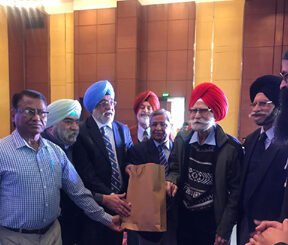
    A couple of years ago, Playwrite, an organization that provides a platform for those associated with sports in various capacities as players, organizers, administrators, doctors and journalists, held its session where Balbir Singh Senior (manager), Ajit Pal Singh (captain) and mercurial Ashok Kumar (forward and gold medal-winning goal scorer) and Dr N. Mohan (Professor of Panjab University) participated to recall those golden moments of 1975.

    Looking Back – When I visited Merdeka Stadium

    It was in 2019 that I got an opportunity to visit the Merdeka Stadium, the historic venue where the 1975 World Cup final between India and Pakistan was played. On March 15, 1975, India scripted history. After winning a bronze in the first World Cup in Barcelona, India finished runners-up in the second World Cup in the Netherlands, losing to the hosts in a tiebreaker after having taken a 2-0 lead early in the game. The wait for glory and the crown ended only in Kuala Lumpur on this day, 48 years ago.

    I had an opportunity to revisit Merdeka Stadium in September 2019. The grassy field on which two great traditional rivals and neighbors slugged out for the gold is no more a hockey venue. Instead, Kuala Lumpur has a new ultramodern hockey complex where all major international hockey events are organized.

    The Stadium Merdeka has a long history. It is known as the site of the formal declaration of independence of the Federation of Malaysia was declared on August 31, 1957, almost 10 years after India got its freedom. Subsequently, it was chosen as a venue for the promulgation of Malaysia on September 16, 1963. At one stage it was the largest stadium in Southeast Asia before it underwent structural changes.

    The stadium has a lower and an upper terrace, with a total capacity of 25,000, as well as 14 tunnel entrances, a covered stand, 50 turnstiles and four floodlight towers. It remained the main venue for holding all major sporting events in Kuala Lumpur till Bukit Jalal National Stadium was built in time for the 1998 Commonwealth Games.

    Besides the World Cup Hockey final in March 1975, it was also the venue for an Olympic Qualifier football event when Malaysia last qualified for the 1980 Moscow Olympic Games. It also used to be the venue for the Merdeka Cup Football Tournament.

    Some members of the 1975 World Cup champion Indian hockey team, including Ashok Dhyan Chand, Aslam Sher Khan and Brig Harcharan Singh, have very fond memories of the event.

    Since then, India has played host to this prestigious FIH tournament four times – 1981-82 in Bombay (now Mumbai), 2010 in New Delhi, 2018 and 2023 in Odisha. Unfortunately, India, as hosts could not even reach the semi-finals of the World Cup. In the last edition held jointly in Rourkela and Bhubaneswar, India touched a new low by failing to qualify even for the quarter-finals.

    Hockey has also come a long way since the maiden 1975 gold medal triumph. From grass, it has moved to synthetic surfaces. It was a year after the Third World up in Malaysia, and the 1976 Summer Olympic Games saw the introduction of synthetic surfaces for hockey competitions. It also marked the beginning of the downfall of Indian hockey. Though India won the gold medal in the 1980 Olympic Games in Moscow, it was primarily because of a boycott by US US-led Western world. The truncated hockey competition saw India winning narrowly against Spain in a closely contested gold medal match.

    Between 1980 and 2021, India did not get any Olympic medals in hockey. It got a reprieve in the 2020 Tokyo Olympic Games held in 2021 when it returned to the podium to win a bronze. But the subsequent World Cup in Odisha in January this year came as a big disappointment and India finished a poor joint ninth with Argentina.

    Ashok Dhyan Chand, who was in Chandigarh to participate in the Playwrite Sports seminar says that each member of the 1975 World Cup champion team enjoys the right to claim his role in bringing singular honor to Indian hockey in the 52-year history of the World.

    Personally speaking, 1973 was our best chance, and I still hold we missed a great opportunity to bring the trophy home after taking a 2-0 lead in the final against the hosts, the Netherlands.

    “Though we had been Olympic champions before but were never a World Cup winner,” says Ashok Kumar who scored the match-winning goal against Pakistan in the final. Pakistan had taken the lead which fullback Surjit Singh neutralized with a penalty corner conversion. It was left to mercurial Ashok Kumar to score the decisive goal. Earlier, it was Harcharan Singh whose goal in the semi-final got India into the final.

    “We all members of the 1975 World Cup champion have only one desire – to see India back on the podium with the gold medal,” says Ashok Dhyan Chand revealing that an exclusive Hockey Museum in memory of his father and Hockey Wizard is under construction at Jhansi. The museum when completed would cost Rs 19 lakh.
    (Prabhjot Singh is a Toronto-based Senior Journalist. He can be reached at Prabhjot416@gmail.com)

  • The top court as custodian of liberties

    The top court as custodian of liberties

    The Manish Sisodia case raises the question whether the liberty of individuals can be held hostage to the benevolence or sense of fairness of the prosecutor alone

    “In eventually restoring Mr. Sisodia’s liberty, pending the final decision in his case, the apex court has redeemed itself of the charge of ambivalence in the earlier rounds despite the existence of legal and factual basis for bail. It need not now ‘trudge on the debris of conscience’. The judgment would have served its purpose if undertrials are not made to languish in custody endlessly, with their freedom, reputation, privacy and dignity irretrievably lost without apology or recompense. And, the nation must repurpose its politics away from personal animosities in an ennobling pursuit of justice and dignity for all, thereby revitalizing a democracy under stress.”

    By Ashwani Kumar

    Former Delhi Deputy Chief Minister Manish Sisodia’s enlargement on bail by the Supreme Court of India, after an unconscionably long incarceration, is a welcome vindication of the apex court’s remit as custodian of individual liberties. In an eloquent exposition of its mandate, the Court reiterated that ‘a constitutional court has to lean in favor of constitutionalism and the rule of law of which liberty is an intrinsic part…’

    Citing its judgment in Arnab Manoranjan Goswami vs The State of Maharashtra and Ors. (2020), it reaffirmed that ‘liberty across human eras is as tenacious as tenacious can be’. Reiterating the salutary constitutional principle expounded as early as 1977 by Justice V.R. Krishna Iyer, that bail is the rule and jail an exception, the Court reaffirmed that the right to fair and speedy trial was implicit in the right to life under Article 21. It concluded that this right was denied to Mr. Sisodia.

    Earlier observations
    In arriving at its conclusions, the Court relied on the observations of the Court in its first order of October 30, 2023 (Manish Sisodia vs Central Bureau of Investigation), and also the submissions advanced before it in the first round, adverting particularly to the 56,000 pages of documents and 456 witnesses (at that stage which, numbers were subsequently increased) in the two cases — and which the Court felt could delay the trial and conclusion of the case inordinately. It also referred to and relied upon several of its judgments, from Kashmira Singh (1977) till the later decisions— (in P. Chidambaram (2020) and Satender Kumar Antil (2022) — on the accused’s right to speedy trial. To these could be added the Court’s decision in Sheikh Javed Iqbal (2024).

    Stating further that the constitutional mandate must prevail as the higher law, the apex court ruled, in Manish Sisodia vs Directorate of Enforcement, purposively that ‘the right to bail in cases of delay, coupled with incarceration for a long period, depending on the nature of the allegations, should be read into Section 439 Cr.PC and Section 45 of the PMLA [Prevention of Money Laundering Act]’.

    In its entirety, the judgment must gladden the hearts of libertarians, considering the troubling and persistent apprehensions about the weaponizing of the stringent penal laws in the country, and concerns about the oppressive application and implementation of the PMLA. Taking cognizance of the information furnished to Parliament recently, the Court noticed that out of the over 5,000 cases brought under the PMLA in the last 10 years, only 40 cases resulted in convictions. In his statement in the Rajya Sabha, the Minister of State for Finance disclosed that ‘the ED filed 15 enforcement case information reports (ECIRs) in 2019, followed by 28 in 2020, 26 in 2021, 34 in 2022, 26 in 2023 and three in 2024 as on July 31. Only one conviction in the cases was reported to have been made in 2020.

    Clearly, the processes of our criminal justice system, leading to endless delays, are oppressive, with procedure itself being the punishment. The reality of the technicalities of procedural laws defeating justice has been judicially recognized and eloquently summed up as ‘the mortality of justice at the hands of law’ — Sushil Kumar Sen (1975); Rani Kusum (2005).

    A caveat
    Notwithstanding its unexceptionable constitutional merit, the judgment begs a troubling question. Was it right for the Court, consistent with its other observations in the first round, to condone the custodial confinement of the accused based on the statement of the prosecution that the trial would be completed within six to eight months? Or to extend the detention of the accused on the basis of the prosecuting counsel’s statement recorded in the Court’s second order of June 4, 2024 that the complaint/charge sheet would be filed on or before July 3, 2024? In a sense, does this not make the prosecutor a judge in its own cause, contrary to the first principles of natural justice and vitiating at its core the procedural imperatives of fair trial?

    The guarantee of civil liberties
    In our constitutional scheme, the liberty of individuals cannot be held hostage to the benevolence or sense of fairness of the prosecutor alone. It must stand on the unbreachable foundation of justice anchored in inalienable rights ‘born in flesh, carried in our bodies from birth to death’. We know that sacrosanct rights ‘undergrid’ the law; that there is no virtue in legal processes that are unjust and laws that fail to render justice must be changed. Denial of freedom is denial of humanity itself. Therefore, its preservation against excesses of the executive is the first charge on the apex Court’s constitutional and moral authority. Although the ultimate guarantee of civil liberties lies in the faith and assertion of the people, as Justice Robert Jackson of the United States reminded us in Douglas vs City of Jeannette (1943), the courts’ auxiliary protection against encroachment of human rights is the crucial test of a vibrant democracy.

    In eventually restoring Mr. Sisodia’s liberty, pending the final decision in his case, the apex court has redeemed itself of the charge of ambivalence in the earlier rounds despite the existence of legal and factual basis for bail. It need not now ‘trudge on the debris of conscience’. The judgment would have served its purpose if undertrials are not made to languish in custody endlessly, with their freedom, reputation, privacy and dignity irretrievably lost without apology or recompense. And, the nation must repurpose its politics away from personal animosities in an ennobling pursuit of justice and dignity for all, thereby revitalizing a democracy under stress.

    (Ashwani Kumar is Senior Advocate, Supreme Court of India and a former Union Minister for Law and Justice.)