Tag: AUKUS

  • India must remain ahead of the curve

    India must remain ahead of the curve

    Pursuit of global aspirations must be tempered by awareness of regional & immediate challenges
    “There is an assumption that the US has enough stakes in its strategic partnership with India not to let the issue get out of hand. However, the extradition of Gupta to America from the Czech Republic and the initiation of judicial proceedings against him mean that the ability of the US administration to manage the fallout will be severely limited. If further damaging evidence becomes public during the trial, there will be even greater reputational damage to India and there will be demands in the US Congress and the American media for punitive measures against India. It would be prudent for the Indian government to work out a coping strategy and remain ahead of the curve.”

    By Shyam Saran

    The din of the Lok Sabha elections is over. A duly elected government is in place and it is gearing up to face both domestic and external challenges. Some of these challenges are not new, though they have a different scale and dimension. But some will be novel and unexpected. On balance, the domestic landscape remains relatively more stable. There may be a coalition government at the Centre, but the BJP remains its largest constituent. Prime Minister Narendra Modi may have been politically diminished by the election results, but he remains the most popular and powerful leader. Temperamentally, he is unlikely to significantly alter the modus operandi he has relied upon during the past decade. He is more likely to double down in implementing his political, ideological and economic agendas than in stepping back into a more consensual mode. To the extent that political stability and policy continuity will matter in a world where even the more powerful countries, including the US, are descending into a period of mounting uncertainty, political polarization and even fragmentation, India will be seen as a more stable and reliable anchor in the international system. That will be an asset it can leverage to advance its interests.

    India is important to the world, but the world remains more important to India. A more modest external posture may help.

    If India is able to sustain its current rate of GDP growth of around 7 per cent per annum over the next decade, as it seems likely to do, that, too, will make it an outlier among major emerging economies. The Modi government has been unusually business-friendly and this has improved the investment environment for domestic and foreign entities. It must now shift from a business-friendly to a market-friendly strategy which creates an enabling environment for all businesses to flourish. If it does, the economic transformation of India will become the great story of the next several decades. This could potentially expand the country’s diplomatic space. Foreign policy should be harnessed to promoting the interests of Indian businesses rather than those of a few chosen entities.

    Unlike the domestic space, the external space will be far more challenging and India’s vulnerabilities will be greater. In a rapidly changing and fluid geopolitical landscape, the uncertainties unleashed by continuing and escalating wars in Europe and West Asia and the prospects of dramatic and deeply disruptive departures in the foreign policies of major powers as a fallout of impending elections will require an extraordinary agility and skillful diplomacy on the part of India. There seems to be an assumption that India’s value as a countervailing and constraining power vis-à-vis China would not only persist but also be enhanced. But as we had witnessed during the Cold War, the dominant powers often temper their confrontation with significant measures of détente and even collaboration at the cost of those allied or aligned with them. One should not rule out such strategic re-ordering of relations between the US and China which may shrink India’s own strategic space and heighten its vulnerability to Chinese pressure.

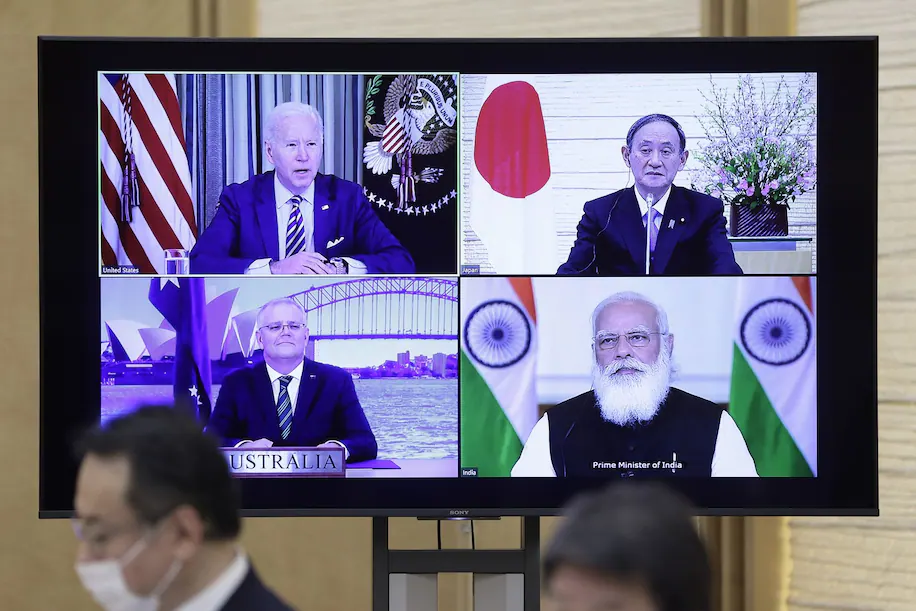
    It is also possible that in meeting the China challenge in the Indo-Pacific, the US may attach greater value to its alliance systems and operational arrangements with other partner countries in the region. The US has worked hard to create a truly trilateral military alliance with Japan and South Korea, helping overcome the historical antipathy between Japan and South Korea. The three countries are now sharing intelligence, conducting military drills and coordinating their postures towards China and the region and this is becoming the core of American Indo-Pacific strategy instead of the Quad (India, Japan, Australia and the US). The AUKUS, comprising Australia, the UK and the US, which is a military alliance based on a substantial nuclear submarine force, will also gain in importance as it begins to be rolled out. The revival of the US-Philippines military alliance and the US gaining access to key bases in that country are another link in the American security chain. The Quad summit scheduled earlier this year in India has been postponed and is unlikely to be convened until after the US presidential elections. But its fate has become uncertain, and with that its value to India as a counter to China.

    There are other vulnerabilities to be dealt with. The allegations regarding assassination attempts, perpetrated by Indian intelligence agents against Khalistani elements in the US and Canada who are accused of spreading terrorism in India, may adversely impact India’s relations with key Western partners. The allegation is that a US citizen, Gurpatwant Singh Pannun, was the target of an assassination plot hatched by an employee of India’s external intelligence agency, R&AW. It relied on an Indian citizen, Nikhil Gupta, to carry this through a hired hitman. The plot was foiled by the US authorities. The Indian government has promised a full investigation. There is an assumption that the US has enough stakes in its strategic partnership with India not to let the issue get out of hand. However, the extradition of Gupta to America from the Czech Republic and the initiation of judicial proceedings against him mean that the ability of the US administration to manage the fallout will be severely limited. If further damaging evidence becomes public during the trial, there will be even greater reputational damage to India and there will be demands in the US Congress and the American media for punitive measures against India. It would be prudent for the Indian government to work out a coping strategy and remain ahead of the curve.

    It is hoped that the newly elected government will re-orient its policy towards its neighborhood, including towards China. There needs to be a re-engagement with China and the search for a new equilibrium in the relationship. The opportunities for a resumption of dialogue at the summit level during the forthcoming summits of the Shanghai Cooperation Organisation and the BRICS grouping should be grasped, even if the prospects of resolving outstanding issues are limited. The same goes for re-engagement with Pakistan, for which the conditions are much more conducive than before, given its grave economic crisis and geopolitical diminution.

    The pursuit of global aspirations must be tempered by an awareness of more regional and immediate challenges. India is important to the world, but the world remains more important to India. A more modest external posture may help.
    (Shyam Saran is a Former Foreign Secretary of India)

  • How Ukraine imbroglio can impact India

    How Ukraine imbroglio can impact India

    By Gurjit Singh

    The standoff between Russia and US-Europe over Ukraine has come at an inopportune time for India. As a UN Security Council (UNSC) member, India is contributing to ensuring peace, security and stability in the world. This role has opportunities for enhancement due to the inability of the permanent five (P5) to act in unison. In the case of Ukraine, the P5 are threatening to go to war with each other, with the UK, US, France on one side, and Russia supported by China on the other. This takes matters totally out of the hands of the UNSC, making it redundant. The Ukraine crisis is curtailing Indian role in the UNSC. New Delhi is doing its best to remain relevant. India is developing relations with the EU and other European countries. This initiative leads India to support the Normandy process and the Minsk agreement, which are European efforts to engage Russia on Ukraine. India would prefer the European way of dealing with Russia than the tough posture which the US wants NATO to adopt. European countries will toe the US line if war erupts. That reduces the efficacy of India’s European initiative presently. India is calling for diplomacy as that will defuse the tension and also give India more leeway.The Russian posture on Ukraine and the reaction to it, strengthened the Sino-Russian partnership. The Xi-Putin summit at the Beijing Winter Olympics lent firmness and robustness to that relationship. China is challenging India, has overthrown extant agreements and increased its military threat. This does not augur well. For long, India depended on Russia for strategic partnership. It still largely depends on Russia for military hardware. While the defense relationship is mutually beneficial, the Sino-Russian axis curtails the Russian ability and intent to support India as in the past.

    Russia’s confrontation with NATO will lead to rigorously imposed sanctions. India has delicately negotiated to stay out of CAATSA (Countering America’s Adversaries Through Sanctions Act) with the purchase of S-400 Triumf missile systems which may not work when a war-like situation prevails. Countries like Germany have stark choices on economic issues, and India will be faced with similar choices on defense supplies from Russia with tougher sanctions that the US is ready to impose. India-Russia trade of about $9 billion annually is about 1% of India’s global trade. The significance is the impact on defense, energy, grain delivery and prices.

    Curtailing of defense supplies will impact India’s ability to respond to China. The diversification of defense purchases that India achieved would come into play but without the competitive pricing and transfer of technology of Russian equipment.

    Strategically, Russia will not attempt to restrain China. In exchange for Chinese support for Russian intent in Ukraine, they would concur with Chinese initiatives in the Indo-Pacific. Russia’s nuanced divergence on India could melt away if the Ukraine crises blows up as both NATO and Russia seek clear Indian support which India hesitates to provide.

    The Ukraine crisis brings Russia and China closer and diverts the attention of Western powers towards Ukraine. The Europeans would have a lesser appetite for the Indo-Pacific once they are embroiled in European matters. France held its Indo-Pacific conference right after the Munich Security Conference this month. They wish to continue to deal with the region while engaged with Russia as well. However, the EU member countries do not have diverse abilities and their Indo-Pacific polices are likely to be on hold till the Russian challenge is settled. At present, US naval forces are at strength in the South China Sea and the broader Indo-Pacific as Taiwan is at stake. They will need allies Japan and AUKUS to play a role. They could well call upon India to act in the Indo-Pacific even if India is not directly involved in an operation around Taiwan.

    This is not different from what India is doing in the Indo-Pacific at present, but India expects support for its position with China on the border issue, as was discussed at the Quad foreign ministers’ meeting in Australia recently. Indian activity, in the midst of the Ukraine crisis, may not be ignored by China and Russia.

    India’s energy security is a matter of worry as there is already a $20 per barrel increase in the price of oil over the estimates used by the Economic Survey 2022. This impacts India’s growth story. Russia is a significant oil producer and the Ukraine crisis and sanctions on Russia would destabilize the oil market. This would gravely impact India’s development plans.

    In 2021, India imported merely 1% of its oil and 0.2% of its gas from Russia. GAIL has a 20-year contract to import 2.5 million tons of LNG from Russia annually. It’s not the direct supply but the prices that will be impacted negatively. Thus, India’s repeated calls for peaceful resolution. The diversification of Indian energy supplies over time will perhaps protect supplies but not control prices.

    Similarly, if the Ukraine crisis leads to Europe, particularly Germany, curtailing gas imports from Russia, it will bring other gas providers to strategically shift supplies to Europe impacting Asian economies. The gas prices nevertheless will rise. The pandemic has slowed down India’s investment in Mozambique in gas offtake and this needs to be hastened to diversify gas imports and stabilize gas pricing in India. There are nearly 25,000 Indians in Ukraine, mostly students. They have been advised to leave Ukraine as flights are still available. Indian mission families too are leaving. This is the correct advisory planned well ahead of a full-scale crisis. Students remain averse to depart when it is feasible, to avoid spending on high-priced tickets. They believe that the government will always step in to rescue them once a crisis unfolds. This attitude needs to change.

    This is an inflection point for India as the Ukraine crisis challenges its ability to influence events in its favor, avoid an impact on its economy, without taking sides in a crisis of indirect interest to it. Such impacts of globalization need careful handling.

    (The author is a former ambassador)

  • Quad or AUKUS – India needs to review its involvement in blocs

    Quad or AUKUS – India needs to review its involvement in blocs

    The interests of the US and India find convergence on the issue of threats to the two countries from terrorists in Pak supported Afghanistan. US may be worried Afghanistan could become a source of another 9/11. India, already being harassed by Pakistan in Kashmir, is naturally concerned with the emergence of the Mullah power in Afghanistan  It is a good reason for the two countries to come closer because of the recent developments in Afghanistan and Pakistan’s efforts to seek control of the government in Afghanistan via the Haqqani group that Pakistan has supported and promoted over decades.

    US has always needed allies to fight its battles and protect its interests. China is the main challenger to America’s economic and military power. America must contain China. India fits into the American scheme. India has a long history of border dispute with China. Again, China is supportive of India’s sworn enemy- Pakistan. Weakening of China will mean weakening of Pakistan. India may also be viewing China as too formidable an economic power to allow India to have the kind of influence it is eying to have in the region. So, India will support any nation or group of nations which might checkmate China.

    We know of traditional rivalry between China and Japan. As for Australia, it is a country living in fear of being overwhelmed by China. So, with support coming from. the US, the neighboring economic giant Japan and a willing collaborator India, Australia hopes to keep China on the leash. We only hope India will weigh coolly what is in its best interests, and not become a pawn in the hands of the individual nations or blocs.