Tag: Aung San Suu Kyi

  • Myanmar security forces arrest key protest leader

    Myanmar security forces arrest key protest leader

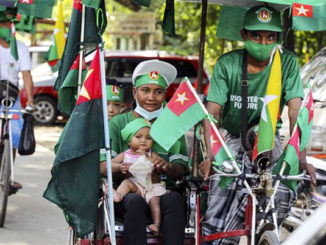
    Yangon (TIP): Myanmar security forces arrested on Thursday one of the main leaders of the campaign against military rule after ramming him with a car as he led a motorbike protest rally, friends and colleagues said. Opponents of a February 1 coup that ousted an elected government led by Nobel peace laureate Aung San Suu Kyi have kept up their campaign against the military this traditional New Year week with marches and various other displays of resistance. “Our brother Wai Moe Naing was arrested. His motorbike was hit by an unmarked police car,” Win Zaw Khiang, a member of a protest organising group, said on social media. Wai Moe Naing, a 25-year-old Muslim, has emerged as one of the most high-profile leaders of opposition to the coup. Earlier, Reuters spoke to Wai Moe Naing by telephone as he was setting off to lead the rally in the central town of Monywa, about 700 km (435 miles) north of the main city of Yangon. — Reuters

  • Myanmar faces growing isolation as military tightens grip

    Myanmar (TIP): Myanmar faced growing isolation on Thursday with increasingly limited internet services and its last private newspaper ceasing publication as the military built its case against ousted elected leader Aung San Suu Kyi. Nobel peace laureate Suu Kyi was overthrown and detained in a February 1 military coup, triggering mass protests across the country that security forces have struggled to suppress with increasingly violent methods. The total documented number of people killed in the unrest stood at 217 but the actual toll was probably much higher, the Assistance Association for Political Prisoners activist group said. Western countries have condemned the coup and called for an end to the violence and for the release of Suu Kyi and others.  Asian neighbours have offered to help find a solution, but the military has a long record of shunning outside pressure. Large parts of an economy already reeling from the novel coronavirus have been paralysed by the protests and a parallel civil disobedience campaign of strikes against military rule, while many foreign investors are reassessing plans.(Reuters)

  • Suu Kyi’s party expected to win second term in Myanmar polls

    Suu Kyi’s party expected to win second term in Myanmar polls

    Bangkok (TIP): Myanmar’s citizens go to the polls Sunday in an effort to sustain the fledgeling democracy they helped install just five years ago.
    There are about 37 million registered voters, though turnout is expected to suffer because of a recent surge in coronavirus cases.
    In 2015, excitement was high over the opportunity to end more than five decades of army-directed rule. The National League of Democracy party of Nobel Peace Prize laureate Aung San Suu Kyi roared to a landslide election victory and she became her country’s leader after many hard years at the forefront of a non-violent struggle against military dictatorships that won international admiration. This year, her party is expected to again top the polls, but some critics feel her administration has failed to embrace democratic principles.
    Chances for real reform were always dicey, as the 2008 constitution drafted under the military assures it of enough seats in parliament to block charter changes. Key ministries are also under the control of the military.
    Critics accuse 75-year-old Suu Kyi and her party of being more concerned about entrenching itself in power than encouraging a broad-based democracy.
    “This time, neither Aung San Suu Kyi nor her party is bringing democracy to Myanmar. Instead, they are trying to bring in a one-party democracy system,” charged Khin Zaw Win, director of the Tampadipa Institute, a Yangon-based policy advocacy group.
    Enfeebling other parties had meant there has been little real debate about policies during the campaign. Myanmar needs a better political mix, he said.
    Even the voting process has become enmeshed in controversy, as the state election commission has been accused of conniving with Suu Kyi’s ruling party by cancelling voting in some areas where parties critical of the government were certain to win seats.
    The Union Election Commission insisted the voting was cancelled because of armed conflict with ethnic guerrillas in those areas.
    The decision was one of several points criticised this past week by Thomas Andrews, the UN special rapporteur for human rights in Myanmar.
    Buddhist-majority Myanmar, he said, would not be able to hold free and fair elections “as long as … the right to vote is denied based on race, ethnicity or religion, as it is with the Rohingya”.
    Long-standing prejudice against the Muslim Rohingya minority, whom many consider to have immigrated illegally from South Asia even though their families have lived in Myanmar for generations, has deprived most of them of the rights of citizenship.
    Western friends of Myanmar were shocked at the brutal 2017 counter-insurgency campaign by Myanmar’s army that drove about 7,40,000 Rohingya to flee into neighbouring Bangladesh, drawing accusations of genocide.
    It also sent Suu Kyi’s reputation with Western admirers into a tailspin when she failed to restrain the security forces. But for most people in Myanmar, the Rohingya are not an issue in the election.
    Andrews also said opposition political parties claim they were denied access to state media and their messages have been censored for criticising government policies.
    Measures to control the coronavirus severely restricted traditional large-scale campaigning by all parties, but Suu Kyi benefits from frequent reports in state media about her carrying out her official duties, and from her regular updates about fighting the coronavirus streamed on her Facebook page. Her administration had already been criticised by free speech advocates. It scrapped some censorship and licensing laws, but aggressively employs defamation and telecommunications laws against journalists and activists critical of the government and the military.
    Failure of much-touted plans to reconcile with the country’s fractious ethnic minorities is another dent in Suu Kyi’s reputation. Ethnic minority groups, mainly in border areas, have for decades been engaged in an on-again, off-again armed struggle for autonomy. AP

  • Myanmar insists no North Korea  links as US envoy visits

    Myanmar insists no North Korea links as US envoy visits

    YANGON (TIP): Myanmar has no military ties with North Korea, a Myanmar official said on Monday, as a US diplomat responsible for North Korea arrived for talks in which he is likely to seek assurances on efforts to isolate it.

    Ambassador Joseph Yun was set to meet Myanmar’s State Counsellor Aung San Suu Kyi and the military’s commander in chief in the capital, Naypyitaw, on Monday, according to the U.S. Embassy in Yangon. Yun attended a conference in Singapore over the weekend focusing on tension on the Korean peninsula over the North’s unrelenting nuclear and missile programmes. Ambassador Joseph Yun’s trip to Asia was announced after North Korea’s test on July 4 of on intercontinental ballistic missile that it says can carry a large nuclear warhead and some experts believe has the range to reach Alaska. Myanmar is the only other stop on his trip, pointing to concern in Washington that Myanmar’s army, which used to have ties with North Korea, continues to give succour to Kim Jong Il’s regime. (Reuters)

  • Myanmar insists no North Korea links as US envoy visits

    Myanmar insists no North Korea links as US envoy visits

    YANGON (TIP): Myanmar has no military ties with North Korea, a Myanmar official said on July 17, as a US diplomat responsible for North Korea arrived for talks in which he is likely to seek assurances on efforts to isolate it.

    Ambassador Joseph Yun was set to meet Myanmar’s State Counsellor Aung San Suu Kyi and the military’s commander in chief in the capital, Naypyitaw, on Monday, according to the U.S. Embassy in Yangon.

    Yun attended a conference in Singapore over the weekend focusing on tension on the Korean peninsula over the North’s unrelenting nuclear and missile programmes. Ambassador Joseph Yun’s trip to Asia was announced after North Korea’s test on July 4 of on intercontinental ballistic missile that it says can carry a large nuclear warhead and some experts believe has the range to reach Alaska.

    Myanmar is the only other stop on his trip, pointing to concern in Washington that Myanmar’s army, which used to have ties with North Korea, continues to give succour to Kim Jong Il’s regime.

    The United States did not inform Myanmar what Yun would discuss, said Kyaw Zeya, permanent secretary at Myanmar’s Ministry of Foreign Affairs. “They are not very specific from the very beginning but we understand he is the special envoy on North Korea,” Kyaw Zeya told Reuters.

    Myanmar was complying with UN resolutions on North Korea, he said. “It’s normal relations between the two countries,” said Kyaw Zeya. “As I understand, there’s no such relations between military to military. Definitely not.”

    The United States in May asked Southeast Asian countries to do more to isolate North Korea, and efforts have increased after its July 4 ballistic missile test.

    RESIDUAL POCKETS?: Myanmar’s former ruling junta, which, like North Korea, was also widely shunned by the outside world over its suppression of human rights, was known to have ties to North Korea, which included sending missile experts and material for arms production to Myanmar. Myanmar insists that arms deals and other military relations with North Korea stopped before its transition to a nominally civilian government in 2011.

    Nobel laureate Suu Kyi took power last year amid a transition from full military rule. But the military could still have “a few residual pockets” with links to North Korea, the then top U.S. diplomat for East Asia, Daniel Russel, told a congressional hearing in September.

    In March, the US Treasury levelled new sanctions against the Myanmar army’s procurement body, the Directorate of Defence Industries (DDI), under the Iran, North Korea, and Syria Nonproliferation Act Sanctions.

    The DDI was previously sanctioned in 2012 and accused of materially assisting North Korea’s regime, but had fallen off the sanctions list in October after the Obama administration dropped most measures against Myanmar in recognition of a successful political transition.

    But despite Suu Kyi leading the civilian administration, Myanmar’s military remains free from civilian oversight. A 2008 constitution drafted by then-ruling generals keeps the army central to politics. (Reuters)

  • Nikki Haley says cannot overlook what is happening in Myanmar

    Nikki Haley says cannot overlook what is happening in Myanmar

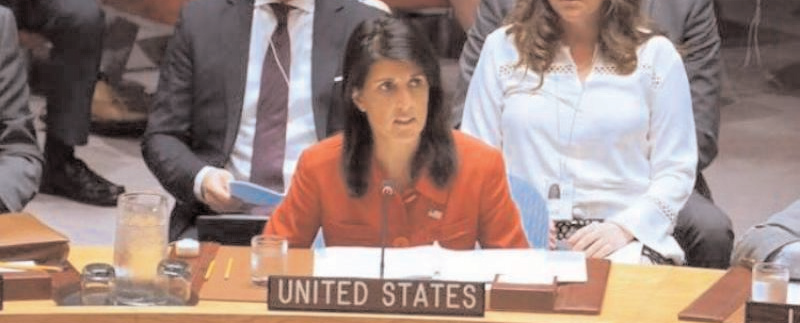
    UNITED NATIONS (TIP): Myanmar should let the UN fact-finding mission probe the alleged human rights violations by the country’s military and security forces, US Ambassador to the UN Nikki Haley has said, underlining that the international community cannot overlook the situation there.

    Myanmar said late last month that it would not grant visas to members of a commission appointed by the UN Human Rights Council to investigate human rights violations by the country’s state security forces, including the recent abuses in Rakhine State.

    The US mission to the UN said violence in Rakhine State against ethnic and religious communities continues to claim lives and there are allegations of sexual violence against women and children.

    “No one should face discrimination or violence because of their ethnic background or religious beliefs. It is important that the Myanmar government allow this fact-finding mission to do its job,” Indian-origin Haley said in a statement here.

    She said the international community cannot overlook what is happening in Myanmar and “we must stand together and call on the government to fully cooperate with this fact-finding mission”.

    “The total number of victims will be unknown unless the fact-finding mission is allowed to proceed,” the UN mission said.

    Geneva director at global rights group Human Rights Watch John Fisher said denying visas to the members of the fact-finding mission would be “a slap in the face” to victims who suffered grave human rights violations by Myanmar’s state security forces.

    “Does Aung San Suu Kyi’s government really want to be included in a very small and ignominious club of countries that reject Human Rights Council decisions? North Korea, Eritrea, Syria, and Burundi are human rights pariah states that obstructed the work of independent, international investigations into alleged rights abuses, and it would be a travesty for a democratically elected, National League for Democracy-led government in Myanmar to do the same,” Fisher said. The rights group said the Myanmar government should immediately announce they will issue visas to the fact-finding mission and fully cooperate with its investigation.

    “Otherwise, the governments that pushed to set up this fact-finding mission need to stand up for it and impose a political consequence on Myanmar for blocking its work,” Fisher added.

    The UN estimates that more than 90,000 Rohingya have been forced to flee their homes in northern Rakhine State since last October. (PTI)

  • ‘I want Apple’: Myanmar abuzz over end of US sanctions

    ‘I want Apple’: Myanmar abuzz over end of US sanctions

    YANGON (TIP): Myanmar cheered a US promise to end sanctions on Sept 16, with residents in its commercial capital clamouring for American brands while politicians and business moguls heralded a new era of transparency and trade.

    US President Barack Obama vowed to scrap the trade limits during Aung San Suu Kyi’s first visit to the White House since her party took power in March, ending decades of military domination.

    The move marks a milestone in the country’s rapid transformation from an international pariah into Asia’s fastest-growing economy under the leadership of the Nobel laureate.

    But Soe Naung Win, who owns a mobile phone shop in Myanmar’s bustling economic capital of Yangon, had more immediate concerns.

  • US lifts Myanmar trade sanctions

    US lifts Myanmar trade sanctions

    WASHINGTON (TIP): President Barack Obama announced that US economic sanctions against Myanmar will be lifted, and trade preferences reinstated to provide duty-free treatment for goods from the Asian nation. The September 14 meeting in Washington was the first by Aung San Suu Kyi as Myanmar’s leader since her pro-democracy party won a stunning victory over the country’s military rulers in elections last year.

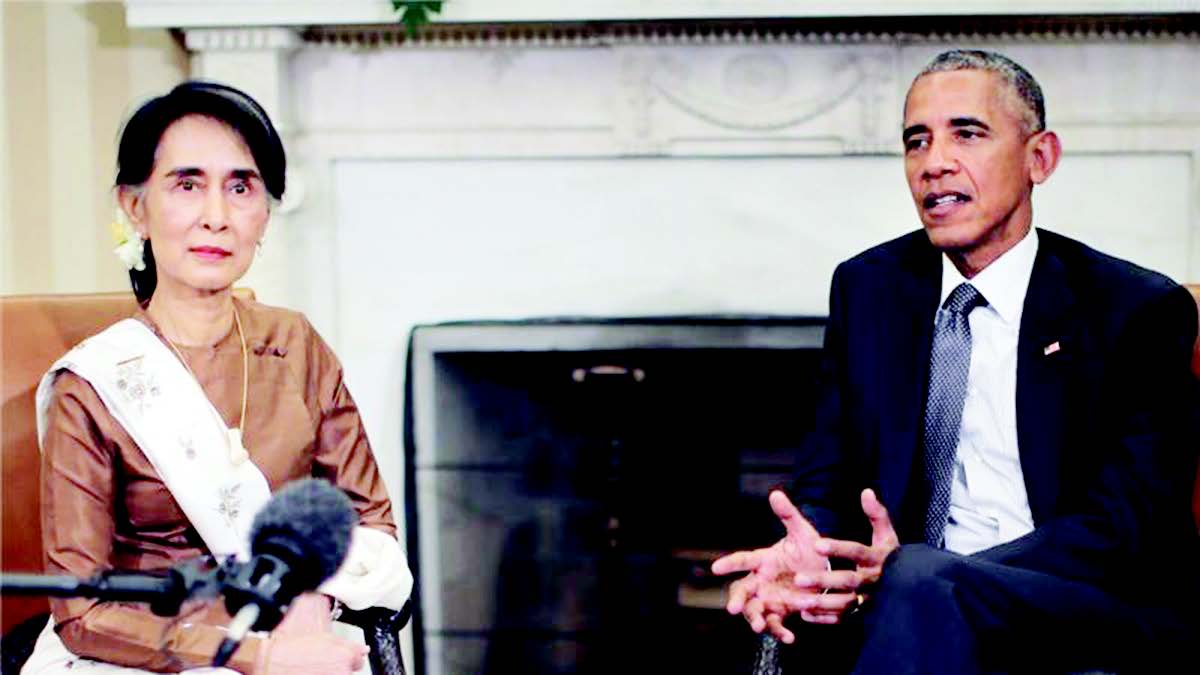
    “The United States is now prepared to lift sanctions that we have imposed on Burma for quite some time,” Obama said, speaking in the Oval Office with Aung San Suu Kyi at his side.

    Earlier, Obama notified the US Congress that he was reinstating preferential tariffs, known as the Generalized System of Preferences (GSP), for Myanmar, which provides duty-free access for goods from poor and developing countries.

    Myanmar, which is also known as Burma, was removed from GSP benefits in 1989 after the country’s ruling military junta brutally crushed pro-democracy protests.

    President Obama said the lifting of some sanctions would happen “soon”, but did not give further details.

    “It is the right thing to do to ensure the people of Burma see rewards from a new way of doing business, and a new government,” he said.

    He also paid tribute to the efforts made towards peace in the country, and the “enormous potential” of the country.

    Ms Suu Kyi called on the US Congress to eliminate all remaining sanctions against Myanmar.

    “Unity also needs prosperity,” she said. “People, when they have to fight over limited resources, forget that standing together is important.”

    “We think that the time has come to remove all of the sanctions that hurt us economically,” she said.

    Removal of long-standing sanctions against Myanmar will help foreign investment and boost the country’s transition to democracy, the White House said prior to the meeting of the two leaders.

    The US eased some sanctions earlier this year to support political reform, but maintained most of its economic restrictions with an eye towards penalizing those it views as hampering Aung San Suu Kyi’s democratically elected government.

    Myanmar’s military stepped back from direct control of the country in 2011 after 49 years in power, but maintains a commanding role in politics, controlling 25 percent of seats in parliament and leading three key ministries.

    Aung San Suu Kyi is barred from the post of Myanmar’s president under the country’s military-drafted constitution, which rules her out because her sons are not Myanmar citizens. Instead, she serves as the country’s de facto leader by holding the positions of foreign minister and state counsellor.

  • US lifts Myanmar trade sanctions

    US lifts Myanmar trade sanctions

    President Barack Obama announced that US economic sanctions against Myanmar will be lifted, and trade preferences reinstated to provide duty-free treatment for goods from the Asian nation.

    Yesterday’s (09/14/2016) meeting in Washington was the first by Aung San Suu Kyi as Myanmar’s leader since her pro-democracy party won a stunning victory over the country’s military rulers in elections last year.

    “The United States is now prepared to lift sanctions that we have imposed on Burma for quite some time,” Obama said, speaking in the Oval Office with Aung San Suu Kyi at his side.

    Earlier, Obama notified the US Congress that he was reinstating preferential tariffs, known as the Generalized System of Preferences (GSP), for Myanmar, which provides duty-free access for goods from poor and developing countries.

    Myanmar, which is also known as Burma, was removed from GSP benefits in 1989 after the country’s ruling military junta brutally crushed pro-democracy protests.

    President Obama said the lifting of some sanctions would happen “soon”, but did not give further details.

    “It is the right thing to do to ensure the people of Burma see rewards from a new way of doing business, and a new government,” he said.

    He also paid tribute to the efforts made towards peace in the country, and the “enormous potential” of the country.

    Ms Suu Kyi called on the US Congress to eliminate all remaining sanctions against Myanmar.

    “Unity also needs prosperity,” she said. “People, when they have to fight over limited resources, forget that standing together is important.”

    “We think that the time has come to remove all of the sanctions that hurt us economically,” she said.

    Removal of long-standing sanctions against Myanmar will help foreign investment and boost the country’s transition to democracy, the White House said prior to the meeting of the two leaders.

    The US eased some sanctions earlier this year to support political reform, but maintained most of its economic restrictions with an eye towards penalising those it views as hampering Aung San Suu Kyi’s democratically elected government.

    Myanmar’s military stepped back from direct control of the country in 2011 after 49 years in power, but maintains a commanding role in politics, controlling 25 percent of seats in parliament and leading three key ministries.

    Aung San Suu Kyi is barred from the post of Myanmar’s president under the country’s military-drafted constitution, which rules her out because her sons are not Myanmar citizens. Instead, she serves as the country’s de facto leader by holding the positions of foreign minister and state counsellor.

  • Aung San Suu Kyi to lead committee for Rohingyas

    Aung San Suu Kyi to lead committee for Rohingyas

    NAY PYI TAW (TIP): Nobel laureate and Myanmar .s State Counselor Aung San Suu Kyi will chair a new committee dedicated to promoting peace and development in Rakhine state, where the persecuted Rohingya Muslim minority lives, officials said on June 1.

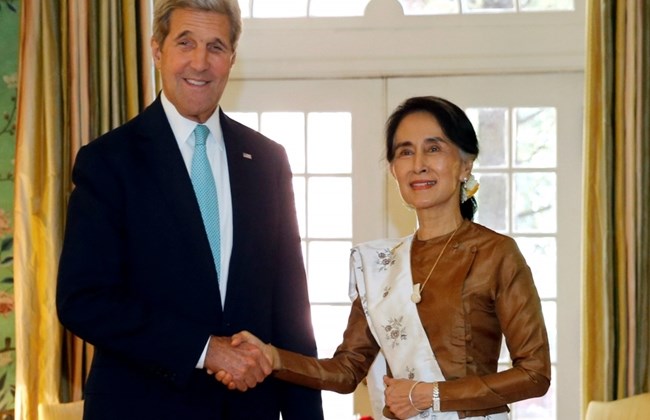
    The founding of the committee was announced a week after the US Secretary of State, John Kerry, urged Suu Kyi, who is also the country’s foreign minister, to promote human rights after a meeting in which both discussed the situation of the Rohingya minority.

    The committee will include 19 more members of the new Cabinet, according to the state newspaper Global New Light of Myanmar.

    Among other matters, it will be responsible for coordinating the activities of UN agencies and international NGOs working in the area.

    These organizations work, albeit with restrictions, in the area to assist the Rohingyas , a minority living in Myanmar for centuries, who are not recognized as Burmese citizens but are considered Bengali immigrants.

    About 120,000 of them are confined in 67 camps and suffer all kinds of restrictions since the outbreak of sectarian violence in 2012 between this minority and the Buddhist majority in the region, which caused at least 160 deaths, EFE news reported.

    In March, just days before handing over power, the former government lifted the state of emergency imposed since then in Rakhine where the Rohingyas have limited freedom of movement and access to education, and suffer the confiscation of their property.

  • Myanmar’s Aung San Suu Kyi gets new role as special adviser

    Myanmar’s Aung San Suu Kyi gets new role as special adviser

    YANGON (TIP): Myanmar’s president signed a bill giving Aung San Suu Kyi a new role of state adviser, shoring up her influence across all branches of government despite vehement opposition from the still-powerful military.

    Suu Kyi is determined to rule the former junta-run nation regardless of an army-scripted constitution that bars her from becoming president, as she strives to meet the aspirations of millions of voters who gave her pro-democracy party a landslide election victory last November.

    She is already foreign minister and met her Chinese counterpart for talks yesterday, prioritising Beijing in her first foray into international diplomacy since her National League for Democracy officially took power last week.

    The bill outlining her advisory role, which mentions the Nobel laureate by name, enables Suu Kyi to wield influence over parliament as well as in the cabinet in a position officially called “state counsellor”.

    It was signed into law by President Htin Kyaw, Suu Kyi’s longtime aide and effective proxy, following debates in both houses of parliament that have seen protests by the army’s legislative representatives.

    “The president has signed the state counsellor bill today,” president office deputy director-general Zaw Htay told AFP.

    He declined to give further details on the legislation, which sped through both houses of parliament thanks to the NLD’s huge majority.

    In a dramatic lower house session yesterday, unelected military MPs — who make up a quarter of the legislature because the constitution reserves seats for them — stood up to register a protest that their suggested amendments were being ignored. The bill was then sent straight to the president without a vote in the combined legislature because no clauses had been altered. One army MP, Brigadier General Maung Maung, complained to reporters after Tuesday’s session that the passage of the bill was “democratic bullying by majority”.

  • Htin Kyaw sworn in as Myanmar’s president

    Htin Kyaw sworn in as Myanmar’s president

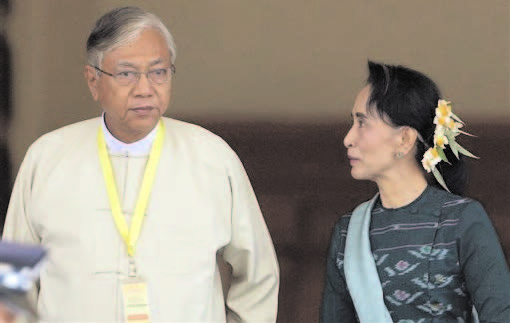
    NAYPYITAW (TIP): Htin Kyaw, a confidante of Nobel laureate Aung San Suu Kyi, was sworn in Wednesday as Myanmar’s president, ushering in the first democratically elected government into office after decades of military rule.

    The 70-year-old Htin Kyaw took the oath of office in a joint session of Myanmar’s newly elected parliament with his two vice presidents at his side, as Suu Kyi sat watching in the front row. “I, Htin Kyaw, will be loyal to the union and the people of the union,” he said, reading from a written pledge, while repeating after the house speaker Mann Win Khaing Than. “I will respect this constitution and the laws of the nation.”

    The same pledge was simultaneously read by First Vice President Myint Swe and Second Vice President Henry Van Tio. Later in the day, outgoing President Thein Sein will formally hand over the presidency to Htin Kyaw.

    Rightfully, the job belonged to Suu Kyi, who has been the face of the pro-democracy movement and who endured decades of house arrest and harassment by military rulers without ever giving up on her non-violent campaign to unseat them. But a constitutional provision barred Suu Kyi from becoming president, and she made it clear that whoever sits in that chair will be her proxy. She has said repeatedly she will run the government from behind the scenes.

    Still, Htin Kyaw will be remembered by history as the first civilian president for Myanmar and the head of its first government to be elected in free and fair polls. Suu Kyi’s party, the National League for Democracy, won a landslide victory in elections last November, in a reflection of Suu Kyi’s widespread public support. The constitutional clause that denied her the presidency excludes anyone from the position who has a foreign spouse or children. Suu Kyi’s two sons are British, as was her late husband. The clause is widely seen as having been written by the military with Suu Kyi in mind.

    The democracy that Suu Kyi and her colleagues are building is still not a complete package. The military has reserved 25 percent of the seats in parliament for itself, guaranteeing that no government can amend the constitution without its approval. Also, it ensured that one of Htin Kyaw’s two vice presidents is a former general, Myint Swe, a close ally of former junta leader Than Shwe. Myint Swe remains on a U.S. Treasury Department blacklist that bars American companies from doing business with several tycoons and senior military figures connected with the former junta.

  • Myanmar president to include Aung San Suu Kyi in his Cabinet

    Myanmar president to include Aung San Suu Kyi in his Cabinet

    NAYPYITAW (TIP): Myanmar’s president-elect on March 22 proposed an 18-member cabinet that will include party leader Aung San Suu Kyi, the former dissident who for decades had campaigned for a democratically elected government to replace the country’s military junta.

    President-elect Htin Kyaw submitted the names to the parliament for a formal review and approval by legislators on Wednesday, after which the Cabinet positions of the ministers will be decided.

    Notable, and top on the list, is Suu Kyi, who was not able to become president because of a constitutional block, even though she led her party to a landslide win in general elections last November.

    It was widely rumored that Suu Kyi will become the foreign minister, but that’s far from certain because if she were to take that post she would have to give up her parliament seat and end party activities.

    “I doubt that Aung San Suu Kyi would take the position of the foreign minister,” said Toe Kyaw Hlaign, a political analyst. “Also, working as a foreign minister requires a lot of time traveling around the world. She will have to do a lot of international relations and overseas trips, and she won’t have the time to exercise control over the government,” he told The Associated Press.

    Suu Kyi has said in the past that she will be “above the president” and indirectly govern the country from behind the scenes.

    Still, Suu Kyi’s entry into the government is a remarkable turn of fortunes not only for the Nobel Peace laureate but also for the country, which had been under an iron-fisted military rule since 1962. For decades the junta kept Myanmar in isolation and economic stagnation while refusing to listen to international counsel or homegrown demands for democracy.

    Suu Kyi came to prominence in 1988 when popular protests were building up. The junta simply crushed the protests that had turned into anti-government riots, killing thousands of people and placing Suu Kyi under house arrest in 1989.

    The general did call elections in 1990 but refused to hand over power when Suu Kyi’s National League for Democracy party won overwhelmingly. Suu Kyi was awarded the Nobel Peace Prize a year later.

    As Myanmar continued to wallow under military rule, Suu Kyi was released and re-arrested several times. The junta finally started loosening its grip on power in 2010, allowing elections that were won by a military-allied party after the NLD boycotted the polls as unfair.

  • Myanmar’s ex-dictator tips Suu Kyi as ‘future leader’

    Myanmar’s ex-dictator tips Suu Kyi as ‘future leader’

    YANGON (TIP): Myanmar’s feared former junta leader Than Shwe has endorsed his one-time nemesis Aung San Suu Kyi as a “future leader” of the country, according to his grandson.

    Than Shwe, a postal clerk turned general who ran the country with an iron fist for nearly two decades until 2010, met with democracy champion Suu Kyi on December 17.

    Her party is preparing for power after November’s massive election win. The talks mark a dramatic turnaround in fortune for Suu Kyi, who was kept under house arrest for years by the 82-year-old retired general for leading the democracy movement against his army.

  • Its back to School In Myanmar, Suu Kyi sends new members to parliament school

    Its back to School In Myanmar, Suu Kyi sends new members to parliament school

    Aung San Suu Kyi is sending her newly elected MPs on a crash course on Myanmar’s parliament as they prepare to take their seats for the first time early next year, her party said today.

    The veteran campaigner’s National League for Democracy party won a thunderous majority in the landmark November polls that are set to tip the balance of power away from the military for the first time in decades.

    Some 390 NLD MPs will flood into parliament in February, mostly political newcomers with no experience of the Naypyidaw legislature, which itself has only been in operation since a quasi-civilian regime replaced military rule in 2011.

    “The new MPs do know about politics but they need to learn more about the parliament,” party spokesman Win Htein said. He said a series of classes would teach the budding politicians about the operations of the legislature as well other key topics like the country’s controversial army-drafted constitution to help “improve their performance” as MPs.

    The tutorials will be held in batches in Naypyidaw and later in Yangon in the coming weeks as the NLD prepares for its historic new role after a quarter century of opposition to military rule.

    Suu Kyi and her party will face a slew of challenges when they take the helm, building on the reforms of recent years to revive Myanmar’s fortunes after nearly half a century of isolation and mismanagement under the former junta.

    They will also have to work with the military, which continues to hold a quarter of parliament seats and control over key ministries. But NLD MPs hoping to hear educational pearls of wisdom from Suu Kyi herself will be disappointed.

  • Myanmar’s Suu Kyi blames lack of safety regulations for deadly landslide

    Myanmar’s Suu Kyi blames lack of safety regulations for deadly landslide

    YAGON/HPAKANT(MYANMAR) (TIP): : A disregard for the rule of law in the jade mining industry in Myanmar had made accidents such as the landslide that killed more than 100 people at the weekend a common occurrence, Nobel laureate Aung San Suu Kyi said on Thursday.

    Authorities called off search efforts late on Wednesday in Hpakant, with as many as 100 people estimated still missing after a huge slag heap of mining debris gave way on Saturday and buried a makeshift settlement of migrant workers as they slept.

    “As far as we understand, it was the fifth similar incident this year,” Suu Kyi told Radio Free Asia’s Myanmar language service during an interview broadcast on Thursday.

    “This sort of accident is common just because there is no rule of law. It also reflects lack of due consideration for the safety of people’s life and property.”

    They were Suu Kyi’s first comments on the disaster in Hpakant, where rescue workers recovered 114 bodies before giving up the search.

    Suu Kyi’s National League for Democracy (NLD), which swept to victory in the Nov. 8 elections, has called for stricter safety measures and increased government oversight of the industry in the wake of the disaster.

    Reforming the sector will be difficult. The lucrative jade industry is dominated by companies linked to leaders of the previous military government, ethnic armies and businessmen with close connections to the former junta.

    Hpakant is at the heart of the jade mining region and produces some of the world’s highest quality jade, but workers, many migrants from other parts of the country, operate in perilous conditions for little pay.

    Some work for mining companies, but many others pick over the massive debris dumps that are excavated from vast mines. They hope to find precious stones that may have been passed over. Landslides on the debris dumps are common, especially during the heavy monsoon rains, but rarely this deadly.

    Htin Kyaw, a local police officer who was assisting with rescue efforts, said that only 80 of the 114 bodies had been identified. Authorities would now focus on finding safe shelter for survivors, he said.

    “Now, we are trying to help relocate those who escaped the landslide to safer places,” he said.

    Exactly how many people were sleeping in the huts and tents is unknown, but Tint Soe, who was elected as lawmaker for the NLD to the lower house for the area, said that he estimated the death toll to be between 170 to 200 people.

  • Myanmar’s persecuted Rohingya see glimmer of hope in Suu Kyi victory

    Myanmar’s persecuted Rohingya see glimmer of hope in Suu Kyi victory

    SITTWE, MYANMAR (TIP): Noor Bagum would have liked to have voted for Aung San Suu Kyi’s National League for Democracy
    (NLD) but, like the majority of Myanmar’s persecuted Rohingya Muslim minority, she took no part in the historic election the Nobel laureate won by a landslide.

    Stripped of their right to cast ballots by the current government, many Rohingya now hope that, with the NLD able to rule largely on its own, a Suu Kyi-led government will work to restore their lives and many of the rights they have lost.

    “I hope that things will get a little bit better,” said Noor Bagum, a 28-year-old mother-of-five, whose village was destroyed during violence between Buddhists and Muslims that swept through Myanmar’s western Rakhine State in 2012.

    Dealing with the Rohingya will be one of the most controversial – and unavoidable – of a long list of issues Suu Kyi will inherit from the current government.

    Feted by many in the West for her role as champion of Myanmar’s pro-democracy movement during long years of military rule, she has been criticized overseas, and by some in Myanmar, for saying little about the abuses faced by the group.

    When an NLD government takes power in March, she will come under mounting international pressure to take a definitive stance in their defence.

    But speaking out for the Rohingya would carry a political cost at home. The group is widely disliked in Myanmar, where they are seen as illegal immigrants from Bangladesh -including by some in Suu Kyi’s party. She risks haemorrhaging support by taking up the cause of the beleaguered minority.

    LOCAL RIVAL

    The NLD also faces a powerful local rival -the Arakan National Party (ANP) – that has been accused of stoking anti-Muslim sentiment and has called for the deportation of Rohingya. The ANP won most of the 29 national level seats in Rakhine and took decisive control of the state’s regional assembly.

    “We’ll be damned if we do, and we’ll be damned if we don’t,” said Win Htein, a senior NLD leader, adding that standing up for the Rohingya would give the ANP “ample reason to criticize the NLD”.

    Although many have lived in Myanmar for generations, the Rohingya are not one of the 135 ethnic groups recognised under the country’s citizenship law and are thus entitled to only limited rights.

  • Myanmar’s Aung San Suu Kyi says rebel groups shouldn’t rush peace deal

    Myanmar’s Aung San Suu Kyi says rebel groups shouldn’t rush peace deal

    HOPONE, Myanmar: Myanmar opposition leader Aung San Suu Kyi over the weekend appealed to ethnic rebel groups in nationwide ceasefire talks with the government not to rush the deal, but work slowly on an agreement that would ensure long lasting peace and stability. The Nobel peace laureate’s comments come ahead of a meeting between Myanmar President Thein Sein and ethnic rebel groups on Wednesday in the capital Naypyitaw to discuss a draft of the long-discussed ceasefire proposal.

  • Myanmar’s Suu Kyi begins election bid with first rally

    Myanmar’s Suu Kyi begins election bid with first rally

    LOIKAW (Myanmar) (TIP): Thousands thronged to see Aung San Suu Kyi’s first rally on Sept 10 as the Myanmar opposition leader launched her bid for historic November elections by touring a remote eastern region seen as a stronghold of the ruling party.

    Suu Kyi urged voters to think of future generations in her debut campaign speech to a rapt audience in Kayah state, many wearing the colourful traditional dress of local ethnic groups, as her party’s first nationwide election bid in a quarter of a century gathers steam.

    “What kind of country will our children grow up in?What kind of education system (will they have), what kind of healthcare system? Will they have security? We have to think about these things,” she said.

    Myanmar is set to go to the polls on November 8 in what many hope will be the country’s freest elections in decades as it emerges from years of military rule.

    But while the army has stepped back from outright control, handing over to a quasi-civilian government in 2011, it retains deep roots in the political system, with a quarter of the legislature ring-fenced for unelected soldiers.

    Kayah is seen as a stronghold of the army-backed ruling Union Solidarity and Development Party (USDP), which currently holds every seat in the state after local ethnic parties were sidelined in flawed 2010 elections also boycotted by Suu Kyi’s National League for Democracy (NLD). The veteran democracy campaigner, whose own constituency is in the rural hamlet of Kawhmu near Yangon, has predicted her party will win a majority in the polls. She has started her campaign by holding rallies in areas of Kayah where president’s office minister Soe Thane and chief peace negotiator Aung Min are set to fight for election as independents.

    Myanmar’s seven ethnic minority states will be a key campaign battleground for the elections.

    Around a third of the country’s population identify as one of the country’s 135 minority groups, which have their own languages and traditions.

    Many of these ethnic regions have fought bitter wars for greater autonomy since the country’s independence from British colonial rule in 1948, and Myanmar’s government has placed a nationwide ceasefire at the heart of its reform drive. Those efforts have produced a ceasefire document — seen as a historic first step in the peace process — but stuttered again this week over lingering mistrust and disagreements over which rebel factions should be allowed to sign the deal.

  • Millions back Aung San Suu Kyi’s call for Myanmar charter change

    Millions back Aung San Suu Kyi’s call for Myanmar charter change

    YANGON (TIP):

    Myanmar’s opposition has gathered millions of signatures in support of changes to a constitution that bars its leader Aung San SuuKyi from becoming president, in a show of political strength ahead of elections next year. Suu Kyi has travelled the country drawing crowds of thousands with speeches urging the military to accept a reduced political role, as her party of democracy veterans touts its moral authority in the former armyrun nation. The petition, which was launched in May, had gathered around three million signatures by early July. “In a democratic country the people’s will is important.

    That is why this is important,” Nyan Win, a spokesman for Suu Kyi’s National League for Democracy (NLD) party, told AFP. The campaign, which ends on Saturday, is focused on altering a provision that currently ensures the military has a veto on any amendment to the junta-era charter. To alter the constitution there needs to be support from a majority of over 75 per cent of parliament. Unelected soldiers, who make up a quarter of the legislature, therefore, have the last say on changes to the charter.

    Nyan Win said he expects the clause to be altered during the current sitting of parliament, which ends later this month, and that this would enable further changes. “It is the main door. If it opens, you’ll see everything,” he said. While the campaign has generated headlines, experts say it is unclear what effect it will have. A member of the constitution amendment committee, which like parliament is dominated by the military and ruling army-backed party, said the petition would make no difference to its deliberations. He said the 31-member group will release its first recommendations in the coming days, but that these are only based on suggestions received before a December deadline.

    “They should have done this earlier,” he told AFP on condition of anonymity because members have been directed not to reveal their deliberations. It is believed the committee has already decided not to recommend a change to the controversial provision that currently bars Suu Kyi from becoming president. Myanmar’s 2008 charter blocks anyone whose spouse or children are overseas citizens from leading the country — a clause widely believed to be targeted at the Nobel laureate, whose two sons are British.

    Suu Kyi spent most of two decades locked up under the junta, but now joins former generals in parliament as an MP, thanks to reforms by a quasi-civilian government that took power in 2011. She has urged soldiers to support the petition. “I would like you all to consider whether getting more opportunities than ordinary citizens is really fair,” she told a rally in Yangon in May, earning a rebuke from the country’s election commission.

    Derek Tonkin, a former British ambassador to several Southeast Asian countries, said Suu Kyi is “desperately disappointed” by the committee’s lack of support and could even consider pulling out of the election if she feels constitution reform falls short. “Much will depend on the personal disposition of Aung San Suu Kyi herself,” he told AFP, adding that the daughter of Myanmar’s independence hero is convinced “that she has been born to rule”.

  • Myanmar security forces arrest key protest leader

    Myanmar security forces arrest key protest leader

    Yangon (TIP): Myanmar security forces arrested on Thursday one of the main leaders of the campaign against military rule after ramming him with a car as he led a motorbike protest rally, friends and colleagues said. Opponents of a February 1 coup that ousted an elected government led by Nobel peace laureate Aung San Suu Kyi have kept up their campaign against the military this traditional New Year week with marches and various other displays of resistance. “Our brother Wai Moe Naing was arrested. His motorbike was hit by an unmarked police car,” Win Zaw Khiang, a member of a protest organising group, said on social media. Wai Moe Naing, a 25-year-old Muslim, has emerged as one of the most high-profile leaders of opposition to the coup. Earlier, Reuters spoke to Wai Moe Naing by telephone as he was setting off to lead the rally in the central town of Monywa, about 700 km (435 miles) north of the main city of Yangon. — Reuters

  • DJ Dave Lee Travis ‘assaulted girls on air’, court hears

    DJ Dave Lee Travis ‘assaulted girls on air’, court hears

    LONDON (TIP): Veteran British presenter Dave Lee Travis sexually assaulted young women while live on television and in his radio studio, prosecutors told his trial on January 14. The 68-year-old former BBC star, one of the biggest names in British broadcasting during the 1970s and 1980s, denies assaulting 11 women, one of whom was underage at the time of the alleged crime. The jury at London’s Southwark Crown Court was shown footage of Travis allegedly putting his hand up a young woman’s skirt as he introduced a song by The Smurfs on the TV show “Top of the Pops” in 1978. Prosecutor Miranda Moore said Travis, who appeared in court under his real name David Patrick Griffin, was an “opportunist” who had targeted “young women who were very vulnerable”.

    Travis spent 25 years presenting on BBC Radio 1, and also hosted a music request show on the BBC World Service, a favourite of Myanmar’s opposition leader Aung San Suu Kyi who was at the time being held under house arrest. The youngest of his alleged victims says she was 15 when he attacked her — below the age of sexual consent in Britain, which is 16. She claims Travis groped her breasts and pinned her to her seat while in his trailer at a concert by the pop group Showaddywaddy in 1978. “In her words, she thought he was going to rape her,” Moore told the jury. Moore said another alleged victim was forced to flee a studio after Travis pressed his groin against her and put his hand into her underwear.

    “She told him to stop and he grabbed her and put the red light on,” Moore said — signalling the studio was broadcasting live and nobody should enter. Another accuser said she was groped by Travis while working at a theatre where he was performing as the “evil wizard” in the pantomime Aladdin in late 1990 or early 1991, the court heard. The jury was told that Travis pulled his hand out of her trousers when he heard a member of the comedy duo the Chuckle Brothers, who were also performing in the pantomime, walking past. Travis is accused of 13 counts of indecent assault between 1976 and 2003, and one count of sexual assault in 2008.

  • Myanmar’s Suu Kyi collects 1990 prize at last

    Myanmar’s Suu Kyi collects 1990 prize at last

    STRASBOURG (France): Aung San Suu Kyi, Myanmar’s Nobel Peace Prize laureate and long-time political prisoner, has finally collected the European Union’s 1990 Sakharov prize for human rights. In October 21 stirring ceremony, European Parliament President Martin Schulz said that “23 years later, we welcome you here and it is a great moment.” Suu Kyi has persevered for decades in promoting democracy. She and her National League for Democracy party were frozen out of politics by the military regime that governed until 2011, and last year she and several dozen party members won parliamentary seats. However, a clause in the army-dictated constitution disqualifies her from becoming president. She is now seeking the constitutional changes that would allow her to seek the presidency.

  • Aung San Suu Kyi says Myanmar unrest an ‘international tragedy’

    Aung San Suu Kyi says Myanmar unrest an ‘international tragedy’

    NEW DELHI: Aung San Suu Kyi on Thursday described violence in west Myanmar between Buddhists and Muslims as a “huge international tragedy” and said illegal migration from Bangladesh had to be stopped. Suu Kyi, on a visit to India, said she had declined to speak out on behalf of stateless Rohingya Muslims who live on both sides of the border as she wanted to promote reconciliation after recent bloodshed. More than 100,000 people have been displaced in Myanmar since June in two major outbreaks of violence in the western state of Rakhine, where renewed clashes last month uprooted about 30,000 people. Dozens have been killed on both sides and thousands of homes torched. “Don’t forget that violence has been committed by both sides, this is why I prefer not to take sides and also I want to work towards reconciliation,” she told a news channel. “Is there a lot of illegal crossing of the border (with Bangladesh) still going on? We have got to put a stop to it otherwise there will never be an end to the problem,” she said. “Bangladesh will say all these people have come from Burma (Myanmar) and the Burmese say all these people have come over from Bangladesh.” The Nobel laureate, who was released from military house arrest in 2010, has faced criticism from human rights groups for her muted response to the ethnic violence in her homeland. “This is a huge international tragedy and this is why I keep saying that the government must have a policy about their citizenship laws,” she said.Myanmar’s 800,000 Rohingya are seen by the government and many in the country as illegal immigrants from neighbouring Bangladesh. They face severe discrimination that activists say has led to a deepening alienation. “There are quarrels about whether people are true citizens under law or whether they have come over as migrants later from Bangladesh,” she said.