Tag: Australia

  • Tiger tees off near home but thinking of Masters

    Tiger tees off near home but thinking of Masters

    PALM BEACH GARDENS (United States) (TIP): World number one Tiger Woods makes his third start of the year on Thursday at the US PGA Tour Honda Classic near his home but his thoughts are already on the Masters.Woods, a 14-time major champion chasing the record 18 major wins of Jack Nicklaus, will be tested by an all-star lineup in the $6 million event at PGA National. Reigning Masters champion Adam Scott of Australia, reigning British Opwn champion Phil Mickelson and Northern Ireland stars Rory McIlroy and Graeme McDowell are also in the field at the first of four consecutive Florida stops on the US tour ahead of the year’s first major, the Masters, in early April at Augusta National.

    “Once we get to Florida, we’re all thinking about it, on our way to Augusta,” Woods said. “For most of the guys, this is like their prep to Augusta this week. The quality and the depth of the field has gotten so much better in recent years.” Woods is already pondering how the 17th hole at Augusta National will play now that the huge century-old pine nicknamed the Eisenhower Tree has been removed from the left side of the fairway following damage from an ice storm. “I’ve hit it a few times. It’s an iconic landmark,” Woods said. “I can’t say some of the guys are going to miss it, but there will be a difference, no doubt about it.

  • Prof CNR Rao becomes 3rd scientist to be awarded Bharat Ratna

    Prof CNR Rao becomes 3rd scientist to be awarded Bharat Ratna

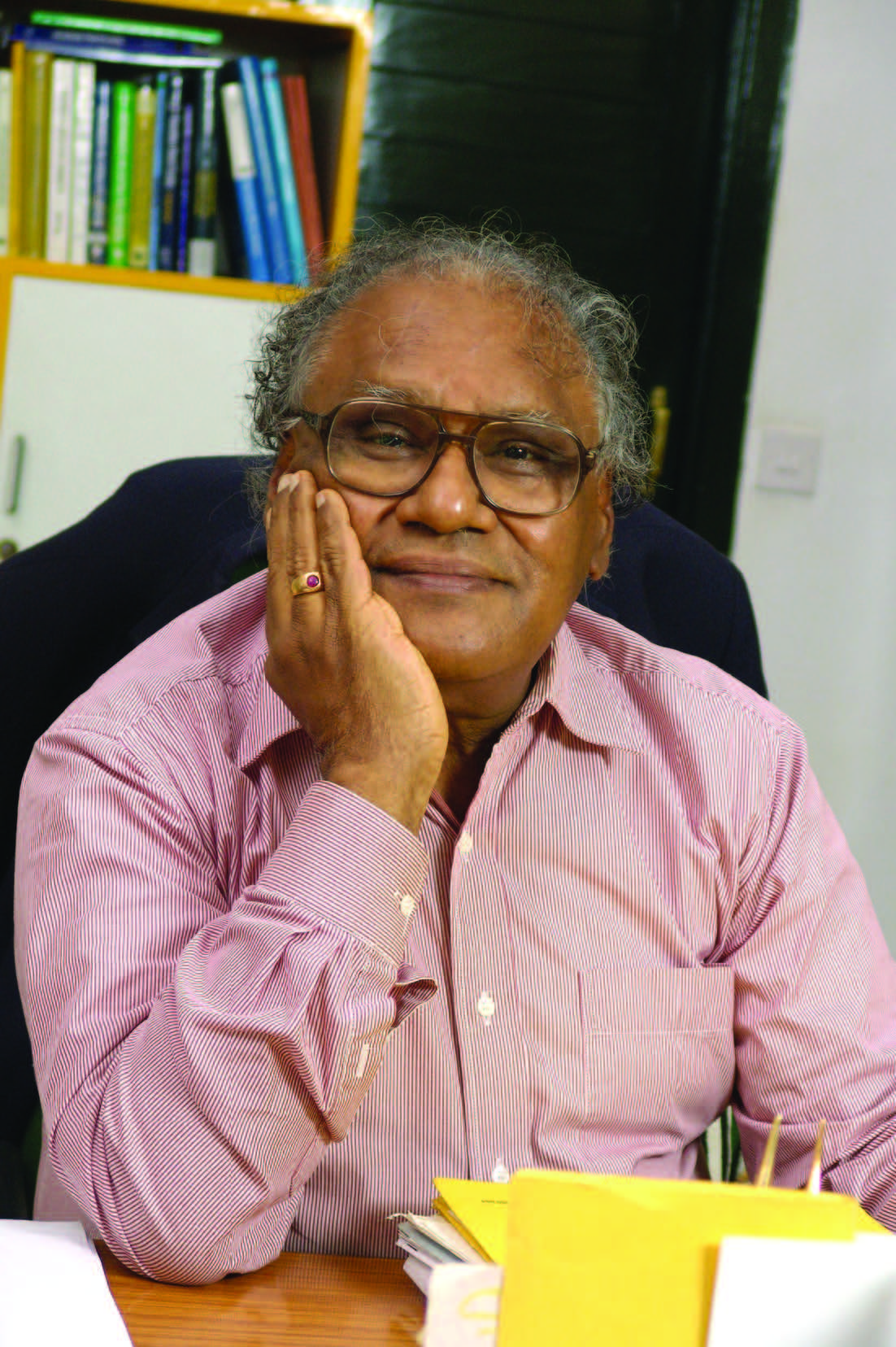
    NEW DELHI (TIP): Professor Chintamani Nagesa Ramachandra Rao is the third scientist to be awarded the highest civilian award — Bharat Ratna, a crowning glory of his inexorable list of outstanding achievements. Before Rao, C V Raman and former President A P J Abdul Kalam were bestowed with the award.

    Professor Chintamani Nagesa Ramachandra Rao is the third scientist to be awarded the highest civilian award — Bharat Ratna, a crowning glory of his inexorable list of outstanding achievements. Rao was conferred with the honour along with cricket icon Sachin Tendulkar on Saturday. Before Rao, C V Raman and former President A P J Abdul Kalam were bestowed with the award.

    The 79-year-old Prof Rao has honorary doctorates from 60 universities that speaks volumes about the world wide acclamation and recognition that he has earned as a scientist par excellence. Rao is the third scientist after C V Raman and former President A P J Abdul Kalam to be bestowed with the honour. Rao, founder of the Bangalore-based Jawharlal Nehru Centre for Advanced Scientific Research, has served as Chairman of the Scientific Advisory Council to Prime Minister under different regimes, a manifestation of immense faith different governments have placed in him.

    A renowned scientist and an institution builder, Rao has worked mainly in solid-state and structural chemistry. Rao, born on June 30 in 1934 to Hanumantha Nagesa Rao and Nagamma Nagesa Rao in Bangalore, could have settled for a cushy job armed with a BSc in 1951 but his unsatiable quest for learning took him to the path of unending scientific journey. Rao was thinking of joining IISc for a diploma or a postgraduate degree in chemical engineering after obtaining bachelors degree from Mysore University in 1951 but destiny took him to Banaras Hindu University where he got admitted for a MSc course.

    He obtained his Ph.D. in 1958 from Purdue University and joined the faculty of Indian Institute of Technology, Kanpur, in 1963. The only son to his parents, he grew up in the old part of Bangalore. Rao recalled once that his mother telling him mythological stories and her daily pujas greatly impacted him, which influenced his own journey into spirituality. “My father wanted me to speak in English too, and it helped that there was an academic atmosphere at home,” Rao noted in an article. During his school days, the freedom movement was in full swing and a young Rao listened to the stirring speeches by leaders like Pandit Jawaharlal Nehru and Dr Sarvapalli Radhakrishnan. He also took part in some of the freedom movement meetings in whatever capacity he could.

    During the early years, Rao once recollected, one of the fondest memories was meeting Nobel laureate professor C V Raman when he visited his school in 1946. MIT, PennState, Columbia and Purdue offered admission with financial support, but Rao chose Purdue, where he completed PhD in two years and nine months, a record of sorts. Life was on a swing for Rao but home pull prevailed and in 1959 he landed in Bangalore to join the IISc as a lecturer on a monthly salary of Rs 500. Rao has made immense contributions to nanomaterials over the last two decades, besides his work on hybrid materials.

    He has worked mainly in solid-state and structural chemistry. His work on transition metal oxides has led to basic understanding of novel phenomena and the relationship between materials properties and the structural chemistry of these materials. Rao was one of the earliest to synthesize two-dimensional oxide materials such as La2CuO4 and his work has led to a systematic study of compositionally controlled metal-insulator transitions. Such studies have had a profound impact in application fields such as colossal magneto resistance and high temperature superconductivity.

    He is the author of around 1,500 research papers and authored and edited 45 books. Rao is currently is serving as the Head of the Scientific Advisory Council to Prime Minister Manmohan Singh. It has been fame and glory all through for Rao until two years ago when he was involved in a plagiarism related controversy. He had been accused of indulging and allowing plagiarism. In December 2011, Rao apologised to ‘Advanced Materials’ — a peer-reviewed journal, for reproducing text of other scientists in his research paper. Rao’s collaborator and other senior author of the paper Professor S B Krupanidhi accused a co-author PhD student at IISc for the mistake.

    “These sentences were part of the introduction of the paper, which was written by our student, that neither of us — namely, the senior authors, Rao and Krupanidhi — paid attention to.” The PhD student took the responsibility for the incident and issued an apology. Later Rao offered to withdraw the article from the journal, but the editor let the publication stay as it is. Rao is also the recipient of Padma Shri and Padma Vibhushan and Karnataka Ratna, the state’s highest civilian honour. Rao received Honorary Doctorates from many Universities spread across the world such as Colorado, Khartoum, Liverpool and Oxford among others.

    He is currently the National Research Professor and Linus Pauling Research Professor and Honorary President of the Jawaharlal Nehru Centre for Advanced Scientific Research in Bangalore. He is also the director of the International Centre for Materials Science. Rao has been bestowed with other awards such as Hughes Medal by the Royal Society in 2000 and he became the first recipient of the India Science Award, instituted by the Union government for his contributions to solid state chemistry and materials science in 2004. The important academic positions Rao held include; Prof of Chemistry, Indian Institute of Technology, Kanpur, India (Head of Department and later Dean of Research of the Institute) (1963-76), Visiting Professor, Purdue University, 1967-68, Commonwealth Visiting Professor, University of Oxford and Fellow, St. Catherine’s College, Oxford (1974-75).

    He was also Distinguished Visiting Professor, LaTrobe University, Melbourne, Australia, Jawaharlal Nehru Professor, University of Cambridge and Professorial Fellow, King’s College, Cambridge Rao is the Founder Chairman, Solid State and Structural Chemistry Unit and Materials Research Laboratory, Indian Institute of Science (1977-84). He was also Director, Indian Institute of Science (1984-94), Visiting Professor, University Joseph Fourier, Grenoble, France (1990), Honorary Professor, University of Wales, Cardiff (1993-1997), President, Jawaharlal Nehru Centre for Advanced Scientific Research (1989-99), Albert Einstein Research Professor (1995-1999) Honorary Professor, Indian Institute of Science (1994). Rao is also Fellow of Indian Academy of Sciences, The Royal Society, London and Foreign Associate, National Academy of Sciences, USA and Founding Fellow and Third World Academy of Sciences, among others.

    Important positions in National and International Bodies include Chairman, Science Advisory Council to the Prime Minister, Immediate Past President, The Academy of Sciences for the developing world (TWAS), Trieste, Chairman, National Nano Initiative, Government of India and Member, Atomic Energy Commission of India. Rao had also served as Member, Planning Commission, Government of India and Chairman and Director of Reserve Bank of India. At the Hall of Sciences at JNCASR are a bust of Rao’s guru Pauling — one of the two greatest scientists of the 20th century (the other being Einstein). Rao’s advice to school children who visit JNCASR is dream big, study hard, and study science.

  • Bharat Ratna for Sachin Tendulkar

    Bharat Ratna for Sachin Tendulkar

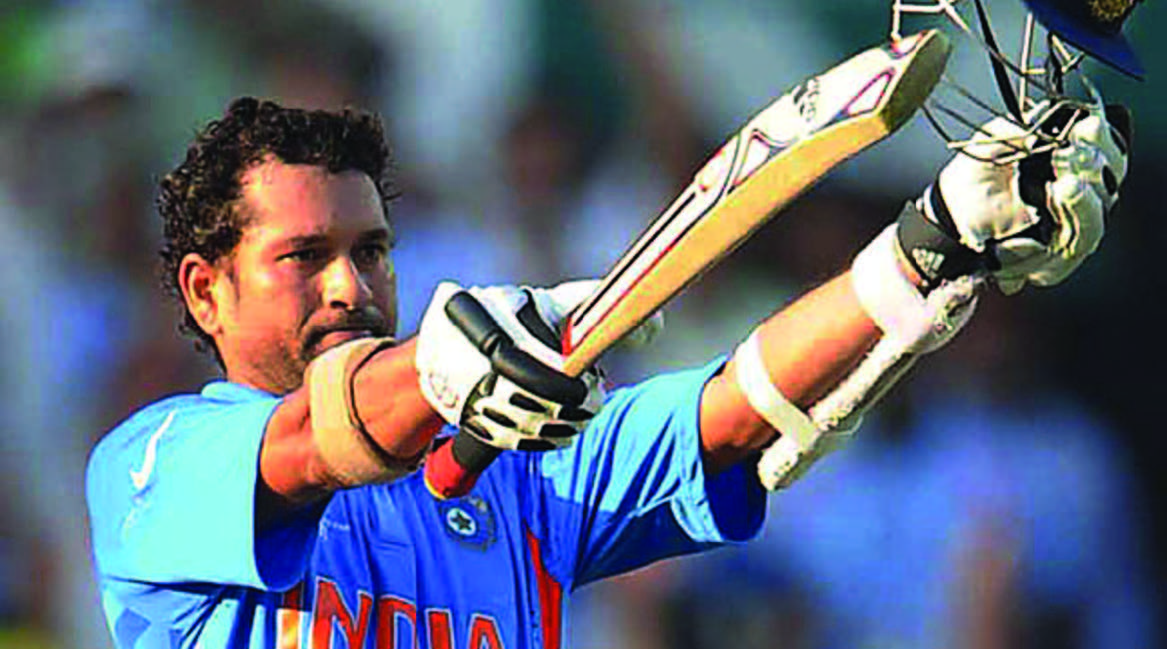
    NEW DELHI (TIP): Sachin Tendulkar was conferred the Bharat Ratna, India’s highest civilian award, by the president Pranab Mukherjee on February 4. Tendulkar, 40, is the first sportsperson, as well as the youngest person to receive the award.

    Sachin Tendulkar was conferred the Bharat Ratna, India’s highest civilian award, by the president Pranab Mukherjee on Tuesday. Tendulkar, 40, is the first sportsperson, as well as the youngest person to receive the award. Speaking during the ceremony at the Rashtrapati Bhawan, Tendulkar said that though he had retired from the game, he would “continue to bat” for India in all spheres of life.

    “It’s the biggest honour for me and I am extremely delighted on receiving the Bharat Ratna,” Tendulkar said. “I am extremely proud to be born in this beautiful nation and I would like to express my gratitude to all the love, affection and support I have received for number of years.

    “My cricket has stopped, but I will continue to bat for India and try my best to give people of India a reason to smile,” he said. “I would like to reiterate what I said a couple of months ago about this recognition and dedicate this to my mother and along with her, all the mothers in India who sacrifice their wishes, aspirations for their children so that their dreams come true.” Tendulkar, who retired from cricket on November 16, 2013 as the game’s highest runscorer in both Tests and ODIs, also saved praise for Professor CNR Rao, the other recipient of this year’s Bharat Ratna.

    8

    “I would like to congratulate Prof CNR Rao for the Bharat Ratna. He has been instrumental in motivating and inspiring youth of India to become scientists. I wish him all the happiness and good health.” India captain MS Dhoni, speaking before the first Test against New Zealand in Auckland, said Tendulkar thoroughly “deserved” the honour. “As a civilian, you cannot get a bigger honour than this. Definitely he deserves it. “The way he has handled himself, not only on the field, off the field as well… Whenever we talk about him, we keep saying the same thing: ideal role model. The kind of pressure there is in Indian cricket, he handled it very well. The kind of performance he has given since the time he debuted was fantastic. An honour well deserved.”

    PROFILE
    Sachin Ramesh Tendulkar famously known as Little Master or Master Blaster is one of the greatest cricketer to have ever played the game. He is the leading run scorer and century maker in both formats of the game. Tendulkar is the only player to be in top 10 ICC Batsmen ranking for 10 years in Tests and in 2002, Wisden ranked Sachin as second greatest Test batsman of all time next only to legendary Sir Donald Bradman and the second greatest ODI batsman behind West Indies great Sir Vivian Richards.

    A normal person can be a specialist in one thing he does the best but Sachin is one man in this world who defies these laws and is a specialist in everything he does. Whether it is batting, bowling or fielding, this man will give everything to help India win. Sachin Tendulkar is one person capable of bringing his country to a standstill. Whenever Sachin strides into the middle, the crowd goes berserk, TRP ratings and TV volume go through the roof, tension levels hit all time high and expectations increase to unprecedented levels. From a child to an 80- year-old man, all have their sights set on Sachin.

    If one has to describe Sachin Tendulkar as a player, he would soon run out of adjectives; words like awesome, brilliant, magnificent are certain to cross your mind, though. He is a genius, with God given talent no doubt. He stands at the crease, with such wonderful balance and poise and at the same time intimidating the bowlers. His footwork is near perfect and he is the nearest thing to Bradman there’s ever been. At 5’5, Tendulkar was not the most colossal player to stride on to the field but he bows out as a giant, who ruled cricket for 24 years and gave his legion of fans mesmerizing and emotionally overwhelming memories.

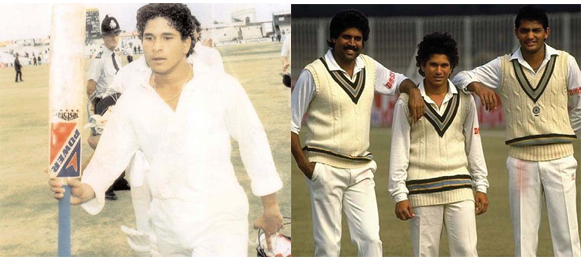
    With a mountain of runs, Tendulkar’s retirement creates a void so big that one can safely say cricket would never be the same again. His journey started way back in 1989 at the tender age of 16. A disarming smile, curly locks, resolute eyes and abundant talent, this was Sachin who first stepped on to Test cricket against a fiery Pakistani bowling attack boasting of that deadly combination of Imran Khan,Wasim Akram and Waqar Younis. Tendulkar has niched out a career out of innovation and adaptability. No bowler has single handedly dominated the master.

    In his glorified two decade journey, Sachin has won almost every award associated with cricket. He also owns the highest number of Man-of-the-Match (62) and Man-of-the-Series awards (26) along with 50,000 in every format of the game. Sachin got the better of every bowling attack. With wickets falling around, he always decided to take the fight to the opposition and single handedly won India several matches. Sachin has been a part six World Cups, a record jointly held by Pakistan’s Javed Miandad. He has scored more than 2000 runs in the competition which is the highest by any batsman.

    The talent and genius of Sachin was best summed up by Bradman when he said Tendulkar’s batting reminded him of his own. Tendulkar was the first cricketer to have scored a double century in ODI cricket, the feet he reached at Gwalior on February 25th 2010 against South Africa, at 37 years of age. During the later half of the ’90s, Tendulkar dominated both ODI and Test cricket at will producing memorable innings all across the globe, including the famous ‘Desert Storm’ against Australia which are arguably two of the best ODI knocks ever played. Sachin’s tremendous performances soon elevated him to the most challenging task of captaining the Indian side. But sadly, the pressure of Captaincy took it’s toll on Sachin as his batting form dipped and many criticized Sachin for not leading from the front. Much has been said about the characteristics of a great batsman by many pundits over the year.

    But when Tendulkar produced what many believe “the most aweinspiring innings” at Sydney in January 2004 against the might Aussies, he redifined greatness. After being repeatedly dismissed playing shots on the off-side, Tendulkar did not attempt even a single off-side stroke until he was a good 150 not out and went to score 241 in that innings. More recently, he was woefully out of form during India’s Test and ODI whitewash at the hands of England last year and carried the weight of expectations to what turned out to be a horror tour of Australia.

    But eventually, the best batsman of the modern era dug in deep and ensured that he went out on his own terms. His impact resonated much beyond the cricket field as he accomplished a rare feat by becoming a Rajya Sabha member last year. “Beneath the helmet, under that unruly curly hair, inside the cranium, there is something we don’t know, something beyond scientific measure. Something that allows him to soar, to roam a territory of sport that, forget us, even those who are gifted enough to play alongside him cannot even fathom. When he goes out to bat, people switch on their television sets and switch off their lives- BBC Sports, on Sachin Tendulkar.”

  • Simon Doull questions India’s selection policy

    Simon Doull questions India’s selection policy

    WELLINGTON (TIP): Former New Zealand fast bowler Simon Doull has questioned Indian team’s selection policy in the ongoing five-match ODI series, which the visitors have already lost, and said he was surprised by the side’s reluctance to change things around them.

    The Men in Blue haven’t won a game in the ongoing tour so far, losing three of the four ODIs (one in Napier and twice in Hamilton), while tying one match at Auckland. The visitors also lost their hard-earned number one ODI ranking. “I am surprised by the reluctance shown by the Indian team to change things around in this series,” said Doull, after India lost the fourth ODI in Hamilton by seven wickets. “They bowled first throughout the series and then batted in a must-win game.

    Before that they selected two new players in the eleven and made a whole lot of changes in their batting line-up. They changed too much at one go and usually it doesn’t work like that,” he insisted. “After the first two ODIs, it was clear that the New Zealand batsmen had found out a weakness in their spin bowling, particularly during the middle overs. But they still persisted with Ravindra Jadeja and R Ashwin. Don’t get me wrong, they are both fantastic cricketers, but why not try Amit Mishra once? He is a leg spinner and could have used the bounce better, and more than anything else, it would have been a change when the series was still there to play for.

    “It is just one of many things that have gone wrong for India, but they didn’t react to it quickly enough,” he added. The Indian bowling has also come under heavy criticism from skipper MS Dhoni, who expressed his dissatisfaction time and again during the series, and most lately after the loss in Hamilton. Doull felt the Indian team were trying too many things. “They are trying too many things,” he said, talking about the young Indian pace contingent. “They have played too much ODI and T20 cricket, or they have played too little. There is no experience in this bowling line-up and they are getting easily carried away.

    They have bowled really short throughout the series, instead of cutting off runs on atleast one side of the ground,” Doull explained. “That is how you bowl overseas and build pressure. They haven’t stuck to the basics. Someone like Bhuvneshwar Kumar, who is otherwise a very good swing bowler, I haven’t seen much swing coming from him in this series. But he has definitely bowled short and wide to the batsmen. Why are they not sticking to the basics and getting carried away so easily? Inexperience cannot be an excuse for too long,” added the former Black Caps’ international with 98 Test and 36 ODI wickets. Asked if the Indian batsmen should also take some of the blame, Doull replied, “For sure.

    They haven’t come in with a game plan against the New Zealand bowling line-up. They must have known that they would be facing a lot of short stuff from the bowlers here, yet their application has been lacking. And their main batsmen aren’t in form, or willing to apply themselves. Their game plan against this bowling has been lacking and New Zealand isn’t even the quickest bowling attack in the world. “Shikhar Dhawan is out of touch and Rohit Sharma has been tied down at the starts. There are not major runs coming from lower down either. You cannot expect Virat Kohli or MS Dhoni to score runs every time.

    Again, they should have realised it earlier than the fourth ODI and adapted to it more quickly, but that didn’t happen and that is why India have lost the series,” he added. This series was billed as preparation for the 2015 ODI World Cup to be hosted jointly by Australia and New Zealand, but the embarrassing loss has raised question marks over India’s title defence, while forwarding the case for the Kiwis in a tournament that they will be playing at home. “This series has thrown up two angles. One, New Zealand have played some good cricket and their plans with respect to stopping a very talented Indian team have worked perfectly, be it in terms of batting, bowling or fielding.

  • Challenges in Indo-Pacific Region

    Challenges in Indo-Pacific Region

    INDIA MUST PLAY A PROACTIVE ROLE FOR LONG-TERM SECURITY AND STABILITY

    It would be in India’s interest to readily join cooperative efforts aimed at maintaining stability. India has acquired robust military intervention capabilities and is formulating a suitable doctrine for intervention”, says the author.

    The security environment in the Indo- Pacific region has been vitiated by territorial disputes on land in the South China Sea and the East China Sea as well as terrorism, the proliferation of small arms and piracy in the Malacca Strait. Freedom of navigation on the high seas is of critical importance for the economies of most Asian countries.

    Maintaining peace and stability and ensuring the unfettered flow of trade and energy supplies through the sea lanes of communications will pose major challenges for the Asian powers as well as the United States. Only cooperative security architecture can provide long-term stability and mutual reassurance. Through its forward military presence and its abiding military alliances, the US has played a key role in providing stability in the Indo-Pacific region through many decades of turbulence during and after the cold war.

    The US is now re-balancing or ‘pivoting’ from the Euro-Atlantic zone to the Indo-Pacific in tune with its changing geo-strategic priorities and the rise of emerging powers. It is also simultaneously downsizing its forces and will need new strategic partners to help it maintain order and stability. According to Rory Medcalf, Senior Fellow, Brookings Institution, Washington, “the choreography of this geopolitical interplay will depend on the quality of leadership and decisionmaking in Beijing, New Delhi and Washington.”

    As C Raja Mohan has averred in his book “Samudra Manthan: Sino-Indian Rivalry in the Indo-Pacific”, the major powers in the region, including Australia, China, India, Indonesia, Japan and the US, need to work creatively to frame acceptable rules for the commons in the Indo-Pacific. Unless such realization comes about, subterranean tensions will continue to hamper stability. China has so far been ambivalent in seeking to join a cooperative framework and has preferred to stand apart. It has failed to realize that its growing trade and massive dependence on energy imports through the Indian Ocean make it imperative for it to join the efforts being made to establish such a framework.

    It would be in India’s interest to readily join cooperative efforts aimed at maintaining stability. India has acquired robust military intervention capabilities and is formulating a suitable doctrine for intervention. Though India has a pacifist strategic culture rather than a proactive one that nips emerging challenges in the bud through pre-emption, it has not hesitated to intervene militarily when its national interests warranted intervention, both internally and beyond the shores. The Army was asked to forcibly integrate the states of Goa, Hyderabad and Junagadh into the Indian Union soon after Independence as part of the nation-building process. The Indian armed forces created the new nation of Bangladesh after the Pakistan army conducted genocide in East Pakistan in 1971.

    India intervened in the Maldives and Sri Lanka at the behest of the governments of these countries and was ready to do so in Mauritius in 1983 when the threat to the government there passed. India had airlifted 150,000 civilian workers from Iraq through Jordan during Gulf War I in what became known as the largest airlift after the Berlin airlift. Also, almost 5,000 civilian workers were evacuated by ship from Lebanon in 2006. After the 2004 South-East Asian tsunami, 72 naval ships had set sail within three days to join the international rescue and relief operations even though India’s eastern sea board had itself suffered extensive loss of life and damage. India’s limited military presence overseas has been mostly benign.

    According to Shyam Saran, a former Foreign Secretary, “…most South-East Asian countries and Japan welcome a larger presence of Indian naval assets in the region.” As part of the Indo-US defense cooperation, joint patrolling of the SLOCs in the Indian Ocean is already being undertaken up to the western mouth of the Malacca Strait as part of joint naval exercises. Other military exercises have led to a broad understanding of each other’s military capabilities and limitations and many interoperability challenges have been ironed out. The Indian Army has designated one infantry division as a rapid reaction division, with an amphibious brigade, an air assault brigade and an infantry brigade. The Army also has an independent parachute brigade that can be deployed at short notice.

    The Indian Navy now possesses the INS Jalashva (USS Trenton) that can carry one infantry battalion with full operational loads and is in the process of acquiring additional landing ships. Besides long-range fighter-bomber aircraft with air-to-air refueling capability like the SU-30MKI, the Indian Air Force has acquired fairly substantive strategic airlift capabilities, including six C-130 Super Hercules aircraft for the Special Forces. A permanent corps-level tri-Service planning HQ with all-weather reconnaissance and surveillance capabilities needs to be set up under the aegis of the HQ Integrated Defense Staff to monitor emerging situations on a regular basis and act as a control HQ for intervention operations.

    In future, India may undertake joint military operations in its area of strategic interest if the country’s major national interests are at stake. Such a campaign may take the form of an intervention under the UN flag – something that India would prefer – or even a “coalition of the willing” in a contingency in which India’s vital national interests are threatened. There will naturally be several caveats to such cooperation as India will not join any military alliance. It will also be necessary to work with other strategic partners and friendly countries in India’s extended neighborhood and with organizations like the Gulf Cooperation Council (GCC), the ASEAN Regional Forum (ARF) and, when possible, even the Shanghai Cooperation Organization (SCO). The aim should be to establish consultative mechanisms through diplomatic channels for the exchange of ideas, and conduct joint training and reconnaissance. Small-scale joint military exercises with likely coalition partners help eliminate interoperability and command and control challenges and enable strategic partners to operate together during crises.

  • FOREIGN RELATIONS OF INDIA

    FOREIGN RELATIONS OF INDIA

    India has formal diplomatic relations with most nations; it is the world’s second most populous country, the world’s mostpopulous democracy and one of the fastest growing major economies. With the world’s seventh largest military expenditure, ninth largest economy by nominal rates and third largest by purchasing power parity, India is a regional power, a nascent great power and a potential superpower.

    India’s growing international influence gives it a prominent voice in global affairs. The Economist magazine argues, however, that underinvestment in diplomacy and a lack of strategic vision have minimised India’s influence in the world. India is a newly industrialised country, it has a long history of collaboration with several countries and is considered one of the leaders of the developing world along with China, Brazil, Russia and South Africa (the BRICS countries). India was one of the founding members of several international organisations, most notably the United Nations, the Asian Development Bank, G20 industrial nations and the founder of the Non-aligned movement.


    32
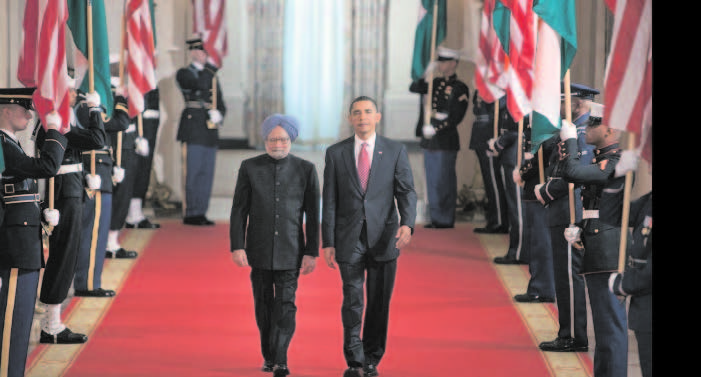
    India has often represented the interests of developing countries at various international platforms. Shown here is Prime Minister Manmohan Singh with Dmitry Medvedev, Hu Jintao and Luiz Inácio Lula da Silva during BRIC summit

    India has also played an important and influential role in other international organisations like East Asia Summit, World Trade Organisation, International Monetary Fund (IMF), G8+5 and IBSA Dialogue Forum. Regionally, India is a part of SAARC and BIMSTEC. India has taken part in several UN peacekeeping missions and in 2007, it was the secondlargest troop contributor to the United Nations.[12] India is currently seeking a permanent seat in the UN Security Council, along with the G4 nations. India’s relations with the world have evolved since the British Raj (1857–1947), when the British Empire monopolised external and defence relations. When India gained independence in 1947, few Indians had experience in making or conducting foreign policy. However, the country’s oldest political party, the Indian National Congress, had established a small foreign department in 1925 to make overseas contacts and to publicise its freedom struggle.

    From the late 1920s on, Jawaharlal Nehru, who had a longstanding interest in world affairs among independence leaders, formulated the Congress stance on international issues. As a member of the interim government in 1946, Nehru articulated India’s approach to the world. India’s international influence varied over the years after independence. Indian prestige and moral authority were high in the 1950s and facilitated the acquisition of developmental assistance from both East and West. Although the prestige stemmed from India’s nonaligned stance, the nation was unable to prevent Cold War politics from becoming intertwined with interstate relations in South Asia.


    33

    In the 1960s and 1970s India’s international position among developed and developing countries faded in the course of wars with China and Pakistan, disputes with other countries in South Asia, and India’s attempt to balance Pakistan’s support from the United States and China by signing the Indo- Soviet Treaty of Friendship and Cooperation in August 1971. Although India obtained substantial Soviet military and economic aid, which helped to strengthen the nation, India’s influence was undercut regionally and internationally by the perception that its friendship with the Soviet Union prevented a more forthright condemnation of the Soviet presence in Afghanistan. In the late 1980s, India improved relations with the United States, other developed countries, and China while continuing close ties with the Soviet Union. Relations with its South Asian neighbours, especially Pakistan, Sri Lanka, and Nepal, occupied much of the energies of the Ministry of External Affairs.

    In the 1990s, India’s economic problems and the demise of the bipolar world political system forced India to reassess its foreign policy and adjust its foreign relations. Previous policies proved inadequate to cope with the serious domestic and international problems facing India. The end of the Cold War gutted the core meaning of nonalignment and left Indian foreign policy without significant direction. The hard, pragmatic considerations of the early 1990s were still viewed within the nonaligned framework of the past, but the disintegration of the Soviet Union removed much of India’s international leverage, for which relations with Russia and the other post-Soviet states could not compensate. After the dissolution of the Soviet Union, India improved its relations with the United States, Canada, France, Japan and Germany. In 1992, India established formal diplomatic relations with Israel and this relationship grew during the tenures of the Bharatiya Janata Party (BJP) government and the subsequent UPA (United Progressive Alliance) governments.

    In the mid-1990s, India attracted the world attention towards the Pakistan-backed terrorism in Kashmir. The Kargil War resulted in a major diplomatic victory for India. The United States and European Union recognised the fact that Pakistani military had illegally infiltrated into Indian territory and pressured Pakistan to withdraw from Kargil. Several anti-India militant groups based in Pakistan were labeled as terrorist groups by the United States and European Union. India has often represented the interests of developing countries at various international platforms. Shown here are Prime Minister Manmohan Singh with Dmitry Medvedev, Hu Jintao and Luiz Inácio Lula da Silva during BRIC summit in June, 2009. In 1998, India tested nuclear weapons for the second time which resulted in several US, Japanese and European sanctions on India.

    India’s then-defence minister, George Fernandes, said that India’s nuclear programme was necessary as it provided a deterrence to potential Chinese nuclear threat. Most of the sanctions imposed on India were removed by 2001. After the 11 September attacks in 2001, Indian intelligence agencies provided the U.S. with significant information on Al-Qaeda and related groups’ activities in Pakistan and Afghanistan. India’s extensive contribution to the War on Terror, coupled with a surge in its economy, has helped India’s diplomatic relations with several countries. Over the past three years, India has held numerous joint military exercises with U.S. and European nations that have resulted in a strengthened U.S.-India and E.U.-India bilateral relationship. India’s bilateral trade with Europe and United States has more than doubled in the last five years.

    India has been pushing for reforms in the UN and WTO with mixed results. India’s candidature for a permanent seat at the UN Security Council is currently backed by several countries including France, Russia,[50] the United Germany, Japan, Brazil, Australia and UAE. In 2004, the United States signed a nuclear co-operation agreement with India even though the latter is not a part of the Nuclear Non- Proliferation Treaty. The US argued that India’s strong nuclear non-proliferation record made it an exception, however this has not persuaded other Nuclear Suppliers Group members to sign similar deals with India. During a state visit to India in November 2010, US president Barack Obama announced US support for India’s bid for permanent membership to UN Security Council as well as India’s entry to Nuclear Suppliers Group, Wassenaar Arrangement, Australia Group and Missile Technology Control Regime.

  • A Panegyric for Arnab Goswami?

    A Panegyric for Arnab Goswami?

    B.V. Rao, editor of Governance Now, explains the name and the phenomenon – Time’s Now’s Arnab Goswami – to a childhood friend who lives in Canada. Readers will surely find the piece a refreshing reading.

    Dear Sharda
    Sometime ago during a Googlegroup discussion you innocently asked: “But who is Arnab?” In India not knowing Arnab is against national interest. You are lucky you live in Canada. But if you don’t want to be deported on arrival on your next visit, you better pay attention to this complimentary crash course on the subject.

    Arnab, as in Arnab Goswami, is India’s most-watched prime time news anchor and editor-in-chief of Times Now. But designations don’t even begin to describe him or what he is famous for. You must have heard about hurricanes Katrina and Sandy. Arnab is also a storm, a news-storm that hits India every night via his show, the “Newshour”.

    Nobody is quite sure how, but somehow Arnab gets to know the questions that the “whole nation” wants answers for, or the sinners the nation wants hanged before midnight that night. In effect then, Arnab speaks for a “billionplus people” each time he takes centre-stage. I can’t say for sure if he took this burden upon himself voluntarily or if his employers made it a contractual obligation. Whatever it is, the fact is that Arnab has come to relish asking the most “simple and direct” questions to the most dubious people demanding instant answers to complex problems because the “nation wants to know” and it wants to know “tonight” as in right now.

    That’s how impatient India has become while you’ve been away, Sharada. The Newshour airs on weekdays from 9 pm and continues till Arnab’s pleasure lasts. Often the show stretches up to 10.50 pm. That’s actually “News hour-and-threequarters- and-then-some” but I guess Arnab has not asked himself a “simple, direct” question: how many minutes make an hour? That, or his primary school maths teacher is not his viewer. In which case it is safe to say Arnab speaks for a billion-plus minus one Indians. You will see that at the altar of national interest it is not just the hour that is stretched.

    About two decades ago, Dileep Padgaonkar was the editor of the Times of India owned by the Jains of Bennett & Coleman who also own Times Now. Padgaonkar had pompously proclaimed that he held the second most important job in the country after the prime minister’s. Arnab hasn’t said it, but I think he disagrees with Padgaonkar on the pecking order: it’s now the prime minister who holds the second most important job in the country. Hence Arnab runs the show like he would run the country or like the prime minister should but doesn’t.

    You see, Sharada, there’s an awful lot of stuff the nation wants to know by nightfall but our prime minister isn’t much of a talker. Arnab fills the need gap. He opens his show with a passionate agenda-setting preamble that spells out all the problems of the day and how he wishes to solve them. We gratefully receive this wisdom and call it Arnab’s Address to the Nation, a prime ministerial duty that has fallen on his broad shoulders because the real guy has abdicated it. Let me tell you this, however. Arnab is a very reluctant power-grabber. It is not his intent to upstage the prime minister or make him look silly.

    He gives the prime minister an entire day to prove his worth and gets to work only at 9 pm when it is clear that the latter can’t handle stuff. He then solves all outstanding national issues of the day in just one 110 minute-hour of feverish debates where he grills the skin off the back of everybody who dares to stand in the way of India’s national interest. He is unrelenting in his pursuit of the truth and doesn’t give up unless everybody has agreed with him.

    “I am worried”, “I am concerned”, “I won’t let you politicize”, “I don’t agree”, “you can’t get away….” are some of the phrases he uses to suggest he is in complete control and that endears him to a nation starved of decisionmakers. Arnab hates home work. He wants to settle everything here and now, tonight. As a result, in Arnab country, there is no trace of the policy paralysis that has grounded the prime minister in the real country. Here you get resolutions, decisions, orders, diktats, judgments, justice and denouements all in one place, one show, by one man.

    The only people paralyzed are the subjects of his grilling and the bevy of experts he gathers around himself, not because he needs them, he doesn’t, but because it must feel awfully good to invite experts and out-talk them on national prime time. Like confused baboons trapped in little boxes, the experts, who are neatly arranged around Arnab’s own imposing self in the centre of the screen, keep staring into nothingness most of the time. Yes, you get the drift, Sharada, Arnab is the main dish here. The rest are just intellectual dips. For most of their airtime the experts keep putting up their hands or calling out “Arnab….Arnab….” to indicate they want to make a point. Arnab is too engrossed in disagreeing with what he has not allowed them to say to care too much. Some clever guests try to appeal to his Assamese roots by hailing “Ornob…Ornob”.

    He ignores them as well. Nationalism, after all, is above parochialism. The cleverer among them have cracked the code: they just agree with Arnab in exchange for a little extra air time. These are usually the people who have paid close attention to Arnab’s Address to the Nation and picked up the right cues on what to say that will get them his benefaction. It is tough to figure out why Arnab needs any experts at all because he knows the answers to all his questions. Times Now insiders say that more often than not he finds questions to the answers he already has. On his show, politicians can’t politicize, bureaucrats can’t beat around the bush, sportspersons can’t play games and lawyers can’t use legalese.

    In fact anybody who is good at something can’t do what they are known to do, to the extent that even civil society can’t be civil, especially if it wants to get a word in sideways. Everybody has to be direct, honest, blunt and keep things simple because that is what the (one-man) nation wants. Corruption, political expediency, opportunism, forked tongues, doublespeak, dishonesty and hypocrisy, are red rags to Arnab. He takes them head-on with the help of his reporters who keep throwing up “documentary” evidence ever so often to expose scamsters. Usually this is a thick sheaf of indistinguishable papers that Arnab holds up threateningly. It could be a bunch of used airline e-tickets for all we know, but since we don’t, he waves the sheaf confidently in the face of the enemies of the nation and it is generally assumed he’s got some incendiary stuff in there. Arnab’s problem-solving repertoire is not restricted to national boundaries.

    In fact, he is at his best when dealing with nations that have evil designs on India. The patriot in Arnab is best aroused when he is dealing with that evil, failed, rogue nation called Pakistan. He deals with Pakistan like no prime minister has ever been able to or decimates it like no Army has ever managed to. Each time a blade of grass bends to the breeze on the LoC, Arnab breathes fire at Pakistan for trying to sneak in terrorists into the country. He lines up a battery of serving and retired generals of Pakistan and conducts the verbal equivalent of a summary execution. Yet, the same generals keep resurfacing on Arnab’s show each time he feels the urge to have a Pakistani or two for dinner. This causes much wonderment among Newshour hounds on the masochist streak that makes the Pakistani generals offer themselves up as bait repeatedly.

    So, it is assumed the money must be good. But since Arnab insists that Pakistan is the way it is only because the generals have sold their country cheap, it is unlikely he is blowing his budget for this routine cross-border target practice. Of course, left to Arnab Pakistan would have existed only as the largest crater on earth since the meteors wiped out all life on the planet. Yes, he would have nuked it many times over by now. The Times of India, the country’s oldest English newspaper and the mother brand from the Times Now stable runs Aman Ki Aasha (Hope for Peace), the widely-acclaimed campaign for ending India-Pakistan hostilities. Just as Arnab doesn’t seem to know of this campaign, the Times of India seems quite oblivious of the fact that the last time there was absolute peace on the LoC was when Arnab took a two-week holiday in early September.

    It could be the marketing genius of the Times group to milk the issue from both ends or it could also be that their internal boundaries are not as porous as our LoC. Apart from conducting war exercises against Pakistan, Arnab land is eyeball-toeyeball with China, exposes the double standards of America in almost anything it does and highlights the hypocrisy of racist Australia which loves the education dollars from India but not the brown students who come along with. His blood boils so much when an old Sikh is roughed up by a bunch of racist women in the UK that he almost gets the whole of Punjab to rise in revolt against the Indian government’s inaction–even though there is nothing it can do as the gentleman is a citizen of the said country–or builds a tide of emotional revulsion against “inhuman” Norway for snatching an infant from his Indian mother’s custody for alleged physical abuse.

    I can go on and on, Sharada, but everything good must come to an end and so must my Arnab eulogy. So, in short and in conclusion, here’s what I have to say: Arnab is not just the editor-inchief of Times Now. He’s India’s protector-inchief. He is the guy who is keeping India safe while you are away on selfish pursuits. You are lucky you can get away by not knowing him.For a billion-plus Indians, minus of course his maths teacher, that is not even a distant option. Because, truth told, Arnab is the best we have got!

  • India’s No. 1 rank at stake in ODI series against Kiwis

    India’s No. 1 rank at stake in ODI series against Kiwis

    DUBAI (TIP): India must win the upcoming five-match one-day series against New Zealand if they have to retain their number one status in the ICC team rankings. India are sitting atop the ICC team rankings table with 120 ratings points, and enter the series leading eighth-ranked New Zealand by 36 ratings points. If India lose the series, starting from January 19 in Napier, they will lose their numero uno status and as many as six ratings points. India have been the number-one ranked ODI side since January 2013, when it replaced England at the top. For New Zealand, a series win against India by any margin will mean that it will push up a place to seventh, ahead of West Indies.

    A series loss for New Zealand, however, will not make any difference to its position on the rankings table. If India do not manage to win the series against New Zealand, either Australia or England could stake a claim on the numberone rank. Australia and England are currently playing a five-match series, with the home team leading 1-0. Australia are currently in second position, six points behind India. For Australia to reclaim the number-one rank, they need to beat England in its ongoing series by a margin of 3-2 or better, and they also require New Zealand to beat India by a margin of 3-2 or better. On the other hand, England, who sit 10 points behind India in third spot, need to beat Australia by a margin of 4-1 or better, and also for New Zealand to win its series against India by a margin of 4-1 or better, to become the number-one ODI side again.

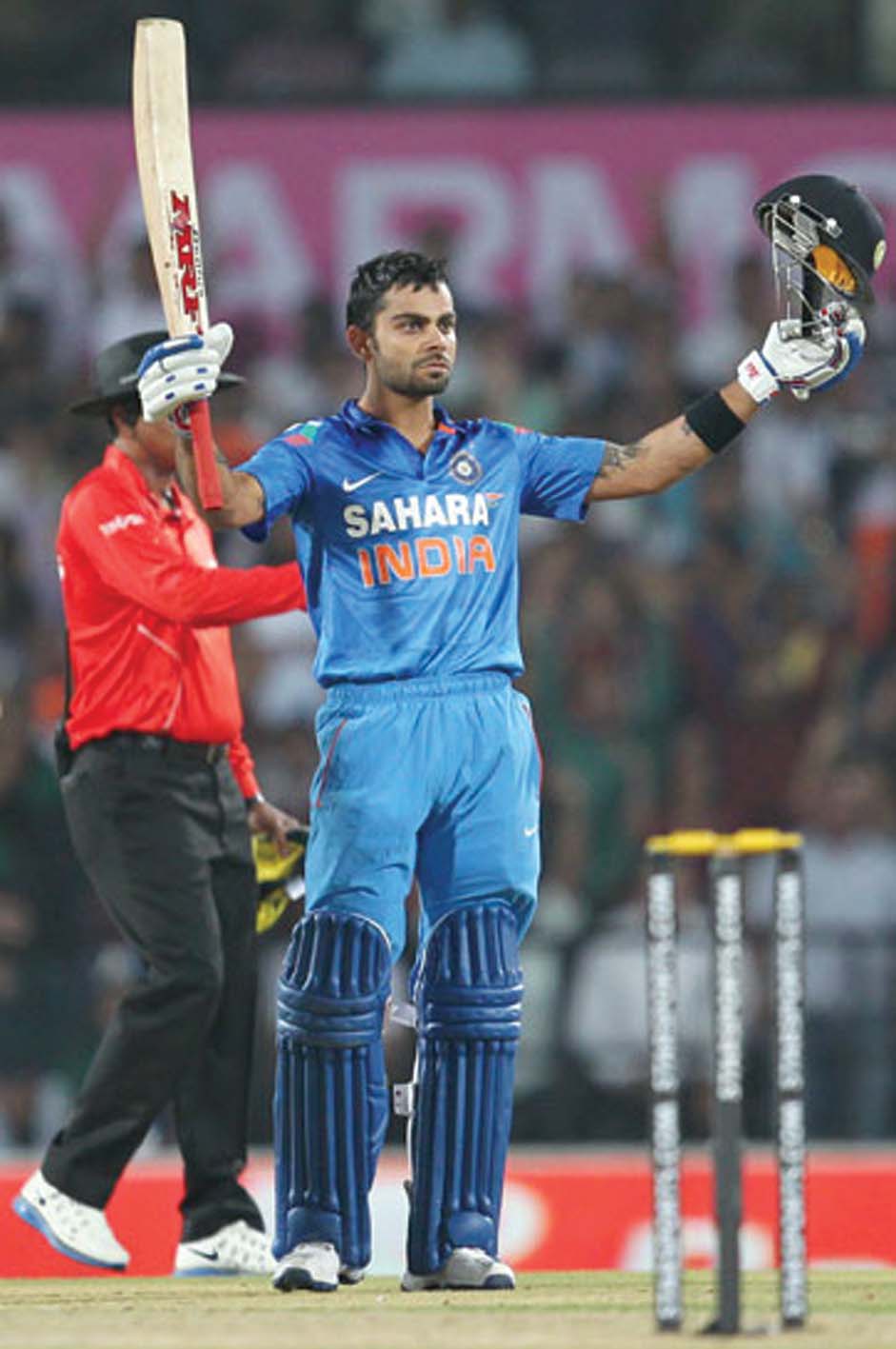
    India’s young batsman Virat Kohli will start the series in New Zealand as the highest-ranked batsman on either side. Kohli is currently in second position in the ICC Player Rankings for ODI batsmen with 859 ratings points, just 13 behind number-one ranked AB de Villiers. A good show with the bat for Kohli could see him reclaim the number-one rank he last held in November 2013. In all, India has three batsmen in the top 10, with Mahendra Singh Dhoni in sixth place and Shikhar Dhawan in 10th spot. Inside the top 20, Ross Taylor in 16th and Rohit Sharma in 18th place are the other batsmen likely to be seen in action.

    Outside the top 20, the batsmen likely to play the series are Suresh Raina (22nd), Brendon McCullum (23rd), Martin Guptill (24th) and Kane Williamson (31st). Meanwhile, Ravindra Jadeja in sixth position will be the highest ranked bowler on either side in the ICC Player Rankings for ODI bowlers. In fact, Jadeja is also the only player in the top 10 of the bowlers’ table who is likely to feature in the series. Among the top 20 bowlers, Ravichandran Ashwin (16th) and Kyle Mills (17th) are the others likely to feature in the series. Outside the top 20, the bowlers likely to play are Bhuvaneshwar Kumar (24th), Tim Southee (26th), Nathan McCullum (28th), Mitchell McClenaghan (29th), Amit Mishra (39th), Mohammed Shami (41st) and Ishant Sharma (50th).

  • Salman Khurshid’s Call to Expatriates to Help Build India’s Brand Image

    Salman Khurshid’s Call to Expatriates to Help Build India’s Brand Image

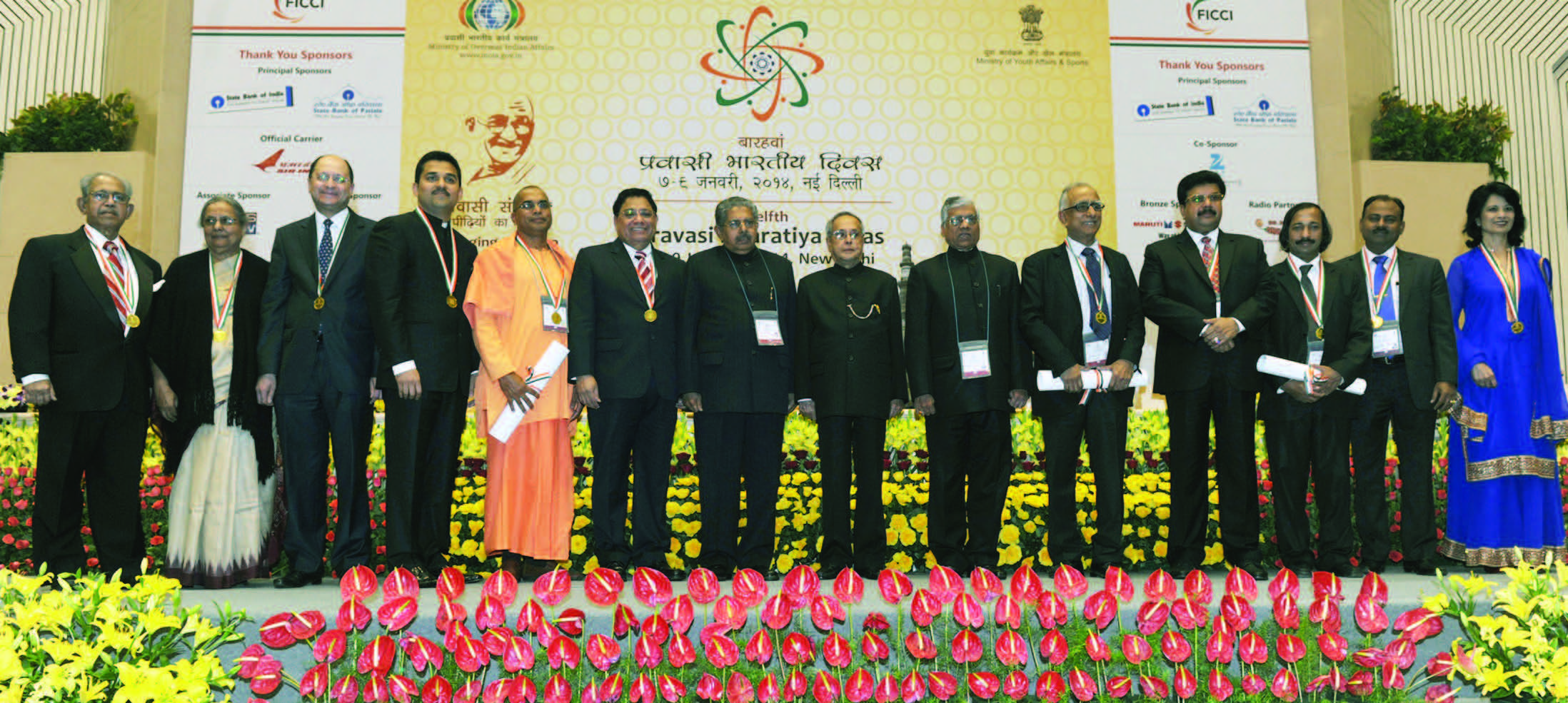
    NEW DELHI (TIP): Minister of External Affairs Sh. Salman Khurshid, has exhorted the overseas Indians to become India’s best ambassadors to spread and popularize the country’s values, beliefs, culture and heritage overseas. Presiding over the session on ‘India Soft Power’ on Day-2 of Pravasi Bharatiya Divas 2014, Khurshid called upon the delegates to be active in social networking to enable India to build its brand name and image so that deeper economic engagements are concluded with overseas economies, irrespective of their size.

    Addressing the session, Kapil Sibal, Minister of Communication & Information Technology and Law & Justice said, the present aspirational India will begin to inspire the remaining part of the globe by 2025, as it will have 90 crore people in the working age population, throwing a lone challenge for successive governments to provide infrastructure and growth opportunities for the people to realize their collective potential. Sibal said that by 2020, 60 crore Indians would have migrated to large cities, embracing latest technologies with the best of education at their command.

    This would create windows for them to unleash their potential and make India a hub to interact and interconnect with the rest of the world. The revenue generated in 2006 through IT &ITEs was estimated at $40 billion which has gone up to $100 billion now. Of this, $75 billion was contributed by export earnings. This was indicative of the strides made by the Indian economy, he added. Sibal complimented the diaspora present at the convention, saying that it epitomized India’s soft power and has done India proud and hoped that it continued to serve India. Minister of Culture, Smt Chandresh Kumari Katoch in her presentation, stated that the Indian diaspora should actively spread its civilization, heritage and cultural ethos in their host countries and organize promotional events.

    Pravasi Bharatiya Samman Awards Winners
    The President of India Sh. Pranab Mukherjee has conferred Pravasi Bharatiya Samman Awards to thirteen NRIs, PIOs and Organisations for their outstanding and illustrious contribution in the country of their residence as well as to India in different spheres of their activity.

    Sr. No Name Country Description
    1 Ms Lisa Maria Singh Australia Public service and fostering friendly relations between India and Australia.
    2 Mr. Kurian Varghese Bahrain Business for enhancing India’s image and for
    Promotion better understanding of India abroad.
    3 Mr Vasdev Chanchlani Canada Community service and fostering ties between India and
    Canada.
    4 Ramakrishna Mission Fiji Community service and philanthropic activity and
    enhancing India’s prestige abroad.
    5 Satnarainsing Baldewsingh Netherlands Public service and developing closer ties
    between India and South Africa.
    6 Bikas Chandra Sanyal France Education and culture and enhancing India’s image.
    7 Sasindran Muthuvel Papua New Guinea In the field of Public service.
    8 Shihabudeen Vava Kunju Saudi Arabia Community service and promoting ties between India and the Kingdom of Saudi Arabia.
    9 Ela Gandhi South Africa Public service, enhancing India’s image and promoting ties between India and South Africa.
    10 Dr. Shamsheer Parambath United Arab Health business and in promoting Better understanding of India
    11 Shailesh Lakhman Vara United Kingdom Public service and in promoting ties between India and the people of U.K.
    12 Dr. Parthasarathy Pillai USA Science and for fostering closer relations between India and USA.
    13 Renu Khator USA Education and enhancing India’s prestige abroad.
  • American Association of Cardiologists of Indian Origin Honors 4 at 2013 Fall Meeting

    American Association of Cardiologists of Indian Origin Honors 4 at 2013 Fall Meeting

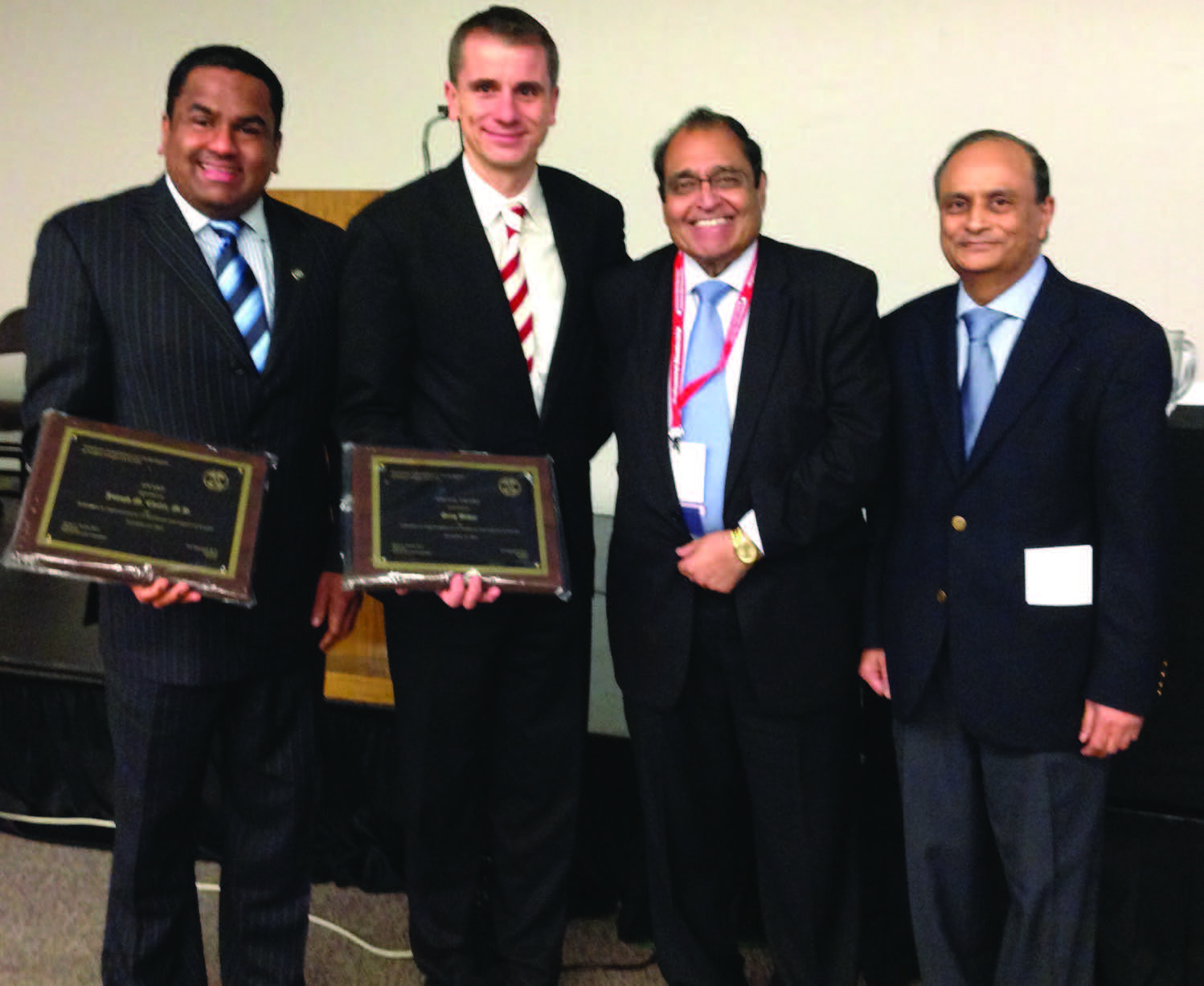
    DALLAS (TIP): American Association of Cardiologists of Indian Origin (AACIO), at its Fall meeting December 4, honored Greg Behar, President and CEO of Boehringer lngelheim Pharmaceuticals, Inc., Dr. Joseph M. Chalil, Associate Director, Health Science Executives, Boehringer Ingelheim USA, and Dr. Dinender K. Singla, a graduate of Post Graduate Institute of Medical Education and Research, Chandigarh, India for their achievements in the field of Cardiology.

    In addition, AACIO Young Investors Award was given to Dr. Ganesh Athappan and the Dr. Madhukar Deshmukh awards were given to Dr. Forum Kamdar and Dr. Manavjot Siddhu. AACIO awards the Dr. Krishna Ramaswamy and two Dr. Madhukar Deshmukh Young Investigator Awards at the AACIO dinner meetings held each year during the American College of Cardiology and the American Heart Association annual convention in March and November. The finalists presented their abstract at the meeting and each received $1000.00 award and a plaque The Fall 2013 annual event, organized by AACIO in coordination with Texas Indo- American Physicians Society (TIPS), North East Chapter and American Association of Physicians of Indian Origin was held at the Dallas Convention Center Theater Complex in Dallas, TX on November 17th, and was attended by over 200 physicians from around the nation.

    Dr. Navin Nanda, the Founding President and Chairman of the AACIO Board of Directors, while lauding honorees for their contributions and achievements, said, “AACIO is proud to honor some of the stalwarts of the pharmaceutical industry like Greg Behar and Chris Kaplan as well as some of the upcoming personalities like Jo Chalil. They have made significant contributions to medical therapeutics in the area of cardiology.” Dr. Nanda is a Distinguished Professor of Medicine and Cardiovascular Disease, Senior Scientist, Minority Health and Research Center and UAB Center for Aging, and UAB Comprehensive Cardiovascular Center, University of Alabama at Birmingham, Alabama. Dr. Ravi Jahagirdar, President Elect, who had represented AAPI at the event, congratulated AACIO for its consistent good work, both in the academic and the applied fields, and reaching out successfully to American Heart Association, and working in tandem with them in many spheres.

    He had special praise for the three Scholarship Awards that are given out each year to young aspiring medical students for poster sessions and in investigative sectors. “We at the national AAPI are proud of these activities,” he said. Dr. Jahagirdar, who will assume charge as the president of the national AAPI in June next year, pledged AAPI’s continued support in the future. In his inaugural address, Dr. Kul Aggarwal, president of AACIO, and Professor of Clinical Medicine, University of Missouri and Chief, Cardiology Section, Harry S. Truman Veterans Hospital, Columbia, Missouri, stated that AACIO provides a central forum for physicians and scientists of Indian origin, living in the United States, who have interest in Cardiovascular Medicine. “Indian Cardiologists are playing an increasingly important role in the provision of Cardiovascular services and also as academic thought leaders in the United States. We are proud of our colleagues.

    AACIO is your organization and joining it adds strength to all of us,” he said. The American Association of Cardiologists of Indian Origin (aacio.org) was formed in 1986 and after crossing puberty, the organization has reached the excited stage of youth after nineteen years. A Symposium, which was part of the meeting was organized by Drs. Navin C. Nanda and Kul Aggarwal. In his insightful presentation on “Newer anticoagulants in the management of a trial fibrillation and stroke prevention” Dr. Sanjeev Saksena, Clinical Professor of Medicine, Rutgers-RWJ Medical School Medical Director, Piscataway, New Jersey, Electrophysiology Research Foundation, Warren, New Jersey & Editor-in- Chief, Journal of Interventional Cardiac Electrophysiology, provided an overview of modern trends. Dr. Amit Khera, Associate Professor, Director, Preventive Cardiology Program, Program Director, Cardiology Fellowship and Dallas Heart Ball Chair in Hypertension and Heart Disease, UT Southwestern Medical Center, Dallas Texas, addressed the audience on “Emerging therapies in dyslipidemia management, beyond statins.” Dr. Nanda educated the audience on “Choice of anti-platelet therapy in acute coronary syndromes.”

    With more than 15 years in the pharmaceutical industry, Greg’s experience includes leadership roles in marketing, sales, business operations and general management. Greg joined Boehringer lngelheim in 2009 as Corporate Vice President of the Cardiovascular and Metabolic Franchise. That same year he became Vice President, Corporate Division Prescription Medicine, leading 14 countries including Northern Europe, Canada and Australia. Prior to Boehringer lngelheim, Greg worked at Novartis Pharma AG in roles of increasing responsibility in Spain and at global headquarters in Switzerland. Another honoree, Dr. Singla has received numerous honors and awards, and has been invited to give talks throughout the world. He also served as a chair/co-chair for scientific meetings, and well published in various peer reviewed journals. He is funded by the National Institute of Health and the American Heart Association grant awards since 2004.

    He has served as an editorial board member for different journals, and is the current Academic Editor for Plos one and Associate Editor for Canadian Journal of Physiology and Pharmacology. Srinivas Reddy Gunukula serves on the Board of Directors of The Heart Hospital Baylor Plano and Director of Center for Advanced Cardiovascular Care at the Heart Hospital McKinnney Campus. He is well known among the Cardiology community in Dallas. Dr. Joseph M. Chalil is a Fellow of American College of Healthcare Executives and is Board Certified in Healthcare Management. He serves as Co-Chair, AAPI Industry Physician Committee and Scientific Advisor, AAPI Cardiovascular, Diabetes and Stroke Network. Dr. Chalil holds three US Patents involving usage of sensors inside Human Body in addition to other applications. His research background includes Clinical Trial Management in Cystic Fibrosis, Multiple Myeloma, and publications in American Journal of Respiratory and Critical Care Medicine. The Asian American Business Development Center, NY has awarded Dr. Chalil the 2013 Outstanding 50 Asian Americans in Business Award. He is a Visiting Professor at various Universities and serves on various company Boards. He is an expert in US Healthcare policy and a strong advocate for patient centered care.

  • Will Indian bowlers be equal to task?

    Will Indian bowlers be equal to task?

    JOHANNESBURG (TIP): There have been instances in recent past when scores well above 300 have looked vulnerable. The Indian bowling attack has looked listless, especially with the field restrictions coming into play in the back end of the innings and the South Africans know all about it. “India are certainly not the best bowling attack in the world. We won’t be underestimating them, but it’s an area where we can get on top of them,” South African skipper AB de Villiers upped the ante on Tuesday. What has let the Indian skipper MS Dhoni down time and again is the lack of penetration in his pace attack towards the end. The yorkers have been far and few in between, and teams, despite losing wickets, have been able to step on the gas at the death.

    The biggest culprit has been Ishant Sharma, who went for 30 in one over in a game against Australia, and hasn’t played an ODI since. Bhuvneshwar Kumar’s lack of pace reduces his efficacy in the slog overs while Umesh Yadav is a little erratic. His only ray of hope is Shami Ahmed, who showed that he can bowl inswinging yorkers in Test matches, but doing it under pressure of ODI death overs is another matter. In such a situation, it becomes crucial for India to pick up early wickets and that’s what the skipper stressed on. “With the two new-ball rule and the conditions in favour of fast bowlers, it’s important how you play the first 10 overs. If a side has wicket in hands, getting a par-plus score in the last 15 is not difficult,” Dhoni said.

    The bowlers did that quite consistently during the Champions Trophy in England in June and de Villiers, despite the jibe, was on the guard. “The batsmen sometimes think they can get on top of this attack very easily and that’s when these guys tend to take a lot of wickets,” the skipper said. The one crucial component of the Indian attack that isn’t getting too much attention in the context of the pacer-friendly tracks of South Africa is spin. But Dhoni, deep down, feels that his spinners are better off in ODIs abroad than they are at home. “They struggle when there’s dew in the ground,” the skipper said, hinting at daynight ODIs in India. He is probably taking hope from R Ashwin and Ravindra Jadeja’s record on tracks where there has been some bounce.

  • ALL TOO EASY FOR INDIA IN THE DECIDER

    ALL TOO EASY FOR INDIA IN THE DECIDER

    KANPUR (TIP): India have been masterful while chasing in ODIs this year, and against a moderate total and a mediocre West Indies attack, they ambled to victory in the seriesdeciding third ODI in Kanpur. Shikhar Dhawan hit his fifth ODI hundred of his magical year and the struggling Yuvraj Singh hit his first ODI half-century in 11 innings as India cruised to their sixth successive oneday series win of the year. With a 9am start on a hazy winter morning, the talk at the toss was about how the first hour would be a challenge for the batsmen.

    West Indies negotiated that phase well losing only one wicket, and halfcenturies from Kieran Powell and Marlon Samuels took them to a strong 164 for 2 when the batting Powerplay was taken. Perfectly placed then for the power-hitters to come; they nearly squandered that advantage by losing three quick wickets, but Darren Sammy and Darren Bravo provided the late flourish to lift them to 263. That proved too little, especially as only Ravi Rampaul and Sunil Narine posed any threat with the ball. Jason Holder had a disappointing day, with Dhawan feasting on the poor lines to take five fours in his first two overs to propel India along early.

    Dwayne Bravo and Sammy were tame, and midway through the chase – when Dhawan and Yuvraj were killing off the chase – West Indies had turned to the innocuous duo of Veerasammy Permaul and Lendl Simmons. There was briefly some hope for West Indies early on, when Rampaul dismissed two of India’s red-hot top three early. He couldn’t get the wicket of Dhawan, though, and Dhawan scored big. As usual, the innings was studded with breathtaking cuts and drives through the off, and without really seeming to make the effort, he had 20 fours to his name was scoring at over a run a ball. While it was Dhawan’s innings that made the game safe, Yuvraj’s will gladden Indian fans.

    A destructive batsman with a penchant for the big stage, Yuvraj hasn’t been among the runs in recent months, even during the Australia series which was a bowlers’ bloodbath. Australia turned to Mitchell Johnson to dismiss him early several times, and West Indies hoped Narine would have a similar impact. Yuvraj wasn’t comfortable against Narine today either, misreading him several times, but he managed to ride out that difficult phase and cashed in against the lesser threats in the attack.

    Even though Dhawan and Yuvraj were dismissed with India just under 50 away from the target, it only afforded the chance for India’s other out-of-form batsman, Suresh Raina, to play a pressure-free cameo on his birthday, with the result never in doubt. It was far easier batting in the evening than in the first hour. India’s new-ball bowlers posed plenty of questions for West Indies’ openers, who were regularly beaten by the movement. Even as late as the 12th over, India had three slips in place.

    Powell had grabbed the chance offered by Chris Gayle’s absence with a half-century in Visakhapatnam, and built on that with another solid score. He was a bit loose outside off early on but settled in as the innings progressed, showing off his driving skills, with a square drive off Mohit Sharma in the sixth over a highlight. He had reached 70 by the 30th over, but miscued a sweep off R Ashwin – the fifth time in a row that the opener has gone past 40 without reaching triple figures.

    His 117-run partnership with Samuels had set West Indies up for a strong total. Samuels was nervy early on, extremely reluctant to get on the front foot against the fast bowlers, and played and missed often. After his initial struggles, he was more at ease against the spinners, stepping out to launch Ashwin onto the temporary roof in the stands beyond long-on. He was reprieved on 60 when Virat Kohli put down a chance at first slip, but was bowled soon after by Ashwin. That was in the first over of the batting Powerplay, and with Simmons and Dwayne Bravo failing, West Indies had suddenly slipped to 196 for 5. However, Darren Bravo made his third consecutive half-century and Darren Sammy’s all-power game worked again this time as they threw the bat around to put on 67 in little over eight overs. It proved to be too little against India’s formidable batting though.

  • Zaheer returns to India Test squad

    Zaheer returns to India Test squad

    MUMBAI (TIP): Zaheer Khan has been recalled to the India Test squad for the forthcoming tour of South Africa. Zaheer is one of five fast bowlers for the two-Test series, and the only newcomer to the 17- member squad is the batsman Ambati Rayudu. However, there was no place for the opener Gautam Gambhir, who scored a century for Delhi in the Ranji Trophy days before the selection meeting.

    It is learnt that the team management indicated to the selectors that they did not want Gambhir in the squad. Zaheer, who last played for India during the home Tests against England last December, was recently omitted from the list of centrally contracted players for the current season. The injury-prone left-arm seamer made a return to the longer format this season with 13 wickets in three Ranji games for Mumbai, including a five-wicket haul. However, he was not considered for the one-day squad.

    Virender Sehwag and Harbhajan Singh – two other players who were not handed central contracts – have been left out of both squads. The Test squad also has Wriddhiman Saha as the backup wicketkeeper for MS Dhoni, the captain. Saha last played for India during the Adelaide Test of 2012. Ravindra Jadeja, the allrounder, returns after sitting out the West Indies Tests to rest his injured shoulder. He is the third spinner in the squad after R Ashwin and Pragyan Ojha. Rayudu, 28, made his international debut during the one-day tour of Zimbabwe in August, where he scored one fifty.

    Amit Mishra, the legspinner, remains in the oneday team but was not included for the Tests. The surprise inclusion in the one-day squad is the fast bowler Ishant Sharma, who was expensive during the seven-match ODI series against Australia recently. Ishant leaked 189 runs in three matches and was dropped after he conceded a whopping 30 runs in one over, which cost India the Mohali ODI. Ishant was part of the Test squad against West Indies but lost his place to the impressive Mohammed Shami, playing his first Test series. Ishant and fast bowler Umesh Yadav were included in the one-day squad in place of seamers Jaydev Unadkat and Vinay Kumar.

    Batsman Ajinkya Rahane has been included in both squads. Yadav said he was pleased with Zaheer’s return to the Test squad, as the latter’s experience was invaluable to the young pacers in the team. “Zaheer has had a great influence on youngsters with his ability to guide us through the bump and grind of international cricket,” Yadav aid. “I have got a lot of valuable tips on fast bowling and there is no better exponent of reverse swing than Zak. He is like a mentor to us and it is an honour to play international cricket alongside him. Zaheer’s advice in match situations is invaluable as he is a brilliant reader of opposition batsmen.” The tour gets underway with the first of three ODIs starting December 5, followed by the two Tests.

    Test squad: MS Dhoni (capt & wk), M Vijay, Shikhar Dhawan, Cheteshwar Pujara, Virat Kohli, Rohit Sharma, Ajinkya Rahane, R Ashwin, Bhuvneshwar Kumar, Umesh Yadav, Mohammed Shami, Ravindra Jadeja, Zaheer Khan, Ambati Rayudu, Wriddhiman Saha (wk), Ishant Sharma, Pragyan Ojha ODI squad: MS Dhoni (capt & wk), Shikhar Dhawan, Suresh Raina, Virat Kohli, Rohit Sharma, Ajinkya Rahane, Yuvraj Singh, R Ashwin, Bhuvneshwar Kumar, Mohammed Shami, Ambati Rayudu, Umesh Yadav, Ishant Sharma, Mohit Sharma, Ravindra Jadeja, Amit Mishra

  • HANUKKAH

    HANUKKAH

    Afestival is a collective celebration of an achievement in a given community. The Festival of Hanukkah is a Jewish celebration, and it is celebrating the recovery and re-dedication of the Jewish Temple in Jerusalem in 165 B.C. Hanukkah is spelled in many different ways in case you want to Google it; Hanuka, Chanukah, Chanuka, Hanuka, Hanukka and other variations. Hanukkah is celebrated for eight days and nights. It is also called the festival of lights. It starts on the 25th of the Jewish month of Kislev each year. The actual date differs due to the lunar calendar.

    It is about 11 days earlier in each successive year. The Jews, Muslims and some Hindu festivals follow the moon for observing their holidays and the date is different every year. This year the festivities will begin with the lighting of Menorah on Thursday, November 28th and will continue thru December 5, 2014. This year, I found one of the best pieces written by Rabbi Michael Lerner, who and I met in Melbourne, Australia and have kept up writing to each other since then. Rabbi Michael Lerner wrote about Chanukah, describing it as “the holiday celebrating the triumph of hope over fear, light over darkness, and the powerless over the powerful.”

    He went on to say that Chanukah is about “understanding that when we connect with the transformative power of the universe, the Force of Healing and Transformation, YHVH, we become aware that the powerless can become powerful, that oppression of any sort is in contradiction to the fundamental nature of human beings as loving, kind, generous, free, creative, intelligent, attuned to beauty, caring for and needing each other beings created in the image of God. When that energy and awareness permeates our consciousness, no ruling elite and no system of exploitation can possibly last for very long.”

    The Hanukkah Story

    Here is a story I received in email that tells the story and significance of Hanukkah. In 168 B.C.E. the Jewish Temple was seized by Syrian-Greek soldiers and dedicated to the worship of the god Zeus. This upset the Jewish people, but many were afraid to fight back for fear of reprisals. Then in 167 B.C.E. the Syrian-Greek emperor Antiochus made the observance of Judaism an offense punishable by death. He also ordered all Jews to worship Greek gods. Jewish resistance began in the village of Modiin, near Jerusalem.

    Greek soldiers forcibly gathered the Jewish villages and told them to bow down to an idol, and then eat the flesh of a pig – both practices that are forbidden to Jews. A Greek officer ordered Mattthias, a High Priest, to acquiesce to their demands, but Mattthias refused. When another villager stepped forward and offered to cooperate on Matthias’ behalf, the High Priest became outraged. He drew his sword and killed the villager, then turned on the Greek officer and killed him too.

    His five sons and the other villagers then attacked the remaining soldiers, killing all of them. Matthias and his family went into hiding in the mountains, where other Jews wishing to fight against the Greeks joined them. Eventually they succeeded in retaking their land from the Greeks. These rebels became known as the Maccabees, or Hasmoneans. Once the Maccabees had regained control they returned to the Temple in Jerusalem. By this time it had been spiritually defiled by being used for the worship of foreign gods and also by practices such as sacrificing swine. Jewish troops were determined to purify the Temple by burning ritual oil in the Temple’s menorah for eight days.

    But to their dismay, they discovered that there was only one day’s worth of oil left in the Temple. They lit the menorah anyway and to their surprise the small amount of oil lasted the full eight days. This is the miracle of the Hanukkah oil that is celebrated every year when Jews light a special menorah known as a hanukkiyah for eight days. One candle is lit on the first night of Hanukkah, two on the second, and so on, until eight candles are lit.

    Significance of Hanukkah
    Muslims, Hindus, Buddhists and others have figured out a way to keep their children in the joyous mood of receiving gifts, so they have their own version of Christmas. Similarly, Jewish children receive gifts for Hanukkah – often one gift for each of the eight nights of the holiday. Many parents hope that by making Hanukkah extra special their children won’t feel left out of all the Christmas festivities going on around them. America is an amazing land!


    26

    Hanukkah Traditions
    Every community has its unique Hanukkah traditions, but there are some traditions that are almost universally practiced. They are: lighting the hanukkiyah, spinning the dreidel and eating fried foods. Get a Hanukkiah. The most basic thing you need to celebrate Hanukkah is a 9- branched candelabra, called a Hanukkiah (or often a Menorah, although technically aMenorah is a 7-branched candelabra), and candles. Eight of the branches represent the eight nights, while the last one (at a different height, usually higher than the rest) is called theshamash or helper candle, and is used to light the rest of the candles. The Hanukkiah is usually lighted at or right after sunset.

  • UN TRUST FUND TO END VIOLENCE AGAINST WOMEN ANNOUNCES OVER USD 8 MILLION IN GRANTS IN 18 COUNTRIES AND TERRITORIES

    UN TRUST FUND TO END VIOLENCE AGAINST WOMEN ANNOUNCES OVER USD 8 MILLION IN GRANTS IN 18 COUNTRIES AND TERRITORIES

    NEW YORK (TIP): The United Nations Trust Fund to End Violence against Women (UN Trust Fund) announced, November 22, USD 8 million in grants to 17 initiatives in 18 countries and territories. First-time grant recipients include organizations from Antigua and Barbuda, Mauritania, Myanmar and Kosovo (under UNSCR 1244). These new grants are expected to reach 2.3 million beneficiaries between 2014 and 2017.

    “Violence against women and girls can be systematically addressed, and, with persistence, eliminated. The UN Trust Fund to End Violence against Women is dedicated to doing just this,” said Ms. Phumzile Mlambo-Ngcuka, Executive Director of UN Women. “Working with partners across the world, the Fund supports concrete action toward a world free of violence. The support of governments, corporations, foundations and individuals is crucial in achieving this goal.” Violence against women and girls continues to be one of the most pervasive human rights violations in the world, affecting as many as one in three women and girls during their lifetime.

    It severely impacts survivors and comes at tremendous emotional and economic costs for families and societies. “The sheer scale of prevailing violence against women and girls is an abomination as well as an obstacle to inclusive development,” said Ms. Lilianne Ploumen, Netherlands Minister for Foreign Trade and Development Cooperation, one of the UNTF’s multi-year donors. “There is urgent need for action to live up to the commitments made in Resolutions and at the Commission of the Status of Women. The Netherlands will continue to support the UN Trust Fund to End Violence against Women and encourages others to do so as well.”

    The grants announced today will support initiatives that respond to three priority areas of the UN Trust Fund: prevention, expanded access to services, and strengthened implementation of national laws, policies and action plans on violence against women and girls. Additionally, this year, funds will be used to address violence against adolescent and young girls, including through engaging school girls in Bangladesh and Viet Nam and developing the capacities of young girl leaders in the Ukraine.

    Other new UN Trust Fund grantees spearheading pioneering approaches include:

    o In South Africa, Grassroot Soccer will upscale and expand its innovative SKILLS Plus sports-based intervention to foster girls’ empowerment, expand girls’ awareness of sexual and reproductive rights and increase girls’ access to medical, legal and psychosocial services;

    o Medical Services in the Pacific will operate mobile clinics in seven rural market locations across Fiji, providing 18,000 women with improved access to sexual and reproductive healthcare, sexual assault counseling and referral services.

    o The Danish Refugee Council will empower displaced women through the provision of legal aid to survivors of violence by creating mobile legal clinics to serve communities hosting high concentrations of returnees and internally displaced persons in Afghanistan and refugee and asylumseekers in Tajikistan.

    The new grants are made possible with generous support from the Governments of Australia, Austria, Germany, Iceland, Ireland, Italy, Japan, Kazakhstan, Liechtenstein, the Netherlands and South Africa. The Fund is also grateful for the vital support of its partners in the private and non-profit sectors: the Saban Foundation; the United Nations Federal Credit Union, UN Women National Committees (Austria, Iceland, Japan, Singapore and the United Kingdom) and Zonta International.

    Administered by UN Women on behalf of the UN System, the UN Trust Fund has supported 368 initiatives in 132 countries and territories, delivering a total of USD 95 million since its establishment by the General Assembly in 1996. On 25 November, the International Day for the Elimination of Violence against Women, the Fund will also launch its next grant cycle with a global call for proposals to support country-level programs to end violence against women and girls in 2014. UN Women is the UN organization dedicated to gender equality and the empowerment of women.

    A global champion for women and girls, UN Women was established to accelerate progress on meeting their needs worldwide. For more information, visit www.unwomen.org. UN Women, 220 East 42nd Street, New York, NY 10017, New York. Tel: +1 646 781-4400. Fax: +1 646 781-4496.

  • FAREWELL SACHIN

    FAREWELL SACHIN

    A time line of Sachin Tendulkar’s 24-year-old illustrious career:

    Feb 23-25, 1988: Tendulkar (14) and Vinod Kambli (16) compile a 664-run unbroken partnership for Shardashram Vidya Mandir against St Xavier’s at Azad Maidan, Mumbai. Kambli remains ubeaten on 349 not out and Tendulkar scores 326 not out. It remains the highest partnership recorded in any form of cricket, until in November 2006. Dec 11, 1988: Makes First-Class debut at the age of 15 and scores an unebaten century against Gujarat at the Wankhede Stadium. Becomes youngest Indian to make a hundred on First-Class debut. Nov 15, 1989: Makes his Test debut in Karachi against Pakistan at the age of 16. Makes 15 on debut. Dec 14, 1989: Suffers a bloody nose in the last Test in Sialkot after being hit by Waqar Younis. Makes 57 in the innings. August 14, 1990: At the of 17 years and 112 days, becomes the then secondyoungest to score a Test century. He scores 119 not out against England at Old Trafford which helped India to get a draw.


    19

    April, 1992: Signs up for Yorkshire and becomes the first overseas signing for the English county. Nov 27-28, 1992: Becomes the youngest player to score 1,000 Test runs at the age of 19 years and 217 days after he scores 111 in India’s 227 in Johannesburg. Feb 11-12, 1993: Gets his first Test century (165) at home against England. Nov 24, 1993: The world saw the first glimpse of Tendulkar as a matchwinning bowler. Bowls India to sensational last-ball win against South Africa in the Hero Cup semi-final. South Africa needing six runs to win off the last over, Tendulkar gave them just three, and India a victory. March 27, 1994: Opens the innings for the first time in an ODI against the New Zealand. Scores 82 off 49 balls. October 1995: Becomes the richest cricketer in the world after he signs up a five-year contract worth Rs 31.5 crore with WorldTel. Feb-March, 1996: Plays his first World Cup at home and scores 523 runs at an average 87.16 and becomes the highest scorer. Aug 8, 1996: Becomes the Indian captain at the age of 23. Jan 2, 1998: Sacked from captaincy after a 15-month stint during which India won just three of 17 Tests. Feb-March, 1998:

    In the best of his form against Australia in a home Test series and also gets his maiden double hundred. He also scored two hundreds and a fifty in the three-Test series that India won 2-1. July 28, 1999: Gets back his captaincy after Mohammad Azharuddin is sacked for India’s failure to reach the semi-finals of the World Cup in England. March 20, 2001: Scores a thrilling century in the deciding Test in Chennai and denies Australia the “final frontier”. March 31, 2001: Becomes the first payer to score 10,000 runs in ODIs en route to his 139 against Australia in Indore. Nov 19, 2001: Fined by match referee Mike Denness for ball tampering. The decision was later overturned after an outcry by the Indian cricket board. Aug 22-23, 2002: Surpassed Don Bradman’s tally of 29 Test centuries. Misses double century by seven at Headingley, but India win by an innings and 46 runs. February-March, 2003: Scores 673 runs at 61.18 in the World Cup and also takes India to sniffing distance of winning the crown. His 98 against Pakistan was one of the best knocks played by Indians at World Cup. Australia are the champions, but Tendulkar is named the Man of the Series. Aug, 2003: Is presented with a Ferrari 360 Modena for going past Bradman’s 29 Test centuries.

    Jan 2-4, 2004: Scores 241 in Sydney, one of his best, even as Australia manage to hold on for a draw, and the series ends 1-1. Aug, 2004: Suffers from tennis elbow during the Videocon Cup in Holland. Misses the Champions Trophy in England, and then the first two home Tests against Australia. March 16, 2005: Scores 52 against Pakistan and becomes the fifth man to score 10,000 Test runs. Dec 10, 2005: Becomes the highest centurion in Test cricket as he overtakes Sunil Gavaskar’s 34 en route to his 109 against Sri Lanka in Delhi. March 19, 2006: Is booed at the Wankhede Stadium after he was dismissed for duck in 33 minutes against England in Mumbai. March, 2006: Again goes under the knife. This time for surgery on his right shoulder in England. May, 2007: For the first time in his career, Tendulkar is rested for the three-ODI series in Bangladesh. Jan 4, 2008: Scores an unbeaten 154, against a major Test playing nation in two years and 19 Tests, against Australia at the Sydney Cricket Ground. March 2, 2008: Sachin scores his first ODI century in Australia, in first of the CB Series final. Oct 17, 2008: Surpasses Brian Lara’s record of most Test runs against Australia at Mohali. Nov 5, 2009: Gets to 17,000 runs during his 175 off 141 balls in a 351-run chase against Australia in Hyderabad.

    India fall short by 19 runs. Feb 24, 2010: Becomes the first player in the history of the game to score 200 in a single innings in a One-Day International. He took 147 deliveries to power India to 401 and a 153-run win against South Africa. Oct 2010: Tendulkar bags his first ICC award, the Sir Garfield Sobers Trophy. Dec 19, 2010: Gets his 50th Test hundred against a difficult South African attack in Centurion. April 2, 2011: Realises his childhood dream of winning the World Cup that too at his home town of Mumbai and at the Wankhede. India beat Sri Lanka to win the World Cup for the second time. March 16, 2012: Gets the 100th international century, scoring 114 in an Asia Cup match against Bangladesh in Mirpur. But India lost the match. The century came after 34 innings and more than a year after scoring his 99th international hundred. Dec 23, 2012: Just minutes before the selectors were set to name the squad for the ODI series against Pakistan, Tendulkar announces his retirement from the format. Tendulkar finished with 18,426 ODI runs and 49 hundreds, well clear of any other batsman. Oct 10, 2013: Tendulkar announces his retirement from Test cricket.

  • SATGURU NANAK PRAGATYA, MITI DHUND JAG CHANAN HOA

    SATGURU NANAK PRAGATYA, MITI DHUND JAG CHANAN HOA

    GURU NANAK’S TEACHINGS AND THEIR RELEVANCE TO MODERN WORLD

    The Sikhs across the world would be joined by Hindus, Muslims and others in celebrating the 545th birth anniversary of Baba Guru Nanak, the fountainhead of Sikhism, Sunday, November 17. The tradition of celebrating the anniversary of the Gurus or the spiritual teachers is called Gurpurb (celebration of the teacher). There are ten Gurus in Sikh faith and their holy book is called the Guru Granth Sahib. Granth Sahib is a compilation of entire teachings of the Gurus and a few saints and remains a perpetual guidance for the Sikhs.

    As a pluralist who has done over 25 hours of Radio Talk shows and two workshops on Sikhism as a part of “Understanding the wisdom of Religion, all the beautiful religions” my goal was to share the essence of each faith and their relevance to the common man on the street who is not related to that particular religion. Let me begin with the recognition of how Guru Nanak’s teaching has produced an exemplary model of dealing with conflicts today. On August 5, 2012, a gunman Wade Michael Page walked into the SikhTemple in Oak CreekWisconsin, and opened the fire killing 6 people causing tremendous panic and apprehension.

    This is an accumulation of many smaller incidents beginning with the murder of Balbir Singh Sodhi, a gas station owner in Phoenix, Arizona, and many incidents later, the humiliation of Dr. Prabhjot Singh, a Sikh Professor in New York and harassment of Mr. Jagjeet Singh, a truck driver by a Judge in Mississippi. http://www.huffingtonpost.com/mikeghouse/ harassment-of-sikhs-inne_ b_3997899.html How did the Sikhs respond to the harassment and the violence? They followed the teachings of Guru Nanak by responding to the Wisconsin massacre with forgiveness, patience, forbearance, and kindness, it was the right thing to do when tragedy befalls a community.

    They set a new benchmark in America. Instead of expressing anger, threatening to sue the authorities, or demonstrating their apprehensions, the Sikhs across America chose the most powerful tools of all: Prayer and forgiveness. Indeed it resonates with the teachings of Jesus, Prophet Muhammad and other great masters, and recently Mahatma Gandhi’s Dandi March and Martin Luther King’s march in Selma. It disarms the oppressor and the message of goodness gets conveyed. Every Gurdwara in America held candle light vigils and speeches focused on forgiveness and goodwill – http://www.youtube.com/watch?v=vNxrf8fFU0 I The selfless service to mankind known as Seva is central to the teaching of Sikhism. There is no thought of reward or gains, it pure service to fellow beings.

    The Sikh community must be appreciated by one and all, and were indeed appreciated at the Unity Day USA for setting the standards of dealing with conflicts. Indeed, it is our duty to “honor and cherish individuals “who have dedicated their lives to building bridges among Americans. Their pioneering spirit in facilitating communities to know each other and to respect each other is appreciated by the people of Dallas/ Fort Worth. On this day, we appreciate and celebrate their contributions towards building a cohesive America, where no one has to live in apprehension, discomfort or fear of the other. Guru Nanakji’s birthday has a special significance to me, indeed, the religion we called Sikhism today, started out as an interfaith movement, where Guru Nanak primarily brought people from different religions together and taught common sense goodness, and serving humanity and caring for the neighbors. Today,

    I wrote my weekly piece at Dallas Morning News on Pluralism, I was asked what verse from Quran I would recommend to those who serve in public office. The verse I recommend reminded me of the Sikh Brother, Bhai Kanhaiya’s story from the battle of Anandpur Sahib in 1704. Quran, 5:8 (Asad translation): “O YOU who have attained to faith! Be ever steadfast in your devotion to God, bearing witness to the truth in all equity; and never let hatred of any-one lead you into the sin of deviating from justice. Be just: this is closest to being God-conscious.

    And remain conscious of God: verily, God is aware of all that you do.” Indeed, the word hatred has multiple meanings in this case – bias to color, race, appearance, deport and other temperamental proclivities that are destructive to everyone. Indeed Bhai Kanhaiya took it further to include enemy soldiers. Martin Luther King Jr., said, “Injustice to one is injustice to all” – thank you Bhai Kanhaiya for setting the new standard of inclusion and caring. Here is a dialogue between Bhai Kanhaiya and Guru Gobind Singh; the 10th Guru of Sikhism who put the final touches to the religion, this story is narrated by many sources including Wikipedia. Guru Gobind Singh summoned Bhai Kanhaiya and explained that he had received a complaint about his actions on the battlefield. Guruji,

    “These brave Sikhs are saying that you go and feed water to the enemy and they recover to fight them again – Is this true?” Bhai Kanhaiya, “Yes,my Guru, what they say is true. But Maharaj, I saw no Mughal or Sikh on the battlefield. I only saw human beings. And, Guru Ji, they all have the same God’s Spirit? – Guru Ji, have you not taught us to treat all God’s people as the same?” Guru Ji said, “Bhai Kanhaiya Ji, You are right. You have understood the true message of Gurbani (compositions of Sikh Gurus) “.

    He then continued and told the Sikhs that Bhai Kanhaiya had understood the deeper message of the Gurus’ teachings correctly and that they all have to strive to learn lessons from the priceless words of Gurbani. Guru also gave Bhai Kanhaiya Ji medical Balm and said “From now on, you should also put this balm on the wounds of all who need it”‘ Then turning to the sangat Guru Ji said, Saadh sangat Ji, Bhai Kanhaiya is a Godfearing saintly soul. His impartial and nonbiased behavior towards others has led him to achieve Sehaj-avastha. Let him carry on with his mission. Many more will follow in his footsteps in the years to come and keep the tradition of Nishkam Sewa alive.”

    Guruji was committed to peace and harmony

    I hope on this auspicious occasion of Gurpurb, the Sikhs can make a genuine effort to pay tribute to the spirit of Guru Nanak Devji and remove the misunderstandings that erupted from a wrong translation of Quran that happened 350 years ago during the reign of Aurangzeb, and has rightfully etched in the psyche of Sikhs. In an article in Huffington Post about Kentucky Senator David William’s bigotry I wrote, “No one has a right to belittle other’s faiths.

    If Senator Williams has a problem let it be his problem and no one should malign Christianity for his bigotry.” Likewise, King Aurangzeb’s bigotry should not be slapped on to Muslims. I have nothing to do with it, nor does any Muslim today has anything to do with him. One single mistranslation of a verse from Quran has created a great misunderstanding between Muslims and Sikhs since the times of Aurangzeb, and has lasted till this day. Sadly there was a lot of bloodshed during the partition of India that has deepened the ill-will among a few Muslims and a few Sikhs.

    It is time to forgive for our own sake, as it will release the tension and apprehension within us and deal with each other as free individuals. I was a speaker on “reading the scriptures” at the Parliament of world’s religions in Melbourne, Australia and discovered this longest running ill-will between Sikhs and Muslims with Dr. Avatar Dhaliwal of Tennessee. I hope, to honor Guru Nanak, we can put this behind through a serious dialogue. I am willing to invest my time for the sake of common good and peace between people of different faiths.We cannot have walls between us by the men who are no more.

    Sikhism was one of the first formal religions that began as a reconciliatory goodwill nurturing faith and let’s give the full value to it and work together. May the Noor (divine light) of Guru Nanankji brighten the world today and for eternity. Amen! The DFW Sikh Community invites you, our friends, neighbors and all members of the community, to join us in the celebration of the 544th coming of the founder of the Sikh Faith, Guru Nanak Dev Ji. His ideals of peace, harmony, egalitarianism, social justice, living in the presence of the One Creator and with dignity and honesty are the fundamentals we strive for everyday.

    This celebration will include the 1st parade in the City of Richardson. When: Saturday, November 16, 2013 from 10:00 AM – 2 PM. Where: Gurdwara Singh Sabha of North Texas in Richardson. Langar will be served. This is the Sikh institution of the community kitchen and as with any and all Sikh events it will include a complimentary vegetarian meal, sweets, refreshments and drinks.


  • GURU NANAK’S TEACHINGS AND THEIR RELEVANCE TO MODERN WORLD

    GURU NANAK’S TEACHINGS AND THEIR RELEVANCE TO MODERN WORLD

    The Sikhs across the world would be joined by Hindus, Muslims and others in celebrating the 545th birth anniversary of Baba Guru Nanak, the fountainhead of Sikhism, Sunday, November 17. The tradition of celebrating the anniversary of the Gurus or the spiritual teachers is called Gurpurb (celebration of the teacher). There are ten Gurus in Sikh faith and their holy book is called the Guru Granth Sahib. Granth Sahib is a compilation of entire teachings of the Gurus and a few saints and remains a perpetual guidance for the Sikhs. As a pluralist who has done over 25 hours of Radio Talk shows and two workshops on Sikhism as a part of “Understanding the wisdom of Religion, all the beautiful religions” my goal was to share the essence of each faith and their relevance to the common man on the street who is not related to that particular religion. Let me begin with the recognition of how Guru Nanak’s teaching has produced an exemplary model of dealing with conflicts today. On August 5, 2012, a gunman Wade Michael Page walked into the SikhTemple in Oak CreekWisconsin, and opened the fire killing 6 people causing tremendous panic and apprehension. This is an accumulation of many smaller incidents beginning with the murder of Balbir Singh Sodhi, a gas station owner in Phoenix, Arizona, and many incidents later, the humiliation of Dr. Prabhjot Singh, a Sikh Professor in New York and harassment of Mr. Jagjeet Singh, a truck driver by a Judge in Mississippi. http://www.huffingtonpost.com/mikeghouse/ harassment-of-sikhs-inne_ b_3997899.html How did the Sikhs respond to the harassment and the violence?

    They followed the teachings of Guru Nanak by responding to the Wisconsin massacre with forgiveness, patience, forbearance, and kindness, it was the right thing to do when tragedy befalls a community. They set a new benchmark in America. Instead of expressing anger, threatening to sue the authorities, or demonstrating their apprehensions, the Sikhs across America chose the most powerful tools of all: Prayer and forgiveness. Indeed it resonates with the teachings of Jesus, Prophet Muhammad and other great masters, and recently Mahatma Gandhi’s Dandi March and Martin Luther King’s march in Selma. It disarms the oppressor and the message of goodness gets conveyed. Every Gurdwara in America held candle light vigils and speeches focused on forgiveness and goodwill – http://www.youtube.com/watch?v=vNxrf8fFU0 I The selfless service to mankind known as Seva is central to the teaching of Sikhism. There is no thought of reward or gains, it pure service to fellow beings. The Sikh community must be appreciated by one and all, and were indeed appreciated at the Unity Day USA for setting the standards of dealing with conflicts. Indeed, it is our duty to “honor and cherish individuals “who have dedicated their lives to building bridges among Americans. Their pioneering spirit in facilitating communities to know each other and to respect each other is appreciated by the people of Dallas/ Fort Worth. On this day, we appreciate and celebrate their contributions towards building a cohesive America, where no one has to live in apprehension, discomfort or fear of the other. Guru Nanakji’s birthday has a special significance to me, indeed, the religion we called Sikhism today, started out as an interfaith movement, where Guru Nanak primarily brought people from different religions together and taught common sense goodness, and serving humanity and caring for the neighbors.

    Today, I wrote my weekly piece at Dallas Morning News on Pluralism, I was asked what verse from Quran I would recommend to those who serve in public office. The verse I recommend reminded me of the Sikh Brother, Bhai Kanhaiya’s story from the battle of Anandpur Sahib in 1704. Quran, 5:8 (Asad translation): “O YOU who have attained to faith! Be ever steadfast in your devotion to God, bearing witness to the truth in all equity; and never let hatred of any-one lead you into the sin of deviating from justice. Be just: this is closest to being God-conscious. And remain conscious of God: verily, God is aware of all that you do.” Indeed, the word hatred has multiple meanings in this case – bias to color, race, appearance, deport and other temperamental proclivities that are destructive to everyone. Indeed Bhai Kanhaiya took it further to include enemy soldiers. Martin Luther King Jr., said, “Injustice to one is injustice to all” – thank you Bhai Kanhaiya for setting the new standard of inclusion and caring. Here is a dialogue between Bhai Kanhaiya and Guru Gobind Singh; the 10th Guru of Sikhism who put the final touches to the religion, this story is narrated by many sources including Wikipedia. Guru Gobind Singh summoned Bhai Kanhaiya and explained that he had received a complaint about his actions on the battlefield.

    Guruji, “These brave Sikhs are saying that you go and feed water to the enemy and they recover to fight them again – Is this true?” Bhai Kanhaiya, “Yes,my Guru, what they say is true. But Maharaj, I saw no Mughal or Sikh on the battlefield. I only saw human beings. And, Guru Ji, they all have the same God’s Spirit? – Guru Ji, have you not taught us to treat all God’s people as the same?” Guru Ji said, “Bhai Kanhaiya Ji, You are right. You have understood the true message of Gurbani (compositions of Sikh Gurus) “. He then continued and told the Sikhs that Bhai Kanhaiya had understood the deeper message of the Gurus’ teachings correctly and that they all have to strive to learn lessons from the priceless words of Gurbani. Guru also gave Bhai Kanhaiya Ji medical Balm and said “From now on, you should also put this balm on the wounds of all who need it”‘ Then turning to the sangat Guru Ji said, Saadh sangat Ji, Bhai Kanhaiya is a Godfearing saintly soul. His impartial and nonbiased behavior towards others has led him to achieve Sehaj-avastha. Let him carry on with his mission. Many more will follow in his footsteps in the years to come and keep the tradition of Nishkam Sewa alive.”

    Guruji was committed to peace and harmony
    I hope on this auspicious occasion of Gurpurb, the Sikhs can make a genuine effort to pay tribute to the spirit of Guru Nanak Devji and remove the misunderstandings that erupted from a wrong translation of Quran that happened 350 years ago during the reign of Aurangzeb, and has rightfully etched in the psyche of Sikhs. In an article in Huffington Post about Kentucky Senator David William’s bigotry I wrote, “No one has a right to belittle other’s faiths. If Senator Williams has a problem let it be his problem and no one should malign Christianity for his bigotry.” Likewise, King Aurangzeb’s bigotry should not be slapped on to Muslims. I have nothing to do with it, nor does any Muslim today has anything to do with him. One single mistranslation of a verse from Quran has created a great misunderstanding between Muslims and Sikhs since the times of Aurangzeb, and has lasted till this day. Sadly there was a lot of bloodshed during the partition of India that has deepened the ill-will among a few Muslims and a few Sikhs. It is time to forgive for our own sake, as it will release the tension and apprehension within us and deal with each other as free individuals. I was a speaker on “reading the scriptures” at the Parliament of world’s religions in Melbourne, Australia and discovered this longest running ill-will between Sikhs and Muslims with Dr. Avatar Dhaliwal of Tennessee.

    I hope, to honor Guru Nanak, we can put this behind through a serious dialogue. I am willing to invest my time for the sake of common good and peace between people of different faiths.We cannot have walls between us by the men who are no more. Sikhism was one of the first formal religions that began as a reconciliatory goodwill nurturing faith and let’s give the full value to it and work together. May the Noor (divine light) of Guru Nanankji brighten the world today and for eternity. Amen! The DFW Sikh Community invites you, our friends, neighbors and all members of the community, to join us in the celebration of the 544th coming of the founder of the Sikh Faith, Guru Nanak Dev Ji. His ideals of peace, harmony, egalitarianism, social justice, living in the presence of the One Creator and with dignity and honesty are the fundamentals we strive for everyday. This celebration will include the 1st parade in the City of Richardson. When: Saturday, November 16, 2013 from 10:00 AM – 2 PM. Where: Gurdwara Singh Sabha of North Texas in Richardson. Langar will be served. This is the Sikh institution of the community kitchen and as with any and all Sikh events it will include a complimentary vegetarian meal, sweets, refreshments and drinks.

  • Police arrest 348 in global child porn investigation

    Police arrest 348 in global child porn investigation

    TORONTO (TIP): More than 300 people, including teachers, coaches and doctors, have been arrested worldwide on child pornography charges after a Canadianled investigation. Toronto police said on Thursday the arrest of 348 people, including 108 in Canada, 76 in the United States and 164 in other countries from Spain to Australia, came after a threeyear investigation of a Toronto company that distributed child porn. “Of concern to the investigators was the number of people (arrested) who have close contact with children. The arrests included 40 school teachers, nine doctors and nurses, 32 people who volunteered with children, six law enforcement personnel, nine pastors or priests, and three foster parents,” Inspector Joanna Beaven-Desjardins, head of Toronto’s Sex Crimes Unit, told a news conference.

  • Substantial Foreign Direct Investment in the United States: Report

    Substantial Foreign Direct Investment in the United States: Report

    WASHINGTON (TIP): The United States has been the world’s largest recipient of foreign direct investment (FDI) since 2006. Every day, foreign companies establish new operations in the United States or provide additional capital to established businesses. With the world’s largest consumer market, skilled and productive workers, a highly innovative environment, appropriate legal protections, a predictable regulatory environment, and a growing energy sector, the United States offers an attractive investment climate for firms across the globe.

    Foreign direct investment in the United States is substantial
    ● In 2012, net U.S. assets of foreign affiliates totaled $3.9 trillion. The United States consistently ranks as one of the top destinations in the world for foreign direct investment (FDI), with inflows totaling $1.5 trillion in FDI just since 2006. For 2012, FDI inflows totaled $166 billion.
    ● The U.S. manufacturing sector draws a considerable share of FDI dollars, led by pharmaceuticals and petroleum and coal products. Outside manufacturing, wholesale trade; mining; non-bank holding companies; finance and insurance; and banking receive the greatest shares of foreign investment.
    ● Investment flows into the United States come mostly from a small number of industrial countries. Since 2010, Japan, Canada, Australia, Korea, and seven European countries collectively have accounted for more than 80 percent of new FDI. Although still small, flows from emerging economies like China and Brazil are growing rapidly.

    Foreign direct investment benefits the U.S. Economy
    ● In 2011, value-added by majority-owned U.S. affiliates of foreign companies accounted for 4.7 percent of total U.S. private output.
    ● These firms employed 5.6 million people in the United States, or 4.1 percent of private-sector employment. About one-third of jobs at U.S. affiliates are in the manufacturing sector.
    ● These affiliates account for 9.6 percent of U.S. private investment and 15.9 percent of U.S. private research and development spending.
    ● In the 2008-09 recession and subsequent recovery, employment at U.S. affiliates was more stable than overall private-sector employment. As a result, U.S. affiliates’ share of total U.S. manufacturing employment rose from 14.8 percent in 2007 to 17.8 percent in 2011.
    ● Compensation at U.S. affiliates has been consistently higher than the U.S. average over time, and the differential holds for both manufacturing and non-manufacturing jobs. Looking ahead, the United States will remain an attractive destination for foreign investment, and this investment will help bolster our economy. However, we need to continue to nurture and build upon the underlying strengths of the U.S. economy that make firms want to invest here; including an open investment regime, a large economy, a skilled labor force, community colleges, world-class research universities, predictable and stable regulatory regime, adequate infrastructure, and new energy sources.

  • CELEBRATIONS AROUND THE WORLD

    CELEBRATIONS AROUND THE WORLD

    Diwali is also celebrated outside of India mainly in Guyana, Fiji, Malaysia, Nepal, Mauritius, Myanmar, Singapore, Sri Lanka, Trinidad & Tobago, Britain, Indonesia, Japan, Thailand, Africa, Australia and the US among the Hindus across the world.

    Britain
    The Indians are the second largest ethnic minority in Britain. To get rid of the feeling of missing their homeland, especially during festival times, the Indians here celebrate most of the festivals. The occasion is marked by visit to the local temple to worship the shrine of Lakshmi, which they have made for Diwali. Eating special sweets, burning of incense sticks, lighting the home and surroundings and the blowing of the conch shell follows the prayer session in the Lakshmi temple. The festival here is celebrated according to the Hindu solar calendar hence it falls in the months of October-November, amongst the cold, damp and windy months in Britain. Still the enthusiasm of the festival celebration makes the task of leaving small lamps on windowsills or by open doorways possible ignoring the chill. The lamps and diyas play their part in maintaining the atmosphere of Diwali at home.

    Guyana
    Guyana, formerly known as British Guiana, is located on the northeast coast of South America. Guyana is 82,978 square miles in area and has a population of about 7,70,000. Hindus constitute 33% of Guyana’s total population. The Co-operative Republic of Guyana in Southern America celebrates Diwali according to the Hindu Solar calendar. The day of the festival is declared as a national holiday in the official calendar of Guyana. The tradition of celebrating the festival is believed to have been brought to Guyana in the year 1853 by the first indentured people from India.

    The legends related to the festival are similar to that of India. The celebration of the festival includes, distribution of sweets, illuminating the inside and outside of the house, exchange of greetings, cleaning of houses and wearing of new clothes. The celebrations hold special significance for the people of Guyana. The distribution of sweet signifies the importance of serving and sharing whereas exchange of greeting cards denotes the goodwill of each other.

    The sweets distributed mainly consist of pera, barfi, and kheer. The tradition of wearing new cloth for the people of Guyana is significant especially in this festival. They believe that wearing new cloth is the symbol of healthy souls in healthy bodies. Cleaning of their homes and keeping them well illuminated in and outside is a practice meant to illuminate the road for Goddess Lakshmi so that while goddess Lakshmi visits their home she faces no problem of light as the Diwali night is regarded as the darkest night of the year.

    Indonesia
    The name Indonesia came from two Greek words: “Indos” meaning Indian and “Nesos” meaning islands. The majority of population follows Islam. Hindus constituent about 2% of Indonesia’s total population. However, the Indonesian island of Bali is famous for celebrating the festival of Diwali, as a majority of the population here is that of Indians. It is one of the most revered festivals of the locals here. The celebration and rituals of the festival is mostly similar to that celebrated by their counterparts in India.

    Malaysia
    Fascinating in its diversity, Malaysia has many mesmerizing charms and attractions. With a population of about 20 million, comprising of a harmonious multi-ethnic mix of Malays, Malaysia promises a colorful potpourri of cultural traditions. Most are based on the various religious practices, beliefs and traditions influencing the costumes, festivals, ceremonies and rituals. The Hindu community of Malaysia constitutes about 8% of its total population .The community celebrates Diwali as a symbol of triumph of good over evil. The Malaysian people call Diwali as Hari Diwali.

    This festival is celebrated during the 7th month of the Hindu solar calendar. The south Indian traditional of oil bath precedes the festivities. The celebration includes visits to temples and prayers at household altars. Small lamps made from clay and filled with coconut oil and wicks are a common sight to signify the victory of Lord Rama, the hero of the Hindu epic Ramayana, over the demon king Ravana. Diwali is celebrated almost all over the Malaysia except in Sarawak & Federal Territory of Labuan.

    Mauritius
    Mauritius is an island in the Indian Ocean that lies to the east of Madagascar. This beautiful landmass is full of picturesque landscapes and enchanting spots. Mauritius accounts a 63% of Indian majority of which 80% follow Hinduism. Hence, celebration of almost all the Hindu festivals in this island is a common phenomenon. In Mauritius, Diwali celebration is an age-old tradition. It holds special significance for the natives, who believe that Diwali has been celebrated even long before the return of Lord Rama from 14 years of exile and his coronation as the king. The festival is marked by lightening of earthen lamps in rows making images out of the rows. Lakshmi is worshiped as the goddess of wealth and crackers are burnt to scare away evil spirits.

    Nepal
    Nepal is a landlocked country nestled in the foothills of the Himalayas. Nepal, a multi-ethnic and multi-lingual society is the only Hindu Kingdom of the world. Diwali is celebrated here with the usual Hindu festivities and rituals. Diwali in Nepal is known as Tihar. Just like most places in India Diwali is celebrated here to honor the goddess of wealth and god of prosperity Lakshmi and Ganesh respectively. The festival of light falls in the months of October or November on the day of Amavasya – the darkest day of the year. The festival here continues for five days. Every day has its special significance. The first day is dedicated to cows as they cook rice and feed the cows believing that goddess Lakshmi comes on cows. The second day is for Dogs as the Vahana of Bhairava.

    Preparation of delicious food especially meant for the dog is a typical characteristic of the day. Lights and lamps are lit to illuminate the entire surrounding and some of the specialty items are prepared to mark the third day of the festival. Fireworks, Lamps and crackers are widely used. The fourth day is dedicated to Yama, the Hindu God of Death. He is prayed for long life. The fifth final day is Bhhaya Dooj dedicated for the brothers who are wished long life and prosperity by their sisters.

    South Africa
    South Africa is located at the southern tip of the continent of Africa. It is a mix of cultures and has one of the largest immigrant Indian communities in the world. The country has almost one million immigrant Indians. Most of these Indian immigrants are concentrated in the eastern regions of Natal and Transvaal of the country. About 65% of Hindus, 15% of Muslims and 20% of Christians live in this area. Due to the majority of the Hindu population, a number of Hindu festivals are celebrated here. Diwali also holds an important place in the festival calendar of the region. The celebration is more or less same to that in India. Most of the Hindus here are from Gujarat and Tamil Nadu and continue to follow their regional variations of Hinduism.

    Trinidad & Tobago
    Trinidad is the most southern of the Caribbean islands, lying only seven miles off the Venezuelan coast, is one of the most exciting, colorful islands of the West Indies. Considered as the land of the Humming Bird, Trinidad and Tobago has a good number of Indian population. For that reason, Hindu festivals, customs, traditions and observances forms an integral part of the society, which comprises the unique beauty of the twin island state. The Diwali celebration has a unique flavor here in the Caribbean island nation. Here 43 per cent of the 1.3 million populations are ethnic Indians. The Diwali celebrations are usually marked as an occasion to unify the nation that consists of Hindus, Muslims, Christians, Indo-Trinidadians and Afro- Trinidadians.

    The festival day is regarded as a national holiday. The festival is also marked by scores of functions besides the usual rituals of the festivity. The functions and celebrations also have an official imprint as the Ministers of the Government also participate in the celebrations sometimes. The belief behind the festival is same as of India, which is, prevalence of good over evil. The celebrations continue for over a week and the headquarters of the National Council of Indian Culture at Diwali Nagar becomes the focal point.

    America
    Diwali is one of the biggest Hindu festivals celebrated among many people and communities in the United States. Many schools, community groups, Hindu associations, Indian organizations and corporate businesses get involved in celebrating Diwali. Politicians, including governors and past presidents, previously made public announcements expressing their greetings and well wishes to Hindus on Diwali. Many Indian stores sell jewelry and traditional outfits, such as chiffon saris, as well as statues of Hindu deities and incent sticks used in prayer around this time of the year. Many women and girls use mehendi, which is a temporary henna decoration, on their palms. It is also common to wear fine jewelry and silk outfits to celebrate this joyous festival.

  • DHAWAN, KOHLI MAKE RUN CHASE EASY

    DHAWAN, KOHLI MAKE RUN CHASE EASY

    Push the boundaries, shift the goalposts, change vocabularies. Three hundred and fifty no longer inspires awe. Not when Indian batsmen are batting on flat Indian pitches surrounded by quick outfields with only four fielders outside the circle and two new balls to kill any chance of reverse swing. With Shikhar Dhawan’s assured century at the top, and Virat Kohli’s 61-ball one at No. 3 – the thirdfastest by an Indian, challenging his own record of 52 balls – India became the first team to have chased down 350 or more twice, both of them in this series, and both without much frenzy.

    The belief and the absolute absence of any slogging was remarkable once again, but India did face some nerves this time around. The match was doing a pretty fine job of retelling the Jaipur ODI story – Dhawan was dropped early, there was a big opening partnership, and Kohli was bursting through the target – when Dhawan played a rare low-percentage shot and exposed Suresh Raina and Yuvraj Singh.

    Mitchell Johnson duly removed them, and 62 off 48 required became 35 off 18 at one point. Kohli, though, pulled out some of the most incredible shots of his innings, driving chest-high balls for fours wide of long-off, to take India through with three balls to spare. With this result the series remained alive, and George Bailey, who might have had reason to believe he had booked his Ashes spot with a 114-ball 156, will have to put in the drawer possible plans of going home early for Ashes preparation.

    Alongside Bailey, adding 168 for the third wicket, was another Ashes candidate, Shane Watson, who scored a century. The two did seem to be struggling against spin, with Australia 89 for 2 after 22 overs, but Watson did enjoy some luck as Ravindra Jadeja overstepped when he edged a slogsweep to point. Once Bailey started taking on the spinners, the wheels came off, India began to bowl poorly, and a colossal 261 runs came in the last 28 overs. As the hitherto respectable figures of all the bowlers took a beating, Bailey reached a host of landmarks.

    He beat the records for most runs in a bilateral series by an Australian or a captain, becoming the second-fastest man to 1,500 runs, and overtaking Misbah-ul-Haq as the leading run-getter this year. In the end, he was left with a rueful smile, half marvelling at the quality of the batting, half resigned to the playing conditions and the pitch and the outfield.

    MS Dhoni, although he won, shared the views about the lopsided nature of the contest, but at one level you can’t take away from the composure Kohli, Dhawan and Rohit showed for a majority of the massive chase. It was as if they didn’t acknowledge the enormity of the task of maintaining a run rate of seven an over for 50 overs. There was no anxiety, no need to hit out, even if Rohit – for example – struggled to find the gaps early in the innings.

    Glenn Maxwell, who later took a diving catch at point off a free hit, will rue dropping an easy offering from Dhawan when the batsman was 19 off 22. Crisp shots and lovely placement remained the feature of the rest of the 178-run partnership as Rohit made up for a slow start with two sixes off Glenn Maxwell in the 29th over. He picked out deep midwicket off a long hop, but that only hastened the chase with Kohli’s entry. From the moment Kohli drove the fifth ball he faced for four through extra cover, he knew he was good for an encore of Jaipur.

    A few blinks later, the partnership for the second wicket was worth 50 runs, out of which Dhawan had scored just nine runs. Kohli was 40 off 26 then. Dhawan, who was cramping by the time he reached his hundred, walked across next ball, and was bowled, giving Australia an opening. Before Australia could enter that opening, though, Kohli brought up his fifth consecutive score of fifty or more. He would soon make it a third consecutive year with 1000 runs or more. There would be a hiccup before the win, though.

    Johnson, who had been kept back for the middler order, was brought back on, and he accounted for Raina and Yuvraj in the same over. Out came Dhoni, and India suddenly slowed down. James Faulkner and Johnson both began to get the ball to move away from the right-hand batsmen, and slowly the asking rate began to climb. Dhoni told Kohli to wait for Johnson to finish off, and that the big over can come in the last four. Johnson finished off with three overs to go and 35 to get.

    Kohli had seen enough. His proximity to the hundred – his 11th in 64 chases, behind only Sachin Tendulkar’s 17 in 242 attempts – didn’t matter. He would charge down the wicket, the bowler would drop short, and he would still manage to drive him to wide long-off. When Australia plugged that gap, he began going wide long-on with similar success. Eventually the asking rate came down to a run a ball in the last over, and India were through with three balls to spare.

  • Umesh Yadav, Rohit Sharma in India Test squad

    Umesh Yadav, Rohit Sharma in India Test squad

    MUMBAI (TIP): Rohit Sharma, who is yet to make his Test debut, has made a comeback to the squad selected for the two Tests against West Indies. Ravindra Jadeja missed out because of a shoulder strain, creating an opening for the third spinner that was filled by legspinner Amit Mishra.

    The surprise, however, was that Zaheer Khan didn’t make it to the four-man pace unit, while Ishant Sharma retained his place. Umesh Yadav returned after a back injury had forced him out of the Australia series, and Mohammed Shami was the new inclusion. After spending the off season training in France and coming back fitter, Zaheer took match hauls of five wickets in successive first-class matches against West Indies A and Haryana.

    Dropped during the England series last year, Zaheer was expected to make it back into the squad. He has not, but the selectors are still looking at him as a prospect for the South Africa tour. The selectors debated whether to bring him back immediately or give him more match time in domestic cricket. The eventual consensus was that he needed more overs under his belt before coming back to Test cricket. “He is very much a part of the plans for South Africa,” the source said. Rohit made his way back into the squad with consistent performances at the top of the order in ODIs, and could even be used as a back-up opener should the need arise.

    As it stands, he and his Mumbai team-mate Ajinkya Rahane will compete for the middle-order vacancy that arises because of the absence of Jadeja, who has been advised two weeks’ rest. Suresh Raina, who was part of the previous Test squad, was dropped. Harbhajan Singh and Ashok Dinda were also dropped. Bhuvneshwar Kumar, the main spinners – R Ashwin and Pragyan Ojha – and other batsmen retained their places. A big matter of debate will be the retention of Ishant, whose results in international cricket have been ordinary of late.

    To go with the recent hidings in one-day cricket, Ishant last took more than three wickets in a Test innings more than two years ago, at Lord’s in July 2011. His overall average of 38 is uninspiring, and since that Lord’s Test every wicket he has taken has cost India 60 runs. Squad: MS Dhoni (capt. & wk), Shikhar Dhawan, M Vijay, Cheteshwar Pujara, Sachin Tendulkar, Virat Kohli, R Ashwin, Bhuvneshwar Kumar, Pragyan Ojha, Amit Mishra, Ajinkya Rahane, Umesh Yadav, Mohammed Shami, Rohit Sharma, Ishant Sharma.

  • Kavi Sammelan/ Mushaira for peace and Unity in Dallas

    Kavi Sammelan/ Mushaira for peace and Unity in Dallas

    DALLAS (TIP): It was an incredibly lovely session of Urdu and Hindi poetry at Hall of State at Fair Park, Dallas, Texas on October 25, with a galaxy of poets locally and from India and Pakistan coming together to give a rare intellectual treat. However, the attraction was Munawwar Rana Saheb one of the greatest poets of our times. Hon. Kapil Sibal, India’s law Minister (Secretary, Department of Justice) was to be the Chief Guest of the event, unfortunately, he was called back in the last minute to stay in New Delhi to handle the national affairs.


    img5

    However, the greatness of the man lay in his response to the need of the day, he realized his absence will embarrass the organizers and the people of Dallas/ Fort Worth. So, he took the time to address the organizer Noor Amrohvi and the audience in a powerful video message with regrets. We the people of Texas appreciate it and honor this gesture of dignity.

    In 1996, when we held a big Cricket event and invited the Ambassadors of Common Wealth Nations, and the Ambassador of Australia and New Zealand were bat ready to come and play, but were pulled back due to back home politics. This happens. The set up was incredible; I have never seen anything like that. It looked like Mughal Shahi Darbar or a Roman Coliseum; Corinthian columns in Gold in the back drop and rows of two white long stretched Sofas that ran across the spectrum of the outdoor arena. It provided a historicity to the samaa (environment).


    img6

    Jyoti Kumar was pleased with the efforts of her team made up of Hindus, Muslims, Sikhs and Christians from the subcontinent. From the planning stages to the execution of the program, each one in the team was committed to the unity theme and she is positive about moving forward with the mashaal (torch bearer) of the Unity. I would encourage Noor Amrohvi, the Chief Organizer to repeat this set next year.

    Janab DD Maini Saheb suggested that we bring the “Kambals” and enjoy the outdoor program. Tirmizi Saheb said, it happens in UK and Germany. Unfortunately, weather did not permit sitting outside, and instead, the program was carried in the auditorium. Agar Chandni raat hoti to kya baat hoti! Every poet was great, but as always a few leave lasting impressions on each one of the audience members.


    img7

    What appeals to you is different than what appeals to me; it is as simple as that. The old saying, beauty is in the heart of the believer remains an eternal truth. I would encourage you to write your impressions in the comment section below, so we have a full range of expressions.

    It is not customary to praise a few and skip the others. Indeed, everyone of the poets came prepared to deliver his and her best and they did, when I get the time, I will write a note about all the poets, but for the time being, here are a few mentions. The biggest hit was Munawwar Rana Saheb, he was everything he was projected to be; one of the best in Urdu/Hindi poetry. Of course, as Noor Amrohvi Saheb said, it’s like “sooraj ko chiragh dikhani wali baat.”

    His style, voice and delivery kept us all sit with full tawajjay (attention) through the very end of the program around 1 AM. His poem Mahajir was just incredible. Indeed, Zia Khan Saheb was sitting two seats from me, it was his story too… they left everything when they went to Peshawar from UP and it is also the story of Maini Saheb, whose family sold their stuff in Lahore for damdies and made it to New Delhi.

    There was a lot of mention about Allahbad, so I bought his book and CD to share it with my wife whose mother was from Allahabad. I did miss Renu Chandra Saheba, who is also from Allahabad. I believe it was Sarfaraz Abad Saheb who said, writing poetry is an amazing experience, you can tell so much in just two lines…. sometimes the whole story can be said in a Rubayee – a Qurartet.

    Poetry is indeed a powerful story telling medium. That was very encouraging to me personally, as I am reviving the poet in me after 35 some years of writing 32 short stories and 43 poems in Urdu/ Hindi, but this time, it will be on social issues and religious and societal pluralism. Dr. Zubair Farooq’s poetry won many hearts – he is an Arab, a medical Doctor serving two hospitals in Dubai but he has learned Urdu and Hindi, and has a passion for the languages, and has written over 24 books.

    His poetry was simply enjoyable and his Urdu accent was delightful and so was his tarannum (Singing). Of course we all have different accents of Urdu, ranging from Dakkani to Punjabi, Bengali, Malayalee, Bihari, Sindhi, Dogri or Gujarati tones. However the standard bearers of Urdu are speakers from New Delhi, Karachi and Lucknow. Why does Dr. Farooq have a passion for the language? Munawwar Rana Saheb used a sentence for a different purpose, but fits right in… Columbus ka Khoon! Meaning why did Columbus sail to different lands? Actor Mahmood would have said, “khujli ka jhaad”.

    Indeed, it was his passion – just as each one of us is driven by a different passion. Mine is Pluralism, what is yours? Think about it and make an effort to say in poetry format, you can do it, it is a challenge for you! Archana Panda Saheba had a powerful message about women and freedom. She shared a story in her poem, about the laanat (curse) of Dowry.

    How a girl is constantly trained to put up with things, the girl in her narrative tells the Groom off while sitting in the Mandap (wedding altar) to his demands of dowry – and then comes the most sensitive moment where parents would normally scream at the girl for bringing shame to the family… instead, her Mother said she was proud of her for the action, and her father puts his hand around her giving her confidence that she did the right thing.

    It is a powerful story and I hope to pass on her information to Dallas organizations like Chetna and Muslim Community Center committed to address the domestic violence issues. She will make a good speaker with little training on Domestic Violence. When I get the time, I will write a note about the other poets. I also appreciate the team led by Noor Amrohvi, Jyoti Kumar, Irfan Ali, Azhar Bukhari, Anand Punjabi, Javed Gill, Sanjeev Gupta, Mushtaq Raes, Nutan Arora, Rehan Kaiser and others.We should always appreciate the sponsors who believe in the program and make it happen – Jyoti and Ashok Kumar, SK Mittal and several others were big supporters.

    Noor Amrohvi Saheb was thorough in appreciating and thanking the poets, volunteers, sponsors and the supporters – he gets 10 for 10 from me. Please note that in March 2014, we will go for the 2nd Annual Pluralism Mushaira/ Kavi Sammelan, where we are planning to start a new dhaar (stream) on poetry with exclusive focus on social, cultural, religious and work place pluralism. Pluralism in one sentence is respecting the otherness of others, and when we do that, conflicts fade and solutions emerge.

  • CELEBRATIONS AROUND THE WORLD

    CELEBRATIONS AROUND THE WORLD

    Diwali is also celebrated outside of India mainly in Guyana, Fiji, Malaysia, Nepal, Mauritius, Myanmar, Singapore, Sri Lanka, Trinidad & Tobago, Britain, Indonesia, Japan, Thailand, Africa, Australia and the US among the Hindus across the world.

    Britain
    The Indians are the second largest ethnic minority in Britain. To get rid of the feeling of missing their homeland, especially during festival times, the Indians here celebrate most of the festivals. The occasion is marked by visit to the local temple to worship the shrine of Lakshmi, which they have made for Diwali. Eating special sweets, burning of incense sticks, lighting the home and surroundings and the blowing of the conch shell follows the prayer session in the Lakshmi temple. The festival here is celebrated according to the Hindu solar calendar hence it falls in the months of October-November, amongst the cold, damp and windy months in Britain. Still the enthusiasm of the festival celebration makes the task of leaving small lamps on windowsills or by open doorways possible ignoring the chill. The lamps and diyas play their part in maintaining the atmosphere of Diwali at home.

    Guyana
    Guyana, formerly known as British Guiana, is located on the northeast coast of South America. Guyana is 82,978 square miles in area and has a population of about 7,70,000. Hindus constitute 33% of Guyana’s total population. The Co-operative Republic of Guyana in Southern America celebrates Diwali according to the Hindu Solar calendar. The day of the festival is declared as a national holiday in the official calendar of Guyana. The tradition of celebrating the festival is believed to have been brought to Guyana in the year 1853 by the first indentured people from India. The legends related to the festival are similar to that of India. The celebration of the festival includes, distribution of sweets, illuminating the inside and outside of the house, exchange of greetings, cleaning of houses and wearing of new clothes. The celebrations hold special significance for the people of Guyana. The distribution of sweet signifies the importance of serving and sharing whereas exchange of greeting cards denotes the goodwill of each other. The sweets distributed mainly consist of pera, barfi, and kheer. The tradition of wearing new cloth for the people of Guyana is significant especially in this festival. They believe that wearing new cloth is the symbol of healthy souls in healthy bodies. Cleaning of their homes and keeping them well illuminated in and outside is a practice meant to illuminate the road for Goddess Lakshmi so that while goddess Lakshmi visits their home she faces no problem of light as the Diwali night is regarded as the darkest night of the year.

    Indonesia
    The name Indonesia came from two Greek words: “Indos” meaning Indian and “Nesos” meaning islands. The majority of population follows Islam. Hindus constituent about 2% of Indonesia’s total population. However, the Indonesian island of Bali is famous for celebrating the festival of Diwali, as a majority of the population here is that of Indians. It is one of the most revered festivals of the locals here. The celebration and rituals of the festival is mostly similar to that celebrated by their counterparts in India.

    Malaysia
    Fascinating in its diversity, Malaysia has many mesmerizing charms and attractions. With a population of about 20 million, comprising of a harmonious multi-ethnic mix of Malays, Malaysia promises a colorful potpourri of cultural traditions. Most are based on the various religious practices, beliefs and traditions influencing the costumes, festivals, ceremonies and rituals. The Hindu community of Malaysia constitutes about 8% of its total population .The community celebrates Diwali as a symbol of triumph of good over evil. The Malaysian people call Diwali as Hari Diwali. This festival is celebrated during the 7th month of the Hindu solar calendar. The south Indian traditional of oil bath precedes the festivities. The celebration includes visits to temples and prayers at household altars. Small lamps made from clay and filled with coconut oil and wicks are a common sight to signify the victory of Lord Rama, the hero of the Hindu epic Ramayana, over the demon king Ravana. Diwali is celebrated almost all over the Malaysia except in Sarawak & Federal Territory of Labuan.

    Mauritius
    Mauritius is an island in the Indian Ocean that lies to the east of Madagascar. This beautiful landmass is full of picturesque landscapes and enchanting spots. Mauritius accounts a 63% of Indian majority of which 80% follow Hinduism. Hence, celebration of almost all the Hindu festivals in this island is a common phenomenon. In Mauritius, Diwali celebration is an age-old tradition. It holds special significance for the natives, who believe that Diwali has been celebrated even long before the return of Lord Rama from 14 years of exile and his coronation as the king. The festival is marked by lightening of earthen lamps in rows making images out of the rows. Lakshmi is worshiped as the goddess of wealth and crackers are burnt to scare away evil spirits.

    Nepal
    Nepal is a landlocked country nestled in the foothills of the Himalayas. Nepal, a multi-ethnic and multi-lingual society is the only Hindu Kingdom of the world. Diwali is celebrated here with the usual Hindu festivities and rituals. Diwali in Nepal is known as Tihar. Just like most places in India Diwali is celebrated here to honor the goddess of wealth and god of prosperity Lakshmi and Ganesh respectively. The festival of light falls in the months of October or November on the day of Amavasya – the darkest day of the year. The festival here continues for five days. Every day has its special significance. The first day is dedicated to cows as they cook rice and feed the cows believing that goddess Lakshmi comes on cows. The second day is for Dogs as the Vahana of Bhairava. Preparation of delicious food especially meant for the dog is a typical characteristic of the day. Lights and lamps are lit to illuminate the entire surrounding and some of the specialty items are prepared to mark the third day of the festival. Fireworks, Lamps and crackers are widely used. The fourth day is dedicated to Yama, the Hindu God of Death. He is prayed for long life. The fifth final day is Bhhaya Dooj dedicated for the brothers who are wished long life and prosperity by their sisters.

    South Africa
    South Africa is located at the southern tip of the continent of Africa. It is a mix of cultures and has one of the largest immigrant Indian communities in the world. The country has almost one million immigrant Indians. Most of these Indian immigrants are concentrated in the eastern regions of Natal and Transvaal of the country. About 65% of Hindus, 15% of Muslims and 20% of Christians live in this area. Due to the majority of the Hindu population, a number of Hindu festivals are celebrated here. Diwali also holds an important place in the festival calendar of the region. The celebration is more or less same to that in India. Most of the Hindus here are from Gujarat and Tamil Nadu and continue to follow their regional variations of Hinduism.

    Trinidad & Tobago
    Trinidad is the most southern of the Caribbean islands, lying only seven miles off the Venezuelan coast, is one of the most exciting, colorful islands of the West Indies. Considered as the land of the Humming Bird, Trinidad and Tobago has a good number of Indian population. For that reason, Hindu festivals, customs, traditions and observances forms an integral part of the society, which comprises the unique beauty of the twin island state. The Diwali celebration has a unique flavor here in the Caribbean island nation. Here 43 per cent of the 1.3 million populations are ethnic Indians. The Diwali celebrations are usually marked as an occasion to unify the nation that consists of Hindus, Muslims, Christians, Indo-Trinidadians and Afro- Trinidadians. The festival day is regarded as a national holiday. The festival is also marked by scores of functions besides the usual rituals of the festivity. The functions and celebrations also have an official imprint as the Ministers of the Government also participate in the celebrations sometimes. The belief behind the festival is same as of India, which is, prevalence of good over evil. The celebrations continue for over a week and the headquarters of the National Council of Indian Culture at Diwali Nagar becomes the focal point.

    America
    Diwali is one of the biggest Hindu festivals celebrated among many people and communities in the United States. Many schools, community groups, Hindu associations, Indian organizations and corporate businesses get involved in celebrating Diwali. Politicians, including governors and past presidents, previously made public announcements expressing their greetings and well wishes to Hindus on Diwali. Many Indian stores sell jewelry and traditional outfits, such as chiffon saris, as well as statues of Hindu deities and incent sticks used in prayer around this time of the year. Many women and girls use mehendi, which is a temporary henna decoration, on their palms. It is also common to wear fine jewelry and silk outfits to celebrate this joyous festival.