Tag: Australia

  • Ind Vs SA: Shikhar Dhawan’s Ton Sets Up India’s Win Over South Africa

    Ind Vs SA: Shikhar Dhawan’s Ton Sets Up India’s Win Over South Africa

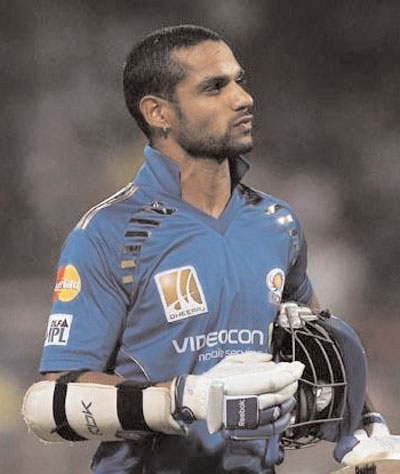
    CARDIFF (TIP): In the middle of all the madness surrounding cricket, if there’s one man having a blast, he’s Shikhar Dhawan. Confined to the first-class circuit for years, tagged a wasted talent and blamed for his off-the-field eccentricities, he’s emerged from those shadows to shine in the brightness of his abilities. He began the year 2013 with a bang, cementing his place in the squad after that spectacular century in his debut Test against Australia, and is now opening the innings for India in the Onedayers.

    On June 6 at the Sophia Gardens, in the opening match of the Champions Trophy against South Africa here, he continued in that same vein of form, scoring 114 runs off just 94 balls inclusive of 12 fours and a six that pushed the opposition into a corner early in the game. Riding on his entertaining innings, India posted a healthy 331-7 in the stipulated 50 overs, and took control of the proceedings. South Africa began the chase well but two suicidal run-outs and some avoidable strokeplay changed the course of their innings.

    Eventually, India won a match — dragged right till the end of the 50th over — by 26 runs. Dhoni hadn’t hinted much about the prospect of Rohit Sharma opening the innings with Dhawan. But on the morning of the match, when the two walked out, it didn’t come as a surprise to see the Mumbai batsman — who seems to have a very strong backing of his captain — open the batting. Dhawan’s form seemed to have rubbed off on Sharma and the duo brought the first 100 runs in just the 16th over, off 98 balls, to set the tone.

    Early on in the innings, it was Sharma who first went after the bowlers. Dhawan joined the party midway through the partnership as the do put on 127 runs. The only chance Dhawan gave in his innings was a stumping opportunity messed up by South Africa’s captain and wicketkeeper AB de Villiers. The rest of his innings only varied between having to make a choice between a drive and a loft and a six or a four as he made light of a wayward South African attack.

    The last 10 overs of India’s innings saw 82 runs scored for the loss of three wickets. That meant 149 runs coming between the 17th and the 40th over for the loss of just four wickets. It underlined Dhoni’s theory of taking a cautious approach and saving wickets for the end. That India were 213-2 at the end of 35 overs and SA 212-6 sums up the story. A great effort also came from allrounder Ravindra Jadeja who seems to be growing in confidence with each game regardless of the format.

    It’s no surprise that Jadeja has been MS Dhoni’s go-to man of late. On Thursday, the 24-year-old’s 29-ball 47 cameo consisting seven fours and a six helped India surge from 260-5 in the 42 over to the eventual total. On the field too, he was electric, picking a wicket, taking a catch, and most importantly, effecting a thriller of a run-out – of Robin Peterson – to snatch back the initiative for India. India now head to London to play the West Indies.

  • INDIA, JAPAN TO SPEED UP EFFORTS ON CIVIL N-DEAL E

    INDIA, JAPAN TO SPEED UP EFFORTS ON CIVIL N-DEAL E

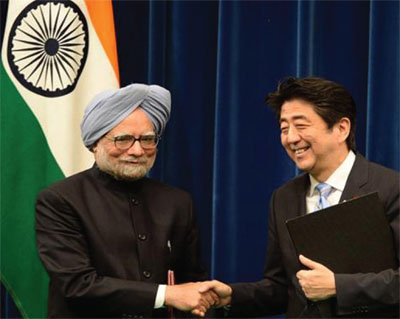
    TOKYO (TIP): Prime Minister Manmohan Singh and his Japanese counterpart Shinzo Abe decided to speed up talks on a civil nuclear deal to allow Japan to export nuclear reactors to India and to bolster maritime security cooperation at a time when China’s postures in the seas of the regional have caused concerns.

    A joint statement issued at the end of the exhaustive talks between Manmohan Singh and Abe said the two Prime Ministers reaffirmed the importance of civil nuclear cooperation between the two countries, while recognising that nuclear safety is a priority for both governments. “In this context, they directed their officials to accelerate the negotiations of an Agreement for Cooperation in the Peaceful Uses of Nuclear Energy towards an early conclusion,” it said.

    India and Japan welcomed the expanding bilateral defence ties and agreed to further cooperate on maritime issues to ensure freedom of navigation and unimpeded commerce. Terming Japan as a partner, Manmohan said at a time of global uncertainties, change and challenges, India and Japan are “natural and indispensable partners for advancing prosperity in our two countries and for a peaceful, stable, cooperative and prosperous future for the Asia-Pacific and Indian Ocean regions”.

    The remarks came amidst flexing of muscles by China in the South China Sea and East China Sea. Both sides expressed their commitment to continue to work to prepare the ground for India to become a full member in the international export control regimes. These included the Nuclear Suppliers Group, the Missile Technology Control Regime, the Australia Group and the Wassenaar Agreement.

    Abe stressed on the importance of bringing into force the CTBT at an early date. Japan wants India to sign both the NPT and the CTBT, which New Delhi terms as discriminatory. On his part, Manmohan reiterated India’s commitment to its unilateral and voluntary moratorium on nuclear explosive testing. The two sides signed the Exchange of Notes for yen loan totalling $ 424 billion. This includes $ 71 billion for the Mumbai Metro Line-lll project as well as the yen loan of the fiscal year 2012 for $ 353.106 billion for eight projects.

    The two sides vowed to further strengthen their strategic ties and deepen economic cooperation. Manmohan said India attaches particular significance to intensifying political dialogue and strategic consultations. He said cooperation in high technology, space, energy security and rare earth minerals will also add rich content to the strategic relationship between the two countries.

    The Prime Minister said there was a meeting of minds in his discussions on global and regional issues. The two leaders welcomed the expanding defence relations between the two countries and decided to conduct naval exercises on a regular basis with increased frequency.

  • SYDNEY TO HOST REGIONAL PRAVASI BHARATIYA DIVAS

    SYDNEY TO HOST REGIONAL PRAVASI BHARATIYA DIVAS

    NEW DELHI/MELBOURNE (TIP): The seventh regional Pravasi Bhartiya Divas will be held in Sydney from November 10 to 12 with an aim to woo overseas investors and deepen two-way engagement with the Indians living there. A simultaneous announcement in this regard was made by Minister of Overseas Indian Affairs Vayalar Ravi here and Barry O’Farrel, Premier of New South Wales through video conferencing from Australia.

    “We organise regional PBDs in different parts of the world, especially where Indians are living. Australia and Pacific region is one such area where large Indian contingent reside,” said Ravi. Speaking from Australia, O’Farrel thanked the Indian government for choosing Sydney for the event.

    “I am delighted to be jointly announcing with minister Ravi that the strong bond between NSW, India and overseas Indians will be further strengthened during the 2013 Regional Pravasi Bharatiya Divas in Sydney…I am confident that the event will be a major success,” O’Farrell said. “The aim of the Regional Pravasi Bharatiya Divas – or Overseas Indian Conference – is to connect India with its vast Indian diaspora and bringing their knowledge, expertise and skills together. NSW is honoured to be a part of this fantastic event,” he added.

    He also hailed Sydney as the perfect location for the conference, adding that the event will generate an estimated USD 2.8 million of economic activity for NSW. Officials in Ministry of Overseas Indian Affairs said the main aim of the event is to showcase India as an attractive investment destination and to deepen the engagement with the Indian community living in Australia. Australian High Commissioner Patrick Suckling, who was present during the announcement, highlighted the growing relationship between the two countries.

    “We have a very strong economic relationship with India. We have a nice, balanced and strategic relationship. We have 4,50,000 Indian citizen living in Australia and Indian people are the fastest growing migrant group in Australia. “Currently Punjabi is the fastest growing language in Australia, Hinduism is the fastest growing religion in Australia and the Prime Minister is determined that India becomes one of our top five partners,” he said. The 2013 Regional Pravasi Bharatiya Divas, the seventh such conference to be held outside India, is expected to attract about 1,000 delegates from the Asia-Pacific.

  • Maryland honors Bollywood director at Shortcut Romeo promo event

    Maryland honors Bollywood director at Shortcut Romeo promo event

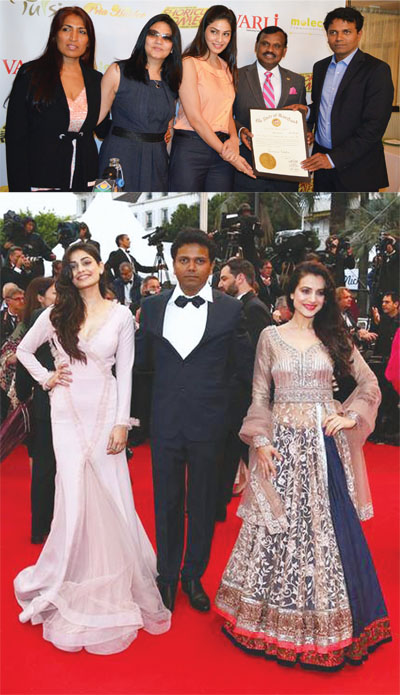
    NEW YORK (TIP): State of Maryland has honored Bollywood film director Susi Ganeshan with a citation for his contribution to Indian cinema. Recalling his 15 years of service and hard work to promote Indian movies, especially Tamil and now Hindi, Maryland Governor Martin O’Malley said in his citation that the State of Maryland is proud to bestow the honor for his contribution to the entertainment industry.

    Dr. Rajan Natarajan, Deputy Secretary of State of Maryland and one of the highranking Indian-American political appointees, presented the citation signed by Governor Martin O’Malley and the replica of great seal of the State of Maryland to Ganeshan at an event in New York attended also by Bollywood actress Puja Gupta, the heroine of his soon-to-be released movie Shortcut Romeo. Dr. Natarajan said Maryland is keen to support Bollywood and would provide all facilities to filmmakers keen to shoot movies in his picturesque state.

    The Governor led a delegation to India recently and is keen on doing business with India. Recently, during his trip to Chennai Dr. Natarajan met with Superstar Rajnikanth and bestowed on him special honor by Maryland Governor. Ganeshan and his team were in New York to promote their latest Bollywood movie Shortcut Romeo after screening the movie and doing red carpet at Cannes Film Festival along with Ameesha Patel and Puja Gupta. Addressing a press conference in Tulsi restaurant last week organized by Varli Media, Molecule Communications and Pria Haider, actress Puja Gupta said as an actress she doesn’t have any limitations.

    “I don’t have any limitations as an actor. As an actor you shouldn’t limit yourself. An actor should have the liberty to do whatever they want to and the director is the one who will decide.” The model-turned-actress has featured in two films F.A.L.T.U. and Go Goa Gone so far and said: “I love that I have become an actress. I never thought I will be an actress. I will try to do the best with the roles given to me…I will do bold roles if I am comfortable with it.

    “The 24-year-old describes Ameesha Patel, with whom she will share the screen space in Shortcut Romeo, as a “wonderful costar”. “She is so gorgeous. She is senior to me and has spent a decade in the industry. There is lot to learn from her.” This is Susi Ganeshan’s first Hindi movie and the remake of Tamil Nadu Government award winning Tamil movie Thiruttu Payale.

    Ganeshan addressed several differences between the two versions, starting with, Why a remake in the first place? Noting a current trend for remakes in Indian cinema, Ganeshan pointed to the vast Bollywood marketplace-and audience for Bolly films–compared with that of Tamil language films. He then related the challenges faced by a director who decides to remake one of his own films.

    To distinguish Shortcut Romeo from Thiruttu Payale, Ganeshan chose a different location, setting it in Kenya instead of India and Australia. He said Kenya provided a location unexposed to Indian film goers, who have now journeyed just about everywhere else in the world on screen. “I filmed in Melbourne for the previous film and don’t want to go to a place I previously used,” he explained.

    “As a creator, I get bored if I copy my own stuff.” When shooting the Hindi version he faced a dilemma in differentiating the camera shots from the Tamil original. “There must be a small change at least,” he said. On an even more fundamental plane, he noted that it was “tough learning Hindi,” as his “mother tongue” is Tamil. Hence, it was also tough “finding an exact match” in Hindi for the original Tamil title, with Shortcut Romeo serving to evoke the search among the generation represented by the film’s characters for shortcuts to money, fame and success.

    “The only barrier” he said, “is achieving the right performance, and feel. “Feel” was especially important when it came to the music for Shortcut Romeo, which was composed by hit Bollywood composer Himesh Reshammiya. “He’s a more popular music director than anyone in [Tamilspeaking] South India, and I needed the right music director for the different musical structure of Bollywood,” said Ganeshan. “I explained to him, ‘This is what I want,’ and he gave me a number of options to choose from.

    We came up with the correct mix of melody songs-which I always loveand fast-paced, peppy dance numbers.” He singled out the soundtrack’s “Khali Salam Dua,” a melodic romantic ballad sung by Mohit Chauhan, as did Bollywood newcomer Pooja Gupta, the 2007 Miss India Universe, who has a key role in Shortcut Romeo. “It’s very meaningful music, subtle and mellow, with the beat of the soul,” said Gupta.

    “It touches your heart.” Shortcut Romeo is an Indian romantic crime thriller film directed and produced by Susi Ganeshan under the banner of Susi Ganesh Productions. It is the Hindi remake of the director’s own Tamil film Thiuttu Payale (2006), starring Neil Nithin Mukesh in the title role with Puja Gupta as his love interest and Ameesha Patel in a negative character. The film was screened at Marche du Film at Cannes Film Festival.

    It is releasing on June 21 all over the world. Himesh Reshmmiya has scored the music and N K Ekambaram is the Director of Photography. Dilip Deo and Hardik Singh Reen have taken care or editing. Susi Ganeshan has directed some award winning movies in Tamil such as Virumbukiren, Five Star, Thiruttu Payale and Kanthaswamy.

  • ICC WITHDRAWS UMPIRE ASAD RAUF FROM CHAMPIONS TROPHY

    ICC WITHDRAWS UMPIRE ASAD RAUF FROM CHAMPIONS TROPHY

    NEW DELHI (TIP): The raging spot-fixing saga in the IPL turned murkier with controversial Pakistani umpire Asad Rauf being withdrawn by the ICC from next month’s Champions Trophy in UK for his alleged role in the scandal which is growing bigger by the day. A week after the sensational arrest of India paceman S Sreesanth and two of his Rajasthan Royals team-mates on charges of spot-fixing, Rauf’s pull-out from the June 6-23 Champions Trophy added a new twist to the fast unfolding drama.

    The ICC said in a statement that Rauf has been withdrawn as he was under investigation by the Mumbai Police, thus becoming the first umpire to come under the scanner in the IPL spot-fixing scandal. “The decision has been made after media reports indicated that the umpire was under investigation by Mumbai Police,” the ICC release said.

    Explaining the decision, ICC Chief Executive David Richardson said: “In the wake of reports that the Mumbai Police are conducting an investigation into Asad Rauf’s activities, we feel that it is in Asad’s best interests as well as those of the sport and the event itself, that he is withdrawn from participating in the ICC Champions Trophy.” Rauf has had a history of controversies and only last year a small-time model named Leena Kapoor had accused him of sexually exploiting her for months before refusing to marry her.

    As per the duty schedule of the on-field umpires, Rauf was supposed to officiate in a warm-up match between Australia and West Indies in Cardiff on June 1. In the tournament group league stage, he was supposed to officiate in two matches in Cardiff. The first on June 9 was between Sri Lanka and New Zealand while other was between West Indies and South Africa. In the ongoing IPL, Rauf had on-field umpiring duty in 13 matches, the last one being in the game between Sunrisers Hyderabad and Kolkata Knight Riders in Hyderabad on May 19.

    The three Rajasthan Royals players — Sreesanth, Ajit Chandila and Ankeet Chavan — are in police custody while actor Vindu Randhawa, son of the late Dara Singh, has also been arrested by the Mumbai Police in connection with the case along with several other bookies, many of whom have underworld connection. But the BCCI threw its weight behind Srinivasan, saying that it was unfair to implicate his son-in-law of any wrong doing until the investigations are over.

  • Australia mulls allowing Sikhs to wear turban at work

    Australia mulls allowing Sikhs to wear turban at work

    SYDNEY (TIP): Australian Prime Minister Julia Gillard has said that she would look into the issue of allowing Sikhs in her country to wear the turban while at work and also while riding motorcycles. “We will work with your community to help make the necessary changes requested on cultural and religious grounds,” the Blacktown Sun quoted her as saying Thursday during a visit to Gurdwara Sahib in the Sydney suburb of Glenwood.

    She said this during a closed door meeting with officebearers of the Australian Sikh Association. The Sikhs also asked Gillard to allow members of their community to wear the six-inch sword, called the kirpan, to official government functions and to differentiate Sikh students from other students in schools. Gurdwara spokesman Balvinder Singh Chahal was quoted as drawing the attention of Gillard to the fact that countries like Canada and Britain already allow Sikh civil engineers to wear the turban instead of the hard hat at work sites and while riding motorcycles.

    “I also would like to point out that the Punjabi language and Sikh religion were the fastest growing language and faith group – at the rate of 205 percent from 2006 to 2011, according to recent census,” he said. He also sought the inclusion of Punjabi language and Sikh history in the curriculum of schools, especially in western Sydney.

  • Bowlers, Dhawan Extend Sunrisers Home Run

    Bowlers, Dhawan Extend Sunrisers Home Run

    HYDERABAD (TIP): This was a clash between the IPL’s most powerful line-up and its most effective attack. Here was a line-up that had had just one failure in nine games. Here was an attack that was still to concede more than 130 at home. The Sunrisers Hyderabad bowlers kept their home run going, stopping Mumbai Indians just short of 130 on a slow pitch which the visiting batsmen could never get going on, despite losing only four wickets.

    Shikhar Dhawan guided the chase single-handedly, peppering both square boundaries as he motored to his second fifty in three innings. Apart from the pitch and the home attack, what went against Mumbai Indians was that they lost their four wickets in groups of two each, sucking out whatever momentum they had managed to build on both occasions. The first time it happened, a start of 32 in 4.2 overs was squandered. The second time, two batsmen, Dwayne Smith and Rohit Sharma, who had spent enough time in the middle to have assessed the wicket, fell in the same over.

    It was Ishant Sharma who began Sunrisers’ dominance. Sachin Tendulkar had whipped and lofted Dale Steyn for successive fours but Ishant’s short of a good length stuff was to prove difficult to time. Tendulkar backed away and missed one that nipped in from that length. Two balls later, the in-form Dinesh Karthik reached for one that wasn’t quite there for the drive, and sliced it to backward point. As he usually does, Dwayne Smith took his time in the Powerplay but unlike normally, he found the runs weren’t coming even during the middle overs.

    Ishant was bowling a superb line and length, and the two legspinners, Amit Mishra and Karan Sharma, were getting grip and turn. Smith was dropped by Ishant at long-off in Mishra’s second over but got a poor decision in the bowler’s next, given out lbw after gloving an attempted sweep onto the pads. Four balls later, Rohit mishit in front of long-off and this time, Ishant made no mistake. Ambati Rayudu and Kieron Pollard had seven overs to go, and managed to last till the end, but as evidence of how accurate the Sunrisers bowlers were, the partnership went over run a ball only twice in those overs.

    Steyn came back well after an expensive opening over, signing off with six full and low balls in his last over. Thisara Perera wasn’t far behind apart from the 20th over that went for 16, finding swing on his full deliveries. Mumbai Indians don’t have a bad attack at all, but Dhawan is not in bad form either after that Test debut against Australia. A chase of 130 could easily have got close – Sunrisers defended 126 here against Pune Warriors – but Dhawan was in a different mood.

    Pragyan Ojha created some pressure, giving just 18 in four overs, but Sunrisers broke away in the 12th over as Rohit tried Smith. Dhawan and Hanuma Vihari took 15 off Smith’s mediums. Dhawan bossed the attack after that, cutting, pulling and lofting over extra cover at will to end the game with a couple of overs left.

  • US aims to expand India arms trade by “billions of dollars”

    US aims to expand India arms trade by “billions of dollars”

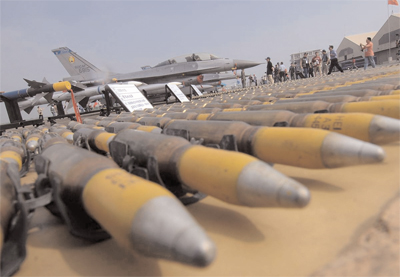
    WASHINGTON (TIP): The United States has already made “tremendous progress” in expanding weapons sales to India since 2008, and US companies could see “billions of dollars” in additional sales in coming years, a senior US State Department official said on april 18.

    Andrew Shapiro, assistant secretary of state for politicalmilitary affairs, said US sales of military equipment to India had grown from zero in 2008 to around $8 billion, despite a decision by India to choose a French-built plane in a closely-watched fighter plane competition. “While that fighter competition loss was disappointing, we have made tremendous progress in the defense trade relationship,” he told a news briefing. “There’s going to be billions of dollars more in the next couple of years.” He said a major arms trade initiative headed by Deputy Defense Secretary Ashton Carter was making good progress and should lead to “an ever greater pace of additional defense trade.” He gave no details on future possible arms sales. US weapons makers including Lockheed Martin Corp (LMT.N), Boeing Co (BA.N), Raytheon Co (RTN.N) and others, are keen to sale their wares to India, the world’s largest arms importer, especially since US military spending is now declining after a decade of sharp growth fueled by the wars in Iraq and Afghanistan. India plans to spend about $100 billion over the next decade upgrading its mostly Sovietera military hardware.

    Shapiro, who is due to leave the State Department at the end of this week, said he had seen news reports about delays in India’s talks with France’s Dassault Aviation (AVMD.PA) about a $15 billion purchase of 126 Rafale fighter jets. But he said the US State Department had not received word from India that it planned to reopen that competition or move ahead with a separate Indian naval fighter competition. Lockheed and Boeing were eliminated from the Indian fighter competition in April 2011.

    Shapiro said the State Department was seeing continued demand for US weaponry from the Middle East and Asia, but US companies faced stiff competition from European weapons makers, who are also facing declining demand in their home markets. He declined to discuss any specific arms sales, but noted that Singapore, Indonesia, and Australia had been key partners in defense trade in recent years. South Korea is also expected to announce the winner of its 60-fighter competition soon.

    Shapiro said his office had dramatically increased its advocacy for US weapons makers under former Secretary of State Hillary Clinton, and her successor, John Kerry, planned to continue the “economic diplomacy” initiative. Shapiro said State Department representatives planned to attend a major air show in Paris in June, despite mandatory budget cuts required under a process known as sequestration, but said officials would have to be conservative about the number of air shows they attended. He said sequestration-related furloughs could also slow the Pentagon’s work on export license requests, which threatened to slow or reverse progress made by the State Department in accelerating work on the licenses to 17 days on average now from 40 to 60 days several years ago. “Those processing times are likely to increase at a time when we’re trying to increase our defense trade. That’s not the best signal to send,” Shapiro said.

  • Gavaskar, Not Sachin Tendulkar, In Dickie Bird’s Test Xi

    Gavaskar, Not Sachin Tendulkar, In Dickie Bird’s Test Xi

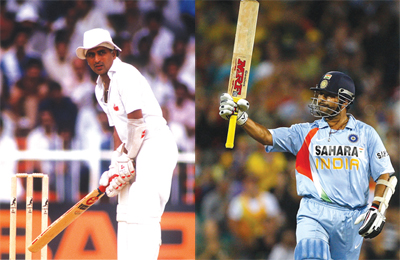
    BANGALORE (TIP): Umpiring legend Harold ‘Dickie’ Bird is someone who believes respect cannot be bought, but earned. While some of the cricketing world’s greatest stars like Sachin Tendulkar and Brian Lara surely have his respect, gaining entry into his all-time greatest Test XI is a tougher feat than they would have imagined. Picking the side for a British daily ahead of his 80th birthday on Friday, Bird suggested he has no issues leaving out Aussie legend Donald Bradman too. Curiously, the top-10 run makers in Tests don’t figure in Bird’s line-up. His team is captained by Pakistani pacer Imran Khan, whose knowledge of the game “was outstanding”.

    Sunil Gavaskar is the only Indian in the XI as he “was one of the two best opening bats I saw”. The list has South African batting great Barry Richards and his countryman Graeme Pollock, three Australians in Greg Chappell, Shane Warne and Dennis Lillee, as many West Indians in Garfield Sobers, Viv Richards and Lance Gibbs and a lone Englishman – wicketkeeper Alan Knott. Apparently, Bird gave Barry and Pollock the benefit of the doubt, stating that both careers were cruelly curtailed by the apartheid.

    Having said that, Barry’s stint with Hampshire in county cricket would have given Bird enough reason to pick him for his playing XI. That he has chosen to give the famed West Indies pace quartet – Michael Holding, Colin Croft, Joel Garner and Andy Roberts – the miss too, is interesting, as is his choice of captain at the expense of Clive Lloyd or his own countryman Mike Brearley. His spinners – Shane Warne and Lance Gibbs – are doubtless world class but then his picks may lead to furrowed brows among Indians as the spin quartet of the 70s – Bishan Bedi, BS Chandrashekar, EAS Prasanna and Venkataraghavan – had held the world in a thrall.

    Close to two decades after he hung up his famous white coat, the cricketing world can’t help but talk fondly of the Englishman who became the game’s first superstar umpire. His quirky antics as a “not-outer” and strong values while playing the “benefit of the doubt” card made Bird one of the most respected invigilators of the game’s laws. “You can’t buy respect, you have to earn it,” Bird was quoted as saying. “And I can honestly tell you I had not one problem with any professional cricketer. If I go to Pakistan, Imran Khan and Javed Miandad invite me round for a meal at their place. If I go to Australia the first man to ring me is Dennis Lillee. If I go to West Indies, the first man on the phone will be Garfield Sobers, the greatest that’s ever lived.

    You’ll never see another like him, not in your lifetime,” the newspaper quoted Bird as saying. A former batsman who made only two hundreds in 93 first-class appearances thanks to his anxiety issues, Bird always fancied himself as a player and compared his skills with that of Geoffrey Boycott. Bird lamented in the interview the end of cricket’s glory days with technological invasion putting paid to decisions going unchallenged and players not having a bit of a laugh on the ground. “The characters have gone out of all sports haven’t they?” he was quoted as saying. Bird, however, admitted that his heart still belonged to the game. “It’s still the greatest game in the world, cricket,” he said.

  • Dev Ratnam-Integrity, Charity, Modesty Propel This Visionary

    Dev Ratnam-Integrity, Charity, Modesty Propel This Visionary

    I am passionate about doing well not only in career but also in my community. I won’t say it’s a passion but I am very keen on being an honorable member in our community. I believe in being a good representative of India. Whatever obligations I have with the government, banks, other financial institutions of US and other countries, I want to deal with them with honor. I never want to escape from that. I never want to fail India, or my state. Life will always force you to deal with breaks, be it good breaks or bad breaks. How you deal with it is your legacy.

    Dev Ratnam began his career as a scientist. But he never wanted to be master at just one trick. He wanted to explore all the opportunities around him before settling into one. He tells us, “In true spirit, I am an entrepreneur, so I try many businesses. Though my education and experience is as a scientist from Penn state in 1977, I still wanted to venture beyond my degrees.” Dev graduated from Indian Institute of Science, Bangalore in Engineering and completed Masters in Engineering from Queens University, Canada and got a Ph.D. in Solid State Science from Penn State University in 1971. Yet, his dream was to always go back to India and set up his own business there. He tried his true best to fulfill that dream. Dev explains, “I was planning to buy a factory from Australia. The agent from Melbourne belonged to a big family.


    img12

    He used to be the Governor of Maharashtra and his son was my partner. We wanted to buy that factory and bring it to Chennai and set it up in India. But somehow the politics played its part after I reached Melbourne. I realized that I would be a minority party. And I had to walk away from my dream of setting up business in India. Of course, I tried to buy a factory from here and take the technology and equipment to India, but that never materialized. But in that search for a factory, I found a company in Long Island called Poly Mag Ink.

    A couple of partners and me bought it, but unforeseen factors didn’t allow it to be a big company. It still exists and it does have big clients like GM, Kodak, etc. Perhaps the location in Long Island was a disadvantage.” While many would give up and try to move on to something else, Dev Ratnam never stopped believing in himself. He defines himself as an eternal optimist and does not think giving up is an option. “I just never wanted to give up. In my years of experience, I have come through all the time. Yes, I did not perhaps see bright successes all over.

    But I have seen spurts of success and it was good with me.” Never to give up, even Dev Ratnam had to let go his dream of establishing business in India. But the blame for that lies on the political system of India. “I don’t want to sound negative, but in 40 years I have never succeeded with one project in India. But in China, South Korea or United States, it is entirely different. That does not make India bad.

    But I cannot recall one fruitful project, be in charity or investment in India.” His passion is what perhaps distinguishes him the most. He is a firm believer in the thought that a successful man is only successful enough if he can give back to his community. Dev explains, “I am passionate about doing not only well in career but also in my community.

    I won’t say it’s a passion but I am very keen on being an honorable member in our community. I believe in being a good representative of India. Whatever obligations I have with the government, banks, other financial institutions of US and other countries, I want to deal with them with honor. I never want to escape from that. I never want to fail India, or my state. Life will always force you to deal with breaks, be it good breaks or bad breaks. How you deal with it, is your legacy.” Dev Ratnam’s dreams and ambitions are just as extraordinary. His dream of helping others has paved the way for success in many people’s lives. He is on the Board of Interfaith Nutrition Network since 1995; had been a voice on the board on behalf of Indian community.

    He charts out a few of his projects. “I just want to do good things in life at this point. I have seen a couple of charitable programs that I want to take up. There is one in particular called Shri Chakra, which is an organization that concentrates on providing electricity through bicycle pedaling. It is on hold for now, due to some real-estate issues, but it’s a temporary hold. I want to provide electricity to rural parts of countries such as India, Afghanistan, Nepal, etc.

    That is my dream for sure. I am working with many major organizations. I am also working on some projects in my village in India too. My daughter is running for the marathon in Rwanda to commemorate the victims of the Rwandan massacre. I am helping her in this project through Rotary Hicksville. So I have a couple of such projects that I am extremely involved in.” Dev Ratnam was born in West Godavari in a small village in Andhra Pradesh and was the eldest son in his family. His father was the biggest influence on his life.


    img13

    Dev explains, “My father’s upbringing had a great impact on me. When he was 14, he had bought a car for marriage. He was a socialist. He too was involved in many ventures. He moved to Chennai with us and I completed my education there. I got a scholarship and went to Canada. From there, I moved here to the US and finished my PhD at Penn State. My father also had a tremendous passion to help people. He never had a formal education.

    Yet he went to Chennai and learnt English and began helping people in many ways. When he came to the US, he hand-drew the map of the US with all the 50 states and began learning about each state. Even before he came here, he knew about Edgar Allan Poe, an American writer and poet most Indians living here now don’t know about.

    But his thinking is what inspired me. Besides being a Socialist, he was able to understand the land of opportunity that United States really is.” Dev Ratnam’s biggest passion after social causes is perhaps traveling. His wife and he share a common interest in visiting and paying homage to the ancient civilizations of the world. “I am a citizen of the world. My wife and I love to travel. We have explored civilizations in Turkey, Greece, Cambodia and other places. We love to go to those places.

    Recently we went to Greece for a vacation. It was astounding to see the civilization there. We stood there and marveled at how the human culture evolved. We paid homage to all these cultures.” Dev admits that his ventures have not been a continual forerunner in their field. He only wishes that he had done his due diligence before beginning the investments. “Do I regret anything I have done? Well, maybe I was not too thorough. My son is 25 and he works for a venture cap holding. And when I see his company work, the immaculate attention to detail, I believe I did not do my due diligence. I guess that is my only regret. But on the other hand, almost all the real estate companies and other companies did just as bad since 2006. So I don’t know if it was just my choices.” He has a lot of praise for our community and believes that there is just as much misconduct in our community as in any other.

    But he commends our community’s foresight and achievements too. “They all belong to different strata. The ones who came in 70s came through education. They got good jobs and earned very well. So they are well adjusted in US. The ones who came in 80s came as immigrants, who basically were brought into the country by mainly extended relatives. They began setting up businesses. Now the people who belong to this group are becoming the core Indian community. They are aggressive, motivated and passionate about their ventures and see them succeeding. I believe they are easily the more successful than any other group of Indian community. So I would say this for our community, that we have an impeccable foresight. We know what can make us prosperous.” Dev Ratnam has an outstanding family too. His wife Prof.

    Runi Mukerji Ratnam is a dynamic leader in academics at SUNY in the entire New York State and a leader in several professional and social organizations. His daughter Romola Ratnam is an NYU graduate and is well known in the sports marketing field in Manhattan. She has also initiated several charity programs much like her father. His son Basudev graduated from Brown University and is an excellent tennis player. Dev Ratnam had ambitions to make his son a national level tennis player but unfortunately Basudev suffered a few injuries that dissuaded him from playing on national levels.

    At present, Basudev is working with a private equity company in Manhattan. Before I take leave, I ask him if he still has plans to move to India and realize his long lost dream. And to that he replies. “No it’s too late now. This is our home now.” From all the readers of The Indian Panorama we wish Mr. Dev Ratnam success in all his professional and social ventures.

  • Singapore Favourable Investment Destination For Indian Companies

    Singapore Favourable Investment Destination For Indian Companies

    NEW DELHI (TIP): Singapore is increasingly popular becoming a popular destination among Indian companies keen on globalising their businesses. “Singapore is seen (by Indian companies) as home away from home for their business growth on the international front because Asia is booming,” according to Lee Eng Keat, International Director at Singapore’s Economic Development Board (EDB). So far, Indian companies have invested US$ 14.11 billion during 2008-09 and 2011-12 in Singapore, said Keat. Several IT companies will accompany the other Indian enterprises already operating out of the city state. In addition, an Indian pharmaceutical major plans to set up its regional office in Singapore this year. “This year we will be garnering more Indian IT investments into Singapore as well as potentially a pharmaceutical project as well,” said Keat.

    However, the name of pharma company was not disclosed. Keat was confident that more and more bio-pharmaceutical and pharmaceutical companies would be locating their regional offices in Singapore. The advance levels of medical, diseases and drug researches undertaken by Singapore-based institutes would support Indian pharma companies’ global market plans.

    Singapore was inviting international corporations in the field of pharmaceuticals to set up operations and business here, Mr Keat added. “We do feel that there are groups of companies in India that are looking into innovative drug developments and formulation capabilities and delivery mechanism,” said Mr Keat. More than 4,500 Indian companies have set up operations in Singapore to globalise their businesses or trades, making it the largest business community in corporate Singapore, ahead of the Chinese, Malaysians and Indonesians. Indian companies are looking at advantages of Singapore’s free trade agreements with China, Australia and Southeast Asia.

    These treaties will enable them to lower the tariff for their exports of goods into these markets. Singapore offers basic financing need to these companies. Keat observed India was looking to increase its trade with China, and pointed out that Singapore offered one of the most competitive foreign exchange options, including Renminbi/Yuan (RMB). Singapore has recently been acknowledged asthe second clearing centre for RMB. China appointed the Industrial and Commercial Bank of China Singapore branch as the clearing bank for RMB in Singapore in February 2013. Keat highlighted options of Singapore’s other financial capabilities including convertible bonds, currency hedging and participation in the equity markets.

    The top Indian companies operating out of Singapore, includes Tata Consultancy Services (TCS) and HCL Technologies as well as infrastructure group Punj Lloyd, highlighted Keat. “These companies see Singapore as a home for innovation. They are actually creating new solutions for their global clients,” he added. These companies have also built their skilled manpower from the cosmopolitan workforce in Singapore and international operations, said Keat. TCS had recruited its top management from Singapore for setting up operations in China, he added.

  • India To Reject Global Arms Trade Treaty

    India To Reject Global Arms Trade Treaty

    NEW DELHI (TIP): New Delhi is set to reject a global arms trade treaty (ATT) since the agreement is heavily loaded against weapons-importing countries like India, and let exporting nations like the US and China call the shots. The treaty, meant to regulate all transfers of conventional arms around the world, is likely to be passed by the UN General Assembly next week. India’s inability to establish an indigenous defence production industry may now become a strategic vulnerability. New Delhi had several concerns which Indian negotiators, led by Sujata Mehta, who heads the Indian mission at the Conference on Disarmament (CD) in Geneva, fought on, but virtually none of them have been incorporated by the treaty’s co-authors, led by Peter Woolacott of Australia. The current round of negotiations in New York is the second and final round.

    The first round, held last July, didn’t have an agreement largely because the US backed out. India wanted the treaty to regulate arms transfers to non-state actors like terror groups. New Delhi’s focus was on terror groups that target the nation or even internal insurgent groups like the Maoists but this was shot down. Countries like the US and the UK who supply arms to opposition groups such as in Syria and Libya wanted to retain the flexibility to continue to do so.

    Terror groups do find mention, but only in the non-binding preamble, and not in the main body. In her remarks, Mehta said, “Without such provisions, the ATT would in fact lower the bar on obligations of all states not to support terrorists and/or terrorists acts …We cannot allow such a loophole in the ATT.” Second, India wanted to preserve bilateral defence cooperation agreements (arms supplies are covered under such pacts) from the ATT’s purview. This hasn’t found favour with the treaty’s authors, either. Mehta said, “Such a loophole in the Treaty would have the effect of strengthening the hands of a few exporting states at the expense of the legitimate defense and national security interests of a large number of importing states.” Once this treaty goes through bilateral arms supply agreements could come under this treaty if the exporting country makes an “export assessment” under article 7 that it feels warrants stoppage of supply. This would be disastrous for India, as was evident during the Kargil war in 1999.

    India and China are the world top arms importers, according to the latest figures by SIPRI. But China itself has climbed to the top five global arms exporters last year — and the bulk of its arms exports are to Pakistan. Given the nature of China-Pakistan relationship, Islamabad is unlikely to suffer even if this treaty comes into effect. On the other hand, for India, it will become the conventional version of the global nuclear suppliers’ regime. Once this treaty goes through India will have to provide similar kinds of end-user verification and access to satisfy exporters that it does with nuclear imports.

    India feels the burden of obligations rests largely on the importers because they have to satisfy the exporters on end-user verification, on keeping national records of weapons and ammunition used, etc. In fact, New Delhi wanted ammunition transfers to stay out of the treaty’s scope, but that too fell by the wayside. A lot of international arms transfers are no longer outright sales, but incorporate leases, and even barter deals in exchange for resources etc. That should have been part of the treaty but it isn’t.

    The treaty absolves any state which transfers arms under its own control if it states that it retains control of such arms. This means diversions and illicit transfers will continue to happen under different guises. The treaty applies to transfers of battle tanks, armoured combat vehicles, large caliber artillery systems, combat aircraft, attack helicopters, warships, missiles and missile launchers, small and light weapons, while ammunition and parts and components are also brought under scrutiny.

  • India Annihilate Australia In Historic 4-0 Series Sweep

    India Annihilate Australia In Historic 4-0 Series Sweep

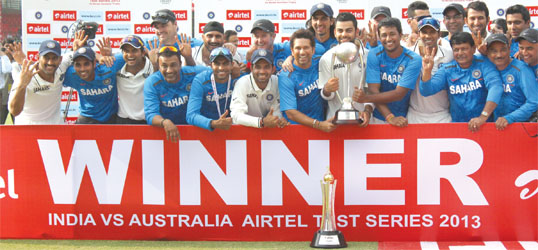
    NEW DELHI (TIP): “Dhonee. Dhonee. Dhoneee.” The chant reverberated around Feroze Shah Kotla as India closed in on victory within three days in the fourth Test against Australia. After a topsy-turvy day that saw 16 wickets tumble, leaving India 156 to win, it was fittingly the captain who hit the winning runs. It was a historic moment, a first ever 4-0 Test series win for India — and MS Dhoni deserved much of the credit.

    His pulverizing double century in the very first Test in Chennai had knocked the fight out of an inexperienced Australian side that never really got back into the contest thereafter. Having set the tone with the bat, Dhoni also exhibited a more animated, proactive style of captaincy, drawing the best out of his young team. Apart from some nervy moments in Delhi, the ploy to produce turning tracks also worked smoothly, unlike the preceding home series against England where India had embarrassingly fallen victim to its own web of spin. Before this series, India’s Test fortunes seemed to be in freefall.

    They had lost 0-4 twice in alien conditions in England and Australia, and then yielded a home series to England too. It seemed they had overestimated their own skills, their ability to outplay opponents even on friendly turf. It didn’t help they were in transition, and had lost a host of big names.

    It paved the way for some rare soulsearching. The selectors finally dropped big names like Virender Sehwag and Gautam Gambhir. A younger crop was given the chance to show their mettle — and seized the opportunity. Murali Vijay finished as the top run-getter on either side, hitting two consecutive tons. Shikhar Dhawan got just one knock but made it count.

    Ironically, his record-busting, blazing 187 revived memories of the very man he had replaced, Sehwag. The young lead spinner, R Ashwin, realized where he had erred against England and made quick changes to his technique to achieve consistency.

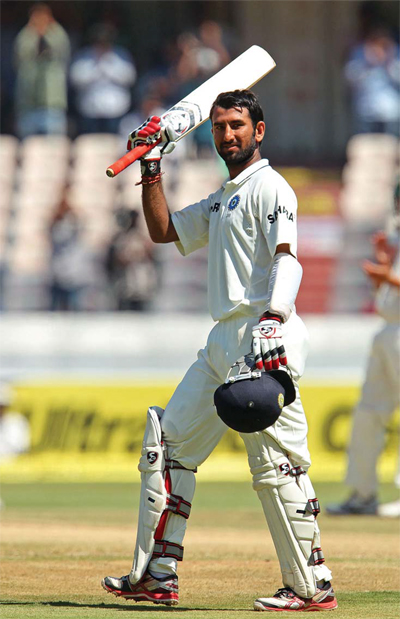
    He ended with 29 wickets, the highest for either side in this series and the seventh-best ever for India. Cheteshwar Pujara continued from where he had left off against England and scored 419 runs at 83.8, reasserting his status as the new bedrock of the side.

    Seamer Bhuvneshwar Kumar got into the act in Hyderabad and Mohali and picked crucial wickets. Dhoni decided to bring in the wildcard Ravindra Jadeja, who responded with 24 wickets at 17.45 with his left-arm spin, including a first-ever five-wicket haul in Delhi on Sunday which helped seal the match in India’s favour. Jadeja also seemed to have a knack for dismissing regular Aussie skipper Michael Clarke, by far Australia’s best batsman. Jadeja’s impact meant Dhoni could play with five specialist bowlers.

    His own form with the bat at No. 6 covered up the deficiencies in the batting lineup. Ashwin talked about how he needed “a kick up the backside” which had helped. The skipper, while maintaining equanimity in victory, stressed on the need for the youngsters to develop “good habits”. “Fortunately I lost all the tosses, which meant we had to bat last in difficult conditions in all the games.

    The individuals came forward to perform. We put a lot of emphasis on partnerships. We were able to implement our learning,” he said. “It was an important series for us. There were a few changes in the sides which were good. It was up to the individuals to rise up and do well. They all did, everybody performed.

    The openers batted well. I’m very happy with the new players. We have had a tough time, and you tend to learn more when you go through a tough period. We showed character in this series, which is important.” Dhoni admitted he had had to alter his laidback style of captaincy too. “With a young side you have to change a bit. You have to talk to them often, get them into a system where they do things that are supposed to be done. It’s important for them to learn good habits which will remain with them when I’m not there three-four years from now.” Australia may not have been the strongest of teams, and the pitches may have played to India’s advantage. Some of India’s younger crop of players are as yet capable of performing only in certain conditions.

    On Sunday, though, it became clear that under Dhoni, they were capable of learning, adapting and implementing changes to the side’s benefit.

    As a dejected Shane Watson from the opposition camp said, “We were not able to perform. Ultimately you cannot hide behind anything else.” An important statement has been made: At home, India remain extremely hard to beat. The confidence gained from this 4-0 win will help smoothen the rocky road ahead when this young side tours away from home.

    Men Who Mattered
    M VIJAY: Highest runscorer on either side in the series, with 430 runs (avg 61.4), including 2 successive tons
    CHETESHWAR PUJARA: Second-highest run-getter with 419 runs (avg 83.8).
    Hit 204 at Hyderabad. His unbeaten 82 at Delhi, playing with a fractured finger, turned a tricky 4thinnings chase into a stroll
    SHIKHAR DHAWAN: Only played 1 innings but his recordbreaking 187 was enough to set up a superb win at Mohali
    R ASHWIN: Learned from disappointing series against England to emerge as top wicket-taker against Aus, with 29 wickets.Deservedly declared man of the series
    RAVINDRA JADEJA: With 24 wickets, proved surprisingly effective as a bowler. Bagged 7 wicketsincluding 5/58 in the 2nd innings-and scored a feisty 43 at Kotla
    MS DHONI: Led with verve and imagination. His 224 in the first Test gave India the upper hand over Aus, which it never let go.

  • India Clinch Series After Winning  Third Test By Six Wickets

    India Clinch Series After Winning Third Test By Six Wickets

    MOHALI (TIP): India clinched the Test series against a spirited Australia with their biggest-ever margin after recording a nervewracking six-wicket victory in the third cricket Test to take a 3-0 lead in the four-match series on March 18. Never in their 81-year-old Test history, have India won more than two matches against Australia in a single series.

    After bowling out Australia for 223 in their second innings, India chased down the target of 133 with 15 balls remaining before close of play in a match which saw a nail-biting finish.

    The hosts encountered some tense moments in their run chase before skipper Mahendra Singh Dhoni smashed three fours off Mitchell Starc in a row to seal the match in India’s favour much to the delight of the home crowd. Earlier, it was a defiant 65-minute last-wicket stand between Starc and Xavier Doherty, during which they consumed 18.1 overs for 44 runs to ensure the Indians, at least, don’t run away with the game before the start of the 15 mandatory overs.

    When the final hour started, India required 45 runs from a minimum of 15 overs. They completed the chase losing the wickets of Murali Vijay (26), Cheteshwar Pujara (28), Virat Kohli (34) and Sachin Tendulkar (21). Dhoni (18) and Ravindra Jadeja (8) were at the crease when the winning runs were scored. In the process, India reclaimed the Border-Gavaskar trophy, which they relinquished after a 0-4 drubbing in Australia last year. The victory was achieved on the back of some fine batting by debutant Shikhar Dhawan and Murali Vijay, both of them scoring big centuries in India’s first innings. Dhawan smashed 187, his 100 coming off a mere 85 balls making him the quickest-ever debutant to reach the three-figure mark.

  • Shikhar Dhawan delight at dashing debut century

    Shikhar Dhawan delight at dashing debut century

    MOHALI (TIP): Shikhar Dhawan has described his record Test debut innings as a dream come true after smashing an unbeaten 185. Dhawan, who replaced his statemate Virender Sehwag in the side, scored the fastest century by a Test match debutant, reaching three figures in just 85 balls as the tourists toiled.

    He hit 33 fours and two sixes in his 168-ball knock and is now just 15 short of becoming the first Indian to score a double century on debut. Alongside him, Murali Vijay was quietly progressing towards his second consecutive Test hundred and was not out on 83 overnight. The 283-run unbeaten first-wicket stand between Dhawan and Vijay was the highest by an Indian pair against Australia. After the day’s play, Dhawan said: “It feels very good. It was a dream for me to score so well on my debut.

    I’ve been working hard since I was dropped after I played my last one-day international for India. I worked really hard and changed myself and became a more mature player. “I was waiting for a chance. I did very well in the domestic circuit and was waiting for a chance to play in international cricket. I guess that went my way. “I wasn’t really playing in a hurry. The fours were going on their own after the ball hit the bat. But I guess I was in a good flow today. I felt my shot selection was good and I played according to how I’d assessed the wicket. I didn’t feel that I rushed things. “I still remember when I debuted for India in ODIs and got out on zero against Australia.

    And then [Mahendra Singh] Dhoni and [Suresh] Raina told me that the players who’ve got out on zero for India on debut, they went really big. This time I was nervous that it was again Australia on my Test debut, because I’d scored zero then. So I was a bit nervous. But everything went well and I was really happy that I grabbed this opportunity and scored a century.” Dhawan made the most of the generosity shown by the Australian team since he was technically run out even before the first ball was bowled. As Starc ran down for the opening delivery, the ball slipped from his grip and the hit the stumps and Dhawan was short of the crease.

    The Australians, however, preferred to have a laugh instead of appealing. Dhawan was severe on Moises Henriques, Lyon and left-arm spinner Xavier Doherty, who leaked 18 runs in the 23rd over. Dhawan completed his century in just 85 balls with an almost suicidal single and got a standing ovation from the crowd.

  • Commonwealth Day Celebrated

    Commonwealth Day Celebrated

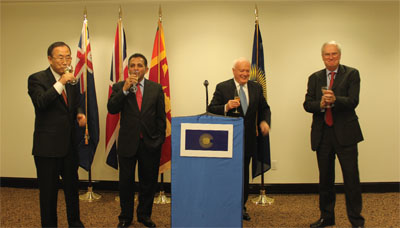
    NEW YORK (TIP): A reception to celebrate the Commonwealth Day was organized at Sri Lanka mission here on 11th March. Sri Lanka, UK and Australia cohosted the event. United Nations Secretary-General Ban Ki-Moon was among those present that included the Permanent Representative of UK Sir Mark Lyall Grant, Permanent Representative of Australia Gary Quinlan, Sri Lanka Permanent Representative Palitha Kohona, and Heads of Missions, senior UN officials and diplomats from various countries.


    img4

    The Permanent Representative of Sri Lanka, Palitha T.B. Kohona welcomed the guests in a speech and insisted on more unity among the Commonwealth Nations, “In the long run, it is tangible benefits that will keep us together. Although ideas and values are important, tangible benefits will be the glue that will bind us together as a family”. He also highlighted the challenges of “youth empowerment, women’s issues and trade and labor liberalization”.

    The Permanent Representative of Australia, Gary Quinlan, in his address spoke of the distinctive differences among the Commonwealth countries. “The Commonwealth comprises of 54 member states, of which, only 4 are developed countries. The rest are still developing”, he added. Permanent Representative of UK Sir Mark Lyall Grant read out a message from Queen Elizabeth. In her message the Queen said, “The heart of the Commonwealth lies in the striving of individuals and communities to achieve great goals”.

  • Can The Australians Regroup And Rise?

    Can The Australians Regroup And Rise?

    Suspension has hit the visitors hard; new opening pair to take guard for India
    MOHALI (TIP): Transition period for both the teams but hour of realisation for one as India and Australia enter the decisive phase of the Test series. India has dominated the two Tests thus far against an opposition that has looked short of confidence and woefully bereft of substance on challenging pitches.

    How strongly Michael Clarke and his band of novices react to the situation here would mean a lot for the Australian camp. This is a bizarre state for the Australian cricket. The team is hardly playing cricket… The Test series, touted as a hugely competitive fixture in the international calendar, has not really lived up to its hype and should have a bearing on the popularity of the longer format of the game. Australia winning 4-0 at home and India threatening to pay back by the same coin cannot be the best advertisement for Test cricket.

    Disturbing trend
    The Indians can’t play seam and bounce and the Aussies have come a cropper against spin. It effectively conveys a disturbing trend that most teams, with the exception of South Africa and England, have forgotten the art of winning away from home. “Good teams win overseas,” Australia coach Micky Arthur said the other day. True. But modern cricket teams have shown a perceptible slide in quality when playing overseas. Clive Lloyd and Steve Waugh have led from the front, registering memorable wins away.

    Sourav Ganguly, too, had a decent record but Clarke and Mahendra Singh Dhoni have not been able to match their home performances with those overseas. The key to survival, as obviously believed by most captains, is to order favourable pitches at home.

    Defining knocks
    Australia has played ordinary cricket on this tour against some motivated stuff from India where Dhoni and Pujara have produced defining knocks to swing the match India’s way at Chennai and Hyderabad. Australia has prepared poorly. Such a contrast from the Alastair Cook-led English team which taught India a few lessons in playing the slow ball! With the exception of Clarke, the Australian batting has appeared clueless against the Indian bowlers on dry and doctored pitches. Mediocrity has been rampant in the Australian ranks as their batsmen have danced to the tune of Indian spinners. The lack of grit and class was so pronounced in the Australian approach.

    Acts of indiscipline, costing four players a place in this match, have hit the Australian camp hard. If it manages to regroup and rise, the series could come alive. On the eve of the third Test match, though, India looks set to savage the opposition as ruthlessly as in the last two encounters.

    A new opening pair, Shikhar Dhawan and Murali Vijay, will take guard on Thursday at the PCA Stadium against an attack minus James Pattinson. Even if Dhoni may not be inclined to disturb the winning combination, a toss up between Harbhajan Singh and Pragyan Ojha can’t be ruled out.

    The pitch, with cracks distinctly visible, is likely to break and a two-paced nature could well prove lethal for the batsmen to survive. Australia may leave out off-spinner Nathan Lyon and left-arm spinner Xavier Doherty in case Mathew Wade reports fit. Brad Haddin had a batting stint in the ‘nets’ since he is expected to bolster the batting with a possible inclusion of Steve Smith.

    Rains predicted
    Cloudy day and showers in the afternoon have been predicted but one can look forward to some intense cricket provided Australia lives up to the gritty image that signified Allan Border and Sunil Gavaskar, in whose name the series trophy is named.

    The teams
    India: M.S. Dhoni (capt.), Murali Vijay, Shikhar Dhawan, Cheteshwar Pujara, Sachin Tendulkar, Virat Kohli, Ravindra Jadeja, R. Ashwin, Harbhajan Singh, Bhuvneshwar Kumar, Ishant Sharma, Ajinkya Rahane, Pragyan Ojha and Ashoke Dinda.

    Australia: Michael Clarke (capt.), Ed Cowan, David Warner, Phillip Hughes, Matthew Wade, Brad Haddin, Moises Henriques, Peter Siddle, Mitchell Starc, Nathan Lyon, Xavier Doherty, Glenn Maxwell and Steve Smith.

  • India Go 2-0 Up After Australia Capitulate

    India Go 2-0 Up After Australia Capitulate

    India 503 (Pujara 204, Vijay 167, Maxwell 4-127) beat Australia 237 for 9 dec (Clarke 91, Wade 62, Jadeja 3-33, Bhuvneshwar 3-53) and 131 (Ashwin 5-63, Jadeja 3-33) by an innings and 135 runs

    HYDERABAD (TIP): When India’s confidence was rattled by the drubbings in Australia and England over the past two years, they took solace in their outstanding home record. Even that bit of relief had been taken away when Monty Panesar and Graeme Swann outspun India earlier this season, but India’s belief at home has come surging back with two thumping victories over Australia. Though it was widely expected that Australia would go down on the fourth day, few thought it would happen with the embarrassing rapidity that it did.

    Australia’s batsmen were once again nonplussed by the turning ball to subside to 131 all out, handing India an inningsand- 135-run victory and a 2-0 series lead. If Australia’s chances were slim at the start of the day, they vanished with two deliveries of vastly contrasting quality. Ishant Sharma got his first wicket of the series with a harmless ball sliding down the leg side which Shane Watson guided through to the wicketkeeper.

    Ravindra Jadeja, usually the butt of derogatory jokes from Indian fans despite a stellar first-class record, then produced the ball of the match, a delivery that drifted onto middle stump and spun back to beat Michael Clarke’s forward defensive to crash into off. From then it was only a matter of time. Ed Cowan had gritted it out for nearly three hours, forgetting the deliveries that ripped past his outside edge to concentrate afresh.

    Jadeja, with his tail up after that magic ball to Clarke, ended Cowan’s resistance on 44 as an edge ricocheted off MS Dhoni’s gloves deflected to Virender Sehwag at slip. It got even better for Jadeja soon after as he lasered in a throw from cover to run out Moises Henriques, who was yards out despite Jadeja fumbling the ball before collecting it. Then the man who started Australia’s slide on Monday evening, R Ashwin, took over. He has kept his Twenty20 variations to a minimum this series, and cleverly used them against the lower order. Glenn Maxwell was looking towards square leg after attempting a flick only to be confounded by the carrom ball that was heading for the off stump. There was time left for Ashwin to complete his eighth five-for in 11 home Tests.

    While the capitulation on Tuesday morning was painful viewing for Australia fans, much of the damage had been done by the batting failure on the first day, when the pitch was at its best. Just three months ago, the much-coveted No. 1 Test ranking was within Australia’s grasp and Clarke and the team management seemed to be able to do no wrong. After the two defeats, he will be assailed by questions, just as Dhoni has been over the past couple of years.

    The result will be a major source of relief for Dhoni, who after settling doubts over his Test batting in Chennai has now become India’s most successful Test captain with 22 wins.

    The next match is in Mohali, typically a swing-friendly surface, but given Australia’s ineptness against spin, the curators are likely to work overtime to produce a turning track there as well.

  • India Crush Australia By 8 Wickets In First Test To Take 1-0 Lead

    India Crush Australia By 8 Wickets In First Test To Take 1-0 Lead

    CHENNAI (TIP): India clinched the first Test against Australia with a comfortable eight-wicket victory to take a 1-0 lead in the four-match series on Tuesday with their spinners taking all the 20 wickets for only the third time in their Test history. The Indians took about 25 minutes in the morning to finally bring an end to the stubborn last-wicket partnership between Moises Hendriques (81 not out) and Nathan Lyon (11) as Australia folded up for 241 in their second innings, leaving the hosts a small victory target of 50.

    The hosts lost both their openers Murali Vijay (6) and Virender Sehwag (19) before overhauling the target with more than two full sessions to spare. Cheteshwar Pujara brought about the winning run off Nathan Lyon to trigger off scenes of celebrations in the galleries and the Indian dressing room as the players congratulated and hugged each other.

    It was a commendable show by the Indians, who have been under pressure of late following a series of indifferent performances in recent times, as they dominated the game right through at the M A Chidambaram stadium where the conditions suited the home team. While captain Mahendra Singh Dhoni expectedly got the man-of-the-match award for his game-changing knock of 224, off-spinner Ravichandran Ashwin scalped 12 wickets in the match to also play a stellar role. The margin of victory could have been bigger had the Indians managed to get rid of the last wicket pair on Day 4 itself and had they not lost both their openers despite chasing a small total.

    The two teams will now travel to Hyderabad for the second Test be played at the Rajiv Gandhi International stadium from March 2 to 6. This was the third time that Indian spinners managed to take all the 20 wickets in a match.

    The first time that Indian spinners bagged all the 20 wickets was at this same venue against England in 1972-73 while the second such instance was against New Zealand in Auckland in 1975-76. Resuming at the overnight score of 232/9, Australia could add just nine runs to their tally much to the relief of the Indians who had a frustrating time trying to dismiss the last-wicket pair.

    It took the Indians just nine overs on Day 5 to put an end to Australia’s resistance when Ravindra Jadeja broke the agonisingly long last-wicket partnership between Henriques and Lyon. Lyon, who showed a lot of grit and temperament to hang on, was dismissed by left-arm spinner Jadeja, caught by Murali Vijay at short-leg.

  • Chennai Knock Dhoni’s Best: Chappell

    Chennai Knock Dhoni’s Best: Chappell

    CHENNAI (TIP): Former Australia captain Greg Chappell has rated MS Dhoni’s double-century in Chennai as his best in Tests. Dhoni’s knock of 224 tilted the scales in India’s favour, according to Chappell, and helped them to a 1-0 lead in the four-match series against Australia. “He has played several memorable knocks in one-day cricket, but this was the best I have seen him play in Test matches,” Chappell told The Times of India. “I have seen him smack a yorker-length delivery from James Anderson for a six. It requires special talent. His success on a crumbling Chennai track stems from his ability to strike the ball hard on pitches where the ball tends to keep low. Had he scored just 124, the match would still have been in the balance. The manner in which he attacked a tiring Australian attack, shielding the tailenders, truly makes him a match-winner.” This was India’s seventh win in the last 21 Tests, five of which have come against West Indies and New Zealand. India lost eight consecutive overseas Tests, and conceded a series at home to England for the first time in 28 years.

    Chappell accepted that the Indian team looked average on their tour of Australia last summer but maintained that Dhoni’s captaincy shouldn’t be under doubt. “It is true that the Indian team under Dhoni looked below par during their tour Down Under, but he has answered his critics in the best possible way. In my book he remains the best man to lead India in all forms of the game. “At a time when players all over the world are struggling to cope with their workload, it is amazing how Dhoni manages to play every game with the same intensity. That he has done it successfully now for five years speaks volumes about Dhoni’s fitness, mental strength as well as his commitment. India are lucky to have him.” Although Australia crumbled under Dhoni’s onslaught to eventually lose by eight wickets, a few of their players had impressed.

    One of them was the debutant Moises Henriques, who scored halfcenturies in both innings, finishing with an unbeaten 81 in the second dig to help prevent an innings defeat. In Henriques, Chappell saw the makings of a long-term allrounder. “It was good to see Henriques coming good at last. He has been on the fringe for a while. I hope he can be the allrounder that Australia have been looking for, particularly after a question mark over Shane Watson’s ability to contribute with the ball.” Regardless of the result of the first Test, Chappell felt the series wouldn’t be onesided. “It will be a close series, but thanks to Dhoni, India do have a significant advantage.”

  • Jallianwala Bagh Killings Deeply Shameful: UK PM

    Jallianwala Bagh Killings Deeply Shameful: UK PM

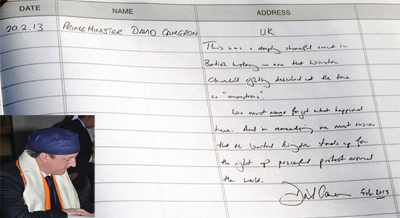
    AMRITSAR (TIP): British PrimeMinister David Cameron visited the site ofa colonial-era massacre in India onFebruary 20, describing the episode as”deeply shameful” while stopping short of apublic apology.On the last leg of a three-day trip aimedat forging deeper economic ties, Camerontook the bold decision to visit the city ofAmritsar and tackle an enduring scar ofBritish rule on the subcontinent, whichended in 1947.Dressed in a dark suit and bowing hishead, he laid a wreath at the memorial tothe victims at Jallianwala Bagh, whereBritish troops opened fire on thousands ofunarmed protesters in 1919.In a message in the visitors’ book, hewrote: “This was a deeply shameful event inBritish history and one that WinstonChurchill rightly declared at the time as’monstrous’.

    David Cameron at Jallianwala Bagh
    “We must never forget what happenedhere. And in remembering we must ensurethat the United Kingdom stands up for theright of peaceful protest around the world.”The number of casualties at theJallianwala Bagh garden is unclear, withcolonial-era records showing about 400deaths while Indian figures put the numberkilled at closer to 1,000.Bhusan Behl, who heads a trust for thefamilies of victims, has campaigned fordecades on behalf of his grandfather whowas killed at the entrance to the walledarea.

    He said he was hoping that Cameronwould say sorry for the slaughter orderedby General Reginald Dyer, which wasimmortalised in Richard Attenborough’sfilm Gandhi and features in SalmanRushdie’s epic book Midnight’s Children.The 1919 slaughter, known in India as theJallianwala Bagh massacre, was describedby Mahatma Gandhi, the father of theIndian independence movement, as havingshaken the foundations of the BritishEmpire.A group of soldiers opened fire on anunarmed crowd without warning in thenorthern Indian city after a period ofunrest, killing hundreds in cold blood.Cameron’s visit and expression of regretfor what happened will stop short of anapology – but will make it clear heconsiders the episode a stain on Britain’shistory that should be acknowledged.

    The gesture, coming on the third andfinal day of a visit to India aimed atdrumming up trade and investment, islikely to be seen as an attempt to improverelations with Britain’s former colonialpossession and to court around 1.5 millionBritish voters of Indian origin ahead of a2015 election.Before his visit, Cameron said there wereties of history between the two countries,”both the good and the bad”.”In Amritsar, I want to take theopportunity to pay my respects atJallianwala Bagh,” he said, referring to thesite of the massacre.Cameron is expected to visit Amritsar’sGolden Temple, a place of pilgrimage forSikhs, and to inscribe his thoughts aboutthe killings in the visitor book.When asked to comment on Britain’scolonial past, he said: “I would argue it’s astrength, not a weakness. Of course thereare sensitive issues, sensitive events, butactually the fact that Britain and India havethis history, have a shared culture and ashared language, I think, is a positive.

    “The British report into the Amritsarmassacre at the time said 379 people hadbeen killed and 1,200 wounded. But aseparate inquiry commissioned by theIndian pro-independence movement saidaround 1,000 people had been killed.Brigadier-General Reginald Dyer, theman who gave the order to fire, explainedhis decision by saying he felt it wasnecessary to “teach a moral lesson to thePunjab”.Some in Britain hailed him “as the manwho saved India”, but others condemnedhim. India became independent in 1947.Many historians consider the massacre aturning point that undermined British ruleof India.It was, they say, one of the moments thatcaused Gandhi and the pro-independenceIndian National Congress movement to losetrust in the British, inspiring them toembark on a path of civil disobedience.

    “Monstrous event”
    Other British politicians and dignitaries- though no serving prime minister – haveexpressed regret about the incident before.In 1920, Winston Churchill, then thesecretary of state for war, called theAmritsar massacre “a monstrous event”,saying it was “not the British way of doingbusiness”.On a visit to Amritsar in 1997, QueenElizabeth called it a distressing episode, butsaid history could not be rewritten.However, her husband, Prince Philip,courted controversy during the visit whenhe questioned the higher Indian death toll.Before he became prime minister, TonyBlair also visited, saying the memorial atAmritsar was a reminder of “the worstaspects of colonialism”.

    In recent years, British leaders havebegun to apologise for some of the excessesof Empire.Visiting Pakistan in 2011, Cameronangered traditionalists at home sayingBritain had caused many of the world’sproblems, including the Kashmir conflictbetween India and Pakistan.When in office, Blair apologised for the19th century Irish potato famine and forBritain’s involvement in the slave trade,while Gordon Brown, his successor,apologised for the fact that British childrenwere shipped to Australia and otherCommonwealth countries between the1920s and 1960s.Britain ruled or held sway in India viathe British East India company from the17th century until 1947.

    India’s colonial history remains asensitive subject for many Indians,particularly nationalists who want Britainto recognise and apologise for its excesses.Others believe bygones should bebygones.”What happened in the past happened inthe past,” Aamir Khan, Bollywood film star,told reporters after a meeting withCameron on Tuesday.”I don’t think we can hold the presentgeneration of Britishers responsible forwhat happened ages ago. It is not fair. Idon’t think that they owe us an apology forwhat happened a century ago.”Cameron has said the two countriesenjoy a “special relationship”, a termusually reserved for Britain’s relations withthe United States, but it is a relationshipundergoing profound change.For now, Britain’s economy is the sixthlargest in the world and India’s the 10th.But India is forecast to overtake its oldcolonial master in the decades ahead andLondon wants to share in that economicsuccess.

  • Gaffe-Prone Philip Trips Again With Nurse Remark

    Gaffe-Prone Philip Trips Again With Nurse Remark

    LONDON: (TIP) Prince Philip, the gaffe-pronehusband of Queen Elizabeth II, has hit the headlinesonce again for his “jovial” remarks, this time inreference to Filipino nurses.The 91-year-old Prince told a nurse from thePhilippines that her country must be “half empty”because so many Filipinos have come to the UK to work.The Duke of Edinburgh made the comment during avisit to the Luton and Dunstable Hospital inBedfordshire to unveil a 5.5-million cardiac centreearlier this week.

    His mood on the day was described as”jovial”, as the royal referred to himself as the “world’smost experienced curtain puller”.A hospital spokesperson did not comment on theDuke’s conversation with the nurse during his “hugelymotivational” visit. “Staff greatly enjoyed theopportunity to meet the Duke of Edinburgh, and weregard all personal conversations he had with our staffand guests as private…”Around 87,000 of the 660,000 nurses working in theUK’s National Health Service are mainly from thePhilippines, India, Australia and South Africa.Buckingham Palace refused to comment on a ‘privateconversation’.

  • Sahara Wants Pune Warriors India To Be Based Out Of Kanpur

    Sahara Wants Pune Warriors India To Be Based Out Of Kanpur

    CHENNAI (TIP): Sahara has expressed its desire to the Indian cricket board (BCCI) to move its Indian Premier League (IPL) franchise, Pune Warriors India, out of the western city due to ongoing tensions between franchise bosses and the Maharashtra Cricket Association. It is understood that members of the PWI management, who were in Chennai during the IPL auctions on Feb 3, have asked the BCCI mandarins that they want their franchise to be based out of Kanpur.

    According to Sahara sources, it is 80% certain that they “won’t play their matches in Pune”. There are, however, some logistical problems regarding Kanpur. Even though a section of the Sahara management is confident that the Green Park Stadium in Kanpur can become their new venue, the fact that it doesn’t have an airport might make things a little difficult. “The nearest airport is in Lucknow and it’s two hours away from Kanpur.

    So, it will be difficult even for the TV crew,” a source said. Therefore, a few other names like Nagpur, Rajkot, Ahmedabad and DY Patil are also being discussed. It is learnt that the name of the franchise might not be changed right away. “It’s not easy to build a brand.

    So they might go slow on the renaming of the franchise,” the source added. There has been a long-standing problem between Sahara and the MCA with the former moving Bombay HC against MCA for “wrongful termination of agreements” with regards to the Subrata Roy Sahara Stadium in Pune.

    Pune sign J&K’s Rasool
    Pune have signed J&K off-spinner Parvez Rasool for the forthcoming IPL season. Rasool took 7-45 for Board President’s XI against Australia and has been snapped up by the franchise in an effort to boost its spin attack. “He is a bowling allrounder and we feel he can play an important role for us,” a Pune source said. Rasool will be the first player from J&K to play in the IPL.

  • Valentine’s Day

    Valentine’s Day

    Every February 14, across the United States and in other places around the world, candy, flowers and gifts are exchanged between loved ones, all in the name of St. Valentine. But who is this mysterious saint, and where did these traditions come from? Find out about the history of this centuriesold holiday, from ancient Roman rituals to the customs of Victorian England.

    The Legend of St.Valentine

    The history of Valentine’s Day– and the story of its patron saint–is shrouded in mystery. We do know that February has long been celebrated as a month of romance, and that St. Valentine’s Day, as we know it today, contains vestiges of both Christian and ancient Roman tradition.

    But who was Saint Valentine, and how did he become associated with this ancient rite? The Catholic Church recognizes at least three different saints named Valentine or Valentinus, all of whom were martyred. One legend contends that Valentine was a priest who served during the third century in Rome.

    When Emperor Claudius II decided that single men made better soldiers than those with wives and families, he outlawed marriage for young men. Valentine, realizing the injustice of the decree, defied Claudius and continued to perform marriages for young lovers in secret.

    When Valentine’s actions were discovered, Claudius ordered that he be put to death. Other stories suggest that Valentine may have been killed for attempting to help Christians escape harsh Roman prisons, where they were often beaten and tortured.

    According to one legend, an imprisoned Valentine actually sent the first “valentine” greeting himself after he fell in love with a young girl–possibly his jailor’s daughter–who visited him during his confinement.

    Before his death, it is alleged that he wrote her a letter signed “From your Valentine,” an expression that is still in use today. Although the truth behind the Valentine legends is murky, the stories all emphasize his appeal as a sympathetic, heroic and–most importantly–romantic figure.

    By the Middle Ages, perhaps thanks to this reputation, Valentine would become one of the most popular saints in England and France.

    Origins of Valentine’s Day: A Pagan Festival in February
    While some believe that Valentine’s Day is celebrated in the middle of February to commemorate the anniversary of Valentine’s death or burial–which probably occurred around A.D. 270–others claim that the Christian church may have decided to place St. Valentine’s feast day in the middle of February in an effort to “Christianize” the pagan celebration of Lupercalia. Celebrated at the ides of February, or February 15, Lupercalia was a fertility festival dedicated to Faunus, the Roman god of agriculture, as well as to the Roman founders Romulus and Remus.

    To begin the festival, members of the Luperci, an order of Roman priests, would gather at a sacred cave where the infants Romulus and Remus, the founders of Rome, were believed to have been cared for by a she-wolf or lupa. The priests would sacrifice a goat, for fertility, and a dog, for purification.

    They would then strip the goat’s hide into strips, dip them into the sacrificial blood and take to the streets, gently slapping both women and crop fields with the goat hide.

    Far from being fearful, Roman women welcomed the touch of the hides because it was believed to make them more fertile in the coming year. Later in the day, according to legend, all the young women in the city would place their names in a big urn. The city’s bachelors would each choose a name and become paired for the year with his chosen woman. These matches often ended in marriage.

    A Day of Romance
    Lupercalia survived the initial rise of Christianity and but was outlawed—as it was deemed “un- Christian”–at the end of the 5th century, when Pope Gelasius declared February 14 St. Valentine’s Day. It was not until much later, however, that the day became definitively associated with love.

    During the Middle Ages, it was commonly believed in France and England that February 14 was the beginning of birds’ mating season, which added to the idea that the middle of Valentine’s Day should be a day for romance. Valentine greetings were popular as far back as the Middle Ages, though written Valentine’s didn’t begin to appear until after 1400.

    The oldest known valentine still in existence today was a poem written in 1415 by Charles, Duke of Orleans, to his wife while he was imprisoned in the Tower of London following his capture at the Battle of Agincourt. (The greeting is now part of the manuscript collection of the British Library in London, England.) Several years later, it is believed that King Henry V hired a writer named John Lydgate to compose a valentine note to Catherine of Valois.

    Typical Valentine’s Day Greetings
    In addition to the United States, Valentine’s Day is celebrated in Canada, Mexico, the United Kingdom, France and Australia.

    In Great Britain, Valentine’s Day began to be popularly celebrated around the 17th century. By the middle of the 18th, it was common for friends and lovers of all social classes to exchange small tokens of affection or handwritten notes, and by 1900 printed cards began to replace written letters due to improvements in printing technology.

    Readymade cards were an easy way for people to express their emotions in a time when direct expression of one’s feelings was discouraged. Cheaper postage rates also contributed to an increase in the popularity of sending Valentine’s Day greetings.

    Americans probably began exchanging hand-made valentines in the early 1700s. In the 1840s, Esther A. Howland began selling the first mass-produced valentines in America.

    Howland, known as the “Mother of the Valentine,” made elaborate creations with real lace, ribbons and colorful pictures known as “scrap.” Today, according to the Greeting Card Association, an estimated 1 billion Valentine’s Day cards are sent each year, making Valentine’s Day the second largest card-sending holiday of the year. (An estimated 2.6 billion cards are sent for Christmas.) Women purchase approximately 85 percent of all valentines.

  • Five Dead As 8.0 Quake Off Solomons Sparks Pacific Tsunami

    Five Dead As 8.0 Quake Off Solomons Sparks Pacific Tsunami

    HONIARA (TIP): A major 8.0magnitude earthquake jolted theSolomon Islands on feb 6 with smalltsunami waves buffeting Pacificcoastlines, leaving at least five peopledead and dozens of homes damagedor destroyed.A quake-generated wave of justunder one metre (three feet) reachedparts of the Solomons, and Vanuatuand New Caledonia also reportedrising sea levels, before a region-widetsunami alert was lifted.Sirens were heard in Fiji, localssaid. “Chaos in the streets of Suva aseveryone tries to avoid the tsunami!!”tweeted Ratu Nemani Tebana fromthe Fiji capital.Quake-prone Japan, which was hitby a huge tsunami in March 2011 thatkilled more than 19,000 people, wasalso on edge with the nationalweather agency warning that a smalltsunami could still come ashore.

    The Pacific Tsunami WarningCenter cancelled its regional alert forPacific-island nations at 0350 GMT,about two and a half hours after thepowerful quake struck at 0112 GMTnear the Santa Cruz Islands in theSolomons.”We can report five dead and threeinjured. One of the dead was a malechild, three were elderly women andone an elderly man,” Chris Rogers, anurse at Lata Hospital in the SantaCruz Islands, told AFP.Solomons Prime Minister GordonDarcy Lilo’s office said four villageson the Santa Cruz Islands had beenhit.”Latest reports suggest thatbetween 60 to 70 homes have beendamaged by waves crashing into atleast four villages on Santa CruzIslands,” Lilo’s spokesman GeorgeHerming told AFP.”At this stage, authorities are stilltrying to establish the exact numberand extent of damage.Communication to (the) Santa CruzIslands is difficult due to theremoteness of the islands.

    “It was not immediately apparentwhether the victims died in the quakeor tsunami.Solomon Islands Red Crosssecretary general Joanne Zolevekesaid she too had been told at leastthree villages were hit, with houseswashed away.”In the Solomon Islands when wetalk about villages there can beanything from 10 to 30 houses,” shesaid.The US Geological Survey said thequake struck the Santa Cruz Islands,which have been rocked by a series ofstrong tremors over the past week, ata depth of 28.7 kilometres (18 miles).The USGS first gave the depth at 5.8kilometres.Several powerful aftershocks werealso recorded.

    “Sea level readings indicate atsunami was generated,” the HawaiibasedPacific centre said after the 8.0quake, before lifting its tsunami alertfor several island nations.Australia’s earthquake monitoringagency and the Pacific centre said atsunami wave was measured at 91centimetres, at Lata, on the mainSanta Cruz island of Ndende.Locals in the Solomons capitalHoniara, 580 kilometres (360 miles)from the epicentre, said the quakewas not felt there.Lata Hospital director of nursingAugustine Bilve said some patientswere evacuated to higher ground toprepare for any injured from thevillages along the coast.

    “There was continuous shaking inLata but no damaged buildings here,”he said.”We were told that after theshaking, waves came to the villages.”In 2007 a tsunami following an 8.0-magnitude earthquake killed at least52 people in the Solomons and leftthousands homeless. The quake wasso powerful that it lifted an island andpushed out its shoreline by dozens ofmetres.The Solomons are part of the “Ringof Fire”, a zone of tectonic activityaround the Pacific Ocean that issubject to earthquakes and volcaniceruptions.Before it was lifted, the tsunamiwarning was in effect for the SolomonIslands, Vanuatu, Nauru, Papua NewGuinea, Tuvalu, New Caledonia,Kosrae, Fiji, Kiribati, and Wallis andFutuna.